Showing posts with label Atonement. Show all posts

Thursday, December 24, 2015

Christmas and the Crucified God

 
Photobucket


This is my annual Christmas article. I have a guest article for friday and so I'll be off until after New Years. So I wish everyone a Mary Christmas!
Please Comment!!!

Christmas, God talk, incarnation, Jurgen Moltmann, Matthew Lamb, Solidarity with Victims, The Crucified God,


The Christian part of Christmas, that's the nativity scene with no trees or elves. That's the part you go to chruch to talk about. Show some mangers and some wise men and play the drummer boy song (eeeeee can't stand that son, p-rum-pum-pum-pum, rum-pum-pum-pum...enough already!) and you've done your bit for Christmas. I actually love Christmas, I like the manger and the baby and all that. Yet that is not what it's about. The entrance of Christ into the world in a lowly birth, worshiped by wise-men and heralded by angles and a star, those are nice folk tale elements. That masks what it's all about in the guise of cute fluffy heart warming imagery. Christmas is about the birth of Christ, God come in the flesh, and that signals to us the death of Christ; its meaning, it's end, it's un-final end and new beginning. The birth heralds more of the positive side of Jesus time in the flesh, his career, his mission, the promise and the possibilities. After all the angels said "peace on earth, good will toward men." How does that connect to a kid born in a manger?

Even with the positive possibilities of peace the birth hearlds the death and since we are compelled to think of both they both remind us of the meaning of Christ's mission and the reason for his coming. I used to read a book every Christmas, the same book. It was one of my all time favorite books; The Crucified God, by Jurgen Moltmann. The subtitle is very important: The Cross of Christ as the foundation and Criticism of Christian Theology. That book seemed to most adequately sum up what the incarnation is about.

Motlmann was from the 60's to the 90's and maybe even up to the present was the greatest living Protestant theologian. He was best known for this book and his Theology of Hope. both of which served to dramatize and legitimize the theology of liberation and the struggles of Latin America. Moltmann's book is actually an argument for placing Praxis on the front burner of theology and leaving the dray musty doctrinal stuff on the back burner. Praxis is the idea of reflection upon material need, how to apply the lessons of theology in a practical way to people's needs.
....... 
To get to the core of the book and it's relation to Christmas, the argument goes like this: So what if Jesus was crucified? what's the big deal? There are much worse ways to suffer. Crucifixion is bad but it is far from the worst thing that can happen to you. So why was it a sacrifice, I mean after all he is God, what would it matter to him if he dies? And he got to come back."

First, most Christians try to answer this out of a need for piety. They do not give a theological answer, they give a pious one. The pious answer can't be undestood by modern people, they lack pious feelings, so it just makes it worse. The pious answer of course is to try and mount up the pain and make it seem so very much worse. O. Jesus suffered in hell and he suffers every minute and he's still suffering and he felt all the agony in the world. Of course it doesn't' really say that anywhere in the Bible. While I think this is true, and while my pious side feels the proper sense of devotion and gratitude to our savior for his work, we can't use this to answer the question because modern impiety can't understand the answer. They just hear us reiterating their hidden primes.
....... 
The other Christian answers are Propitiatory atonement, Substitutionary, or Moral government. These are the tree major ways of looking at the atonement. Propitiation means to turn away anger. This answer is also incomprehensible to moderns. God is so very angry with us that he can't stand the sight of us, he has to stick Jesus between himself and us so he will see Jesus and turn away his anger. This just makes God seem like a red faced historical parent who couldn't comprehend the consequences of his creation when he decided to make it. Substitutionary atonement says that Jesus took our place, he received the penalty our sins deserved. This comes in two verities. One is financial transaction, Jesus paid the debt. the other is closer to moral government, Jesus was executed because he stepped in and took the place of the guilty party. Both of these are also problematic, because they really allow the guilty to get off Scott free and persecute an innocent person. Again modern people can't understand this kind of thinking; you could not go down to the jail and talk them into letting you take another prisoners place. We can harp on how this is a grace so fine we can't undersigned it in the natural mind, and relapse into piety again singing the praises to God for doing this wonderful act, but it wont answer the atheists questions.
....... 
I realize that the view I hold to is a little known minority view. I know I'm bucking the mainstream. But I think it makes a lot more sense and  actually explains why there was an atonement. Before getting into it, however, I want to comment upon the atheist hidden premise. The explicit premise of the atheist argument is that atonement works by Jesus suffering a whole lot. If Jesus suffers enough then restitution is made. But wait, restitution for what? For our sins? Then why should Jesus suffer more than we do or more than our victims do? Why do atheists seem to think,  that Jesus must suffer more than anyone ever has for the atonement to work? It's because the hidden premise is that God is guilty and the atonement is the time God pays for his own mistakes. Jesus has to suffer more than anyone to make up for what God has done, in conceiving of us by creating us. The sickness of the modern mind can scarcely comprehend Christian theology now. I wonder if it isn't too late and we are just past the day when people in the West can really be saved?

I mean consider the idea that usually acompanies this argument: well he is God after all, a little torutre death cant' hurt him. In the old days, when we had a culture that ran on Christian memories, people said how great that God would do this for us when he didn't have to! Now the argument is "Of course he had to, it's the least he can do, after all I didn't asked to be born, so I'm entitled to whatever goodies I can get in compensation." That's why I think the hidden premise is to blame God; its as though they are saying God has to suffer more than anyone to make up for the suffering he caused as creator. This sort of attitude marks the disease of the modern mind.

In any case, my view is the Participatory atonement. It was embraced by several church fathers and modern theologians supporting it are mentioned below:

I.The Atonement: God's Solidarity With Humanity.

........A. The inadquacy of Financial Transactions


Many ministers, and therefore, many Christians speak of and think of Jesus' death on the cross as analogous to a financial transaction. Usually this idea goes something like this: we are in hock to the devil because we sinned. God pays the debt we owe by sending Jesus to die for us, and that pays off the devil. The problem with this view is the Bible never says we owe the devil anything. We owe God. The financial transaction model is inadequate. Matters of the soul are much more important than any monetary arrangement and business transactions and banking do not do justice to the import of the issue. Moreover, there is a more sophisticated model; that of the sacrament for sin. In this model Jesus is like a sacrificial lamb who is murdered in our place. This model is also inadequate because it is based on a primitive notion of sacrifice. The one making the sacrifice pays over something valuable to him to appease an angry God. In this case God is paying himself. This view is also called the "propitiation view" becuase it is based upon propitiation, which means to turn away wrath. The more meaningful notion is that of Solidarity. The Solidarity or "participatory" view says that Jesus entered human history to participate in our lot as finiate humans, and he dide as a means of identifying with us. We are under the law of sin and death, we are under curse of the law (we sin, we die, we are not capable in our own human strength of being good enough to merit salvation). IN taking on the penalty of sin (while remaining sinless) Jesus died in our stead; not in the manner of a premature animal sacrafice (that is just a metaphor) but as one of us, so that through identification with us, we might identify with him and therefore, partake of his newness of life.

.......B. Christ the Perfect Revelation of God to Humanity

In the book of Hebrews it says "in former times God spoke in many and various ways through the prophets, but in these latter times he has spoken more perfectly through his son." Jesus is the perfect revelation of God to humanity. The prophets were speaking for God, but their words were limited in how much they could tell us about God. Jesus was God in the flesh and as such, we can see clearly by his character, his actions, and his teachings what God wants of us and how much God cares about us. God is for humanity, God is on our side! The greatest sign of God's support of our cause as needy humans is Jesus death on the cross, a death in solidarity with us as victims of our own sinful hearts and societies. Thus we can see the lengths God is will to go to to point us toward himself. There are many verses in the Bible that seem to contradict this view. These are the verses which seem to say that Atonement is propitiatory.

.......C. Death in Solidarity with Victims.............. 
1) Support from Modern Theologians

.......Three Major Modern Theologians support the solidarity notion of atonement: Jurgen Moltmann (The Crucified God), Matthew L. Lamb (Solidarity With Victims), and D.E.H. Whiteley (The Theology of St. Paul).In the 1980s Moltmann (German Calvinist) was called the greatest living protestant theologian, and made his name in laying the groundwork for what became liberation theology. Lamb (Catholic Priest) was big name in political theology, and Whiteley (scholar at Oxford) was a major Pauline scholar in the 1960s.In his work The Crucified God Moltmann interprits the cry of Jesus on the cross, "my God my God why have you forsaken me" as a statement of solidarity, placing him in identification with all who feel abandoned by God.Whiteley: "If St. Paul can be said to hold a theory of the modus operandi [of the atonement] it is best described as one of salvation through participation [the 'solidarity' view]: Christ shared all of our experience, sin alone excepted, including death in order that we, by virtue of our solidarity with him, might share his life...Paul does not hold a theory of substitution..." (The Theology of St. Paul, 130)An example of one of the great classical theologians of the early chruch who held to a similar view is St. Irenaeus (according to Whiteley, 133).

..............2) Scrtiptural


...all of us who were baptized into Christ Jesus were Baptized into his death.? We were therefore burried with him in baptism into death in order that just as Christ was raised from the death through the glory of the father, we too may live a new life. If we have been united with him in his death we will certanly be united with him in his resurrection.For we know that the old self was crucified with him so that the body of sin might be rendered powerless, that we should no longer be slaves to sin.--because anyone who has died has been freed from sin.Now if we have died with Christ we believe that we will also live with him, for we know that since Christ was raised from the dead he cannot die again; death no longer has mastery over him; the death he died to sin he died once for all; but the life he lives he lives to God. In the same way count yourselves dead to sin but alive to God in Chrsit Jesus.(Romans 6:1-5)

.......In Short, if we have united ourselves to Christ, entered his death and been raised to life, we participate in his death and resurrection through our act of solidarity, united with Christ in his death, than it stands tto reason that his death is an act of solidarity with us, that he expresses his solidarity with humanity in his death.

.......This is why Jesus cries out on the cross "why have you forsaken me?" According to Moltmann this is an expression of Solidarity with all who feel abandoned by God.Jesus death in solidarity creates the grounds for forgiveness, since it is through his death that we express our solidarity, and through that, share in his life in union with Christ. Many verses seem to suggest a propitiatory view. But these are actually speaking of the affects of the solidarity. "Since we have now been justified by his blood, how much more shall we be saved from God's wrath through him! For if when we were considered God's enemies, we were reconciled to him through the death of his son, how much more, having been reconciled, shall we be saved through his life! What appears to be saying that the shedding of blood is what creates forgiveness is actually saying that the death in solidarity creates the grounds for reconciliation. IT says we were enemies then we were reconciled to him through the death, his expression of solidarity changes the ground, when we express our solidarity and enter into the death we are giving up to God, we move from enemy to friend, and in that sense the shedding of blood, the death in solidarity, creates the conditions through which we can be and are forgiven. He goes on to talk about sharing in his life, which is participation, solidarity, unity.

.......D. Meaning of Solidarity and Salvation.

.......Jurgen Moltmann's notion of Solidarity (see The Crucified God) is based upon the notion of Political solidarity. Christ died in Solidarity with victims. He took upon himself a political death by purposely angering the powers of the day. Thus in his death he identifies with victims of oppression. But we are all victims of oppression. Sin has a social dimension, the injustice we experience as the hands of society and social and governmental institutions is primarily and at a very basic level the result of the social aspects of sin. Power, and political machinations begin in the sinful heart, the ego, the desire for power, and they manifest themselves through institutions built by the will to power over the other. But in a more fundamental sense we are all victims of our own sinful natures. We scheme against others on some level to build ourselves up and secure our conditions in life. IN this sense we cannot help but do injustice to others. In return injustice is done to us.Jesus died in solidarity with us, he underwent the ultimate consequences of living in a sinful world, in order to demonstrate the depths of God's love and God's desire to save us. Take an analogy from political organizing. IN Central America governments often send "death squads" to murder labor unionists and political dissenter. IN Guatemala there were some American organizations which organized for college students to go to Guatemala and escort the leaders of dissenting groups so that they would not be murdered.

.......The logic was that the death squads wouldn't hurt an American Student because it would bring bad press and shut off U.S. government funds to their military. As disturbing as these political implications are, let's stay focused on the Gospel. Jesus is like those students, and like some of them, he was actually killed. But unlike them he went out of his way to be killed, to be victimized by the the rage of the sinful and power seeking so that he could illustrate to us the desire of God; that God is on our side, God is on the side of the poor, the victimized, the marginalized, and the lost. Jesus said "a physician is not sent to the well but to the sick."The key to salvation is to accept God's statement of solidarity, to express our solidarity with God by placing ourselves into the death of Christ (by identification with it, by trust in it's efficacy for our salvation).

.......E. Atonement is a Primitive Concept?

.......This charge is made quite often by internet-skeptics, especially Jewish anti-missionaries who confuse the concept with the notion of Human sacrifice. But the charge rests on the idea that sacrifice itself is a prematurity notion. If one commits a crime, someone else should not pay for it. This attack can be put forward in many forms but the basic notion revolves around the idea that one person dying for the sins of another, taking the penalty or sacrificing to remove the guilt of another is a premature concept. None of this applies with the Participatory view of the atonement (solidarity) since the workings of Christ's death, the manner in which it secures salvation, is neither through turning away of wrath nor taking upon himself others sins, but the creation of the grounds through which one declares one's own solidarity with God and the grounds through which God accepts that solidarity and extends his own; the identification of God himself with the needs and cry of his own creation.

The Blogging Parson
Moltmann's theodicy is the great strength of this work, in that it directly engages the protest atheism of the mid twentieth century without negating the powerful emotional impact of its claims. We are returned to the cross as the heart of the Christian message repeatedly - it is no accident that Luther features so strongly and so positively in these pages. Further, the rigour of his penetrating search for the implications of the cross for God himself has led him rightly to the trinity, and stands as a rebuke to the western tradition for neglecting this understanding of God for so long. The atonement is necessarily a trinitarian event/process. The sense of God identifying with human beings in Christ is also very strong. Moltmann develops a theology of the atonement with a cosmic scope, and does not fall into the trap of individualising the work of the cross.

Moltmann's work turns out to develop a "Trinitarian history of God." This works through a dialectic through which God rejects the Son, then accepts the son, then raises the son to a hope and a future in which we can participate. This also raises a dialectical relation between God and man because the son becomes part of humanity then humanity becomes part of the son through adoption to sonship and participation in the future. Christ particpates in our life and We in his. That's quite a philosophical turn on for a German.

Blogging Parson again:
We might complain that Moltmann's doctrine of God suffers from an overdose of Hegelianism, by presenting the history of the world as God's history, the process by which he realizes himself. By rejecting impassiblity and divine aseity, does he allow a compromise of God's freedom? This having been said, is God still as impersonal as he ever was under the scholastics? Further, the God presented here seems almost dependent on, or at least intrinsically tied to, the world. His is a vulnerable God. Moltmann's trinitarian reflection leaves him open to the charge of tritheism - however, he more than responds to such a charge in The Trinity and the Kingdom of God; and he is recapturing a biblical emphasis, after all.
While the cosmic vision of Moltmann's theologia crucis is admirable, it says almost nothing about individual salvation - in fact, it almost non-soteriological. He describes God's judgement in the terms of the "giving up" of human beings to their godlessness, as in Rom 1 (p.242). The atonement is achieved not by any substitutionary work of Christ but by his identifying with human beings in their lostness, by solidarity with them. In the end, his panentheism leads him to a universalist model; and the preaching of the cross becomes a following of God's example in identifying with the lost and godforsaken.
This last criticism I think is valid on the surface. Mostlamann doesn't spend a lot of time focusing on individual piety I think the implications for the individual are obvious and it's up to the individual to step into a relationship with God. For me I find Chrsitmas can be a great way to do what but only if you overlook the commercial crap and read a book like the Crucified God..


Online copy of Crucified God by Jurgen Moltmann

Wednesday, May 14, 2014

Are all Faiths the Same? How do we shed exclucivity and yet stay faithful to Christ?

  photo 1world.jpg


I have been assuming that experience of God is at a subliminal level. Since we all experience it that way we can experience it and not even know. Thus to talk about the inklings of ideas of God that we get and about any actual known experiences we have, we must filter that through cultural constructs. The reason is obvious, becuase culture is langue and it's through the constructs of culture that we interpret the world. God is beyond our understanding. Even those experience directly and so power they know it, are still confronted with a phenomenon of which they cannot speak directly. To make sense of it and to communicate it to others we must filter it through constructs. That means that our understanding of God is largely metaphor.

Given this framework I've come to a slow conclusion over the last couple of decades that the same reality stands behind all faiths. That doesn't mean that I see Krishna or Bhudda as Jesus, but it does mean that I see God as the motivating instigator of religion as a whole and of belief in God in particular. I see God as working in all cultures. I see God as having interaction with all faiths, but not filling the blanks as other gods. I see a basis for this in the Bible.

Paul said "To those who through persistance seek glory, honor and immortality he will give eternal life.But for those who are self-seeking and who reject the good and follow evil there will be wrath and anger...first for the Jew and then for the gentile; but glory honor and peace for everyone who does good. For God does not show favoritism. All who sin apart from the law will perish apart form the law and all who sin under the law will be judged by the law. For it is not those who hear the law who are righteous in God's sight, it is those who obey the law who will be declared righteous.

Indeed when Gentiles who do not have the law, do by nature things required by the law, they are a law for themselves even though they do not have the law, since they show that the requirement of the law are written on their hearts, their consciences bearing witness and their hearts now accusing, now even defending them..." (Romans 2:7-15).[1] New American Standard and other translations say "their hearts accusing, now excusing them..." Most Christians are afraid of this conclusion and they down play this verse. Often Evangelicals will come back and say "he makes it clear in the next passage that no one can really follow the law on their hearts." Well, if they can't, than they can't. But if they can, and do, than God will excuse them. God knows the heart, we do not. The verse clearly opens the door to the possibility of salvation (although by Jesus) thorugh a de facto arrangement in which one is seeking the good without knowing the object one is seeking (Jesus). In other words, it is possible that people in other cultures who follow the moral law written on the heart know Jesus de facto even if they don't know him overtly. Paul backs up this conclusion in Acts 17:22-30 [2] Paul goes to Athens as is asked by the Athenian philosophers to explain his ideas to them.

These were pagan followers of another religion. Paul stood up and said to them, "Men of Athens, I see that in every way you are very religious for as I walked around and observed your objects of worship I even found an alter with this inscription 'TO AN UNKOWN GOD' Now what you worship as something unknown I am going to proclaim to you."He basically says that they are worshiping God, they just don't know who he is. That's why he says "I will make it known to you." He doesn't say "you have the wrong idea completely." Most Evangelicals dismiss this as a neat rhetorical trick. But if we assume that Paul would not lie or distort his beliefs for the sake of cheap tricks, we must consider that he did not say "you are all a bunch of pagans and you are going to hell!" He essentially told them, "God is working in your culture, you do know God, but you don't know who God is. You seek him, without knowing the one you seek. He goes on,(v27)"God did this [created humanity and scattered them into different cultures] so that men would seek him and perhaps reach out and find him though he is not far form each one of us." This implies that God not only wants to work in other cultures, but that it is actually his paln to do things in this way. Perhaps through a diversity of insights we might come to know God better. Perhaps it means that through spreading the Gospel people would come to contemplate better the meaning of God's love.

In any case, it does mean that God is working in other cultures, and that God is in the hearts of all people drawing them to himself. Of their worship of idols, Paul said "in past times God overlooked such ignorance but now he commands all people everywhere to repent" (v30). Now what can this mean? God never overlooks idolatry or paganism, in the OT he's always commanding the Israelite to wipe them out and expressly forbidding idolatry. It means that on an individual basis when God judges the hearts of people, he looks at their desire to seek him, to seek the good. That their status as individuals in a pagan culture does not negate the good they have done, and their ignorance of idolotry does not discount their desire to seek the good or the truth. IT means that they are following Jesus if they live in the moral life, even though they follow him as something unknown to them. IT also means that all of us should come into the truth, we should seek to know God fully, and when we do that we find that it is Jesus all along.

One thing this might change is our understanding of the chruch. It was the theologian Cyprian (200-258) who said there is no salvation outside the chruch. This doctrine is called extra ecclesiam. He was born in Carthage around 200. He was made Bishop of Carthage in 248, died in 258. [3] In his most important work, "De unitate ecclesiae."  he states: "He can no longer have God for his Father who has not the Church for his mother; . . . he who gathereth elsewhere than in the Church scatters the Church of Christ" (vi.); "nor is there any other home to believers but the one Church" (ix.).[4] Cyprian should not come across as a bad guy even though he makes this exclusivity statement. For one thing he favored reinstating (after suitable intervals of probation and penance) those who fell away under persecution recognizing the extreme hardship they were under. He also faced sickness in order to stay in the city and care for plague victims. He was falsely accused and put to death by the very chruch which he so ardently defended.[5]

This is in the third century. Christianity had been going for a long time before this formal declaration that there is no salvation outside the chruch. Of course this doesn't mean they had not been saying it here and there all along. Yet they were pretty far removed from the understanding of Paul who way back there in the late 50s of the first century was telling the Greeks they already knew God but needed to know more about him. Not only had a lot happened, Christianity became a religion prosecuted religion of martyrdom, but also thoroughly gentile so that the perspective of Judaism was forgotten. Jews reject idols but they did not see pagans as damned merely for being who they were. Modern Jews still largely hold to that preservative.

One problem with extra ecclesiam is I'm a protestant! That began as a Catholic doctrine, when the split came with the east the Roman Catholics continued the idea, it's a Roman catholic notions. Though many protestants passionately accept the Father's as gospel the teachings of the Apostolic fathers became the teachings of the Catholics and are acted upon as though they exclude protestants. At least before Vatican II. While I am passionately defending extra ecclesiam a bunch of Catholics are looking at me and saying "but you are outside the chruch yourself!" So I have to re think this busienss of the nature of the chruch. First of all I have have to see the chruch as the tool, not the point of the mission. It is Christ's mission not the church's mission. As Motlmann says "The Mission has a chruch."[6] I also no longer see the church as the agent of salvation. Membership in the chruch is not what saves us. It maybe valid, it may be necessary but it's not the saving agent. Christ's atoning sacrifice is what creates the ground upon which forgiveness is possible. The chruch just preaches the message.

We find in the OT there were priests and prophets of God who were not connected with Israel, thus they were outside what was the chruch of that time. Balaam of Balaam's Donkey,(numbers 22:21-29) was called a prophet and was told to prophesy against the Israelites. 

Numbers 22:
 And Balak the son of Zippor was king of the Moabites at that time. Then he sent messengers to Balaam the son of Beor at Pethor, which is near the River[a] in the land of the sons of his people,[b] to call him, saying: “Look, a people has come from Egypt. See, they cover the face of the earth, and are settling next to me! Therefore please come at once, curse this people for me, for they are too mighty for me. Perhaps I shall be able to defeat them and drive them out of the land, for I know that he whom you bless is blessed, and he whom you curse is cursed.”
When he sees the angel and gets it right that he's suppossed to say waht God tells him he says: 38 “Well, I have come to you now,” Balaam replied. “But I can’t say whatever I please. I must speak only what God puts in my mouth.” He doesn't say say "what God is this? what angle is this." He is already known as a spiritual person who could curse Israel, he already knows God and knows about God's angels. So there is evidence of spiritually and following of God outside the "chruch" of that day. We have a similar phenomenon with Melchizedek. He is called a priest of God most high, before Israel exists. In 14 Genesis He is introduced as King of Salem, and in Hebrews he is he is said to be a type of Christ and placed into Israel as bearer of an order of Priesthood through which Jesus' own high priesthood is reconned. (Heberws 7).

I normally value the fathers and use them as precedents but I have to take Paul's preservative over that of the Church fathers, especially such a late father as third century. I can't accept a rigid exclusive view that would condemn other traditions and culture just for being who they are.  It would be totally unjust if God condemned people just becuase they take their own culture seriously. We have to take our own culture seriously, what else do we have? Why should be accept a foreign culture merely becasue they say "we are the right way?" How can we expect them to be any different. 

Yet there are considerations that have come to concern me.


The three major considerations:

(1) Passages about idolatry

Exodus 20:3-6 ESV / 290 helpful votes

“You shall have no other gods before me. “You shall not make for yourself a carved image, or any likeness of anything that is in heaven above, or that is in the earth beneath, or that is in the water under the earth. You shall not bow down to them or serve them, for I the Lord your God am a jealous God, visiting the iniquity of the fathers on the children to the third and the fourth generation of those who hate me, but showing steadfast love to thousands of those who love me and keep my commandments.

1 John 5:21 ESV / 145 helpful votes

Little children, keep yourselves from idols.

Jonah 2:8 ESV / 135 helpful votes

Those who pay regard to vain idols forsake their hope of steadfast love.

Colossians 3:5 ESV / 130 helpful votes

Put to death therefore what is earthly in you: sexual immorality, impurity, passion, evil desire, and covetousness, which is idolatry.

Psalm 16:4 ESV / 83 helpful votes

The sorrows of those who run after another god shall multiply; their drink offerings of blood I will not pour out or take their names on my lips.

numerous others.


(2) Warning not to preach any other Gospel

Galations 1:
But even if we or an angel from heaven should preach a gospel other than the one we preached to you, let them be under God’s curse! As we have already said, so now I say again: If anybody is preaching to you a gospel other than what you accepted, let them be under God’s curse!


(3) false prophets lead one away to other gods.


Deuteronomy 18:20 ESV / 48 helpful votes

But the prophet who presumes to speak a word in my name that I have not commanded him to speak, or who speaks in the name of other gods, that same prophet shall die.’


It might bear reiterating: I am not saying that other gods are actually god.I may have expressed myself badly at times on message boards, but that's no excuse. We must continue to be clear. I say "all gods point to God." Point to does not mean they are God. Krishna is not Jesus. I am not saying Brahmin is the creator God of the universes. I am saying that all people have an innate sense of the true creator God and they are seeking God and they have a concept of God, however flawed or inaccurate all our concepts are. The direction in which they point is toward the true God but that does not mean that the specific personage of which they conceive is actually the true thing. I don't worship otehr gods nor do I encourage other to do so. I do appreciate and admire other faiths, and I study other faiths. I only study them with an understanding that aspects of their view might point in the right direction but for me Jesus is it. I'm not studying other faiths becuase I'm shopping for a new faith. Nor do I read them to put them down or to compare them unfavorably to my own. It just has to do with being a scholar.

I find value in the perspectives without worshiping other gods or abandoning my own faith. There is some comparison bewteen the talk of sowing and reaping in the OT, view of Karma in Hinduism and talk to balance and the Tao in Taoism. I'm not accessing that to obtain salvation through good Karma or through the Tao.

The question about the Gospel, what constitutes "another Gospel" I find is the most crucial question. That statement goes with the theology in the book of Galatians. It's a theology contains a social aspect and it counters racism, sexism, and preaches equality and social action.[7] He gives a short summary of the Gospel just before the statement about another Gospel so there's no doubt what he's calling the  Gospel: Grace and peace to you from God our Father and the Lord Jesus Christ, who gave himself for our sins to rescue us from the present evil age, according to the will of our God and Father, to whom be glory for ever and ever. Amen. This corresponds to Peter's understanding in Acts: "for there is no other name under heaven given among men by which we must be saved" (Acts 4:12). I don't say there is any other name. If I one who follows the true nature of the good, the creator God and seeks the right, is defacto follow Jesus even though he may not know it's Jesus he's following, that is not the same as saying that he's saved by another name. It's saying he saved in spite of antoehr name.

The Gospel I responded to and was born again by was more a presence than a theology. I  was responding to a real presence that I actually felt and a prayer that was answered immediately, a miracle before my very eyes.[8] I understood little theology but what I did understand was that Jesus would change my life from inside, by reigniting some aspect of my spiritual being, through his love, or the sake of his love and not in exchange for anything I could do or as a reward for anything I achieved. I knew it had something to do with Jesus death on the cross and his resurrection. I could not have explained it then as I can now.

I genuinely respect other faiths because they are indicative of who people are. Faiths are different because they are filtered through culture, and culture is what makes us who we are, either directly or indirectly. Even in rebellion against our culture we are being shaped by it. All faiths point to the one reality behind them all but this s not a licensee to worship "other gods." Once we know Jesus we know God. That doesn't mean that people of other faiths are seeking turth, that they aren't imbued with truth, that they don't follow Jesus without realizing that's who he is.


Sources


[1](Romans 2:7-15).

[2] Acts 17:22-30

[3]"Cyprian," Wikipedia,  http://en.wikipedia.org/wiki/Cyprian
accessed 5/13/14.

[4] Ibid.

[5] James E. Keifer, "Cyprian of Carthage, Bishop and Martyr." Bibliographical sketches of Memorable Christians of the Past. Online source: http://justus.anglican.org/resources/bio/242.html
accessed 5/13/14.

[6] I hope the reader will forgive me but I don't know where that quotation is found. I think it might be in Jurgen Motlmann's The Crucified God. I remember it from class notes in seminary (Perkins: SMU). 

[7] Metacrock, "Women and Christity: Netiehr male nor female." Doxa: Christian Thought i the 21st century. On line resource. http://www.doxa.ws/social/Women/equal2.html
accessed 5/13/14

[8] see page 2 of my testimony: http://www.doxa.ws/Theology/Testamony.html

Wednesday, December 18, 2013

Christmas and The Crucified God


Photobucket


This is my annual Christmas article. I have a guest article for friday and so I'll be off until after New Years. So I wish everyone a Mary Christmas!


The Christian part of Christmas, that's the nativity scene with no trees or elves. That's the part you go to chruch to talk about. Show some mangers and some wise men and play the drummer boy song (eeeeee can't stand that son, p-rum-pum-pum-pum, rum-pum-pum-pum...enough already!) and you've done your bit for Christmas. I actually love Christmas, I like the manger and the baby and all that. Yet that is not what it's about. The entrance of Christ into the world in a lowly birth, worshiped by wise-men and heralded by angles and a star, those are nice folk tale elements. That masks what it's all about in the guise of cute fluffy heart warming imagery. Christmas is about the birth of Christ, God come in the flesh, and that signals to us the death of Christ; its meaning, it's end, it's un-final end and new beginning. The birth heralds more of the positive side of Jesus time in the flesh, his career, his mission, the promise and the possibilities. After all the angels said "peace on earth, good will toward men." How does that connect to a kid born in a manger?

Even with the positive possibilities of peace the birth hearlds the death and since we are compelled to think of both they both remind us of the meaning of Christ's mission and the reason for his coming. I used to read a book every Christmas, the same book. It was one of my all time favorite books; The Crucified God, by Jurgen Moltmann. The subtitle is very important: The Cross of Christ as the foundation and Criticism of Christian Theology. That book seemed to most adequately sum up what the incarnation is about.

Motlmann was from the 60's to the 90's and maybe even up to the present was the greatest living Protestant theologian. He was best known for this book and his Theology of Hope. both of which served to dramatize and legitimize the theology of liberation and the struggles of Latin America. Moltmann's book is actually an argument for placing Praxis on the front burner of theology and leaving the dray musty doctrinal stuff on the back burner. Praxis is the idea of reflection upon material need, how to apply the lessons of theology in a practical way to people's needs.
....... 
To get to the core of the book and it's relation to Christmas, the argument goes like this: So what if Jesus was crucified? what's the big deal? There are much worse ways to suffer. Crucifixion is bad but it is far from the worst thing that can happen to you. So why was it a sacrifice, I mean after all he is God, what would it matter to him if he dies? And he got to come back."

First, most Christians try to answer this out of a need for piety. They do not give a theological answer, they give a pious one. The pious answer can't be undestood by modern people, they lack pious feelings, so it just makes it worse. The pious answer of course is to try and mount up the pain and make it seem so very much worse. O. Jesus suffered in hell and he suffers every minute and he's still suffering and he felt all the agony in the world. Of course it doesn't' really say that anywhere in the Bible. While I think this is true, and while my pious side feels the proper sense of devotion and gratitude to our savior for his work, we can't use this to answer the question because modern impiety can't understand the answer. They just hear us reiterating their hidden primes.
....... 
The other Christian answers are Propitiatory atonement, Substitutionary, or Moral government. These are the tree major ways of looking at the atonement. Propitiation means to turn away anger. This answer is also incomprehensible to moderns. God is so very angry with us that he can't stand the sight of us, he has to stick Jesus between himself and us so he will see Jesus and turn away his anger. This just makes God seem like a red faced historical parent who couldn't comprehend the consequences of his creation when he decided to make it. Substitutionary atonement says that Jesus took our place, he received the penalty our sins deserved. This comes in two verities. One is financial transaction, Jesus paid the debt. the other is closer to moral government, Jesus was executed because he stepped in and took the place of the guilty party. Both of these are also problematic, because they really allow the guilty to get off Scott free and persecute an innocent person. Again modern people can't understand this kind of thinking; you could not go down to the jail and talk them into letting you take another prisoners place. We can harp on how this is a grace so fine we can't undersigned it in the natural mind, and relapse into piety again singing the praises to God for doing this wonderful act, but it wont answer the atheists questions.
....... 
I realize that the view I hold to is a little known minority view. I know I'm bucking the mainstream. But I think it makes a lot more sense and  actually explains why there was an atonement. Before getting into it, however, I want to comment upon the atheist hidden premise. The explicit premise of the atheist argument is that atonement works by Jesus suffering a whole lot. If Jesus suffers enough then restitution is made. But wait, restitution for what? For our sins? Then why should Jesus suffer more than we do or more than our victims do? Why do atheists seem to think,  that Jesus must suffer more than anyone ever has for the atonement to work? It's because the hidden premise is that God is guilty and the atonement is the time God pays for his own mistakes. Jesus has to suffer more than anyone to make up for what God has done, in conceiving of us by creating us. The sickness of the modern mind can scarcely comprehend Christian theology now. I wonder if it isn't too late and we are just past the day when people in the West can really be saved?

I mean consider the idea that usually acompanies this argument: well he is God after all, a little torutre death cant' hurt him. In the old days, when we had a culture that ran on Christian memories, people said how great that God would do this for us when he didn't have to! Now the argument is "Of course he had to, it's the least he can do, after all I didn't asked to be born, so I'm entitled to whatever goodies I can get in compensation." That's why I think the hidden premise is to blame God; its as though they are saying God has to suffer more than anyone to make up for the suffering he caused as creator. This sort of attitude marks the disease of the modern mind.

In any case, my view is the Participatory atonement. It was embraced by several church fathers and modern theologians supporting it are mentioned below:

I.The Atonement: God's Solidarity With Humanity.

........A. The inadquacy of Financial Transactions


Many ministers, and therefore, many Christians speak of and think of Jesus' death on the cross as analogous to a financial transaction. Usually this idea goes something like this: we are in hock to the devil because we sinned. God pays the debt we owe by sending Jesus to die for us, and that pays off the devil. The problem with this view is the Bible never says we owe the devil anything. We owe God. The financial transaction model is inadequate. Matters of the soul are much more important than any monetary arrangement and business transactions and banking do not do justice to the import of the issue. Moreover, there is a more sophisticated model; that of the sacrament for sin. In this model Jesus is like a sacrificial lamb who is murdered in our place. This model is also inadequate because it is based on a primitive notion of sacrifice. The one making the sacrifice pays over something valuable to him to appease an angry God. In this case God is paying himself. This view is also called the "propitiation view" becuase it is based upon propitiation, which means to turn away wrath. The more meaningful notion is that of Solidarity. The Solidarity or "participatory" view says that Jesus entered human history to participate in our lot as finiate humans, and he dide as a means of identifying with us. We are under the law of sin and death, we are under curse of the law (we sin, we die, we are not capable in our own human strength of being good enough to merit salvation). IN taking on the penalty of sin (while remaining sinless) Jesus died in our stead; not in the manner of a premature animal sacrafice (that is just a metaphor) but as one of us, so that through identification with us, we might identify with him and therefore, partake of his newness of life.

.......B. Christ the Perfect Revelation of God to Humanity

In the book of Hebrews it says "in former times God spoke in many and various ways through the prophets, but in these latter times he has spoken more perfectly through his son." Jesus is the perfect revelation of God to humanity. The prophets were speaking for God, but their words were limited in how much they could tell us about God. Jesus was God in the flesh and as such, we can see clearly by his character, his actions, and his teachings what God wants of us and how much God cares about us. God is for humanity, God is on our side! The greatest sign of God's support of our cause as needy humans is Jesus death on the cross, a death in solidarity with us as victims of our own sinful hearts and societies. Thus we can see the lengths God is will to go to to point us toward himself. There are many verses in the Bible that seem to contradict this view. These are the verses which seem to say that Atonement is propitiatory.

.......C. Death in Solidarity with Victims.............. 
1) Support from Modern Theologians

.......Three Major Modern Theologians support the solidarity notion of atonement: Jurgen Moltmann (The Crucified God), Matthew L. Lamb (Solidarity With Victims), and D.E.H. Whiteley (The Theology of St. Paul).In the 1980s Moltmann (German Calvinist) was called the greatest living protestant theologian, and made his name in laying the groundwork for what became liberation theology. Lamb (Catholic Priest) was big name in political theology, and Whiteley (scholar at Oxford) was a major Pauline scholar in the 1960s.In his work The Crucified God Moltmann interprits the cry of Jesus on the cross, "my God my God why have you forsaken me" as a statement of solidarity, placing him in identification with all who feel abandoned by God.Whiteley: "If St. Paul can be said to hold a theory of the modus operandi [of the atonement] it is best described as one of salvation through participation [the 'solidarity' view]: Christ shared all of our experience, sin alone excepted, including death in order that we, by virtue of our solidarity with him, might share his life...Paul does not hold a theory of substitution..." (The Theology of St. Paul, 130)An example of one of the great classical theologians of the early chruch who held to a similar view is St. Irenaeus (according to Whiteley, 133).

..............2) Scrtiptural


...all of us who were baptized into Christ Jesus were Baptized into his death.? We were therefore burried with him in baptism into death in order that just as Christ was raised from the death through the glory of the father, we too may live a new life. If we have been united with him in his death we will certanly be united with him in his resurrection.For we know that the old self was crucified with him so that the body of sin might be rendered powerless, that we should no longer be slaves to sin.--because anyone who has died has been freed from sin.Now if we have died with Christ we believe that we will also live with him, for we know that since Christ was raised from the dead he cannot die again; death no longer has mastery over him; the death he died to sin he died once for all; but the life he lives he lives to God. In the same way count yourselves dead to sin but alive to God in Chrsit Jesus.(Romans 6:1-5)

.......In Short, if we have united ourselves to Christ, entered his death and been raised to life, we participate in his death and resurrection through our act of solidarity, united with Christ in his death, than it stands tto reason that his death is an act of solidarity with us, that he expresses his solidarity with humanity in his death.

.......This is why Jesus cries out on the cross "why have you forsaken me?" According to Moltmann this is an expression of Solidarity with all who feel abandoned by God.Jesus death in solidarity creates the grounds for forgiveness, since it is through his death that we express our solidarity, and through that, share in his life in union with Christ. Many verses seem to suggest a propitiatory view. But these are actually speaking of the affects of the solidarity. "Since we have now been justified by his blood, how much more shall we be saved from God's wrath through him! For if when we were considered God's enemies, we were reconciled to him through the death of his son, how much more, having been reconciled, shall we be saved through his life! What appears to be saying that the shedding of blood is what creates forgiveness is actually saying that the death in solidarity creates the grounds for reconciliation. IT says we were enemies then we were reconciled to him through the death, his expression of solidarity changes the ground, when we express our solidarity and enter into the death we are giving up to God, we move from enemy to friend, and in that sense the shedding of blood, the death in solidarity, creates the conditions through which we can be and are forgiven. He goes on to talk about sharing in his life, which is participation, solidarity, unity.

.......D. Meaning of Solidarity and Salvation.

.......Jurgen Moltmann's notion of Solidarity (see The Crucified God) is based upon the notion of Political solidarity. Christ died in Solidarity with victims. He took upon himself a political death by purposely angering the powers of the day. Thus in his death he identifies with victims of oppression. But we are all victims of oppression. Sin has a social dimension, the injustice we experience as the hands of society and social and governmental institutions is primarily and at a very basic level the result of the social aspects of sin. Power, and political machinations begin in the sinful heart, the ego, the desire for power, and they manifest themselves through institutions built by the will to power over the other. But in a more fundamental sense we are all victims of our own sinful natures. We scheme against others on some level to build ourselves up and secure our conditions in life. IN this sense we cannot help but do injustice to others. In return injustice is done to us.Jesus died in solidarity with us, he underwent the ultimate consequences of living in a sinful world, in order to demonstrate the depths of God's love and God's desire to save us. Take an analogy from political organizing. IN Central America governments often send "death squads" to murder labor unionists and political dissenter. IN Guatemala there were some American organizations which organized for college students to go to Guatemala and escort the leaders of dissenting groups so that they would not be murdered.

.......The logic was that the death squads wouldn't hurt an American Student because it would bring bad press and shut off U.S. government funds to their military. As disturbing as these political implications are, let's stay focused on the Gospel. Jesus is like those students, and like some of them, he was actually killed. But unlike them he went out of his way to be killed, to be victimized by the the rage of the sinful and power seeking so that he could illustrate to us the desire of God; that God is on our side, God is on the side of the poor, the victimized, the marginalized, and the lost. Jesus said "a physician is not sent to the well but to the sick."The key to salvation is to accept God's statement of solidarity, to express our solidarity with God by placing ourselves into the death of Christ (by identification with it, by trust in it's efficacy for our salvation).

.......E. Atonement is a Primitive Concept?

.......This charge is made quite often by internet-skeptics, especially Jewish anti-missionaries who confuse the concept with the notion of Human sacrifice. But the charge rests on the idea that sacrifice itself is a prematurity notion. If one commits a crime, someone else should not pay for it. This attack can be put forward in many forms but the basic notion revolves around the idea that one person dying for the sins of another, taking the penalty or sacrificing to remove the guilt of another is a premature concept. None of this applies with the Participatory view of the atonement (solidarity) since the workings of Christ's death, the manner in which it secures salvation, is neither through turning away of wrath nor taking upon himself others sins, but the creation of the grounds through which one declares one's own solidarity with God and the grounds through which God accepts that solidarity and extends his own; the identification of God himself with the needs and cry of his own creation.

The Blogging Parson
Moltmann's theodicy is the great strength of this work, in that it directly engages the protest atheism of the mid twentieth century without negating the powerful emotional impact of its claims. We are returned to the cross as the heart of the Christian message repeatedly - it is no accident that Luther features so strongly and so positively in these pages. Further, the rigour of his penetrating search for the implications of the cross for God himself has led him rightly to the trinity, and stands as a rebuke to the western tradition for neglecting this understanding of God for so long. The atonement is necessarily a trinitarian event/process. The sense of God identifying with human beings in Christ is also very strong. Moltmann develops a theology of the atonement with a cosmic scope, and does not fall into the trap of individualising the work of the cross.

Moltmann's work turns out to develop a "Trinitarian history of God." This works through a dialectic through which God rejects the Son, then accepts the son, then raises the son to a hope and a future in which we can participate. This also raises a dialectical relation between God and man because the son becomes part of humanity then humanity becomes part of the son through adoption to sonship and participation in the future. Christ particpates in our life and We in his. That's quite a philosophical turn on for a German.

Blogging Parson again:
We might complain that Moltmann's doctrine of God suffers from an overdose of Hegelianism, by presenting the history of the world as God's history, the process by which he realizes himself. By rejecting impassiblity and divine aseity, does he allow a compromise of God's freedom? This having been said, is God still as impersonal as he ever was under the scholastics? Further, the God presented here seems almost dependent on, or at least intrinsically tied to, the world. His is a vulnerable God. Moltmann's trinitarian reflection leaves him open to the charge of tritheism - however, he more than responds to such a charge in The Trinity and the Kingdom of God; and he is recapturing a biblical emphasis, after all.
While the cosmic vision of Moltmann's theologia crucis is admirable, it says almost nothing about individual salvation - in fact, it almost non-soteriological. He describes God's judgement in the terms of the "giving up" of human beings to their godlessness, as in Rom 1 (p.242). The atonement is achieved not by any substitutionary work of Christ but by his identifying with human beings in their lostness, by solidarity with them. In the end, his panentheism leads him to a universalist model; and the preaching of the cross becomes a following of God's example in identifying with the lost and godforsaken.
This last criticism I think is valid on the surface. Mostlamann doesn't spend a lot of time focusing on individual piety I think the implications for the individual are obvious and it's up to the individual to step into a relationship with God. For me I find Chrsitman can be a great way to do what but only if you overlook the commercial crap and read a book like the Crucified God..


Online copy of Crucified God by Jurgen Moltmann

Wednesday, August 07, 2013

Jesus' "Client Centered Apppoarch" Spiritual Therapy (back to Dave's Challenge)

 photo TheologyLiberation_zps7e7e7172.jpg


 Remember Dave wanted me to describe Chrsitain message without using any conventional language because he consider all the Christian terminology to be worn out, to have become so often used we don't think about it anymore. I thought I did pretty well but Dave didn't think so. I'm working on the premise that granting the problem Dave finds, worn out language, the other approach we can do, besides Dave's approach (which is chucking traditional terms and re-describing) is to re-define the old terms.

I said: "I've already demonstrated how one might expand upon God talk without referring to God per se."

Dave answers:
You've touched on the edges of how one might do so, but still firmly rooted in a heavily theological framework and philosophical perspective. There's still the issue of Christianity.
 No offense to my friend Dave, who is a professional academic and very intelligent but he's not a theologian, it's only because you know the theology  that you think so. Ok obviously it's rooteded in a theological framework, got that right, that doesn't mean it's worn out and imprinted as wrote and imprinted so we don't think about it becuase it's not even known the public. The vast majority of Christians dont' even know what process theology or liberal theology says. The wouldn't know Paul Tillich form a hole in the ground.

In terms of christian specifics I think I've been discussing two issues that seek to redefine the meanings of classical Christian terms. I've been discussing these terms for years it's making less than a surface scratch. There's one of me. If I had a whole army of evangelists doing the same thing we might get somewhere. Ministers come out of seminary eager to talk about what they spent four years learning, then get it taken out of them in the next four years by having to fit their learning around the community and focus upon things like organizing chairs and cleaning toilets. Yes, more than one old friends from theology schools tells me when no one cleans the toilet at a small chruch its' the Pastor's job. Enough chair arranging and toilet cleaning will knock the ground of being right out of you. The two issues I have in mind are my view of the atonement, and the meaning of the supernatural. I have blog pieces and pages on my websites on both issues. Atonement is here. My take on the supernatural is here.

The first issue, Atonement, we can start with the issue of the term itself. We think we know what it means, it means Jesus died on the cross for our sins. This phrase sill illicit thoughts of compassion and empathy for Jesus' pain from believers, it's a symbol of ridicule form atheists who say things like "but he was son of God it wasn't really a sacrifice." The whole concept has become a mark of derision. Also they question "how could it do any good to die for someone else s sins?" Not that these are cogent criticisms by any means, not that we should change the terms at the first sign of ridicule, but the point is well taken that the concepts have become such cliches they have lost their cultural capital. Or maybe not since the 80% still find it meaningful, but for that reaming 20% perhaps they have.

My point is just choosing an new term wont help, because we would still define it in the same way. We could say "Jesus exhibited a client-centered approach death-wise." what does that mean? Means he died for your sins. Back to the standard usage. How do we reflect that in a new way without changing the meaning? I don't propose this just for the sake of the 3% of atheists, in fact atheists are totally un-taken with my approach. My approach is to look more deeply at what God was doing in setting up the atonement. Why did he use it? I use Jurgen Moltmann's term "solidarity" to describe the atonement.[1] That is not a standard description. That same concept is also expressed in Matthew Lamb's book Solidarity with Victims. [2] Jesus death on the cross is God's statement of solidarity to humanity.  It's not a magic incantation of sympathetic magic, it's a logical statement of God's attitude toward us. By becoming human and dying as one of the lowest in society God says "I am willing to identify with you to the point of sharing your fate. I care about you, I'm one of you, mean so much to me I'm willing to be you." When we place ourselves into Christ's death by giving our lives to Christ and reckon ourselves dead to the world but alive to Christ, we accept solidarity with God. The Cross is God's statement of solidarity with us, and our stepping into that death is our statement of solidarity with God. The grounds upon which sin is forgiven is created by that solidarity. Solidarity is just another way of expressing the concept of covenant.

..all of us who were baptized into Christ Jesus were Baptized into his death.? We were therefore buried with him in baptism into death in order that just as Christ was raised from the death through the glory of the father, we too may live a new life. If we have been united with him in his death we will certainly be united with him in his resurrection.For we know that the old self was crucified with him so that the body of sin might be rendered powerless, that we should no longer be slaves to sin.--because anyone who has died has been freed from sin.Now if we have died with Christ we believe that we will also live with him, for we know that since Christ was raised from the dead he cannot die again; death no longer has mastery over him; the death he died to sin he died once for all; but the life he lives he lives to God. In the same way count yourselves dead to sin but alive to God in Christ Jesus.(Romans 6:1-5) [NIV]


I have never heard anyone in any chruch express it this way. It was expressed this way a lot at Perkins School of Theology (SMU).

As to the second issue, the supernatural, that requires a complex history lesson and a complete exposure of the hijacked meaning which was coopeted and ruined by the enlightenment. The term "supernatural" is certainly over used, chicle, worn out, because its' not even used correctly anymore. In modern times, based upon the enlightenment high jack it came to mean something like a realm of magic, the place where all the wired stuff is kept. Atheists have come to use it to mean "all that pertains to the things we hate and disbelieve." They use "natural" to mean "without God" and supernatural means "with God." They also throw in psychic power, ghosts, magic, Bigfoot and whatever else they can't explain or don't believe in. This is not the historical meaning of term. I urge the reader to read my article linked above (here) because it's a complex topic that requires a lot of understanding.

The term supernature was invented by Pseudo-Dionysius the Arieopagite (around 500AD). The term referred to the power of God to raise humanity to the higher level of understanding and spiritual reality. It referred specifically to that form of experience known as "mystical experience." This is all it refereed to. It was not about miracles or magic and it was not removed form the realm of nature. It happened in the realm of nature. This is a recovery of the original concept that I'm advocating not inventing a new description. Yet it's not worn out of cliched rather the "new" version is the worn out version and the original is fresh.

At this point we have what I call "the Tillich twist." This is a twist on the concept of supernatural that invovles Tillich's understanding. This is controversial, of course the atheist told me I'm totally nuts to think of this, I can't think of a better endorsement. Tillich said his mission to was shut down belief in the supernatural. He hated the supernatural.

And I even speak of "breaking in," which has a supernatural sound but is not supernaturalism. You approach something here that is fundamental to all my thinking — the antisupernaturalistic attitude. If you would like to prepare yourself, I recommend the one section about reason and revelation in the first volume of my Systematic Theology, where I deal extensively with miracle, inspiration, ecstasy, and all these concepts, and try to interpret them in a nonsupernaturalistic — and that would mean also a nonsuperstitious — way.

Student: Well, in catechism in Sunday school, we learned that miracles imply a "suspension of the laws of nature." I suppose that is as good a definition as any.

Now if you define a miracle like this, then I would simply say that this is a demonic distortion of the meaning of miracle in the New Testament. And it is distorted because it means that God has to destroy his creation in order to produce his salvation. And I call this demonic, because God is then split in himself and is unable to express himself through his creative power. In truth, of course, there are many things that are miraculous, literally "things to be astonished about," from mirari in Latin, to be astonished. And if you refrain from defining miracles in this distorted, actually demonic, way, we can begin to talk intelligently about them.
Dr. Tillich: Where did you learn this? It is very interesting. Because this is precisely the idea which I fiercely combat in all my work, whenever I speak of these things. Was that really taught in your catechism, or by the Sunday-school teacher, who could not do better because she had learned it from another Sunday-school teacher who also could not do better?...
Now if you define a miracle like this, then I would simply say that this is a demonic distortion of the meaning of miracle in the New Testament. And it is distorted because it means that God has to destroy his creation in order to produce his salvation. And I call this demonic, because God is then split in himself and is unable to express himself through his creative power. In truth, of course, there are many things that are miraculous, literally "things to be astonished about," from mirari in Latin, to be astonished. And if you refrain from defining miracles in this distorted, actually demonic, way, we can begin to talk intelligently about them.[3]

I contend he was talking about the phony version. He may not have understood that it was phony, so in rejecting it he's also moving back to to the original even he may not know that's what was happening. He did endorse and wrote sympathetically of mysticism and mystics. The concept of supernatural (ala original version) is not "breaking in" to nature but a harmonious two-sided relationship. This concept expressed by Fairweather [4] might be seen to relate to what Tillich is saying.

Now the next point I want to make is that actual miracle stories are always in danger of being brought down to a kind of rationalistic supranaturalism. By this I mean that they are thought of as supranatural in the sense of the breaking in of a causal power from another realm. But miracles operate in terms of ordinary causality. To think of them as involving an objective breaking of the structure of reality, or suspending the laws of nature, is superstition.[5]

The traditional language is important because it points to continuity. Theology is about tradition, but the theology of the last hundred years has been about new perspectives and enfranchisement of those with no voice. In turning back to older perspectives and applying them to modern context we are reinvigorating the language and finding new nuances.


sources


[1] Jurgen Moltman, The Crucified God:The Cross of Christ as The Foundation and Criticism of Christian Theology. Minneapolis, Minnesota :Fortress Press, 1993.
on Amazon
http://www.amazon.com/dp/0800628225/?tag=googhydr-20&hvadid=16274691927&hvpos=1t1&hvexid=&hvnetw=g&hvrand=13991023451003997032&hvpone=&hvptwo=&hvqmt=b&hvdev=c&ref=pd_sl_603e6hpw60_b
[2] Matthew Lamb, Solidarity With Victims: Toward a Theology of Social Transformation. New York:Crossroads publication company, 1982.
[3] Donald Mackenzie Brown, Ultiamte Cocnern: Tillich In Dialaogue. New York: Harper & Row,1965  This book was prepared for Religion Online by Harry W. and Grace C. Adams.http://www.religion-online.org/showchapter.asp?title=538&C=604
 accessed 8/6/13.
Donald Mackenzie Brown is Chairman of the Department of Religious Studies at the University of California in Santa Barbara.
[4] Eugene R. Fairweather, “Christianity and the Supernatural,” in New Theology no.1.  New York: Macmillian, Martin E. Marty and Dean G. Peerman ed. 1964. 235-256.

[5] Tillich, ibid.

Wednesday, December 21, 2011

Crucified God, Moltmann, part 2

Photobucket

Moltmann has no mockish sentiments comparing bogus stories about kings sacrificing their sons, nor does he communicate the meaning of cross by multiplying examples of the physical torment a crucifixion victim undergoes. Those are all third rate apologetic and they have no place in Moltmann's thinking. Moltmann talks about the eschatological meaning of the cross. He had already laid down the most sophisticated eschatology in his first groundbreaking work Theology of Hope. He goes on to talk about the meaning of the cross in terms of the solidarity statement.

The participation of Christ in the life of humanity creates the basis for God's solidarity. Other martyr figures died for their noble causes but Jesus did not die for a noble cause. No one understood that he was making a statement of God's solidarity. He was tagged as a blasphemer by the religious authorities and he was being crucified as a criminal with criminals. It was understood that his cause was political power and he was labeled as such. Thus he was not sen as atoning for the sins of the world but as another misguided terrorist who tried to take power and didn't make it. He was crucified among thieves which to the masses "this guy is no better than a thief."

Atheists on message boards sometimes go through gyrations trying to deny that the atonement meant anything. They will say "that was no sweat for God. He was invulnerable like superman and so he didn't feel a thing." Motlmann doesn't mention atheists but that kind of response, which carries all the subtly and sensitivity of a lynch mob, is totally inapplicable. Even though Moltmann doesn't talk about the physical torturer of the cross he illustrates the devastating nature of its meaning in the abandonment by God. This is not an attempt to say "see Jesus really suffered after all." The God haters who long to think of God as suffering will have to be disappointed. The issue of solidarity is not an issue of "did he really suffer?" Instead it's an issue abandonment.

Jesus was abandoned by God. Moltmann makes that point in showing that only one evangelist records that cry "my God, my God why have you forsaken me?" The others all soften it up (Luke, Matt, John). They change it to "into thy hands I commend my spirit," or "it is finished." Mark records the original abandonment cry and Jesus life ends there. Jesus dies abandoned by God. He has no noble cause to die for, he's labeled and classed at the lowest level of society, and dies misunderstood and alone. Moltmann is not wallowing in how much he suffered because the abandonment plays a much more important role in the drama of salvation. It's not that it gives Jesus "street cred" as suffering. It links him to humanity. It establishes the solidarity because he died as a man at the lowest level of humanity, tragically and alone, as we die. He was a man and he died as men die. He felt abandoned by God as we all feel and as some of us feel in extreme measure.

Of cousre that sets up the hope of the resurrection.
As Paul says:

...all of us who were baptized into Christ Jesus were Baptized into his death.? We were therefore buried with him in baptism into death in order that just as Christ was raised from the death through the glory of the father, we too may live a new life. If we have been united with him in his death we will certainly be united with him in his resurrection.For we know that the old self was crucified with him so that the body of sin might be rendered powerless, that we should no longer be slaves to sin.--because anyone who has died has been freed from sin.Now if we have died with Christ we believe that we will also live with him, for we know that since Christ was raised from the dead he cannot die again; death no longer has mastery over him; the death he died to sin he died once for all; but the life he lives he lives to God. In the same way count yourselves dead to sin but alive to God in Chrsit Jesus.(Romans 6:1-5)


As I express it on my website doxa:

Jurgen Moltmann's notion of Solidarity (see The Crucified God) is based upon the notion of Political solidarity. Christ died in Solidarity with victims. He took upon himself a political death by purposely angering the powers of the day. Thus in his death he identifies with victims of oppression. But we are all vitims of oppression. Sin has a social dimension, the injustice we experience as the hands of society and social and governmental institutions is primarily and at a very basic level the result of the social aspects of sin. Power, and political machinations begin in the sinful heart, the ego, the desire for power, and they manifest themselves through institutions built by the will to power over the other. But in a more fundamental sense we are all victims of our own sinful natures. We scheme against others on some level to build ourselve up and secure our conditions in life. IN this sense we cannot help but do injustice to others. In return injustice is done to us.Jesus died in solidarity with us, he underwent the ultimate consequences of living in a sinful world, in order to demonstrate the depths of God's love and God's desire to save us. Take an analogy from political organizing. IN Central America governments often send "death squads" to murder labor unionists and political dissenter. IN Guatemala there were some American organizations which organized for college students to go to Guatemala and escourt the leaders of dissenting groups so that they would not be murdered.

The logic was that the death squads wouldn't hurt an American Student because it would bring bad press and shut off U.S. government funds to their military. As disturbing as these political implications are, let's stay focused on the Gospel. Jesus is like those students, and like some of them, he was actually killed. But unlike them he went out of his way to be killed, to be victimized by the the rage of the sinful and power seeking so that he could illustrate to us the desire of God; that God is on our side, God is on the side of the poor, the victimized, the marginalized, and the lost. Jesus said "a physician is not sent to the well but to the sick."The key to salvation is to accept God's statement of solidarity, to express our solidarity with God by placing ourselves into the death of Christ (by identification with it, by trust in it's efficacy for our salvation).
When we put ourselves into Christ's death and reckon ourselves dead with him then we are in solidarity with God and that puts in the stream of the hope of resurrection which is real and truly had through Christ's actual resurrection. That is the real meaning of Christmas.

Friday, October 21, 2011

Revolutionary Jesus

Photo Sharing and Video Hosting at Photobucket
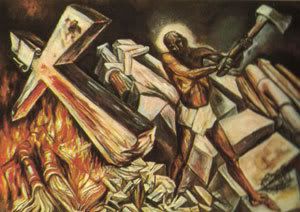
Mural by Jose Clemente Orozco "Christ Destroying
his Cross," 1943

This post comes under the heading of "what I want to tell atheists positively about Jesus." I started it back when I posted that one about Jesus and Dylan. It's based upon my outrage or dismay (I should say) over learning that so many atheists don't admire or respect Jesus as a historical figure. I re-posting it because after reading it again it seems pretty good.It's also in response to the statements by Weekend Fisher.

I have been deeply moved by Mexican muralist José Clemente Orozco's (1883-1949) painting of Jesus chopping down his own cross. The Christ of this mural prostrate is drawn in a very primitive style. Christ is not the Pascal lamb but refuses his destiny and will not go to the cross. The painting is disturbing because the first impression is that of blasphemy. Is the artist mocking Christ? Is he rejecting faith at its most sacred level? Orozco is not trying to blaspheme Jesus, nor is he denying the atonement. I find this painting very moving not our any rejection of Christ’s sacrifice or any desire to defame the doctrine of atonement, but because for me it says Jesus would, weather as the son of God, or if he was only a man in history, refuse to be the poster boy for institutional hypocrisy, Jesus would NOT allow himself to be used as symbol to sanctify the institution as it oppresses the poor and ignores the needs of the people. I believe that the real Jesus of history is both the Son of God and the man of history, and he does refuse this role. The real Jesus was a revolutionary of a most remarkable kind. Often we hear that Jesus is the great ethical teacher, and he claimed to be the Messiah, and savior of the world. We usually understand his ethics as an addendum, something any self respecting son of God would be required to have, but mainly irrelevant to his claims of godhood. Jesus ethics were far from being an addendum, however, they were the weaponry and major battle tactics of his amazing revolution. Politics and religion were intertwined in first century Hebrew society. Jesus’ ethics and his Messianic claims work together to fulfill his ultimate mission of world saving and together they make for one the most unique revolutions in human history.

It is not so strange to think of Jesus as a revolutionary. There were even Priests in Latin America in the 60’s, such as Camillio Tores but joined Che and became gorilla fighters. But Jesus the man of history was a true revolutionary. The region from which Jesus is said to have sprung is known as “the Galilee.” The Galilee was a hot bed of revolution, filled with uprisings and tensions. The Romans regarded it as the seat of Zealotry where the real revolutionaries were based. Just four miles from Jesus’ family farm “Nazareth” is a major metropolis known as Serapes. Just four miles down the road Jesus would have had access to what was then modern sophistication, political unrest and new ideas. Nor did he have to go to India to learn of traditions beyond his native prudential Judaism, the major trade route to India went right by his house,. That route lay on the plain of Megiddo where the end of the world is supposed to take place, the final battle between good and evil. Nazareth overlooks the plain of Megiddo and apparently the battle of Armageddon. All of these influences would have been at work in Jesus upbringing. Not to mention the fact that he was a descendant of David, born in Bethlehem and named as the high priest of Zechariah (Joshua = Jesus) who is linked to the Messiah (Zechariah 4).

Jesus revolution, however, was a bit odd. He did not lead an army nor did he command his followers to fight or pick up weapons. His was a non-violent revolution in the mode of Gandhi and that is where his ethics play a major role in backing his mission. The role of the Messiah in the society of Israel was that of political liberator, but it took on overtones of cosmic proportion. In the book of Isaiah we see the concept of Messiah first begins to be introduced, and is then back read into previous statements such as Moses admonition that “a prophet like me will come” and even God’s word to Eve “I will place enmity between the serpent and your seed.” The Messianic kingdom sketched out at the end of Isaiah is not the millennial kingdom of Christ’s post epochal reign on earth, but Israel after the return from the exile. By the second temple period and the time of Jesus, the concept had grown to almost divine proportions. The Messiah was to stand on the top of the temple and shout “Jerusalem your time at hand” the end of the world would ensue. The Messiah was to rise from the dead all of fallen Israel and for that reason he held the keys of life and death. The Jews did not see the Messiah as world redeemer; they did not see him as atoning sacrifice. These weren't entirely Christian innovations, they were foreshadowed at Qumran. But they weren't mainstream. The Jews certainly did not expect the Messiah to be crucified and raise from the dead.

Jesus was such a radical revolutionary, that is a "strange" different, unconventional one, that when his guys made noises about actually installing him on the throne the ran from them. That's because he knew, as everyone from the Galilee knew, the futility of trying to fight the Romans. The slaughter of the innocents in the book of Luke, is not recorded in history. Atheists are always quick to remind us of this. But it does not have to be recorded to have happened because that kind of thing happened all the time. Even a gathering as innocent as the sermon on the mount risked attack by Romans even though nothing provocative was being said. When they started talking about making Jesus king he slopped away and ran from them. Not because he lost his nerve, but because that would totally divert the people from his true purpose. Jesus has no intention of leading an armed revolt that was the opposite of what he had in mind. neither did he intend to pacify the people to accept pain and hardship with platitudes about pie in the sky. Was his program escapist? Was it just a personal nirvana with no touch stone in reality or responsibility to the world? It was not this ether. It was a practical and pragmatic system fro changing the nature of the world by changing the way people relate to each other. He accomplished this by taking people out of the world while keeping them in it.

In Jesus' system we live by the dictates of a higher citizenship, a world beyond this one ruled entirely by God. This is echoed in the model prayer he taught the disciples "thy kingdom come thy will be don't on earth, as it is in heaven." The device Jesus used for this trick of living by the rules of world while being physically in another, we the kingdom of God. The Kingdom of God was the essence of Jesus' message:


Mt 3:2
and saying, "Repent, for the kingdom of heaven is near."


atheists think Jesus was saying "If you don't believe in me you will go to hell." But he actually never says this. All the action is in the kingdom and the kingdom is the big deal. The coming of the kingdom Jesus makes out to be an immanent, immediate, almost emergency status event that will happen soon, and when it does, man is it a big thing!

Mt 4:17
From that time on Jesus began to preach, "Repent, for the kingdom of heaven is near."

Mt 4:23
Jesus went throughout Galilee, teaching in their synagogues, preaching the good news of the kingdom, and healing every disease and sickness among the people.

Mr 1:15 - Show Context
"The time has come," he said. "The kingdom of God is near. Repent and believe the good news!"


He never says the Kingdom is reward becasue you had the good sense to believe on him, but he does speak as though its the answer to all our troubles:


Mt 5:3
"Blessed are the poor in spirit, for theirs is the kingdom of heaven.

Mt 5:10
Blessed are those who are persecuted because of righteousness, for theirs is the kingdom of heaven.


Most revolutionaries come to abolish the standing order, not impose a kingdom, one kingdom over another.It is within this context that he talks about the ethics and personal relationships and how to relate to people. This is not just some ad-on that's in addition to believing the right things, nor is it unrelated, but it is an outgrowth, a logical extension, one is the basis of the other. The Kingdom is coming. It's power is already here. We can be part of it now, because it has two aspects. This is "realized Eschatology" which was developed by the theologian C.H.Dodd; the kingdom has an "already" dimension" and a "not yet" dimension. We live in the kingdom now even as we are in the world. How we treat each other is an integral aspect of the kingdom.


Mt 5:20
For I tell you that unless your righteousness surpasses that of the Pharisees and the teachers of the law, you will certainly not enter the kingdom of heaven.


Mt 7:21 - Show Context
"Not everyone who says to me, 'Lord, Lord,' will enter the kingdom of heaven, but only he who does the will of my Father who is in heaven.


Jesus ethical and moral teachings may be the greatest ever recorded, of course that's a biased and culturally bound appraisal. But they are certainly among the greatest, and the leaders and theologians of other world religions laud him for his teachings and many of them try to claim him as their own; the Muslims, The Hindu, and the B'Hai. Yet is was not the originality of his moral thinking that makes him great; the Stoics and others said many of the same things. And yet there are certain factors which do make Jesus' teachings unique and worthy of particular attention above and beyond that of most if not all ethical teachers...

Let's use a crash course in Jesus' ethics as a means of understanding his values:

Beatitudes

The "beatitudes" that Jesus speaks in the Sermon on the mount indicate the value system out of which he worked. Blessed means "happy" but he is saying more than "happy are the peacemakers." In pronouncing them blessed he is saying basically 'these are the good guys' and indicates a natural Tao working through the divine economy to protect and vindicate those who live by such values. "Blessed are the poor in spirit for theirs is the kingdom of heaven; blessed are those who mourn for they shall be comforted;...meek will inherit the earth...those who hunger and thirst after righteousness for they will be filled...merciful shown mercy...pure in heart will see God...peacemakers called sons of God...those persecuted for righteousness for theirs is the kingdom of heave." (Matt.5:3-10)

This is the way, this is how to be, these are the values one should hold. This is basically what he is saying. Essentially these qualities are those of a righteous person, they are oriented around God as the primary value and love for the neighbor as the main manifestation of love for God. To mourn probably means repenting for the evil we have done, or at least being able to empathize with other, to care about the pain others. "poor in spirit" refers to real poor people made more explicit in Luke, but the poor in the Bible are the righteous poor who trust in God for their sustenance.

prioritize: Seek Ye first the Kingdom of God...

"Do not be anxious saying 'what shall we eat?' 'what shall we drink?' 'what shall we wear?' The Gentiles seek all fo these things and your heavnly Father knows that you need them all, but seek first his kingdom and his riaghteousness, and all these will be added unto you..." (Matt. 5:28-33)

prime directive: Golden Rule

"Do unto others as you would have them do unto you." ..Other religions, probably all, have similar injunctions, but I have not found has this qualifier making it a self-reflexive command.


Self-Reflexive nature

By placing the command in terms of one's own standard of well being, the command becomes an exhortation to "love the neighbor as you love yourself." No higher standard could be given, one does to himself only that which he/she most desires to be done. By placing the command in these terms one cannot refuse to come to the aid of anyone in need. We would all prefer that others come to our aid. If the command were stated negatively, "do not do unto others that which you would not have done to yourself" one could ignore the neighbor in need. If the command stopped at merely loving the enemy or the neighbor one could refuse to help. By placing it in these self reflexive terms it is made active. One must go out of his way to seek out the needy.

b) Categorical Imperative.

Kant's great ethical system the categorical imperative was based on the Golden Rule of Jesus.

3) Love for Enemies

If you love those who love and hate those who hate you even the Gentiles do that, but I say unto you love your enemies, pray for those who persecute you

matt 5-6....

4) Greatest commandment

Matt 22:35. "and one of them, a lawgiver, ask him a question to test him, 'teacher what is the greatest commandment?' ...37 "and he said to him ye shall love the Lord you God with all your heart, with all your soul and with all your mind. This is the great and first command,and the second is like it, You shall love your neighbor as yourself. On these two commands depend the law and the prophets." (RSV).

Note: All legal regulations and striving of law keeping are summed up in love of God and love of neighbor. This shows that Jesus' ethics surpass the rule keeping stage and ascend to the highest level of conceptual morality, that of the ideal stage where actions are motivated by internalized principles. Moreover, by basing the second command upon love for the neighbor, but relating to love for self, it forms it's own second version of the categorical imperative. Note also if we love our neighbor as ourselves we are commanded to love ourselves, to rectify the self image in relation to reciprocal nature with others. At the same time, we cannot get off the hook by loving enemies any less (since even enemies are neighbors). Thus the will for the good of the other is indexed by our own will for our own good.

Psychological Motivations

Great Compassion


The compassion of Jesus can be seen in many of the stories. The woman caught in the act of adultery is taken before him and the mob wants to stone her. She has broken the law, she is worthy of death (accordion to that culture and that time). Jesus stoops and writes in the sand. We don't know what he wrote, but perhaps it was the names of those in the mob who had slept with her (they weren't being accused). He says "let he who is without sin cast the first stone..." There is the compassion he exhibited to the many people who implored him for healing, and he never refused anyone.We forget anyone else would have been running from those lepers and demoniac that he healed. The demoniac were dangerous, and the leapers thought contagious. But the also demonstrates a total lack of hypocrisy in being unafraid to associate with those who needed him most. When he was criticized for being in the company of drunkards and prostitutes; he merely made fun of the prudes and said, in affect "well, I didn't come to help those who are so well off (the self righteous people) but those who know they need help" There is no way to capture the greatness of Christ's compassion and moral teachings in one of these sub points, but I urge you to get a Bible and read the Gospels over and over, and with an open heart and you will see no greater compassion than that of Jesus Christ, and that of course is culminated in his sacrifice on the cross for our sins.

Greatest Sacrifice

He did lay down his life for the sins of the world. "Greater love hath no man than to give up his life for a friend," yet Jesus' died for everyone; and his own understanding of what he was doing was that he laid down his life as a "ransom for many." But it seems unlikely that his followers would enlarge upon his mission to this extent. Perhaps they could have enlarged upon his death o include the mission to Israel and it was Paul who expanded it to the rest of the world. But there is great likelihood that he understood himself to be doing something beneficial for all humanity. After all it was not Pauline Theology but the understanding of the Beloved Disciple of the fourth Gospel who puts into Jesus mouth the statement "for God so loved the world that he gave his only begotten son that whosoever believes on him should not perish but have everlasting life."


Living as though we were in the kingdom now is the most radical move of any revolutionary program. We don't need to hurt anyone, we don't need to fight anyone. ;We just treat people the way God wants us to treat them, out of love. Over time like the mustard seed int he parable he told, the kingdom will grow into a mighty tree that will shade the world. Of course that brings up a sore spot. Some might suggest that has not happened. Others might suggest are still working on it. I think it's worked out much better than skeptical types are willing to admit. Of course the problem is the quasi religious types who think they can manipulate the truth for their devices, and the legalistic types who think they have to kiss up the quasi religious types or they aren't religious enough. While there's a long way to go we need to be cognizant of the fact that Christianity is more than just a social agenda and plan for living. The Kingdom of God is not just a social club or a political program it's a spiritual reality. What Jesus was offering was not just membership in heaven, but a heaven that starts now on earth and is manifested in the way we treat people.