Showing posts with label incarnation. Show all posts

Thursday, December 24, 2015

Christmas and the Crucified God

 
Photobucket


This is my annual Christmas article. I have a guest article for friday and so I'll be off until after New Years. So I wish everyone a Mary Christmas!
Please Comment!!!

Christmas, God talk, incarnation, Jurgen Moltmann, Matthew Lamb, Solidarity with Victims, The Crucified God,


The Christian part of Christmas, that's the nativity scene with no trees or elves. That's the part you go to chruch to talk about. Show some mangers and some wise men and play the drummer boy song (eeeeee can't stand that son, p-rum-pum-pum-pum, rum-pum-pum-pum...enough already!) and you've done your bit for Christmas. I actually love Christmas, I like the manger and the baby and all that. Yet that is not what it's about. The entrance of Christ into the world in a lowly birth, worshiped by wise-men and heralded by angles and a star, those are nice folk tale elements. That masks what it's all about in the guise of cute fluffy heart warming imagery. Christmas is about the birth of Christ, God come in the flesh, and that signals to us the death of Christ; its meaning, it's end, it's un-final end and new beginning. The birth heralds more of the positive side of Jesus time in the flesh, his career, his mission, the promise and the possibilities. After all the angels said "peace on earth, good will toward men." How does that connect to a kid born in a manger?

Even with the positive possibilities of peace the birth hearlds the death and since we are compelled to think of both they both remind us of the meaning of Christ's mission and the reason for his coming. I used to read a book every Christmas, the same book. It was one of my all time favorite books; The Crucified God, by Jurgen Moltmann. The subtitle is very important: The Cross of Christ as the foundation and Criticism of Christian Theology. That book seemed to most adequately sum up what the incarnation is about.

Motlmann was from the 60's to the 90's and maybe even up to the present was the greatest living Protestant theologian. He was best known for this book and his Theology of Hope. both of which served to dramatize and legitimize the theology of liberation and the struggles of Latin America. Moltmann's book is actually an argument for placing Praxis on the front burner of theology and leaving the dray musty doctrinal stuff on the back burner. Praxis is the idea of reflection upon material need, how to apply the lessons of theology in a practical way to people's needs.
....... 
To get to the core of the book and it's relation to Christmas, the argument goes like this: So what if Jesus was crucified? what's the big deal? There are much worse ways to suffer. Crucifixion is bad but it is far from the worst thing that can happen to you. So why was it a sacrifice, I mean after all he is God, what would it matter to him if he dies? And he got to come back."

First, most Christians try to answer this out of a need for piety. They do not give a theological answer, they give a pious one. The pious answer can't be undestood by modern people, they lack pious feelings, so it just makes it worse. The pious answer of course is to try and mount up the pain and make it seem so very much worse. O. Jesus suffered in hell and he suffers every minute and he's still suffering and he felt all the agony in the world. Of course it doesn't' really say that anywhere in the Bible. While I think this is true, and while my pious side feels the proper sense of devotion and gratitude to our savior for his work, we can't use this to answer the question because modern impiety can't understand the answer. They just hear us reiterating their hidden primes.
....... 
The other Christian answers are Propitiatory atonement, Substitutionary, or Moral government. These are the tree major ways of looking at the atonement. Propitiation means to turn away anger. This answer is also incomprehensible to moderns. God is so very angry with us that he can't stand the sight of us, he has to stick Jesus between himself and us so he will see Jesus and turn away his anger. This just makes God seem like a red faced historical parent who couldn't comprehend the consequences of his creation when he decided to make it. Substitutionary atonement says that Jesus took our place, he received the penalty our sins deserved. This comes in two verities. One is financial transaction, Jesus paid the debt. the other is closer to moral government, Jesus was executed because he stepped in and took the place of the guilty party. Both of these are also problematic, because they really allow the guilty to get off Scott free and persecute an innocent person. Again modern people can't understand this kind of thinking; you could not go down to the jail and talk them into letting you take another prisoners place. We can harp on how this is a grace so fine we can't undersigned it in the natural mind, and relapse into piety again singing the praises to God for doing this wonderful act, but it wont answer the atheists questions.
....... 
I realize that the view I hold to is a little known minority view. I know I'm bucking the mainstream. But I think it makes a lot more sense and  actually explains why there was an atonement. Before getting into it, however, I want to comment upon the atheist hidden premise. The explicit premise of the atheist argument is that atonement works by Jesus suffering a whole lot. If Jesus suffers enough then restitution is made. But wait, restitution for what? For our sins? Then why should Jesus suffer more than we do or more than our victims do? Why do atheists seem to think,  that Jesus must suffer more than anyone ever has for the atonement to work? It's because the hidden premise is that God is guilty and the atonement is the time God pays for his own mistakes. Jesus has to suffer more than anyone to make up for what God has done, in conceiving of us by creating us. The sickness of the modern mind can scarcely comprehend Christian theology now. I wonder if it isn't too late and we are just past the day when people in the West can really be saved?

I mean consider the idea that usually acompanies this argument: well he is God after all, a little torutre death cant' hurt him. In the old days, when we had a culture that ran on Christian memories, people said how great that God would do this for us when he didn't have to! Now the argument is "Of course he had to, it's the least he can do, after all I didn't asked to be born, so I'm entitled to whatever goodies I can get in compensation." That's why I think the hidden premise is to blame God; its as though they are saying God has to suffer more than anyone to make up for the suffering he caused as creator. This sort of attitude marks the disease of the modern mind.

In any case, my view is the Participatory atonement. It was embraced by several church fathers and modern theologians supporting it are mentioned below:

I.The Atonement: God's Solidarity With Humanity.

........A. The inadquacy of Financial Transactions


Many ministers, and therefore, many Christians speak of and think of Jesus' death on the cross as analogous to a financial transaction. Usually this idea goes something like this: we are in hock to the devil because we sinned. God pays the debt we owe by sending Jesus to die for us, and that pays off the devil. The problem with this view is the Bible never says we owe the devil anything. We owe God. The financial transaction model is inadequate. Matters of the soul are much more important than any monetary arrangement and business transactions and banking do not do justice to the import of the issue. Moreover, there is a more sophisticated model; that of the sacrament for sin. In this model Jesus is like a sacrificial lamb who is murdered in our place. This model is also inadequate because it is based on a primitive notion of sacrifice. The one making the sacrifice pays over something valuable to him to appease an angry God. In this case God is paying himself. This view is also called the "propitiation view" becuase it is based upon propitiation, which means to turn away wrath. The more meaningful notion is that of Solidarity. The Solidarity or "participatory" view says that Jesus entered human history to participate in our lot as finiate humans, and he dide as a means of identifying with us. We are under the law of sin and death, we are under curse of the law (we sin, we die, we are not capable in our own human strength of being good enough to merit salvation). IN taking on the penalty of sin (while remaining sinless) Jesus died in our stead; not in the manner of a premature animal sacrafice (that is just a metaphor) but as one of us, so that through identification with us, we might identify with him and therefore, partake of his newness of life.

.......B. Christ the Perfect Revelation of God to Humanity

In the book of Hebrews it says "in former times God spoke in many and various ways through the prophets, but in these latter times he has spoken more perfectly through his son." Jesus is the perfect revelation of God to humanity. The prophets were speaking for God, but their words were limited in how much they could tell us about God. Jesus was God in the flesh and as such, we can see clearly by his character, his actions, and his teachings what God wants of us and how much God cares about us. God is for humanity, God is on our side! The greatest sign of God's support of our cause as needy humans is Jesus death on the cross, a death in solidarity with us as victims of our own sinful hearts and societies. Thus we can see the lengths God is will to go to to point us toward himself. There are many verses in the Bible that seem to contradict this view. These are the verses which seem to say that Atonement is propitiatory.

.......C. Death in Solidarity with Victims.............. 
1) Support from Modern Theologians

.......Three Major Modern Theologians support the solidarity notion of atonement: Jurgen Moltmann (The Crucified God), Matthew L. Lamb (Solidarity With Victims), and D.E.H. Whiteley (The Theology of St. Paul).In the 1980s Moltmann (German Calvinist) was called the greatest living protestant theologian, and made his name in laying the groundwork for what became liberation theology. Lamb (Catholic Priest) was big name in political theology, and Whiteley (scholar at Oxford) was a major Pauline scholar in the 1960s.In his work The Crucified God Moltmann interprits the cry of Jesus on the cross, "my God my God why have you forsaken me" as a statement of solidarity, placing him in identification with all who feel abandoned by God.Whiteley: "If St. Paul can be said to hold a theory of the modus operandi [of the atonement] it is best described as one of salvation through participation [the 'solidarity' view]: Christ shared all of our experience, sin alone excepted, including death in order that we, by virtue of our solidarity with him, might share his life...Paul does not hold a theory of substitution..." (The Theology of St. Paul, 130)An example of one of the great classical theologians of the early chruch who held to a similar view is St. Irenaeus (according to Whiteley, 133).

..............2) Scrtiptural


...all of us who were baptized into Christ Jesus were Baptized into his death.? We were therefore burried with him in baptism into death in order that just as Christ was raised from the death through the glory of the father, we too may live a new life. If we have been united with him in his death we will certanly be united with him in his resurrection.For we know that the old self was crucified with him so that the body of sin might be rendered powerless, that we should no longer be slaves to sin.--because anyone who has died has been freed from sin.Now if we have died with Christ we believe that we will also live with him, for we know that since Christ was raised from the dead he cannot die again; death no longer has mastery over him; the death he died to sin he died once for all; but the life he lives he lives to God. In the same way count yourselves dead to sin but alive to God in Chrsit Jesus.(Romans 6:1-5)

.......In Short, if we have united ourselves to Christ, entered his death and been raised to life, we participate in his death and resurrection through our act of solidarity, united with Christ in his death, than it stands tto reason that his death is an act of solidarity with us, that he expresses his solidarity with humanity in his death.

.......This is why Jesus cries out on the cross "why have you forsaken me?" According to Moltmann this is an expression of Solidarity with all who feel abandoned by God.Jesus death in solidarity creates the grounds for forgiveness, since it is through his death that we express our solidarity, and through that, share in his life in union with Christ. Many verses seem to suggest a propitiatory view. But these are actually speaking of the affects of the solidarity. "Since we have now been justified by his blood, how much more shall we be saved from God's wrath through him! For if when we were considered God's enemies, we were reconciled to him through the death of his son, how much more, having been reconciled, shall we be saved through his life! What appears to be saying that the shedding of blood is what creates forgiveness is actually saying that the death in solidarity creates the grounds for reconciliation. IT says we were enemies then we were reconciled to him through the death, his expression of solidarity changes the ground, when we express our solidarity and enter into the death we are giving up to God, we move from enemy to friend, and in that sense the shedding of blood, the death in solidarity, creates the conditions through which we can be and are forgiven. He goes on to talk about sharing in his life, which is participation, solidarity, unity.

.......D. Meaning of Solidarity and Salvation.

.......Jurgen Moltmann's notion of Solidarity (see The Crucified God) is based upon the notion of Political solidarity. Christ died in Solidarity with victims. He took upon himself a political death by purposely angering the powers of the day. Thus in his death he identifies with victims of oppression. But we are all victims of oppression. Sin has a social dimension, the injustice we experience as the hands of society and social and governmental institutions is primarily and at a very basic level the result of the social aspects of sin. Power, and political machinations begin in the sinful heart, the ego, the desire for power, and they manifest themselves through institutions built by the will to power over the other. But in a more fundamental sense we are all victims of our own sinful natures. We scheme against others on some level to build ourselves up and secure our conditions in life. IN this sense we cannot help but do injustice to others. In return injustice is done to us.Jesus died in solidarity with us, he underwent the ultimate consequences of living in a sinful world, in order to demonstrate the depths of God's love and God's desire to save us. Take an analogy from political organizing. IN Central America governments often send "death squads" to murder labor unionists and political dissenter. IN Guatemala there were some American organizations which organized for college students to go to Guatemala and escort the leaders of dissenting groups so that they would not be murdered.

.......The logic was that the death squads wouldn't hurt an American Student because it would bring bad press and shut off U.S. government funds to their military. As disturbing as these political implications are, let's stay focused on the Gospel. Jesus is like those students, and like some of them, he was actually killed. But unlike them he went out of his way to be killed, to be victimized by the the rage of the sinful and power seeking so that he could illustrate to us the desire of God; that God is on our side, God is on the side of the poor, the victimized, the marginalized, and the lost. Jesus said "a physician is not sent to the well but to the sick."The key to salvation is to accept God's statement of solidarity, to express our solidarity with God by placing ourselves into the death of Christ (by identification with it, by trust in it's efficacy for our salvation).

.......E. Atonement is a Primitive Concept?

.......This charge is made quite often by internet-skeptics, especially Jewish anti-missionaries who confuse the concept with the notion of Human sacrifice. But the charge rests on the idea that sacrifice itself is a prematurity notion. If one commits a crime, someone else should not pay for it. This attack can be put forward in many forms but the basic notion revolves around the idea that one person dying for the sins of another, taking the penalty or sacrificing to remove the guilt of another is a premature concept. None of this applies with the Participatory view of the atonement (solidarity) since the workings of Christ's death, the manner in which it secures salvation, is neither through turning away of wrath nor taking upon himself others sins, but the creation of the grounds through which one declares one's own solidarity with God and the grounds through which God accepts that solidarity and extends his own; the identification of God himself with the needs and cry of his own creation.

The Blogging Parson
Moltmann's theodicy is the great strength of this work, in that it directly engages the protest atheism of the mid twentieth century without negating the powerful emotional impact of its claims. We are returned to the cross as the heart of the Christian message repeatedly - it is no accident that Luther features so strongly and so positively in these pages. Further, the rigour of his penetrating search for the implications of the cross for God himself has led him rightly to the trinity, and stands as a rebuke to the western tradition for neglecting this understanding of God for so long. The atonement is necessarily a trinitarian event/process. The sense of God identifying with human beings in Christ is also very strong. Moltmann develops a theology of the atonement with a cosmic scope, and does not fall into the trap of individualising the work of the cross.

Moltmann's work turns out to develop a "Trinitarian history of God." This works through a dialectic through which God rejects the Son, then accepts the son, then raises the son to a hope and a future in which we can participate. This also raises a dialectical relation between God and man because the son becomes part of humanity then humanity becomes part of the son through adoption to sonship and participation in the future. Christ particpates in our life and We in his. That's quite a philosophical turn on for a German.

Blogging Parson again:
We might complain that Moltmann's doctrine of God suffers from an overdose of Hegelianism, by presenting the history of the world as God's history, the process by which he realizes himself. By rejecting impassiblity and divine aseity, does he allow a compromise of God's freedom? This having been said, is God still as impersonal as he ever was under the scholastics? Further, the God presented here seems almost dependent on, or at least intrinsically tied to, the world. His is a vulnerable God. Moltmann's trinitarian reflection leaves him open to the charge of tritheism - however, he more than responds to such a charge in The Trinity and the Kingdom of God; and he is recapturing a biblical emphasis, after all.
While the cosmic vision of Moltmann's theologia crucis is admirable, it says almost nothing about individual salvation - in fact, it almost non-soteriological. He describes God's judgement in the terms of the "giving up" of human beings to their godlessness, as in Rom 1 (p.242). The atonement is achieved not by any substitutionary work of Christ but by his identifying with human beings in their lostness, by solidarity with them. In the end, his panentheism leads him to a universalist model; and the preaching of the cross becomes a following of God's example in identifying with the lost and godforsaken.
This last criticism I think is valid on the surface. Mostlamann doesn't spend a lot of time focusing on individual piety I think the implications for the individual are obvious and it's up to the individual to step into a relationship with God. For me I find Chrsitmas can be a great way to do what but only if you overlook the commercial crap and read a book like the Crucified God..


Online copy of Crucified God by Jurgen Moltmann

Wednesday, December 18, 2013

Christmas and The Crucified God


Photobucket


This is my annual Christmas article. I have a guest article for friday and so I'll be off until after New Years. So I wish everyone a Mary Christmas!


The Christian part of Christmas, that's the nativity scene with no trees or elves. That's the part you go to chruch to talk about. Show some mangers and some wise men and play the drummer boy song (eeeeee can't stand that son, p-rum-pum-pum-pum, rum-pum-pum-pum...enough already!) and you've done your bit for Christmas. I actually love Christmas, I like the manger and the baby and all that. Yet that is not what it's about. The entrance of Christ into the world in a lowly birth, worshiped by wise-men and heralded by angles and a star, those are nice folk tale elements. That masks what it's all about in the guise of cute fluffy heart warming imagery. Christmas is about the birth of Christ, God come in the flesh, and that signals to us the death of Christ; its meaning, it's end, it's un-final end and new beginning. The birth heralds more of the positive side of Jesus time in the flesh, his career, his mission, the promise and the possibilities. After all the angels said "peace on earth, good will toward men." How does that connect to a kid born in a manger?

Even with the positive possibilities of peace the birth hearlds the death and since we are compelled to think of both they both remind us of the meaning of Christ's mission and the reason for his coming. I used to read a book every Christmas, the same book. It was one of my all time favorite books; The Crucified God, by Jurgen Moltmann. The subtitle is very important: The Cross of Christ as the foundation and Criticism of Christian Theology. That book seemed to most adequately sum up what the incarnation is about.

Motlmann was from the 60's to the 90's and maybe even up to the present was the greatest living Protestant theologian. He was best known for this book and his Theology of Hope. both of which served to dramatize and legitimize the theology of liberation and the struggles of Latin America. Moltmann's book is actually an argument for placing Praxis on the front burner of theology and leaving the dray musty doctrinal stuff on the back burner. Praxis is the idea of reflection upon material need, how to apply the lessons of theology in a practical way to people's needs.
....... 
To get to the core of the book and it's relation to Christmas, the argument goes like this: So what if Jesus was crucified? what's the big deal? There are much worse ways to suffer. Crucifixion is bad but it is far from the worst thing that can happen to you. So why was it a sacrifice, I mean after all he is God, what would it matter to him if he dies? And he got to come back."

First, most Christians try to answer this out of a need for piety. They do not give a theological answer, they give a pious one. The pious answer can't be undestood by modern people, they lack pious feelings, so it just makes it worse. The pious answer of course is to try and mount up the pain and make it seem so very much worse. O. Jesus suffered in hell and he suffers every minute and he's still suffering and he felt all the agony in the world. Of course it doesn't' really say that anywhere in the Bible. While I think this is true, and while my pious side feels the proper sense of devotion and gratitude to our savior for his work, we can't use this to answer the question because modern impiety can't understand the answer. They just hear us reiterating their hidden primes.
....... 
The other Christian answers are Propitiatory atonement, Substitutionary, or Moral government. These are the tree major ways of looking at the atonement. Propitiation means to turn away anger. This answer is also incomprehensible to moderns. God is so very angry with us that he can't stand the sight of us, he has to stick Jesus between himself and us so he will see Jesus and turn away his anger. This just makes God seem like a red faced historical parent who couldn't comprehend the consequences of his creation when he decided to make it. Substitutionary atonement says that Jesus took our place, he received the penalty our sins deserved. This comes in two verities. One is financial transaction, Jesus paid the debt. the other is closer to moral government, Jesus was executed because he stepped in and took the place of the guilty party. Both of these are also problematic, because they really allow the guilty to get off Scott free and persecute an innocent person. Again modern people can't understand this kind of thinking; you could not go down to the jail and talk them into letting you take another prisoners place. We can harp on how this is a grace so fine we can't undersigned it in the natural mind, and relapse into piety again singing the praises to God for doing this wonderful act, but it wont answer the atheists questions.
....... 
I realize that the view I hold to is a little known minority view. I know I'm bucking the mainstream. But I think it makes a lot more sense and  actually explains why there was an atonement. Before getting into it, however, I want to comment upon the atheist hidden premise. The explicit premise of the atheist argument is that atonement works by Jesus suffering a whole lot. If Jesus suffers enough then restitution is made. But wait, restitution for what? For our sins? Then why should Jesus suffer more than we do or more than our victims do? Why do atheists seem to think,  that Jesus must suffer more than anyone ever has for the atonement to work? It's because the hidden premise is that God is guilty and the atonement is the time God pays for his own mistakes. Jesus has to suffer more than anyone to make up for what God has done, in conceiving of us by creating us. The sickness of the modern mind can scarcely comprehend Christian theology now. I wonder if it isn't too late and we are just past the day when people in the West can really be saved?

I mean consider the idea that usually acompanies this argument: well he is God after all, a little torutre death cant' hurt him. In the old days, when we had a culture that ran on Christian memories, people said how great that God would do this for us when he didn't have to! Now the argument is "Of course he had to, it's the least he can do, after all I didn't asked to be born, so I'm entitled to whatever goodies I can get in compensation." That's why I think the hidden premise is to blame God; its as though they are saying God has to suffer more than anyone to make up for the suffering he caused as creator. This sort of attitude marks the disease of the modern mind.

In any case, my view is the Participatory atonement. It was embraced by several church fathers and modern theologians supporting it are mentioned below:

I.The Atonement: God's Solidarity With Humanity.

........A. The inadquacy of Financial Transactions


Many ministers, and therefore, many Christians speak of and think of Jesus' death on the cross as analogous to a financial transaction. Usually this idea goes something like this: we are in hock to the devil because we sinned. God pays the debt we owe by sending Jesus to die for us, and that pays off the devil. The problem with this view is the Bible never says we owe the devil anything. We owe God. The financial transaction model is inadequate. Matters of the soul are much more important than any monetary arrangement and business transactions and banking do not do justice to the import of the issue. Moreover, there is a more sophisticated model; that of the sacrament for sin. In this model Jesus is like a sacrificial lamb who is murdered in our place. This model is also inadequate because it is based on a primitive notion of sacrifice. The one making the sacrifice pays over something valuable to him to appease an angry God. In this case God is paying himself. This view is also called the "propitiation view" becuase it is based upon propitiation, which means to turn away wrath. The more meaningful notion is that of Solidarity. The Solidarity or "participatory" view says that Jesus entered human history to participate in our lot as finiate humans, and he dide as a means of identifying with us. We are under the law of sin and death, we are under curse of the law (we sin, we die, we are not capable in our own human strength of being good enough to merit salvation). IN taking on the penalty of sin (while remaining sinless) Jesus died in our stead; not in the manner of a premature animal sacrafice (that is just a metaphor) but as one of us, so that through identification with us, we might identify with him and therefore, partake of his newness of life.

.......B. Christ the Perfect Revelation of God to Humanity

In the book of Hebrews it says "in former times God spoke in many and various ways through the prophets, but in these latter times he has spoken more perfectly through his son." Jesus is the perfect revelation of God to humanity. The prophets were speaking for God, but their words were limited in how much they could tell us about God. Jesus was God in the flesh and as such, we can see clearly by his character, his actions, and his teachings what God wants of us and how much God cares about us. God is for humanity, God is on our side! The greatest sign of God's support of our cause as needy humans is Jesus death on the cross, a death in solidarity with us as victims of our own sinful hearts and societies. Thus we can see the lengths God is will to go to to point us toward himself. There are many verses in the Bible that seem to contradict this view. These are the verses which seem to say that Atonement is propitiatory.

.......C. Death in Solidarity with Victims.............. 
1) Support from Modern Theologians

.......Three Major Modern Theologians support the solidarity notion of atonement: Jurgen Moltmann (The Crucified God), Matthew L. Lamb (Solidarity With Victims), and D.E.H. Whiteley (The Theology of St. Paul).In the 1980s Moltmann (German Calvinist) was called the greatest living protestant theologian, and made his name in laying the groundwork for what became liberation theology. Lamb (Catholic Priest) was big name in political theology, and Whiteley (scholar at Oxford) was a major Pauline scholar in the 1960s.In his work The Crucified God Moltmann interprits the cry of Jesus on the cross, "my God my God why have you forsaken me" as a statement of solidarity, placing him in identification with all who feel abandoned by God.Whiteley: "If St. Paul can be said to hold a theory of the modus operandi [of the atonement] it is best described as one of salvation through participation [the 'solidarity' view]: Christ shared all of our experience, sin alone excepted, including death in order that we, by virtue of our solidarity with him, might share his life...Paul does not hold a theory of substitution..." (The Theology of St. Paul, 130)An example of one of the great classical theologians of the early chruch who held to a similar view is St. Irenaeus (according to Whiteley, 133).

..............2) Scrtiptural


...all of us who were baptized into Christ Jesus were Baptized into his death.? We were therefore burried with him in baptism into death in order that just as Christ was raised from the death through the glory of the father, we too may live a new life. If we have been united with him in his death we will certanly be united with him in his resurrection.For we know that the old self was crucified with him so that the body of sin might be rendered powerless, that we should no longer be slaves to sin.--because anyone who has died has been freed from sin.Now if we have died with Christ we believe that we will also live with him, for we know that since Christ was raised from the dead he cannot die again; death no longer has mastery over him; the death he died to sin he died once for all; but the life he lives he lives to God. In the same way count yourselves dead to sin but alive to God in Chrsit Jesus.(Romans 6:1-5)

.......In Short, if we have united ourselves to Christ, entered his death and been raised to life, we participate in his death and resurrection through our act of solidarity, united with Christ in his death, than it stands tto reason that his death is an act of solidarity with us, that he expresses his solidarity with humanity in his death.

.......This is why Jesus cries out on the cross "why have you forsaken me?" According to Moltmann this is an expression of Solidarity with all who feel abandoned by God.Jesus death in solidarity creates the grounds for forgiveness, since it is through his death that we express our solidarity, and through that, share in his life in union with Christ. Many verses seem to suggest a propitiatory view. But these are actually speaking of the affects of the solidarity. "Since we have now been justified by his blood, how much more shall we be saved from God's wrath through him! For if when we were considered God's enemies, we were reconciled to him through the death of his son, how much more, having been reconciled, shall we be saved through his life! What appears to be saying that the shedding of blood is what creates forgiveness is actually saying that the death in solidarity creates the grounds for reconciliation. IT says we were enemies then we were reconciled to him through the death, his expression of solidarity changes the ground, when we express our solidarity and enter into the death we are giving up to God, we move from enemy to friend, and in that sense the shedding of blood, the death in solidarity, creates the conditions through which we can be and are forgiven. He goes on to talk about sharing in his life, which is participation, solidarity, unity.

.......D. Meaning of Solidarity and Salvation.

.......Jurgen Moltmann's notion of Solidarity (see The Crucified God) is based upon the notion of Political solidarity. Christ died in Solidarity with victims. He took upon himself a political death by purposely angering the powers of the day. Thus in his death he identifies with victims of oppression. But we are all victims of oppression. Sin has a social dimension, the injustice we experience as the hands of society and social and governmental institutions is primarily and at a very basic level the result of the social aspects of sin. Power, and political machinations begin in the sinful heart, the ego, the desire for power, and they manifest themselves through institutions built by the will to power over the other. But in a more fundamental sense we are all victims of our own sinful natures. We scheme against others on some level to build ourselves up and secure our conditions in life. IN this sense we cannot help but do injustice to others. In return injustice is done to us.Jesus died in solidarity with us, he underwent the ultimate consequences of living in a sinful world, in order to demonstrate the depths of God's love and God's desire to save us. Take an analogy from political organizing. IN Central America governments often send "death squads" to murder labor unionists and political dissenter. IN Guatemala there were some American organizations which organized for college students to go to Guatemala and escort the leaders of dissenting groups so that they would not be murdered.

.......The logic was that the death squads wouldn't hurt an American Student because it would bring bad press and shut off U.S. government funds to their military. As disturbing as these political implications are, let's stay focused on the Gospel. Jesus is like those students, and like some of them, he was actually killed. But unlike them he went out of his way to be killed, to be victimized by the the rage of the sinful and power seeking so that he could illustrate to us the desire of God; that God is on our side, God is on the side of the poor, the victimized, the marginalized, and the lost. Jesus said "a physician is not sent to the well but to the sick."The key to salvation is to accept God's statement of solidarity, to express our solidarity with God by placing ourselves into the death of Christ (by identification with it, by trust in it's efficacy for our salvation).

.......E. Atonement is a Primitive Concept?

.......This charge is made quite often by internet-skeptics, especially Jewish anti-missionaries who confuse the concept with the notion of Human sacrifice. But the charge rests on the idea that sacrifice itself is a prematurity notion. If one commits a crime, someone else should not pay for it. This attack can be put forward in many forms but the basic notion revolves around the idea that one person dying for the sins of another, taking the penalty or sacrificing to remove the guilt of another is a premature concept. None of this applies with the Participatory view of the atonement (solidarity) since the workings of Christ's death, the manner in which it secures salvation, is neither through turning away of wrath nor taking upon himself others sins, but the creation of the grounds through which one declares one's own solidarity with God and the grounds through which God accepts that solidarity and extends his own; the identification of God himself with the needs and cry of his own creation.

The Blogging Parson
Moltmann's theodicy is the great strength of this work, in that it directly engages the protest atheism of the mid twentieth century without negating the powerful emotional impact of its claims. We are returned to the cross as the heart of the Christian message repeatedly - it is no accident that Luther features so strongly and so positively in these pages. Further, the rigour of his penetrating search for the implications of the cross for God himself has led him rightly to the trinity, and stands as a rebuke to the western tradition for neglecting this understanding of God for so long. The atonement is necessarily a trinitarian event/process. The sense of God identifying with human beings in Christ is also very strong. Moltmann develops a theology of the atonement with a cosmic scope, and does not fall into the trap of individualising the work of the cross.

Moltmann's work turns out to develop a "Trinitarian history of God." This works through a dialectic through which God rejects the Son, then accepts the son, then raises the son to a hope and a future in which we can participate. This also raises a dialectical relation between God and man because the son becomes part of humanity then humanity becomes part of the son through adoption to sonship and participation in the future. Christ particpates in our life and We in his. That's quite a philosophical turn on for a German.

Blogging Parson again:
We might complain that Moltmann's doctrine of God suffers from an overdose of Hegelianism, by presenting the history of the world as God's history, the process by which he realizes himself. By rejecting impassiblity and divine aseity, does he allow a compromise of God's freedom? This having been said, is God still as impersonal as he ever was under the scholastics? Further, the God presented here seems almost dependent on, or at least intrinsically tied to, the world. His is a vulnerable God. Moltmann's trinitarian reflection leaves him open to the charge of tritheism - however, he more than responds to such a charge in The Trinity and the Kingdom of God; and he is recapturing a biblical emphasis, after all.
While the cosmic vision of Moltmann's theologia crucis is admirable, it says almost nothing about individual salvation - in fact, it almost non-soteriological. He describes God's judgement in the terms of the "giving up" of human beings to their godlessness, as in Rom 1 (p.242). The atonement is achieved not by any substitutionary work of Christ but by his identifying with human beings in their lostness, by solidarity with them. In the end, his panentheism leads him to a universalist model; and the preaching of the cross becomes a following of God's example in identifying with the lost and godforsaken.
This last criticism I think is valid on the surface. Mostlamann doesn't spend a lot of time focusing on individual piety I think the implications for the individual are obvious and it's up to the individual to step into a relationship with God. For me I find Chrsitman can be a great way to do what but only if you overlook the commercial crap and read a book like the Crucified God..


Online copy of Crucified God by Jurgen Moltmann

Sunday, December 19, 2010

Incarnation part 1: Radical Jesus

Photo Sharing and Video Hosting at Photobucket
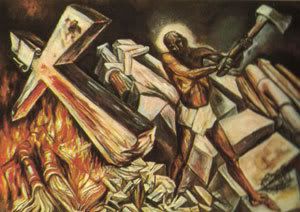
Mural by Jose Clemente Orozco


Overlooking Christmas I promised to deal with the Incarnation this week. Rather than do a bunch of holiday cleches, manger scenes and baby Jesus, or dry boring things about the Trinity I will attack the radical end of it. Christmas is about the birth of Christ and that means the incarnation. More important than getting the doctrine stated right (do embrace the Nincene creed) is to understand what it means. The incorantion has a spceific meaning that is very important. I will deal with that in two segments, this one and one on Jurgen Moltmann on Wednesday.

Here I will start at the other end of things, the meaning of incorporation through an understanding of Jesus as a man in society. the symbol of the manger is the humble origin. The reason for that is solidarity with humanity. Jesus was one of us. God became one of us. He was one whom the murder of the poor was murder, the elites would despise. The best incornation passage was written by Paul, one of the most beautiful and sumps up the meaning best:

Philipians 2
6 Who, being in very naturea]">[a] God,
did not consider equality with God something to be used to his own advantage;
7 rather, he made himself nothing
by taking the very natureb]">[b] of a servant,
being made in human likeness.
8 And being found in appearance as a man,
he humbled himself
by becoming obedient to death—
even death on a cross!


I have been deeply moved by Mexican muralist José Clemente Orozco's (1883-1949) painting of Jesus chopping down his own cross. The Christ of this mural prostrate is drawn in a very primitive style. Christ is not the Pascal lamb but refuses his destiny and will not go to the cross. The painting is disturbing because the first impression is that of blasphemy. Is the artist mocking Christ? Is he rejecting faith at its most sacred level? Rosco is not trying to blaspheme Jesus, nor is he denying the atonement. I find this painting very moving not out of any rejection of Christ’s sacrifice or any desire to defame the doctrine of atonement, but because for me it says Jesus would, weather as the son of God, or if he was only a man in history, refuse to be the poster boy for institutional hypocrisy, Jesus would allow himself to be used as symbol to sanctify the institution as it oppresses the poor and ignores the needs of the people. I believe that the real Jesus of history is both the Son of God and the man of history, and he does refuse this role. The real Jesus was a revolutionary of a most remarkable kind. Often we hear that Jesus is the great ethical teacher, and he claimed to be the Messiah, and savior of the world. We usually understand his ethics as an addendum, something any self respecting son of God would be required to have, but mainly irrelevant to his claims of godhood. Jesus ethics were far from being an addendum, however, they were the weaponry and major battle tactics of his amazing revolution. Politics and religion were intertwined in first century Hebrew society. Jesus’ ethics and his Messianic claims work together to fulfill his ultimate mission of world saving and together they make for one the most unique revolutions in human history.

It is not so strange to think of Jesus as a revolutionary. There were even Priests in Latin America in the 60’s, such as Camillio Tores but joined Che and became gorilla fighters. But Jesus the man of history was a true revolutionary. The region from which Jesus is said to have sprung is known as “the Galilee.” The Galilee was a hot bed of revolution, filled with uprisings and tensions. The Romans regarded it as the seat of Zealotry where the real revolutionaries were based. Just four miles from Jesus’ family farm “Nazareth” is a major metropolis known as Serapes. Just four miles down the road Jesus would have had access to what was then modern sophistication, political unrest and new ideas. Nor did he have to go to India to learn of traditions beyond his native prudential Judaism, the major trade route to India went right by his house,. That route lay on the plain of Megiddo where the end of the world is supposed to take place, the final battle between good and evil. Nazareth overlooks the plain of Megiddo and apparently the battle of Armageddon. All of these influences would have been at work in Jesus upbringing. Not to mention the fact that he was a descendent of David, born in Bethlehem and named as the high priest of Zechariah (Joshua = Jesus) who is linked to the Messiah (Zechariah 4).

Jesus revolution, however, was a bit odd. He did not lead an army nor did he command his followers to fight or pick up weapons. His was a non-violent revolution in the mode of Gandhi and that is where his ethics play a major role in backing his mission. The role of the Messiah in the society of Israel was that of political liberator, but it took on overtones of cosmic proportion. In the book of Isaiah we see the concept of Messiah first begins to be introduced, and is then back read into previous statements such as Moses admonition that “a prophet like me will come” and even God’s word to Eve “I will place enmity between the serpent and your seed.” The Messianic kingdom sketched out at the end of Isaiah is not the millennial kingdom of Christ’s post epochal reign on earth, but Israel after the return from the exile. By the second temple period and the time of Jesus, the concept had grown to almost divine proportions. The Messiah was to stand on the top of the temple and shout “Jerusalem your time at hand” the end of the world would ensue. The Messiah was to rise from the dead all of fallen Israel and for that reason he held the keys of life and death. The Jews did not see the Messiah as world redeemer; they did not see him as atoning sacrifice. These weren't entirely Christian innovations, they were foreshadowed at Qumran. But they weren't mainstream. The Jews certainly did not expect the Messiah to be crucified and raise from the dead.

Jesus was such a radical revolutionary, that is a "strange" different, unconventional one, that when his guys made noises about actually installing him on the throne the ran from them. That's because he knew, as everyone from the Galilee knew, the futility of trying to fight the Romans. The slaughter of the innocents in the book of Luke, is not recorded in history. Atheists are always quick to remind us of this. But it does not have to be because that kind of thin happened all the time. Even a gathering as innocent as the sermon on the mount risked attack by Romans even though nothing provocative was being said. When they started talking about making Jesus king he slopped away and ran from them. Not because he lost his nerve, but because that would totally divert the people from his true purpose. Jesus has no intention of leading an armed revolt that was the opposite of what he had in mind. neither did he intend to pacify the people to accept pain and hardship with platitudes about pie in the sky. Was his program escapist? Was it just a personal nirvana with no touch stone in reality or responsibility to the world? It was not this ether. It was a practical and pragmatic system fro changing the nature of the world by changing the way people relate to each other. He accomplished this by taking people out of the world while keeping them in it.

In Jesus' system we live by the dictates of a higher citizenship, a world beyond this one ruled entirely by God. This is echoed in the model prayer he taught the disciples "thy kingdom come thy will be don't on earth, as it is in heaven." The device Jesus used for this trick of living by the rules of world while being physically in another, we the kingdom of God. The Kingdom of God was the essence of Jesus' message:


Mt 3:2
and saying, "Repent, for the kingdom of heaven is near."

atheists think Jesus was saying "If you don't believe in me you will go to hell." But he actually never says this. All the action is in the kingdom and the kingdom is the big deal. The coming of the kingdom Jesus makes out to be an immanent, immediate, almost emergency status event that will happen soon, and when it does, man is it a big thing!


Mt 4:17
From that time on Jesus began to preach, "Repent, for the kingdom of heaven is near."

Mt 4:23
Jesus went throughout Galilee, teaching in their synagogues, preaching the good news of the kingdom, and healing every disease and sickness among the people.

Mr 1:15 - Show Context
"The time has come," he said. "The kingdom of God is near. Repent and believe the good news!"

He never says the Kingdom is reward becasue you had the good sense to believe on him, but he does speak as though its the answer to all our troubles:

Mt 5:3
"Blessed are the poor in spirit, for theirs is the kingdom of heaven.

Mt 5:10
Blessed are those who are persecuted because of righteousness, for theirs is the kingdom of heaven.

Most revolutionaries come to abolish the standing order, not imposes a kingdom, one kingdom over another.It is within this context that he talks about the ethics and personal relationships and how to relate to people. This is not just some ad on that's in addition to believing the right things, nor is it unrelated, but it is an outgrowth, a logical extension, one is the basis of the other. The Kingdom is coming. It's power is already here. We can be part of it now, because it has two aspects. This is "realized Eschatology" which was developed by the theologian C.H.Dodd; the kingdom has an "already" dimension" and a "not yet" dimension. We live in the kingdom now even as we are in the world. How we treat each other is an integral aspect of the kingdom.

Mt 5:20
For I tell you that unless your righteousness surpasses that of the Pharisees and the teachers of the law, you will certainly not enter the kingdom of heaven.


Mt 7:21 - Show Context
"Not everyone who says to me, 'Lord, Lord,' will enter the kingdom of heaven, but only he who does the will of my Father who is in heaven.

Living as though we were in the kingdom now is the most radical move of any revolutionary program. We don't need to hurt anyone, we don't need to fight anyone. ;We just treat people the way God wants us to treat them, out of love. Over time like the mustard seed int he parable he told, the kingdom will grow into a mighty tree that will shade the world. Of course that brings up a sore spot. Some might suggest that has not happened. Others might suggest are still working on it. I think it's worked out much better than skeptical types are willing to admit. Of course the problem is the quasi religious types who think they can manipulate the truth for their devices, and the legalistic types who think they have to kiss up the quasi religious types or they aren't religious enough. While there's a long way to go we need to be cognizant of the fact that Christianity is more than just a social agenda and plan for living. The Kingdom of God is not just a social club or a political prgram it's spiritual power.

The fullness time will bring the healing of all wounds. Jesus incorporation prelude to his death in solidarity with humanity. The death cancels the future but the resurrection gives him a hope and a future. We step into solidarity with God we step into the hope and the future.

The full passgae in Philipians 2:

6 Who, being in very naturea]">[a] God,
did not consider equality with God something to be used to his own advantage;
7 rather, he made himself nothing
by taking the very natureb]">[b] of a servant,
being made in human likeness.
8 And being found in appearance as a man,
he humbled himself
by becoming obedient to death—
even death on a cross!

9 Therefore God exalted him to the highest place
and gave him the name that is above every name,
10 that at the name of Jesus every knee should bow,
in heaven and on earth and under the earth,
11 and every tongue acknowledge that Jesus Christ is Lord,
to the glory of God the Father.