Showing posts with label Jesus myth. Show all posts

Wednesday, December 16, 2015

Did anyone exist in the first century? (part 2): Paul


 photo 1PA30_zpsbvsgbcam.jpg


Kenneth Humphreys Is probably the major Paul Myther.I can't find out much about him, but he wrote a Jesus Myth book, The Christos Mythos. See a review by major historian James omerea. His anti-Paul arguments are laid out on a blog: A Fabricated Apostle: Two Different Pauls.

Humphreys has many argumens but I will deal with six, and to summarize them:

(1)Argument from silence on Paul's great acts

(2) Disparities between Epistles and Acts

(3)Conflicts between Paul's Roman citizenship and Jewishness

(4) Paul's conversion story is implausible.

(5)Supposedly parallel passages with Josephus.

(6)No evidence of Paul in Ephesus His First Argument is an Argument from Silence (OF COURSE). There's no record of Paul being assigned to enforce Jewish sanctions against heretics. Moreover, Paul was always meeting Kings and civic dignitaries yet there is no record of it in secular history. "The trail-blazing Christian missionary and apostle, St Paul, appears nowhere in the secular histories of his age (not in Tacitus, not in Pliny, not in Josephus, etc.) Though Paul, we are told, mingled in the company of provincial governors and had audiences before kings and emperors, no scribe thought it worthwhile to record these events."

Humphreys seems to assume that there's some archives to which we can go to look up all that happened in first century Palestine. There is no such place. They did not have a vast governmental achieve, if they did we don't have it now. We have little from the first century. The list of all first century writings that don't mention Jesus (excluding prolific Philo) is so small it's not much bigger than those that do. Any authority granted Paul if even written, would be so totally obscure it's silly to expect to have it.[1] As for meeting with important people a lot of that was due to Paul claiming rights of Roman citizenship when charged with crimes. There's nothing remarkable about that so no reason to expect to find the records. That's like saying "my son [the drug addict] is always talking to layers and judges so he's an important guy." Moreover, Stephan Neil points out that Luke gets the titles of all the functionaries correct in all the different regions.Neil thinks that one of the most impressive aspects of Luke as an historian is that he always gets the titles right. Many of the titles of local officials which Luke provides us with were not validated until modern times. "The writer of Acts knew the correct titles and used them with varying precision. In the words of Ramsey: 'the officials with whom Paul and his companions were brought into contact are those who would be there. Every person is found just where he ought to be; proconsuls in senatorial provinces, asiarchs in Ephesus, strategoi in Philippi, politarchs in Thessolonica, magicians and soothsayers everywhere.' The Most remarkable of these titles is Politarch the ruler of the city used in Acts 17:6...previously this word had been completely unknown except for this passage in Acts. It has now been found in 19 inscriptions dating from he second century..." Neil argues that titles are the hardest things to get right, modern French writers never get English titles right, and this is something that would easily and surely betray an anachronism (147)Historians of the modern day judge Luke a superb historian.This is good evidence that he did make the journey because getting such title's right is very hard to do.[2]It seems the author really was on the trip and thus it's not made up out of whole cloth. He probably knew Paul as well.

His second argumentis that the Pauline Epistles and the book of acts portray widely divergent views of Paul. Paul of the epistles is independent and confident, not intimidated by authority of the Apostles. He confronts Peter (Galatians); the Paul of Acts is cooperative, dedicated to the team, and willing to be commanded and led:

Now part of the brethren ("with them coming in and going out at Jerusalem" - 9.28), he is "managed" by the elders. Disciples "took him" from Damascus (9.25) and Barnabas "brought him" to the apostles (9.27). They "brought him" to Caesarea and then they "sent him" to Tarsus. Barnabas "brought" Paul back to Antioch (11.26) and then with him was "sent" to Jerusalem with famine relief (11.30) – (as it happens, a visit to Jerusalem completely unknown to Paul himself). Eventually the brethren "send" Paul on his first missionary journey (13.4). As a missionary, Paul is very much on the collective message:"And as they went through the cities they delivered them the decrees for to keep that were ordained of the apostles and elders which were at Jerusalem. And so were the churches established." – Acts 16.4,5.

From Thessalonica, Paul is "sent away" to Berea by the brethren (17.10). He is also "sent away" by sea and "brought" to Athens (17.14,15). In Cenchrea, Paul even takes a Jewish vow and shaves his head! (18.18).
On this point there's an ironic but obvious counter. Humphrey's says of the Paul of Acts: "The closest Acts comes to bestowing the title [Apostle] is 14.14 where his name follows Barnabas and the plural is used." Then: "Full of his own importance, in all his letters Paul hammers home the point that he is an apostle and that his appointment comes directly from the divine." Do you see a relationship there? That is certainly not proof that he didn't exist. All it really proves is that once got out on his own he realized how they treated him and decided to do it this own way; more a proof of his historicity because it shows he was human. Moreover the fact of shaving his head means he was in conflict with them. He was commanded to do it, it was a PR move and Paul's own idea. My argument is not that here is no disparity but that Humphreys is making much more out of it than should be made. First you have the difference between Paul's account of himself (ok so he's not Mother Teresa--he has an ego)juxtaposed to Luke's understanding of him. In fact Luke's account might have been recorded and embellished from verbal recollections by a well meaning acolyte. Secondly you have to consider the tine and the on text. Luke is writing to put Paul's life in a light that would flatter him and promote unity, and he was writing in the 80s, 20 years after Paul's death. Paul was writing to churches ad hock about immediate problems confronting. Humprey's argues that Paul, in his letters, doesn't tell them about the things in the book of Acts. Yet he was not writing an auto biography. He also did not tell them about his mother, we can safely assume he had one. At worst all this proves is that the Greek physician was a spin doctor not that Paul did not exist.

In his third argument, implausible and contradictory aspects of Paul's story, Humphrey's real ignorance is showing. He thinks that if Paul was a hotshot student of the major rabbi, there would be some Jewish polemics about it. Then an even more egregious and telling display of how little he really knows: "How likely is it that Paul really studied under the Pharisaic grandee (Acts 22.3)? Paul clearly had difficulty with the Hebrew language: all his scriptural references are taken from the Greek translation of Jewish scripture, the Septuagint." He also compounds the ignorance by questioning if a Roman citizen could have any authority in Judaism and asserts nothing in the texts spell out official authority.

First, Paul's status as a hotshot student. No one ever really said, nor did Paul say, "I was the best student.." He said he learned from Gamaliel he did not say "I was the top student." He said "I was zealous" and he said kept the law he didn't say "I was brilliant I was the best." Of course there is also the possibility that such polemics did exist but are lost to posterity; I've already shown that we have little in the way of documents surviving that era. The Romans may well have destroyed any achieves they had in 70 or in 135. When they destroyed Jerusalem the second time they put Roman temples over Christian and Jewish holy sites such as the site of Jesus' tomb. hy would they not destroy archives?[3]

Secondly, the Septuagint gaff. It is common knowledge that the LXX (Septuagint) was the Bible of the early church. In fact the Jews were so angry that the Christians made so much of the Greek scripture and used it to link Jesus to Messiah that they commissioned a new Greek Translation in 100 AD. Why? Because Palestinian Jews spoke Greek. obviously Paul had no trouble with either language he used LXX because that was the favorite of the people.
This translation became very popular among Jews in the first two centuries before Christ because many Jews in those days did not understand Hebrew. Their ancestors had left Israel centuries before, and generation after generation gradually lost the ability to read the Scriptures in Hebrew.Many of the Jews in Jesus' day used the Septuagint as their Bible. Quite naturally, the early Christians also used the Septuagint in their meetings and for personal reading; and many of the New Testament apostles quoted it when they wrote the Gospels and Epistles in Greek. What is most fascinating is that the order of the books in the Septuagint is the same order in our Bibles today, and not like the Hebrew scrolls....
[4]

As for Roman citizenship in Judaism apparently he doesn't know, what anyone well versed in Paul should know, that the Jews of Asia minor did have Roman citizenship and they were full fledged Jews and had rabbis and everything (Tarsus, where Paul was from, is in Asia minor).[5] The fourth argument with which I will deal is argument from incredulity; has a lot of little parts, part of his spread on implausibility. The doubts the conversion story, saying if Paul was not convinced by Jesus' miracles why would the Damascus road experience.

Perhaps because it happened to him? Let's assume Paul saw Jesus from afar as a member of a huge crowd, a hostile spectator who never said one word tov Jesus. Probably didn't get close. For all we know he could have been back in Cilicia during Jesus ministry, but let's assume he was there. He's watching Jesus surrounded by hundreds, or thousands, of followers what's he going to do attack him? He was smart enough to know he wouldn't get very far. He was a scholar not a son of Hercules. Would he be convinced by Jesus? I imagine he would think of Jesus in the same way that Modern atheists think of faith healers. Having the experience himself could be transformative.

The fifth argument is not one argument but kind of argument he makes many times. He compares passages in Josephus to those in Acts to show that "this is where they got their ideas." This takes an absurd form even counting passages that have nothing more in common than the uses of two names that are the same: John and Silas. Josephus in his Life (auto biography) says (as Humphries summarizes) "Josephus was himself betrayed by 'John', chose an ally named 'Silas', and made a miraculous escape!" While in Acts (16:25-29) Paul sees some reason not to take John and does take Silas. Jo is betrayed by a John, and has an ally named Silas. In a second such example(also from Life but not cited so we don't know where Jo tells Jews not to force circumcision on some gentiles and Paul says the same thing in relation to Timothy.

This is typical of myther thinking (see part 1). Two stories share the same word so one must have copied the other or must be referring to the other. read the parallels see that the stories are not about the same things it's only veg references like negative about a John and Silas is a friend.[6]

The Sixth Argument no evidence of Paul in Ephesus. He argues that all the legends have John founding the church of Ephesus not Paul. Paul was supposed to have lived there for three years a d founded the church there.

Just left our one little thing, mythers have so thoroughly purged the Bible from their consciousness he doesn't even consider it to exist. So he doesn't dawn on them that the txt is an artifact itself, like pot shard. All he can see is the pastoral epistles not written by Paul. But they were written in Ephesus. So why are people in Ephesus trying to attribute works to Paul? Not just because he was important but, perhaps, because he was in Ephesus. Otherwise why attribute the work to someone who was never in that city. What's really odd is that suddenly we trust these legends. The Bible is rubbish and has no authenticity, full of mythys and copied after pagan religion but in this one area the Christian legends (they are really legends) are right that John started the church in Ephesus. Praise God, We found one historical church figure who actually existed! In reality of course we better reason to think Paul was there than was John. On the other hand there is no reason why they both could not have been there. The most up to date scholarship shows us that there ere many Christian communities in Ephesus. There was no on church community that was the true official church.[7] Some were gnostic some had nothing to do with each other. There could have been a core community started by Paul that eventually merged with the Johanine community, if John was even there. Another possibility is that is that Paul could still exist even if he never went to Ephesus.

Even if we accept his major thesis that Acts is a gloss on Paul for propagandistic purposes, that still doesn't prove there was no historical man who wrote Romans and was named Paul, and was from Tarsus. none of these arguments actually prove there was no Paul. The author of Acts could have propagandized weather Paul existed or not. Just for the record, I can accept that Luke did propagandize or spin or gloss to some extent, but Acts is too well verified by Sir William Ramsey not to be a valuable historical source. But that's another blog. I will do a part 3 giving positive reasons to believe that Paul existed. Remember Paul is a source for proving that Jesus existed. see Cadre blog pieces on historicity of Acts (Nov 4, 2007 by BK and one by me against Richard "Bayes Boy" Carrier's views im marfh of 14).

Sources


[1] E.M. Blaiklock, Jesus Christ: Man or Myth? Nashville: Thomas Nelson Publishers, 1984.

Non Christian writings of Roman empire (excluding Philo) that don't mention Jesus. This is all of them, the point being we don't have much first century stuff.

* An amateurish history of Rome by Vellius Paterculus, a retired army officer of Tiberius. It was published in 30 A.D., just when Jesus was getting started in His ministry.
* An inscription that mentions Pilate.
* Fables written by Phaedrus, a Macedonian freedman, in the 40s A.D.
* From the 50s and 60s A.D., Blaiklock tells us: "Bookends set a foot apart on this desk where I write would enclose the works from these significant years." Included are philosophical works and letters by Seneca; a poem by his nephew Lucan; a book on agriculture by Columella, a retired soldier; fragments of the novel Satyricon by Gaius Petronius; a few lines from a Roman satirist, Persius; Pliny the Elder's Historia Naturalis; fragments of a commentary on Cicero by Asconius Pedianus, and finally, a history of Alexander the Great by Quinus Curtius.

Of all these writers, only Seneca may have conceivably had reason to refer to Jesus. But considering his personal troubles with Nero, it is doubtful that he would have had the interest or the time to do any work on the subject.
* From the 70s and 80s A.D., we have some poems and epigrams by Martial, and works by Tacitus (a minor work on oratory) and Josephus (Against Apion, Wars of the Jews). None of these would have offered occasion to mention Jesus.
* From the 90s, we have a poetic work by Statius; twelve books by Quintillian on oratory; Tacitus' biography of his father-in-law Agricola, and his work on Germany. [Blaik.MM, 13-16]

"To this Meier adds [ibid., 23] that in general, knowledge of the vast majority of ancient peoples is "simply not accessible to us today by historical research and never will be." It is just as was said in his earlier comment on Alexander the Great: What we know of most ancient people as individuals could fit on just a few pieces of paper. Thus it is misguided for the skeptic to complain that we know so little about the historical Jesus, and have so little recorded about Him in ancient pagan sources. Compared to most ancient people, we know quite a lot about Jesus, and have quite a lot recorded about Him!"

So there just aren't that many overall sources to go by in the first palce. But why wouldn't more of Jesus' contempoaries write about him?

[2] Stephen Neil, The Interpretation of the New Testament:1861-1961, London: Oxford University press, 1964,143.

[3]G.Cornfeld,Archaeology of The Bible: Book by Book, New York: Harper and Row, 1976, 271-2).

[4] John Barnett, "What Bible Did Jesus Use? "Jesus.org. on line resource URL: http://www.jesus.org/birth-of-jesus/genealogy-and-jewish-heritage/what-bible-did-jesus-use.html

[5] Paul Trebilco, The Early Christians in Ephesus From Paul To Ignatius,Grand Rapids, Michigan: Wm. B. Eerdmans Publishing Co., 2007.

article about Tarsus then and now, archeological excavations and pictures.

[6] compare the two passages
" But when John [of Gichala] was come to the city of Tiberias, he persuaded the men to revolt from their fidelity to me ...

A messenger had come to me from Silas, whom I had made governor of Tiberias ...

Upon the receipt of this letter of Silas, I took two hundred men along with me, and traveled all night ...
"But Paul thought not good to take John with them, who departed from them from Pamphylia ...
And Paul chose Silas, and departed, being recommended by the brethren unto the grace of God.– Acts 15.38,40
" And at midnight Paul and Silas prayed, and sang praises unto God: and the prisoners heard them

" And at midnight Paul and Silas prayed, and sang praises unto God: and the prisoners heard them.


We can see there is almost nothing parallel about these passages. The names are about all they have in common.

[7] Trebilco, op,cit., 2-4.

Monday, December 14, 2015

Did Anyone Exist in The First Century? (part 1): The Peter Myth


Photobucket


The Jesus myther thing is funny. They wanted to be totally sure they wouldn't go to hell so they convinced themselves Jesus just didn't exist. Actually they got the idea from 18th and 19th century people such as Bruno Bauer who did not have benefit of more recent scholarly developments. It was an age of unbelieving super liberal scholarship where thinkers like Von Harnack were more common and believing scholars like Lightfoot and Wescott were less common. Atheists are already skeptical of any counter evidence and it's really the final solution of atheism to erase Jesus from history. But Paul proves Jesus existed. He met his brother and some of his best friends, and speaks of his fleshly nature and earthly linage. But not to worry, Paul didn't exist. That's right there is actually a big movement (by Jesus myth standards) to say Paul didn't exist. But Paul is proved to have existed because the author of Peter's epistles, whoever he was, said he did. Guess what? There's a group of peter mythyers. Dare I pointed out that Clement of Rome seemed to suggest that he saw both Peter and Paul, what do you think they would say?

The author of There was no historical Paul the Apostle is a brave skeptic who objectively imposes the most demanding standards of skepticism upon all but his own views. When considering the Bible he bravely informs us to be skeptical and critical think. He forgot to do that with his own stuff. I notice he's an Acharya S-ie.(like a "Moonie")he says:
Acharya is operating basically within the right paradigm, in which all the figures are approached as essentially mythological. Like most scholars, she has only a lower type of grasp of esoteric religion, but she knows that whatever esoteric religion, mysticism, and gnosis amounts to, Christianity was that rather than a literalist scenario. She argues that the apostles are all mythic-only, and more notably, argues that Paul is ahistorical.
Who is Ashara S and what is her Paradigm? She's a major Jesus myth person who was given a very important mission, that of destroying Christianity. Who gave her this a mission? Moscow? No. Castro? No. The Underworld? no,. Little gray space aliens*. That being said I think we skip over the paradigm. The myther movement is full of crack pots and non professional scholars. The most scholarly they have are the band of 19th century people. i'm going to lay out the sources that I think are their best and deal withy them. Since most of us have probably heard a lot of Jesus myth stuff I will deal withy only the Paul and Peter myth stuff.

Something like real scholarship on the Peter myther scene is Arthur Drews (1865-1935) author of The Legend of St. Peter. Historian, Philosopher, representative of Monism in Germany. He was at the tail end of that pack of people who denied Jesus[' existence whom Schweitzer debunked and put to flight..[1] That's why Drews has been described as "forgotten." There's an online version of his Witness to the Historicity of Jesus (1912) is online.[2] I will deal with that one soon, but looks pretty standard. A recent translation of his St. Peter books is available on Amazon...[3]

Despite the fact that Drews was areal scholar his information is out of date because we was working a hundred years ago. Every assumption he made and all of his information it's all horribly out of date. His basic working method is a joke today. I respect him greatly for what he did in his day; that was great learning he was very learned. But in this day it's all so anachronistic. I've always observed that atheists on message boards, so many of their arguments are rooted in the 19th century. Allo of Drews's arguments are based upon a kind of associative word play where if two stories use te same word, such ads "stone," one story must come from the other. Every little nuance is jam packed with hundreds of associations like this so that Peter is called Cephus and Mithra was born from rock, therefore, peter is copied after Mithra. This was the kind of methodology that was used back then because they didn't know as much as we do. They made outmoded assumptions like all religioms are mythical, all religions barrow from each other. Barrowing doesn't happens in ideas it happens in imagery and word play from mythological narrative. Akk of his arguments are like this:

Dupuis was the first scholar to identify St. Peter as Janus [the term janitor, originally keyholder, derives from janus]. Janus in turn derives fron Dianus (>> day), a god of the daylight hours, male form of Diana, the famous lunar- and wildlife deity. Janus was considered the god of all doors, especially responsible for the portal to heaven. The month January is named after Janus.

One star in Virgo is called Janus. This implies astromythical imagery. In the old days, Janus was at the Medium Coeli at sunrise around the winter solstice, thus opening a new year. Janus was not only competent for opening and closing days and years, but also war and peace. Janus was here seen as superior to Jupiter, the father of the gods. As Janus leads the annual circle of the zodiacal signs, St. Peter leads the twelve apostles of Roman Christianity.

Hercules is called a mace bearer, but key and mace can be expressed as synonymous in Latin: Hercules is thus a key holder like Janus.

The regions of the near East get most rain in winter. This leads to the picture of Janus as a ferrymen across the invernal flood. Argo, called the ship of Janus, was back then seen in the medium coeli during rain time. Janus as a ferryman again alludes to Peter's activity as a fisherman.

Janus was depicted not only with the key to heaven, but also with a long staff that can be reinterpreted as the shepherd's staff with which St. Peter watches over the 'sheep' of the Catholic church.

Janus was depicted as two-faced, watching both ahead and back, from horizon to horizon.


This is why the Jesus myth crowd are stuck on the dying rising savior thing and the copy cat savior thesis. They respect these guys, they think they are forgotten geniuses, and they are. There' a reason why they were forgotten. They pend all their time reading this stuff and very few Christians know how to answer it. When they hear Christians say these guys aren't scholars they know better. They were scholars they are just outmoded. Schweitzer said Bauer was a genius. But he also said he was wrong. Atheists spend so much energy shouting that theology is stupid they really think that theology is about this stuff they refuse to learn.

Think about all the things that have changed since Drews wrote. First, since they discovered the Dead Sea Scrolls we can see the New Testament is really a lot more Jewish than they thought. My apologist comrades and I have always wondered why they can't see that all the elements of the Jesus story are in Judaism. Because they are reading stuff from a time when scholars thought that the NT was all Greek and gnostic, The assumption of Gnosticism was because they didn't have Naghammadi to compare to. Now that tendency to see Gnosticism in the NT was alive and well as late as the end of the 20th century with Elaine Peaggles book. But what people don't know is that the scholars were cringing at bad the book I was in the classes of some of those scholars.,

Let's look at some of the specifics of his argument. After an absurd land slide of associative connects that human being thinks in, we have two emblems that link Jesus to pagan gods and they all are given by him to Peter (in the quotation of he summary above): the Shepard's staff, and Keys to the kingdom. In addition he's linked to Mithra because they both have some tangential relation to rocks. Mithra was a Shepard, Peter as Shepard of the church is also linked through Janus as Ferryman and Peter as fisherman. They both have boats. No one thinks this way. No one would say "I'm going to make up a Pal for Jesus and Janus reminds me of Shepherds so I'll have him be a bishop of the church." Notice the association is made to Jesus giving Peter a staff but no such thing happened. Jesus tells Peter, "feed my sheep,' but it says nothing about a staff. It's like James Joyce playing charades. A stream of consciousness mae up of Freud-like associations.

Another unknown in the days of Drews was the real belief system of Mithrism. It began in Persia but Mithra is thought to be a mythological figure from India. The Persian cult traveled to Rome. Even in Drews day they knew that they had no written materials from the cult. They were guessing about the importance of sheep and the comic bull. No proof that the Roman cult had Mithra the Shepard Mithra, the links to Jesus and Peter just evaporate. They that solders in Jerusalem took Christianity back to Rome and thus Christianity influenced Mithraism. The most damaging fact is what they did not know because it was discovered by David Ulancy (Mithra scholar par excellence) in the 1980s: The Roman cult was a front for another cult. They weren't even serious the rock or any of it. That sort of cuts down on thye odds that they would be influencing Jews in Palestine. There are two statements that need to be understood concerning Mithrism and Christianity, the totally disprove the idea that Jesus was patterned after Mithra. The first is by David Ulansey the major scholar of Mithrism:

Owing to the cult's secrecy, we possess almost no literary evidence about the beliefs of Mithraism. The few texts that do refer to the cult come not from Mithraic devotees themselves, but rather from outsiders such as early Church fathers, who mentioned Mithraism in order to attack it, and Platonic philosophers, who attempted to find support in Mithraic symbolism for their own philosophical ideas. "At present our knowledge of both general and local cult practice in respect of rites of passage, ceremonial feats and even underlying ideology is based more on conjecture than fact." [5]
Fanz Cumont was a major scholar, he often shows up on the bibliography of every major Jesus myther (he's on Kane's and Frick and Ghandy). He was a real scholar and a major scholar, but the mythers apparently don't read his entire book:
"There is no real evidence for a Persian Cult of Mithras. The cultic and mystery aspect did not exist until after the Roman period, second century to fourth. This means that any similarities to Christianity probably come from Christianity as the Soldiers learned of it during their tours in Palestine. The Great historian of religions, Franz Cumont was able to prove that the earliest datable evidence for the cult came from the Military Garrison at Carnuntum, on the Danube River (modern Hungary). The largest Cache of Mithric artifacts comes form the area between the Danube and Ostia in Italy." [5][6]
" The connections from Mithrism to Jesus evaporate, and thus the connections from Mithrism to Peter as well. This and much more is carefully documented on my Mithrism pages. There are more big surprises there. It also would not hurt to see my Jesus Christ Copy cat savior? pages, In fact here is my whole Jesus myth menu. My historical Jesus Menu.
I don't know much about Janus but I have researched several of the figures used by mythers for the (alleged) patterns of the Jesus figure. They always evaporate when we move out of tye fairyland of myther books and read real mythology books such as Hamilton and Bullfinch. Not Christian apologists. Real secular schools of myth and folklore.

Nex time I'll deal with a couple more writers whom I consider to be challenging and scholarly and the one tangible bit of evidence outside the NT that documents the existence of both Paul and Peter.

Sources

[1] Albert Schweitzer, The Quest of The Historical Jesus. [2]Author Drews, Witness to the Historicity of Jesus (Joseph McCabe Trans.) Original publication 1912. online URL:http://www.mountainman.com.au/essenes/Witnesses_to_the_historicity_of%20Jesus_AUTHUR_DREWS_1912.htm accessed 12/1/15Atheist Press 1997 [3]____________,and Frank Zindler The Legend of St. Peter. American Atheist Press(Trans. Frank Zindler) 1997 (original 1910). [4] Klaus Schilling's summary of "Die Petruslegende" by Arthur Drews on Theory of ego website. Online resource URL: http://www.egodeath.com/arthurdrewslegendstpeter.htm#_Toc116703882accessed 12/1/15. Thisi a summary of the book. The whole thing reads like that. [5] David Ulansey, Mithraic Studies: Proceedings of the First International Congress of Mithraic Studies. UK:Manchester U. Press, 1975. ,437. [6] (Franz Cumont, The Mysteries of Mithra Chicago: Open Court, 190), 87ff.

* this is from the link to the thing by8 Holding. Radio talk show the subject was extraterrestrials. The calls says clearly he is discussing extra terrestrials. Caller: "Ok Mohammed also met one of them in a cave…a similar type of being. And also in the book of Isaiah, Daniel…all the extra-biblical texts talk of the same type of beings and other cultures talk of the same type of beings. I'm wondering how they all would describe the same thing…"

Acharya: "Well, I can tell you I've had beings around me too and they are telling me to put this information out there. So I'm not disagreeing that there are beings. But it takes a great deal of knowledge and refinement of that knowledge to realize what you're looking at and unfortunately most people don't have the platform from which to be viewing this information necessarily. So they…there's all kinds…The speculation that starts getting in becomes quite tortured…"

see the link at top


Friday, December 04, 2015

FFF:Klatoo Nicto Acharya: Fun with Jesus mythers


Thank God it's Fun Filled Friday! what could be more fun than the loveable antics of the Jesus myth crowd?
 photo the-day-the-earth-stood-still-special-edition-20081204031734253-000_zpsd230edd4.jpg

Acharya S: "Well, I can tell you I've had beings around me too and they are telling me to put this information out there.


J.P. Holding sent me this file on Acharya S, Jesus myth apologist, based upon his own experiences in dealing with her.

When, I first came across the work of Acharya S in an article by Glenn Miller that dealt with the assertion that the Gospels borrow from pre-Christian pagan mythology (
http://www.christian-thinktank.com/copycat.html), it was already under heavy fire. Glenn pointed out that Acharya does not use any recent scholarly works or deal with the primary sources on the lives of the god-men that allegedly provided the framework for the story of Christ. He went on to investigate the Acharya's list of similarities, and came to the conclusion that her work was extremely erroneous.

I followed the link to her site that he provided, and came across her e-mail address so I decided to send her a letter. After stating that her work was "interesting", and that I had a few questions concerning some of it that I'd like her to address point-by-point, I sent her an excerpt from and a link to Glenn's site. I received no response from Acharya S. I did however receive this letter from a friend of Acharya named Lee, insisting that I disregard Glenn's work because Glenn is a Christian:

Acharya sent me the following question of yours. She is quite busy.

What else do you expect a Christian to say? Beliefs need to be justified, don't they. Use your head.

If you are trying to decide whether to buy a Honda or A Buick, do you go to the Honda dealer and ask him about Buicks, or vice versa?

No way, Jose, not unless you are braindead and stupid.

I do a lot of research on the Old Testament, and New Testament, especially the definitions of the Hebrew words and the transliterations into Greek. I will never go to a Christian or Jewish source for definitions, never that is the road to stupidity. I really solely on secular academic sources, because they are the least biased.
However if you have a need to believe, in anything, then you will believe and all you will look for and acknowledge are arguments which will salvage your beliefs. On the other hand if you know that we live in a world of Borg or Serpents People (groups of people controlled by words) then you know instinctively that you can't trust the words of Word Controlled Humans, or the Borg.The question is then personal to you. Are you an individually sovereign person, who is in charge of your own personal cosmology, your own identity, your own thoughts, your own ability to reason or think, or are you a braindead part of a hive, a collective of Borg.
Lee Markland who is not a drone.

After weeks of arguing with Lee, I decided to end the correspondence due to her inability to directly address any of the points Glenn had made. She apparently thought it was enough to plagiarize anti-Christian rants from skeptical web-sites and tell pornographic jokes about Jesus. I e-mailed Acharya, informing her of the red herrings and intemperate remarks made by her friend, but received no response. Having lost all hope of communicating with Acharya, I decided to buy her book, The Christ Conspiracy, to see if maybe there she could support any of the claims made on her web-site. Her book, especially the list of "savior gods", was not even as well documented as her web-site and I found the majority of the information to be either ridiculously out of date or just plain ridiculous. After running into several skeptics who described her as "brilliant" and her book as "the truth about Christianity", I decided to beg JP Holding to put her up in the Rogue's Gallery. Though he felt Acharya's work was not even worthy of a response, I mailed him the book and told him about all of the skeptics I had come across who were buying into it. He agreed to rogue her, even if just for the sake of humor.

A few weeks later, a friend of mine sent me the following link to an audio file of Acharya's appearance on the show "Sightings" hosted by Jeff Rense. This can be found at

http://www.audionet.com/shows/endoft...05/end0527.ram

Towards the last quarter of the show, a caller is discussing the existence of "alien beings", and Acharya makes what I thought were some rather interesting admissions. The conversation is as follows:

Caller: "I wanna tell the lady that I think there's a heavy..uh…extraterrestrial connection..ummm…involved with a lot of our ancient activities. Um, I believe a lot of its missed...um…in relation to missing information or information they just weren't given but but you can't deny the fact of...um…eyewitness accounts throughout the Bible and extra-biblical texts…especially uh, the apocryphal texts…involved with beings who have hair white like wool and eyes like flames, because um…eh…they are throughout our history and um, they have some integral part they're playing…involved with various different religions. Uh, there's too much of them seen…and uh um…involved with the high priests of various different religions, to be just a myth, because um…uh…if you read the Jewish Kabballah…uh, it talks of seven planets with seven cultures there. One of em called Thebel (sp?), which is a sun in our solar system…far away from the sun. Uh, all these things are written down and somebody had to give them the information. There's just too many eyewitness accounts that there's definitely a connection there!"

Acharya S: "Well, I don't know what you mean by eyewitness accounts but uh…quite a few of the artifacts that people are taking to be…um…alien visitation…uh…legends, like for example there's the story of Ezekiel. He's describing…when he talks about the wheel within the wheel…he's talking about the zodiac. Ok, so if you're gonna be looking for characters, the first thing you have to realize however is that many of the myths that we're discussing do record astronomy and astrology. Now as far as other influences upon those stories, that's another factor. I have not denied that there have been contact with strange entities. I think there's definitely been so. In the Tibetan world, they claim on-going contact with people who live inside Venus…Venusians."

Caller: "What about the…even if you look at the book of Revelation the first chapter there…as John turns around, and he knows its, for instance Jesus, he says 'Aha'…and the being says 'Aha, its me…yes I am, the one…the hair white like wool and the eyes like flames'..The same thing with the book of Enoch, when Noah was born…"

Acharya: "Ok the eyes of flame and the white wool is the sun, itself. So the whole book of Revelation is basically Zoroastrian and its astronomical. Much of what's being described in there is interplayed in the heavens."

Caller: "Ok Mohammed also met one of them in a cave…a similar type of being. And also in the book of Isaiah, Daniel…all the extra-biblical texts talk of the same type of beings and other cultures talk of the same type of beings. I'm wondering how they all would describe the same thing…"

Acharya: "Well, I can tell you I've had beings around me too and they are telling me to put this information out there. So I'm not disagreeing that there are beings. But it takes a great deal of knowledge and refinement of that knowledge to realize what you're looking at and unfortunately most people don't have the platform from which to be viewing this information necessarily. So they…there's all kinds…The speculation that starts getting in becomes quite tortured…"

Caller: "Can I say one more thing?"

Host: "Sure"

Caller: "Um…I have a…um…family history of…a very interesting family background and um… uh, my biological mother had an actual contact with one of these beings and the information she was giving was quite astounding. So..in my…the only thing coming from is I absolutely know that they're real. So, anybody can take that for what it's worth. What I'm telling you…as far as I'm concerned, I know they're absolutely real and the things that I know of are absolutely astounding…so we should uh…There may be myth…There may be myth in everything else but I can tell you beyond a shadow of a doubt that I'm…that I can tell you….that they are absolutely real."

Acharya: "Well, I think I just said that I have also experienced many beings, many many times."

It seemed to me that Acharya was speaking about alien "beings" here, as was the caller. I provided the link, and showed the transcript to a fan of hers, and he immediately ran back to her asking what she had meant. He first reported that Acharya claims she was just joking about the "beings", but when I questioned him about the fact that no one else on the show seemed to think so, he claimed that the "beings" she was referring to are human "beings", i.e., her friends. Somehow, the new explanation just didn't square with the language she uses in the interview so I decided to e-mail her anonymously and ask her myself. This was her response:

…concerning the "beings" business. I've gotten a few messages concerning the idiotic and retarded claims of my detractors, who have no credibility. Nor do they have any true spirituality or empathy. That comment was made on Jeff Rense's show, "Sightings." It is truly pitiful that these morons could listen to that interview and remain fixated on that one comment, entirely unaffected by all the profound information I relayed. They are really sick. My point was that I could feel the suffering of all those who were hideously tortured and murdered in the name of this disgusting ideology and its repulsive godman. I spent the first decade of my life literally barfing over man's inhumanity to man and other creatures. That is the reason why I do what I do: I am extremely empathetic, and I feel for people all over the world, as well as for those who have died horribly. Such is a true spiritual experience, which these chowderheads think they're having with their garbagey cartoon character god. In any case, I don't believe in anything, including that there are only three dimensions. I've had many experiences in other dimensions, which is why I am not a hardcore skeptic.
First of all, Acharya didn't relay any "profound information" on this show. She simply read the same old erroneous list of god-men and their alleged attributes out of her book. Secondly, this explanation is extremely hard to swallow, as it would be completely out of context in the conversation with the caller. Regardless of what it was she actually meant, from the quality of her work and statements like those above, it seems obvious that we are not dealing with a "scholar", as she refers to herself, but someone who has spent too much time in the New Age section at her local bookstore. I'm not sure what kind of scholarly standards exist in the other realms Acharya visits. But here in this dimension, its necessary that she provide the primary sources that predate Christianity to establish the alleged borrowing she insists the early Christians engaged in to create their "garbagey cartoon character god."

Bottom line: Though I feel like I'm (pick one) a) calling in the Air Force to take out a fly; b) using Excalibur to lance a boil on the face of modern Biblical Scholarship; c) using a shotgun to break a pinata, I leave it to my friend, J.P. Holding, to reduce Acharya's laughable theories to rubble, and her mindless fans to the quivering amoeba they are. Of course, she'll never know it happened. This is the same woman who accused Glenn Miller of "turning wheels" in response to his devastating refutation of her work on the dying and rising gods. Needless to say, the S doesn't stand for Smart. I will thoroughly enjoy watching Acharya's wacky would-be scholarship get thrown to the lions of Tekton Apologetics.


Friday, October 21, 2011

Revolutionary Jesus

Photo Sharing and Video Hosting at Photobucket
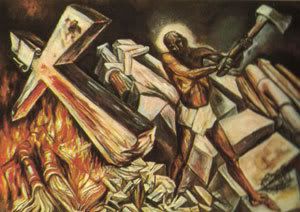
Mural by Jose Clemente Orozco "Christ Destroying
his Cross," 1943

This post comes under the heading of "what I want to tell atheists positively about Jesus." I started it back when I posted that one about Jesus and Dylan. It's based upon my outrage or dismay (I should say) over learning that so many atheists don't admire or respect Jesus as a historical figure. I re-posting it because after reading it again it seems pretty good.It's also in response to the statements by Weekend Fisher.

I have been deeply moved by Mexican muralist José Clemente Orozco's (1883-1949) painting of Jesus chopping down his own cross. The Christ of this mural prostrate is drawn in a very primitive style. Christ is not the Pascal lamb but refuses his destiny and will not go to the cross. The painting is disturbing because the first impression is that of blasphemy. Is the artist mocking Christ? Is he rejecting faith at its most sacred level? Orozco is not trying to blaspheme Jesus, nor is he denying the atonement. I find this painting very moving not our any rejection of Christ’s sacrifice or any desire to defame the doctrine of atonement, but because for me it says Jesus would, weather as the son of God, or if he was only a man in history, refuse to be the poster boy for institutional hypocrisy, Jesus would NOT allow himself to be used as symbol to sanctify the institution as it oppresses the poor and ignores the needs of the people. I believe that the real Jesus of history is both the Son of God and the man of history, and he does refuse this role. The real Jesus was a revolutionary of a most remarkable kind. Often we hear that Jesus is the great ethical teacher, and he claimed to be the Messiah, and savior of the world. We usually understand his ethics as an addendum, something any self respecting son of God would be required to have, but mainly irrelevant to his claims of godhood. Jesus ethics were far from being an addendum, however, they were the weaponry and major battle tactics of his amazing revolution. Politics and religion were intertwined in first century Hebrew society. Jesus’ ethics and his Messianic claims work together to fulfill his ultimate mission of world saving and together they make for one the most unique revolutions in human history.

It is not so strange to think of Jesus as a revolutionary. There were even Priests in Latin America in the 60’s, such as Camillio Tores but joined Che and became gorilla fighters. But Jesus the man of history was a true revolutionary. The region from which Jesus is said to have sprung is known as “the Galilee.” The Galilee was a hot bed of revolution, filled with uprisings and tensions. The Romans regarded it as the seat of Zealotry where the real revolutionaries were based. Just four miles from Jesus’ family farm “Nazareth” is a major metropolis known as Serapes. Just four miles down the road Jesus would have had access to what was then modern sophistication, political unrest and new ideas. Nor did he have to go to India to learn of traditions beyond his native prudential Judaism, the major trade route to India went right by his house,. That route lay on the plain of Megiddo where the end of the world is supposed to take place, the final battle between good and evil. Nazareth overlooks the plain of Megiddo and apparently the battle of Armageddon. All of these influences would have been at work in Jesus upbringing. Not to mention the fact that he was a descendant of David, born in Bethlehem and named as the high priest of Zechariah (Joshua = Jesus) who is linked to the Messiah (Zechariah 4).

Jesus revolution, however, was a bit odd. He did not lead an army nor did he command his followers to fight or pick up weapons. His was a non-violent revolution in the mode of Gandhi and that is where his ethics play a major role in backing his mission. The role of the Messiah in the society of Israel was that of political liberator, but it took on overtones of cosmic proportion. In the book of Isaiah we see the concept of Messiah first begins to be introduced, and is then back read into previous statements such as Moses admonition that “a prophet like me will come” and even God’s word to Eve “I will place enmity between the serpent and your seed.” The Messianic kingdom sketched out at the end of Isaiah is not the millennial kingdom of Christ’s post epochal reign on earth, but Israel after the return from the exile. By the second temple period and the time of Jesus, the concept had grown to almost divine proportions. The Messiah was to stand on the top of the temple and shout “Jerusalem your time at hand” the end of the world would ensue. The Messiah was to rise from the dead all of fallen Israel and for that reason he held the keys of life and death. The Jews did not see the Messiah as world redeemer; they did not see him as atoning sacrifice. These weren't entirely Christian innovations, they were foreshadowed at Qumran. But they weren't mainstream. The Jews certainly did not expect the Messiah to be crucified and raise from the dead.

Jesus was such a radical revolutionary, that is a "strange" different, unconventional one, that when his guys made noises about actually installing him on the throne the ran from them. That's because he knew, as everyone from the Galilee knew, the futility of trying to fight the Romans. The slaughter of the innocents in the book of Luke, is not recorded in history. Atheists are always quick to remind us of this. But it does not have to be recorded to have happened because that kind of thing happened all the time. Even a gathering as innocent as the sermon on the mount risked attack by Romans even though nothing provocative was being said. When they started talking about making Jesus king he slopped away and ran from them. Not because he lost his nerve, but because that would totally divert the people from his true purpose. Jesus has no intention of leading an armed revolt that was the opposite of what he had in mind. neither did he intend to pacify the people to accept pain and hardship with platitudes about pie in the sky. Was his program escapist? Was it just a personal nirvana with no touch stone in reality or responsibility to the world? It was not this ether. It was a practical and pragmatic system fro changing the nature of the world by changing the way people relate to each other. He accomplished this by taking people out of the world while keeping them in it.

In Jesus' system we live by the dictates of a higher citizenship, a world beyond this one ruled entirely by God. This is echoed in the model prayer he taught the disciples "thy kingdom come thy will be don't on earth, as it is in heaven." The device Jesus used for this trick of living by the rules of world while being physically in another, we the kingdom of God. The Kingdom of God was the essence of Jesus' message:


Mt 3:2
and saying, "Repent, for the kingdom of heaven is near."


atheists think Jesus was saying "If you don't believe in me you will go to hell." But he actually never says this. All the action is in the kingdom and the kingdom is the big deal. The coming of the kingdom Jesus makes out to be an immanent, immediate, almost emergency status event that will happen soon, and when it does, man is it a big thing!

Mt 4:17
From that time on Jesus began to preach, "Repent, for the kingdom of heaven is near."

Mt 4:23
Jesus went throughout Galilee, teaching in their synagogues, preaching the good news of the kingdom, and healing every disease and sickness among the people.

Mr 1:15 - Show Context
"The time has come," he said. "The kingdom of God is near. Repent and believe the good news!"


He never says the Kingdom is reward becasue you had the good sense to believe on him, but he does speak as though its the answer to all our troubles:


Mt 5:3
"Blessed are the poor in spirit, for theirs is the kingdom of heaven.

Mt 5:10
Blessed are those who are persecuted because of righteousness, for theirs is the kingdom of heaven.


Most revolutionaries come to abolish the standing order, not impose a kingdom, one kingdom over another.It is within this context that he talks about the ethics and personal relationships and how to relate to people. This is not just some ad-on that's in addition to believing the right things, nor is it unrelated, but it is an outgrowth, a logical extension, one is the basis of the other. The Kingdom is coming. It's power is already here. We can be part of it now, because it has two aspects. This is "realized Eschatology" which was developed by the theologian C.H.Dodd; the kingdom has an "already" dimension" and a "not yet" dimension. We live in the kingdom now even as we are in the world. How we treat each other is an integral aspect of the kingdom.


Mt 5:20
For I tell you that unless your righteousness surpasses that of the Pharisees and the teachers of the law, you will certainly not enter the kingdom of heaven.


Mt 7:21 - Show Context
"Not everyone who says to me, 'Lord, Lord,' will enter the kingdom of heaven, but only he who does the will of my Father who is in heaven.


Jesus ethical and moral teachings may be the greatest ever recorded, of course that's a biased and culturally bound appraisal. But they are certainly among the greatest, and the leaders and theologians of other world religions laud him for his teachings and many of them try to claim him as their own; the Muslims, The Hindu, and the B'Hai. Yet is was not the originality of his moral thinking that makes him great; the Stoics and others said many of the same things. And yet there are certain factors which do make Jesus' teachings unique and worthy of particular attention above and beyond that of most if not all ethical teachers...

Let's use a crash course in Jesus' ethics as a means of understanding his values:

Beatitudes

The "beatitudes" that Jesus speaks in the Sermon on the mount indicate the value system out of which he worked. Blessed means "happy" but he is saying more than "happy are the peacemakers." In pronouncing them blessed he is saying basically 'these are the good guys' and indicates a natural Tao working through the divine economy to protect and vindicate those who live by such values. "Blessed are the poor in spirit for theirs is the kingdom of heaven; blessed are those who mourn for they shall be comforted;...meek will inherit the earth...those who hunger and thirst after righteousness for they will be filled...merciful shown mercy...pure in heart will see God...peacemakers called sons of God...those persecuted for righteousness for theirs is the kingdom of heave." (Matt.5:3-10)

This is the way, this is how to be, these are the values one should hold. This is basically what he is saying. Essentially these qualities are those of a righteous person, they are oriented around God as the primary value and love for the neighbor as the main manifestation of love for God. To mourn probably means repenting for the evil we have done, or at least being able to empathize with other, to care about the pain others. "poor in spirit" refers to real poor people made more explicit in Luke, but the poor in the Bible are the righteous poor who trust in God for their sustenance.

prioritize: Seek Ye first the Kingdom of God...

"Do not be anxious saying 'what shall we eat?' 'what shall we drink?' 'what shall we wear?' The Gentiles seek all fo these things and your heavnly Father knows that you need them all, but seek first his kingdom and his riaghteousness, and all these will be added unto you..." (Matt. 5:28-33)

prime directive: Golden Rule

"Do unto others as you would have them do unto you." ..Other religions, probably all, have similar injunctions, but I have not found has this qualifier making it a self-reflexive command.


Self-Reflexive nature

By placing the command in terms of one's own standard of well being, the command becomes an exhortation to "love the neighbor as you love yourself." No higher standard could be given, one does to himself only that which he/she most desires to be done. By placing the command in these terms one cannot refuse to come to the aid of anyone in need. We would all prefer that others come to our aid. If the command were stated negatively, "do not do unto others that which you would not have done to yourself" one could ignore the neighbor in need. If the command stopped at merely loving the enemy or the neighbor one could refuse to help. By placing it in these self reflexive terms it is made active. One must go out of his way to seek out the needy.

b) Categorical Imperative.

Kant's great ethical system the categorical imperative was based on the Golden Rule of Jesus.

3) Love for Enemies

If you love those who love and hate those who hate you even the Gentiles do that, but I say unto you love your enemies, pray for those who persecute you

matt 5-6....

4) Greatest commandment

Matt 22:35. "and one of them, a lawgiver, ask him a question to test him, 'teacher what is the greatest commandment?' ...37 "and he said to him ye shall love the Lord you God with all your heart, with all your soul and with all your mind. This is the great and first command,and the second is like it, You shall love your neighbor as yourself. On these two commands depend the law and the prophets." (RSV).

Note: All legal regulations and striving of law keeping are summed up in love of God and love of neighbor. This shows that Jesus' ethics surpass the rule keeping stage and ascend to the highest level of conceptual morality, that of the ideal stage where actions are motivated by internalized principles. Moreover, by basing the second command upon love for the neighbor, but relating to love for self, it forms it's own second version of the categorical imperative. Note also if we love our neighbor as ourselves we are commanded to love ourselves, to rectify the self image in relation to reciprocal nature with others. At the same time, we cannot get off the hook by loving enemies any less (since even enemies are neighbors). Thus the will for the good of the other is indexed by our own will for our own good.

Psychological Motivations

Great Compassion


The compassion of Jesus can be seen in many of the stories. The woman caught in the act of adultery is taken before him and the mob wants to stone her. She has broken the law, she is worthy of death (accordion to that culture and that time). Jesus stoops and writes in the sand. We don't know what he wrote, but perhaps it was the names of those in the mob who had slept with her (they weren't being accused). He says "let he who is without sin cast the first stone..." There is the compassion he exhibited to the many people who implored him for healing, and he never refused anyone.We forget anyone else would have been running from those lepers and demoniac that he healed. The demoniac were dangerous, and the leapers thought contagious. But the also demonstrates a total lack of hypocrisy in being unafraid to associate with those who needed him most. When he was criticized for being in the company of drunkards and prostitutes; he merely made fun of the prudes and said, in affect "well, I didn't come to help those who are so well off (the self righteous people) but those who know they need help" There is no way to capture the greatness of Christ's compassion and moral teachings in one of these sub points, but I urge you to get a Bible and read the Gospels over and over, and with an open heart and you will see no greater compassion than that of Jesus Christ, and that of course is culminated in his sacrifice on the cross for our sins.

Greatest Sacrifice

He did lay down his life for the sins of the world. "Greater love hath no man than to give up his life for a friend," yet Jesus' died for everyone; and his own understanding of what he was doing was that he laid down his life as a "ransom for many." But it seems unlikely that his followers would enlarge upon his mission to this extent. Perhaps they could have enlarged upon his death o include the mission to Israel and it was Paul who expanded it to the rest of the world. But there is great likelihood that he understood himself to be doing something beneficial for all humanity. After all it was not Pauline Theology but the understanding of the Beloved Disciple of the fourth Gospel who puts into Jesus mouth the statement "for God so loved the world that he gave his only begotten son that whosoever believes on him should not perish but have everlasting life."


Living as though we were in the kingdom now is the most radical move of any revolutionary program. We don't need to hurt anyone, we don't need to fight anyone. ;We just treat people the way God wants us to treat them, out of love. Over time like the mustard seed int he parable he told, the kingdom will grow into a mighty tree that will shade the world. Of course that brings up a sore spot. Some might suggest that has not happened. Others might suggest are still working on it. I think it's worked out much better than skeptical types are willing to admit. Of course the problem is the quasi religious types who think they can manipulate the truth for their devices, and the legalistic types who think they have to kiss up the quasi religious types or they aren't religious enough. While there's a long way to go we need to be cognizant of the fact that Christianity is more than just a social agenda and plan for living. The Kingdom of God is not just a social club or a political program it's a spiritual reality. What Jesus was offering was not just membership in heaven, but a heaven that starts now on earth and is manifested in the way we treat people.

Saturday, March 20, 2010

Doherty part 6: From Group Leader to Cosmic Christ

Finally, Doherty brings up the lack of suffering in Q sayings:

But the most telling feature of the Q Jesus has proven to be the most perplexing, for he seems to bear no relationship to Paul's. Scholars continue to puzzle over the fact that Q contains no concept of a suffering Jesus, a divinity who has undergone death and resurrection as a redeeming act. Q can make the killing of the prophets a central theme (e.g., Luke 11:49-51) and yet never refer to Jesus' own crucifixion! Its parables contain no hint of the murder of the Son of God.

Yet it is not sure that Q doesn't refer to Jesus' suffering or death. Suffering and death are implied all over Q as David Seely ("Jesus Death in Q") tells us (see page 4). Death is frame by cynical view point that reflects the current events through the lives of the prophets of the past. That would be a good reason why the Q saying source does not refer one.

(Doherty goes on) "About the resurrection, Q breathes not a whisper. Jesus makes no prophecies of his own death and rising, as he does in other parts of the Gospels. Note that in a Q passage in Luke 17, the evangelist has to insert into Jesus' mouth a prophecy of his own death (verse 25); it is not in Matthew's use of the same passage" (24:23f).

Of course these scholars make an arbitrary assumption that the saying is placed in Jesus' mouth just Matt didn't use it. The idea that there is no resurrection in Q is not in line with the view of James M. Robinson, who is certainly a much more renown Q scholar than is Doherty:

The Real Jesus of the Sayings "Q" Gospel

by James M. Robinson

James M. Robinson is the Arthur J. Letts Professor of Religion and Director of the Institute for Antiquity and Christianity at the Claremont Graduate School and Co-chair of the International Q Project.

Religion online

Although the Sayings Gospel has no passion narrative or resurrection stories, this omission does not necessarily lead to the conclusion that the Q people knew nothing of Jesus' fate or had never thought about where it left them. It is hardly probable that his death was not quickly rumored among his followers, even into the most obscure corners of Galilee. But then, after his death, was not the only sensible thing to do, to give up the whole thing as some tragic miscalculation, a terrible failure? Jesus had assured them, "the Father from heaven gives good things to those who ask him," and yet his last word according to Mark was "My God, My God, why have you left me in the lurch?" (Mark 15:34). What was there left to proclaim?

The emergence of the Sayings Gospel was, to put it quite pointedly, itself the miracle at Easter! Rudolf Bultmann formulated a famous, or infamous saying to the effect that Jesus rose into the kerygma. But perhaps we would do better to say: Jesus rose into his own word. The resurrection was attested, in substance at least, in the Q community, in that his word was again to be heard, not as a melancholy recollection of the failed dream of a noble, but terribly naive, person, but rather as the still valid, and constantly renewed, trust in the heavenly Father, who, as in heaven, will rule also on earth.

There are a few sayings in Q that are best understood in terms of such a "resurrection" faith. "What I say to you in the darkness, speak out in the light; and what you hear whispered into your ear, preach from the rooftops" (Q 12:3/Matt. 10:27). This sounds as if Jesus had rather secretively only whispered his message and left the spreading of the good word to his disciples. We would have expected it to be just the reverse. Surely Jesus said it better, louder, and clearer than anyone! But perhaps such a saying reflects the recollection that his message was suppressed by force and thus obscured but then became all the brighter and louder as it was nevertheless revalidated and reproclaimed.

Q is that material which is shared by Matthew and Luke and not by Mark. But the tomb and the cross are in all four Gospels, so ex hypothesis we must regard them as not in Q. The fact is they may well have been part of Q. They are by definition not Q simply because they are shared by all four Gospels. Since we don't have a copy of Q there's no way to know. At this point scholars weed out connections between early Q and Messiahood by arbitrary and circular means. Speaking of that, Doherty has gone a long way on sheer conjecture about the contents of a document the existence of which we can't even begin to verify. Now I'm a liberal and I'm a good sport Q wise. I think there probably was a Q document, in fact I'm inclined to think it was Matthew's "Logia."

Doherty continues:

Most startling of all, the Jesus of Q has no obvious significance for salvation. Apart from the benefits accruing from the teachings themselves, scholars admit that there is no soteriology in Q, certainly nothing about an atoning death for sin. The "Son who knows the Father" (Luke 10:22, a late saying recast from an earlier Wisdom saying) functions as a mediator of God's revelation—simply personifying what the Q community itself does. The Gospel of Thomas is similarly devoid of any reference to Jesus' death and resurrection.

Funny he should mention the Gospel of Thomas. Soteriological implications are all over Q and they are not hard to find. But be that as it may, Thomas is looked to as a backing for Q in many ways, it supposedly implies that the saying source was a prior form of the narrative Gospel, and it uses many Q sayings. But in Thomas there are clear statements of Soteriological value, and of the deity of Christ:

saying no.28: Jesus said, "I took my stand in the midst of the world, and in flesh I appeared to them. I found them all drunk, and I did not find any of them thirsty. My soul ached for the children of humanity, because they are blind in their hearts and do not see, for they came into the world empty, and they also seek to depart from the world empty. But meanwhile they are drunk. When they shake off their wine, then they will change their ways."

In terms of Q's soeteriology, or alleged lack thereof, Doherty has simplified the issues. It is not true that Q has no Soeteriology, it more the case that the Soteriology of Q is not Pauline and is very Jewish, very law oriented, so says John Kloppenborg, the scholar who first began the emphasis on Q's lack of a cross or a tomb (see Formation of Q 1987). In terms of Soeteriology we know that the early church was confused. Jesus was not a system builder, he was concerned with modeling behavior and with impressing upon people how to live a godly life. God drafted Paul to be the first systematic Christian theologian, that's why he wrote so much of the NT. So it was Paul who sorted out what it all meant and how all the pieces fit and there's nothing wrong with that. As Christians we should just accept that God chose to do it that way. But the issue in terms of Q is how much of Q do we have? Do we have all the pieces in Matt and Luke? Kloppenborg argues that we do because Matt uses all of Mark so why wouldn't he use all of Q. But he can only rest on that answer if we can be sure that Matt always used every source the same way; Mark was a narrative and Q a saying list.

Dennis Ingolfsland

Journal of the Evangelical Theological Society,
Jun 2003

Kloppenborg's stratification of Q
and its significance for
historical Jesus studies

The second reason Kloppenborg cites for believing that virtually all of Q can be recovered is Kilpatrick's argument that the disappearance of Q was explicable only on the assumption that it was almost completely absorbed in Matthew and Luke.27 Some have objected, however, that by this logic Mark might have been expected to disappear also, since virtually all of Mark is included in Matthew. In Excavating Q, Kloppenborg responds to this objection by citing Luhrmann who proposed that Mark's survival and Q's disappearance are simply accidents of history in that Mark's Gospel happened to be carried to Egypt where it was copied and Q was not. Moreover, responding to Dunn who argued that Q may have disappeared for theological reasons, Kloppenborg writes, "In fact we do not know why Q disappeared."28

Kloppenborg is right, of course, but he seems unaware that in arguing that Q's disappearance may have been an accident of history and by admitting that we frankly do not know why Q disappeared, he has contradicted one of his own primary reasons for assuming that we know the extent of Q, that is, that the disappearance of Q "was explicable only on the assumption that it was almost completely absorbed in Matthew and Luke."29 Therefore, the main reasons Kloppenborg proposes for assuming that virtually all of Q can be reconstructed have been successfully refuted by his own arguments.

At this stage he returns to his bread and butter, spinning moonbeams about Paul.

How is this radical divergence between Paul and Q explained? It shows, say the scholars, the differing responses by different circles to the man Jesus of Nazareth. But they founder when they try to rationalize how such a strange phenomenon could have been possible. Besides, the documents reveal many more "responses" than just two. We are to believe that early Christianity was wildly schizophrenic. First Paul and other epistle writers abandoned all interest in the earthly life and identity of Jesus, turning him into a cosmic Christ who created the world and redeemed it by his death and resurrection. The Q community, along with that of the Gospel of Thomas, on the other hand, decided to ignore that death and resurrection and preserve the earthly teaching Jesus, a preacher of the coming end of the world.

Doherty contradicted by Koester, again

Of course that little fantasy is dispelled by my list, which I take from Helmutt Koester, that shows Paul's deep dependence upon Gospel sayings. It's a total myth to assume that he never quotes a Q saying. Yes Doherty tries to say that Paul never quotes Q, but the man he uses as an authority, Helmutt Koester, says Paul quotes Q quite a bit and that Q was widespread.

Helmut Koester comments on the provenance of Q (Ancient Christian Gospels, p. 164):

"Even the sayings used for the original composition of Q were known and used elsewhere at an early date: they were known to Paul, were used in Corinth by his opponents, employed perhaps in eastern Syria for the composition of the Gospel of Thomas, and quoted by 1 Clement in Rome at the end of the 1st century. The document itself, in its final redacted form, was used for the composition of two gospel writings, Matthew and Luke, which both originated in the Greek-speaking church outside of Palestine."

Koster latter theorizes that Paul had the Q saying source with him and this is what he calls "my Gospel." It's equally foolish to assume that he doesn't mention the cross or resurrection. Of course because he doesn't anticipate Doherty 2000 years latter and say "O by the way, this was in real flesh and blood on earth in history" then he couldn't have believed it? That's where Doherty wins his fan base, by appealing to the Christ haters who want to destroy Christianity and the mythers who care nothing for facts of reality. By appealing to those who love to fill the cracks in knowledge with their dreams.

view this as a nice chart (scroll down)

Just a small part of the list linked to above:
The last supper (1 Cor 11:23ff)
Confessed his Messiahship before Pilate (1 Tim 6:13)
Died for peoples' sins (Rom 4:25, 1 Tim 2:6)
He was killed (1 Cor 15:3, Phil 2:8)
Buried (1 Cor 15:4)
Empty tomb is implied (1 Cor 15:4)
Jesus was raised from the dead (2 Tim 2:8)
Resurrected Jesus appeared to people (1 Cor 15:4ff)
James, a former skeptics, witnessed this (1 Cor 15:7)
as did Paul (1 Cor 15:8-9)
This was reported at an early date (1 Cor 15:4-8)
He ascended to heaven, glorified and exalted (1 Tim 3:16, Phil 2:6f)
Disciples were transformed by this (1 Tim 3:16)
Disciples made the Gospel center of preaching (1 Cor 15:1-4)
Resurrection was chief validation of message

We see that Paul does quote Q and he does refer to crucifixion, resurrection, and even soteriology. He makes all sorts of references which Doherty denies, to Jesus blood line, his life on earth, alludes to the empty tomb, to his crucifixion to his Messiahship. On the next page I will examine more closely Doherty's allegations about the contents of Q and Pauline theology vis, alleged Gnosticism. I will argue that the theology is very Jewish not Gnostic.

Friday, March 12, 2010

Part 3 Refutting Doherty's Evolution of Jesus: The Ancient Tradition of the Cross and the Tomb

Doherty says:

"Only in Justin Martyr, writing in the 150s, do we find the first identifiable quotations from some of the Gospels, though he calls them simply "memoirs of the Apostles," with no names." This is already been disproved. I've already pointed out quotations and allusions in all the major Apostolic fathers, in Paul and in pre Mark Redaction. Doherty seems mainly to be carping on the fact that no one sties chapter and verse, as though he doesn't know they didn't write in chapters and verses.

Doherty evokes Koster, but as we see with the myther penchant for quoting Cumont, it's clear he has not read Koster closely enough:

"Scholars such as Helmut Koester have concluded that earlier "allusions" to Gospel-like material are likely floating traditions which themselves found their way into the written Gospels. (See Koester's Ancient Christian Gospels and his earlier Synoptische Uberlieferung bei den apostolischen Vatern.) Is it conceivable that the earliest account of Jesus' life and death could have been committed to writing as early as 70 (or even earlier, as some would like to have it), and yet the broader Christian world took almost a century to receive copies of it?"

But what does Koester really say? Here he speaks of how Papyrus Egerton 2 indicates an independent tradition, but that tradition is common with the canonical material and the cross and tomb are part of that tradition.

Koster:

"There are two solutions that are equally improbable. It is unlikely that the pericope in Egerton 2 is an independent older tradition. It is equally hard to imagine that anyone would have deliberately composed this apophthegma by selecting sentences from three different Gospel writings. There are no analogies to this kind of Gospel composition because this pericope is neither a harmony of parallels from different Gospels, nor is it a florogelium. If one wants to uphold the hypothesis of dependence upon written Gospels one would have to assume that the pericope was written form memory....What is decisive is that there is nothing in the pericope that reveals redactional features of any of the Gospels that parallels appear. The author of Papyrus Egerton 2 uses independent building blocks of sayings for the composition of this dialogue none of the blocks have been formed by the literary activity of any previous Gospel writer. If Papyrus Egerton 2 is not dependent upon the Fourth Gospel it is an important witness to an earlier stage of development of the dialogues of the fourth Gospel....(Koester , 3.2 p.215)

But that earlier stage, and therefore the independent tradition is independent in that it is not merely copied form the canonical Gospels, but it does stand behind them as part of the material upon which they draw. But that material included almost word for word what is the canonicals, this table is but two examples presented by Koster:

Egerton 2: "And behold a leper came to him and said "Master Jesus, wandering with lepers and eating with them in the inn, I therefore became a leper. If you will I shall be clean. Accordingly the Lord said to him "I will, be clean" and immediately the leprosy left him.

Mark 1:40: And the leper came to him and beseeching him said '[master?] if you will you can make me clean. And he stretched out his hands and touched him and said "I will be clean" and immediately the leprosy left him.

Egerton 2: "tell us is it permitted to give to Kings what pertains to their rule? Tell us, should we give it? But Jesus knowing their intentions got angry and said "why do you call me teacher with your mouth and do not what I say"?

Mark 12:13-15: Is it permitted to pay taxes to Caesar or not? Should we pay them or not? But knowing their hypocrisy he said to them "why do you put me to the test, show me the coin?"
(all of that looks better in the chart on Doxa, in fact this whole pages does--scroll down).


As we can see these are the same stories, they are in a slightly different form, older (according to Koster) than those found in the canonicals, but basically the same stories. If we must assume that the tradition was a whole, why would the Orthodox just barrow from certain stories of a tradition that was totally alien to their view? The tradition as a whole must have included the cross and the tomb, and the textual evidence shows that these elements are part of the PMR and are as old as the writing itself.

Gospel of Peter

Fragments of the Gospel of Peter were found in 1886 /87 in Akhimim, upper Egypt. These fragments were from the 8th or 9th century. No other fragment was found for a long time until one turned up at Oxyrahynchus, which were written in 200 AD. Bishop Serapion of Antioch made the statement prior to 200 that a Gospel had been put forward in the name of Peter. This statement is preserved by Eusebius who places Serapion around 180. But the Akhimim fragment contains three pericopes. The Resurrection, to which the guards at the tomb are witnesses, the empty tomb, or which the women are witnesses, and an epiphany of Jesus appearing to Peter and the 12, which end the book abruptly.

Many features of the Gospel of Peter are clearly from secondary sources, that is reworked versions of the canonical story. These mainly consist of 1) exaggerated miracles; 2) anti-Jewish polemic. The cross follows Jesus out of the tomb, a voice from heaven says "did you preach the gospel to all?" The cross says "Yea." And Pilate is totally exonerated, the Jews are blamed for the crucifixion. (Koester, p.218). However, "there are other traces in the Gospel of Peter which demonstrate an old and independent tradition." The way the suffering of Jesus is described by the use of passages from the old Testament without quotation formulae is, in terms of the tradition, older than the explicit scriptural proof; it represents the oldest form of the passion of Jesus. (Philipp Vielhauer, Geschichte, 646] Jurgen Denker argues that the Gospel of Peter shares this tradition of OT quotation with the Canonicals but is not dependent upon them. (In Koester p.218) Koester writes, "John Dominic Crosson has gone further [than Denker]...he argues that this activity results in the composition of a literary document at a very early date i.e. in the middle of the First century CE" (Ibid). Said another way, the interpretation of Scripture as the formation of the passion narrative became an independent document, a ur-Gospel, as early as the middle of the first century!

Corosson's Cross Gospel is this material in the Gospel of Peter through which, with the canonicals and other non-canonical Gospels Crosson constructs a whole text. According to the theory, the earliest of all written passion narratives is given in this material, is used by Mark, Luke, Matthew, and by John, and also Peter. Peter becomes a very important 5th witness. Koester may not be as famous as Crosson but he is just as expert and just as liberal. He takes issue with Crosson on three counts:

1) no extant text, its all coming form a late copy of Peter,
2) it assumes the literary composition of latter Gospels can be understood to relate to the compositions of earlier ones;
3) Koester believes that the account ends with the empty tomb and has independent sources for the epihanal material.

Koester:

"A third problem regarding Crossan's hypotheses is related specifically to the formation of reports about Jesus' trial, suffering death, burial, and resurrection. The account of the passion of Jesus must have developed quite early because it is one and the same account that was used by Mark (and subsequently Matthew and Luke) and John and as will be argued below by the Gospel of Peter. However except for the appearances of Jesus after his resurrection in the various gospels cannot derive from a single source, they are independent of one another. Each of the authors of the extant gospels and of their secondary endings drew these epiphany stories from their own particular tradition, not form a common source." (Koester, p. 220)

"Studies of the passion narrative have shown that all gospels were dependent upon one and the same basic account of the suffering, crucifixion, death and burial of Jesus. But this account ended with the discovery of the empty tomb. With respect to the stories of Jesus' appearances, each of the extant gospels of the canon used different traditions of epiphany stories which they appended to the one canon passion account. This also applies to the Gospel of Peter. There is no reason to assume that any of the epiphany stories at the end of the gospel derive from the same source on which the account of the passion is based." (Ibid)

What this means is that the individual sittings of Jesus at the end of the Gospels came from different sources, were perhaps embellishments, but the basic story, the basic tradition from which all the other sources, canonicals, Peter, Thomas, Q, Egerton 2 all of them derive, included the cross and the tomb.

Raymond Brown, in Death of the Messiah demonstrates brilliantly that the story of the guards on the tomb as reported in Peter is not derived from Matthew, but is an independent tradition, perhaps as old or older. He demonstrates the independence of Peter's Passion narrative and tomb sequences in a huge and brilliantly constructed chart, which cannot be reproduced here, but which is elaborate. He uses the same argument that Koester uses above, not one forged s a document or redacts or copies a document by taking every other word. When one finds this kind of divergence in the working is indicates a separate tradition.

GPet follow the classical flow from trail through crucifixion to burial to tomb presumably with post resurrectional appearances to follow. The GPet sequence of individual episodes, however, is not the same as that of any can canonical Gospel...When one looks at the overall sequence in the 23 items I listed in table 10, it would take very great imagination to picture the author of GPet studying Matthew carefully, deliberately shifting episodes around and copying in episodes form Luke and John to produce the present sequence. [Brown, Death of the Messiah, 1322]

This work Brown did upon the independent tradition of GPet was the work that made his initial reputation as a major scholar.

Gospel of the Hebrews

We do not possess any copies of this work. It exists only in quotations from church fathers, but that's the similar situation with Q as well. GHebrews includes the atonement and the resurrection, and the tradition is independent of the canonicals and is traced to mid fist century. This gives us several sources that show a pre Mark tradition not derived from the canonical Gospels that is at least as old as the hypothetical tradition to which Doherty alludes; it contains Jesus, it contains the cross and the tomb:

Peter Kirby:

Early Christian Writings, Gospel of the Hebrews.

Unlike other Jewish-Christian gospels, the Gospel of the Hebrews shows no dependence upon the Gospel of Matthew. The story of the first resurrection appearance to James the Just suggests that the Jewish-Christian community that produced this document claimed James as their founder. It is reasonable to assume that the remainder of the gospel is synoptic in flavor. The Gospel of the Hebrews seems to be independent of the New Testament in the quoted portions; unfortunately, since the gospel is not extant, it is difficult to know whether unquoted portions of the Gospel of the Hebrews might show signs of dependence.

Cameron makes these observations on dating and provenance: "The earliest possible date of the composition of the Gospel of the Hebrews would be in the middle of the first century, when Jesus traditions were first being produced and collected as part of the wisdom tradition. The latest possible date would be in the middle of the second century, shortly before the first reference to this gospel by Hegesippus and the quotations of it by Clement and Origen. Based on the parallels in the morphology of the tradition, an earlier date of composition is more likely than a later one. Internal evidence and external attestation indicate that Egypt was its place of origin."

Brief note on Gospel of Thomas

Peter Kirby gives a good summary of the ms attestation of Thomas:

The Gospel of Thomas is extant in three Greek fragments and one Coptic manuscript. The Greek fragments are P. Oxy. 654, which corresponds to the prologue and sayings 1-7 of the Gospel of Thomas; P. Oxy. 1, which corresponds to the Gospel of Thomas 26-30, 77.2, 31-33; and P. Oxy. 655, which corresponds to the Gospel of Thomas 24 and 36-39. P. Oxy 1 is dated shortly after 200 CE for paleographical reasons, and the other two Greek fragments are estimated to have been written in the mid third century. The Coptic text was written shortly before the year 350 CE.

Even though scholars date the actual MS to the third or fourth century, a large camp of scholars, including those who discovered Thomas, date the actual writing in middle first century. Does this work indicate a separate tradition growing up along side the canonical Gospels, a tradition that lacked the cross and the empty tomb? It does constitute a MS tradition that is not derived from the canonical Gospels, but that is not proof of "another" Church that lacked the atonement or the resurrection as central pillars of its testimony to Jesus. What it proves is that by the time these sources manifest themselves as second century or later Gnostic "other Gospels" they are minus those elements because the Gnostics would allow them to slip out. First, piece of proof on this point, GThom was heavily redacted. In fact we possess it four separate versions:

Ron Cameron (The Anchor Bible Dictionary, v. 6, p. 535):

Substantial differences do exist between the Greek fragments and the Coptic text. These are best explained as variants resulting from the circulation of more than one Greek edition of Gos. Thom. in antiquity. The existence of three different copies of the Greek text of Gos. Thom. does give evidence of rather frequent copying of this gospel in the 3d century. According to the critical edition of the Greek text by Attridge (in Layton 1989: 99), however, even though these copies do not come from a single ms, the fragmentary state of the papyri does not permit one to determine whether any of the mss "was copied from one another, whether they derive independently from a single archetype, or whether they represent distinct recensions." It is clear, nevertheless, that Gos. Thom. was subject to redaction as it was transmitted. The presence of inner-Coptic errors in the sole surviving translation, moreover, suggests that our present Gos. Thom. is not the first Coptic transcription made from the Greek. The ms tradition indicates that this gospel was appropriated again and again in the generations following its composition. Like many other gospels in the first three centuries, the text of Gos. Thom. must be regarded as unstable.

It would seem that the tradition of the Gospel of Thomas is varied and the text has been through several redactions.

Arguing Thomas' independence from the Synoptics Stephen J. Patterson (quoted by Kirby) compares the wording of each saying in Thomas to its synoptic counterpart with the conclusion that Thomas represents an autonomous stream of tradition (The Gospel of Thomas and Jesus, p. 18):

Patterson (quoted by Kirby): If Thomas were dependent upon the synoptic gospels, it would be possible to detect in the case of every Thomas-synoptic parallel the same tradition-historical development behind both the Thomas version of the saying and one or more of the synoptic versions. That is, Thomas' author/editor, in taking up the synoptic version, would have inherited all of the accumulated tradition-historical baggage owned by the synoptic text, and then added to it his or her own redactional twist. In the following texts this is not the case. Rather than reflecting the same tradition-historical development that stands behind their synoptic counterparts, these Thomas sayings seem to be the product of a tradition-history which, though exhibiting the same tendencies operative within the synoptic tradition, is in its own specific details quite unique. This means, of course, that these sayings are not dependent upon their synoptic counterparts, but rather derive from a parallel and separate tradition.

That proves that GThom was independent, that it was not derived by copying the canonicals, but it doesn't prove that saying pertaining to the Cross and the Tomb weren't just left out. Cameron argues that he can prove this:

Cameron (537) quoted by Kirby: Those who argue that Gos. Thom. is dependent on the Synoptics not only must explain the differences in wording and order, but also give a reason for Gos. Thom.'s choice of genre and the absence of the gospels' narrative material in the text. To assert, for example, that Gos. Thom. erased the passion narratives because Gnosticism was concerned solely with a redeeming message contained in words of revelation (Haenchen 1961: 11) is simply not convincing, since the Apocryphon of James (NHC I, 2), the Second treatise of the Great Seth (NHC VII, 2), and the Apocalypse of Peter (NHC VII, 3) all indicate that sayings of and stories about the death and resurrection of Jesus were reinterpreted by various Gnostic groups. For any theory of dependence of Gos. Thom. on the NT to be made plausible, one must show that the variations in form and content of their individual sayings, together with the differences in genre and structure of their entire texts, are intentional modifications of their respective parallels, designed to serve a particular purpose.

This last criterion that Cameron lays down, that "the variations in form and content of their individual sayings, together with differences in genre and structure of their entire texts, are intentional modifications of their respective parallels, designed to serve a particular purpose," why is it necessary to show that? All they had to do was leave out the bits about the cross and the resurrection. If we assume that both canonicals and GThom have a common ancestor, some group or body of sayings that they both draw from, that's pretty obvious, or there would not be such parallels, the Gnostic use of that tradition could very as greatly as just leaving out the key expressions of doctrines hey no longer included in their tradition. There are numerous parallels not only between GThom and canonicals, but E2 and the canonicals. So it's clear that these "other gospels" drew upon the same parent sources, since it is equally clear that they did not just copy the canonicals. This might indicate that the groups producing Q, Thomas and E 2 did not use sayings pertaining to the cross and the resurrection. There is evidence that they had traditions that hinted at them, and the heavy redaction might indicate purging of such sayings. Let us not forget we are dealing with sayings and not narrative. Talk of context is not the same as if we were dealing with the expunging of a part of the plot in a narrative structure. All they have to do is leave out certain sayings. There are hints this may have been done. We can see from the chart above (parallels between E2 and John) that there are passes that deal with arresting Jesus and doing violence to him. That opens the door to the possibility that cross sayings have been expunged from the overall tradition.

Let us just assume for a moment that Doherty's hypothetical case is true and there was a Q community that is also represented in general by other words, such as E2 and GThom. The overall tradition must have at one time included some references to arrest and violence toward Jesus. Thus I am arguing two things:

(1) the door is open through the heavily redacted nature of the ms to have expunged sayings not in harmony with group ideology, at some later point of transmission after the composition of the individual works. if not


(2) good indications exist that some notion of Jesus being arrested and killed existed in the general tradition and were merely not included, either left out of these individual works (Q, E2, GThom) or they fell out before the composition of these works.

As to the argument that other Gnostics deal with the cross and the tomb, so why not these? The reason for that might be because those other works were not part of the early tradition. If these sources under discussion emerged form the mid first century, the other works Cameron mentions (Apocryphon of James, Seth literature from Nag Hammadi) were much latter works. The latter came form after the Orthodox church was more pervasive and the passion and resurrection were undisputed; those events had gained so much ground in the story they could not be ignored. In the early days, the mid firs century, groups that looked down upon the flesh and deemphasized or were embarrassed by those events merely left them out and stopped dealing with them at some point. So they were either expunged from the parent sources that E2 and GThom used, (meaning the source itself was reshaped to exclude them) or they just weren't included in latter copies from which these latter were produced. At that point, only 18 years after the original events, in the groups of the original community, eye witnesses would still be alive to correct error, but in rough groups breaking off or in groups scattered far away (Egypt, Antioch) they would have been able to de-emphasize the cross at that time. Basically we need more information before we really know what the infant church taught.

Now we must turn Doherty's fantasy of a "Q community" because it is the crux of his whole argument. That is where he develops the idea of this "other tradition" that began as the original infant church.

Aside from all that, the Gospel of Thomas does actually contain a reference to the cross of Christ:

GThom:55: Jesus said: He who does not hate his father and his mother cannot be a disciple to me. And (he who does not) hate his brothers and sisters and take up his cross like me, will not be worthy of me.