Showing posts with label Christian ethics. Show all posts

Tuesday, October 04, 2016

Ethical Naturalism and Value Systems: The Euthyphro Dilemma (part 3,final)


 photo Joseph_Fletcher_zps362f9578.jpg
Joseph Fletcher: Situation Ethics,
episcopal priest, pioneer in bio ethics.


The Euthyphro Dilemma

            Christian values have been assailed by modernity since the enlightenment. One of the major forms that attack takes is through the “Euthyphro dilemma.” This dilemma is aimed at the assumption that the only form of Christian ethics is divine command theory,[1] that God makes something good just because he says it, and his saying is an arbitrary whim. According to Baggett and Walls account of Louise Antony version is “are morally good actions morally Good simply in virtue of the gods favoring them or does God favor them because they are—independently of his favoring them—morally good?[2] Antony replaces “the gods” with “God” indicating that the God of monotheism is her intended target of rhetorical analysis, as Baggett and Walls point out. Yet the dilemma was orinally cast with Greek gods in mind. Bagget and Walls’s take on the dilemma is very detailed and complex, it’s one of the best in recent years. I won’t be going into it with that kind of complexity. The basic upshot of the dilemma is that either God is subject to an independent standard outside himself, and thus he is not God and secular thought might find that standard so we don’t need religion, or morality is just an arbitrary whim on God’s part. Yet the dilemma is based upon the Greek gods not the Christian, and as noted, Antony shifts form the Greek to the God of the Christian tradition with no justification. The Greek gods were continent beings, they had parents they were not eternal they were not the creators. The dilemma really doesn’t apply to the God of the Christian tradition who is eternal and the basis of all that is. That means there’s a closer relationship between the good God than just God’s commands. That connection  closer than divine command theory would have it; it’s not just a matter of “good is what God says it is,” although it is dependent upon God, but not just on his commands.[3]
            The relationship between God and the good is not merely based upon voluntarism, that God demans X therefore is good. Rather, it is that God is the basis of the good. Goodness is God’s character and without God there would be no concept of the good. God depends upon God but not just upon his commands. It’s not merely that there would be no big bully on the block to tell us what is good, but that there would be no good itself because God is the good itself. The good is derived form God’s character and God’s character is love, love is the background of the moral universe (Augustine) and thus goodness is derived form love. That brings up several problems. For example, J.L. Mackie argues that once one affirms the existence of unchangeable moral good then God becomes unnecessary and secular thinkers might find those principles without God.[4] The concept of unchangeable moral good that is detachable form God is an impossibly. It might be that thinkers could come to conclusions that coincide with truths implicit upon God’s character and not know it. That’s hardly the same as saying God is “unnecessary.” If there’s any relation between what’s good and what’s true and if good is based upon God’s character there’s no true ontological separation between those two. In discussions with atheists when I say that morality is based upon love and love is God’s character they usually balk at both aspects of that statement: they figure love is a reaction of chemicals in the brain that just produces little sentimental or romantic feelings, and moral good is derived from behavior not from love. Usually they don’t observe the implicit value that would make a behavior good or bad. There’s more to it than just saying good is based upon God’s character. It’s also a matter of God’s judgment. God’s power, knowledge and goodness underwrite his moral authority.[5]God not only creates all that is, including planning its purpose, but also knows the truth and is the only mind that can figure the complexities of all existing relationships between moral concepts and human behavior, and the only truly objective judge who knows the subjects of moral behavior better than they know themselves, and in addition to all that has the forthrightness and loving concern to explicate moral judgments fairly. When I say “love” is behind the good I don’t mean romantic love or sentimentality but the Greek term agape.  The idea that love is the basis of he good may be a problem for some Christians because there is a concept in the Christian tradition that love and moral goodness are two counterpoising forces that have to keep each other in balance. I suggest that is nonsense if we are talking about Gods’ love, the love that is the basis of God’s character. “Whoever does not love does not know God, for God is love.” (1 John 4:8).


What is the good?


            Agape is used of God’s love through the New Testament. It is translated as “charity” at times.[6] The word is linked with good will and benevolence. The King James translation renders it “charity” (1 Corinthians 13:1). There’s more to it than that. It’s also linked to “preference” to prefer the other. The word is used for the love of God for man and man for God, the love humans for each other, and the love of God for Christ.[7] Agape is the basis of the good. What is good evaluated as what is agapic (loving). Other moral precepts and axioms such as justice, fairness and reciprocity would all be meaningful only in relation to agape. In fact one major theological ethicist came to that conclusion back in the 1960s, that was Joseph Fletcher. A lot of Christians were outraged by his view of “situation ethics,” and his book by the same title.[8] It was controversial and it drew lots of fire including the charge of “new morality.” Nevertheless he was a top notch ethicist. Fletcher argues that love and justice are the same. Justice is the distributive aspect of love.[9] He calls upon Augustine and argues that love must be prudent. He argues that this view forces us to pull back from the notion that love is sentimental and “mushy” and non intellectual. This is the intellectual side of love; today we call it “tough love.” Literally the argument is how do we manae to supply the beneficiaries of love when there are so many? The answer is by turning the problem into a question of justice. We make sure that justice is done at the same time making sure that love is distributed and doing it in such a way that we exclude one for he sake of the other.[10] Thus we can see how the other aspects of moral axioms indeed stem form love. Love is the background of the moral universe.
            Christian ethics certainly revolve around love. The value system that we use to inform that choice is the one through which Augustine re-valued the values of the Roman Empire. That value system plays out upon the eternal scale of values. We love the eternal we use the temporal. Human beings are eternal, created in the image of God, thus each human being is an end in himself/herself. Temporal things are means to ends. Thus temporal things are to be used and put aside but human beings matter. If science was the basis of ethics, nature never tells us that humans are valuable, there would be no basis for valuing humans except the cultural, and that is relative and can be discarded. Ethical naturalists might kid themselves about the alleged “objective basis” for ethics, they sound like persupositionalist Christian apologists trying to explain what that means. Without the arbitrary assumption already built in regarding the value of human worth, without appeal to a transcendent value system such as Christian agape there is no basis that science could ever give us for not using humans and valuing things. One finds scientistic thinkers such as atheists, especially on the popular level, expressing the sentiments that “humans are not so special.” We don’t have souls, there’s no God, we are just bags of chemicals or jumped up apes so why should we think we are special? Steve Paulson is an example from the popular level. Although he has an advanced science degree and works in science, obliquely. He’s a producer for public radio and an author. He expresses the idea that humans are just “cosmopolitan apes.” Again the idea is not to find fault with evolution. We can accept evolution as scientific fact and accept ethics as philosophical fact and accept The Bible as spiritual fact all at the same time and value humanity. Paulson says:

Most assume that humans are fundamentally different form the rest of the animal world…many people believe that but to biologists we are animals. It’s hard to believe that we are fundamentally different because there is no part of the human brain that is not present in the monkey’s brain. Our brains are bigger and we certainly have more powerful computer than any other animal, but the computer is not fundamentally different. So there’s no fundamental divide between humans and Chimpanzees? no…if you were to ask what the big difference is I would probably say it’s language but like all capacities once you break them down you are going to find some of these part sin other species.[11]

He argues that chimps have morality, “they have a sense of fairness.” Is it really a concept of fairness or just behavior would be fair if they really understood it, but perhaps they don’t? He finds that chimps respond to the needs of others, they seem to share food with those who don’t have enough. Is this really ethical thinking or just a instinctive sense of love that might pervade all creatures? He’s talking about cooperation in hunting. That’s not proof that they value each other. It could just be a practical matter that helps them all. It is evidence of outcome oriented thinking that doesn’t necessarily recognize a moral dimension but a practical survival dimension. Isn’t that what Harris and Churchland and Wilson are reducing ethics to?
            More examination of how this thinking plays out at the popular level, even though this is not scientific, we find bloggers expressed some odd sentiments. The blog “Think Atheist” urges that we should be “ridding ourselves of humanities self centrality: The Importance of Inclusively.”[12]


Humanity thought the universe spun around the Earth as if it were the purpose of the universe. Likewise, the sun.

Another way we think we are special is amongst the rest of the life forms on the planet. We like to believe that there are animals... and there are humans. We seem to have a hard time admitting to ourselves that we are animals. But we are. I'd like to take this idea one step further though. We are all LIFE. We are all BIOLOGY. And the separations between us that seem so important, identifiable and distinctive. Are actually not all that different in the end. All life on this planet evolved IS RELATED. FAMILY. By quantifiable amounts. 99% of our DNA is that of a chimpanzees and 50% of our DNA is that of a banana. ALL LIFE is CLOSELY related. We all come from the same place and we're all going in the same direction. We are procreating and spreading the seed of life, adapting to new environments by all means necessary, even if we must evolve.[13]

If we are animals and we are life and we are no better than any other animals or life would it really matter if we don’t get the quinine to the children dying of malaria? After all there’s lots more life where that life comes from and no one is special. Or that we have to allow dying or even killing off some group so the rest will have more to go around? After all a good outcome is all that matters, we are not special so we can be a means to an end. How are they going to decide this in the clash of such values? Neither the nature from which they take their ethical axioms, nor the science they prize so highly tells us to value humanity or to make humans ends in themselves. How will they resolve such conflicts?            
            These ideas can be put into a positive version. Yet if we assume that we are now coasting on Christian memories and the culture has lots of ideas left over from a time when we valued humanity, what’s going to happen in a couple of generations when those ideas are all gone and we are just seen as “some examples of life among other life,” no better than any other animal and not more than a means to an end; the end being an outcome considered “moral” by those who don’t see a difference in marmoset values and human values. Out come is not totally divorced from deontology. Just because a deontologist doesn’t use outcome as the basis for ethical “ought” doesn’t mean we don’t care about having good outcomes. It seems that if there is no ethical deliberation along the lines of basic value system there is no ethical thought. If there is no ethical thought there is no ethical action. Reducing meta ethical theory (the theory of what makes a thing good or not) to behavior is not the answer. Valuing human individuals as ends in themselves and worthy of preserving rights and ends seems like a good place to start thinking about the sorts of outcomes we desire.


[1] David Baggett and Jerry L. Walls, Good God: The Theistic Foundations of Morality. Oxford, New York: Oxford University Press, 2011, 32.
[2] Ibid., 32.
[3] Ibid., 84.
[4] Ibid., 85.
[5] Ibid., 123.
[6] Bible Hub website, Thayers Greek Lexicon, Electronic Database. Bible soft, 2002, 2011.  http://biblesuite.com/greek/26.htm  accessed 5/30/13.
[7] Ibid.
[8] James F. Childress, “Introduction,” Joseph Fletcher, Situation Ethics: the New Morality. Louisville Kentucky: Westminster, John Knox Press, originally published 1966. 1.
[9] Ibid., 87. Not only did Fletcher receive a lot of criticism, “situation ethics” was the title of the book and the name of the ethical theory, the subtitle was “the new morality.” Both became dirty words, so the actual title of the book was like a charge leveled against him. I am not supporting situation ethics but I do support Fletcher’s reading of love and justice.
[10] Ibid.,  88.
[11] Steve Paulson, The Cosmopolitan Ape: primatology, empathy, morality, community, culture.” Website: http://nautil.us/issue/1/what-makes-you-so-special/the-cosmopolitan-ape  accessed 6/3/13.
[12] Dragontorn, Think Atheist, “Ridding ourselves of Humanities Self Centrality: the Importance of Inclusively.” Blog: http://www.thinkatheist.com/profiles/blogs/ridding-ourselves-of-humanity-s-self-centrality-the-importance-of  accessed 6/3/13.
[13] Ibid.

Monday, May 26, 2014

Ethical Naturalism and Value Systems: part 3, The Euthyphro Dilemma (final)

 photo Joseph_Fletcher_zps362f9578.jpg
Joseph Fletcher: Situation Ethics,
episcopal priest, pioneer in bio ethics.


The Euthyphro Dilemma

            Christian values have been assailed by modernity since the enlightenment. One of the major forms that attack takes is through the “Euthyphro dilemma.” This dilemma is aimed at the assumption that the only form of Christian ethics is divine command theory,[1] that God makes something good just because he says it, and his saying is an arbitrary whim. According to Baggett and Walls account of Louise Antony version is “are morally good actions morally Good simply in virtue of the gods favoring them or does God favor them because they are—independently of his favoring them—morally good?[2] Antony replaces “the gods” with “God” indicating that the God of monotheism is her intended target of rhetorical analysis, as Baggett and Walls point out. Yet the dilemma was orinally cast with Greek gods in mind. Bagget and Walls’s take on the dilemma is very detailed and complex, it’s one of the best in recent years. I won’t be going into it with that kind of complexity. The basic upshot of the dilemma is that either God is subject to an independent standard outside himself, and thus he is not God and secular thought might find that standard so we don’t need religion, or morality is just an arbitrary whim on God’s part. Yet the dilemma is based upon the Greek gods not the Christian, and as noted, Antony shifts form the Greek to the God of the Christian tradition with no justification. The Greek gods were continent beings, they had parents they were not eternal they were not the creators. The dilemma really doesn’t apply to the God of the Christian tradition who is eternal and the basis of all that is. That means there’s a closer relationship between the good God than just God’s commands. That connection  closer than divine command theory would have it; it’s not just a matter of “good is what God says it is,” although it is dependent upon God, but not just on his commands.[3]
            The relationship between God and the good is not merely based upon voluntarism, that God demans X therefore is good. Rather, it is that God is the basis of the good. Goodness is God’s character and without God there would be no concept of the good. God depends upon God but not just upon his commands. It’s not merely that there would be no big bully on the block to tell us what is good, but that there would be no good itself because God is the good itself. The good is derived form God’s character and God’s character is love, love is the background of the moral universe (Augustine) and thus goodness is derived form love. That brings up several problems. For example, J.L. Mackie argues that once one affirms the existence of unchangeable moral good then God becomes unnecessary and secular thinkers might find those principles without God.[4] The concept of unchangeable moral good that is detachable form God is an impossibly. It might be that thinkers could come to conclusions that coincide with truths implicit upon God’s character and not know it. That’s hardly the same as saying God is “unnecessary.” If there’s any relation between what’s good and what’s true and if good is based upon God’s character there’s no true ontological separation between those two. In discussions with atheists when I say that morality is based upon love and love is God’s character they usually balk at both aspects of that statement: they figure love is a reaction of chemicals in the brain that just produces little sentimental or romantic feelings, and moral good is derived from behavior not from love. Usually they don’t observe the implicit value that would make a behavior good or bad. There’s more to it than just saying good is based upon God’s character. It’s also a matter of God’s judgment. God’s power, knowledge and goodness underwrite his moral authority.[5] God not only creates all that is, including planning its purpose, but also knows the truth and is the only mind that can figure the complexities of all existing relationships between moral concepts and human behavior, and the only truly objective judge who knows the subjects of moral behavior better than they know themselves, and in addition to all that has the forthrightness and loving concern to explicate moral judgments fairly. When I say “love” is behind the good I don’t mean romantic love or sentimentality but the Greek term agape.  The idea that love is the basis of he good may be a problem for some Christians because there is a concept in the Christian tradition that love and moral goodness are two counterpoising forces that have to keep each other in balance. I suggest that is nonsense if we are talking about Gods’ love, the love that is the basis of God’s character. “Whoever does not love does not know God, for God is love.” (1 John 4:8).


What is the good?


            Agape is used of God’s love through the New Testament. It is translated as “charity” at times.[6] The word is linked with good will and benevolence. The King James translation renders it “charity” (1 Corinthians 13:1). There’s more to it than that. It’s also linked to “preference” to prefer the other. The word is used for the love of God for man and man for God, the love humans for each other, and the love of God for Christ.[7] Agape is the basis of the good. What is good evaluated as what is agapic (loving). Other moral precepts and axioms such as justice, fairness and reciprocity would all be meaningful only in relation to agape. In fact one major theological ethicist came to that conclusion back in the 1960s, that was Joseph Fletcher. A lot of Christians were outraged by his view of “situation ethics,” and his book by the same title.[8] It was controversial and it drew lots of fire including the charge of “new morality.” Nevertheless he was a top notch ethicist. Fletcher argues that love and justice are the same. Justice is the distributive aspect of love.[9] He calls upon Augustine and argues that love must be prudent. He argues that this view forces us to pull back from the notion that love is sentimental and “mushy” and non intellectual. This is the intellectual side of love; today we call it “tough love.” Literally the argument is how do we manae to supply the beneficiaries of love when there are so many? The answer is by turning the problem into a question of justice. We make sure that justice is done at the same time making sure that love is distributed and doing it in such a way that we exclude one for he sake of the other.[10] Thus we can see how the other aspects of moral axioms indeed stem form love. Love is the background of the moral universe.
            Christian ethics certainly revolve around love. The value system that we use to inform that choice is the one through which Augustine re-valued the values of the Roman Empire. That value system plays out upon the eternal scale of values. We love the eternal we use the temporal. Human beings are eternal, created in the image of God, thus each human being is an end in himself/herself. Temporal things are means to ends. Thus temporal things are to be used and put aside but human beings matter. If science was the basis of ethics, nature never tells us that humans are valuable, there would be no basis for valuing humans except the cultural, and that is relative and can be discarded. Ethical naturalists might kid themselves about the alleged “objective basis” for ethics, they sound like persupositionalist Christian apologists trying to explain what that means. Without the arbitrary assumption already built in regarding the value of human worth, without appeal to a transcendent value system such as Christian agape there is no basis that science could ever give us for not using humans and valuing things. One finds scientistic thinkers such as atheists, especially on the popular level, expressing the sentiments that “humans are not so special.” We don’t have souls, there’s no God, we are just bags of chemicals or jumped up apes so why should we think we are special? Steve Paulson is an example from the popular level. Although he has an advanced science degree and works in science, obliquely. He’s a producer for public radio and an author. He expresses the idea that humans are just “cosmopolitan apes.” Again the idea is not to find fault with evolution. We can accept evolution as scientific fact and accept ethics as philosophical fact and accept The Bible as spiritual fact all at the same time and value humanity. Paulson says:

Most assume that humans are fundamentally different form the rest of the animal world…many people believe that but to biologists we are animals. It’s hard to believe that we are fundamentally different because there is no part of the human brain that is not present in the monkey’s brain. Our brains are bigger and we certainly have more powerful computer than any other animal, but the computer is not fundamentally different. So there’s no fundamental divide between humans and Chimpanzees? no…if you were to ask what the big difference is I would probably say it’s language but like all capacities once you break them down you are going to find some of these part sin other species.[11]

He argues that chimps have morality, “they have a sense of fairness.” Is it really a concept of fairness or just behavior would be fair if they really understood it, but perhaps they don’t? He finds that chimps respond to the needs of others, they seem to share food with those who don’t have enough. Is this really ethical thinking or just a instinctive sense of love that might pervade all creatures? He’s talking about cooperation in hunting. That’s not proof that they value each other. It could just be a practical matter that helps them all. It is evidence of outcome oriented thinking that doesn’t necessarily recognize a moral dimension but a practical survival dimension. Isn’t that what Harris and Churchland and Wilson are reducing ethics to?
            More examination of how this thinking plays out at the popular level, even though this is not scientific, we find bloggers expressed some odd sentiments. The blog “Think Atheist” urges that we should be “ridding ourselves of humanities self centrality: The Importance of Inclusively.”[12]


Humanity thought the universe spun around the Earth as if it were the purpose of the universe. Likewise, the sun.

Another way we think we are special is amongst the rest of the life forms on the planet. We like to believe that there are animals... and there are humans. We seem to have a hard time admitting to ourselves that we are animals. But we are. I'd like to take this idea one step further though. We are all LIFE. We are all BIOLOGY. And the separations between us that seem so important, identifiable and distinctive. Are actually not all that different in the end. All life on this planet evolved IS RELATED. FAMILY. By quantifiable amounts. 99% of our DNA is that of a chimpanzees and 50% of our DNA is that of a banana. ALL LIFE is CLOSELY related. We all come from the same place and we're all going in the same direction. We are procreating and spreading the seed of life, adapting to new environments by all means necessary, even if we must evolve.[13]

If we are animals and we are life and we are no better than any other animals or life would it really matter if we don’t get the quinine to the children dying of malaria? After all there’s lots more life where that life comes from and no one is special. Or that we have to allow dying or even killing off some group so the rest will have more to go around? After all a good outcome is all that matters, we are not special so we can be a means to an end. How are they going to decide this in the clash of such values? Neither the nature from which they take their ethical axioms, nor the science they prize so highly tells us to value humanity or to make humans ends in themselves. How will they resolve such conflicts?            
            These ideas can be put into a positive version. Yet if we assume that we are now coasting on Christian memories and the culture has lots of ideas left over from a time when we valued humanity, what’s going to happen in a couple of generations when those ideas are all gone and we are just seen as “some examples of life among other life,” no better than any other animal and not more than a means to an end; the end being an outcome considered “moral” by those who don’t see a difference in marmoset values and human values. Out come is not totally divorced from deontology. Just because a deontologist doesn’t use outcome as the basis for ethical “ought” doesn’t mean we don’t care about having good outcomes. It seems that if there is no ethical deliberation along the lines of basic value system there is no ethical thought. If there is no ethical thought there is no ethical action. Reducing meta ethical theory (the theory of what makes a thing good or not) to behavior is not the answer. Valuing human individuals as ends in themselves and worthy of preserving rights and ends seems like a good place to start thinking about the sorts of outcomes we desire.


[1] David Baggett and Jerry L. Walls, Good God: The Theistic Foundations of Morality. Oxford, New York: Oxford University Press, 2011, 32.
[2] Ibid., 32.
[3] Ibid., 84.
[4] Ibid., 85.
[5] Ibid., 123.
[6] Bible Hub website, Thayers Greek Lexicon, Electronic Database. Bible soft, 2002, 2011.  http://biblesuite.com/greek/26.htm  accessed 5/30/13.
[7] Ibid.
[8] James F. Childress, “Introduction,” Joseph Fletcher, Situation Ethics: the New Morality. Louisville Kentucky: Westminster, John Knox Press, originally published 1966. 1.
[9] Ibid., 87. Not only did Fletcher receive a lot of criticism, “situation ethics” was the title of the book and the name of the ethical theory, the subtitle was “the new morality.” Both became dirty words, so the actual title of the book was like a charge leveled against him. I am not supporting situation ethics but I do support Fletcher’s reading of love and justice.
[10] Ibid.,  88.
[11] Steve Paulson, The Cosmopolitan Ape: primatology, empathy, morality, community, culture.” Website: http://nautil.us/issue/1/what-makes-you-so-special/the-cosmopolitan-ape  accessed 6/3/13.
[12] Dragontorn, Think Atheist, “Ridding ourselves of Humanities Self Centrality: the Importance of Inclusively.” Blog: http://www.thinkatheist.com/profiles/blogs/ridding-ourselves-of-humanity-s-self-centrality-the-importance-of  accessed 6/3/13.
[13] Ibid.

Friday, October 21, 2011

Revolutionary Jesus

Photo Sharing and Video Hosting at Photobucket
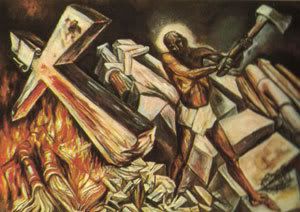
Mural by Jose Clemente Orozco "Christ Destroying
his Cross," 1943

This post comes under the heading of "what I want to tell atheists positively about Jesus." I started it back when I posted that one about Jesus and Dylan. It's based upon my outrage or dismay (I should say) over learning that so many atheists don't admire or respect Jesus as a historical figure. I re-posting it because after reading it again it seems pretty good.It's also in response to the statements by Weekend Fisher.

I have been deeply moved by Mexican muralist José Clemente Orozco's (1883-1949) painting of Jesus chopping down his own cross. The Christ of this mural prostrate is drawn in a very primitive style. Christ is not the Pascal lamb but refuses his destiny and will not go to the cross. The painting is disturbing because the first impression is that of blasphemy. Is the artist mocking Christ? Is he rejecting faith at its most sacred level? Orozco is not trying to blaspheme Jesus, nor is he denying the atonement. I find this painting very moving not our any rejection of Christ’s sacrifice or any desire to defame the doctrine of atonement, but because for me it says Jesus would, weather as the son of God, or if he was only a man in history, refuse to be the poster boy for institutional hypocrisy, Jesus would NOT allow himself to be used as symbol to sanctify the institution as it oppresses the poor and ignores the needs of the people. I believe that the real Jesus of history is both the Son of God and the man of history, and he does refuse this role. The real Jesus was a revolutionary of a most remarkable kind. Often we hear that Jesus is the great ethical teacher, and he claimed to be the Messiah, and savior of the world. We usually understand his ethics as an addendum, something any self respecting son of God would be required to have, but mainly irrelevant to his claims of godhood. Jesus ethics were far from being an addendum, however, they were the weaponry and major battle tactics of his amazing revolution. Politics and religion were intertwined in first century Hebrew society. Jesus’ ethics and his Messianic claims work together to fulfill his ultimate mission of world saving and together they make for one the most unique revolutions in human history.

It is not so strange to think of Jesus as a revolutionary. There were even Priests in Latin America in the 60’s, such as Camillio Tores but joined Che and became gorilla fighters. But Jesus the man of history was a true revolutionary. The region from which Jesus is said to have sprung is known as “the Galilee.” The Galilee was a hot bed of revolution, filled with uprisings and tensions. The Romans regarded it as the seat of Zealotry where the real revolutionaries were based. Just four miles from Jesus’ family farm “Nazareth” is a major metropolis known as Serapes. Just four miles down the road Jesus would have had access to what was then modern sophistication, political unrest and new ideas. Nor did he have to go to India to learn of traditions beyond his native prudential Judaism, the major trade route to India went right by his house,. That route lay on the plain of Megiddo where the end of the world is supposed to take place, the final battle between good and evil. Nazareth overlooks the plain of Megiddo and apparently the battle of Armageddon. All of these influences would have been at work in Jesus upbringing. Not to mention the fact that he was a descendant of David, born in Bethlehem and named as the high priest of Zechariah (Joshua = Jesus) who is linked to the Messiah (Zechariah 4).

Jesus revolution, however, was a bit odd. He did not lead an army nor did he command his followers to fight or pick up weapons. His was a non-violent revolution in the mode of Gandhi and that is where his ethics play a major role in backing his mission. The role of the Messiah in the society of Israel was that of political liberator, but it took on overtones of cosmic proportion. In the book of Isaiah we see the concept of Messiah first begins to be introduced, and is then back read into previous statements such as Moses admonition that “a prophet like me will come” and even God’s word to Eve “I will place enmity between the serpent and your seed.” The Messianic kingdom sketched out at the end of Isaiah is not the millennial kingdom of Christ’s post epochal reign on earth, but Israel after the return from the exile. By the second temple period and the time of Jesus, the concept had grown to almost divine proportions. The Messiah was to stand on the top of the temple and shout “Jerusalem your time at hand” the end of the world would ensue. The Messiah was to rise from the dead all of fallen Israel and for that reason he held the keys of life and death. The Jews did not see the Messiah as world redeemer; they did not see him as atoning sacrifice. These weren't entirely Christian innovations, they were foreshadowed at Qumran. But they weren't mainstream. The Jews certainly did not expect the Messiah to be crucified and raise from the dead.

Jesus was such a radical revolutionary, that is a "strange" different, unconventional one, that when his guys made noises about actually installing him on the throne the ran from them. That's because he knew, as everyone from the Galilee knew, the futility of trying to fight the Romans. The slaughter of the innocents in the book of Luke, is not recorded in history. Atheists are always quick to remind us of this. But it does not have to be recorded to have happened because that kind of thing happened all the time. Even a gathering as innocent as the sermon on the mount risked attack by Romans even though nothing provocative was being said. When they started talking about making Jesus king he slopped away and ran from them. Not because he lost his nerve, but because that would totally divert the people from his true purpose. Jesus has no intention of leading an armed revolt that was the opposite of what he had in mind. neither did he intend to pacify the people to accept pain and hardship with platitudes about pie in the sky. Was his program escapist? Was it just a personal nirvana with no touch stone in reality or responsibility to the world? It was not this ether. It was a practical and pragmatic system fro changing the nature of the world by changing the way people relate to each other. He accomplished this by taking people out of the world while keeping them in it.

In Jesus' system we live by the dictates of a higher citizenship, a world beyond this one ruled entirely by God. This is echoed in the model prayer he taught the disciples "thy kingdom come thy will be don't on earth, as it is in heaven." The device Jesus used for this trick of living by the rules of world while being physically in another, we the kingdom of God. The Kingdom of God was the essence of Jesus' message:


Mt 3:2
and saying, "Repent, for the kingdom of heaven is near."


atheists think Jesus was saying "If you don't believe in me you will go to hell." But he actually never says this. All the action is in the kingdom and the kingdom is the big deal. The coming of the kingdom Jesus makes out to be an immanent, immediate, almost emergency status event that will happen soon, and when it does, man is it a big thing!

Mt 4:17
From that time on Jesus began to preach, "Repent, for the kingdom of heaven is near."

Mt 4:23
Jesus went throughout Galilee, teaching in their synagogues, preaching the good news of the kingdom, and healing every disease and sickness among the people.

Mr 1:15 - Show Context
"The time has come," he said. "The kingdom of God is near. Repent and believe the good news!"


He never says the Kingdom is reward becasue you had the good sense to believe on him, but he does speak as though its the answer to all our troubles:


Mt 5:3
"Blessed are the poor in spirit, for theirs is the kingdom of heaven.

Mt 5:10
Blessed are those who are persecuted because of righteousness, for theirs is the kingdom of heaven.


Most revolutionaries come to abolish the standing order, not impose a kingdom, one kingdom over another.It is within this context that he talks about the ethics and personal relationships and how to relate to people. This is not just some ad-on that's in addition to believing the right things, nor is it unrelated, but it is an outgrowth, a logical extension, one is the basis of the other. The Kingdom is coming. It's power is already here. We can be part of it now, because it has two aspects. This is "realized Eschatology" which was developed by the theologian C.H.Dodd; the kingdom has an "already" dimension" and a "not yet" dimension. We live in the kingdom now even as we are in the world. How we treat each other is an integral aspect of the kingdom.


Mt 5:20
For I tell you that unless your righteousness surpasses that of the Pharisees and the teachers of the law, you will certainly not enter the kingdom of heaven.


Mt 7:21 - Show Context
"Not everyone who says to me, 'Lord, Lord,' will enter the kingdom of heaven, but only he who does the will of my Father who is in heaven.


Jesus ethical and moral teachings may be the greatest ever recorded, of course that's a biased and culturally bound appraisal. But they are certainly among the greatest, and the leaders and theologians of other world religions laud him for his teachings and many of them try to claim him as their own; the Muslims, The Hindu, and the B'Hai. Yet is was not the originality of his moral thinking that makes him great; the Stoics and others said many of the same things. And yet there are certain factors which do make Jesus' teachings unique and worthy of particular attention above and beyond that of most if not all ethical teachers...

Let's use a crash course in Jesus' ethics as a means of understanding his values:

Beatitudes

The "beatitudes" that Jesus speaks in the Sermon on the mount indicate the value system out of which he worked. Blessed means "happy" but he is saying more than "happy are the peacemakers." In pronouncing them blessed he is saying basically 'these are the good guys' and indicates a natural Tao working through the divine economy to protect and vindicate those who live by such values. "Blessed are the poor in spirit for theirs is the kingdom of heaven; blessed are those who mourn for they shall be comforted;...meek will inherit the earth...those who hunger and thirst after righteousness for they will be filled...merciful shown mercy...pure in heart will see God...peacemakers called sons of God...those persecuted for righteousness for theirs is the kingdom of heave." (Matt.5:3-10)

This is the way, this is how to be, these are the values one should hold. This is basically what he is saying. Essentially these qualities are those of a righteous person, they are oriented around God as the primary value and love for the neighbor as the main manifestation of love for God. To mourn probably means repenting for the evil we have done, or at least being able to empathize with other, to care about the pain others. "poor in spirit" refers to real poor people made more explicit in Luke, but the poor in the Bible are the righteous poor who trust in God for their sustenance.

prioritize: Seek Ye first the Kingdom of God...

"Do not be anxious saying 'what shall we eat?' 'what shall we drink?' 'what shall we wear?' The Gentiles seek all fo these things and your heavnly Father knows that you need them all, but seek first his kingdom and his riaghteousness, and all these will be added unto you..." (Matt. 5:28-33)

prime directive: Golden Rule

"Do unto others as you would have them do unto you." ..Other religions, probably all, have similar injunctions, but I have not found has this qualifier making it a self-reflexive command.


Self-Reflexive nature

By placing the command in terms of one's own standard of well being, the command becomes an exhortation to "love the neighbor as you love yourself." No higher standard could be given, one does to himself only that which he/she most desires to be done. By placing the command in these terms one cannot refuse to come to the aid of anyone in need. We would all prefer that others come to our aid. If the command were stated negatively, "do not do unto others that which you would not have done to yourself" one could ignore the neighbor in need. If the command stopped at merely loving the enemy or the neighbor one could refuse to help. By placing it in these self reflexive terms it is made active. One must go out of his way to seek out the needy.

b) Categorical Imperative.

Kant's great ethical system the categorical imperative was based on the Golden Rule of Jesus.

3) Love for Enemies

If you love those who love and hate those who hate you even the Gentiles do that, but I say unto you love your enemies, pray for those who persecute you

matt 5-6....

4) Greatest commandment

Matt 22:35. "and one of them, a lawgiver, ask him a question to test him, 'teacher what is the greatest commandment?' ...37 "and he said to him ye shall love the Lord you God with all your heart, with all your soul and with all your mind. This is the great and first command,and the second is like it, You shall love your neighbor as yourself. On these two commands depend the law and the prophets." (RSV).

Note: All legal regulations and striving of law keeping are summed up in love of God and love of neighbor. This shows that Jesus' ethics surpass the rule keeping stage and ascend to the highest level of conceptual morality, that of the ideal stage where actions are motivated by internalized principles. Moreover, by basing the second command upon love for the neighbor, but relating to love for self, it forms it's own second version of the categorical imperative. Note also if we love our neighbor as ourselves we are commanded to love ourselves, to rectify the self image in relation to reciprocal nature with others. At the same time, we cannot get off the hook by loving enemies any less (since even enemies are neighbors). Thus the will for the good of the other is indexed by our own will for our own good.

Psychological Motivations

Great Compassion


The compassion of Jesus can be seen in many of the stories. The woman caught in the act of adultery is taken before him and the mob wants to stone her. She has broken the law, she is worthy of death (accordion to that culture and that time). Jesus stoops and writes in the sand. We don't know what he wrote, but perhaps it was the names of those in the mob who had slept with her (they weren't being accused). He says "let he who is without sin cast the first stone..." There is the compassion he exhibited to the many people who implored him for healing, and he never refused anyone.We forget anyone else would have been running from those lepers and demoniac that he healed. The demoniac were dangerous, and the leapers thought contagious. But the also demonstrates a total lack of hypocrisy in being unafraid to associate with those who needed him most. When he was criticized for being in the company of drunkards and prostitutes; he merely made fun of the prudes and said, in affect "well, I didn't come to help those who are so well off (the self righteous people) but those who know they need help" There is no way to capture the greatness of Christ's compassion and moral teachings in one of these sub points, but I urge you to get a Bible and read the Gospels over and over, and with an open heart and you will see no greater compassion than that of Jesus Christ, and that of course is culminated in his sacrifice on the cross for our sins.

Greatest Sacrifice

He did lay down his life for the sins of the world. "Greater love hath no man than to give up his life for a friend," yet Jesus' died for everyone; and his own understanding of what he was doing was that he laid down his life as a "ransom for many." But it seems unlikely that his followers would enlarge upon his mission to this extent. Perhaps they could have enlarged upon his death o include the mission to Israel and it was Paul who expanded it to the rest of the world. But there is great likelihood that he understood himself to be doing something beneficial for all humanity. After all it was not Pauline Theology but the understanding of the Beloved Disciple of the fourth Gospel who puts into Jesus mouth the statement "for God so loved the world that he gave his only begotten son that whosoever believes on him should not perish but have everlasting life."


Living as though we were in the kingdom now is the most radical move of any revolutionary program. We don't need to hurt anyone, we don't need to fight anyone. ;We just treat people the way God wants us to treat them, out of love. Over time like the mustard seed int he parable he told, the kingdom will grow into a mighty tree that will shade the world. Of course that brings up a sore spot. Some might suggest that has not happened. Others might suggest are still working on it. I think it's worked out much better than skeptical types are willing to admit. Of course the problem is the quasi religious types who think they can manipulate the truth for their devices, and the legalistic types who think they have to kiss up the quasi religious types or they aren't religious enough. While there's a long way to go we need to be cognizant of the fact that Christianity is more than just a social agenda and plan for living. The Kingdom of God is not just a social club or a political program it's a spiritual reality. What Jesus was offering was not just membership in heaven, but a heaven that starts now on earth and is manifested in the way we treat people.