Monday, July 19, 2010

The Modal Argument

Photobucket
Charles Hartshorne 1897-2000
Modern Champion of the modal argument


What follows is one of the most challenging subjects you will ever hear about. It is the best way to get a head ache, but I think it proves the existence of God. The problem is it requires a very specialized background to understand it. First you have to understand modal logic.

Modal Logic is so called because it turns upon the use of so called "modal operators." It's called "modal" because it is the logic of modes of being. "modes" as in what type of existence something exits in, weather it is dependent upon other things, weather it can cease or fail to exist and so forth. The modal operators are "necessity," "contingency" "impossibly," "possibility."

Necessity and contingency lie at the base of our modern understanding of cause and effect. They come from scholastic notions of logic, but the distinction between the notion our modern notions of c/e and the scholastic ones in the middle ages is not that great. The  scholastic had more levels of cause, efficient cause, final cause and several others. But one could everything we have done in modern science using the scholastic ideas of c/e.

Necessity doesn't mean has to exist. It doesn't mean God is necessary to the existence of the world (except in so far as if God exists then of closure God is necessary to the world as creator--without God there would be no world).The modal argument does not begin with the assumption that God has to exist. It begins with the assumption that there is a valid distinction between necessity and contingency, which there must be.It proceeds along the lines of hypothetical consequence that obtain from different scenarios of God's existence. It concludes that is necessary. But by "necessary" it means not contingent, or not dependent upon something else for its' existence.

This is often misconstrued by atheists and taken to mean the argument proceeds from God's existence as an assumed first premise. This is not the case, the first premise is either/or. Either God's existence is necessary or it is impossible. This allows for the possibility that there is no God. So the argument does not begin by "defining God into existence."

Necessity means either non dependent or cannot cease or fail. By "fail" I mean there could not not be a God. That is the conclusion of the argument, not the premise.

Contingent means the opposite: that a thing is dependent upon a prior thing for existence, or that it could cease or fail to exist.

Impossible means logically impossible, something in the structure of the idea contradictions, such as square circles.

one of the sore spots that atheists get stuck on is the idea that God cannot be contingent. They will always leap to the conclusion that this is defining God into existence, because they don't understand the concept of God. God, by the nature of the concept, carriers certain parameters just as the existence of any human assumes humanity, or the existence of any tree assumes that the tree in question is a plant. To have to define that God is not contingent should not even come into it. The idea of God is that of eternal creator of all things. Thus God cannot cease to exits and cannot be dependent upon anything (or he wouldn't be the creator of all things). Atheists usually assume that all knowledge has to be empirical. they will argue this is defining God into existence. maybe God is contingent.

Maybe there is a begin like the one we talk about but he's not eternal or the creator of all things, but that means he's not the God we are talking about.


Hartshorne's version goes like this:

1) God can be analytically conceived without contradiction.
2) Therefore God is not impossible.
3) By definition God cannot be contingent.
4) Therefore God is either necessary or impossible.
5) God is not impossible (from 2) therefore, God is necessary.


Argument:my version

1) God can be analytically conceived, as eternal necessary being, without contradiction.

2) Therefore God is not impossible,(because no contradiction).

3) By definition God cannot be contingent (becasue God is eternal).

4) Therefore if God exists, God's existence is necessary, if God does not exist, it is because God is impossible.

5) God is not impossible (from 2) therefore, God is necessary.

6) Whatever is necessary by the force of Becker's modal theorum must necessarily exist.


A. The logic of the argument:

This argument is analytical, it proceeds from the basis in logic to argue that the concept of God is such that if we understood the meaning of the terms we would have to conclude that God must exist. Naturally that is a very controversial position. Many Christians and other theists reject the ontological argument on the grounds knowledge must be somewhat empirical. Nevertheless the argument has been used for a long time, and despite its many apparent deaths, it keeps returning in one form or another. Perhaps the best book on the subject is The Many Faced Argument by John Hick. Somehow the ontological argument just wont die. I feel that this is not so much because the argument itself is true as a proof, but because it gets at something deeper than proof, something to do with the way to think about God, and it strikes a deep cord in our consciousness, even though as a proof it may fail. For this reason alone it is important to know, if only to know the concept itself.

1) God can be analytically conceived without contradiction.
2) Therefore God is not impossible.
3) By definition God cannot be contingent.
4) Therefore God is either necessary or impossible.
5) God is not impossible (from 2) therefore, God is necessary.
6) Whatever is necessary by the force of Becker's modal theorem must necessarily exist.

(This is actually my re-statement of what Hartshorne is saying).

Hartshorne's actual modal logic looks like this:

The OA: an assessment:

by Ed Stoebenau

http://www.eskimo.net/~cwj2/atheism/onto.html Hartshorne's ontological argument is based on Anselm's second argument and claims that God's existence is logically necessary. Hartshorne's argument is given here, where "N(A)" means "it is logically necessary that A," "~A" means "it is not the case that A," "-->" is strict implication, "v" means "or," and "g" means "God exists":

g --> N(g)
N(g) v ~N(g)
~N(g) --> N(~N(g))
N(g) v N(~N(g))
N(~N(g)) --> N(~g)
N(g) v N(~g)
~N(~g)
N(g)
N(g) --> g
g


This argument is valid. Furthermore, given an Anselmian conception of God, premises one and five are sound. Premise two is just the law of the excluded middle, and premise three is a law of the modal logic S5. Premise nine is obviously sound, so this leaves premise seven as the only premise to question. Premise seven says that it is logically possible that God exists.


Yes, those funny lines, "g-->N(g)" are the argument, those are the formal symbols used in modal logic.

B. God's Possibility vs. Impossibility.

The argument turns on the distinction between necessity and contingency, and upon the distinction between mere possibility and the nature of necessary being as not mere possible. In other words, God is either necessary or impossible. If God exists than he is ontologically necessary, because he is logically necessary by definition. But if he does not exist than it is ontologically impossible that he exists, or could come to exist. This is because God cannot be contingent, by definition. A contingency is just not God. So if God is possible, he can't be "merely possible" and thus is not impossible, which means he must be necessary.

God is conceivable in analytic terms without contradiction:
The universe without God is not conceivable in analytical terms; it is dependent upon principles which are themselves contingent. Nothing can come from a possibility of total nothingness; the existence of singularities and density of matter depend upon empirical observations and extrapolation form it. By definition these things are not analytical and do depend upon causes higher up the chain than their being (note that the skeptic at this point probably denies the validity of analytic proofs but to reverse the argument must accept such proof).

Since the concept is coherent and not contradictory and is derived from analytic terms, to reverse the argument the atheist must show that God is impossible since the burden of proof is now on the one arguing that a contingent state of affairs could produce a universe in which being has to be.

D. Answering Objections:

1) The argument can be reversed

Atheists have tried to reverse the argument merely by saying:

1) either God exists or he doesn't
2) God is either necessary or impossible. Necessary if he exists, impossible if he does not
3) God is impossible
4) Therefore God does not exist.

But of course this is merely stipulation. They assume that what the argument is doing is just stipulating everything that has been said about God, but on the "Modes of Being" page I show that each of these modalities of existence are logical deductions.Either a thing exists or it does not. One can equivocate about the meaning the term "existence," but here I clearly mean concrete actual existence in the "real" world. If a thing does not exist it is either that it could, but just doesn't happen to exist, or that it cannot exist because it is a conceptual contradiction, such as square circles, or round triangles and so on. Therefore, if it does exist, it is either that it exists contingently or that it is not contingent but exists necessarily (that is it could not fail to exist without contradiction). These are the four most basic modes of being and cannot be denied. They could be subdivided, for example fictional contingency, such as Sueprman or Dick Tracy, that which would be contingent if it had real concrete actuality, but is merely a fictional concept. But the four modes are the basic logical deductions about the nature of existence.

The idea that the argument can be reversed just by switching the lines and declaring God impossible merely begs the question. Is God really impossible just because we can utter those words? Is God logically necessary just because we can utter those words?. No, but that's not what is being said. God is logically necessary as a concept. That is the nature of the God-concept, that's the idea of God. To deny that would be like saying "how do you know that tables are things to put things on?" Or "how do you know that triagles have three sides?"The question is one of actuality, so if it is possible that God exists than God is ontologically necessary and thus has real concede existence because since God is not contingent it cannot be that God is "merely possible." If it is at all possible that God exists, than it's not impossible. To show that the argument can truly be reversed the atheist must show why God is impossible, and to do that he/she must show that God cannot be understood analytically without contradiction.


Another attempt at reversing the argument, which is always used on message boards when I make this argument: just to put not in front of each line. "It is possible that god does not exist." The premise is they don't have to prove God is impossible, but just that the possibility of God's not existing reverses the argument.

The problem is, the premise is false. If god is not analytically impossible (contradictory) then God must exist. Thus it is not ture that it is possible that God does not exist. The logic works like this:


(1) If God is indeed possible, the God cannot be impossible.

(2) to say God is not possible is the same as saying god is impossible.

(3) if something is possible, it can't be impossible.

(4) you must show why God is impossible.

(5) I have shown why God is possible, becasue God is conceivable without contradiction.

(6) anticipating answer on entity and consciousness, consciousness is not a primary quality of God. Other things are consciousness, that is not something uniquely establishes God as God, logical necessity is such a thing.

(7) If God is possible, and can't be impossible, and can't be contingent, then to be possible for God is to be logically necessary. Thus it does not work to say God is not possible because it isn't true, thus it's a false premise.


To make good on any reversal they must show a contradiction in the concept of God. To this they always retort "well you can't prove that God is not contradictory." But I don't have to prove that. One can assume that if there is no contraction it is not contradictory. They are the one's seeking to make the reversal, so it's their burden of proof. But to prove that God is possible all one need do is conceive god analytically without contradiction. what else could one do to prove a possibility?


2) The assumption that we are merely loading the concept with terms that make it necessary, or that the definition of God as necessary is arbitrary.

This is really the same argument one must make to reverse the argument of necessary being. This is what atheists always argue. The first thing they say bout it is that we are just arbitrarily sticking on the term "necessary" and playing word games. Some go so far as to try and demonstrate this by sticking the term necessary on other things, such as "purple cow" or anything they think of, and that's supposed to show what we are doing. I regard this move as nothing more than a demonstration that they do not understand the concepts The necessity of necessity and why it must be applied to God is demonstrated on the "modes of being" page. Moreover, this move is nothing more than the perfect Island argument. It can't work because it merely enthrones contingencies. Our reason for saying that God is necessary is much more logical and organic and is much more than a mere word game.

While it is true that God as being itself is a pre-given postulate and is independent of proof because it is part of the definition of God, the realization that being has t be means that this must be the case.

3) The assumption that we are lending existence to a fictional being.

This is merely an assumption. The necessary existence of God is implied in the possibility of God's existence and the realization that the the only alternative is impossibility. God is possible and thus necessary. Some have tried to argue that they are breaking up the four categories with a 5th not seen, that of "fictional" but that applies to the category 4 that of non-existing contingency.

4) Equivocating between types of necessity.

The argument says that to say God is necessary as a postulate of definition is speaking of ontological necessity, than to assert the actuality of it is moving from logical to ontological necessity.

To say that a thing is logically possible is to say that it might have existed in the past or may exist in the future. But for God to exist he must always have existed; in the past, in the future, or all time. Given logical necessity the logical possibility of God 's non existence is impossible. Therefore, ontological necessity implies logical necessity. One implies the other and it is a rational move from one to the other.


This argument may seem like merely a trick of words, and modal logic may be controversial, but it turns on very basic logic, such as modus tolens or modus ponens which is accepted by all logicians. On Argument 1 I document Antony Flew saying that the logical categories of "Necessary" and "contingent" truth are accepted by all logicians.

TrentDougherty
Concise intero to the Modal Ontological Arugument for The Existence of God.

http://www.abarnett.demon.co.uk/atheism/ontol.html

TERMS

‘Modal’ – Pertaining to the modes of existence (de re) or of propositions (de dicto) as necessary or possible.  ‘Necessity’ is a mode of being for a thing or proposition as is ‘Possibility’.
‘Ontological’ – from Greek ontoV for being.
‘Argument’ – designed to logically support a proposition (not to be confused with persuasion which is a psycho-social phenomenon, not a philosophical one).
Throughout this description I shall use standard notation and notation used when the font is restricted to a single typeset as in a text only document for HTTP purposes on the Internet.

The modalities are symbolized as follows:
A square or in typeset [] preceding an expression means “It is necessary that…” or “It is necessarily the case that…” or simply “Necessarily…” e.g. as applied to a propositional function.

Ps/[]Ps – “It is necessarily the case that s is P” where s is a constant referring to some individual and P is a predicate.
A Diamond à or in typeset <> preceding an expression means “It is possibly the case that…” or “It is possible that…” or simply “Possibly…”

SEMANTICS

Possibility is defined as consistency.  àPs/<>Ps reads as “Possibly, s is P” and means that there is no contradiction in attributing P to s.  Necessity is defined as “not possibly not the case”.  If something cannot not be, then it must be.

Psº~à~Ps or []Ps=~<>~Ps
THE CALCULUS

There are many different ways to axiomatize a logic, just as there are different ways to axiomatize geometry.  Axioms in some systems will be theorems in others, but since axioms and theorems have the same validity it is only a matter of formal difference.  One of the most used systems of modal logic is called S5.  There is an interesting theorem in S5 called Brouer’s Theorem.
(PàP)à(àPàP) or (P-->[]P)-->(<>P-->P)
This theorem is derivable in weaker systems as well.
The modal ontological argument for the existence of God is just a substitution instance for this theorem.  There are only two propositions needed.
THE PROPOSITIONS

First comes the definition of God as a being who, IF he exists, does so necessarily, i.e. a Necessary Being.  This is only the definition of what God would be like IF he existed.  The proposition is formalized as
GàG or G-->[]G
“If God exists, then he necessarily exists.”
The other proposition is the assertion that it is possible that God exists.
àG or <>G
“Possibly, God exists.”
RULES OF INFERENCE

The only rule of inference needed is Modus Ponens.
PàQ  “If P, then Q”
P
Therefore Q
Now we are ready to put the argument together.

THE ARGUMENT
1.      (GàG)à(àGàG)
2.      GàG
3.      àG
4.      àGàG
5.      G
(Theorem, sub G for P)
(Def of God)
(premise)
(1, 2 MP)
(4, 3 MP)

or
1.      (G-->[]G)-->(<>G-->G)  (Theorem, sub G for P)
2.      G-->[]G  (Def of God)
3.      <>G (premise)
4.      <>G-->G  (1, 2 MP)
5.      G  (4, 3 MP)

COMMENTARY

It is quite a simple argument which makes it hard to understand its fullness.  The simple is packed with meaning.  As you can see, there is one and only one premise, that it is possible that God exists.  If this be granted, then his necessary existence follows. Since all efforts to show that the concept of God is contradictory have failed heretofore I conclude, somewhat reluctantly, that God exists.  Kai Neilson tried to argue this in his debate with J.P. Moreland, but didn’t make much progress.

Now I realize that to the average person, this seems like a trick, but the average person is not particularly accustomed to following logical arguments at all, much less highly specialized forms of logical calculi developed by professional philosophers.  Most professors at the University level don’t even know modal logic and many have never studied it and some have never heard of it.  What do those who know it, but don’t believe in God say?  They say that the concept of God is incoherent.  I have not yet seen an even slightly plausible argument to that effect.  Until I do, the OA will be cogent to me.  I might add that I am a convert on this argument.  I argued for years that the ontological argument was flawed until someone showed me the modal version.  I have always followed Reason wherever it lead and, as usual, it lead to God.

SELECTED BIBLIOGRAPHY

Adams, Robert M., _The Virtue of Faith_, esp. “The Logical Structure of Anselm’s Arguments,” Oxford University Press: 1987.
Moris, Thomas V, _Anselmian Explorations_, esp. “Necessary Beings,” University of Notre Dame Press: 1987.
Plantinga, Alvin, _The Nature of Necessity_, esp. “God and Necessity,” Oxford University Press: 1974, 1992.
Plantinga, Alvin, _The Ontological Argument_, Anchor Books, 1965.
Swinburne, Richard, _The Coherence of Theism_, Oxford University Press: 1977, 1993.


Oddly enough that quotation is linked to a site by an atheist named Adrian Barnett who is attacking my older version of this argument, but he was gracious enough to put this quotation, which I think works against his argument, by a philosopher in the UK.


About Hartshorne


Hartshorne Lived to be 103, at the time of his death in the Fall of 2000, he was known as "the greatest living Metaphysician." Hartshorne was one of the major forces in the "back to God" movement in Philosophy (a term coined by  Christianity Today in a 1979 article. His first and greatest calim to fame is as the second most influential voice in process philosophy, along with Alfred North Whtiehead, but he is also credited as the man who brought the Ontological argument back from ignominious defeat by Kant almost two centuries earlier. Hartshorne was also a recognized authority on birdsong, and an authority on bycicles, having never driven a car a single time in his centogenerian lifespan. Hartshorne devoted the last years of life to waging a letter's to the editor campaign to advocate social issues such as medical care.

Saturday, July 17, 2010

Bill Walker Please Read my Post for Once

Photobucket
Bill walker is a regular reader and commenting atheist critic of this blog and mainly of Atheist Watch. Apparently he doesn't actually read my posts because I've said things that totally contradict the assertions he makes and that should tell anyone of reasonable intelligence that their view of what I believe is wrong; but he doesn't seem to notice. Here he's at it again:


billwalker said...

Joe, I'm still hoping that you'll take a cosmic view of the Cosmos & of the primitive tribal god our ancestors invented during the early iron age. If you need help on this, it's to be had on ExChristian.net,also Atheist Nexus.Reconciling the dogma of Xianity & science, especially Astronomy, is impossible. When one considers the fact of several hundred BILLION galaxies,each with up to several hundred billions in each of them, ours being one of the smaller ones, & of 13.7 BILLION years in existence, the sheer unlikelihood of 'the creator sending his only offspring to be born of a virgin in the early iron age in a dinky town in the middle east, isn't just astronomically unlikely. It's frigging INSANE. Please open your mind to examining the doctrines of Xianity.
He makes the astoundingly naive assertion that if one was to understand the juxtaposition of modern astronomy with ancient primitive beliefs once could not be a Christian. At this point he would have to assume that all Christians are literatists and too stupid to understand Genesis as metaphor or mythology or to see the big man in the sky of the OT as metaphor. This does nothing but highlight the ignorance and stupidity of not reading theology but pretending to pompously critique it. If he read theology he would know that the vast majority of theologians in the world today (being the more learned end of Christian camp) do not buy Genesis as a literal history of creation.

Not that there's a logical reason why the big man in the sky could not create an unbounded universe. The universe is finite, contrary to Bill's understanding. He, like most atheists who yak at Chrsitians about the wonderfulness of science really knows little about scinece. Universe is finite yet unbounded. NO reason why a guy with a body if he was powerful enough could not or would not create it. Of course the truth of it is most modern theologians (myself included ) do not think God is a big man or has a body. I am sure Bill thinks we do. I took four courses in astronomy in college and I'll wager that's more than Bill took and I will wager I know more about astronomy than he does.

I've said this explicitly a number of times and if Bill was really reading he should get it. I understand that the people who wrote the OT, the collections of writings that make it up (it did not fall out of the sky as one bound volume nor were all the parts of it written by the same guy) were written by primitive people whose understanding is not up to par with ours in terms of science or the cosmos. We all  know this. As many times as I've talked by my view of inspiration he should understand that I do not regard the books of the Bible as "written by God" but as human accounts of divine/human encounters. It's a totally different model than the one he is use to assuming Christians believe. It's a model that allows for mistakes in fact. It's a model that allows for mistakes in scinece and history. It's a model that is not about inerrency.

My assumption is that there is this aspect to all being, it is an aspect that is eternal. Invidious "things" aka "the beings" are temporal, contingent, and temporary. They come into being, the go out of being, they replaced by other temporal, contingent, temporary things. There is an aspect to being that is eternal. It has no beginning and no end, it is not a series of causes, it's not really a "final cause" since you can't really trace it as a series of causes and effects. This aspect is called "being itself" the basis of what being is, the "ground of being." "Ground refers not only  to basis, so its' the basis of 'the beings" or all that exits, but it's also "ground" as in "depth psychology." When Tillich says "Being has depth" he's saying that that there's an aspect of being we only understand subliminally, an aspect that fits into the background, that we don't think about usually and we can't see we can't locate it as a "thing" among other things, but it's always there and it always has been and always will be.

It's that thing we call "God." The primitives in sensing the presence of it try to pin it down and say what it is the attached to it the cultural constructs they understood best. In the world of the bronze age when they wrote the OT works the first draft of J (the J document that was woven together with E,D, and P to form the OT) they filtered this eternal aspect of being through their lens of cultural understanding they linked it the king on his throne because that was the most powerful they knew of, that's what they thought about when they thought of creative power and the force of divine will. Of cousre understanding it as a will at all was an even older construct. So they speak about "the Lord" and they portray him as a man on a throne a king, becuase that's what they thought about when they thought of power. We come along for generation after generation thinking of God in this say, as a king, as "the Lord." We don't realize there are other constructs we have ourselves we can also filter it through. For me one of those constructs is Necessary Being. I use this one becasue I like philosophy and find a helpful distinction the one between necessity/contingency, so I call it "eternal necessary being."

This "being itself" is not "a being" but being, the thing that the act of being is. The basis of the act of being. We can even say that is a construct. But this aspect of being is in all things. It's in the ground, the in the air, it's in us, in me and you, in  each of us. The unwary can become concerned and think its' pantheism, it is not pantheism. Pantheism reduces God to a thing, the force of nature, or the sum total of all things taken together. But God is not a "thing" alongside other things. I call it an "aspect of being" that itself is a construct and might be in danger of reducing God to a thin, if we think of it as one ingredient in making up the universe with other ingredients, it also makes the universe sound like a cake.

I've expressed this before in this blog. I quote a translator form 1923 who describes Dionysus the Areopagine's view of God. I find this is a find description that really sums up what I believe.

The ideas of “Pseudo Dionysus” as he is most often known in the west, are set down in a long introduction by the translator Clearance Edwin Rolt. Rolt died at thirty-seven and this was his only book, but he had been hailed as one of the finest scholars ever produced by Queens College. Thus I think it only fair that we quote from the man himself. The major concept in which turns all Dionysus has to say is daubed by Rolt as the Super Essential Godhead:


The basis of their teaching is the doctrine of the Super-Essential Godhead (ὑπερούσιος θεαρχία). We must, therefore, at the very outset fix the meaning of this term. Now the word “Essence” or “Being” (οὐσία) means almost invariably an individual existence; more especially a person, since such is the highest type that individual existence can in this world assume. And, in fact, like the English word “Being,” it may without qualification be used to mean an angel. Since, then, the highest connotation of the term “Essence” or “Being” is a person, it follows that by “Super-Essence” is intended “Supra-Personality.” And hence the doctrine of the Super-Essential Godhead simply means that God is, in His ultimate Nature, Supra-Personal.
Now an individual person is one who distinguishes himself from the rest of the world. I am a person because I can say: “I am I and I am not you.” Personality thus consists in the faculty of knowing oneself to be one individual among others. And thus, by its very nature, Personality is (on one side of its being, at least) a finite thing. The very essence of my personal state lies in the fact that I am not the whole universe but a member thereof.


God, on the other hand, is Supra-Personal because He is infinite. He is not one Being among others, but in His ultimate nature dwells on a plane where there is nothing whatever beside Himself. The only kind of consciousness we may attribute to Him is what can but be described as an Universal Consciousness. He does not distinguish Himself from us; for were we caught up on to that level we should be wholly transformed into Him. And yet we distinguish between ourselves and Him because from our lower plane of finite Being we look up and see that ultimate level beyond us. The Super-Essential Godhead is, in fact, precisely that which modern philosophy describes as the Absolute. Behind the diversities of this world there must be an Ultimate Unity. And this Ultimate Unity must contain in an undifferentiated condition all the riches of consciousness, life, and existence which are dispersed in broken fragments throughout the world. Yet It is not a particular Consciousness or a particular Existence. It is certainly not Unconscious, Dead or, in the ordinary sense, non-Existent, for all these terms imply something below instead of above the states to which they are opposed.

At this point I quote myself because I've put this up before:

We can see in that description several features which correspond to the things Tillich says. One interesting discussion that I close before it is started is the “personal” aspects. I am saving that discussion for its own chapter on Being itself and consciousness. The first point of interest is the connection between being and essence. He defines ousia as either one. Ousia of course is the root words of homoousios. Rolt confirms Tillich’s view in saying that essence refers to a particular existence, but the Super Essential is in contrast to an individual person. God is beyond the consciousness of an individual, but is in fact a universal consciousness that is in all things and can identify with all beings. I’ve already dealt with Tillich’s nix on pantheism; this is not a pantheistic idea. Yet in defining it Rolt deals with many of the aspects of God as being iself expressed by Tillich. God is infinite, God is not one person among others, transcendent of all we know and dwells on a plane beyond our understanding. The term “Super Essential” can be understood as “ground of being” or “Being itself.” They are basically saying the same thing. The Greek phrase he uses for “Super-Essential Godhead” is ‘humperusios Thearkia: Super means “over” or “transcendent” a structure over something else, such as “superstructure.” Thearkia is commonly the term in the NT for “Godhead.” What is being communicated is the notion of transcendence but also the transcendental signifier, the overview to the ordering of meaning and order, that is equivalent to the concept of a ground, of course as pointed out, essential has an affinity with being. Thus we could as well translate it “ground of being.” The concept of God as “Ground of Being” is the concept of “Super Essential” God. I don’t suggest that “ground” would be a good translation as translations go, but I do think it’s hinting at the same idea.

Pseudo Dionysius himself begins by embracing the vita negative, God is beyond our understanding, we don’t try to say what God is, we experience what God is (mystical union) we say what God is not and infer from that the truth, except where we are given clear understanding in Scripture. “We must not then dare to speak, or indeed to form any conception of the hidden Super-Essential Godhead, except those things that are revealed to us from the Holy Scriptures. For a Super-Essential understanding of it is proper to unknowning which lieth at the Super-Essence thereof surpassing discourse, intuition, and Being.” The translator capitalizes being.

The one who is beyond thought surpasses the apprehension of thought; the good which is beyond utterance surpasses the reach of words. Yea, it is a unity which is the unifying source of all unity and a Super-Essential Essence, a Mind beyond the reach of mind and Word beyond utterance, Eluding Discourse, intuition, Name and every kind of being. It is the universal cause of existence while itself existing not for it is beyond all being and such that it alone could give, with proper understanding thereof, a revelation of itself.(52)


Notice that this appears to be where Tillich obtains his usage of the term “existence,” and the distinction that God does not exist. What is puzzling is that while Tillich says God is beyond existence, because existence is for contingent things, and God is Being itself, identifies God with Being, Dionysus says God is beyond being. But then he is a full blown neo-Platonist. For him being is just reality and that is a copy of the true nature of things in which it participates. Tillich seems to move one step over from neo-Platonism toward modern existentialism. Dionysus tells us that we must make no expression or positive statement about the Super-Essential Godhead except those revealed in scripture for these are actually revealed by God. He tells us that “many writers thou wilt find who have declared that it [Super-Essential Godhead] is not only invisible and incomprehensible but also unreachable and past finding out since there is no trace of any that have penetrated the depth of its infinitude.” God reveals “itself” in stages commensurate with the powers of the subject for understanding. The notion that God is so wholly other, so transcendent of understanding is right in line with Tillich’s view. It’s clear Dionysius is a major source for Tillich’s existential ontology.

Do you see now how this view just totally kicks in the head of any idea that I think there's this big man in the sky? In this view God does not have to create by sitting around and saying "I think I will make me a universe." He doesn't even have to be a planner or do any kind of ratiocination. In this view God could be a principle like the dialectic, the laws of physics, the unified field, or even evolution 'itself.' (what else but an "itself?"). But don't go thinking this destroys Christianity or that it is the least bit unorhtodox. Dionysus is at the center of Greek Orthodox world, he's as Orthodox as one can get. Nor does it eliminate the idea of a loving fatherly God who cares about you, the concept itself (see above) include the idea of God as conscious. In  fact it leaves us with the idea of mind as the basis of reality rather than energy or mater. Thus "God" would be the origin of the conscious. the planing and all that seems to connect God to the mind like that of a man can be understood as an instant or a second a nono second requiring no reflection. It is both deterministic and random it's both impersonal and the product of a consciousness. That makes "God" both loving and dispassionate. It also means sense because God transcends all our neat little categories. This is why the atheists can't determine or second guess what God would do. That would require understanding God and God is beyond our understanding.

God is not the man on a throne and the open boundless nature of the universe reflects God's unconditioned nature. While at the same time we can relate to God's love and accurately call God "father." The contingent nature of the universe reflects it's created nature and thus highlights God as the eternal necessary aspect of being.


Source:

Dionysius the Areopagite: on Divine names and the Mystical Theology, trans. Clearance Edwin Rolt , New York, New York: Cosmio 2007, from original 1920 publication. see also online versionChristian Classics Ethereal Library, on line version, The Author and his Influence, trans by, 1920 website URL: by http://www.ccel.org/ccel/rolt/dionysius.iii.i.html
visited May 13,
[1] Ibid, Introduction, 4-5
[1] Pseudo-Dionysius, On Divine Names, Ibid 52
[1] Ibid, 53
[1] Ibid.

Wednesday, July 14, 2010

My Film Reviews

I love reviewing great films. I'm sure my reviews are very amateurish and crappy but I still love doing them. I love great artistic cinema. This kind of film is just virtually unknown in America. I like to do all I can to enhance it's popularity. All my film reviews have gotten good hits from readers when I've done them on the blog and seem to be popular. I though it would be good since I've done so many to make them easier to find and read.

Not that anyone cares but here are my top 10 favorite films. I do believe these are the best films of all time:

 Seventh Seal (Ingmar Bergman)
La Dulce Vita (Federico Fellini)
The Bicycle Thief (Vittorio De Sica)
Wild Strawberries (Bergman)
The Virgin Spring (Bergman)

Rashomon, (Akira Kurosawa)
The Seven Samurai, (Akira Kurosawa)
La Strada (Federico Fellini)
Dr. Strangelove, (Stanly Kubrick)
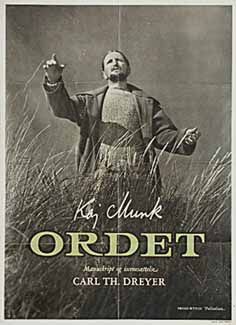
Ordet (Carl Drayer)


Greatness has Left the Planet: Ingmar Bergman dies


Bergman

My Obituary for Bergman when he died (July 2007--he was born July 1918). It gives a general summary of his major films and his style and focuses on his greatest film, "The Seventh Seal." Bermgan is my very favorite director and "the Seventh Seal" is my very Favorite Film (along with "Wild Strawberries"). There are film critics who argue that is the greatest film ever made and I agree completely! This film Bergman's first major international success (1857).

Bergman is my favorite director, though he was an atheist his father was accomplished minister and Chaplin to the Queen of Sweden. Bergman deals whit religion in many of his films, he is not a mocking ridicule artist but deal sensitively with it and openly confronts his struggles over it and his desire for God and his desire for truth. Even though he did not believe in God he demonstrates a lot of sympathy perhaps even envy for the believer.

 The Seventh Seal

Photobucket
knight (Max Von Sydow) playing chess with death

(this is no. 1 on my list)


Wild Strawberries (1957)

(Bergman)

Released the same year as Seventh Seal this is my second favorite (sometimes first) film. It reinforced the image of Bergman as the greatest international director of his time. It's not a Rambo movie, there no explosions are car chases. On the Surface it sounds real boring, and old professor and daughter-in-law take a road trip across Sweden as he goes to receive an honorary degree as a life-time achievement award. The professor also takes an emotional journey in his mind from childhood to present reflecting upon how his life has gone. It's an existential classic. It's boring if you can only related to adventure movies but it's pleasant and thoughtful. It has provocative dream sequences that figure into the plot.

no 4 on my list

The Virgin Spring (1960)

Photobucket

(Bergman)
This was a follow up to the two previous films, it is also one of Bergman's greatest. Coming on the heals of the other two it established him as the greatest director of his time. It's based upon the story by a Swedish writer and might be based upon a folk tale. Set in the middle ages and deals with the murder of a girls and her father's revenge.
no 5 on my list


Through a Glass Darkly (1961)

Photobucket


(Bergman)
This is the first in his trilogy. The three films Bergman made as his great Trilogy which were supposed to deal openly with the problems of religion and belief were "Through a Glass Darkly", "Winter Light," and "The Silence." Unfortuantely none of these were his among his greatest films. In my view if one complied trilogy of the three greatest films he made it would be those three listed above.

This film is about a woman's mental illness and struggles with God and her father.


Winter Light (1963)

Photobucket

Second in Bergman's trilogy. This film is rarely reviewed. I have been told I'm the only one some people can find who really reviewed it. I feel it's a great film and I tell you why in the review. It's the one that most directly takes on the problem of belief in God of any of his films.


  photo La_Dolce_Vita_281960_film29_coverart_zps57cd016a.jpg


 La Dulce vita, Federico Fellini


La Dulce Vita (The good life), Federico Fellini (1960).   I am about the ten millionth person to review this film. I have nothing original to say about it, it's all coming from the commentary on the DVD plus what I've learned about Cinema over the years, but nevertheless I take great pleasure in discussing it. This is one of the greatest films ever made. It's clearly up there with Bergman's the Seventh Seal. It's going to be in the top ten of any critic worth his celluloid. It's number 2 in my top 10.* At first glance this might appear to be a banal look at a group of shallow play boy and play girl fashion model types form the late 50's who lived in Italy and had no thoughts in their heads. So what? I like to review great art films that have something to say about God, such as  Wild Strawberries, but what does this pack of refugees from the Italian version of "the Nanny" have to do with God? A lot actually, there's much more going on there than meets the eye. First we have to fix the film in relation to cenematic history.

no 2 on my list


 photo 220px-Vitelloni_psoter_zps7382becf.jpg

Federico Fellini's I Vitelloni


 photo Ladri3_zps8b20dcea.jpg


Victorio De Sica's The Bicycle Thief


The Shoes of the Fisherman

Vitorio De Sica (July 7, 1901-Nov 13, 1974)


De Sica is one of my favorite directors (his film "The Bicycle thief," is no 3 on my list of top 10). Italian born he began his film career before WWII as a romantic lead. He began to direct about the time the war broke out. The established himself as a direction of International repute with the Bicycle thieves (1848). This remains his greatest film in my opinion. Among his other greats, perhaps his greatest films are "Miracle in Milan" which is credited with inspiring the scene in ET where he's flying on the Bicycle and and "Umberto D." The Shoes of the Fisherman (1960s) is about the first non Italian pope (over a decade before JPII) who is played by Anthony Quinn and is a Russian and is called upon to deal with the forces of Communism and world hunger.


Photobucket


"Ordet": (The word), a film 

by Carl Dreyer 


Danish director Drayer was Bergman's older contemporary and probalby his inspiration. He's a lot like a Danish Bergman. Best known for his silent films such as Joan of Arch. Ordet was his only financial success among his sound films. It is also one of greatest critical successes.
no. 10 on my top 10 list


 Two films by Robert Bresson: Balthazar and Country Priest

  photo MV5BNzcwMTQ5NzI3MV5BMl5BanBnXkFtZTcwMTExMTkyMQ_V1_SY317_CR50214317__zpsbb5ce287.jpg


Mochette by Robert Bresson


Photobucket

Akira Kurosawa (1910-1998)

Rashomon
(the 2014 version of
the review)


Here I turn to my second favorite director the Bergman of Japan. Kurosawa was trained in private military academy before world war II and thus part of his education was training with a sword as the old Smarai were trained. As a film maker he directed a slew of bloody Samurai films, for which he was very famous all over Asia. These were the Westerns are for us, like the cowboy movies of Japan. The most famous of his Samurai films is "the Seven Samurai" which was the prototype for the American Western "the Magnificent Seven."

no. 6 on my list top 10.


Photobucket

"Roshaimon" is a profound existential film. It is set n the Samurai period and invovles a Samurai duel but it's not really a Samurai movie and is not very bloody. Its' an existential thriller that imparts to the view a profound moral discussion that rivals the book of Job for its moving philosophical reflections upon the human condition.


Woman in the Dunes

Hiroshi Teshigahara's brilliant 1964 Sisyphan metaphor. This film grows on you. At first it seems tedious and closed in, then expansive and open to the wind.


American Films that I consider to be artistically great

Sansho The Bailiff Director:Kenji Mizoguchi

Kurisawa is the more Western-like Japanese director. Mizoguchi is liked in Japan for his strict Japanese style and flavor. This film is about slavery set in medieval Japan.


Photobucket


In the Shoes of the fisheman
Michael Johnson


  Photobucket


"Ace in the Hole"

Directed by Billy Wilder

  photo acehole1_zpse3bd12eb.jpg

This is a fine film. It deserves to be on my list of  American films that have an artistic quality I would put up against the Europeans and Japanese.


these are two nice films. Not great, they are almost fine but in a small low budget way. I enjoy them so I enjoy writing about them. Norman Foster was a fine director.

Brighty of the Grand Canyon

Norman Foster


 photo 51u2BaxSwsuL_SY344_PJlook-inside-v2TopRight10_SH20_BO1204203200__zps4309d2a6.jpg


 photo boggycreek2_zps0f17ee47.jpg


The Legend of Boggy Creek


Sunday, July 11, 2010

On Rational Warrant

Photobucket
 Toulmin


Skeptics usually argue against a level of absolute proof. Some skeptics may claim that they don't demand absolute proof, but the level of most God arguments and most discussions about those arguments is undertaken with an assumption that the argument has to actually it's objective, that God exists. At least that's taken to be the objective. I understood things like way myself, yet my friends and I in our collegiate and undergraduate settings, our coffee shops and debate squad discussions Always hinted at a notion that there are levels of proof. I used to describe this in terms of "not mathematical level of proof but something more on a practical level." After doctoral work, in which I had not really thought about the issue for a long time, I discovered the intent war between atheists and theists and jumped in with both fists flying. I didn't really understand how how why but for some reason it occurred to me (almost instantly) that that second order of proof was the rational warrant belief. There was an article that I can't even find now, I don't remembered who wrote,it talked about propositions as things in which to place confidence rather than "prove" and the ability to place confidence in  a partially proved hypothesis. The basis justification for doing this is the "rational warrant." This soon became my standard position. I do not argue to prove the existence of God but to demonstrate the ratinoally warranted nature of belief.

The levels of the term proof that I've discussed, in my internet sojourn, are "absolute" and 'practical." Rational warrant is any logical argument that warrants a belief, or a sense of placing confidence in a proposition. being "rational" means there are logical reasons to support it, being a "warrant" means it's a reason to believe something. Warrant is permission. so the aspect of an argument that logically demonstrates a reason to believe something is a warrant. Rationally warranted belief is confidence placed in a proposition (the belief) that is well placed as demonstrated by the warrant; the warrant is a sort of "permission" to believe or to place confidence.The practical level of proof I said is based upon the daily needs of life while the absolute sense of proof is jsut that, that which can be demonstrated to be 100% proved. There really almost no things in this life that can be proved that way. One of the big games the atheist play is to confuse the issue of belief by constantly demanding 100% absolute proof then denying that is their standard when pressed with the impossibly of the task. Pracical level of belief is confidence placed in a proposition on the basis of an ad hoc or incomplete basis. We might also it the "Thomas Reid level." That is, life is not going to stop and give us a chance to try out every single theory we can think of before we get back to make a decision about God belief. Life is moving on and we are going to die before we find out why we are here if we are waiting around for absolute proof. So the practical level is one that is ratinoally warrant, in which we can place confidence in a proposition because the proposition is justified logically even though we do not have absolute proof.

Rational warrant is nothing more than what logicians call 'warrant.' it's an established aspect of a logical argument. Attaching the Word rational to it only means that it's arrived at through reason. There's nothing magic about the term that, its not some ontological principle that has to be true no matter what, it's just a good old fashioned warrant for an argument. The only real difference in this and what people usually con true as logical argument is that the Aristotelian version of logic seems to demand necessity. That which is logically is necessitated by logic as the mandatory conclusion. Whereas rationally warranted conclusions are more or less permissive rather than mandatory. That is to say they are justified in so far as logic goes, but they are not necessarily the only logical conclusion. Atheists are always asking me "does this mean atheism could rationally warranted too." Theoretically it does, sure! It's still their burden of proof to show that it is. Atheists are always treating rational warrant as though its some sort of freak idea I made up myself that no logician would ever support. In fact all kinds of major logicians support it and it' easy to see that it's just a standard concept if one just does a modicum research one will see that logicians talk about warrant all the time.

  Stephen Toulimin (March 25, 1922-December 4, 2009) was a major logician of the 20th century who can be singled out as a major figure in the development of a permissive sort of warrant principle. He was one of the major thinkers of the twentieth century, important developing logic, ethics, moral reasoning. He was most famous for the Toulmin diagram which was a way of diagramming an argument to understand it's logic, similar to a vin diagram only more complex.

Encyclopedia Britannica online
Originally published: Philosophy and Rhetoric (Vol. 41, No. 1) 2008
"Toulmin's Rhetorical loigc: What's the Warrant for Warrant?"
by William Keith, David Beard
Summary:
"The article discusses the argument of Stephen Edelston Toulmin concerning the misunderstandings of warrant as emphasized in composition and communication literature. According to the author, Toulmin believes that a good argument can be followed by providing good justification to a claim that can support to criticism and earn a positive verdict. In The Uses of Argument (1958), Toulmin proposed a layout on warrant for analyzing arguments. Toulmin stresses that warrant is the statement that authorizes the movement from the data to the claim. The author notes that Toulmin's argument has created confusion to scholars with their understanding. The author suggests to study the first book of Toulmin "Reasons in Ethics" to fully understand the argument using Toulmin's model."

Toulmin stresses that warrant is the statement that authorizes the movement from the data to the claim. That's just what I said about it. I said that before I found this article. The argument has a permissive nature but this does not mean that the ordinary burdens of logical inference are removed.

(Ibid)
A theory of reasoning must define a principle that allows movement; in formal logic this principle is represented by the material conditional.1 Toulmin claimed, in The Uses of Argument (1958), that not all argument was reducible to logic. He offered an alternative to the material or formal conditional; he envisaged a different inference principle, which he called a warrant. He insisted that warrants, rather than being abstractions like conditionals, were bounded by institutional and disciplinary constraints, contextual boundaries he called fields. As Foss, Foss, and Trapp summarize, "the warrant assesses whether or not the trip from grounds to claim is a legitimate one" (11)--within those institutional and disciplinary constraints. In a sense, Toulmin is subtly moving ninety degrees from the classical tradition of logic. In classical logic, the term Aristotle uses to describe the character of logical inference in the syllogism, anagkhaios, is usually translated as necessary, but it might also be rendered as constrained or compulsory; in a valid syllogism the reasoner "needs to" draw the conclusion. In contrast, in a Toulmin argument, she is allowed to draw the conclusion. A warrant, normally, is permission to do something, and that permission is conditional.2 The common use of the term "warrant" in law is the prototype: a warrant to search a home is permission to search it. In many secondary texts on Toulmin's model, the warrant is called an "inference license." Despite the innovation of Toulmin's response to classical logic and the popularity of his model for argumentation theory, a problem still remains: Scholars are not in agreement on what a warrant is or how to identify it, either Philosophy and Rhetoric, Vol. 41, No. 1, 2008.

In Toulmin's concept of argument the claim is the statement you are asking to be accepted. As I put it above the "hypothesis" in which one is asked to place confidence.

According to "Changing Minds.org."
"Toulmin's Argument Model"

Grounds (according to Toulmin)

The grounds (or data) is the basis of real persuasion and is made up of data and hard facts, plus the reasoning behind the claim. It is the 'truth' on which the claim is based. Grounds may also include proof of expertise and the basic premises on which the rest of the argument is built.
The actual truth of the data may be less that 100%, as all data are based on perception and hence there is some element of assumption about it.
It is critical to the argument that the grounds are not challenged because, if they are, they may become a claim, which you will need to prove with even deeper information and further argument.
For example:
Over 70% of all people over 65 years have a hearing difficulty.
Information is usually a very powerful element of persuasion, although it does affect people differently. Those who are dogmatic, logical or rational will more likely to be persuaded by factual data. Those who argue emotionally and who are highly invested in their own position will challenge it or otherwise try to ignore it. It is often a useful test to give something factual to the other person that disproves their argument, and watch how they handle it. Some will accept it without question. Some will dismiss it out of hand. Others will dig deeper, requiring more explanation. This is where the warrant comes into its own.

Warrant links the data and other grounds to the claim (Ibid). The Warrant legitimizes the Claim by showing the relevance. The Warrant can be simple or complex, it can be merely implied or explicitly stated. The warrant is further supported by "backing" additional information which adds support to the warrant. Two more terms need expliantion:

Qualifier

The qualifier (or modal qualifier) indicates the strength of the leap from the data to the warrant and may limit how universally the claim applies. They include words such as 'most', 'usually', 'always' or 'sometimes'. Arguments may thus range from strong assertions to generally quite floppy or largely and often rather uncertain kinds of statement.
For example:
Hearing aids help most people.
Another variant is the reservation, which may give the possibility of the claim being incorrect.
Unless there is evidence to the contrary, hearing aids do no harm to ears.
Qualifiers and reservations are much used by advertisers who are constrained not to lie. Thus they slip 'usually', 'virtually', 'unless' and so on into their claims.

Rebuttal

Despite the careful construction of the argument, there may still be counter-arguments that can be used. These may be rebutted either through a continued dialogue, or by pre-empting the counter-argument by giving the rebuttal during the initial presentation of the argument.
For example:
There is a support desk that deals with technical problems.
Any rebuttal is an argument in itself, and thus may include a claim, warrant, backing and so on. It also, of course can have a rebuttal. Thus if you are presenting an argument, you can seek to understand both possible rebuttals and also rebuttals to the rebuttals.(Ibid)
 (see alsoToulmin, S. (1969). The Uses of Argument, Cambridge, England: Cambridge University Press).

The aspects will be present in most arguments and will be built in to a good argument and my be implicit but they will be part a good argument.  Thus we can see for those who accuse my view point of being made up that it is not made by me, but it is made up at all it was made up by one of the major logicians of the twentieth century. The crucial distinction between the ratinoal warrant and an ordinarily Aristotelian argument is that the conclusion is not so mandatory as permissive. This means one need to demonstrate beyond all doubt that God exits but in demonstrating the rational warrant for belief one has shown that good logical reasons allow for belief while they don't prove beyond a doubt that God must exist. This is very important in light of the realization that God is not given in science data, and being beyond human understanding cannot be demonstrated to be real, and in a Paul Tillich since is beyond existence anyway. Therefore the demonstration of a rational warrant should be valid enough to logically justify belief. That means there is no basis upon which to argue that religion is irrational or stupid.

Friday, July 09, 2010

My Exchange with Zuckerman: His answers to my comments

PhotobucketPhotobucket


Metacrock ...vs..........,,,,,,.... Zuckerman

  This is in the comment section of a blog (see the last link on the original article published this Blog on Monday Zuckerman part 1--From the Square: "does Religion make you nice?"). Is this guy really Zuckerman? I have solid proof now that it is him. I have emailed the guy where he teaches and he said it is him. I am now getting ready to continue exchanging emails.

Comment from Metacrock
Time January 24, 2009 at 11:59 am

Hey Dr. Z, I think you miss the boat in so many ways. Yes I’m sure you are just a humble socail scientist trying to make a sound contribution to the Western tradition. But, I was a sociology major. I got out of sociology because of their anti-religoius number crunching attitude. I studied soc of religion with Ansen Schupe as an undergraduate. He was not what I would call “anti-religious.” I learned more from him than from anyone in my undergraduate days.
But miss the boat in several ways:
(1) you are not distinguishing between belief and participation. When your informants say “I believe in something” that does not make them atheists it doe snot make them anti-religious. It does not mean they are without God. God does not have to be a big man in the sky.
(2) a vast plethora of data demontrates the innate nature of religious belief. Just showing a culture where the religious participation is different doesn’t mean you have proven that that society is “without God.”
(3) the basic values that laid the foundation for the welfare state were handed down by the Christian past. The institution of the church had little to do with making the welfare state, Christianity as a belief system and system of values may have had a lot to do with it in terms clearing he way.
(4) I’ve seen a lot of evidence for a new alternative view of religion in Scandinavia similar or analogs to the “new religions” of Japan. You are not hip to this trend at all.
(5) There is a vast body of data demonstrated the innate nature of religion and its’ value for society
340 (at least) studies on mystical experince and the cross culturally verified M scale makes these empirical.
about 400 studies on Juvenile crime and religion that show religious belief and participation make for less of it.
all together given studies on religion and health, religious experince a psychosocial value and social ills, there are probably about 2000 studies that show the value of religion. They all over Pub med. They are scholarly, empirical, not hard to find. I”m not even counting those bogus prayer studies or bogus new age like healing at a distance stuff.
You are just scratching the surface. you are very far from proving your thesis.

 Z's First reply

Comment from Phil Zuckerman
Time February 12, 2009 at 8:56 pm
Dear Metarock — thanks for your message.
Let me briefly try to respond.
1) I agree. But BOTH participation and belief are low in DK and SE. I totally that when someone says that they believe in “something” they are not necessarily an atheist. But when people said this to me, I pushed them to explain and discuss this “something” — they had little or nothing to say. I asked them how important this “something” was to them — generally they said not at all — just if pushed they think there may be “something” out there. You can call this theism or spirituality if you like, but it is VERY WEAK — which was my point.

But being "weak" is not important, because they are also weak in atheism as well. That is not a news story, "Northern Europe is weak in Christian belief" so what? you can hardly conclude that their social welfare state is based upon being weak in Christianity. You are still not accounting for the past when it was strong and that strength built the progressive state they live in. What they are strong in today is not atheism but secularization, there's a big difference.

Zuckerman:
2) If religious belief is “innate” (which by that I assume you mean in-born, biological, or natural), then why are there about 500 or 700 million people that are non-believers? The latest Harris poll shows that nearly 20% of Americans are atheist or agnostic. A recent Barna poll puts it is 9% — either way, we’re talking millions and millions of people. What happened to their “innate” religious belief? How do you explain the low levels of religiosity in DK and SE or Estonia — or heck, among Jews? The whole “religion is innate” theory is hard to square with millions and millions and millions of non-believers.
3) If this is true, then why are there no excellent welfare states in heavily Christian lands such as Latin America or Africa or the USA? I don’t disagree that Christian values had something to do with the establishment of the welfare state — but so what? What is your point? My point is this: isn’t it interesting that where religious belief is the weakest, society is the most healthy, and where religious belief is strongest, society is a mess. How do you explain this fact?
 That is not true. 20% is way over inflated and ridiculous. You are misquoting Barna, you are not using Gallop and you are ignoring the most important Pew study which is the most elaborate and best representative study every done on the religious landscape in America (2007) and it found 1.6% were atheists! you are falling for the media short hand which lumps in all kinds of people such as those who believe in God but don't like religion, agnostics, witches and other kinds of religions, you are accepting them all as "atheist." Every time you find anything over 3% for atheism check the stats to see and every time you find they are including believers in God who don't like organized religion.

That doesn't even disprove innate religious belief. No one says that religious belief can't conform itself to other kinds of institutions. Atheists use scinece as an er zots religion. Science functions ni atheist metempsychosis as religion does in Christian metaphysics. The state functioned in communist metaphysics as God does in Christian metaphysics.


4) By all means, do share. Are you referring to the article by Stark, Hamberg, and Miller? I have plenty of critiques of that…

No. I am basing the innateness of religion on the work by Newberg on Brain reaction to prayer and medication. There is strong evdience for some genetic base to religion: it may be Spandrels it doesn't have to be a gene. But there is strong evidence and the assumption in Nuero psychology is now that there is a genetic base or some form of brain chemistry that is linked to innate religious ideas.
5) Then why are the most religious states in the USA (measured both by belief AND participation) the most messed up (highest murder rates, poverty rates, etc)? Why are the most religious nations in the world the most messed up? Why does the USA have the highest murder rate compared to much more secular nations? Hm…I just don’t understand how you can argue this…

 If you can't understand why that's argument from sign and way too simplistic correlation you aer not much of a social scientist. I don't know any sociologist, (yes I do know sociologists it was my major and I completed it) that would make such a simplistic correlation and draw causal conclusions from it. That's so simplistic when the obvious variables of poverty and education you can link to anything.

6) I don’t deny that religion has positive social or psychological benefits. But these befits probably come from the good that comes from being part of a caring community — the benefits of social capital, social support, etc. — I am sure that they don’t come from the precious blood of Jesus…

That's where you are demonstrably wrong! The bleief itself is credited with the effects. It probably has something do with the social network but not much. It is demonstrably not the result of just having a good network because no study comparing nets works demonstrates hat secular networks are better. All studies demonstate that the religious networks is better.

Your last little quip betrays your lack of objective analysis, your ideological motivations.

300 studies

Religious Experience Studies

 Dr. Z then adds this:


Comment from Phil Zuckerman
Time February 12, 2009 at 9:52 pm
Metarock — also, I am curious: do you really think that all people, all cultures, and all countries are somehow religious in equal measure? If yes, you will have to ignore a shit-load of data that says otherwise, and if no, then why is it that the least religious people/nations tend to be doing quite well, while the most religious people/nations tend to be the worst off (at least when considering standard sociological measures like poverty, homicide, education, life expectancy, etc.)….granted, suicide tends to be lower among the religious (and the poor), but this is an exception that merely proves the larger rule…and the research that I am familiar with concerning mental health suggests that it is the MODERATELY religious that report better health than the secular AND the strongly religious — again, I would explain this being a result of social support and being part of a loving community, not innate theism, per se…

Your reading of those stats is ideologically motivated and not based upon very keen analysis. Most of this is explained in my comments above. But, the appraise "least religious" is misleading because its a subjective measure. You are not based upon actual beliefs but upon participation in somethings of social institutional nature while ignoring others. Like the Sweds don't to church as much  as Americans but 80s are members. You can't account for the particularization in Japan. you and Paul used to use (or least he did) Japan as an "atheist country" but in terms particularization in festivals such Bonn it's still very religious.

The health thing you are totally out of the loop on. A huge number of studies demonstrate religious particularization is a key factor in heath, not moderate but high participation it's a siding scale. That research is too diverse to just lump it all into one category or draw short hand conclusions from one liners. I'm not impressed with your off the cuff short one liner analysis that doesn't dig behind the stats.

Tuesday, July 06, 2010

Zuckerman part 2

Photobucket

Zuckerman

Zuckerman and Paul both trade on the idea of "athiest coutnries." they use countries in which chruch affilation is weak and define those as "atheist." There is no such ting as an "atheist country." The only atheist countries that ever existed were the USSR adn its satellites and Commuist China. China is moving toward religious freedom. USSR no longer exits, and the new Russian and it's neighbors are now countries in which freedom of reilgion is practiced.

Europe and Japan are not nearly as weak on belief in God as they are on affiliation with Christian churches. They are not atheist countries.

A study or literary search by Greely and Jagodzinski demonstrate this ponit:

The Demand for Religion:
Hard Core Atheism and "Supply Side" Theory

Wolfgang Jagodzinski
University of Cologne

Andrew Greeley
University of Chicago
University of Arizona


The title "dmeand for religion" does not refur to the idea that religion is in big demand in those coutnires but it's an analysis of the "supply side" theory of religious origins that has become poular among anthropologists.


Nevertheless in the process of critqiue the authors prove that there is much moer demand in most countries than Zuckerman would have us believe.


In this essay we mainly address ourselves to those variants of Secularization theories which predict a general decline in the demand for religion or at least in the demand for large transcendental systems. If this demand does not decline in the more advanced societies and if it correlates neither with age nor education nor time the core assumptions of Secularization theories are disconfirmed. Since Communism may have accelerated this process of secularization we will pay particular attention to the development in former socialist countries. If the demand for religion should be high in all these societies this clearly would support the new economic approach.

Opponents (Blau, Land, and Redding 1992, Breault 1989; Bruce 1992; Demerath 1996; Land and Blau 1991) of the economic model of religion have been quick to respond. They have taken issue with some of the individual studies the "supply siders" have reported and also (Demerath 1996) have ridiculed the notion that religion can be the subject of "rational choice." The basic thrust of the criticism, however, implicit it might be, is doubt that there is no relatively consistent demand for religious "compensation..."

In this essay we address ourselves first to the question of that group in which a demand for religious services must be presumed to be non-existent – "hard core" atheists, those who are convinced both that God does not exist and that there is no possibility of life after death. If the proportion of populations in different countries which fall into this category are relatively small and if they correlate neither with age nor education nor time, then the "Supply Side" theory cannot be rejected: the proportion of the population which might have a latent demand for religion may still be substantial, even in supposedly secularized countries. Then we turn to Norway, one of the allegedly "secularized" countries to determine whether it might be a religious market place that has been neglected by a "lazy monopoly." Next we consider data from Ireland to determine whether the open religious marketplace of Northern Ireland has produced a more "zealous" manifestation of Catholicism than that which can be found in the South where Catholicism has a de facto if not de jure monopoly; finally we ask whether Socialism in East Germany has been able to reduce the demand for religion, something which the supply side theory would implicitly think unlikely.


The authors used a questioniare asking respondents about thier beleifs to assertain weather they were "hard core, soft core" atheists, believers, involved in reilgion.

Their measure of "hard" and "soft" core atheisms includes:

Hard = convenced there is no God

soft type 1 = probably not a God but may be aferlife and spiruitality

soft type 2 = Agnostics; may or may not be a God, don't know.


Northern Europe not hard core atheist.


1. The proportion of Hard Core atheists is relatively small in all the countries except East Germany (42.7%)

2. The proportion is above 10% only in former socialist countries (12.4% in Russia, 13.9% in Slovenia, and 11.3% in Hungary) and in the Netherlands (11.4%) and in Israel (12.1%).

3. In the other eleven countries, the highest rates of Hard Core atheism are in Norway (6.7%) and Britain (6.3%). Thus if latent demand for religion is excluded only from the Hard Core atheists, there is still the possibility of a large clientele for those firms which might venture into the religious market place in such supposedly "secularized" countries as Norway and Britain.

4. There are not all that many Hard Core atheists in the countries studied, nor indeed all that many soft core atheists either.

5. The "Softest Core" Atheists are less than a third of the population in every country except East Germany. They are more than a fifth of the population only in four former Socialist countries – East German Russia, Hungary and Slovenia. With the exception than of East Germany more than two thirds of the population of the countries studied are willing to admit the existence in some fashion of God and the likelihood of life after death. Devout many of them may not be but on the two central issues they are more religious than not. They then may be considered as part of the religious market place if not always enthusiastic consumers.

Furthermore in the sample as a whole, Hard Core atheism correlates only with gender (women less likely to be atheists) and not with education or age (those favorite measures of the more naïve of the "secularization theorists.") 83% of the Hard Core Atheists say they never believed in God, 61% say they never attended church services when they were eleven or twelve years old and 9% more say they only rarely attended. The choice of Hard Core atheism as a philosophy of life was apparently made at a very young age in life and is sustained through the life course.

Age correlates significantly with Hard Core atheism only in Britain (r=-.08), East Germany (r=-.18), the Netherlands (r=-.05) and Israel (r=+.08), Hungary (-.14). Education correlates significantly with Hard Core Atheism only in Hungary (r=.11), Slovenia (r=.18), and Norway (r=.10) West Germany (r=.08), Israel (r=.10). In these countries as in the whole sample, there is an inverted U curve in the relationship between age and atheism, the very young and the very old being somewhat less likely to be atheists. In the middle years of life, however, the line representing atheism is flat. Only in Slovenia and Hungary is education still a significant correlate of Hard Core Atheism in a regression equation which includes age and gender.


Note that in their findings hard core atheism is not related to education or parental influence but to socialization


Zuckrman claims that the superior educational system in northern European, made possible by atheism, also breeds more atheism as people grow up being trained to be "rational" and "scientific." But this study shows that the real reason is not realted to education at all but to socialization. While atheists might try to argue "that's what we are saying" its' really not. They are actually arguing that education is waht produces it, but socialization means they just haven't been exposed to religious thinking enough. The upshot of this is that if they were so exposed they would probably see the value in religion so it is not 'enlightened thinking' but merely custum and lack of exposure, which is exactly what the atheist say causes people to be religious. So this is significant that the very same reasons they attribute religion to are actually behind atheism.

Furthermore in the sample as a whole, Hard Core atheism correlates only with gender (women less likely to be atheists) and not with education or age (those favorite measures of the more naïve of the "secularization theorists.") 83% of the Hard Core Atheists say they never believed in God, 61% say they never attended church services when they were eleven or twelve years old and 9% more say they only rarely attended. The choice of Hard Core atheism as a philosophy of life was apparently made at a very young age in life and is sustained through the life course.


No trend toward growth of atheism

The data in Table 3 provide little evidence of short run change in atheism rates. There is no significant relationship between time and Hard Core Atheism in the EVA study. With the possible exception of East Germany and Slovenia, the findings of the second EVS and the first ISSP studies are similar enough that it can be said that they replicate one another despite the different wording of the questions,. One can conclude that there is little support for the notion that atheism increased between 1981 and 1991. There are not many Hard Core atheists in the countries studied and their numbers did not increase during the nineteen eighties.


Failure of Secularization:Atheism is not growing


Norway had one of the highest rates of hard core atheism, Norway should have a high degree of secular ideology and experince growth n atheism. Norway has not see a major growth in atheism.


Greely study atain:

Data from the Norwegian version of 1991 International Social Survey program study of religion (which asked more questions than the standard ISSP module) provide an opportunity to replicate the Stark and Iannaccone findings (1995)that the so called "secularized" countries of Europe were not in fact secularized. Is Norway a country in which religion is moribund or is it perhaps a potential market place for religious competition? Might there be a potential demand for religion to which industrious "firms" might respond?


45% believe in God--ony 10% firmly do not

Forty five percent of Norwegians believe in God and only 10% firmly believe that God does not exist. 60% say that life after death is certain or probable and 58% say that in some fashion Jesus is their savior (a question asked only in the Norwegian version of the ISSP). It is difficult to dismiss a country with those rates as totally "secularized," especially since there is evidence (Greeley 1995 p87 ) that Norwegian belief in life after death has not changed in the last five decades. Hence it seems appropriate to ask what the condition of the religious market place in Norway might be and whether an increase in the supply of religious firms might lead eventually to a resurgence of observable religious practice


typology of religous market shows possiblity of belief high

We devised a typology of possible Norwegian religious market places. At the low end were the Atheists and the Agnostics who either rejected God firmly or said that they did not know about God’s existence. 22% of the respondents fell into these categories, 9% in the former and 13% in the later. The next level consisted of the "Marginally" religious, those who did not attend church services but expressed some kind of belief in God. 33% of the respondents fell into this category. The fourth level – which we call "Private" was occupied by those who believed in God but did not attend church services often, a quarter of the Norwegians. Finally there was a group we call Devout which both believed in God and attended Church services regularly. This group included 20% of the respondents. Thus (Table 4) almost half of Norwegians are religious in some fashion and only a fifth are either firm atheists or agnostics.

Religious beliefs among Norwegians increases as one moves in Table 4 from the Atheists to the Devout. However a surprising proportion of those who are Atheists and Agnostics acknowledge that God is loving, believe (at least probably) an afterlife, and that in some fashion Jesus is their savior. While these two groups could hardly be considered as prime religious markets in Norway, they are not without some religious inclinations.

Those who are Marginally religious constitute a market place that might be more ready to listen to new religious entrepreneurs. Almost half of them believe in life after death, two fifths acknowledge Jesus as savior, and seven out of ten believe that God is loving. Large majorities in the "Private" market place endorse these convictions and believe in the existence of heaven.

Similar patterns exist for religious practices in Table 5. Some Atheists attend services occasionally and some engage in the ceremony of lighting a candle on the grave. More than 2/5 contribute money to church organizations which in Norway is more of a civic than a religious practice. The Agnostics have certainly not cut themselves off completely from religion. 43% attend church services at least some times and 37% light a candle for the dead. The majority of the Marginals (58%) attend church services and light a candle for the dead (62%) and 21% of them have said prayers with a child at bed time. Thirty percent of the Private group pray at least once a week, 77% attend church services regularly and 30% have prayed with a child at night. In the Private and Devout groups the custom of lighting a candle for the dead is reported less frequently than in the Marginal group, perhaps because it is considered a folk custom.