Friday, June 17, 2005

Have Tomb, Will Argue


In response to the empty tomb book published by the ensomble of internet infidels.My arguments are found in several pages that disprove any assertion of a late developing tomb myth.


http://www.geocities.com/metacrock2000/Jesus_pages/Resurrection/Tomb_yes.html


I have two major argments both of which demonstrate the historicity of an early claim of an existing empty tomb.

(1) The per Markan redactions includes story of empty tomb as early as AD 50

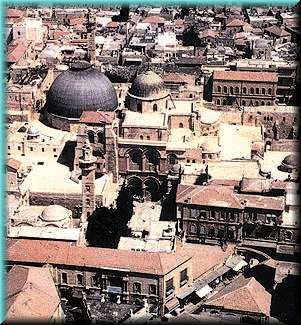
(2) archaeoloigcal evidence indicates the tomb is under the chruch of the Holy Seplechur.


this is the second argument:

One of the major Skeptical arguments against the Resurrection of Christ states that no tomb was ever venerated as the stie of the Resurrection until Constantine arbitrarily chose one in the foruth century;that the Chruch of the Holy Seplechur, the oldest traditional site, was just a fabrication. None of this is true. While it cannot be proven conclusively that the CHS is the actual tomb site, there is a strong probablity that it is, and there is good evidence to suggest this. The tradition can be traced back to the first century. Thus a tomb was venerated in the first century.

The Church of the Holy Seplechur is owned jointly by three major Christian denominations: The Roman Catholics, the Orthodox, and the Arminian Orthodox. The site was chosen and "discovered" to be the orignal tomb of Christ by Constantine in 336 AD when he accompanied his mother to the Holy Land in search of the true cross and other artifacts.


My Argument is not that we can prove that the CHS is the tomb, but that the strong probablity that it was venertaed as the tomb in the frist century, destorys the skeptical claim in books such as The Empty Tomb.The skeptics contributing to that book must disprove the possiblity of the CHS before they can dismiss historicity of the empty tomb.


My arguments will be presented in three major areas:

I. The modern site of CHS is the site Constantine chose; its place in the sourrounding city is an exact fit for the physical and social envoriment of the tomb.


II. Oral tradition guided Constantine's choice, passed down from the Jewish Christian community to the Gentile Chrsitians.

III. Modern archeaology verifies the claims of this tradition.


I. The modern site of CHS is the site Constantine chose; its place in the sourrounding city is an exact fit for the physical and social envoriment of the tomb.


A.Validation of Constantine's site two sources:


(1) The Description of the site itself


The Descriptions given by Eusebius, and by Crusaders in the Middle ages, match the actual site.

Carbo Excavation.


Chruch of The Holy Seplechur--Government of Israel site, visited 6/7/01

http://www.israel-mfa.gov.il/mfa/go.asp?MFAH00v10


"This courtyard, outside the present-day Church of the Holy Sepulcher, is partly supported by a large, vaulted cistern. The northern wall of this cistern is very impressive, consisting of large blocks with dressed margins, still standing several meters high. It has been suggested that this early wall served as the retaining wall of the second century Hadrianic raised platform (podium). This appears to support Eusebius' statement that the Temple of Venus, which Hadrian erected on the site of Jesus' tomb, stood here before the original church was built."

"The Basilica: Early masonry below the catholicon of the Crusader period was exposed during the excavations. This made possible the reconstruction of the original design of the 4th century basilica. The position of the two central rows of columns in the basilica (out of the four rows) may be determined by the remains of their foundations, which can be seen along the northern and southern sides of the chapel of St. Helena. In a small underground space north of this chapel, a massive foundation wall of the early basilica was exposed. On a large, smoothed stone which was incorporated in this wall, a pilgrim to the original church left a drawing of a merchant ship and the Latin inscription: "O Lord, we shall go." Beneath the apse of the present-day catholicon, part of the apse that marked the western end of the original church was exposed. Eusebius described this apse as being surrounded by twelve columns, symbolizing the twelve apostles."

"The Rotunda and Sepulcher:The most important element of the complex is the rotunda which contains the sepulcher itself. The sepulcher stands in an elaborate structure within the rotunda, surrounded by columns supporting an ornamented, domed roof.Some masonry remains were revealed below the floor and around the perimeter of the rotunda. Wherever bedrock was exposed, there were indications of stone-quarrying in earlier periods. The quarrying operation lowered the surface level around the sepulcher, which thus stood well above its surroundings. An architectural survey of the outer wall of the rotunda - 35 m. in diameter and in some sections preserved to a height of 10 m. - shows that it maintains its original 4th century shape. The sepulcher itself is surrounded by a circle of twelve columns - groups of three columns between four pairs of square piers. It is possible that the columns for the 4th century rotunda were removed from their original location on the facade of the Roman temple. Renovation of the piers exposed evidence that the columns had originally been much higher and that the Crusaders cut them in half for use in the 12th century rotunda.The renovation of the Church of the Holy Sepulcher is still in progress, but after generations of neglect, the building has already regained most of its former beauty.

"The survey and excavations were conducted by V. Corbo, Ch. Coüasnon, M. Broshi and others, on behalf of the Christian communities which control most of the Holy Sepulcher: the Roman Catholic; the Greek Orthodox; and the Armenian Orthodox."


(2) Description of the Edicule.


The Edicule is the little house put over the tomb to protect it, before the basillica was built. Constantine is known to have put up the first one, and it has been described and documented in many ways. Biddle Traces this developement and finds:


The History of the Edicule

ad communications.org.


"From the time of Constantine to the present day historians have been blessed with the archaeological evidence discovered showing the Edicule in its original form. The following list is only a fraction of what has been retrieved and the approximate dates of their origination.

Appearances of the Edicule (325-1009 ad)

1) 440 a.d.: on ivory casket side carving.
2) a Narbonne marble model (5th century).
3) Casket lid (6-7th century).
4) Pewter flask (6-7th century).
5) Pewter Medallion.
6) Glass Flasks.
7) Pottery Pilgrim Flask (shows Edicule and Golgotha).
8) Gold ring with the 3D Edicule on top.
9) Mosiac in the Church of St. Stephen in Jordan.
10) Bronze Censer casts (1009 a.d.)

Appearances of the Edicule (11th Century -1555)

1) Paintings.
2) Drawings.
3) Crusader Coins/Seals.
4) Models.

Appearances of the Edicule (1555-1808 ad)

1) Stone scale models.
2) Wooden models of the Church of the Holy Sepulchre with Edicule model inside.
3) Engravings.
4) Pottery.


Martin Biddle


Tomb of Chist

Israel Review of Arts and Letters

Wesite belonging to:Israel Ministry Foreign Affairs

visited 1/8/05


Biddle:Constantines edicule, the first of the four "little houses" which have covered and protected the remains of the tomb since its discovery in 325-6, was destroyed in 1009 and no fragment of it has been seen since. How then do we know what it looked like? The best evidence is provided by a replica standing about a metre high, cut in a block of Pyrennean marble, found at Narbonne in south-west France, and dating from the fifth or sixth century CE. Being cut in local marble it cannot be a direct copy of the edicule in Jerusalem, but must be based on some intermediate copy, probably itself a model rather than a set of drawings. Its evidence is therefore second-hand, but there are sufficient other sources to show that it is likely to be in architectural terms a close representation of the Jerusalem original. The other fifth to seventh-century sources are pictures in mosaic, moulded pewter flasks and medallions, the painted lid of a box of relics (found in the Lateran in Rome), images on pottery and glass, and the written records of pilgrims. All these sources present their own problems of date and interpretation, but it is a remarkable range of evidence in different media, more evidence perhaps than for any other vanished building of late antiquity. But the picture is confused by the parallel existence of completely fanciful representations, some of the highest artistic quality, in the form of ivory panels carved in Alexandria and Italy. These show idealized edicules, bearing no relation to reality, but they have confused generations of scholars. Only the objects made in Palestine, mostly probably in Jerusalem, for the pilgrim trade, or copying such local products, like the Narbonne marble, tell us what the edicule built by Constantine was really like.

Constantines edicule survived for 600 years until it was deliberately destroyed in 1009 by order of the Fatimid Caliph of Egypt, al-Hakim, in an insane and short-lived attack on the holy sites of Christianity. Within three or four years al-Hakim had relented, urged on by his mother, Maria, a Christian whose brother Orestes had been Patriarch of Jerusalem. By 1012 rebuilding had begun, and by 1014, Maria had "began to rebuild with well-dressed squared stones the Temple of Christ destroyed by her sons order."

The destruction had been very thorough: Constantines great church of the Martyrion was cut down and never rebuilt, but al-Hakims agents admitted that they could not entirely root out the tomb, and they left parts of the rotunda surrounding the tomb standing to a height of about 11 metres, as one can still see today. By the millennium of Christs crucifixion in 1030 or thereabouts, when thousands of pilgrims were again travelling to the Holy Land, the edicule and the rotunda had been put back into sufficient order for pilgrims to take part in the Easter liturgies and to observe the ceremony of the Descent of the Holy Fire.

William of Tyre, the great Crusader historian, who wrote in the 1160s and 1170s, says that the restoration was completed by the Byzantine Emperor Constantine IX Monomachos in 1048. William is our only evidence for this, and his indications of date are inconsistent. No Byzantine chronicler believed this. John Skylitzes, writing in the mid-11th century, a strictly contemporary witness, noted that the Emperor Romanos III (1028-34) "strove eagerly to take the rebuilding in hand; but his death intervened and his successor completed the work." This was the Emperor Michael IV, the Paphlagonian, who reigned from 1036-41.


Biddle traces the full history in the article (see link).


The shapes and appearances have been correlated by the Biddle excavation using advanced thechnology wihch enable the archaeologist to see inside to the orignal layer. The Ediclues was repaced many times wiht scuceeding layers, until it became onionlike, hiding an original core of Constantine's Dome, which has now been penitrated by Biddle using the most advanced technology. There is virtually no doubt that the CHS is the site Constantine chose.


Secrets of the Dead (PBS)


In addition to the traditional methods used by archeologists to study buildings, including taking comprehensive and detailed photographs and studying ancient documents and drawings, archeologists Martin and Birthe Biddle and their colleagues employed a number of sophisticated scientific techniques to examine the Church of the Holy Sepulchre and the edicule that purportedly houses the Tomb of Christ.

The primary technology used in their survey of the site was photogrammetry, which allows researchers to create two or three-dimensional images of a structure from any vantage point. The data from which the images are constructed comes from conventional or digital photographs. Not just any photographs, however; they have to include small, reflective "targets" stuck on walls or other surfaces with adhesive. The targets have cross-hairs, which allow their exact location to be measured with a surveying tool called a theodolite. From the location of the targets, an imaginary coordinate grid is constructed in and around the entire site -- within the edicule of the Church of the Holy Sepulchre, for example. "When you take your photographs you have, preferably, four of these targets in each one," says Martin Biddle. The photographs are taken in "stereopairs," overlapping images that, when viewed in a certain way, form a three dimensional image of an object. "The stereopairs are set up in a photogrammetric plotter with the coordinate values you know from your survey. Thereafter, you can plot any point in the stereo image in terms of that coordinate grid. You know the x and y and z axes -- up and down and sideways," Biddle explains. "Once you have that data in, you can instruct the machine to print out a view looking up from underneath, or down from above -- whatever way you want."


http://www.bib-arch.org/barso99/roll2.html

B. Site's Physical and Social Fit in the Jerusalem Environment


(1)Site location is right in Relation to City Wall

One of the major means of identification is through the relation to the city wall. They know where the tomb was suppossed to be in relation to the wall and that gives a vector in which to begin searching. Than there are two other peices of crucial evidence, the description by Eusebius and artifacts which link the site with the tomb.

ad communications.org

The Tomb of Jesus, where is it?


"In 1963 Archaeologist Kathleen Kenyon while digging near the Church of the Holy Sepulcher proved that at the time of the Crucificion, the Church location was outside the walls of the Old City, during a dig a 49 ft. trench revealed a quarry which was in used between the 7th century b.c. and the first century. Additional support comes from the middle 1960's where repairs were given to the Church of the Holy Sepulchre (floor) as well as a nearby Lutheran Church where quarrying evidence and pottery was uncovered. In addition to these discoveries the 1976 excavation by Dr. Christos Katsambinis revealed a cone-shaped grey rock with an incline (35 ft. high) probably the famed Golgotha which had two small caves that from a distance looked like a large skull (E.B. Blaiklock and R.K. Harrison)."


(2) Site was a Cemetary with Garden


Martin Biddle

Tomb of Chist

Israel Review of Arts and Letters

Israel Ministry Foreign Affairs


"It is not as if it was the only tomb there. Some eight rock-cut tombs have so far been found below the Church of the Holy Sepulchre. Some have kokhim (Heb.), the deep niches at right-angles to the wall into which a body could be inserted as into the drawers of a modern mortuary. At least one of these tombs (now below the Coptic Patriarchate) seems to be very like the tomb whose remains are still today covered by the edicule. Perhaps Eusebius identified the tomb now preserved within the edicule as the Tomb of Christ because it was near to Golgotha. This is suggested in St. Johns Gospel when it says that there was a "garden" at the place of Crucifixion, and that in that garden there was a tomb. But it may also have been because of the features of the tomb then discovered: a movable rolling stone, a low entrance through which it was necessary to bend down to look in or enter, and a bench on the right-hand side where Christs body could have lain and the "angel" could have sat, matched those described in the Gospel."


(3) Name Galgotha Stuck to the Site.


"Some points are crucial to note. First, the site was outside the city walls at the date of the Crucifixion in 30 or 33 CE. Second, the tomb was in an existing Jewish cemetery of rock-cut tombs typical of the Jerusalem area in the Second Temple period. Third, the place-name Golgotha seems to have lived on in local memory, despite the vast changes in the area brought about by Hadrians foundation of Aelia Capitolina in 132 CE. Before the end of the third century, Eusebius wrote in his Onomastikon, the "Place-Names of Palestine," that: "... Golgotha, place of a skull, where the Christ was crucified ... which is pointed out in Aelia to the north of Mt. Sion."

"It is only in recent years that study of Eusebius text has shown that the writing of his Onomastikon should be dated to the late third century, perhaps to the 290s, long before Constantines workers cleared the Rock of Golgotha and uncovered the tomb.

There was thus a landmark to guide Constantines workmen. They removed the Roman temple covering the site and the masses of earth and rubble forming the platform on which it stood, cleared the Rock of Golgotha and then, to their surprise, found a tomb which fitted the Gospel descriptions. The position is best put by the Israeli scholar Dan Bahat, former City Archaeologist of Jerusalem:

"We may not be absolutely certain that the site of the Holy Sepulchre Church is the site of Jesus burial, but we certainly have no other site that can lay a claim nearly as weighty, and we really have no reason to reject the authenticity of the site."


II. Site Location Handed on by Oral Tradition.


No one really knows how Contantine chose the site. Biddle thinks it was by graffiti found on the walls. Most historians beileve that the Jewish-Christian community passed on an orgal tradition telling their Genitle counterparts how to find the location.


A. Location Handed Down From First Century Jewish Christians, To Gentile Christians, to Eusebius.


New Advent
Catholic Encyclopeida
Holy Seplechur

A.L. MCMAHON
Transcribed by Robert B. Olson

http://www.newadvent.org/cathen/07425a.htm


"But nearly all scholars maintain that the knowledge of the place was handed down by oral tradition, and that the correctness of this knowledge was proved by the investigations caused to be made in 326 by the Emperor Constantine, who then marked the site for future ages by erecting over the Tomb of Christ a basilica, in the place of which, according to an unbroken written tradition, now stands the church of the Holy Sepulchre."


The oral tradition makes the most sense because it would give the clearest marker. Of course it is true that Constantine could have just chosen the site at random, or for some other reason. But oral tradition is alluded to by Eusebius, and it is validated by modern archaeology. Before getting into that, let's explore the tradition itself.


B. Tradition linked to First Century.

Several issues that skeptics will raise include: 1)the tradition only began in the foruth century, 2) That Helena just chose the site arbitrarily, 3) that the site was moved in the middle ages, 4) that legonds and "traditions" are worthless. But all of these are false. The tradition can be linked to the first century..

New Advent
Catholic Encyclopeida
Holy Seplechur

A.L. MCMAHON

Transcribed by Robert B. Olson


1) Site remembered by Jewish Christian Community after departure from Jerusalem in 60.


"These scholars contend that the original members of the nascent Christian Church in Jerusalem visited the Holy Sepulchre soon, if not immediately, after the Resurrection of the Saviour. Following the custom of their people, those who were converts from Judaism venerated, and taught their children to venerate, the Tomb in which had lain the Foundation of their new faith, from which had risen the Source of their eternal hope; and which was therefore more sacred and of greater significance to them than had been the tombs of Abraham, Isaac, Jacob, and David, which they had hitherto venerated, as their forefathers had for centuries. Nor would Gentile converts have failed to unite with them in this practice, which was by no means foreign to their own former customs.


2) Christian Community Re-established in Second Century.

"The Christians who were in Jerusalem when Titus laid siege to the city in the year 70 fled, it is true, across the Jordan to Pella; but, as the city was not totally destroyed, and as there was no law prohibiting their return, it was possible for them to take up their abode there again in the year 73, about which time, according to Dr. Sanday (Sacred Sites of the Gospels, Oxford, 1903), they really did re-establish themselves. But, granting that the return was not fully made until 122, one of the latest dates proposed, there can be no doubt that in the restored community there were many who knew the location of the Tomb, and who led to it their children, who would point it out during the next fifty years. The Roman prohibition which kept Jews from Jerusalem for about two hundred years, after Hadrian had suppressed the revolt of the Jews under Barcochebas (132-35), may have included Jewish converts to Christianity; but it is possible that it did not. It certainly did not include Gentile converts."


3) Tradition past from Jewish Christian community in Jerusalem to Gentile Christians.


"The list of Bishops of Jerusalem given by Eusebius in the fourth century shows that there was a continuity of episcopal succession, and that in 135 a Jewish line was followed by a Gentile. The tradition of the local community was undoubtedly strengthened from the beginning by strangers who, having heard from the Apostles and their followers, or read in the Gospels, the story of Christ's Burial and Resurrection, visited Jerusalem and asked about the Tomb that He had rendered glorious."


C.Trial of Witnesses from Second Century to Contantine.


1)Pilgrims.

[Ibid]

"It is recorded that Melito of Sardis visited the place where "these things [of the Old Testament] were formerly announced and carried out". As he died in 180, his visit was made at a time when he could receive the tradition from the children of those who had returned from Pella. After this it is related that Alexander of Jerusalem (d. 251) went to Jerusalem "for the sake of prayer and the investigation of the places", and that Origen (d. 253) "visited the places for the investigation of the footsteps of Jesus and of His disciples". By the beginning of the fourth century the custom of visiting Jerusalem for the sake of information and devotion had become so frequent that Eusebius wrote, that Christians "flocked together from all parts of the earth". It is at this period that history begins to present written records of the location of the Holy Sepulchre. The earliest authorities are the Greek Fathers, Eusebius (c.260-340), Socrates (b.379), Sozomen (375-450), the monk Alexander (sixth century), and the Latin Fathers, Rufinus (375-410), St. Jerome (346-420), Paulinus of Nola (353-431), and Sulpitius Severus" (363-420).


2) Eusebius.

[Ibid]
Of these the most explicit and of the greatest importance is Eusebius, who writes of the Tomb as an eyewitness, or as one having received his information from eyewitnesses. The testimonies of all having been compared and analysed may be presented briefly as follows: Helena, the mother of the Emperor Constantine, conceived the design of securing the Cross of Christ, the sign of which had led her son to victory. Constantine himself, having long had at heart a desire to honour "the place of the Lord's Resurrection", "to erect a church at Jerusalem near the place that is called Calvary", encouraged her design, and giving her imperial authority, sent her with letters and money to Macarius, the Bishop of Jerusalem. Helena and Macarius, having made fruitless inquiries as to the existence of the Cross, turned their attention to the place of the Passion and Resurrection, which was known to be occupied by a temple of Venus erected by the Romans in the time of Hadrian, or later. The temple was torn down, the ruins were removed to a distance, the earth beneath, as having been contaminated, was dug up and borne far away. Then, "beyond the hopes of all, the most holy monument of Our Lord's Resurrection shone forth" (Eusebius, "Life of Constantine", III, xxviii). Near it were found three crosses, a few nails, and an inscription such as Pilate ordered to be placed on the Cross of Christ. The accounts of the finding of the Holy Sepulchre thus summarized have been rejected by some on the ground that they have an air of improbability, especially in the attribution of the discovery to "an inspiration of the Saviour", to "Divine admonitions and counsels", and in the assertions that, although the Tomb had been covered by a temple of Venus for upwards of two centuries, its place was yet known."


Of course, Corfeld says that these pagan monuments, intended to defile the site and make it unfit for veneration, only served to mark the location, so that Christains could remember where it was by marking the pagan monument.There are more serious considerations which I do not have time to address here. I suggest that the reader click on the link above and read the entire article. But the point here is that, unlike many skeptics try to claim, the situation is not that no one ever heard of the site before Contantine; he did not pull it out of think air. There is a traceable tradition going back to the fist century.


D. Site not questioned until 18th century.

[Ibid]
"It was not until the eighteenth century that the authenticity of this tomb was seriously doubted. The tradition in its favour was first formally rejected by Korte in his "Reise nach dem gelobten Lande" (Altona, 1741). In the nineteenth century he had many followers, some of whom were content with simply denying that it is the Holy Sepulchre, because it lies within the city walls, while others went further and proposed sites outside the walls. No one, however, has pointed out any other tomb that has a shred of tradition in its favour."

Why I Do Not Find Authorship a Compelling Issue

I do not consider it necessary that the gospels be written by their namesakes in order to consider them properly canonical and inspired by God. The major reason for looking at it this way is because the Gospels are not products of any one author. This is the way modern scholarship approaches the Gospels (see Luke Timonty Johnson--Ancient Christian Writtings). Due to the redaction process, and prior to redaction the fact that the Gospel material is extracted from an oral tradition which wound up in pre Markan saying sources, each Gospel is seen as the proaction of a community rather than an individual.

This communal authorship works both for and against an Evangelical position. Adjacent an Evangelical faith, it argues that the Gospel text is not inerrent, that it has mistakes and is transmitted by unknown persons whose identities cannot be pinned down. Indeed, to many atheists that's just the same as saying the authorship credentials are worthless and the Gospels cannot be verified. It works for an Evangelical faith commitment in that it grounds authorship not in specific personalities but in whole communities. The communal nature of early Christianity is well known, but often misunderstood. The transmission of the Gospel story is seen through the eyes of skeptics as the random transmission of wild rumors. Bautlmann's work on form criticism is understood as a condemnation to any eye witness appeal, and the Gospels are dismissed as a mass of unintelligible gibberish. But in reality, a lot of good work has been done on understanding early community as a controlled environment for the dissemination of information.

The best work for beginning this process of understanding is that of Oscar Cullman's The Johannine Circle(Philadelphia: Westminster, 1976) that first proposed the Johoninne community as a control environment, and much has been done sense then on that theme (see also:Robinson, James M. "The Johannine Trajectory," in: idem and Helmut Koester, Trojectories Trhough Early Christinity, Fortress Press 1971).A Doctoral dissertation at University of Dallas in the 1980s, The Mattrnew School, analyzed Matthew as the product of a community. When I say community I mean a commune. We know from Acts that the early Jerusalem church pooled their belongings and lived together and broke bread daily to study the teachings of Jesus and the OT prophets. Most scholars today argue that it was out of this time and place that the understanding of Jesus as messiah and his death as atonement were worked up and applied to the tragic events that galvanized the community of his followers, and having discovered this happy spin, some scholars argue, the resurrections stories for were forged. Of course that assumes the resurrection even didn't happen. On the other hand, there is no particular reason why one can't reverse the process; out of the realization of a risen savior the church used this communal structure to being a process of transmission which safeguarded the testimony of the community.

Oral cultures do not create oral traditions Willie Nile. Oral traditions are both constructed and passed on out of a very careful process. The passing of oral tradition is highly contextualized. They don't just allow anybody to stand on a street corner and make up some new story. Only officially recognized bards or story tellers can pass on the information. In cultures where the oral tradition is more than bardic, the information is relied through Rabbinical or other teaching authority. It is highly likely that the early communities, as they fragmented around Jerusalem, Samaria, and Antioch the verus members of that original community split off and went to live with the verus Christian communities. They guarded the transmission of the events surrounding Jesus' life and death and resurrection and most likely corrected errors of misspellings. The main thing is, this only had to go on for 20 years. After that point the testimony became written and the safeguarding was all in the test.

Of course I can't prove that this is really the way it happened. But it is most likely because there was a whole community, if we believe that Gospel accounts which witnessed the risen Christ and that's probably where Paul's 500 come in. This was the community Bethany where Jesus and his disciples stroll in the last couple of chapters of Luke just before the assignation. We also have a community in the Galilee where much of Jesus ministry took place, and we have one in Jerusalem where the last part took place. In each of these locations whole groups of people would have been part of the events and witness to Jesus preaching and teaching, and miracle working. It is the whole community of the early faithful that produced the Gospels through this process of oral tradition and redaction, and they were working from a carefully controlled process through which real eye witnesses corrected the mistakes of transmission.

Evangelicals do not like this idea because it departs from the old familiar truth tree. The truth tree was asserted by Josh McDonnell and seemed to give a much needed credibility to the Gospels. That was a major factor in getting my attention as a young college atheist, way back when. But the truth tree was an old argument which McDowell resurrected. It was first established by second century Orthodoxy and was never as clear cut and dried as McDowell would have us believe. Be that as it may, there are indications that some authoritative eye witnesses stand behind each of the Gospels, yet they do not have to be the ones traditionally assigned. For example, I am convinced that the author of John was an eye witnesses to Jesus life and ministry but that he was not the Apostle John. Clearly he was someone to whom the original community attached a great deal of significance, someone who had seen the original events unfold. The Elders of the community make a big deal out of who he was, and material of John is so heavily redacted it seems clearly to be the production of a greatly debated body of teaching that had been circulating through its respective community for a long time. I think the most likely candidate for authorial of the fourth Gospel is the Elder John of whom Papas speaks. He was a disciple although not the Apostle. He may also be the author of the epistles of John, who does call himself "the Elder." The difference in style is accounted for by the redaction process. the Elders of the community at the end of the book make it clear that they are compiling the teachings of this amazing person, this beloved disciple. So they are not recycling his words like notes at a college lecture. They are unpacking the summary of a very long and intenseness berate process that has torn a community apart. I'll say more on that but one can read about it on my John Page.

Matthew was most likely a narrativeal structure placed over the oriental saying source constructed by the Apostle Matthew. That can't be proven, but it makes sense given the testimony of Papias concerning the "loggia." But it is not necessary for the actual Apostle Matthew to have had anything to do with the book for it to be inspired. Even if we can't defend the specific personalities involved, there is no reason to about the basic information based upon the idea of community as author.

Evangelical apologists are sometimes uncomfortable with this notion of communal authorship. Some of them site the notion that its' too "liberal" (the evil buzz word). It caters to the enlightenment notion that the Bible has to have verification of logic, reason, and historicity. But when we look at what Evangelical scholars are doing, they are more often than not using these same ideas to verify the autoharp. That's why Layman is doing, and I dot' think he would have a problem with doing that, to the extent that it can be done; as I have no problem with asserting one's faith in the authorship of the namesakes. It's all a matter of what we think will reach people. I have never seen obscurantism reach any skeptic. It's true because it's the word of God and that's you need to know, is not a useful apologetic ploy. Either defending traditional authorship or not, I have no problem either way. But I dot' find it necessary to do so.

a more detailed expalination from my stie "Doxa."


Community as Author


We do not have to know the exact identity of the authors, because the original material comes from the community itself


A.Eye Witness check in Community.


B.Oral tradition was not uncontroled.

Oral tradition in first-century Judaism was not uncontrolled as was/is often assumed, based on comparisons with non-Jewish models. From pg. 53-55 in B.D. Chilton and C.A. Evans (eds.), "Authenticating the Activities of Jesus" (NTTS, 28.2; Leiden: E.J. Brill, 1998):


"...[T]he early form criticism tied the theory of oral transmission to the conjecture that Gospel traditions were mediated like folk traditions, being freely altered and even created ad hoc by various and sundry wandering charismatic jackleg preachers. This view, however, was rooted more in the eighteenth century romanticism of J. G. Herder than in an understanding of the handling of religious tradition in first-century Judaism. As O. Cullmann, B. Gerhardsson, H. Riesenfeld and R. Riesner have demonstrated, [22] the Judaism of the period treated such traditions very carefully, and the New Testament writers in numerous passages applied to apostolic traditions the same technical terminology found elsewhere in Judaism for 'delivering', 'receiving', 'learning', 'holding', 'keeping', and 'guarding', the traditioned 'teaching'. [23] In this way they both identified their traditions as 'holy word' and showed their concern for a careful and ordered transmission of it. The word and work of Jesus were an important albeit distinct part of these apostolic traditions.

"Luke used one of the same technical terms, speaking of eyewitnesses who 'delivered to us' the things contained in his Gospel and about which his patron Theophilus had been instructed. Similarly, the amanuenses or co-worker-secretaries who composed the Gospel of John speak of the Evangelist, the beloved disciple, 'who is witnessing concerning these things and who wrote these things', as an eyewitness and a member of the inner circle of Jesus' disciples.[24] In the same connection it is not insignificant that those to whom Jesus entrusted his teachings are not called 'preachers' but 'pupils' and 'apostles', semi-technical terms for those who represent and mediate the teachings and instructions of their mentor or principal.
[25]

------------------ 22. O. Cullmann, "The Tradition," in Cullmann, The Early Church (London: SCM Press; Philadelphia: Westminster, 1956) 55-99; B. Gerhardsson The Origins of the Gospel Traditions (Philadelphia: Fortress, 1979); H. Riesenfeld The Gospel Tradition (Philadelphia: Fortress, 1970) 1-29; Riesner, Jesus als Lehrer.

23. Rom 6:17; 16:17; 1 Cor 11:2, 23; 15:3; Phil 4:9; Col 2:6-7; 2 Thess 2:15; 3:6; 2 Tim 3:14; Titus 1:9; 2 John 9-10; Jude 3: Rev 2:13, 24. Cf. Abot 1:1; Philo, The Worse Attacks the Better 65-68. 24. John 19:35; 21:24-25; cf. 13:23; 18:15-16; 19:26-27; 20:1-10; 21:7, 21-23. Cf. J. A. T. Robinson, Redating the New Testament (Philadelphia: Westminster, 1976) 298-311. 25. On parallels with other rabbis and their disciples and other Jewish usage cf. Mark 2:18 = Luke 5:33; K.H. Rengstorf TDNT 1 (1964) 412-43;.TDNT 4 (1967) 431-55.

Also, there wasn't an necessarily a long period of solely oral transmission as has been assumed:

"Under the influence of R. Bultmann and M. Dibelius the classical form criticism raised many doubts about the historicity of the Synoptic Gospels, but it was shaped by a number of literary and historical assumptions which themselves are increasingly seen to have a doubtful historical basis. It assumed, first of all, that the Gospel traditions were transmitted for decades exclusively in oral form and began to be fixed in writing only when the early Christian anticipation of a soon end of the world faded. This theory foundered with the discovery in 1947 of the library of the Qumran sect, a group contemporaneous with the ministry of Jesus and the early church which combined intense expectation of the End with prolific writing. Qumran shows that such expectations did not inhibit writing but actually were a spur to it. Also, the widespread literacy in first-century Palestinian Judaism [18], together with the different language backgrounds of Jesus' followers--some Greek, some Aramaic, some bilingual--would have facilitated the rapid written formulations and transmission of at least some of Jesus' teaching.[19]" (p. 53-54)

------------------ 18. Cf. Josephus, Against Apion 2.25 204: The Law "orders that (children) should be taught to read."; cf. idem, Ant. 12.4.9 209; Philo, Embassy to Gaius 115, 210, Further, see R. Riesner, Jesus als Lehrer (WUNT 2.7; Tubingen: Mohr [Siebeck], 1981; 4th ed., 1998) 112-15. 19. Jesus had hearers and doubtless some converts from Syria (Matt 4:25), the Decapolis (Matt 4:25; Mark 3:8; 5:20; 7:31), Tyre and Sidon (Mark 3:8; 7:24, 31; Matt 15:21).

N. T. Wright, critiquing the Jesus Seminar's view of oral tradition as uncontrolled and informal based on some irrelevant research done in modern Western non-oral societies writes:

"Against this whole line of thought we must set the serious study of genuinely oral traditions that has gone on in various quarters recently. [65] (p. 112-113)

--------------- 65. For example, see H. Wansbrough (ed.), Jesus and the Oral Gospel Tradition (JSNTSup 64; Sheffield: JSOT Press, 1991), referring to a large amount of earlier work; Bailey, "Informal Controlled Oral Tradition," 34-54. The following discussion depends on these and similar studies, and builds on Wright, The New Testament and the People of God, 418-43; and idem, Jesus and the Victory of God, 133-37.


"Communities that live in an oral culture tend to be story-telling communities. They sit around in long evenings telling and listening to stories--the same stories, over and over again. Such stories, especially when they are involved with memorable happenings that have determined in some way the existence and life of the particular group in question, acquire a fairly fixed form, down to precise phraseology (in narrative as well as in recorded speech), extremely early in their life--often within a day or so of the original incident taking place. They retain that form, and phraseology, as long as they are told. Each village and community has its recognized storytellers, the accredited bearers of its traditions; but the whole community knows the stories by heart, and if the teller varies them even slightly they will let him know in no uncertain terms. This matters quite a lot in cultures where, to this day, the desire to avoid 'shame' is a powerful motivation. "Such cultures do also repeat, and hence transmit, proverbs, and pithy sayings. Indeed, they tend to know far more proverbs than the orally starved modern Western world. But the circulation of such individual sayings is only the tip of the iceberg; the rest is narrative, narrative with embedded dialogue, heard, repeated again and again within minutes, hours and days of the original incident, and fixed in memories the like of which few in the modern Western world can imagine. The storyteller in such a culture has no license to invent or adapt at will. The less important the story, the more the entire community, in a process that is informal but very effective, will keep a close watch on the precise form and wording with which the story is told. "And the stories about Jesus were nothing if not important. Even the Jesus Seminar admits that Jesus was an itinerant wonder-worker. Very well. Supposing a woman in a village is suddenly healed after a lengthy illness. Even today, even in a non-oral culture, the story of such an event would quickly spread among friends, neighbors and relatives, acquiring a fixed form within the first two or three retellings and retaining it, other things being equal, thereafter. In a culture where storytelling was and is an art-form, a memorable event such as this, especially if it were also seen as a sign that Israel's God was now at last at work to do what he had always promised, would be told at once in specific ways, told so as to be not just a celebration of a healing but also a celebration of the Kingdom of God. Events and stories of this order are community-forming, and the stories which form communities do not get freely or loosely adapted. One does not disturb the foundations of the house in which one is living."[B.D. Chilton and C.A. Evans (eds.), Authenticating the Activities of Jesus (NTTS, 28.2; Leiden: E.J. Brill, 1998) p. 113-115.]


Summary:

In addition to all of this we have corss referencing with the Pauline Corpus and with extra cononical sources. What all of this tells us is that the transmission process kept a stable and reiable body of inforiation in circulation to the time of writitng the texts. This time of texts Kosters places at AD 50 and Corsson and others back him on this. See Helmutt Koster's Ancient Christian Gospels for a brilliant exposition on these sources. What all of this amounts to is the unfolding of a complete defense of the historicity of the Gospels without the truth tree of torch passing from teacher to student. Becasue the studnets are the community tiself, and the community then becomes the teacher. But all of thse had to be kept in place only 20 years, and to that point eye witnesses would still have been alive. There is validation in the historical sources of the Pauline Cropus. IN other words we know there was a Peter, and Peter was a major player in the original events, he lived in Paul's time, met Paul and was able to relate his information to Paul. Thus the total body of sources backing the histoircity of Godples includes:

(1) Texts themselves
(2) community as author
(3) Pauline corpus
(4) extra cononical works themselves
(5) Pre Markan redaction refleted in readings of the Diatesseron
(6) works of Apostlic fathers.

If all of this seems far too empirically bassed for the pure of heart, it is the bread and butter of modern apologetics. In short, liberal textual ciriticism is useful. Stop throughing stones and start making use of it.

About the Gay Issue

I havent' said this because I feel that I shouldn't have make protestations about my own oreintation. If I do, it looks like I"m defensive. But now I will becasue I have a point to make. (Nuc nuc nuc).

I have always had a visseral reaction round gays (when more than one is present).I can with one indiviudal friend who is gay the topic never comes up and we have a good converstation. But in a crowd of gay people, or in the home of a gay couple, when they began rubbing and stuff, I feel very uncomfortable. I used to have occasion to hand out with gays in my political activist days because they were an important part of our little leftie coalition in Dallas. You can well imagine how, in Dallas Texas, a leftist coalition can ill afford to lose any members.

Eventually I came to realize that I felt that visseral reaction becasue I'm not gay. That doestn' mean they are bad, it means that's not for me. Being the mature person I am, I don't confusse that sense of turned offness with any kind of actual proof about God's will or the eternal state of gay people.

I think the real acid test of knowing you aren't gay is that you aren't attracted to people of your own sex. But I find in arguing with certain funamenatlists, they seem to constantly imply that I am gay! They just assume so, even when I flatly deny it. This is the frsit time I defended this position that the Bible doesnt' condmen it. I denfeded it on a popular Christian message board, and some of the other side kept sticking in little implications. One guy thought he had to keep making brave manly statments like "we wont let you corrupt our children."

This same guy blurted out "that's why you hate the book of Jude." (!)(???) where that came from I will never know. I said nothing about hating the book of Jude, and I promise, I do not hate the book of Jude. I have opinions on it, some I'ms sure our stalward defender of sexual morality will not appreciate, but I certainly don't hate it.

the thing is, this peranoid reaction tells me more about him than it does about the issues. I mean so much peranoid knee jerk reaction one starts to get the idea that they are trying to convence themselves. "I'm not gay! Not like you are, no! Nope! no I'm not, don't even think that, I'm reallly not!" What does that suggest?


The Biblicality of the issue revolves around the status of impurity vs. real sin. In trying to research this topic I discover that there aer only a couple of impurities which have death penutly as their prescrition. But there is only one that is in Numbers or Leviticus and not repeated in Dueteronomy. That would be this activity. So while the issue is very serious, since in one book death is the penalty, that still doesn't make it a sin. I wonder if the real upshot of that isn't a civil matter. In other words it was considreed a civil violation and not a religious one.

btw I don't like watching hetero couples who are on the verge of making out in public either, but I think that's a different thing. I feel that they are showing off.

OK I have a sudden urge to watch a Judy Garland movie now.

God argument no1

Now go through the steps one by one and show me what's wrong with my logic?

Being Has to Be.


A. Logic of the Argument.

P1)Nothingness as a putative state of affiars (PSA) is impossilbe;it is a contradiction in terms since a PSA is something and thus cannot be total absolute nothingness.

P2)The concept of Nothingness as PSA is incoherent; What would total absolute nothingness mean? Even when Physicists speak of "nothing" they don't mean real absolute nothingness.

P3) If Nothingness were the PSA nothing could ever come to be; it cold not rise in time because time is something and thus the PSA would already contradict itself; it could not rise beyond time, since there is no change or causality beyond time.

P4) Thus, Nothingness cannot be a PSA, and therefore, something must have always been for all eternity.

P5) Since this "Something" has to be eternal, it must be necessary and without cause; Being Itself is the logially necessary candidate since the nature of Being is to be.

P6)Therefore, Being Itself, or the Ground of Being is eternal, uncreated, necessary being, and must be the thing that has given rise to all other things that come to be.

P7) These attrbutes, necessary, eternal, fist cause, creator of all that is, are the very crucial attributes of God.

P These attributes are mutually exclucive, that is, they could only be held by one enetity, and cannot shared in the same way at the same time; this can be seen immidately from the logic of he case; how could there be two grounds of being? How could there be two first causes or two things that are logcially necessary to have been the PSA?

P9) Therefore, God and the Ground of Being, or Being Itself must share identity.

P10) Since we Know that Being is, we know that God is.
Metacrock: Have Theology, Will Argue!

Wednesday, June 15, 2005

New Controversy

Something I've been studying, becasue I've seen so much animosity unfolding in the chruch.

We have reached a time in the history of the chruch when we have got to stop tearing the chruch apart in a civil war over conflicting issues of morality. We must simpley cease demonizing those who do not think as we do. We must cesase meaningless prattle about how clear the truth is and strating to understand the other person. Try to think "maybe they have a reason for seeing that way."


OK Im still not committed to a position, but in the interest of showing people that nothing is as cut and dried as we sometimes think they are, as a cautionary tale against pride in the clear cut, I will show that the verses that seem the most anti-gay really give pause.


Romans 1: 18-32

the problem here is that the words used to suggest the moral status of homosexual acts are actually not words connoting sin, but impurity. You probalby assume as I once did that impurity equals sin, such is not necessarily the case. for example, going to a furneral would make a Jew unclean, or impure. Now does that mean we are going to hell everytime we go t a funeral? We have to get square again to get back in God's grace form the wretched abominable state of funeral going?

How many Evangelicals mix two fabrics in the same garment? Let their wives go to chruch in new dreses with make up and jewelry? These are things that were described as impurity in the Levitical code. Why do we not morun and put a stop to them and call those who do them inhuman and austrocize them?


"For the wrath of God is revealed from heaven against all ungodliness (asebeia) and wickedness (adikia) of those who by their wickedness suppress the truth. For what can be known about God is palin to them, because God has shown it to them. Ever since the creation of the world his eternal power and divine nature, invisible though they are, have been understood and seen through the things he has made. So they are without excuse; for though they knew God, they did not honor him as God or give thanks to him, but they became futile in their thinking and their senseless minds were darkened. Claiming to be wise, they became fools; and they exchanged the glory of the immortal God for images resembling a mortal human being or birds or four-footed animals or reptiles.

"Therefore God gave them up to the lusts of their hearts to impurity (akatharsia), to the degrading (atimazesthai) of their bodies among thmeselves, because they exchanged the truth about God for a lie and worshipped and served the creature rather than the Creator, who is blessed forever! Amen.

Notice at this point they already had the sin, and homosexuality is not counted among the sinful things, but as impurity. First they had the sin, then they are given over to impurity. The upshot of impurity is no holiness=not knowing God. Note, given over to impurity it says they didn't know God. But it doestn' count with the actual sins.

"For this reason God gave them up to degrading (atimias) passions. Their women exchanged natural (physiken) intercourse for unnatural (para physin), and in the same way also the men, giving up natural (physiken) intercourse with women, were consumed with passion one for another. Men comitted shameless (dishonorable)(aschemosyne) acts with men and recieved in their own persons the due penalty for their error.

"And since they did not see fit to acknowledge God, God gave them up to a base mind and to things that should not be done. They were filled (pepleromenous) with every kind of wickedness (adikia), evil, covetousness, malice. Full of envy, murder, strife, deceit, craftiness, they are gossips, slanderers, God-haters, insolent, haughty, boastful, inventors of evil, rebellious towards parents, foolish, faithless, heartless, ruthless. They know God's decree, that those who do such things deserve to die-- yet they not only do them but applaud those who practice them."


Of course we all know that only gays are prideful and ruthless, foolish ect ect. right? certinly hetero's are never that way. Of course you know I"m kidding. So we all know gays that do NOT fit this discrition, we all know heteros who do. So that is NOT a sing or a way to tell, it is not indicative of what gayness leads to.

But he's talking about human deprativty he's going to wind up telling the reader that we are all depraved and we cannot make ourselves rigetous by keeping the law. along the way he dsecribes a degeration of humanity from knwoing God to idolotors, but we read ito the mix the assumption that homosex is the very worst thing, and so when it comes to that he must be describing the worst thing on earth, right? Wrong.

Its not that clear cut because the words that pertain to homosexual relations used above do not petain to actual sin. The verse Paul speaks of lesbians is the only one in the bible that pertains to them.

The words pertain to that which is unnaural. We assume unnatural equals sin, but that can never be demonstrated in scripture. Moreover, it doesn't mean "Unnatural" In the sense that it's agaisnt physicla nature, it means unnatural for us in a cutlural sense.

taken for example the word (physiken) that is used to describe the kinds of realtions given up by the women in exchange for the wrong kind, the woamn on woman which is (para physin). Both come from the word "phsysis" or Phusys, meaning the natural or relam of nature. (we get our workd "phsics" from those words). para Phyusin just means "not natural." para has many meanings but it can mean the oppossite of something. Well this term doesnt' mean necessarily natural as in contrary to the laws of nature. But means natural as in easy, expected, appropriate. In other words, if it is ashamed for a man to have long hair, it isn't because his hair wont grow, it's because it is normal and expected that he should cut it.

in other words, the term applies to that which is culturally acceptabel. Para Physin applies to that which is not culturally acceptabel. So he's saying that after beign loaded up with iniquity because they turned their backs on God, they then turned to starnge pracitces which the Jews find wired, but not necessarily saying those practices are sinful.

the point of his discourse is not to show homosexuality is wrong, but to show us that we are not capable of bineg holy without God's grace. That is why he ends the passage by saying "you who criticize these people for these things do you do things just as bad, "you are not an idolotor, do you rob temples?"


Another verse that seems on the surface, the way it's translated to issue a blanket statment that homsexuals are among the most viel and will go to hell, turns out ot be very ambiguous and not at all clear cut.


1 Corinthians -10


"Or do you not know that the unrighteous shall not inherit the kingdom of God? Do not be deceived; neither fornicators, nor idolaters, nor adulterers, nor effeminate, nor homosexuals, {1Cr 6:10)
Nor thieves, nor covetous, nor drunkards, nor revilers, nor extortioners, shall inherit the kingdom of God."


Let's look at two key words in this text:


Effiminate = Malakos:


soft, soft to the touch
metaph. in a bad sense
effeminate
of a catamite
of a boy kept for homosexual relations with a man
of a male who submits his body to unnatural lewdness
of a male prostitute


Homosexual = arsenokoites:

"abusers of self with minkind" or more intelligent than Strong's "those who defile themselves with other men."

Do we know that that is actually talking about Gays? Well, it could be. But if you consider male prostitutes or the kinds of relationships the greeks had, it's not necessarily just talking about any "gay" men. It may not even really be refurring to homosexuals at all, but giving the translators some benifit of a doubt, it could be more speicific than just any gays.

That's the out that I see on either passage; it could be talking about prostitutes and not faithfull metro chruch goes who remian monogomous with each other.


Here's another odd thing about the issue. In the verse under discussion above Paul uses the term Malakos (effeminate). One possible defintion is that of a boy kept for homosexual purposes by an older man. So he says this guy wont make it into the kingdom. But, why not the older man? Why would the boy be the villian? Why not the older guy?

That could be what he means by "those who abuse themselves with others." But then this could change the interp either way. It lends credence to the idea that the homosexual act itself is wrong. It also means Paul is speaking specifically about the kinds of relationships the greeks had and not just any gay relationship.

The latter is more likely, since the only reason to conclude the former would be to put the emphasis upon the act itself, but I dont' know that the word does that; by including both the members of the pair, he seems to be condmen whole relationship, which was maked by force, impossition of a powerful figure upon a socially weak figure who had no choice, and inapproriate age grouping, where older man uses young boy. By including both members he seems to be commenting more on the dynamic of the relationship rather than the actual act.

So the upshot is:

(1) where Paul discusses the actual beahviors and desires of homosexuality, he seems to conmden them only as violations of impurity laws, not as actual sin.

(2) where he does condmen homosexuality as sin it seems to pertian more to the reltaionship dynamic found in ancient greaco-roman soicity not just any homosxual desire per se. To that extent, the use of a young boy as a male prosititute seems to be the kind of things he's condmening.

To that extent are we so sure about condmening some gay couple who faitfully attend a metro chruch, who truely believe in christ and who are not invovled in a wild and gross life? Of course we can believe they all are and let our imaginations run wild, that tells me more about us than it does "them."

Tuesday, June 14, 2005

Tiny Thinker Challenges

Tiny Thinker is one of my oldest and best friends on the net. He's a Buddhist, or an agnostic with Buddhistic leanings. He challenges the article I wrote just below, and I answer him. He felt this was best done on his message board, so here's a link to that discussion:

Tiny's Challenge

Have I Denied God?

On CARM apologetics, someone was arguing that the YEC time line for civilization didn't make sense compared to the "real" time line anthropologists have pieced together. He argued that the world couldn't go from everyone on earth knowing God sent the flood and had Noah make the ark, to total polytheism, error and deceit (again) in just 299 years. He based that time frame on taking the genealogies in Genesis literally and assuming that children were born when the father's were young. Thus Ham's 500 life span overlapped with others and put him into the time of Abraham. So why wouldn't anyone listen to him?


That's actually a cogent argument, against a YEC, and why I am not a YEC (part of it). But his conclusion was that "Y" (the God of the bible, God of Ab, Isaac, Jacob) was just a myth derived from the polytheistic sources. Now that in itself is a pretty interesting problem. Because isn't it odd that the little old Jews, slaves in Egypt perhaps, or just hangers on among other Semitic tribes in the Levant, would come up with occam's razor a couple of thousand years before Occam? But I'm getting ahead of myself. Why would the Jewish monotheism by Occam's Razor? The Razor is basically the idea that we should not multiply entities beyond necessity. In other words, why stack up the idea of an essence of trueness to make trees be trees, when the basic facts that make trees require only the characteristics of trees and not some special additional quality of "trueness?" Thus, in cutting away all the other members of the various mid eastern pantheons and getting down to the heart of the matter of being; one all powerful, all knowing, all present creator God who tells Moses (at least in the LXX) I am being itself.

So the monotheistic approach is evidence of true religious genius on the part of the Jews, and yet the atheists don't see that as an advance, must less do they comprehend the argument, how could a race of religious geniuses be wrong?Be that as it may, the original argument still deserves an answer. How did human religious thinking move from this brilliance of, "one is all we need, so don't multiply gods beyond necessity," to vast polytheistic schemes, only to find the one again? Could that really be the way it would go? If so, what does that say for "Y" (Or "J") the God of the Bible? Should he have been known to everyone on earth from the beginning, and if known why would he himself be forgotten again, as in the time of the flood? This seems especially odd if there were fold people still around, Noah's kids.

My answer was that religious consciousness evolved slowly and from a primitive state, like all other thinking. It would have been natural to our preter human ancestors who were more in touch with nature wildlife than we are, and would have gradually become sharp over time to take on the personality and kingly qualities of the "God of the Bible." But wait! Isn't that just out and out giving up? Isn't that just admitting that the God of the Bible is a myth and that the atheist evolutionary account of religion is right? No! Of course not. Did any of you really think I was going to say that? On CRAM I said the literary image of "Y" is a metaphor for the true creator, and that this cultural image of the King of Heaven developed over time with the idea of heave itself. The stories of the Suzerain and Akkadian creation and flood are obviously the source of the Genesis creation myth, and are clearly must older. So its no doubt that Hebrew thinking and religious understanding developed out of the previously existing clutters and religious traditions of the fertile crescent, and developed over time. But it is a safe bet that no one worshiped "J" or "Y" by name during that pre-Israliate era.
No one on CARM has as of yet taken up the problem with my answer and offered a challenge. I expected the YEC's and fudies to challenge from the standard ponit that I"m denying the God of the Bible, and the atheists from the stand point that the God of the Bible can't be defended.

So I'll take up these challenges here. Am I not giving up the God of the Bible to reduce God to that of a literary metaphor? And how can the God of the Bible be defended when he derives as myth historically from other religious systems? Let's don't forget, God says, in the Bible, "I will not give my glory to another." Much is made of the name of God, so the name, the identity, the thing I'm calling "Metaphor" and saying developed over time, seems to be very important to the Bible. It's a crucial act of Deity in the Bible.

Fallacy of "God of the Bible."

This is a point I've tried to get across for a long time. The atheist and message board way of thinking has left its indelible mark in the form of this kind of thinking; "the Christian God," "your God," "the God of the Bible." But it's a fallacy to speak of all these differing gods as though they are all sitting in the "green room" Of ontology waiting to go on stage on some sort of metaphysical talk show that will give them existence. They are not competing possibilities; they are all different ideas about the same thing! That's the point about being itself. God is not one example of a huge category consisting of multiple possibilities. That's what it means to say "a god" as opposed to "God." If we deal with contingencies, any given contingency could be replaced by another. I have "a penny" but it doesn't have to be this penny that I hold in my hand, it could be any penny. It's one of many, its "a penny" because its' not "the penny." But God cannot be replaced. That's the fallacy of those atheists, God is not a contingency waiting to exist in a field of other possible gods. God is the only God there could be, we just all have different ideas about "him." Those ideas are different because they are filtered through our cultural constructs, but they are all born of wordless, imageless mystical experience that we experience at the most basic level of consciousness. Thus we are not dealing with a possibly of God...we are dealing with the only God there is or could be, not "a God" but God. Not "a being" but a category above our contingency, "being itself." This is the thing that being is, it is to be the will of this from of existing consciousness.

Specific God Personality: and Jesus

But what does this mean for "Y" the God of the Bible? Dose it mean that the name and the glory that attaches to that name can just as eaisly be dished out to MIthras or Buddha or Brahmin or whoever? Does it mean the voice that says "let there be light" is not the same as the figure who appears to Abraham to tell him Sarah will conceive? Does it mean that the entity which covenanted with Abraham is just a metaphor, just a made up figure like Santa Clause who is only loosely based upon a half backed reality we can never pin down? Of course not! Because this concept of God, as portrayed in the Bible (rather than "the God of the Bible") linked to the concrete historical figure of Jesus of Nazareth. That links the character we see coming through the prhopets and the name we are given by the prophets with the actual representative of God on earth and links the identities together as indicative of the true reality spoken of as "being itself." That's why the name and glory are important, not because God is an ego maniac, which is suggested by immature skeptics all the time, but because it gives us a highway marker to associate the creator, the deity encountered by the people of Israel and Jesus of Nazareth all together as one reality.

Where does Myth Come in?


What about that Metaphor which I said developed over time and grew up with the Israelites? If "Y" is the reality of being itself and manifested himself as Jesus, where is the metaphor I spoke of? Well, first of all, in accepting that skeptic's assessment, we are getting ahead of ourselves. He wants to make a problem out of the fact that on one knew to Call God "Y" until the OT came out, or that no one knew to call God "I am" until Moses. So if these figures are not derived from human history all along, the assumption goes, then the whole fabric of the Bible must have been made up at some point in history and must be dependent upon forerunners. But the deceptive aspect is that anything in a text is a metaphor because all linage is metaphorical, and all religious language in particular is analogical; so it's all metaphor to begin with, and that doesn't separate it from the reality that the metaphor represents. The metaphor is found in the expectations we put into the symbol or the cypher that stands for the reality that the Biblical authors experienced. Some prophet may go up on a hill and what he experiences in prayer he cannot communicate clearly and we will never know what he really felt, saw, smelled, understood, but what comes out is a long diatribe against someone, for someone, pleading with a group of people to think and act a certain way; we fill that indication with expectations about God the king on a throne with a white beard. So the metpahor really exists in our heads and not on the pages of a text. In the text the find the literary element, but in our minds we carry with us the metaphorical image which is our individual understanding of God. That metaphor is wrong, and it has a history, it didn't exist before a certain time, but the thing it pertains to is not wrong and not false.

We should not find it strange that the idea of a particular personality of God and a name developed slowly. Nor should we find it strange that for millions of years there were no terrestrial beings on earth who knew that name. The earliest clear delineation of divine reality was probably some nameless feeling connected to a thunderstorm of something, it meant nothing to anyone, but stood apart form other nameless nothings connected to other forms of weather. But the Bible seems to imply sharp movements of revelation when some person, Abraham or Moses came to understand God in terms never before understood. No one else had ever been old "I am that I am" is his name. No one else had ever been told to go off into the wilderness and find a promised land. Let us not forget we don't know his real name. It cannot be prouneced and even the name we do have (which I write only as "Y"--which it isn't) is not the full name, but the name without the vowels--so that the "God of the Bible" is truley a mystery even to those follow. We do have hints of God reaching people in other religious systems. I've always been fascinated by Melchizadeck, the priest of Salem (pre-Israelite Jerusalem). He is described as "a preist of God most high" and yet, not connected to Israel or the Jews, what group worshiped that God? Would they have been worhsipping him as some pagan deity with a wired name and a carving in stone? We can't know. What we can know is, here was a guy, who was said to be an actual preist of the true God, who was worshipping God prior to the personaity of the "Bible God."

The only logical conclusion is that there is a reality to God that transcends culture and religious tradition and is not found just in the pages of the text. That reality has always been around as long as humans have had hearts. My only task as an apologist is to persaude atheists to be open to experiencing that reality, and to consult the text as a general guide.

Wednesday, June 08, 2005

What I can't get Christians to Face Squarely

i say this a lot, but no seems to grasp the import of it. There is no passage where we are told to make a Bible. There is no Biblical verse that says "Make unto theyself a Bible." There are passage where they speak of texts, and where they speak of writings, there are a couple of passages that the community of faith has a set of books, but no real passage where it says "thou shalt make a bible."


The Closest thing we have to that may well be "All scritpure is Godbreathed." But taht doesn't tell us what we should understand as the body of scritpure. Since it was written (by Paul) before the even close of the Hebrew canon (council of Jamnia, 90 AD) there was no closed set of works which one might understand as "scripture." Now we can reasonably infur that it means the body of works authoritatively consulted by Jews for thei religious observances, which would clearly include the pentatuqe and at least some portions of the Tenoch (that means the frist five books of OT and some of the prophets). But it might also include things we don't even have now, or ideas we know nothing about. It might even include the oral traditions that became part of the Talmud, the mishna for example, the Jerusalaem Talmud.

Certinaly when Paul wrote that prhrase he was not thinking of a NT canon at all. So the whole idea of Scripture for Paul lacks a NT. The Christian canon was totally a matter of the Bishops decisons in councils that weren't even dermpt of when Paul wrote that phrase.

My point is that we cannot see the Bible as God's memo to the empolyees of a vast company, which I'm afraid is really how most Christians see it. We cannot embrace any sort of verbal plenary inspritaion because that would assume ideas that are not just given. This doesn't mean we should give up on the Bible. It means we should learn to see it as a collection of writtins which are human in nature, and which testify to the divine/human enconter.

Tuesday, June 07, 2005

Salvation and Other Faiths

Two corrections or clearifications to make before you read:


(1) I include atheists and agnostics as "other faiths."

(2) when I say hell = seperation from God I do believe in annihilation for the unbeliever, not hell fire and brimestone or conscious never ending torure. I don't beleive in this as a "punishment" but as a consquence of a choice people make. But I think there will be a point at which we know we face that end, and that creates the sense of seperation that serves as punishment for those who really deserve punsihment, like Hitler and Reagan.


Here's my essay from Doxa:


II. Is Belief in Salvation Unfair to Those of Other faiths?


A.Salvation unfair?


1) Well meaning people will not be saved?

Many good and well meaning people do not feel the need to be saved. Some wonder why is it not enough to jut be good and well meaning. Surely God knows that we are well meaning, if God looks upon the heart, so why do we need to conform to the ideological strictures of a particural religious view? Wouldn't God be extremely unjust to condemn someone who was well meaning? And aren't Chrisitans really unfiar to assume that all but those who follow their views are not well meaning?2) Unfair because believers in other religious traditions will not be saved?This is an often heard objection and it is not without merit. Why should God send someone to hell for all eternity, simpley because he/she was born in a culture that is not open to Christianity, perhaps has not herd of Jesus, and perhaps even at a time before there was any possibility of hearing (say before Christ came to earth). Such a person would have no chance of being saved. Closer to home, a person in another culture who is very committed to the religious tradition he/she was brought up in, why should such a person suffer eternally just for being who they are? That is basically what it amounts to, everyone is proud of their own culture, and everyone identifies with his/her own religious tradition in a very personal way. Why should someone be condemned just for being who they are, being born and raised in the culture they were born into?


B. Unjust because it implies an unjust alternative?

Sice hell is eternal, and sin is finite, it seems unjust to punish someone in a mannar that far exceeds the crime. Moreover, isn't the punishment unfair in the first place? Just to go to hell simpley for not being a Christian, this is very unjust becuase it means that who the person is and what they live for, and the nature of their intensions aren't even considered. To just whisk people off to hell forever, where there is no learning process so no chance to correct mistakes, is unjust.


C.Popular misconceptions of the nature of the Gospel.

"Gospel" means "Good News." The Good News is not that people are going to hell. The Good News is that God cares and provides a way to orient our lives toward him so that we can know him in this life, and in the world to come.


1) Are there really well meaning people?

"All have sinned and fallen short of the Glory of God." From a human perspective, relatively speaking from one human to another there are, of course, well meaning people. There are good people all around us, from a human perspective. Relative to the Divine however, no one is good, no one is capable of meriting salvation. We all have our sins, we all have our human frailties. We are all caught up in "height" (our ability through the image of God in which we were created to move beyond our human finitude and seek the good) and "depth" (our nature burrdened in the sinful wickedness to human deceit).

These are Augustinian terms and they basically mean that we are both, good and bad, saint and sinner. God knows the heart, He Knows what we truely seek. God is merciful and is able to forgive our tresspasses. But, if we are really well meaning toward God we will seek the turth. If we are seeking the truth than God will make it plan to us.


2) Other Religions

Paul said "To those who through persistance seek glory, honor and imortality he will give eternal life.But for those who are self-seeking and who reject the good and follow evil there will be wrath and anger...first for the Jew and then for the gentile; but glory honor and peace for everyone who does good. For God does not show favoritism. All who sin apart from the law will perish apart form the law and all who sin under the law will be judged by the law. For it is not those who hear the law who are righteous in God's sight, it is those who obey the law who will be declaired righteous.

Indeed when Gentiles who do not have the law, do by nature things required by the law, they are a law for themselves even though they do not have the law, since they show that the requirement of the law are written on their hearts, their consciences bearing witness and their hearts now acusisng, now even defending them..." (Romans 2:7-15). New Aameircan Standard and other translations say "their hearts acusing, now excusing them..." Most Chrsitians are afraid of this conclusion and they down play this verse. Often Evangelicals will come back and say "he makes it clear in the next passage that no one can really follow the law on their hearts." Well, if they can't, than they can't. But if they can, and do, than God will excuse them. God knows the heart, we do not. The verse clearly opens the door to the possibility of salvation (although by Jesus) thorugh a de facto arravngement in which one is seeking the good without knowing the object one is seeking (Jesus). In other words, it is possible that people in other cultures who follow the moral law written on the heart know Jesus de facto even if they don't know him overtly. Paul backs up this conclusion in Acts 17:22 Paul goes to Athens as is asked by the Athenian philsophers to explain his ideas to them.

These were pagan followers of another religion. Paul stood up and said to them, "Men of Athens, I see that in every way you are very religious for as I walked around and observed your objects of worship I even found an alter with this inscription 'TO AN UNKOWN GOD' Now what you worship as something unknown I am going to proclaim to you."He basically says that they are worshiping God, they just don't know who he is. That's why he says "I will make it known to you." He doesn't say "you have the wrong idea completely." Most Evangelicals dismiss this as a neat rhetorical trick. But if we assume that Paul would not lie or distort his beliefs for the sake of cheap tricks, we must consider that he did not say "you are all a bunch of pagans and you are going to hell!" He essentially told them, "God is working in your culture, you do know God, but you don't know who God is. You seek him, without knowing the one you seek. He goes on,(v27)"God did this [created humanity and scattered them into different cultures] so that men would seek him and perhaps reach out and find him though he is not far form each one of us." This implies that God not only wants to work in other cultures, but that it is actually his paln to do things in this way. Perhaps through a diversity of insights we might come to know God better. Perhaps it means that through spreading the Gospel people would come to contemplate better the meaning of God's love.

In any case, it does mean that God is working in other cultures, and that God is in the hearts of all people drawing them to himself. Of their worship of idols, Paul said "in past times God overlooked such ignorance but now he commands all people everywhere to repent" (v30). Now what can this mean? God never overlooks idolotry or paganism, in the OT he's always commanding the Isralites to wipe them out and expressly forbidding idolotry. It means that on an idividual basis when God judges the hearts of people, he looks at their desire to seek him, to seek the good. That their status as individuals in a pagan culture does not negate the good they have done, and their ignorance of idolotry does not discount their desire to seek the good or the truth. IT means that they are following Jesus if they live in the moral life, even though they follow him as something unkonwn to them. IT also means that all of us should come into the turth, we should seek to know God fully, and when we do that we find that it is Jesus all along.


3) Justice of Punishment.

Jesus himself never speaks directly of hell, but always in parables. The other statements of Hell are mainly in euphamistic passages or in apocolypic passages such as the book of Revelation. But I suggest that for some crimes hell is deserved. The slaughter of innocent people, the disruption of thousands of lives, the Hitlers of the world, and those who rationalize the deeds through "following orders" deserve to suffer the consequences of their actions. Evil has consequences, and those who committ evil should suffer the consequences, and they will.I have no direct knolwege of what hell is. It is based upon the Greek mythological concept of Tartarus which got into Hebrew thinking through hellenization. There is no "hell" in the Tennach or the Pentatuch ("OT"). In the Hebrew scriptures there is only mention of Sheol, or the "the grave" to which everyone goes. But in the books of Revelation it does speak of those who work inequity being "outside the Kingdom of God." I dont' believe that hell is litteral fire and brimestone, I do believe it is some state of anxiety or seperation from God.


C. Knowing God.

Heb. 8:10-12 "...I will put my laws in their minds and write them on their hearts I will be their God and they will be my people. No longer will a man say to his neighbor 'know the Lord' for they will all know me from the least of them to the greatest. For I will forgive their wickedness and remember their sins no more." This passage promises a "personal religionship with God."The word for "to Know" is the Greek Term Ginosko, which means personal epirential knowledge. To give one's life to Jesus means to develop a personal religionship with Jesus. Jesus said (John) "My sheep know my voice..." Personal relitionship means that it is more than a set of rules, more than an ideology or a belief system, but a matter of the heart, the emotions, religious affections. IT may not be through dramatic miraculous effects (although I do believe that that is open to all Christians) but it is deeper than mere rule keeping, and does make for a satisfaction nothing else can match.God acts upon the heart. Salvation is a matter of "knowing God" not of mere intellectual asscent. What does it mean to know God? It means that being a Christian is a matter of experiencing God's love in the heart and of loving God and others. It is also a matter of being "led" by God through impressions upon the heart, and not merely a set of rules or a list of beliefs that one must check off. IT is the development of "religiuos affections."The excitement of knowing God is unequalied by anything else in this life.

III. Developing Personsonal Relationship with God.


A. Getting Saved.

This is very simple. God keeps it simple so all of us can do it. John tells us "...that whosoever believes on him shall be saved." (3:16). Beleif is the first step. But believe doesn't just mean intellectual asscent, it means to place our faith in him, to trust him, as said above to place ourselves into his death, to express our solidarity with him.

Paul says "...That if you confess with your mouth 'Jesus is Lord' and believe in your heart that God raised him from the Dead, you will be saved, for it is with your heart that you believe and are justified, it is with your mouth that you confess and are saved....everyone who calls on the name of the Lord will be saved." (Romas 10:9-12).

Note that the resurrection is stipulated as a criterion of belief, and notice that it also says believe in your heart. Belief is not mere intellecutal asscent but is a decision of the will to trust in God. Does this mean we must believe in the resurrection to be saved? It at least means we must believe in the thing the resurrection points to, the new life in Christ, that we trust God to give us this new life and that such life is found in him. Everyone who calls upon the name of the Lord will be saved. What does it mean to call upon the name of the Lord? It means, to place our trust in God and in Jesus as God's Son, as our savior.


B. The Name of Jesus

The name of Jesus then becomes our expression of solidarity with God, that we state clearly that we choose God's way, we want to change our lives and we are ready to accept God's terms for life; that we respond to the solidarity he shows us by committing to solidarity with him.In Acts 2: 38 the mob asks Peter what they must do, in response to the miracles of Penticost and Peter's sermon on Jesus being raised form the dead. Peter tells them "Repent, and be baptized everyone one of you in the name of Jesus Christ that your sins may be forgiven." Does this mean that baptism is a pre-requiset for salvation? I don't believe so. They were really asking a more general question than "how do I get saved." IN response to Peter's sermon they were asking in a general way "well, we curcified the Messiah, what can we do about it."

Peter tells them two things, repent (change your mind, express sorrow for sin and determine not to sin any longer) AND be baptized as an expression of surrender to God (in keeping with the Jewish custom). The key here is to repent, turn from the present course of life and follow Jesus. Baptism is something we should do. It is an expression of our faith, and a symbol that we palce our hope in God, die to the old way, it is an outward symbol of placing ourselves in solidarity with God and in Jesus death. But the important thing here is to repent. And, "you will recieve the gift of the Holy Spirit."Latter in Acts when Peter takes the Gospel to the gentiles for the first time, the house of Cornelius. He tells them (Acts 10:43)"... everyone who believes in him recieves forgiveness of sins through his name." With that the Holy Spirit comes upon them while Peter is still talking. He does not tell them to be baptized, nor does God wait for that to give the gift of the Holy Spirit (which is the renewing of the spirit, the "born again" experience and empowering for service to God). So here again the common link is belief, which implies a committment of trust.Eph 1: 13 "Having believed you were marked in him with a seal the promised Holy Spirit who is a deposit guaronteeing our inheritance unto redeemption of those who are God's possession."Romas 5 "since we have been justified through faith we have peace with God through our Lord Jesus Christ through whom we have gained access into this grace..."Therefore, "getting saved" is very simple, although it may be the hardest thing you will ever do. Just place our trust in Jesus and give your life to God. Actively determine to believe (place trust) in Jesus and his sacrafice on the corss, God's expression of solidarity with humanity.


C. The formula.

It doesn't matter what formula you use, just pray, tell God you are sorry for your sins and you want to change and follow him, ask him to save you and to come into your life, and tell him you want to committ your life to Jesus. Don't formulate preconcieved notions about how you are suppossed to feel, just try to be sensative to how you do feel. Read and study the Bible and find a chruch where you feel at home and where they beleive the Bible. It is important to develop freindships with believers, but don't burn your books, don't become obligated to obey some preacher man in everything he would tell you, if a group insists that you need their particuarl group to be saved, or if they impose a bunch of rules don't stay with them. God will convict you about what you need to change. Just try to be open to him. Of course some things are obvious, stop sinning try to be good to peole and spread the word about what Jesus is doing in your life.B. Personal TestamonyI Hesitate to give my "testimony" because it's private, and I don't want skeptics trying to disect it, and also becasue all conversions are different, most aren't dramatic, and I don't want people expecting that if they pray to be saved the same things will happen to them that happened to me. It is different for everyone, God taylor makes conversions special for each individual. But it does seem logical to at least mention it.

Sunday, June 05, 2005

Preasence of God

My friend, Pastor Dorcas, (of ECA) has ask those of us on that list to discussion our sense of feeling the presence of God.The reader can find her refelctions on this topic on the link on the right side bar to the blog "the Owl's song."

Just to tackle it from a phenomenologial persective, that is, to record the sensations and sense of it without commentary or attempt to categorize or expalin.

I have many different experiences which I associate with the presence of God. It's hard to describe and sometimes easy to confusse the thing itself withe certain affects. For example if I say "I have a great sense of peace," that doesn't really speak to the sense of God's presence but the affect of God's presence; yet sometimes that's all that can be said.

My frist such experince,when I really said "hey there's some reality here beyond anything I've known," was the night I got born again. At that time I a sensation of being looked at from some great height. I had a sense of being cleaned, especially inside. I felt a sense of all pervacive peace and cleaness and as it washed over me I felt I was being cleaned. I felt loved. I felt that someone was looking at me with great love.

When I got baptism of the Holy Spirit I sensed something like elecricity. another way I've descbied it is "liquid love." I don't know why I say "liquid" becasue even though the sensation was akin to wetness, I remained dry. I also felt a tingling all over lik electricity. Physical affects included palms of my hands burning and tingling, a force like a magnet pulling my arms up and I could actually feel waves of it washing over me and I could feel a gentle pull guiding my arms upward as I began to speak some lanague I dind't know. My mouth was heavey like it was a chore to speak (I was saying "prise god" and stuff) and so I began to speak the way my mouth wanted to go, and it sounde like some language I'd never heard before. I did say two word I found latter in national geographic as Myian place names.

Also a phenomenon of dizziness. I would feel dizzy and like passing out after praying for some time, and that would be accompanied by a feeling of great exceptional peace, but also like I wash rag that jut got wrung out, no stength left. I would feel like I was flaoting, sometimes like floating over the world.

But all of these things are basically affets on me. I still find it impossible to describe what exactly the thing is that I call "the presence of God." I can say it's a sense of cleaness, like everything around has been scrubed. Sometimes a sense of urgency, or a sense of importance, as though some great and imporatnt visitor is coming. I have a sense of shrinking in signficance and standing before the infinite, before the sublime. That's like when you stand in the desert at night under the stary sky, only even moreso.

Sometimes a sense of "utter dependence." That is the feeling that everying is connected and the whole that is connected is depepndent upon some greater thing that pervades the universe.

I used to get that feeling in my patio at night. I'd sit out under the stars late on a summer night and listen to the traffic on the freeway just a few blocks off, and get a sense of the connection between me, and my garden, my house, my neighborhood, the freeway, the cars, the factors that made the cars, the world as a whole the stary sky, it's all one thing and all created by some higher all pervasive form of being which creates and holds things together.

Church Meeting

Saturday night I went to a pesudo-Charismatic service, of the type called "prayer and praise." That means that the point of the thing was the singing. Everyone rasing their hands up, or clapping, big hoopla. I really loved that stuff back when I first got saved, but haven't been to such a service in a long time. A friend I've known for many years urged me to go with her. She's concerned about my spiritual life, because I'm not going to charismatic chutes, and I don't go regularly. I sort of got out of the habit in those years when I cared for my parents and couldn't leave home.

It was nice to back int that sort of environment again, to feel the presence of the Holy Spirit, the peace and spiritual excitement. The sermon was good too, all about looking beyond the superficial aspects of a person and seeing their spiritual needs. He said a lot of good thins about accepting people, not for the way they look, or rejecting them because they don't measure up to our notion of propriety, but seeing them as spiritual people with spiritual needs, and people for whom Christ died.

But the thing is it also raised certain conflicts. I found myself being very judgmental about the basic middle class milieu about me. Most such Churches in North Dallas are White middle class. While all the people were nodding in agreement wit the wonderful message of accepting people who are different, no one sitting around me doing the nodding was different. Still I hate to fault them for who they are. I hate to become the opposite end of the problem and judge those guys for how they appear. They can't help it if they are acceptable.

Inevitably, at least for me, it raised the question of Christian identity and social action. I can't get around that dilemma. The dilemma that I will always be at odds with the church politically; at least as long as church favors bourgeoisie culture. Because for them being a Christian means being a republican, so how can I join in with them when for me being a republican means supporting muddier, rape, torture and lies in central America? Sorry to all those of you out there in log land who are republicans. I know the average person doesn't put things together the way I do. Maybe we can't make such clean cut judgments, when the Deems have a lot of dirt to sweep under the rug too.

But where does that leave me? Still squirming for an answer about the finding the basis upon which I can fellowship with church and still stand up for the ideals I believe in. But as we prayed and praised I began to feel the presence of God; then I realized at least a partial answer. The answer is we are called to love people. Jesus teaches us that the second greatest commandment is "love your neighbor has yourself." I don't need to judge the republicans or take the church to task for its social sins. I need only to love them and support the political angina that I see flow out of the basic motivation of human compassion.

Friday, June 03, 2005

The Logic of the Lamp Post

I was planing on using an analogy for my argument about phenomenology. It ws the logic of the lampe post. That's the idea that you drop your car keys in the dark, where do you start looking? Under the light. But if you dind't drop them under light, why would you look there? Because that's the only place you could find them. That would have fit the situtaion thusly: my approach to God arguemnts is to calim the idea Schleiermacher's "co-determinate." That is, a "trace" or "finger print" or some aspect that goes alonog with God, but is not but which will be indicative of God. We can't prove God in an emprically verifiable way, so we do the next best thing, we "prove" the co-determinate.Of course, the 64, Million dollar question (yea,it's suppossed to be 64,000,but inflation...) how do we know what the co-determinate is? But let's brackett that for now, I'm still working on what's wrong with the analogy.

So the idea is we prove what we can, we look under the lamp post. The problem is, the lamp post is also what empiricism is doing. The empiricists,the scientific reductionists, (ie skeptics) are looking at what they can see and nothing more. The conclude on the basis of a limited and narrow range of data that there can't be anything else out there in the dark but that which they see in this mall patch of light. I was in a qunadry. Should I re-shape the analogy? Should I find a new analogy, does this mean that there is no real difference in the phenomenological approach and the empirical scietnific (sketpical) approach? Before I go any further let me qualify that I use the term "scientific" opporationally. I am not saying that all scientific thinking is skeptical and anti-religious. I am just using that phrase here for the purposes of describing the oppossition in terms they like to see themselves.

Let's ask ourselves what is the basic difference in what the empiricists (inductive scientific thinkers) are doing and what the phenomenologist is doing? The empiricists are restricting what they look for to that which can be statitstically recorded. That's how indictive reasoning works, they have to be able to make statistical averages, and they figure the probabileis give them enough weight that they don't to prove 1x1 corrolations, they can rest upon the stronger statistical corollations. But the problem is that a lot of things far between the cracks.

On average men are taller and physically stronger than women. There are women who are taller tha me, women who are stronger than me. There are women who can beat the you know what out of me. If we made a statisitical law that "men are taller and strong than women" man women would fall between the cracks, there would be many distinctions. Well this get's scientific materilsts in trouble they try to apply their method to rulling out miracles. They have to place 'the miracle' in the category of "that which does not happen" because they have ruled out all the enstances of them, becasue they dont' happen. So thehy are actually arguing in a circle. The Loudes miracles are notable exceptions which fall bellow the materilsts radar. The phenomenoloigist is not doing this. The idea of phemonmenology is that we allow the sense data to detemrine the categoires. In other words, we say "I am meeting a woman who taller and stronger than I am, I wont make a law like statement based upon statistical averages about the realitve size and strength of genders."

So I guess one way I could alter my analogy would be to say that the empiricist has a pre concived notion of what the key must look like. You describe it to him, but he has his fixed idea, so even if he sees it he wont pick it up because he's determined it has to fit a certain shape. Moreover, the phenomenologist says "the key could be in the dark, in fact the key probably is in the dark. If nothing else we will just rule out the key being in the light." But the empirist says "no, our understanding of the ligted areas tells everything we need to know about the dark areas. So if there is no key in the lighted area, there no key in the dark area.

Of course I've made my materilst unnecessarily stupid because most of them are going to compleicate things by being much smarter than that. But that's a simplistic examle of what I mean (any resemblance between my hypotethical empiricist and actual posters on the CARM board is purely a matter of opinion). So while meothodologies choose fields in which a co-detemrniate can be found, one has a preconcieved set of assumptions about what that something is, and about what the territory we cannot investigate is like, and the other does not.

Now how do we know the co-detemrinate? Schleiermacher saw it as the feeling of utter dpendence, because the object or correlary of having such a feeling was the thing that evokes the feeling. Just feelings of sublimity imply that one enoucnters the sublime, feelings of love imply that there is a beloved, so feelings of utter dependence imply that there is a universal necessity upon which the live world and worlds are supremely utterly dependent. We can also include mystical experince and life transformation because these are part and parcell of what is meant by the idea of religion and the divine. As far back as we can dig for artifacts we seem to find some form of mystical experince at the heart of all organized religion. So we can conclude that God, religion, and life transformation always go hand in hand. The studies themselves tell us that life transformation always accompanies dramatic experiences which are understood as and which evoke a strong sense of the Holy. Is this really phenomenological? We can screw up our phenomenological credentials by responsding to it in a non phenomenological way. But it is the product of the phenomenological method, because it derives from obserfation of the phenomena and allowing the phenomena to tell us what categories to group the data into.

Thursday, June 02, 2005

Stupidity amazes me

I love to think about travel, so I tried to look at the stats on the far away readers of this blog. Someone coming in through the Netherlands was coming via an atheist board. I went to see it and someone had posted a thing about stupid I am. Probably some Cretan who ran in with me on the sec web and never understood what I was saying to begin with.


It really gets me. Why do they try? You mention a bunch of books by a bunch of guys they've never heard of, Heidegger,Schleiermacher, Popkin, Hacking, Hegel, they can tell by the way I talk about them that they must be important, but to them they are just geeks or freaks, or nobodies. they don't care. They know nothing, they think nothing, they are just waiting for the next fruit roll up commercial to come on so they can go "yea I hate school too!" Why do they bother pretending they understand the issues?

It often happens that they will say "megashit your argument are illogical and circular." I'll say 'OK show which rule of logic makes them illogical? Do they violate the law of excluded middle? Why are they circular? Do they have premise resting on the conclusion? show me where? But I get nothing back but the sound of crickets. Yet it never occurs to them, Duh the reason I can't understand what he's talking about is because he's smart and I'm stupid.

And they go on this way with other little pimple faced 15 year olds, and it never occurs to them that most of the Christians are talking about the wired name guys and saying stuff they don't understand.

When they get really desperate the use that stupid "atheists have higher IQ's" website with all the studies put in the wrong categories. So they want to convince themselves they are o so smart, but it never occurs to them they can't do anything smart people do. They don't read books, they have no vast stock pile of learning, they dot' understand big words, they never think about anything, they have no culture.

Of course they believe that science is the only from of knowledge, so it wouldn't even occur to them that not knowing anything about art or letters means they are less well educated, and that's a mark of intelligence. All of this watt off a ducks back.

There are some atheists who are angry because big mean preacher man wouldn't let them screw. They can feel so much smarter than religious people because that website says so, and so if they just wave the science flag they don't have to understand science, they just have to reject religion and art. Most atheists I find on the net do not understand science. So for them science becomes a kind of er zots religion, because they have a mysterious relationship to it, they trust it to save them from big mean preacher man's angry God, and yet its' ineffable, its' a mysteries Tremendum that they can never penetrate.

Now I know many smart atheists on the net, and of cooers I'm sure if I don't say this Tiny Thinker will certainly make a comment. But I do know many smart atheists and non Christians and many who are smart enough to know better than to indulge int he kind of petulance that this kind I'm speaking of had indulged in.

For that matter, there are some really stupid Christians on the net too. I just wan to say much about that, too embarrassing. I will say this, I got into an argument on a message board with a Christian who claimed that genesis was literal. I said "where's the water above the firmament and where's the firmament?" Firmament in real Semitic mythology meant a dome over the earth with doors in it to be opened so that rain and snow could fall to earth. That was the water above the firmament. so when Genesis speaks of "the water above the firmament" it's actually affirming a flat domed earth. This guy said "it's spiritual water so you can't see it."

Explaining what's wrong with that would just take too much energy. But I am always amazed by these people.