Sunday, February 26, 2023

Peter and Mark: Problems With Authorship


Modern scholarship has long rejected Petrian authorship. Conservatives are less likely to accept that verdict but essentially there seems to be no strong compelling reason to accept Peter as author of I Peter. There may,however, be a couple of reasons to question that conclusion.The assumption among modern scholars is against Petrine authorship, but there are some arguments for it. First the weak:

-attributes itself to Peter
-knew christians from far away who Peter could have met on Pentecost
-Claims to have been sent from Babylon; babylon means Rome;we know that Pete wound up in Rome documented by 1 Clement [1]
-The author of the letter also indicates that he has a close relationship with “Marcus my son” (1 Peter 5:13). This may be the same John Mark with whose family Peter had found refuge years earlier.[2]

Those may be good answers in context but anyone could say those things That does not prove Peter wrote the epistle. The best reasons to think he did are that the early fathers understood that he did. The second reason is the above context and the realization that the author gives away his Jewishness in the use of Hebrewisms related to speaking of God. Chapter 2:11. Sets himself and readers apart from Gentile pagans.

For my money the best reason to deny Petrian authorship is because the book is so well written. [3] It doesn't seem likely that a Galaleian fisherman would know such fine Greek. Since Papias says he used John Mark as interritor in  Rome it seems clear he could not have written in Greek.But he could have asked someone to fix the letter for him. So it could be that the letter is based upon Peter's ideas but brought to reality by words of another. Maybe that's what he means by saying Silas helped  with the letter at end of chpatr 5,v"12 With the help of Silas, whom I regard as a faithful brother, I have written to you briefly, encouraging you and testifying that this is the true grace of God. Stand fast in it."

It is also possible that John Mark was the one who wrote the letter for him. Of course we could never prove that.

This raises a question about Marcan authorship of the gospel of Mark. If Mark was interpreter for Peter in Rome we should expect him to communicate well in Greek. Yet the Gospel of Mark is not well written. My Greek professor said his Greek was horrible and his professor called Mark "the illiterate one." He gets tenses wrong, he gets persons; wrong as in first and second and many other things.

"Ben Witherington in The Gospel of Mark: A Socio-Rhetorical Commentary (pp. 18-9) documents a number of stylistic traits of Mark's Gospel:"
Historical present tense verbs
Repetition of phrases
Impersonal plural verb followed by a singular verb
First-person plural narrative
Parenthetical clarifications
γάρ-clauses
Anacoluthon
Paratactic καί
Aramaic phrases
Unusual words or constructions
Chreia
As Witherigton Puts it:

"In sum, these traits point to an author who struggles to express himself in the language he is writing...  So the text itself suggests the author of Mark was, in fact, an Aramaic speaker."[4]

Mark could still stand behind the document as its root source although it was written by someone else. Mark could have imparted the knowledge Peter gave him to the community and the community produced the actual author. The name Mark is associated with the work because it was a product of the Mark community.

Neither case can be proven and it may be likely either namesake stands behind the work. Does that mean the works should just be chucked out? Apostoloic authorship was a major criterion for acceptance in the cannon, That is the reason they kept sticking names of prominent evangelists on Gospels. Even so in these documents the Bishops saw the rudiments of the Gospel as they were meant to be. Thus these books belong in the canon.

Notes

[1]Michael J. Kok "Peter in Rome: Peter endured many labours in 1 Clement 5:4," The Jesus Memoirs... ) (June 9:2017)
https://jesusmemoirs.wordpress.com/2017/06/09/peter-in-rome-1-clement-5/

Kok: Current Position: New Testament Lecturer and Dean of Student Life, Morling College Perth Campus

Education: Bachelor of Arts in Religion and Theology with a Specialization in Biblical Studies (Taylor University College), Master of Arts in Religious Studies (University of Alberta), Ph.D. in Biblical Studies (University of Sheffield)

1 Clememt 5:4 documents Peter in Rome, he was present himself and saw Peter.

for Text of Clement see Peter Kirby, early Christiam writtings: https://www.earlychristianwritings.com/text/1clement-lightfoot.html Also backed by St Ignatious. Two greats attest to it.

Persuasive evidence does exist that Clement had personal contact with Simon Peter and studied under the apostles. Irenaeus of Lyons (AD 130—200) informs us that “this man [Clement of Rome], as he had seen the blessed apostles, and had been conversant with them, might be said to have the preaching of the apostles still echoing [in his ears], and their traditions before his eyes” (Against Heresies 3:3).
https://www.gotquestions.org/Clement-of-Rome.html

[2]Frank F. Judd Jr.,"The Case for Petrine Authorship of 1 Peter," The Ministry of Peter the Cheif Apostle, Frank Judd, Religious Studies Center,BYU,(bi date listed) https://rsc.byu.edu/ministry-peter-chief-apostle/case-petrine-authorship-1-peter

[3]Ibid

[4]Ben Witherington, in "What Evidence Suggests That Greek was NOt Mark's First Lamgague," Biblical Hermeneutics, Stack Exchage. (Jyly 30, 2018) https://hermeneutics.stackexchange.com/questions/2021/what-evidence-suggests-that-greek-was-not-marks-first-language


Monday, February 20, 2023

Could God Create a Perfect World?


For the purposes of this article the counter apologist will be known as "CA."Free will defense as "FWD." I will answer one major point in CA's essay but I think it is a point upon which his entire project for the article rests.

In this essay I focus upon the deterministic contradiction CA thinks he has found in the FWD. At the end I will briefly discuss the question in the title.

My goal is to show that Christian responses to the problem of evil while referencing Libertarian Free Will (LFW) are at best ineffectual at answering the problem of evil because LFW does not preclude god creating what I call “heaven world” where any natural number of created beings all freely choose to never sin and always freely choose to love god. Theistic and especially Christian apologists want to deny that god could create such a world, despite it being a logically possible world and god supposedly being able to do anything logically possible by way of his omnipotence.[1]
The upshot being that if God could have created that world then why didn't he? Why did he create this world instead? At this point he introduces the thoughts of 16th-century Spanish Jesuit priest and Roman Catholic theologian Luis de Molina.Molina believed that God knew all counterfactuals. Here is CA's actual example: “Bob will always freely choose X in situation Y”.[2]

this schema, god looks at all logically possible worlds, and then chooses which one to instantiate along with the people who will be in it. Then creation plays out deterministically, where the sum total of situations of the universe god created plays out and each person god created goes through them. The key is that each person makes a “free decision” that god knew they’d pick for every situation they live through.[3]
If Bob always chooses xin Y then God can't make a world in which Bob chooses not X.This is what CA says."What strikes me is exactly how deterministic this libertarian free will ends up being. The idea is that Bob always freely chooses X in situation Y, yet the theist apologist will insist that somehow it is still logically possible that Bob chooses ~X in situation Y."[4]

At this point he thinks he's shown that free will responses to theodicy are contradictory since they insist that Bob still has free will even tough he always only chooses one way."What strikes me is exactly how deterministic this libertarian free will ends up being. The idea is that Bob always freely chooses X in situation Y, yet the theist apologist will insist that somehow it is still logically possible that Bob chooses ~X in situation Y. I believe that this is where a hidden contradiction is being glossed over."[5]

But since Bob is only hypothetical and is predetermined by his place as an example, there is no actual role played by Bob. This example has nothing to do with real world outcomes. Suppose I decree an example that Bob sometimes chooses not X? Does that not reverse the argument? There is no determinism involved in the real world account of this example.

Consider the alternative, what if we insist that “always” is not a rigid designator for the identity of ‘Bob’ because we want to hold that it is logically possible that 'Bob'
freely chooses ~X in situation Y? In this case there is a logically possible world in which ‘Bob’ freely chooses ~X in situation Y and a logically possible world where ‘Bob’ freely chooses X in situation Y. Here it is up to God to choose which world to instantiate.  If this is the case then the schema for Molinism falls apart, because then god can't have foreknowledge of which choice Bob will make in situation Y without god having to choose which world to instantiate, which in turn seems to rob 'Bob' of his supposedly libertarian free will.
So no matter what Bob chooses it's deterministic? That makes no sense because the argument is based upon Bob always doing the same thing.CA's answer to Bob changing is that it's still deterministic. That is clearly foolish because it means the terms of his original example are meaningless.

The CA is beating up on some strain of thought he doesn't like, but I did a piece on free will defense without using any of these categories. CA's argument does not disprove the faith,It's more like the partial failure of some Free Will theodicy.[6]

As for the larger question: can God make a perfect world? My question is how do we know what a perfect world is, from God's perspective. Probably it would involve people who can be in a relationship with God. Of course God can make a perfect world but he can't stockit with people who freely love the good unless he allows them to go through the process of choosing freely. That necessitates free will and that risks people making evil choices.

If God supports free will then for him a world of robots who are created having chosen would not be perfect, their choices would not be their own. God can create a perfect world but he has to first allow us to go through the muck to build one,

NOTES

[1]The Counter Apologist, "The Utter Failure of the Free Will Theodicy," Counter Apologist Blog. (oct 17,2022) https://counterapologist.blogspot.com/2022/10/the-utter-failure-of-free-will-theodicy.html#more. accessed feb15,2023.

Orubted transcrit here: https://counterapologist.blogspot.com/2022/10/the-utter-failure-of-free-will-theodicy.html#more

[2]Ibid

[3]Ibid

[4]Ibid

[5]Ibid

[6]Joseph Hinman,"My Free Will Defense," Metacrock's Blog,(JANUARY 29, 2023) https://metacrock.blogspot.com/2023/01/my-freewill-defense.html" accessed Feb 24 2023

Sunday, February 12, 2023

Christianity is a personal relationship with God.

The progressive Christian movement includes a segment who have rejected all the doctriens of the faith, I'll worry abut why latter; but one aspect of this apostacy is the rejection of salvation especially as a personal experience. I will demonstrate the entire point of christiantiy is personal salvation. That is not to say that it excludes social justice. I will deal with that at the end. One exampe of this rejection is Boyd Evans who is a Parish preist at St. thomas episcopal makes a statement which I found on facebook.

Boyd Evans "Christianity was never about individual salvation, It is well past time for us to get over this notion, if you don't believe that your salvation is bound up with your neighbors you have entirely missed Jesus' message."[1]

Robin Meyers defines salvation as:
The best single English synonym for “salvation”—“transformation”. Transformation of ourselves and the world. It’s about personal transformation and transformation of society as a whole. Salvation can be experienced as healing—a salve. Salvation is a healing ointment. Giving the transformation from blindness to seeing. In Eastern orthodoxy—primary definition of salvation is enlightenment. Jesus came as a light in our darkness[2]
I don't disagree with him and I certaily want to be mindful of the social justice connotations but that does not exclde being saved from sin and going to heaven. One is about growth of the other. God wants us to be coduits for his love to reach the world, But we can't shine the love of God into the world without seeing the need to change the world.

I don't know if Meyers holds his view in contrast to being saved from sin or in agreement with my view. But I will argue that personal relatioip with God, which includues beimg savd form sin,is fundmanetal to the meaning of being a Christian.

in more conservative churches where “salvation” meant believing certain things in order to get certain rewards, especially the assurance of going to heaven. Your discomfort comes from critical thinking, since to be “saved” assumes that you are lost and cannot save yourself. It also assumes that we are born into Original Sin as an inheritance, like being born left-handed or with red hair. Like so much of the language of evangelical Christianity, the “believer” is helpless and hopeless until we submit to a higher power. Or, more accurately, until we agree to say that we “accept Jesus Christ as our personal Lord and Savior” and know that our sins were forgiven by his death on the cross. It also assumes that the whole purpose of the life of Jesus was to die, when in fact he was killed. [3]
Meyers'understanding of orthodox view of salvation is wrong.It is not a reward for following rules. It is the outcome of a personal relatioship with God which is what the faith is about.Clearly a personal love relationshp between God and the believer reults in personal salvation as it's major effect. It is clear this is the goal of the christian faith. The Elder John tells us this when he says:"7 Dear friends, let us love one another, for love comes from God. Everyone who loves has been born of God and knows God. 8 Whoever does not love does not know God, because God is love." [1jn4:7-8] The Greek term used here to mean "Know" is Ginosko. Usually defined in lexicons as:

"to learn to know, come to know, get a knowledge of perceive, feel to become known to know, understand, perceive, have knowledge of to understand What does Ginóskó mean?" [4] Ginosko is special because it connotes the kind of knowledge that comes from personal experience.
The word ginōskō, ..., often describes the kind of knowledge involved in building an intimate relationship with a person. In fact,ginōskō is tied so tightly to relationships that it is used to describe the sexual relations between a husband and wife (Matthew 1:25; Luke 1:34).[5]
What is the Greek definition of knowledge? Epistêmêis the Greek word most often translated as knowledge, while technê is translated as either craft or art.Apr 11, 2003.

Thus when it speaks of Giosko we can be sure it is speaking of a personal dimension ot the faith. The faith is not just a bunch of good works and nice attitiudes. It's a relationship with God. The author of the Johanine literatrue (Gospel and epistles of John loved to use the word ginosko: In 1 John he uses it 21 times.[6] In the Gosel he uses it 141 times.one example:"If you had known (ginosko) Me (Jesus), you would have known (ginosko) My Father also; from now on you know (ginosko) Him, and have seen Him. (Jn 14:7). Wiersbe: What does it mean to “know the Father?”

Some of the social justice crowd reject the Johonine literatire becaues they don't like personal salavtion and they dont want to know God in that way. They still claim to follow Jesus but they just dovthesame thingtheevangelicals did. They transfomr the faith into politics. What the synoptic Gospels? Is there no use of ginosko knowing God in Matthew Mark or Luke?

Mat 7:23 - And then will I profess unto them, I never knew G1097 you: depart from me, ye that work iniquity.

Mat 12:7 - But if ye had known G1097 what this meaneth, I will have mercy, and not sacrifice, ye would not have condemned the guiltless.

Mat 13:11 - He answered and said unto them, Because it is given unto you to know G1097 the mysteries of the kingdom of heaven, but to them it is not given.

Mat 25:24 - Then he which had received the one talent came and said, Lord, I knew G1097 thee that thou art an hard man, reaping where thou hast not sown, and gathering where thou hast not strawed:

Mar 4:11 - And he said unto them, Unto you it is given to know G1097 the mystery of the kingdom of God: but unto them that are without, all these things are done in parables:

Matthew 7:9-12 New Living Translation (NLT) “You parents—if your children ask for a loaf of bread, do you give them a stone instead? Or if they ask for a fish, do you give them a snake? Of course not!

Luk 10:22 - All things are delivered to me of my Father: and no man knoweth G1097 who the Son is, but the Father; and who the Father is, but the Son, and he to whom the Son will reveal him.

Romans 1:21;

21 For although they knew God, they neither glorified him as God nor gave thanks to him, but their thinking became futile and their foolish hearts were darkened.

Romans 8:15: “For you did not receive the spirit of bondage again to fear, but you received the Spirit of adoption by whom we cry out, 'Abba, Father.Jul 19, 2020

Romans 8:28. New International Version ... And we know that in all things God works for the good of those who love him, who have been called according to his ..

1cor 1 21 For since in the wisdom of God the world through its wisdom did not come to know God, God was well-pleased through the foolishness of the message preached to save those who believe. None ofthese verses say the poimt is... but they areindicative of the poimt, /they

What does it mean to be in a personal relationship with God? How does one have a persoanl relationship with someone who can't be seen or heard? It is a mistake to think that God is not communicating with us just because we can't see or hear him audibly. God communicates with us im serveral ways. Of course thorugh scriptire but that is not a personal relationship in and of itself; it may be part of one. Also God speaks to the heart directly. Wr can't hear it but we can feel it,we can come to understand it.Such a relationshp is conducted largely thorgh prayer and thorugh meditating upon God's presemce. We can feel God's presence.Tjis isnot merely fantasy, the affects of the experence and the resultsin thelifeof believer bearoot aninidcatiomn of reality see my first book The Trace of God.[7]

If you don't have a relationship with God like this that does not mean you are not saved. The relationship is there to be had if you sek it, if yo tristi Jesus atomememtand epemdt. give your life to Christ..

NOTES

[1]Boyd Evans, Twitter

https://twitter.com/revboydevans

Boyd Evans,"Rector of St. Thomas Episcopal Church in Abingdon, Virginia. Former scientist (nanotechnology, magnetic materials, biomedical) at Oak Ridge National Laboratory. @revboydevans" Abingdon, VA

https://www.linkedin.com/in/boyd-evans-3a36362

[2]Rev. Dr. Robin Meyers,"What does salvation mean in Progressive Christianity?,"Progressive Christianity.org, (May 7, 2022). https://progressivechristianity.org/resources/what-does-salvation-mean-in-progressive-christianity/ (accessed Hab 24,2023)

[3] Ibid

[4]The NAS New Testament Greek Lexicon, Strong's Number: 1097 Browse Lexicon Original Word Word Origin ginosko.(1999). https://www.biblestudytools.com/lexicons/greek/nas/ginosko.html#:~:text=ghin%2Doce'%2Dko,a%20knowledge%20of%20perceive%2C%20feel

Greek lexicon based on Thayer's and Smith's Bible Dictionary plus others; this is keyed to the large Kittel and the "Theological Dictionary of the New Testament." These files are public domain.

[5]Ezea project, "Greek word of the week:ginosko," (2021) https://ezraproject.com/ginosko-knowledge-that-goes-beyond-information/#:~:text=The%20word%20gin%C5%8Dsk%C5%8D%2C%20on%20the,%3B%20Luke%201%3A34).

"Ezra Project is dedicated to helping people explore the Bible for themselves, through a developing knowledge of the New Testament in its original Greek. It is a ministry project developed by Dr. John Bechtle, an experienced professor and writer who has spent several decades helping people understand the Scriptures." see :about:

[6]Ginosio in 2st John: 1 John 2:3; 1 John 2:4; 1 John 2:5; 1 John 2:13; 1 John 2:14; 1 John 2:18; 1 John 2:29; 1 John 3:1; 1 John 3:6; 1 John 3:16; 1 John 3:19; 1 John 3:20; 1 John 3:24; 1 John 4:2; 1 John 4:6; 1 John 4:7; 1 John 4:8; 1 John 4:13; 1 John 4:16; 1 John 5:2; 1 John 5:20

[7]Joseph Hinman, The Trace of God: A Rational Warrant for Belief.

Sunday, February 05, 2023

The Scientific Nature of Physicalism:Turtles All the Way Down

I first heard the anecdote about turtles when it starred Wittgenstein. In some class he taught, supposedly, they were referring to the Indian cosmogany in which the earth sits on the back of an elephant and the elephant is on the back of a great turtle. A student asked "what does the turtle sit on?" Supposedly Wittgenstein said "from there on it's turtles all the way down." There is no real proof that Wittgenstein ever said that. Googling the phrase, it is associated with him without proving who said it. Moreover, no one knows what it means. I've seen about six interpretations. It's always associated with the sort of flippant remark a skeptic might make about religious answers. Here I use it as a metaphor for the arrogance of scientism to think that scientific exactitude and certainty rules out the possibility of other realms and forms of truth that science can't seek.

One of the most solid things in modern science is the Greek concept of the atom, and Greek atomism stands as atheistic symbol and as the basis of scientific thought. The reason atheists use an atomic symbol for their own is becuase they harken back to Greek atomistic view as a replacement for belief in deity. Science shows us all, we know the basic building blocks of reality, sub atomic particles, and thus we know there's no need for a God, yada yada yada. When we examine those bulwarks of modern thought we see that they are shaky and as uncertain as the one about the turtles. This is especially apt for sub atomic particles; science has never found a basic particle, it seems there is always a smaller one, it's particles all the way down.

The Issue of Transcendence

Are there realms beyond our knowing, is this possible? If so, is there any possibility of our investigating them? Scientists have usually tended to assume that metaphysical assumptions about realms beyond are just out of the domain of science and can’t be investigated so they don’t bother to comment. Victor Stenger, however, wants to be able to assert that he’s disproved them so he argues that the magisteria do overlap. “There exists a widespread notion, promulgated at the higher levels of the scientific community itself, that science has nothing to say about God or the supernatural…”[1] He sights the national academy of sciences and their position that these are non overlapping magisteria, “science is a way of knowing about the natural world. It is limited to explaining the natural world. Science can say nothing about the supernatural. Weather God exists or not is a question about which science is neutral.”[2] Stenger disagrees. He argues that they can study the effects of prayer so that means they can eliminate the supernatural.

Two things are wrong with Stenger’s approach. First, he doesn’t use Lourdes or any other empirical record of miracles. He’s going entirely by double blind studies which can’t control for prayer from outside the control group; that makes such studies virtually worthless. So in effect Stenger is taking the work of people who try to empirically measure what is beyond the empirical, then when it doesn’t work he says “see, there’s nothing beyond the empirical.” That proves nothing more than the fact that we can’t measure that which is beyond measuring. Secondly, he doesn’t deal with the real religious experience studies or the M scale. That means he’s not really dealing with the empirical effects of supernature. I deal with the M scale at length in my book The Trace of God. I’ve just demonstrated good reason to think that supernature Is working in nature. It’s not an alien realm outside the natural, it’s not a miracle it’s not something that sets its self apart form the daily regular workings of the world. Supernature is of God but nature is of God. God made nature and he works in nature. We can tell the two apart by the results. Now I am going to deal with the other two issues, are there realms beyond the natural? Are there evidences of a form of supernatural in the world that stand apart from the natural such that we can call them “miracles?” Are there realms beyond the natural? Of course there can be no direct evidence, even a direct look at them would stand apart from our received version of reality and thus be suspect. The plaintive cry of the materialists that “there is no evidence for the supernatural” is fallacious to the core. How can there be evidence when any evidence that might be would automatically be suspect? Moreover, science itself gives us reason to think there might be. Quantum physics is about unseen realms, but they are the world of the extremely tiny. This is the fundamental basis of reality, what’s beneath or behind everything. They talk about “particles” but in reality they are not particles. They are not bits of stuff. They are not solid matter.[3] Treating particles as points is also problematic. This is where string theory comes in.

This is where string theory comes in. In string theory fundamental particles aren't treated as zero-dimensional points. Instead they are one-dimensional vibrating strings or loops. The maths is hair-raising, and the direct evidence non-existent, but it does provide a way out of the current theoretical cul-de-sac. It even provides a route to unifying gravity with the other three fundamental forces - a problem which has baffled the best brains for decades. The problem is, you need to invoke extra dimensions to make the equations work in string-theory and its variants: 10 spacetime dimensions to be precise. Or 11 (M-theory). Or maybe 26. In any case, loads more dimensions than 4. So where are they then? One idea is that they are right under our noses, but compacted to the quantum scale so that they are imperceptible. "Hang on a minute", you might think,"How can you ever prove the existence of something that, by definition, is impossible to perceive?" It's a fair point, and there are scientists who criticize string theory for its weak predictive power and testability. Leaving that to one side, how can you conceptualize extra dimensions?[4] There is no direct evidence of these unseen realms and they may be unprovable. Why are they assumed with such confidence and yet reductionists make the opposite assumption about spiritual realms? It’s not because the quantum universe realms are tangle or solid or material they are not. Scientists can’t really describe what they are, except that they are mathematical. In fact why can’t they be the same realms? Then there’s the concept of the multiverse. This is not subatomic in size but beyond our space/time continuum. These would be other universes perhaps like our own, certainly the size of our own, but beyond our realm of space/time. Some scientists accept the idea that the same rules would apply in all of these universes, but some don’t.

Beyond it [our cosmic visual horizon—42 billion light years] could be many—even infinitely many—domains much like the one we see. Each has a different initial distribution of matter, but the same laws of physics operate in all. Nearly all cosmologists today (including me) accept this type of multiverse, which Max Tegmark calls “level 1.” Yet some go further. They suggest completely different kinds of universes, with different physics, different histories, maybe different numbers of spatial dimensions. Most will be sterile, although some will be teeming with life. A chief proponent of this “level 2” multiverse is Alexander Vilenkin, who paints a dramatic picture of an infinite set of universes with an infinite number of galaxies, an infinite number of planets and an infinite number of people with your name who are reading this article.[5]

Well there are two important things to note here. First, that neither string theory nor multiverse may ever be proved empirically. There’s a professor at Columbia named Peter Woit who writes the blog “Not Even Wrong” dedicated to showing that string theory can’t be proved.[6] There is no proof for it or against it. It can’t be disproved so it can’t be proved either.[7] That means the idea will be around for a long time because without disproving it they can’t get rid of it. Yet without any means of disproving it, it can’t be deemed a scientific fact. Remember it’s not about proving things it’s about disproving them. Yet science is willing to consider their possibility and takes them quite seriously. There is no empirical evidence of these things. They posit the dimensions purely as a mathematical solution so the equations work not because they have any real evidence.[8]

We could make the argument that we have several possibilities for other worlds and those possibilities suggest more: we have the idea of being “outside time.” There’s no proof that this is place one can actually go to, but the idea of suggests the possibility, there’s the world of anti-matter, there are worlds in string membranes, and there are other dimensions tucked away and folded into our own. In terms of the multiverse scientists might argue that they conceive of these as “naturalistic.” They would be like our world with physical laws and hard material substances and physical things. As we have seen there are those who go further and postulate the “rules change” idea. We probably should assume the rules work the same way because its all we know. We do assume this in making God arguments such as the cosmological argument. Yet the possibility exists that there could be other realms that are not physical and not “natural” as we know that concept. The probability of that increases when we realize that these realms are beyond our space/time thus they are beyond the domain of our cause and effect, and we know as “natural.” It really all goes back to the philosophical and ideological assumption about rules. There is no way to prove it either way. Ruling out the possibility of a spiritual realm based upon the fact that we don’t live in it would be stupid. The idea that “we never see any proof of it” is basically the same thing as saying “we don’t live it so it must not exist.” Of course this field is going to be suspect, and who can blame the critics? Anyone with a penchant for the unknown can set up shop and speculate about what might be “out there.” Yet science itself offers the possibility in the form of modern physics, the only rationale for closing that off is the distaste for religion.

All that is solid melts into air

This line by Marx deals with society, social and political institutions, but in thinking about the topic of SN it suggests a very different issue. The reductionst/materialists and phsyicalists assume and often argue that there is no proof of anything not material and not ‘physical” (energy is a form of matter). We see this in the quotes at the beginning of the chapter. The hard tangible nature of the physical is taken as the standard for reality while the notion of something beyond our ability to dietetic is seen in a skeptical way, even though the major developments in physics are based upon it. Is the physical world as tangible and solid as we think? Science talks about “particles” and constructs models of atoms made of wooden tubes and little balls this gives us the psychological impression that the world of the very tiny is based upon little solid balls. In reality subatomic particles are not made out of little balls, nor are these ‘particles” tangible or solid. In fact we could make a strong argument that no one even knows what they are made of.

We keep talking about "particles", but this word doesn't adequately sum up the type of matter that particle physicists deal with. In physics, particles aren't usually tiny bits of stuff. When you start talking about fundamental particles like quarks that have a volume of zero, or virtual particles that have no volume and pop in and out of existence just like that, it is stretching the everyday meaning of the word "particle" a bit far. Thinking about particles as points sooner or later leads the equations up a blind alley. Understanding what is happening at the smallest scale of matter needs a new vocabulary, new maths, and very possibly new dimensions. This is where string theory comes in. In string theory fundamental particles aren't treated as zero-dimensional points. Instead they are one-dimensional vibrating strings or loops. The maths is hair-raising, and the direct evidence non-existent, but it does provide a way out of the current theoretical cul-de-sac. It even provides a route to unifying gravity with the other three fundamental forces - a problem which has baffled the best brains for decades. The problem is, you need to invoke extra dimensions to make the equations work in string-theory and its variants: 10 spacetime dimensions to be precise. Or 11 (M-theory). Or maybe 26. In any case, loads more dimensions than 4.[9]

Particles are not solid; they are not very tiny chunks of solid stuff. They have no volume nor do they have the kind of stable existence we do. They “pop” in and out of existence! This is not proof for the supernatural. It might imply that the seeming solidity of “reality” is illusory. There are two kinds of subatomic particles, elementary and composite. Composite are made out of smaller particles. Now we hear it said that elementary particles are not made out of other particles. It’s substructure is unknown. They may or may not be made of smaller particles. That means we really don’t know what subatomic particles are made of. That means scientists are willing to believe in things they don’t understand.[10] While it is not definite enough to prove anything except that we don’t know the basis of reality, it does prove that and also the possibilities for the ultimate truth of this are still wide open. To rule out “the supernatural” (by the wrong concept) on the assumption that we have no scientific proof of it is utterly arrogance and bombast. For all we know what we take to be solid unshakable reality might be nothing more than God’s day dream. Granted, there is end to the spinning of moon beams and we can talk all day about what ‘might be,’ so we need evidence and arguments to warrant the placing of confidence in propositions. We have confidence placing evidence; it doesn’t have to be scientific although some of it is. That will come in the next chapter. The point here is that there is no basis for the snide dismissal of concepts such as supernatural and supernature.

Notes

[1] Victor Stenger, God and The Folly of Faith: The Incompatibility of Science and Religion. Amherst: New York: Prometheus Books, 2012. 225.

[2] Stenger, ibid, quoting National Academy of Sciences, Teaching about Evolution and the Nature of Science. Washington DC: National Academies Press, 1998, 58.

[3] STFC “are there other dimensions,” Large Hadron Collider. Website. Scinece and Facilities Council, 2012 URL: http://www.lhc.ac.uk/The%20Particle%20Detectives/Take%205/13686.aspx

[4] ibid

[5] George F.R. Ellis. “Does the Miltiverse Reallly Exist [preview]” Scientific American (July 19, 2011) On line versoin URL: http://www.scientificamerican.com/article.cfm?id=does-the-multiverse-really-exist, George F.R. Ellis is Proffessor Emeritus in Mathematics at University of Cape Town. He’s been proessor of Cosmic Physics at SISSA (Trieste)

[6] Peter Woit, Not Even Wrong, Posted on September 18, 2012 by woi blog, URL: http://www.math.columbia.edu/~woit/wordpress/

[7] ibid, “Welcome to the Multiverse,” Posted on May 21, 2012 by woit URL: http://www.math.columbia.edu/~woit/wordpress/?p=4715

[8] Mohsen Kermanshahi. Universal Theory. “Sring Theory.” Website URL: http://www.universaltheory.org/html/others/stringtheory5.htm

[9] STFC ibid, op cit.

[10] Sylvie Braibant; Giorgio Giacomelli; Maurizio Spurio Particles and Fundamental Interactions: An Introduction to Particle Physics (2nd ed.). Italy: Springer-Verlag, science and Business media, 2009, pp. 1–3.

Sunday, January 29, 2023

My Freewill Defense

The Free Will Defense is offered by Christian apologists as an answer to any sort of atheist argument such as the problem of pain or the problem of evil. The argument runs something like: God values free will because “he” (“she”?) doesn’t want robots. The problem with this approach is that it often stops short in analysis as to why free will would be a higher value than anything else. This leaves the atheist in a position of arguing any number of pains and evil deeds and then crying that God had to know these things would happen, thus God must be cruel for creating anything at all knowing the total absolute pain (which usually includes hell in most atheist arguments) would result from creation.

The apologists answers usually fail to satisfy the atheist, because in their minds noting can outweigh the actual inflicting of pain. Something atheists evoke omnipotence and play it off against the value of free will, making the assumption that an “all powerful God” could do anything, thus God should be able to cancel any sort of moral debt, make sin beyond our natures, create a pain free universe, and surely if God were all loving, God would have done so.

The better twist on the free will defense would be to start from a different position. We should start with the basis for creation, in so far as we can understand it, and then to show how the logical and non self contradictory requirements of the logic of creation require free will. What is usually missing or not pointed out is the necessity of free will in the making of moral choices. This is the step that atheists and Christian apologists alike sometimes overlook; that it is absolutely essential in a non-self contradictory way, that humanity have free will. Thus, free will must out weight any other value. At that point, since it is a matter of self contradiction, omnipotence cannot be played off against free will, because God’s omnipotence does not allow God to dispense with Free will!

Before moving to the argument I want to make it clear that I deal with two separate issues: the problem of pain (not a moral issue–tornadoes and diseases and the like) becasue it doesn’t involve human choice. Pain, inflicted by accident and nature is not a moral issue, because it involves no choices. Thus I will not deal with that here. I am only concerned in this argument with the the problem of evil that is, the problem of moral choice. The free will defense cannot apply to makes where the will does not apply.

Basic assumptions

There are three basic assumptions that are hidden, or perhaps not so obivioius, but nevertheless must be dealt with here.

(1) The assumption that God wants a “moral universe” and that this value outweighs all others.

The idea that God wants a moral universe I take from my basic view of God and morality. Following in the footsteps of Joseph Fletcher (Situation Ethics) I assume that love is the background of the moral universe (this is also an Augustinian view). I also assume that there is a deeply ontological connection between love and Being. Axiomatically, in my view point, love is the basic impitus of Being itself. Thus, it seems reasonable to me that, if morality is an upshot of love, or if love motivates moral behavior, then the creation of a moral universe is essential.

(2) that internal “seeking” leads to greater internalization of values than forced compliance or complaisance that would be the result of intimidation.

That’s a pretty fair assumption. We all know that people will a lot more to achieve a goal they truly beileve in than one they merely feel forced or obligated to follow but couldn’t care less about.

(3) the the drama or the big mystery is the only way to accomplish that end.

The pursuit of the value system becomes a search of the heart for ultimate meaning,that ensures that people continue to seek it until it has been fully internalized.

The argument would look like this:

(1)God’s purpose in creation: to create a Moral Universe, that is one in which free moral agents willingly choose the Good.

(2) Moral choice requires absolutely that choice be free (thus free will is necessitated).

(3) Allowance of free choices requires the risk that the chooser will make evil choices

(4)The possibility of evil choices is a risk God must run, thus the value of free outweighs all other considerations, since without there would be no moral universe and the purpose of creation would be thwarted.

This leaves the atheist in the position of demanding to know why God doesn’t just tell everyone that he’s there, and that he requires moral behavior, and what that entails. Thus there would be no mystery and people would be much less inclined to sin.

This is the point where Soteriological Drama figures into it. Argument on Soteriological Drama:

(5) Life is a “Drama” not for the sake of entertainment, but in the sense that a dramatic tension exists between our ordinary observations of life on a daily basis, and the ultiamte goals, ends and purposes for which we are on this earth.

(6) Clearly God wants us to seek on a level other than the obvious, daily, demonstrative level or he would have made the situation more plain to us

(7) We can assume that the reason for the “big mystery” is the internalization of choices. If God appeared to the world in open objective fashion and laid down the rules, we would probably all try to follow them, but we would not want to follow them. Thus our obedience would be lip service and not from the heart.

(8) therefore, God wants a heart felt response which is internationalized value system that comes through the search for existential answers; that search is phenomenological; introspective, internal, not amenable to ordinary demonstrative evidence.

In other words, we are part of a great drama and our actions and our dilemmas and our choices are all part of the way we respond to the situation as characters in a drama.

This theory also explains why God doesn’t often regenerate limbs in healing the sick. That would be a dead giveaway. God creates criteria under which healing takes place, that criteria can’t negate the overall plan of a search.

My own moral decision making paradigm is deontological, because I believe that teleological ethics reduces morality to the decision making of a ledger sheet and forces the individual to do immoral things in the name of “the greatest good for the greatest number.” I find most atheists are utilitarians so this will make no sense to them. They can’t help but think of the greatest good/greatest number as the ultaimte adage, and deontology as empty duty with no logic to it. But that is not the case. Deontology is not just rule keeping, it is also duty oriented ethics. The duty that we must internalize is that ultimate duty that love demands of any action. Robots don’t love. One must freely choose to give up self and make a selfless act in order to act from Love. Thus we cannot have a loved oriented ethics, or we cannot have love as the background of the moral universe without free will, because love involves the will.

The choice of free will at the expense of countless lives and untold suffering cannot be an easy thing, but it is essential and can be justified from either deontolgoical or teleological perspective. Although I think the deontologcial makes more sense. From the teleological stand point, free will ultimately leads to the greatest good for the greatest number because in the long run it assumes us that one is willing to die for the other, or sacrifice for the other, or live for the other. That is essential to promoting a good beyond ourselves. The individual sacrifices for the good of the whole, very utilitarian. It is also deontolgocially justifiable since duty would tell us that we must give of ourselves for the good of the other.

Thus anyway you slice it free will outweighs all other concerns because it makes available the values of the good and of love. Free will is the key to ultimately saving the babies, and saving them because we care about them, a triumph of the heart, not just action from wrote. It’s internalization of a value system without which other and greater injustices could be foisted upon an unsuspecting humanity that has not been tought to choose to lay down one’s own life for the other.

Sunday, January 22, 2023

The Atonement As God's Solidarity with Humanity

Here is the way I find many atheists and skeptics thinking about the idea of Jesus sacrafice on the cross:

So what if Jesus was crucified? what's the big deal? There re much worse ways to suffer. Crucificition is bad but it is far from the worst thing that can happen to you. So why was it a sacrifice, I mean after all he is God, what would it matter to him if he dies? And he got to come back.
Now this is incredibly ignorant, but it occurs to me there are some resons for this kind of chaotic thinking, but also one big hidden premise. Before launching into that analysis, however, I would like to comment on the inadequacy of Christian understanding.

First, most Christians try to answer this out of a need for piety. They do not give a theological answer, they give a pious one. The pious answer can't be undestood by modern people, they lack pious feelings, so it just makes it worse. The pious answer of course is to try and mount up the pain and make it seem so very much worse. O. Jesus suffered in hell and he suffers every minute and he's still suffering and he felt all the agony in the world. Of course it doesn't' really say that anywhere in the Bible. While I think this is true, and while my pious side feels the prier sense of reversions and gratitude to our savior for this work, we can't use this to answer the question because modern impiety can't understand the answer. They just hear us reiterating their hidden primes.

The other Christian answers are Propitiatory atonement, Substitutionary, or Moral government. These are the three major ways of looking at the atonement. Propitiation means to turn away anger. This answer is also incomprehensible to moderns. God is so very angry with us that he can't stand the sight of us, he has to stick Jesus between himself and us so he will see Jesus and turn away his anger. This just makes God seem like a red faced historical parent who couldn't comprehend the consequences of his creation when he decided to make it. Substitutionary atonement says Jesus took our place, he received the penalty our sins deserved. This comes in two verities: (1) financial transaction, Jesus paid the debt,(2) the other is closer to moral government, Jesus was exicucted because he stepped in and took the place of the guilty party. Both of these are also problematic, because they really allow the guilty to get off Scott free and persecute an innocent person. The thing is in real life you could not go down to the jail and talk them into letting you take another prisoners place. WE can harp on how this is a grace so fine we can't understand it in the natural mind, and relapse into piety again singing the praises to God for doing this wonderful act, but it wont answer the atheists questions.

I realize that the view I hold to is a little known minority view. I know I'm bucking the mainstream. But I think it makes a lot more sense and shows why there was an atonement. Before getting into it, however, I want to comment upon the atheist hidden premise. The explicit premise of the atheist argument is that atonement works by Jesus suffering a whole lot. If Jesus suffers enough then restitution is made. But wait, restitution for what? For our sins? Then why should Jesus suffer more than we do or more than our victims do? Why do skeptics seem to think, that Jesus must suffer more than anyone ever has for the atonement to work? It's because the hidden premise is that God is guilty and the atonement is the time God pays for his own mistakes. Jesus has to suffer more than anyone to make up for what God has done, inconveniencing us by creating us.

The sickness of the modern mind can scarcely comprehend Christian theology now. I wonder if it isn't too late and we are just past the day when people in the West can really be saved?

I mean consider the idea that usually acompanies this argument: well he is God after all, a little torutre death cant' hurt him. In the old days, when we had a culture that ran on Christian memories, people said how great that God would do this for us when he didn't have to! Now the argument is "Of course he had to, it's the least he can do, after all I didn't asked to be born, so I'm entitaled to whatever goodies can get in compensation." That's why I think the hidden premise is to blame God; its as though they are saying God has to suffer more than anyone to make up for the suffering he caued as creator. This sort of atttitude is very troubling. In any case, my view is the Participatory atonement. It was embraced by several church fathers and modern theologians supporting it are mentioned below:


I.The Atonement: God's Solidarity With Humanity.

A. The inadquacy of Financial Transactions

Many ministers, and therefore, many Christians speak of and think of Jesus' death on the cross as analogus to a finacial transaction. Usually this idea goes something like this: we are in hock to the devil because we sinned. God pays the debt we owe by sending Jesus to die for us, and that pays off the devil. The problem with this view is the Bible never says we owe the devil anything. We owe God. The financial transaction model is inadqueate. Matters of the soul are much more important than any monitary arrangement and buiness transactions and banking do not do justice to the import of the issue. Moreover, there is a more sophisticated model; that of the sacrafice for sin. In this model Jesus is like a sacraficial lamb who is murdered in our place. This model is also inadequate because it is based on a primative notion of sacrafice. The one making the sacrafice pays over something valuable to him to apease an angry God. In this case God is paying himself. This view is also called the "propitiatior view" becuase it is based upon propitation, which means to turn away wrath. The more meaningful notion is that of Solidarity. The Solidarity or "participatry" view says that Jesus entered human history to participate in our lot as finiate humans, and he dide as a means of identifying with us. We are under the law of sin and death, we are under curse of the law (we sin, we die, we are not capable in our own human strength of being good enough to merit salvation). IN taking on the penalty of sin (while remaining sinless) Jesus died in our stead; not in the mannar of a premative animal sacrafice (that is just a metaphor) but as one of us, so that through identification with us, we might identify with him and therefore, partake of his newness of life

. B. Christ the Perfect Revelation of God to Humanity

In the book of Hebrews it says "in former times God spoke in many and verious ways through the prophets, but in these latter times he has spoken more perfectly through his son." Jesus is the perfect revelation of God to humanity. The prophets were speaking for God, but their words were limited in how much they could tell us about God. Jesus was God in the flesh and as such, we can see clearly by his charactor, his actions, and his teachings what God wants of us and how much God cares about us. God is for humanity, God is on our side! The greatest sign of God's support of our cause as needy humans is Jesus death on the cross, a death in solidarity with us as victims of our own sinful hearts and socieities. Thus we can see the lengths God is willing to go to to point us toward himself. There are many verses in the Bible that seem to contradict this view. These are the verses which seem to say that Atonement is preipiatory.

C. Death in Solidarity with Victims

1) Support from Modern Theologians

Three Major Modern Theologians support the solidarity notion of atonement: Jurgen Moltmann (The Crucified God), Matthew L. Lamb (Solidarity With Victims), and D.E.H. Whiteley (The Theology of St. Paul).In the 1980s Moltmann (German Calvinist) was called the greatest living protestant theologian, and made his name in laying the groundwork for what became liberation theology. Lamb (Catholic Priest) was big name in political theology, and Whiteley (scholar at Oxford) was a major Pauline scholar in the 1960s.In his work The Crucified God Moltmann interprits the cry of Jesus on the cross, "my God my God why have you forsaken me" as a statement of solidarity, placing him in identification with all who feel abandoned by God.Whiteley: "If St. Paul can be said to hold a theory of the modus operandi [of the atonement] it is best described as one of salvation through participation [the 'solidarity' view]: Christ shared all of our experience, sin alone excepted, including death in order that we, by virtue of our solidarity with him, might share his life...Paul does not hold a theory of substitution..." (The Theology of St. Paul,Whiteley 130). An example of one of the great classical theologians of the early chruch who held to a similar view is St. Irenaeus (according to Whiteley, 133).

2) Scrtiptural

...all of us who were baptized into Christ Jesus were Baptized into his death.? We were therefore burried with him in baptism into death in order that just as Christ was raised from the death through the glory of the father, we too may live a new life. If we have been united with him in his death we will certanly be united with him in his resurrection.For we know that the old self was crucified with him so that the body of sin might be rendered powerless, that we should no longer be slaves to sin.--because anyone who has died has been freed from sin.Now if we have died with Christ we believe that we will also live with him, for we know that since Christ was raised from the dead he cannot die again; death no longer has mastery over him; the death he died to sin he died once for all; but the life he lives he lives to God. In the same way count yourselves dead to sin but alive to God in Chrsit Jesus.(Romans 6:1-5)

In Short, if we have united ouselves to Chrsit, entered his death and been raised to life, we participate in his death and ressurection thourgh our act of solidairty, united with Christ in his death, than it stands to reason that his death is an act of solidarity with us, that he expresses his solidarity with humanity in his death.

This is why Jesus cries out on the cross "why have you forsaken me?" According to Moltmann this is an expression of Solidarity with all who feel abandoned by God.Jesus death in solidarity creates the grounds for forgiveness, since it is through his death that we express our solidarity, and through that, share in his life in union with Christ. Many verses seem to suggest a propitiatory view. But these are actually speaking of the affects of the solidarity. "Since we have now been justified by his blood, how much more shall we be saved from God's wrath thorugh him! For if when we were considered God's enemies, we were reconciled to him through the death of his son, how much more, having been reconciled, shall we be saved through his life!"(Rm 5:9-11). What appears to be saying that the shedding of blood is what creates forgiveness is actually saying that the death in solidarity cretaes the grounds for reconciliation. IT says we were enemies then we were reconciled to him thorugh the death, his expression of solidarity changes the ground, when we express our solidarity and enter into the death we are giving up to God, we move from enemy to friend, and in that sense the shedding of blood, the death in solidarity, creates the conditions through which we can be and are forgiven. He goes on to talk about sharing in his life, which is participation, solidarity, unity.

. D. Meaning of Solidarity and Salvation.

. Jurgen Moltmann's notion of Solidarity (see The Crucified God) is based upon the notion of Political solidarity. Chrsit died in Solidarity with victims. He took upon himself a political death by purposly angering the powers of the day. Thus in his death he identifies with victims of oppression. But we are all vitims of oppression. Sin has a social dimension, the injustice we experience as the hands of society and social and governmental institutions is primarily and at a very basic level the result of the social aspects of sin. Power, and political machinations begin in the sinful heart, the ego, the desire for power, and they manifest themselves through institutions built by the will to power over the other. But in a more fundamental sense we are all victims of our own sinful natures. We scheme against others on some level to build ourselve up and secure our conditions in life. In this sense we cannot help but do injustice to others. In return injustice is done to us.Jesus died in solidarity with us, he underwent the ultiamte consquences of living in a sinful world, in order to demonstrate the depths of God's love and God's desire to save us. Take an analogy from political organizing. In Central America governments often send "death squads" to murder labor unionists and political dissenter. IN Guartemala there were some American organizations which organized for college students to go to Guatemala and escourt the leaders of dissenting groups so that they would not be murdered. The logic was that the death squads wouldn't hurt an American Student because it would bring bad press and shut off U.S. govenment funds to their military. As disturbing as these political implications are, let's stay focussed on the Gospel. Jesus is like those students, and like some of them, he was actually killed. But unlike them he went out of his way to be killed, to be victimized by the the rage of the sinful and power seeking so that he could illustrate to us the desire of God; that God is on our side, God is on the side of the poor, the vitimized, the marginalized, and the lost. Jesus said "a physician is not sent to the well but to the sick."The key to salvation is to accept God's statement of solidarity, to express our solidarity with God by placing ourselves into the death of Christ (by identification with it, by trust in it's efficacy for our salvation).

. E. Atonement is a Primetive Concept?

. This charge is made quite often by internet-skeptics, espeically Jewish anti-missionaries who confuse the concept wtih the notion of Human sacrifice. But the charge rests on the idea that sacrafice itself is a premative notion. If one committs a crime, someone else should not pay for it. This attack can be put forward in many forms but the basic notion revolves around the idea that one person dying for the sins of another, taking the penalty or sacrificing to remove the guilt of another is a premative concept. None of this applies with the Participatory view of the atonement (solidarity) since the workings of Christ's death, the mannar in which it secures salavtion, is neither through turning away of wrath nor taking upon himself other's sins, but the creation of the grounds through which one declairs one's own solidarity with God and the grounds through which God accepts that solidairty and extends his own; the identification of God himself with the needs and crys of his own creation.

.

.

Sunday, January 15, 2023

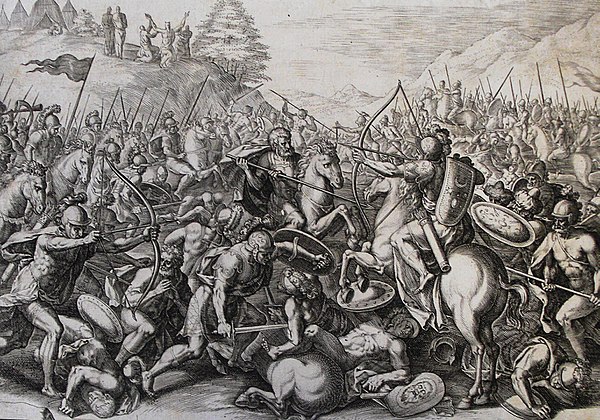
The Amalekite Problem

The Amalekite problem should be a much bigger problem for Christian apologists than it is. As a Christian apologist, I say we don't take it seriously enough. The reason for this, however, is because the atheists harp on it constantly, and no answer is ever good enough for them. I can understand that, since there doesn't seem to be a good answer, but one does get tried of trying. I am more appualed by some Christian answers than I am by the atheists constant harping. In the OT God orders the Israelits to wipe out many differt people's, but for some reason the Amalekites have become the icon of brutality and genocide disguissed as divine wrath.Christian apologists only make it worse when they try to defend it as a rational action. This usually takes the form of "well they deserved it, they were really evil, God gave them 400 yeas to repent, that's more than enough time,in fact its just down right generous; therefore, it's ok to slaughter little babbies." I always get visions of Gastopo and guys in jack boots.

I sometimes wonder what my fellow Christians think about in their spare time

This is one of the basic reasons I'm no longer an inerrentist. I cannot accept the idea that God would ever command salughter of infants. Slaughtering anyone is bad enough, but to slaughter innocents, that's never acceptable. I don't accept that God would really do that. Here I draw upon my models of inspiration: the Bible is a collection of writtings made by humans which reflect their encounters with the divine. That's not to say these writtings don't have a lot of purely human understanding in them. People were very cruel in the ancient world. Genocide, slaughter, infanticide, brutality in war, these were commonplace, and they are all reflected in the book of 1 Samuel.

It's not that there is no value to the conventional answer, but it doesn't go all the way.

The Conventional Answer: The Amalekites were Jerks

The Amalekites were basically a grang of thugs, they tried to do to Israel what Israel did to them. In fact, they were foreign invaders, they were reaching beyond their own lands to raid others beyond their boarders. God's command to wipe them out can be seen as an act of divine justice, the exicution of the highest authority agaisnt a lawless people who had to be stopped. But that answer doesn't cover all the bases. It doesn't justify the slaughter of infants.

I think to some extent the action against adults was justified. One could understand this as the divine court passing sentence on lawless criminals; these were thugs who had tried to wipe out Israel; God gave them time to repent.None of that answers for total destruction and slaughter of infants.

I will argue that God didn't order the slaughter of infants. While we cannot prove this with an actual text, there's a very good likleyhood that it was an addition to the text, and thus not the original command.

Purpose of the Narrative

1 Sam 7:3–15:35. The emergence of monarchy is the theme of 1 Sam 7:3–15:35, which is particularly linked to the person of Saul. There is no doubt that this narrative is the result of an intensive redactional process, but the exact features of this are impossible to determine. While the story is cast around the disputed leadership of Samuel and the emergence of Saul, the real debate does not concern personalities. Rather, it concerns the relationship between the faith of the community and public forms of power and how the trust Israel has in Yahweh should be implemented in institutional forms. The narrative discloses to us opinions which believe not only that monarchy is required to cope with historical threats, but that monarchy is a gift from Yahweh to Israel for the securing of the community. A counter opinion, more forcefully expressed, argues that monarchy is a departure from faith in Yahweh even as it is a departure from the old tribal organization. Both opinions are expressed in this complicated narration of chaps. 7–15. It is a truism of scholarship that the narrative contains two sources reflecting two strongly held political opinions which judge the institution of monarchy positively and negatively. Scholarship moreover has held that the pro-kingship source is from the period itself, whereas the anti-kingship sources are later, reflecting disillusionment with the tyranny of Solomon.

The slaughter of the infants, which is just one phrase in a larger command, is not a major focuss at all. It is a refelection of the attitude of ancient peole, and the over all passage is designed to show that Saul did wrong by not wipping out enough people! The redactor doesn't really care about the infants at all, the only point is that the action is part of showing strength of Sauls character in following God's command. The action is not a polemic justifying slaughter of enemies, but a mere after thouht, part of a larger whole.The point of the passage is the justification of monarchy. Samuel represents the old form of power, the weak system which had to be changed because new times reqiured strong leadership. But Saul was not that leader; the monarchy was good but Saul was not the man for the job. He didn't obey God compeltely enough. There is also a discordant voice that God didn't want the people to have a monarch, but that voice is brought under submission to the will of the people.

The Text

The text of 1 Samuel is one of the most heavily redacted in the Bible. As we will see, it's very presence in the canon has been brought into question, but the version we have is probably a corrupted second rate copy, and the LXX is closer, and Q4Sama at Qumran closer still, to the actual original.

Institutte Bibilcal Scientific Studies:

Biblical Archaeology, Dead Sea Scrolls and OT

"1&2 Samuel"

"For the past two centuries textual critics have recognized that the Masoretic Text (MT) of 1&2 Samuel has much textual corruption. The Samuel MT is shorter than the LXX and 4QSama. The Samuel MT has improper word division, metathesis, and other orthographic problems. Certain phrases and clauses go against the Hebrew grammar rules. Parallel passages vary from each other" (See Charlesworth, 2000, pp.227-8).

"In 1952 Roland De Vaux and Lankester Harding found manuscripts of Samuel under three feet of debris in Qumran Cave 4. 4QSama shows that the Old Greek Bible (LXX) was based on a Vorlage similar to 4QSama. Josephus agrees with 4QSama in 6 places against the MT and LXX. Josephus, 4QSama, and LXX share about three dozen readings against the MT" (See Charlesworth, 2000, pp.229).

"Where the book of Chronicles parallels 1 Samuel, the readings of Chronicles follow 4QSama rather than the MT 42 times. Only one time does Chronicles agree with the MT. Over 100 times 4QSama does not agree with any ancient reading" (See Charlesworth, 2000, pp.230-31).

The Book of Samuel varies widely and frequently from the Masoretic Text. 4QSama preserves a number of superior readings that help correct errors in the Masoretic Text (DSS Bible, 213). Let's look at some of these.

One dramatic example is in I Samuel 11 where the MT and KJV left out the first paragraph. The Longer reading in the DSS explains what happens in this chapter. It says:

"Nahash king of the Ammonites oppressed the Gadites and the Reubenites viciously. He put out the right eye of all of them and brought fear and trembling on Israel. Not one of the Israelites in the region beyond the Jordan remained whose right eye Nahash king of the Ammonites did not put out, except seven thousand men who escaped from the Ammonites and went to Jabesh-gilead" (The Dead Sea Scroll Bible translated by Abegg, Flint, and Ulrich page 225). Then verse one of I Samuel 11 starts.

1 Samuel 14:30

There is a mis-division of words here in the MT. The 4QSama divides it differently which makes better sense. The MT has hkm htbr rather than hkmh hbr in the 4QSama.

1 Samuel 14:47

There is a singular instead of a plural noun in 4QSama. 4QSama is the better reading.

1 Samuel 15:27 There is an omission of the subject in the MT. According to 4QSama Saul is the subject who grabbed the garment, not Samuel.

The Place of 1st Sam in Canon

Revisited Albert C. Sundberg, Jr Thomas J. Sienkewicz and James E. Betts "The Old Testament of the Early Church" published by Monmouth College in Monmouth, Illinois in 1997. department.monm.edu/class...bergJr.htm

The Prophets collection was canonized about two centuries after the Law, i.e., about 200 B.C.E. This collection is divided into two sections, the Former Prophets (the historical books): Joshua, Judges, Samuel, Kings, which were in circulation about 550 and reached their final form before the Latter Prophets. Except for minor editorial changes made later, the Chronicler utilized the Former Prophets in their final form. However, apparently he did not regard them as canonical because he took great liberties with them, especially with Samuel and Kings, in his rewriting of the national history.

The Latter Prophets (Jeremiah, Ezekiel, Isaiah and the Twelve12) contain sections undoubtedly from the third century (cf. Isa. 24-27; Pfeiffer 1941:61, 441-443). This places the terminus a quo after the Chronicler. On the other hand, the absence of the Book of Daniel (dating 164 B.C.E.) from the collection indicates that the collection was already closed at its writing, otherwise it would have been included. Thus, the Prophets collection must have been canonized about 200 B.C.E. Sirach13 44-49, a list of famous men in Jewish history, is a summary of the Law (ch. 44-45) and Prophets (the Former, 46-48.18; 49.1-50; the Latter, 48.20-25; 49.6-10, even naming the Twelve). H. J. Cadbury found that Septuagintal language has influenced the Greek of Sirach. He says, "That the translator knew the prior Greek translations of some of the canonical books is not only implied in the preface. . .

but is sufficiently proved by his use of identical Greek with the Septuagint in the same context" (Cadbury 1955:219-225). This is shown in verbal coincidences that are most striking in the catalogue of famous men and their respective parallels in the Old Testament and in detailed descriptions of the accouterments and service of the High Priest. In some cases these coincidences are striking because of the unusualness of the words, or the transfer of a word in the same context where Sirach and the Septuagint agree against the Masoretic text (1 Sam. 13.3), or where the translator shows a knowledge of Greek Chronicles. This evidence that the translator of Sirach knew a standard Septuagint text tends to confirm the judgment that the statements in the prologue testify to the canonical status of the Prophets. Thus, it is evident that the canon in Sirach consisted of the Law and the Prophets. Daniel (9.2) cites Jeremiah (25.11 ff.) as "the word of the Lord to Jeremiah."

This tells us that the place of Samuel in the canon was by no means assured. Because the redactor didn't feel the former prophets were canonical, great libertties were taken. We also see differences between the Ms which form the parent of the LXX translation, and those of MT. What all of this amounts to is that 1 Samuel is a very corrupt text, and the likelyhood is quite high that the passage is redacted. This is even more certain when we consider that the infant passage itself has been redacted.

James A. Sanders, Inter Testamental and Biblical Studies at Clairmont, Cannon and Community, a Guide to Canonical Criticism. Philladelphia: Forterss Press, 1984, 15-16.

"There are remarkable differences between the LXX and MT of 1 and 2 Sam. Jeremiah, Esther, Daniel, Proverbs and Ezekiel, 40-48, and on a lesser level numerious very important differences in lesser books such as Isaiah and Job. Before the discovery of the Scrolls [Dead Sea] it was difficult to know wheather most of these should be seen as translational, Or as reflecting the inner history of the Septuegent text, or all three. Now it is abundantly clear that the second period of text transmission [which is BC], actually that of the earliest texts we have, was one of limited textual pluralism. Side by side in the Qumran library lay scrolls of Jeremiah in Hebrew dating to the pre-Chrsitian Hellenistic period reflecting both the textual tradition known in the MT and the one in the LXX without any indication of preference. So also for 1 and 2 Sam."

Redaction of Infant Slaughtering Passage

Notes in the New Oxford Annontated Bible on 1 Sam 15:1-35

"Another story of Saul's rejection: The late source. Compare this section with 13:7-15, Samuel, not Saul is the leading figure once more."

This is the very passage in which Samuel relays God's command to wipe out the infants. So even though I still need to find more speicific evidence for that very passage, there is a good chance of proving redaction. While its true that I can't produce an actual MS showing no infant slaughter command, the passage in whcih that command is given has been redacted. The odds are very high that this command was not part of the orignal passage, or we can regard it as such. We know that slaughtering infants in evil, and we have no obligation to accept a command as divine that we know to be totally at odds with God's law and God's moral code.

Wednesday, January 11, 2023

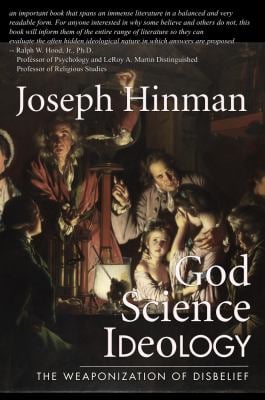
God, Science, and Ideology by Joseph Hinman


https://www.amazon.com/dp/0982408765

my new book God,Science, and Ideology ($28.11) Exposes the false science behind atheistic criticisms of belief in God as Unscientific.--Joseph Hinman.

“[T]hese detractors from religion illustrate the use of reductionism and its ideological assumptions in their work. . . they trade on the assumption that our mastery of reality through the physical sciences is so exacting that we can rip God out of heaven and hold him up to the light, and he will disappear in a puff of disillusionment. . . . They claim to disprove something that can’t be disproven using the methods they rely on.”

Monday, January 09, 2023

The great falling away

In Pew Research Center telephone surveys conducted in 2018 and 2019, 65% of American adults describe themselves as Christians when asked about their religion, down 12 percentage points over the past decade.Meanwhile, the religiously unaffiliated share of the population, consisting of people who describe their religious identity as atheist, agnostic or “nothing in particular,” now stands at 26%, up from 17% in 2009.[1]
That is a significant loss, 12%. Notice they are not going to the atheists. Although they are going to be unaffiliated which includes atheists. The religiously unaffiliated share of the population, consisting of people who describe their religious identity as atheist, agnostic or “nothing in particular,” now stands at 26%, up from 17% in 2009.But of those categories only atheist means no belief in God. The actual atheists have risen to 4%, That;s iniscrule. Only a couple more points than American communists.

Atheists have held steady at 2%. Those who abandon organized religion are not abandoning belief in God per say. That Is good news, but the church needs to take seriously the fact that it is becoming non dominant in the culture. Why is this happening? A major reason is the religious right.

In a 2002 article, sociologists Michael Hout and Claude S Fischer argued that a significant trend in American religion – the skyrocketing number of people disaffiliation from religion – could be partly explained as a political backlash against the religious right. In the two decades since this article was published, a wealth of additional evidence has emerged to support its general argument.[2] Sociologists Joseph O Baker and Buster G Smith summarize the sentiment driving this backlash: “If that’s what it means to be religious, then I’m not religious.”[3]
The great Christian consensus of the past made seminaries and charities possible. It was comforting but it was not real Christianity but socialization. It made real christianity possible but at the exprense of great hyocracy thorgh social oppression. We need to worl toward real spirituality which means keeping Jesus teachings, loving our enemies as well as freeing the oppressed.


Notes


[1]PEW RESEARCH CENTER."In U.S., Decline of Christianity Continues at Rapid Pace,"(OCTOBER 17, 2019)https://www.pewresearch.org/religion/2019/10/17/in-u-s-decline-of-christianity-continues-at-rapid-pace/ (Acessed Jan 6, 2023).

[2]Michael Hout and Claude S. Fischer,"Why More Americans Have No Religious Preference: Politics and Generations," American Sociological Review, Vol. 67, No. 2 (Apr., 2002), pp. 165-190 (Acessed Jan 6, 2023).

[3]Ruth Braunstein"The backlash against rightwing evangelicals is reshaping American politics and faith" The Guarduan (Tue 25 Jan 2022)https://www.theguardian.com/commentisfree/2022/jan/25/the-backlash-against-rightwing-evangelicals-is-reshaping-american-politics-and-faith (Acessed Jan 6, 2023).

Thursday, January 05, 2023

Does the Bible support Oppression?

This is the continuation to the discussion that began  under the topic "Dark Sideof The Bible."

Anonymous [Pixie] said...

Joe: I was recently conversing with an atheist, who for lack of anything better to say, pulled out the old bit about how oppressive the Bible is.

Pix> There are two aspects to this. The first is whether the Bible is morally bad because it oppresses people.

But the second - and I think more important - is whether a book that supports oppression is compatible with the claim that Christianity is true. I would suggest that this is what the atheist was concerned with too.

Unfortunately, your post addresses the former.

Yes but you disprove no 1 as I think I did, no 2 is moote.In other words the book does not support oppression and  that was the condition under which the truth of Christianity would be questioned, solve1 that takes care of 2.

Joe: The atheist has to show that belief in God, specifically the Hebrew God, made the situation worse. If it didn't worsen the lot of the people of that era, then where's the blame?

No, we only need to show that the Bible made the world a worse place.

How is that not the same thing? Assuming one could believe in God and not accept the OT then showing the problem with the bible doesn't even invalidate belief in Christian God.

And the verses about slavery surely do that. It is well established that slave-owners in the pre-bellum southern US used the Bible to support their position. If the Bible had not said chattel slavery was allowed, that would take away their arguments. That would surely have reduced their support, even if it did not stop them having slaves themselves.

The bible never uses the phrase chattel  slavery, it never says slavery is good. It speaks of it as a fact of life in ANE but it never endorses it. In the NT it pronounces the slave trade to be a major sin which would shut down slavery.Slavery of that era wasnt synonimous with slavery  in the antebellum south, slaves in bbile times were mostly captives in war. They did not have a slave raising industry.

However, we can also do as you ask. How God commands the Hebrews to treat a defeated people after a battle:

16 However, in the cities of the nations the Lord your God is giving you as an inheritance, do not leave alive anything that breathes. 17 Completely destroy[a] them—the Hittites, Amorites, Canaanites, Perizzites, Hivites and Jebusites—as the Lord your God has commanded you.

Compare to how the Babylonians treated the Hebrews when they were defeated. The Babylonians did NOT kill every last one of them, instead they exiled the priesthood and the ruling class. Most of the people were allowed to live on as before. The Babylonians were FAR more humane.

You are assuming that the quotes you make  are indicative or Biblical norms. They did not always wipe out every one in battle.Even so the canon of OT was not fixed in the time of Christ. It was not closed until AD 90's. That means verses from Tenock may not have been part of what Jesus called Scripture. certainly we are free to ascertain that given passages constitute human input and not divine.

Joe: We can't expect people in the ancient world, who lived prior to the modern western concepts of autonomy, individualism and democracy and expect them to have learned better at Woodstock. They didn't have Woodstock to learn from and they weren't hippies, they had no sexaul revoltuion and they couldnt' go to a corner drug store and read about it in a teen magazine or a tabloid.

But supposedly they had God telling them! Why did God not tell them about the concepts of autonomy, individualism and democracy? I think it is because God is not real...

why did Jesus not introduced antiseptic surgery? Or nuclear power? God is working with human evolution he's not the big monolith from 2001 a space Odyssey.We are acquiring the sensibilities of the good by developing them as we go along.

Joe: But basically God keeps pace with the understanding of people.

Because he is imaginary, and the Christian concept of God changes as society changes. Hence God seems to keep pace with society.

That is not proof that God is not real. Assuming he is real, how do we avoid understanding him through our present state of awareness? We have to screen God's revelation to us through our understanding. What else can we do?


The Meaning of Imago Dei

Imago Dei or "image of God" is a major concept in christian theology. Many take it to mean the inellectual aspect of man patterened after the sentient qualifites of God. Some think of it as physical body.

Genesis 1:26-27

26 Then God said, “Let us make mankind in our image, in our likeness, so that they may rule over the fish in the sea and the birds in the sky, over the livestock and all the wild animals,[a] and over all the creatures that move along the ground. 27 So God created mankind in his own image, in the image of God he created them;male and female he created them.”
Pete Enns argues "it is complete guesswork. It is also difficult to see what is gained here. Preserving the biblical description of human origins this way means it has to be adjusted well beyond what it says...

More importantly, equating image of God with the soul or other qualities that make us human puts a burden on Genesis 1:26-27 than it cannot bear—which brings us to the next point."[1]

But then turns around and bases his view entirely on guess work around a secondary meaning of image as a representation of likeness such as sculpture or painting.

J. Richard Middleton (Roberts Wesleyan College) puts it well in The Liberating Image. He offers that the image of God describes “the royal office or calling of human beings as God’s representatives and agents in the world.” Image of God means that humans have been given “power to share in God’s rule or administration of the earth’s resources and creatures.”[1] When one reads Genesis 1:26-27 with this in mind, the point becomes fairly obvious: “Let us make humankind in our image, according to our likeness, and let them have dominion over the fish…birds…cattle…wild animals…creeping things” (NRSV).
Are fish, birds, and livestock supposed to see man and say to themselves, "O that's like God being in charge of things?" It makes more sense that it either refers to God's physical body or to God's qualities as a conscious thinking entity. If one is not prepared to think of God as having a body, and I am not, then it must be the latter. The fact that the text equates image with ruling over creation indicates it's more than justa body. It's the quality that n=enables ruling over creation.

[1] Pete Enns,"What Does 'Image of God' Mean?" Biologos (July 27, 2010) https://biologos.org/articles/what-does-image-of-god-mean?fbclid=IwAR2qn0WA2918_6XFTPRgPSviVZyoS78yt9Y8PpnyvbS7khGUR7X88jNb-4Q accessed 1/5/2023

Tuesday, January 03, 2023

Dark Side of the Bible

I was recently conversing with an atheist, who for lack of anything better to say, pulled out the old bit about how oprressive the Bible is. Of course he had to multiply examples with quote after quote about stoning the women and killing others and making slaves obey, yada yada yada, like I haven't thought about this. Iike I was a political organizer in the central America movmenet for years and a seminary student in a very liberal seminary, and I never gave a thought to the social relations in the Bible!

I said the verse about slaughter of the Amalektie infants was an interpolation. He responds with bo'd coup verses, one after another, all suppossedly saying the same things (of course they realy didn't say the same thing, just many things that offend the twentieth century sensiablity). Since there are just way too many veres to respond once for one, and it's all just mulitplying examples, I will list some general princples that I think answer the over all situtation viz God and social opression, especially as it realtes to the OT.

(1)But first, it's important to recognize the objective.

The atheist has to show that belief in God, speicifally the Hebrew God, made the situation worse. If it didn't worsen the lot of the people of that era, then where's the blame? To do that they have to do two things:

(a) compare to sourounding culture

(b) show that the problem comes directly from belief in the kind of God hte Hebrews had, as oppossed to other types of the day.

(2) Can't hold up ancient world people to modern standards.

We can't expect people in the ancinet world, who live prior to the modern western concepts of autonomy, indivuidualism and democracy and expect them to have leanred better at Woodstock. They didn't have Woodstock to learn from and they weren't hippies, they had no sexaul revoltuion and they couldnt' go to corner drug store and read about it in a teen magazine or a tabloid.

(3) Social Evolution not Revoltuion

Christ didn't explain to people how to build nuclear power plants or th theory of germs and anticeptic surgery, he didn't write medical books to make their lives better. He did some religious thing and went away again. That's becuase his mission was primarily spiritual. He was not a social revolutionary, even though what he said would be very revolutionary if it were practiced.

But basically God keeps pace with the understanding of people. The atheists seem to think that eveyrthing should be a vast revelation, unfolding of the new world before everyone's eyes. I've already sketched out my theory of soeteriologial drama in which God wants an individual search in the heart, and that's why he doesnt' pull back the veil of the sky, reveal heaven and set up shop on earth.

God allows us to make the journey. He allows us to set up our own socieity to apply the principles we learn to internatlize on our spiritual search as part of our ethical understanding concerning living in the world. Thus God allows Society to evolve at it's own place and allows the understanding of people to guide social reform and revolution.

Naturally things will look a lot rougher at the begining than at the end. The ancient world will be a lot more primative and barbarck than the modern world. That's just the conept of social evolution.

(4)The Bible is personal revealation not a guide to social utopia

What throws a lot of people off is that God seemed to be leading a nation in the OT. One would then expect that he would introduce that nation to the proper social enlightement. We forget a lot of those texts were polotical propaganda. The basic funciton of the OT is to form a cultural background so the mission of messiah makes sense. The real narue of Biblical revolation is the dialectical relationship between the reader and text. In other words, don't be suckered by ancient nationalism.

(5) The God led society was progressive

When you compare those barbaric practices of the Hebrews with those of sourrounding cultures they were better. They were more progressive. Consider the nature of war; most slaves were captives taken in war, for most nations around that day a woman captured in war was just a thing to be used as the captor saw fit. She would never again have any kind of rights or consideration and in a many cases be killed. In Hebrew culture she was protected form rape and in seven years had a chance to free herself.

*poor people could glean parts of the harvest for thsemselves

*everyone got land *women went to Moses and demanded their fair share and it was given them

*Women takne in slavery protected from rape

*in Jubalee year the captives could free themselves.

*court sysetm set up to hear compalints of people

actually most of this stuff is more progressive than Trump's social agenda.

(6) Christian principles led to modern concepts of personhood and human rights.

the slave owners in the American south followed their econimic interest. But the workers int he underground RR who tended to be christains, and quakers and abolitinoists over all followed their reilgious princples,and they oppossed salvery, and closed down the slave trade in the 1820's before the civil war, and latter supported the union and helped end the insittution of slavery in the Confederacy and went on to push for women's rights as well.

*First Women's sufferage group in America Pheobe Palmer and Methodist Woen's Association

* firstt organize Abolition groui in America, very same people, Methodist women

*Chrarles Finney crusaded agisnt slavery and supported the abolution movment,and brought the entire second great awakening into the cause. He said "revolution is of God when the intellegence and understanding of the people exceeds the oppression being done to them."

* *Pesant revolts in south Germany for rightrs of the poor

*Olypia, Deconess of Constantinople gave her personal fortune to free slaves. St. John Crysostom led social reform movment that was headed by man Deconeses of his diocesies.

*Christians for Socialism in 20th century chile

*CLamb Central america

*Snadinistas printed bibles tought Bible in literacy campign

*Father Ernesto Cardinal in Nicaragua, Father Camillio Tores in Boliva, all over Latin America Preists and nuns lead social and poltiical revolution against US cold war poltiics and social oppression.

*1930s America Chrsitians for socialism and industrial ation

*Dorothy Day supports christian socialism and starts comminites to bring soup kitchens to poor and share all goods in common.

In every time and place, in every social setting some chrsitrians have wored against the oppression to be the salt and light.

It's a journey of hte individual heart but it plays itself out in the way we relate to each other.

Thursday, December 22, 2022

Merry Christmas

I thought warv on Christmas was BS umtil today.I see people bending over backards to keep from saying it. Embers of the great Trib.

Thursday, December 15, 2022

The stupidest atheists on the net

I finally found him, Now U've seen itall. This guy wims theaway stupidiest athyest with this brilliant arguent:

L: Gibbs McGuire

Joe Hinman I’ve seen the propaganda videos and articles. What I want is a link to Jesus or god actually speaking and performing the kind of miracles claimed by the bible.
\
https://www.facebook.com/groups/467799950536561/posts/1150272712289278/?comment_id=1150916628891553&reply_comment_id=1151650885484794¬if_id=1671035530522132¬if_t=group_comment_mention

Sunday, December 11, 2022

St Augustine's Corrolation: God, Truth, Being itself


…St. Augustine’s view that God is being itself is based partly upon Platonism (“God is that which truly is” and partly on the Bible—“I am that I am”). The transcendence of time as a condition of full reality is a central theme…[in Augustine’s work].[1]

Of course Augustine was one of the seminal thinkers of all Church history. Along with Aquinas he’s probably one of the two most important theologians of all time. He might be called the last thinker in the tradition of the classical age. His view of the Trinity cemented the Orthodox position and set the Western view of Trinity on it’s trajectory diverging from the eastern Church. His work The City of God is one of the greatest theological master pieces of all time, and to think it’s a letter to friend (a letter the size of the New York Phone book).

Augustine expresses the concept of the super-essential Godhead many times and in many ways. Augustine was a Platonist. In that regard perhaps his greatest innovation was to place the Platonic forms in the mind of God. That is a major innovation because it trumps the Neo-Platonistic following after Plotinus, who conceived of a form of the forms. In Augustinian understanding the equivalent of the “the one” the form that holds all other forms within itself is the mind of God. Augustine never made an argument for the existence of God because for him God was known with certainty and immediacy. God is immediately discerned in the apprehension of truth, thus need not be “proved.” God is the basis of all truth, and therefore, cannot be the object of questioning about truth, since God is he medium through which other truths can be known.[2] Tillich said:

Augustine, after he had experienced all the implications of ancient skepticism, gave a classical answer to the problem of the two absolutes: they coincide in the nature of truth. Veritas is presupposed in ever philosophical argument; and veritas is God. You cannot deny truth as such because you could do it only in the name of truth, thus establishing truth. And if you establish truth you affirm God. “Where I have found the truth there I have found my God, the truth itself,” Augustine says. The question of the two Ultimates is solved in such a way that the religious Ultimate is presupposed in every philosophical question, including the question of God. God is the presupposition of the question of God. This is the ontological solution of the problem of the philosophy of religion. God can never be reached if he is the object of a question and not its basis.[3]
Augustine says God is truth. He doesn’t so much say God is being as he says God is truth. But to say this in this way is actually in line with the general theme we have been discussing, the one I call “super-essential Godhead,” or Tillich’s existential ontology. Augustine puts the emphasis upon God’s name as love, not being. Since he was a neo Platonist he thought of true reality as beyond being and thus he thought of God as “beyond being.”[4] This makes no sense in a modern setting since for us “to be” is reality, and to not be part of being would meaning being unreal. But in the platonic context, true reality was beyond this level of reality and what we think of as “our reality” or “our world” is only a plane reflection of the true reality. We are creatures of a refection in a mud puddle and the thing reflected that is totally removed from our being is the true reality. It was this distinction Tillich tried to preserve by distinguishing between being and existence.

Augustine looked to the same passage in Exodus that Gilson quotes in connection with Aquinas. Augustine’s conclusions are much the same about that phrase “I am that I am.” This is one of his key reasons for his identification between God and truth. He saw the nature of God’s timeless being as a key also to identifying God with truth. The link between God and truth is the Platonic “one.” Augustine puts the forms in the mind of God, so God becomes the forms really. The basis of this identification is based partly upon God’s eternal nature. From that point on it’s all an easy identification between eternal verities, such as truth, eternal being, beauty, the one, and God. The other half of the equation is God’s revelation of himself as eternal and necessary through the phrase, for very similar reasons to those listed already by Gilson, between I am that I am and being itself (or in Augustine’s case the transcended of being). “He answers, disclosing himself to creature as Creator, as God to man, as Immortal to mortal, eternal to a thing of time he answers ‘I am who I am.’”[5]

From Psalm 101:25 he ponders the phrase “generation of generations” rather than the choice of saying your years is endless.” He concludes that this Psalm is not merely saying God is living through a parade of endless years but that God is timeless. He concludes that the generation of generations is a timeless generation. He concludes that God’s years are his substance, they cannot be separated from God himself (as we see ‘substance” can be a way of saying “being). “God’s years are God’s eternity, his eternity is God’s very substance.” Thus God is not only eternal but his being his essence coincide, his eternal nature is the same as his being. Thus God is eternal necessary being.[6]


notes

[1] Carl Avren Levenson Reality: Readings in Phlosophy. Indianapolis, Indiana:Hackett Pulbishing company, inc. Carl Avren Levenson, John Westphal, editors, 1994, 54

[2] Donald Keef, Thomism and the Ontological Theology: A Comparison of Systems. Leiden, Netherlands: E.J. Brill, 1971, 140.

The “two Ultimates” discussed are philosophy and Religion.

[3] Paul Tillich, Theology of Culture,Oxford: Oxfored University pressm 1964 12-13

[4] Jon D. Levenson, Creation and the Persistence of Evil: The Jewish Drama of Divine Omnipotence Princeton University Press,1994, The quotation above from the Levenson and Westphal book says Augistine believe God was being itself, Marion seems to say that Augustine put God beyond being. I think it’s debatable as to which he did because he didn’t say directly which it was. I’m assuming Marion is probably right just because of the time in which he lived and because he was a Platonic thinker.

[5] see fn1.

Posted by Joseph Hinman (Metacrock) at 6:43 AM Labels: apologetics, Augustine, corrospondence theory of truth, God is truth, norm of truth No com

[6] New Advent, Exposition in psalsm 101
https://www.newadvent.org/fathers/1801101.htm