Showing posts with label Heidegger and Being. Show all posts

Monday, March 26, 2012

Atheist Reject Liberal Theology by Resorting to Fundamentlaism.

Photobucket


Atheist criticism of modern liberal theology is to theology as Fancis Shaffer's criticism of art is to art.

Recently I find more and more atheists on CARM going on the offensive against liberal theology. Yet since they refuse to read any they don't know anything about it. They base thier understanding of it on Spinoza becuase that's all know about. this refusal to learn about the things they critize is giong to a mainia. On CARM Magritte says:

Since at least Spinoza and the Enlightenment when it became safer (relatively speaking) to directly criticize the Bible and theism, apologetics has been waging a war of redefinition and redrawing of boundaries. Modern "liberal" Christianity now has boundaries that are practically fractal in their infinite detail. Whenever a threat emerges, apologetics swiftly whisks God to safety with rationalization. Boundaries are redrawn, words redefined.

Spinoza is not very important to modern liberal theology. They just think that because he's the only alternative view of God they understand. They think primarily that Spinoza is a pantheist which they are willing to tolerate because they see it as a step toward atheism. This guys sees liberal theology as some kind of refuge that fundamentalism takes when it can't stand up to atheism. That is totally ignorant on many levels:

(1) Spinoza has very little to do with modern theology,t hey are ignorant enough to think if it's not the big man in the sky it must be Spinozian deified nature (Spinoza did not deify nature but they don't bother to learn what he really thought).

(2) Liberal theology is much older than fundamentalism. It definately existed about 300 years before inerrency (19th century). Way before any modern athiesm so trying to see ita s a refuage of failed apologetic is just sheer ignorance.

(3) Fundamentalists hate liberal theology. Liberal theologians are not fundamentalists hiding from atheism they are rarely former fundiese. Most fundies see liberal theology as satan infiltrating the faith to steal away the faithful. Most of them wont go near it. Most liberals see fundamentalism and apologetic is country corn pone hick's ville and they wont go near it!

(3) Calling liberal theology a renationalisation is total stupidity. This complety ignores the rich intelletual tradion that is traced back to Erasmus and the Northern Renaissance.

This atheist assault interprets everything it doesn't understand as "rationalization." Here is his answer to one argument I made.
This sometimes gives a strong whiff of desperation and post hoc thinking. I'll give an example: I was asking Metacrock a while back about why God did not heal amputees. His reply was that limb regrowth would be such a strong indication of God's presence that it would take awaLinky our free will as to whether or not to believe. How is one to argue with an opponent who pulls such things out of his keister on the spur of the moment?
This is totally taken out of context. Fist of all that's not even my answer. It's only a small part of my answer and it's argued hypothetically anyway. For a more full understanding of my answer on the amputee thing see my essay God and Amputees and also why wont God heal stupidity? The answer he's talking about is based upon a larger argument that is my answer to theodicy: Soteriolgocal Drama. That's my answer. It's unique to me. He's asserting that it's some srot of arche type for all liberal theology when in reality no liberal theologians even know about it and if they did they probalby wouldn't embrace it. That is idea is unique to me. But then CARM atheists are so ignorant of theology they tend to assume that I'm the only liberal. I went I went to seminary with other people. I'm just sure there were other students in those classes. Someone took those degrees on graduation. I doubt if they canceled commencement just becuase i didn't go. I graudated I just didn't feel like doing the cap and gown thing.

I invite other atheists, deists and agnostics to submit their own examples of this sort of thing. It's been going on for many generations and we should at least do it the dignity of understanding it.
He speaks giving it the dignity of understanding which is ironic becuase he has not giving it that himself. He read any theologians. When one mentioned reading them they say "they just make stuff up." This is stupid, it's just lapin stupid anti-intellectual grab age. If they had the gumption to actually read some they would find out its not just making stuff up but they can't even take the obvious step of doing some basic study. The older example was to charge that liberal theology 'enables' fundamentalism. I don't what these people think they are saing. Do they ever think at all? That's like saying socialists are enabling capitalism. How? By opposing it? That logic suggests that atheism is enabling Christianity. They might as well argue that modern art enables old fashioned realism in art.

In that CARM thread I have to hand it to Humble thinker. He usually blocks with atheists even though he claims to be a Christian, but this time he has a cogent comment:

But I think the question is this: is the "strongest possible case" in question merely post hoc rationalizations in an attempt to make the case stronger or is it a prior held belief that, upon questioning, is presented without the intention of artificially making the case stronger? Hopefully that sentence didn't get too convoluted.

"Lance" another atheist poster reiterates and magnifies the original theme. In so doing illustrates more ignorance:

Doesn't it seem strange to you that as our philosophies and sciences have become more and more sophisticated, he concept of God has been shrinking back and becoming more and more abstract? God's become more and more unfalsifiable, more and more difficult to clearly define and theistic language seems to have become more and more obscure when speaking about him. Did not people used to believe that God wanted all people to have a personal relationship with him, to the point of him preforming miracles in front of crowds of people? God used to make a splash. Now modern theologians have changed his nature such that he's hiding from us, not letting us have any very solid reason for believing he's even there because he doesn't want to make his existence obvious.

He asserts that the concept of God is "shrinking back becoming more abstract" because he defines teh true and proper understanding as the big man in the sky. He does this because he privileges fundamentalist as the truth Christianity even though liberalism is must older. Also becuase like a true fundie he's reading the Bible literally so the metaphor of king and father he sees a literal instruction about the nature of God.Atheist are really fundies. The think the reason they are atheists is because they take the Bible super literally and can't think their way through it. They see any problematic nature as contradiction becuase they can't think, they see answering problems as some form of "giving up." He says God has "become more unfalsifiable." When was God ever falsifiable? That's becuase he has to understand problematic nature of God as grounds to see contradiction and give up the faith. that's what makes him an atheist. So he's really privileging atheism and in the final analysis the whining because they can't reduce liberal theology to their frontal of finding trivial contradictions in the bible.

The question of God's falsifiability is a complex one and deserves a lot more attention then these guys are willing to give it. I've written on the question of God's falsifiability on this blog in the 2007, and also more recently in 2011. Modern theologians have changed it so that God is now hiding form us. This is just sheer ignorance of a group of ideologues who refuse to study their opponents views but reduce them to a set of slogans. Modern liberal theologians deny that God is hidden. When they give answers atheists do not listen. I've repeated Hartshorne's answer many times:

quoting myself from my Thomas Reid argument (no 8 on the god arguemnt list--see page 2)

According to Hartshorne, "[o]nly God can be so universally important that no subject can ever wholly fail or ever have failed to be aware of him (in however dim or unreflective fashion)." Now the issue of why God doesn't hold a "press conference" has do do with the fact that God does not communicate by violating normal causal principles. In process terms, the "communication" of God must be understood as the prehension of God by human beings. A "prehension" is the response of an occasion to the entire past world (both the contiguous past and the remote past.) As God is in every occasion's past actual world, every occasion must "prehend" or take account of God.

It should be noted that "prehension" is a generic mode of perception that does not necessarily entail consciousness or sensory experience. Impervious postings I explained that there a two modes of pure perception --"perception in the mode of causal efficacy" and "perception in the mode of presentational immediacy." If God is present to us, then it is in the presensory perceptual mode of causal efficacy as opposed to the sensory and conscious perceptual mode of presentational immediacy. That is why God is "invisible", i.e. invisible to sense perception. The foundation for experience of God lies in the nonsesnory non-conscious mode of prehension. So now, there is the further question: Why is there variability in our experience of God?. Or, why are some of us atheists, pantheists, theists, etc.? Every prehension has an initial datum derived from God, yet there are a multiplicity of ways in which this datum is prehended from diverse perspectives.

I agreed with Hume that sense perception tells us nothing about efficient causation (or final causation for that matter). Hume was actually presupposing causal efficacy in his attempt to deny it (i.e., in his relating of sense impressions to awareness). Causation could be described as an element of experience, but as Whitehead explains, this experience is not sensory experience. From Hume's own analysis Whitehead derives at least two forms of nonsensory perception: the perception of our own body and the nonsensory perception of one's past.
I will make it more simple than that. Being is hidden. A basic reading of Heidegger will tell us this. God is being itself, the basic hiddenness of being is the hiddenness of God. But being is not hidden it's mere ready-to-hand. This phrase refers to the nature of being that is so familiar we take it for granted and don't notice it. It's like a carpenter who so familiar with his tools that usin them is such second nature he doesn't even have to think about it. Saint Augustine says God is nearer than my inmost being. I used to use a whimsical example: suppose a fish could be scientist and a fishy committee assigns him to find this substance humans talk about, water. He studies every aspect of the world around him and never finds water becuase it never occurs to him he's looking through it.

Sunday, May 15, 2011

Atheist misconceptions about Metaphysics

Photobucket


Atheists have many misconceptions about the term. Most of the time they seem to think it means some special way or argument for God, or that's synonymous with their screwed up understanding of "supernatural" (which is not the right definition of that term either but that's another story).

standard misconception that Metaphysics is about "things beyond the physical" that's not true. AT least not necessarily. For exampel the question of free will is a metaphysical question and the will is a real thing it's not a concrete thing in the physical. The question about mental vs physical is a metaphysical question.

Stanford encyclopedia.
"Metaphysics"


It is not easy to say what metaphysics is. Ancient and Medieval philosophers might have said that metaphysics was, like chemistry or astrology, to be defined by its subject matter: metaphysics was the “science” that studied “being as such” or “the first causes of things” or “things that do not change.” It is no longer possible to define metaphysics that way, and for two reasons. First, a philosopher who denied the existence of those things that had once been seen as constituting the subject-matter of metaphysics—first causes or unchanging things—would now be considered to be making thereby a metaphysical assertion. Secondly, there are many philosophical problems that are now considered to be metaphysical problems (or at least partly metaphysical problems) that are in no way related to first causes or unchanging things; the problem of free will, for example, or the problem of the mental and the physical.


Conversely the idea that metaphysics is just making things up is also obviously false since the will and the mental and the physical are not made up.

Misconceptions:

I. Metaphysics is about magic, supernatural or made up stuff

That's was disproved in the things said above. In Heidegger's version of metaphysics scinece is a form of metaphysics.

II. we can't test or verify anything about metaphysics

Modal logic is a limit on any metaphysical construct. Other kinds of logic as well, also assist. We don't need to empirical investigation to know that there are no square circles. We can rule them out with logic. so logic can tell us things. Obviously we are not going to build a rock with just logic. We can use logic to screen metaphysical ideas.

III. That metaphysics is about magic and psychic powers.

Nope it's not, not at all. As I said in Heidegger's view science is metaphysics.


IV. That Christians have to support metaphysical thinking.

false. Especially if one is a Heideggerian Christian because in Heidegger's terms metaphysics is a bad thing. For Heidegger metaphysics is herding or grouping sense data into pre conceived categories. That's actually what reductionism is doing. Reductionism and naturalism are both metaphysics.

There are two major thinker's whose views of metaphysics I go by. One is Heidegger the other is Bruce Wiltshire.He is a professes emeritus at Ruttger's University.


He wrote a book called Metaphysics: An Introduction to Philosphy

He defines metaphysics as talk about talk about the world. That's tricky because you might think it's just "talk about the world." It's not talking about the world, it's talking about how to talk about the world. so metaphysics for him is a methodological procedure.

I think what both of these views have in common is that they are about how to organize knowledge about the world. For me that's my idea of metaphysics how to organize knowledge, organizing it in a way that it's all put into preconceived categories.

So the same reasons that make me dislike reductionism also make me dislike metaphysics.
For me as with Heidegger the alternative is phenomenology, which means allowing the sense data to suggest their own categories.When one says "Metaphysics is no good it's just making things up," Or "there's no God" or "scinece is the only form of knowledge" one is doing metaphysics. You guys don't even know it but most of you are doing metaphysics all the time.

An example of metaphysics would be Tillich's ideas about the depth of being. Tillich's theological method, is a good example of metaphysical work that's almost scientific and offers more than just speculation. Depth of being is an example of metaphysics.

Tillich equates knowing that being has depth with knowing that God is real. This will be the basis of the “realization” that is the end goal and object of my work in this regard. The development of an alternative to endless arguments that must be taken on faith before they prove anything is moving toward an understanding of realization as the alternative to argument. We have seen this quotation before but I will use it here again:

"The name of infinite and inexhaustible depth and ground of our being is God. That depth is what the word God means. And if that word has not much meaning for you, translate it, and speak of the depths of your life, of the source of your being, of your ultimate concern, of what you take seriously without any reservation. Perhaps, in order to do so, you must forget everything traditional that you have learned about God, perhaps even that word itself. For if you know that God means depth, you know much about Him. You cannot then call yourself an atheist or unbeliever. For you cannot think or say: Life has no depth! Life itself is shallow. Being itself is surface only. If you could say this in complete seriousness, you would be an atheist; but otherwise you are not."[i]

This is not a literal one-to-one correspondence. When one concludes that being has depth one has not proved the existence of God in the sense that the ontological argument is supposed to do. This is not a priori truth. It is more than just a “rhetorical” statement. The statement is hermeneutical and ontological although not literal. The quotation itself tells us why he says that if we know being has depth we can’t be atheists. He equates depth of being with the source of being, the source of life, and he tells us that the term “God” means depth. Literally the word “God” does not mean “depth.” He’s saying that the concept of God in modern theology and in the Christian tradition has always been that God transcends the level of mere things in creation. Depth of being means that being is not just the fact of things existing, nor is it only a surface understanding of the causes of things around us. The depth of being is the big picture, the idea that being is more than what we observe empirically, it is the spiritual sense, depth in in profundity. He actually uses the term “depth” in more than one sense; suffering as in depth of despair, profundity, as in “deep meaning,” and transcendence, beyond the surface level. All of these uses are embodied in his essay.[ii] According to this statement, when we come to realize that there’s a lot more to being than just surface fact of existence, then we understand that God is real. Thus God and the depth of being are equated. This is because God is not a big man in the sky, but rather, God is the power of being, that to say the ground upon which all is has come to be and in which it coheres and continues. In the last chapter I discussed the possibility that this is the power of mind to perceive or to think the universe. The connection between the possibilities of consciousness as the basis of reality and the philosophical questions raised by this notion, as well as others related to it, form the basis of a good place to start exploring the depth of being.

In the previous chapter I discussed the hard problem of human consciousness. In the opening chapter I discussed philosophical questions at the epistemic level that science cannot answer. The fact that these questions cannot be answered by empirical research or observation is a good indication that there is a depth being beyond the surface of things existing. This in and of itself proves that being has depth. The fact that we have these questions to ask, they mean something to most people, and we can answer them through science, which is to say, through empirical observation of the surface of fact of existence or thing-hood, indicates that there is a depth there that be probed through reason. The hard problem of consciousness is one of those issues. There are many focal points that highlight these kinds of questions and demonstrate the depth of being. Many of these can be used as God arguments, and the traditional God arguments can be used as focal points for reflection upon the depth of being. In the subsequent chapter I will deal with God arguments. For now I want to focus upon the major issues of the depth of being. The point is that in understanding the depth of being one is forced to confront the realization of the reality of God. Since my overall point is to produce a theology of the realization toward a new apologetic, these “focal points,” are like stepping stones that lead us down the path to realization.

In his essay The Shaking of the foundations,[iii] Tillich discusses depth of benig and some things have been said about that already (chapter 3). At this point, however, I will depart from Tillich’s organizational scheme but not from is basic thought and intent. There are what I like to call “deep structures” in reality that can be observed, or teased out. These deep structures can be organized into ideas that might serve to illustrate the point of depth of being, or might ever serve the function of arguments either for the reality of God or for the rational nature of belief. This is what I call the “focal points,” or a term of my invention I also like, “signifiers of depth.” The signifiers of depth highlight the deep structures. These consist of Tillich’s ontological categories. These categories are empirically derived forms of speaking. Because they are ontological, considered with the nature of being, they are in everything, not limited to religion. We make our world out of the categories, which determines the content. When I say “our world” I mean the world of our constructs, the world in our minds that consists of what we understand and how we understand it. The cause of the big bang is not part of this world because we don’t understand it or observe it. The attitudes we perceive in others may be mysterious or they may be understood wrongly or rightly but what we perceive about them is part of the world of our constructs because we perceive and it registers upon our understanding in some way. It is out of this amalgam of understood constructs that the categories are forged. This is all empirically deduced by Tillich.[iv] The categories do not include the unconditioned (God) because it transcends our understanding. But we have ideas about God that are derived from experiences and teachings and these are part of the categories, but they are not the uncontained, they are not the reality of God they are perception of God.

The categories are:

Being and non being, and the forms finitude.[v]

The forms of finitude:

*time: central to finitude because it limits being

*space: to be special is to be limited by the possibility of non being

*causality: determinate of being enables symbol and logical interpretation

*substance: the nature or mode of being

When Tillich gets even more specific forms of finitude include at some point self and the world. Much was said about self and the world in chapter 3. Tillich teases out problems of insecurity relating to each category:

*temporal (finitude) = we die.

*spatial = limitation of space (another form of finitude) remind us that we are limited in duration and in reach.

*causality = remind us of being and non being

*substance = we limited to accidents of being;

All of these produce anxiety at the prospect of non being (death). This is where Tillich plugs in the object of ultimate concern. The fact that we have an ultimate concern and that we can be bothered by the prospect of our finitude and cessation of being points to the deep structures of reality; it shows us that there’s more there than just the fact of existence, there’s the fact of cessation of existence and that it bothers us. Sometimes atheists try to deny that they have an ultimate concern or that they care about death. Even if one doesn’t feel the ultimate concern it’s logically there, and all one need do is to read the literature of the world to know that for most of humanity death is the ultimate concern.

Some atheists or skeptics might be inclined to say this is all just speculation and can’t be proved. Actually there is no reason to doubt any of this so far. We can deduce all of this; Tillich says it’s empirical, from the universally expressed observations and aspirations of humanity. These ideas, there is time, there is space, there is ultimate concern, time and space are forms of finitude and they remind us we are going to die, this is hardly arcane metaphysics or the ravings of a mad man. These are things most great writers throughout human history have said in one way or anther. The relationship of duration to finitude is deductive and hardly brain surgery. From these categories, that are more or less universally understood, we derive equally basic epistemological questions. These basic epistemological questions are indicative of the meaning and nature of being; they are born out of the way our insecurities about our own being strike us. We caused to reflect upon what we know and how we know it. The fact that we are caused to reflect upon such basic aspects is indicative of deep structures in being; since being is more than just a surface inventory of things that exist, but must be understood in relation to how we know what we know, there is reason enough to consider that being has depth. These questions may sound silly to the uninitiated in philosophy, but they have a serious purpose in being asked. This has already been presented in chapter 1. Questions such as “why is there something rather than nothing?” “Why am I here?” “What is life about?” The very fact of these questions, and that they are asked seriously and at times with great longing indicates to us the depth of being.


Deep s


[i] Tillich, Shaking of the foundations 0p cit, (see chapter three) 52.

[ii] Ibid, 52-53

[iii] Ibid

[iv] Tillich, Systematic I. 197

[v] Tillich, Shaking… op cit 197=200


Sunday, March 27, 2011

Heidegger's Notion of "Dasein"

Photobucket


Heidegger was the next evolutionary step beyond Husserl in the development of phenomenology. Husserl dealt with objects in much the way that Descartes did; we are conscious of them, they are intentionally conscious of them. In this version of phenomenology we understand the essential structures apart form the reality of objects.[i] He regarded them as objects and his version of phenomenology is about how we regard objects as actors on stage in the Cartesian theater. This approach of Husserl is known as “transcendental phenomenology.” Heidegger takes a different approach, known as “hermeneutic phenomenology.”[ii] Heidegger deals with objects, aspects of our perceptions in being as we live our lives, in the way that fish regard water, as something so close to us, so all pervasive, so fundamental to existence that we don’t even notice it. Perhaps one of the best examples of this is his concept of “ready-to-hand.” Or an even better example would be the carpenter who is so use to his tools the use of them is second nature. He doesn’t have to be careful with the hammer he just hammers. He doesn’t think about what he’s doing because it’s so much a part of his being he doesn’t need to think about it. Such is our encounter with being and with most things in being. This is misleading because the subject is extremely complex. There is a multiplicity of opinions as to what Heidegger was really saying, and the philosopher himself doesn’t help by clarifying.[iii] Heidegger distinguishes first between a general sense of being for anything or everything, being itself, and the being of human beings that is aware of itself, what Sartre calls “being por soi,” being for itself. The being of inanimate objects Sartre calls “being en soi,” or “being in itself.” To distinguish between being in general or apart form any particular thing (being itself) and that of an individual, the use of the term “a being” is employed by translators, while Heidegger himself uses the German terms “Sein” (being) and das Seiende for the latter. Human being in particular Heidegger speaks of as Dasein, which is by its nature vested with an implied social dimension.

For Heidegger the Western tradition has erred with Aristotle in assuming humans are rational. We develop theories of rule keeping and decision making that assumes humans are rational; this turns out to be superficial. We are also irrational, we have depths and we are complex creatures, we don’t understand ourselves.[iv] The Western tradition erred with Plato in assuming that we can understand the world in a detached way by taking a step back and developing a theory of theory, “discovering the principles that underlie the profusion of phenomena.”[v] The mistake is in thinking we can have a theory of everything. Heidegger opposes the idea of a theory of everything. We cannot have a theory of what makes theory possible. This calls into question the foundations of Western thought.[vi]

Since Descartes philosophers have been struck with the epistemological problem of explaining how the ideas in our mind can be true of the external world. Heidegger shows that this subject/object epistemology presupposes a background of everyday practices into which we are socialized but that we do not represent in our minds. Since he calls this more fundamental way of making sense of things our understanding of being, he claims that he is doing ontology that is, asking about the nature of this understanding of being that we do not know--that is not a representation in the mind corresponding to the world—but that we simply are. [vii]

Heidegger sides with Kierkegaard rather than with Descartes. Cartesian doubt is phony, the Cartesian theatre of the mind is contrived and thought and awareness flow out of being rather than standing as a conclusion to a philosophical premise, “I think, therefore, I am.” As Dreyfus points out, refereeing to SK’s view “I am, therefore, I think.”[viii] Heidegger questions the concept that we gain control of our lives by clarifying the principles which govern our action. It may not be possible or even desirable to do so. These principles work best for us when they remain in the background. “What is important and meaningful in our lives is not and should not be accessible to critical reflection.”[ix] There are many ways to put the reason, because our actions “lack seriousness” or because we can’t generalize properly, but probably the best reason for this is because when we try to clearly all the principles we construct pre conceived categories that are of necessity incomplete or wrong simply because we can’t know the principles and work by them at the same time.

This is an un-Heideggerian reason, its my reason but I think it applies to what he is saying: clarified categories are pre conceived and that contradicts the way we work in categories that are hidden. The success of the way we work with the principles is that we don’t know them, or don’t know all about them, we couldn’t use them properly if we were trying to figure them out all the time. Thus the answer is to allow the sense data to suggest the categories to us. Otherwise we try to group or herd sense data into the pre conceived categories. Heidegger calls this inexplicable background (the undisclosed principles) that enables us to understand, the understanding of being. These hidden functions, the principles, operate for all aspects of our lives. They are in the meeting of every person we encounter and in every confrontation with life we endure. Heidegger’s approach to working with these hidden principles without trying to explicate them is the source of such slogans as “back to the things in themsevles.” He’s trying to get under the formalized understanding of principles and encounter the actual principles themselves as they work from within. This is what he means by doing hermeneutics form within a hermeneutical circle. [x] Heidegger’s notion of being is very important to this work, as the concept of God as being itself (or the ground of being) is the central point, and Heidegger was a major influence upon Tillich, who is the central figure carrying the ball for he notion of God as being itself. Yet Heidegger’s notion of being is extremely complex. To really do it justice would require a book in itself. Therefore, the important part for my purpose is to understand what Tillich took away form Heidegger’s understanding of being itself. One thing Tillich didn’t get from Heidegger was the notion that God is being itself. So Tillich’s admiration for Heidegger had limits. Tillich’s view that God is being itself is rejected by Heidegger, also by Bautlmann , Barth, and Reinhold Neibuhr.[xi] Nevertheless it will be important to understand some basic ideas relating to Heidegger’s concept.

The one thing that stands out about Hediegger’s notion of being, and Tillich’s, I’m sure it will be the first major criticism made of this work, that there seems to be no there “there.” There’s no clear simple obvious sense in wich one can actually define Heidegger’s notion of being. It is clearly much more involved than just saying “being is a from of the verb “to be” and refers to the existence of things. This is primarily because Hediegger didn’t really seem to want to say “this is being, walk therein.” His view turns upon the hidden nature of being. It’s almost in his interest, one could say, not to define being too sharply. He argued that the question of being was the most important and fundamental question for philosophy, yet one that could never be answered.[xii] When we get into unraveling Tillich’s position we see that the complexity is of major importance. In regard to Tillich this comes under the heading of “depth of being.” For Heidegger we can’t just blurt out an answer because being is hidden and is something transparent to us but something we work in and is to close to us to really understand, like water for the fish. For Tillich there’s more to being than the bits we can see or experience, so it’s not just hidden but has depths, it’s deep and complex. Philipse Surveys the ground of American commentary on this point and finds an array of differing views. Dreyfus says Heidegger’s notion of being is “an intelligibility correlative with our everyday practices.”[xiii] According to Sheehan being itself refers to the “analogically unified meaning of being”[xiv] For Michael Zimmerman it’s “the history shaping ways in which entities reveal themselves.”[xv] Philipse argue that these are all aspects but don’t tally with all of Heidegger’s texts. It’s clear they all deal with the human experience of our own being rather than the fundamental fact of existence apart forms any specifics. That is crucial to understanding Hdiegger’s meaning, because he’s talking about Dasin, human being, what means to engage in our own human form of being; that does have a social dimension.

Heidegger’s interest in being as a philosophical question, and the notion that it is the most fundamental question, come from his reading of the dissertation by the nineteenth century philosopher Franz Brentano, who dealt with Aristotle’s interpretation of being; the notion of the fundamental nature of the quesiotn goes all the way back to the Greek philosopher.[xvi] Aristotle recognizes distinctions in the many ways being is used, Brentano reflected the diversity.[xvii] Aristotle has four ways of understanding being: (1) (V7 Metaphysics, 1026a:33) Kata Sumbebekos, what something is said to be identically; (2) “being” in the sense of being true; (3) “being” in the sense of being potentially or actually; (4) Being as it is in the 10 categories. Heidegger analyses each of these aspects[xviii], but they are still only aspects of a reality that continually recedes the more one chases it. As Philipse puts it, “although Aristotle did analyze did analyze different meanings of being, he did not discover the one leading and fundamental sense from which the other meanings somehow derived.”[xix] Heidegger never does get to the answer, the upshot of all of his ferment is that toward the end of his life he intimated that being receded and was more hidden.[xx]

The social aspect in the analysis of human being will get Heidegger in trouble. Of course that’s his entre into the world of politics, or at least the intellectual tie to his philosophizing. I will not go into any detail on that matter. Heidegger was a Nazi, but history has allowed his philosophizing to continue despite his political blunder. Philosophers who were avowed enemies of the Nazis, such as Marcuse and Tillich, still wound up using Heidegger. Marcuse seems to have had no use for Heidegger personally after the war, but continue to think through the lens of his philosophy.[xxi] The view seems very different from America, approaching these thinkers through the sterility of metaphysics and abstract ideas about being, divorced form the political realities and concrete life that brought these thinkers into conflict. When we plug in the historical and political things make more sense.


[i] Paul Gorner, “Heidegger, Phenomenology, and the essence of Technology.” Online Journal, Philosophy: University of Aberdeen. Websties URL: http://www.abdn.ac.uk/philosophy/endsandmeans/vol2no1/gorner.shtml visted 6/31/10

Paul Gorner is Lecturer in philosophy at the University of Aberdeen

[ii] Hubert L. Dreyfus, Being in the World: A Commentary on Heidegger’s Being and Time. Massachusetts Institute of Technology, quotations from Being and Time by John Macquarrie, 1991, 2.

[iii] Herman Philipse, Heidegger’s Philosophy of Being: A Critical Interpretation Princeton New Jersey: Princeton University Press, 1998, 3. Online page number URL: http://books.google.com/books?id=D9y2rHPCOgsC&dq=What+is+Heidegger%27s+notion+of+being+itself%3F&source=gbs_navlinks_s visited 10/4/10. online page numbers apply

[iv] Dreyfus, Ibid, 1

[v] Ibid, 1

[vi] Ibid

[vii] Ibid, 3

[viii] Ibid.

[ix] Ibid, 4

[x] Ibid

[xi] Walter Leibrecht, “The Life and Mind of Paul Tillich,” Religion and Culture: Essays in Honor of Paul Tillich, Walter Leibrecht ed. New York: Harper and Row, 1972 (originally 1959). Notes, 355 FN 2

[xii] Philipse, 8

[xiii] Hubert Dreyfus, in Ibid, 3

[xiv] Thomas Sheehan, in Ibid

[xv] Michael Zimmerman, in Ibid.

[xvi] Ibid, 5

[xvii] Ibid.

[xviii] Ibid.

[xix] Ibid, 6

[xx] Ibid, 8-9

[xxi] I say this based upon an incident recorded by Barry Katz in his Marcuse and The Art of Liberation. Apparently Marcuse made one attempt to learn how it was that Heidegger could be Nazi, he was not satisfied with he answer (which was something like “it seemed right at the time) he made no more efforts to contact his old teacher.

Wednesday, March 02, 2011

Phenomenology 2: Overview of Phenomenology; thinking and methiod


Photobucket


part 2 of 3


This is an overview; it doesn’t have that much to do directly with Tillich or theology. The Husserl ideas I’m going to discuss really have very little to do with Tillich. It is important to understand phenomenology its attitudes and its methods, to clear up some of the basic misconceptions about phenomenology as a whole before beginning the discussion Tillich and his concept of God, because pheneomonlogical attitude is very important to Tillich, as is Heideggerian phenomenology and its relation to ontology.

Gallagher and Zahavi demonstrate many examples of the term phenomenology being used wrongly by scientists to designate a first hand account of a phenomenon. One example they offer is atheist top gun Daniel Dennett who charges phenomenology with employing “introspective methodology.” Metzinger is sited as making similar comments.[i] As our authors point out, these citic’s arguments are based upon the accounts of difficulties with first hand approach to data generation. The conflict arises in differences between first hand accounts. Metzinger apparently takes “data” to be bits of information extracted by measurement devices. This is a tendency I observe in the critique of Proudfoot in the Trace…reductionists seek to eliminate the person, there is no personal first hand dimension to knowledge, it’s all mechanical and what can be produced in such a way as to quantify and end all dispute. According to Metazinger data must be extracted from a well defined intersubjective procedure, must be open to criticism, and constantly seeks impendent verification.[ii] The problem with phenomenology is that it supposedly doesn’t fit these characteristics because it’s introspective. Yet Gallagher and Zahavi dispute the idea that phenomenology is based upon introspection.

Consider Husserl’s Logical Investigations, a recognized milestone in the twentieth century philosophy and indisputably a work in phenomenological philosophy. In fact, Husserl himself to it to be his “breakthrough” to phenomenology. What kind of analysis does one find in this book? One finds Husserl’s famous attack on and rejection of psychologism; a defense of the irreducibility of logic and the ideality of meaning; analysis of pictorial representations; a theory of the part-whole relation; a sophisticated account of intentionality; and an epistemological clarification of the relationship between concepts and intuitions, to mention just a few of the many topics treated in the book. Does Husserl use an introspective method, and is this a work in introspective psychology? Anyone who reads logical investigations should answer ‘no,’ since what we find there are clearly philosophical arguments and analyses. Rather than concluding that shi work is not phenomenology, one should rather consider the hasty identification of phenomenology and introspective psychology.[iii]

To this response we might also add two more points. First, what the reductionsts are seeking to do is to pigeonhole phenomenology into the categories that allow for the big tricks of reduction to played on it: label, redefine, lose the phenomena. Secondly, because Phenomenology is not hard science it can’t be subjected to the methods of hard science and thus must be fitting into categories that would allow the reduction to take place. The reductionist cannot recognize the categories of phenomenological thinking or it would have to recognize the validity of another method and admit that there is more than one source of knowledge. This admission is counter to the basis of reductionism so it must be avoided, thus phenomenological categories must be ignored and phenomenological method must be fitted into reductionism’s categories.

Gallagher and Zahavi argue that many of Husserl’s observations were refined by subsequent thinkers such as Sartre, thus contradicting the notion that they were merely introspective. They point out that they can’t find an example of anyone rejecting Husserl’s views on the basis that they have better introspective data.[iv] Metzinger claims that phenomenology can’t generate a growth of knowledge; there is no way to reach an inter-subjective consensus on things likes “this the purest form of blue.” But, as Gallagher points out, the kinds of claims Metzinger uses as examples are not the kind usually made by phenomenological philosophers, “and to suggest so is to reveal one’s lack of familiarity with the tradition in question.”[v] As he says, “Phenomenologists would typically argue that it is a metaphysical fallacy to locate the phenomenal realm in the mind, and to suggest that the way to access and describe it is by turning the gaze inward.”[vi] The divide between inside and outside is a naive “common sense” metaphysics and is suspect when used as a clue to understanding consciousness, as Husserl points out.[vii] The charge of introspection is based upon the metaphysics of this divide between inner and outer. “To speak of ‘introspection’ is to (tacitly) endorse the idea that consciousnesses is inside the head and the world is outside.”[viii] That probably sounds entirely reasonable to a lot of reader, after all our brains do the perceiving they are in our heads, at least for most. The world is presumably outside our heads. But the problem is arraign one’s metaphysics to assume that all that is in the head is false and untrustworthy and all that is outside is objective and transparent, this is merely an attempt to arrange the world according to an ideology schematic rather than allowing the sense data to suggest the categories that we use to understand things. After all our understanding of the world is our only conduit by which we can understand. We have no other means but our perceptions, thus all the assumed “rock solid” of the objects we subject to reduction become merely the constructs we build in our heads according to pre conceived categories. Where else would these categories be kept but in our heads. Reductionism takes place in the mind. So the reductionist is fooling herself in thinking that the methods she chooses are immune to the same slipperiness of “subjectivity” and somehow become rock solid merely because they are examinations of things taken to be rock solid. That’s the mistake alluded to above that thinking that examining an objective reality makes the examination of it objective.

Nor is phenomenology merely a study of the subjective. Phenomenologists do not locate the phenomenal realm within the mind. Phenomenology is about the world as it actually is and as it appears to us, it is not about “inner truth.” [ix] Phenomenology is concerned with phenomena and their appearances. Some philosophers understand phenomena to mean the immediate givenness of the object. Yet most phenomenologist do not make an easy one-to-one association between phenomena and appearance. Appearances can be deceiving, but neither do they assume a reality behind the appearance. The appearance is not a smoke screen to get out of the way before we can discover the truth of the object. Phenomenologists do not understand reality as two separate realms, one of appearances and one of hidden realities. Rather than regard questions of reality and modes of appearance as unimportant or merely subjective such an investigation is of philosophical importance.[x] Husserl’s early investigations were based upon the consideration that he was providing a new epistemological foundation for science. He soon realized that “rather than focusing exclusively upon the objects of knowledge we should describe and analyze the experiential dimension in detail in order to disclose the cognitive contribution of the knowing subject.”[xi] Science is so absorbed in its investigation of the natural world it does not reflect upon its own presuppositions and “conditions of possibility.”[xii] To accomplish this we need to bracket our natural attitude because that will lead to naïve acceptance of “common sense” approach. This is not a form of skepticism. No one doubts that the world exists; the bracketing is not metaphysics but an aid to focus. It is rather a suspension of our natural inclination to regard the world as we do, as a world of appearances of objects to focus upon.

Husserl calls this suspension epoche’ (ep-osh-ae); “The purpose of the eopche’ is not to dobut, neglect abandon or exclude reality from consideration; rather the aim is to suspend or neutralize a certain dogmatic attitude toward reality.”[xiii] We are to focuss directly upon reality as it is given in whatever way it makes its appearance to us. In other words “the epoche’ is a change in attitude toward reality”[xiv] This will become important in dealing with Tillich the phenomenological attitude toward reality. What the epoche’ rules out is “taking the world for granted” as Gallagher and Zahavi put it.[xv] But this epoche is not a one time accomplishment, it’s not an attitude once adopted automatically delivers the goods. One must continually accomplish the adoption of this attitude and then begin other procedures as well. It is important to remember this attitude is not a turn inward. It is not a search of one’s inward self to find truth, although in dealing with the question of God and being itself one might have to turn inward at some point, in so doing one Is not doing phenomenology per se. Phenomenology is not closing off from the world around us or a turn inward to some inner truth. Phenomenology continues the connection to the world but regards the perception of it as well as the thing perceived.

The real difference with phenomenology as theological method, from past uses of theological method, is that it starts from human experience of life in the world, not from first principles or logical axioms. This is why the empirical evidence of religious experience will be so crucial, because that is a quantitative means of learning something about how certain humans experience their world in the relation to what they believe to be the divine. Of course this is not to rule out logic or first principles. The approach must be global. No one would demand this more than Tillich himself who believed that the method must be tailed to the problem. The problem of God and being is a global one. This problem involves all that is and all that we experience of life.

Inter-subjectivity

Moving beyond the subject/object dichotomy is a major aspect of phenomenological method. In the last chapter I discussed the pretense of objectivity. The alternate fear on the other side of the God camp is fear of subjectivity. The alternative to “subjectivity” is “iner-subjectivity.” Victory Daniels Emeritus, professor of psychology at Sonoma state university. Defines inter-subjective in this way:

intersubjectivity: The process of several, or many people, coming to know a common phenomenon, each through his or her subjective experience, and relating their experiences to each other.[xvi]

The inter-subjective is a major issue as it is the alternative to atheist fear of the subjective, and the inability to provide “objective” data in direct documentation of something is beyond our ability to understand and its not given in sense data. The only way to get at something that only be experienced and can only partially be described is to get at through the subjective experience. But the subjective experience is a problematic in terms of verification. Thus we need a chorus of subjective sources which can relate to each other and form an inter-subjective understanding.

A good example would be the occurrence of religious experiences of the kind referred to as “peak” or “mystical” that I talk about in The Trace of God. Mystics from around the world, throughout history and in all cultures have the same kinds of experiences; they describe them in the same way. Many people often believe intuitively that they do not have the same kinds of experiences but thanks to the empirical research done by Ralph Hood Jr. of the University of Tennessee at Chattanooga we know now that they do. Hood validated the writings of W.T. Stace who created a theory of mystical experience by reading many of the major mystics of the world. Thanks to Hood’s invention of the research study instrument called “the M scale” we are able validate the nature of a mystical experience and distinguish it form other kinds of “religious” or “strange” phenomena. Thus we can measure different kinds of experiences against each other and determine the differences and similarities in various mystical writings.[xvii]

Verification

When I make the argument that science can’t tell us about God, atheists are more likely than anything else to say that “science is the only form of verification that can systematically demonstrated every time.” Of course that is irrelevant to the issue that science can’t tell us about God. It is also untrue, there are other means of verification; it all depends upon what one wishes to verify. There are forms of verification for phenomenology, but the major pitfall that we must avoid expecting the sort of verification we have in science, we must not expect the kind of results we have in science. We can’t duplicate scientific results with phenomenology, but we can have a phenomenological form of variation. Again, phenomenology is complex, layered, dividing into schools and this is a shallow overview of phenomenology as it pertains to theological methods. I am not aiming to give the kind of depth to the topic that I would if the whole work was about phenomenology. Some suggest that the purpose of phenomenological method is to “’see’ the logic of meaning, of an experience, for any subject, rather than to discover causal connections or patterns of correlation.”[xviii] Of course this is phenomenology in psychology, not philosophy. That should be a sore subject with some atheists since the scientisitic type shows her true colors by rejecting as scientific any use of phenomenology on the grounds that “philosophy is just made up” but they totally ignore the fact that phenomenology is also used in science. Gallagher and Zahavi argue above that the purpose is to understand the perception of the perceiving subject rather than the material “essence” of a given object. Thus these two purposes coincide where the “social science” purpose also dealing understanding the perspective of the perceiving subject. To that extent verification, even scientific verification, is possible in verifying the inter-subjective perceptions of various subjects or in terms of the relation of the overall phenomenological methodology to some sort of “hard data.”

For example, I have seen atheists argue on the internet that inter-subjectivity is still subjective and as such has no validity and is merely a fantasy unsupported by any sort of hard data (as though subjective consciousness is not part of human experience). There is hard scientific data that supports the validity of inter-subjectivity as a category in human perceptions and demonstrates a biological basis for it. The discovery of mirror neurons is of great importance for the verification of inter-subjectivity.

G. Rizzolatti and V. Gallese found in experiments with primates that a set of neurons in the premotor cortex represents the visually registered movements of another animal. The activity of these mirror neurons presents exactly the same pattern of activity as appears in the movement of one's own body. These findings may be extended to other cognitive and emotive functions in humans. I show how these neurological findings might be “translated” phenomenologically into our own experienced sensations, feelings and volitions.[xix]

While hard data can verify aspects of phenomenological method, the danger, as Dukes points out, is that in search of such “hard data” confirmation subjects often wind up being treated as objects of experimental manipulations.[xx] Thus “phenomenology” winds up with the same problems that it tried to go around in hard science. Phenomenology offers an addition to human sciences, but only if it maintains its actual perspective and doesn’t expect to duplicate results of hard sciences.
Photobucket

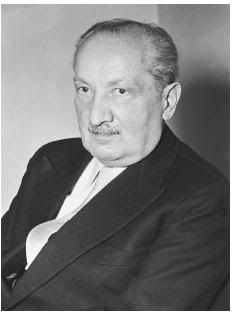
Martin Heidegger

Heidegger and Being

Heidegger was the next evolutionary step beyond Husserl in the development of phenomenology. Husserl dealt with objects in much the way that Descartes did; we are conscious of them, they are intentionally conscious of them. In this version of phenomenology we understand the essential structures apart form the reality of objects.[xxi] He regarded them as objects and his version of phenomenology is about how we regard objects as actors on stage in the Cartesian theater. This approach of Husserl is known as “transcendental phenomenology.” Heidegger takes a different approach, known as “hermeneutic phenomenology.”[xxii] Heidegger deals with objects, aspects of our perceptions in being as we live our lives, in the way that fish regard water, as something so close to us, so all pervasive, so fundamental to existence that we don’t even notice it. Perhaps one of the best examples of this is his concept of “ready-to-hand.” Or an even better example would be the carpenter who is so use to his tools the use of them is second nature. He doesn’t have to be careful with the hammer he just hammers. He doesn’t think about what he’s doing because it’s so much a part of his being he doesn’t need to think about it. Such is our encounter with being and with most things in being. This is misleading because the subject is extremely complex. There is a multiplicity of opinions as to what Heidegger was really saying, and the philosopher himself doesn’t help by clarifying.[xxiii] Heidegger distinguishes first between a general sense of being for anything or everything, being itself, and the being of human beings that is aware of itself, what Sartre calls “being por soi,” being for itself. The being of inanimate objects Sartre calls “being en soi,” or “being in itself.” To distinguish between being in general or apart form any particular thing (being itself) and that of an individual, the use of the term “a being” is employed by translators, while Heidegger himself uses the German terms “Sein” (being) and das Seiende for the latter. Human being in particular Heidegger speaks of as Dasein, which is by its nature vested with an implied social dimension.

For Heidegger the Western tradition has erred with Aristotle in assuming humans are rational. We develop theories of rule keeping and decision making that assumes humans are rational; this turns out to be superficial. We are also irrational, we have depths and we are complex creatures, we don’t understand ourselves.[xxiv] The Western tradition erred with Plato in assuming that we can understand the world in a detached way by taking a step back and developing a theory of theory, “discovering the principles that underlie the profusion of phenomena.”[xxv] The mistake is in thinking we can have a theory of everything. Heidegger opposes the idea of a theory of everything. We cannot have a theory of what makes theory possible. This calls into question the foundations of Western thought.[xxvi]

Since Descartes philosophers have been struck with the epistemological problem of explaining how the ideas in our mind can be true of the external world. Heidegger shows that this subject/object epistemology presupposes a background of everyday practices into which we are socialized but that we do not represent in our minds. Since he calls this more fundamental way of making sense of things our understanding of being, he claims that he is doing ontology that is, asking about the nature of this understanding of being that we do not know--that is not a representation in the mind corresponding to the world—but that we simply are. [xxvii]

Heidegger sides with Kierkegaard rather than with Descartes. Cartesian doubt is phony, the Cartesian theatre of the mind is contrived and thought and awareness flow out of being rather than standing as a conclusion to a philosophical premise, “I think, therefore, I am.” As Dreyfus points out, refereeing to SK’s view “I am, therefore, I think.”[xxviii] Heidegger questions the concept that we gain control of our lives by clarifying the principles which govern our action. It may not be possible or even desirable to do so. These principles work best for us when they remain in the background. “What is important and meaningful in our lives is not and should not be accessible to critical reflection.”[xxix] There are many ways to put the reason, because our actions “lack seriousness” or because we can’t generalize properly, but probably the best reason for this is because when we try to clearly all the principles we construct pre conceived categories that are of necessity incomplete or wrong simply because we can’t know the principles and work by them at the same time.

This is an un-Heideggerian reason, its my reason but I think it applies to what he is saying: clarified categories are pre conceived and that contradicts the way we work in categories that are hidden. The success of the way we work with the principles is that we don’t know them, or don’t know all about them, we couldn’t use them properly if we were trying to figure them out all the time. Thus the answer is to allow the sense data to suggest the categories to us. Otherwise we try to group or herd sense data into the pre conceived categories. Heidegger calls this inexplicable background (the undisclosed principles) that enables us to understand, the understanding of being. These hidden functions, the principles, operate for all aspects of our lives. They are in the meeting of every person we encounter and in every confrontation with life we endure. Heidegger’s approach to working with these hidden principles without trying to explicate them is the source of such slogans as “back to the things in themsevles.” He’s trying to get under the formalized understanding of principles and encounter the actual principles themselves as they work from within. This is what he means by doing hermeneutics form within a hermeneutical circle. [xxx] Heidegger’s notion of being is very important to this work, as the concept of God as being itself (or the ground of being) is the central point, and Heidegger was a major influence upon Tillich, who is the central figure carrying the ball for he notion of God as being itself. Yet Heidegger’s notion of being is extremely complex. To really do it justice would require a book in itself. Therefore, the important part for my purpose is to understand what Tillich took away form Heidegger’s understanding of being itself. One thing Tillich didn’t get from Heidegger was the notion that God is being itself. So Tillich’s admiration for Heidegger had limits. Tillich’s view that God is being itself is rejected by Heidegger, also by Bautlmann , Barth, and Reinhold Neibuhr.[xxxi] Nevertheless it will be important to understand some basic ideas relating to Heidegger’s concept.

The one thing that stands out about Hediegger’s notion of being, and Tillich’s, I’m sure it will be the first major criticism made of this work, that there seems to be no there “there.” There’s no clear simple obvious sense in wich one can actually define Heidegger’s notion of being. It is clearly much more involved than just saying “being is a from of the verb “to be” and refers to the existence of things. This is primarily because Hediegger didn’t really seem to want to say “this is being, walk therein.” His view turns upon the hidden nature of being. It’s almost in his interest, one could say, not to define being too sharply. He argued that the question of being was the most important and fundamental question for philosophy, yet one that could never be answered.[xxxii] When we get into unraveling Tillich’s position we see that the complexity is of major importance. In regard to Tillich this comes under the heading of “depth of being.” For Heidegger we can’t just blurt out an answer because being is hidden and is something transparent to us but something we work in and is to close to us to really understand, like water for the fish. For Tillich there’s more to being than the bits we can see or experience, so it’s not just hidden but has depths, it’s deep and complex. Philipse Surveys the ground of American commentary on this point and finds an array of differing views. Dreyfus says Heidegger’s notion of being is “an intelligibility correlative with our everyday practices.”[xxxiii] According to Sheehan being itself refers to the “analogically unified meaning of being”[xxxiv] For Michael Zimmerman it’s “the history shaping ways in which entities reveal themselves.”[xxxv] Philipse argue that these are all aspects but don’t tally with all of Heidegger’s texts. It’s clear they all deal with the human experience of our own being rather than the fundamental fact of existence apart forms any specifics. That is crucial to understanding Hdiegger’s meaning, because he’s talking about Dasin, human being, what means to engage in our own human form of being; that does have a social dimension.

Heidegger’s interest in being as a philosophical question, and the notion that it is the most fundamental question, come from his reading of the dissertation by the nineteenth century philosopher Franz Brentano, who dealt with Aristotle’s interpretation of being; the notion of the fundamental nature of the quesiotn goes all the way back to the Greek philosopher.[xxxvi][xxxvii] Aristotle recognizes distinctions in the many ways being is used, Brentano reflected the diversity. Aristotle has four ways of understanding being: (1) (V7 Metaphysics, 1026a:33) Kata Sumbebekos, what something is said to be identically; (2) “being” in the sense of being true; (3) “being” in the sense of being potentially or actually; (4) Being as it is in the 10 categories. Heidegger analyses each of these aspects[xxxviii], but they are still only aspects of a reality that continually recedes the more one chases it. As Philipse puts it, “although Aristotle did analyze did analyze different meanings of being, he did not discover the one leading and fundamental sense from which the other meanings somehow derived.”[xxxix] Heidegger never does get to the answer, the upshot of all of his ferment is that toward the end of his life he intimated that being receded and was more hidden.[xl]

The social aspect in the analysis of human being will get Heidegger in trouble. Of course that’s his entre into the world of politics, or at least the intellectual tie to his philosophizing. I will not go into any detail on that matter. Heidegger was a Nazi, but history has allowed his philosophizing to continue despite his political blunder. Philosophers who were avowed enemies of the Nazis, such as Marcuse and Tillich, still wound up using Heidegger. Marcuse seems to have had no use for Heidegger personally after the war, but continue to think through the lens of his philosophy.[xli] The view seems very different from America, approaching these thinkers through the sterility of metaphysics and abstract ideas about being, divorced form the political realities and concrete life that brought these thinkers into conflict. When we plug in the historical and political things make more sense.


[i] Gallagher, op cit, 20. Dennett is sited for Consciousness Explained, 1991, 44.

[ii] Ibid.

[iii] Ibid.

[iv] Ibid.

[v] Ibid. 21

[vi] Ibid.

[vii] Ibid, Hsserl, Logical Investigations, is sited.

[viii] Ibid.

[ix] Ibid.

[x] Ibid. 22

[xi] Ibid. references Logical Investigations, 2001 edition 170

[xii] Ibid.

[xiii] Ibid, 23

[xiv] Ibid.

[xv] Ibid.

[xvi] Victor Daniels, Pdf lecture notes Sonoma State University web site: URL: http://www.sonoma.edu/users/d/daniels/phenomlect.html visited 6/16/10

[xvii] references to M scale in Trace of God (find)

[xviii] Sheree Dukes, Abstract: “Phenomenological Methodology” in the Human Scineces.” The Journal of Religion and Health, Neatherlands: Springer.Vol 23, no 3, Sept 1984. 197-203

Dukes was in the Department of Psychology Boston Universlity.

[xix] Dieter Lohmar. Abstract, “Mirror Neurons and the Phenomenology of Inter-Subjectivity.” Phenomenology and the Cognitive Sciences, Netherlands: Springer, (Volume 5, no 1) March, 2006, 5-16.

Lohmar is at University of Koln, Germany.

[xx] Dukes, Ibid.

[xxi] Paul Gorner, “Heidegger, Phenomenology, and the essence of Technology.” Online Journal, Philosophy: University of Aberdeen. Websties URL: http://www.abdn.ac.uk/philosophy/endsandmeans/vol2no1/gorner.shtml visted 6/31/10

Paul Gorner is Lecturer in philosophy at the University of Aberdeen

[xxii] Hubert L. Dreyfus, Being in the World: A Commentary on Heidegger’s Being and Time. Massachusetts Institute of Technology, quotations from Being and Time by John Macquarrie, 1991, 2.

[xxiii] Herman Philipse, Heidegger’s Philosophy of Being: A Critical Interpretation Princeton New Jersey: Princeton University Press, 1998, 3. Online page number URL: http://books.google.com/books?id=D9y2rHPCOgsC&dq=What+is+Heidegger%27s+notion+of+being+itself%3F&source=gbs_navlinks_s visited 10/4/10. online page numbers apply

[xxiv] Dreyfus, Ibid, 1

[xxv] Ibid, 1

[xxvi] Ibid

[xxvii] Ibid, 3

[xxviii] Ibid.

[xxix] Ibid, 4

[xxx] Ibid

[xxxi] Walter Leibrecht, “The Life and Mind of Paul Tillich,” Religion and Culture: Essays in Honor of Paul Tillich, Walter Leibrecht ed. New York: Harper and Row, 1972 (originally 1959). Notes, 355 FN 2

[xxxii] Philipse, 8

[xxxiii] Hubert Dreyfus, in Ibid, 3

[xxxiv] Thomas Sheehan, in Ibid

[xxxv] Michael Zimmerman, in Ibid.

[xxxvi] Ibid, 5

[xxxvii] Ibid.

[xxxviii] Ibid.

[xxxix] Ibid, 6

[xl] Ibid, 8-9

[xli] I say this based upon an incident recorded by Barry Katz in his Marcuse and The Art of Liberation. Apparently Marcuse made one attempt to learn how it was that Heidegger could be Nazi, he was not satisfied with he answer (which was something like “it seemed right at the time) he made no more efforts to contact Heidegger.