Showing posts with label Film Review. Show all posts

Friday, January 08, 2016

Fun filled Friday: Review, the Thing From Another World


 photo 2048044089_d079730c71_o_zps5ypigzzl.jpg


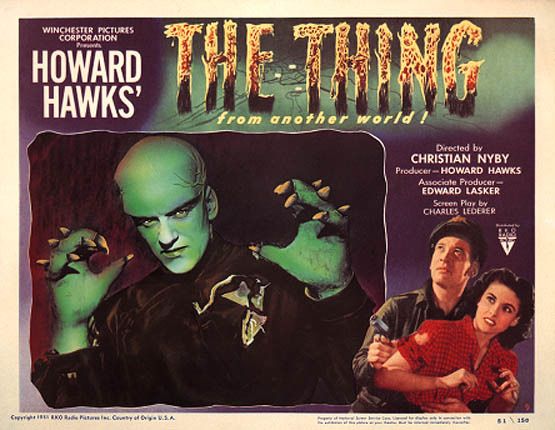
Thank God it's Fun filled Friday! Happy Friday fun loving readers. Today I am going to review one of my favorite 50's horror films, The Thing From Another World. I love the genre, cheap 50's vegly scifi-ish. The "new" style of horror in that era. I'll be doing of my favorites from that era, Creature From The Black Lagoon, And Them! I'll get to those eventually.  I first saw this as a kid, summer afternoon. One of our two best friends came over with a stack of comic books, we had pop cycles, we had swam in the morning and were settled back for an afternoon of comic books and "dialing for Dollars." That's the first time I saw The Thing From Another World (1951). It was great, exciting, suspenseful. Little did I know at the time it was also cold war hysteria. I'll get to that.

Directors: , (uncredited)     Nyby directed a lot tv in the 60s and 70s including Maybery RFD.

Writers: (screenplay), (based on the story "Who Goes There?" by), 2 more credits »    

Stars: , , |                          

Arness (Marshal Dillon) Plays the Creature, hard to recognize.

Reporter Ned "Scotty" Scott (Douglas Spencer) has come to a military base at the North Poll because he's looking for a story and he's heard that a large group of scientists have gathered there for some unknown reason. It's sort of "hush-hush" but they take him along anyway. There is a major storm in the offing, communications are getting difficult. A sub plot is introduced in the relationship between Captain Patrick Hendry (Kenneth Tobey) and Nikki Nicholson (Margaret Sheridan). They have known each other in the past, it's implied that their relationship was based upon casual sex. They play coy with each other and hint that they might resume where they left off. Of course they didn't show anything because it was a horror movie back then that meant  large part of the audience would be children.

The crew goes out into frozen waste land to explore the crash site of sn aircraft near by. This is why the scientists were there, they didn't know whose plane it was, they thought it be a meteor or it could be Russian. The see a craft under the ice. They don't see wings and they can't make out the shape so they stand over it and trace out the shape by linking arms. They notice they are standing in a circle. The craft is circular. There is a moment of stunned realization. They try to use bombs to free it from the ice but blow it up. They find the frozen body of the pilot freed from the ice by the blast.

Back at the base we have the first confrontation between the scientists and the hero  (Patrick Hendry--like Patrick Henry--"give me liberty or give me death"). This is how we know it's a red scare movie. The main scientist,  Dr. Arthur Carrington (Robert Cornthwaite),  is a type I grew up with, I recognized the trope even when I did not know what it was about. Liberal do gooder, whimpy, doesn't ant to fight, placing absolute faith in science and peace and reasoning with the enemy, in opposition to the All American hero (like Patrick Henry) who knows the answer always lies in theatrical heroics. This type was so common I remember the first time I saw the movie I said to myself "O yea that kind of guy."The thing frozen in the ice really spooks them, especially after they clean it up and can see the face is not human. They don't know if it is conscious or not, of course the scientists want to defrost it. The hero says no and he puts a guard on it. It's locked in a store room, the windows broken so the ice wont melt. OK spoilers past this point.

Of course the ice get's melted. The guy assigned to guard it leaves a heating pad on it. Stupid mistake. He put the blanket over it because he didn't want to see it staring at him. Barnes, the idiot with the heating pad escapes with his life, as the creature breaks out. He locks the door from the outsides and alerts the base. They arm and come back only to find the creature has fled through the open window. Outside they hear and see in the distance a form fighting with the dogs.

Examining the dogs they find an  arm torn off the creature during the battle.  The scientists, upon examining the arm, find that he's s vegetable man. his cellular structure is like that of a vegetable. The arm starts moving when blood from the dogs gets on it. They theorize that the creature  is made up of fiber and seed pod and can break into autonomous units. They all arm with  guns and axes and barricade themselves from the storeroom. The sled dogs are all dead, the base is snowed in, and the communication is out.

Dr. Carrington notices several of the plants he was tending have died. He theorizes that the door was open long enough to let in cold air from outside; they search the place and find a dog dead and drained of blood. The creature had been there and is getting blood to  speed up cell division and hatch his seed pods. The others are worried about surviving but weak-kneed liberal egg head Carrington expresses sympathy for the creature, isolated in the cold on a strange world and attacked by dogs. He wants the dead dog kept from Hendrey so he can communicate with the creature.

There is a missing blood supply. Nikki finds Carrington's notes and shows them to Hero Hendrey (hey it pays to snoop in a red scare). He has the major confrontation with Carrinton. Meanwhile they realize the creature got the blood supply so he's coming and going as he pleases. They barricade themselves in the mess hall. They prepare to fight to the death. Here comes the major spoilers.

The creature breaks in. They dowse it with kerosene and set it on fire. The things gets away he is just irritated and cuts off the oil supply. Now they are trapped and freezing. They still have power (oil heaters) but Hendry figures the creature will attack the generators. He wants to set up a trap but the fire didn't seem to hurt him. Someone suggests  electricity. They rig up a thing to produce an electrical arch in the door way. On his way to the trap Carrington intercepts the creature warns him of the trap (just like those traitor liberals) and makes a little speech exhibiting all the liberal values about intelligent creatures working together. It's pretty clear by that point that the creature wants their blood to nurture the seedlings from his pods so the can raise an army. He bashes Carrington out of the way and goes on to the trap. See you can't reason with the commies, not even a vegetable  man commie from another planet.

He bursts in the door, they turn on the electrical gadget, he's caught in an arching bolt of electricity and fried to a crisp. The sky clears, communication is open. Pat and Nikki decide to get serious and [plan their future together (the hero always get's the girl--when he fights commies). The film's famous ending shows the reporter phoning in his story and he says say we need to remain vigilant against further threats from outer space, he ends by repeatedly shouting "watch the skies! Watch the skies," getting louder, WATCH THE SKIES!" Film critics tend to believe that he is really saying to watch for Russian bombers.

The red scare was no j9ke it destroyed a lot of innocent lives. This  film, in spite of it's true propagandistic motives, is fun to watch and it is exciting and fun to make fun of it.


 photo 11292552_ori_zpsxffdv67e.jpg

Friday, November 06, 2015

Fun Filled Friday: Review, The Legond of Boggy Creek


 photo boggycreek2_zps0f17ee47.jpg

Great one for today, boy are we having fun!


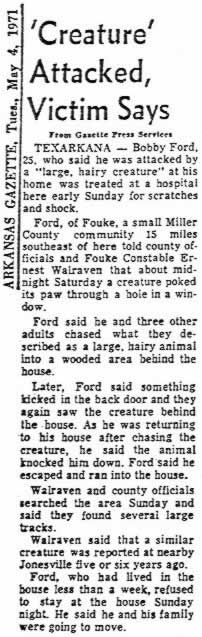
Here is another funky little film that has that student film feel. This one is directed by Charles Peierce (June 16, 1938-March 5, 2010 (aged 71). He was born in Hammond Indiana. As a small child he was moved to the same general area in which the action of Boggy Creek takes place. This is no doubt where he learned the legend of the "Fouke Monster," the Bigfoot-like creature that is the center of the film. He drafted customers from the local gas station to act in the film,[1]  (released in 1972). One might suspect the gas station approach to casting judging by the amature acting feel of the film. Even though it's about a  dark, scary,  confusing, if not corny, wacky subjet, it has a positive harmless student film quality. It's something about that amature quality I find appealing. It's not a great film, it's not even a fine film. Yet it's appealing in a home-spun way. It was also Pierce's directorial debout. He moved Carmel, befriended Clint Eastwood, Eastwood helped him get a job directing Sudden Impact (1983) a major motion picture starring Clint Eastwood (It's really Dirty Hary No.4). He is said to have invented the phrase "make my day."[2] He made other films including Boggy Creek II (which lacks the magic of BC I). The film was Written by Sean Taylor . (according to the IMBD). Wikipedia says it was written by Earl E. Smith.

There is a magic to this film. It is quite strange because all the individual elements suck. It's a pile of crap in every category from acting, to production values, yet it just has a feel the way it all comes together, innocent, sincere, alarming, scary, but somehow postive. It harkens back to child hood.


From IMBD page:
Cast overview, first billed only:
Vern Stierman ...
Narrator
Chuck Pierce Jr. ...
Jim as Boy
William Stumpp ...
Jim as Adult
Willie E. Smith ...
Willie
Lloyd Bowen ...
Himself
B.R. Barrington ...
Himself
J.E. 'Smokey' Crabtree ...
Himself (as Smokey Crabtree)
Travis Crabtree ...
Himself
John P. Hixon ...
Himself
John W. Oates ...
Himself
Buddy Crabtree ...
James Crabtree
Jeff Crabtree ...
Fred Crabtree
Judy Baltom ...
Mary Beth Searcy
Mary B. Johnson ...
Sister
Louise Searcy ...
Herself
The nerration begins with a framing device that opens and closes the film. Plays the narrating charter, who has returned to the cabin he lived in as a child. His mother and he were trying to eek out a living in that rural community, described as so small you would miss it if you blinked while driving through. The man peers through the windows of the empty abandoned house, as he sentimentally examines the property and his eyes room to the wooded horizon that sounds the poetry completely. It's moving toward dusk and he's thinking, i the dying evening sun light, "it's still out there." He ponders his memories of the creature.

We see him a as a boy, , dashing through a huge field of ankle and waste high grain or grass. he's climbing a fens and talking about how the creature had shown up he often heard it screaming from the woods. No one knew what it was but some felt it sought a mate. He hears the scream from the woods off in the distance and hurries along his way even faster. He comes to the little story on a dirt road were three old men are, one watching the other two play checkers. The boy comes in and asked teh owner, his landord, to come to the farm as his mother asks, investigate the strange noises. The landlord tells him there is no booby man in the woods, but he will change his mind by the end of the film. The boy hurries back, again hearing the scream. Then we move into the action of the film narrated by the adult version of the boy. This framing device is one of the best decisions the director made. It really takes us into the action. That scene would have been played out in the 40's when the Fouke monster first showed up. It was a latter version of a phenomenon from the 20's in neighboring county of Johnson called "the Johnson monster."

Some form of Harry monster can be found roaming that area as far back as white settlers were there to record it. The framing device close the film with the man pondering "is it still there, is it watching me now?" The sun is setting and  sense of tension grows that he's goign to be there after dark in an abandoned house and the thing is right outside. But he leaves just in time and the film ends. In the middle of these two segments he narratives the actions that happened years latte, in the 1960s. The resurgence of the Fouke monster in the 1960s is really the most famous period of activity. The film centers around a family called "Crabtree" who in real life is the family of Smoky Crabtree who has made a carrier out of the monster. He written many books and so on such as Smoky and the Fouke Monster. Notice Travis Crabtee plays himself. Oddly enough buddy Crabtree is played by James Crabtree. Kind of makes you wonder.


One member of the family sees the creature while sitting by a river bank. He only has bird shot in his gun so he doesn't fire on it. It's maybe a hundred years away so he just watches it. We catch only a fleeting glimpse of it. That is the second initiative choice the director makes that creates the magic of the film aside form the narrative framing device, that is the indirect approach to the horror. That is always the most effective appraoch to a horror tale, as evidenced by the Blair Witch Project. The whole film is really series of vignettes of various sightings. The man who owned the little story and laughed at the narrator's mother's fear saw the creator and shot it but the gun had no real effect. He now believed in the harry monster. Another saw it take two hogs one hundred pounds each, one under each arm, and step over the fence and walk away. Two boys found three towed foot prints in the mud while fishing. One of these scenes shows one of the only three semi direct views we get of the creature in the whole film. One is the scene with the Crabtree man by the bank.

The other major scene that all these little views of it are moving toward, where we see it grab a man on a porch. But it's dark and you only see ti fro a second. There's an extremely well done scene where a boy is out near his house with a shot gun he's looking for the origin of a noise. This on toward evening, it's perfectly light. He walks right up within feet of it but he has his back to it so he doesn't see it. It's only obscured by a few leafless three branches so we can see clearly it's a Bigfoot-like thing similar to the Patternson film. The creature makes a noise, the boy turns with great alarm sees it standing right there, nd fires! The creature is clearly hurt, annoyed but not damaged. It is angry! He's screaming and hitting trees. They boy is running to his house.

 photo boggycreek-thumb_zps72491d57.jpg

 Three major event-scenes that describe the film and fill in the action leading up to the denumont, which is the siege of a certain familie's house. Strangely enough there's a song in the film. It's like an Innocent Disney kind of song about what a wonderful life it is in the woods, "hey Smoky Crabtree." It's so corny and out of place. Here's this horror thing running around, no one knows what it is, it's scary but there's this innocent little song about how great it is. It's so kitschy and out of place. In trying to figure is it that this song doesn't spoil the film for me even though it's ridiclous, makes the film see like "a hoot," or does it work with the flim to help the "magic," I would have say it works with it. It would be so easy to ruin it. The song is a prelude to a since with an old hermit who Travis Crabtree befriends. He brings the old man tobacco and stuff. The old man seems to say he's never seen the creature then latter says he doesn't bother it and it doesn't bother him. It leaves one wondering "why is this here in this film?" It seems to serve no function. It's almost like he was going to make a different film and then put it in for filler. Coming right after the song seems even more superfluous.  Yet like the song it doesn't destroy the film.  For one thing part of the charm of the film is its armature nature. So this helps on that score. Then I think it's characterization. The population of Fouke and the surrounding area is a major character in its own right, this is part of charactoriztion where we see the nature of the populace.

In terms of action of the creature we see a scene in which a young girl goes to bed, taking care of her siblings. The creature comes right out side. Earlier that evening as she drew water for the house she watched the woods feeling something was there. Now she watches through a window as we hear it growling. It's supposed to be killing a cat but I can never make anything out, not even on DVD. It's all dark. Another scene shows three girls in a small clap board house, alone. They are going to bed they are having a pajama party. The three hear the creature breathing outside. It tries to get in. They put a chair at the door and get the father's shot gun. They don't necessarily know how to load or shoot it. They are not harmed but the sense of tension and vulnerability really words to make a scary scene. We do not see the creature at all. The idea the three women alone raises a question echoed throughout the film as a theme, it it looking for a mate. It's either horrassing women alone or taking live stock as food. Since it's appearances seemed to run in periods, punctuated by long periods of absence, as the Johnson monster in the 20s, the Fouke monster in the 40s, and 60s, they speculate that it get's lonely. One wonders why they would assume it's the same creature after all those years? There have to be others or it would die off.
The community has a big monster hunt with hunters from all over the state bring dogs, coon hounds and so on. But the dogs wont move in on the scent once they get it. The hunt goes nowhere. One guy sees it and is thrown from his horse. All of the scenes in the film are based upon "real" claims of sightings and stories in the community. It's narrated as a documentary but shows some dialogue in scenes as a docudrama.

Then we come to the major point, the siege. A family has moved in to a rent house along a back road in the area. The husbands are working near by and the two women and children are accompanied by a brother of one of the woman, a young man who may be the one grabbed on the porch. They hear the thing outside at night and are frightened. It comes up on the porch and tries to get in. It even turns the knob but they put a chair there. It reaches into the living room at one point through the front window. All we see is a hairy arm. It almost grabbed one of the people. It also reaches in through a bathroom window and almost gets the young man visiting his sister. The men come home and go out to confront it. All they have is flash lights. You would not find me doing that. The thing comes up on the porch behind one of them and grabs him and throughs him. I say he got off easy. They rush him to a hospital at  Texarkana. The boy is in shock. This is said to be a true story. The people decide to pack up go at first light they never come back. That's basically the end of the film.

Then the framing devise closes it with the man wondering is it watching me now. Leaving just before dark. It's not an art film and not a fine film, it has a quality to it that I find appealing. It works on a couple of levels. Maybe that's it's secrete. It's a cult classic for Bigfoot hunters but no one regards it as a serious source of information because nothing it says about the creature is advanced knowledge, so any bigfoot hunter worth his wood knocks knows that information anyway. It's not really documenting anything because no attempt is made to actually demonstrate the veracity of the stories, no story teller is really identified other than the fictitious narrator. On one level its a laughable amateurish attempt that makes the work a hoot. On a deeper level it's a respectable first attempt to bring to light a subject that the director no doubt grew up with and wants us to take seriously. But it's an innocent presentation that doesn't seek to scare the viewer with horrific nonsense but just tells its tail outright. The two best choices are the framing devise, which pulls us in to the guy's plight and his naustalgia and the wonderment at "what happened to the thing?" The indirect appraoch to presenting the horror is always very effective. The imagination can compel us to look.


accessed April 24, 2014.

[2] Ibid.


Watch the entire film on Youtube

Thursday, October 29, 2015

Davy and Goliath VS. Gumby and Pokey.


I used to have film fest Friday. I got so many film reviews I decided to make a film blog(silver age of film--link in side bar).. Now I can't put films here because the nine people who look at the films are already readers here. So we can't have film fest Friday but we can have (wait for it)...Fun Filled Friday! In other words I'm too lazy to write anything profound so I'm recycling schlock. Have fun.
Ps, it wouldn't kill you to go look at the film blog--come to that it wouldn'thurt if bought my book either.


  photo Art_Clokey_zpsaf17ae9a.jpg
Art Clokey in the 60s (October 12, 1921 – January 8, 2010)

In keeping with my tradition of using friday for light fare, mostly film review, I decided to have a battle between two children's shows that I thought were  most creative. These are creative because they don't just draw the cartoons, they created miniature worlds in clay and they move them around physically. So they have little model worlds and everything in it has to be a tiny model; even facial expressions require a second doll for that expression.

One is a plodding Christian Children's cartoon,Davy and Goliath. The morality of each episode is heavy handed. It's a nostalgic childhood memory, each episode is filled with charm and skill, but the moral hangs heavy over the production, from the opening "A mighty Fortress is Our God" to the closing credits with production team of the Lutheran Church in America, it's a trip to Sunday School in moving clay. Against that image we have Gumby and Pokey which is one of the most creative cartoons ever made. Like Davy and Goliath, Gumby is done in clamation, but it's rawkus and anything can happen. It's the thoroughly creative brain child of an acid dropping hippie. While Davy and Goliath were directed by Author Clokey, Gumby and Pokey were created by Author Clokey. I saw an interview of him talking about his drug taking. It's not there now. I can't prove it because it's been taken down but I saw it.

That's right both are done by the same guy. Clokey's work on Davy and Goliath was commissioned by the Luthern Church in America and he was no alone in producing the script. His work with Gumby was a labor of love. Still both are loaded with charm and creativity. Was he an acid dropping hippie? One might think so watching Gumby and Poky. They go inside books and find whole worlds there. They are baked inside pies after being attacked by pastries. They melt down the drain while taking showers and come out poured into the kitchen sink by Gumby's parents.

Gumby has the  head sloped to one side so he would not appear as a fallac symbol. The name of the company called frama visions based upon the Sanskrit word for "love." "Gumby is an act of love to children." In one episode Gumby acquires the midus touch but instead of turning things to gold he turns them into art works, they actually pop into little mini sculptures that really look like they could be real art works. In one episode when they go inside a book the world the come out in is a planet in outer space it's already inhabited by another kid who is reading the book.

 photo mqdefault_zpsfb2953d6.jpg
Gumby and Pokey


Clokey put a lot of creativity into Davy and Goliath but it's more restrained. The little world is amazing because in miniature it looks just like a real world. Their little houses look modern 50's style houses inside. They have little door knobs, they have little tooth brushes. Davy is always getting into some kind of danger from his own stupidity. He's locked in a refrigeration freight car and carried to another tow. Goliath is stranded on the edge of a water fall and Davy has to swim out and save him. He's cornered by an escaped lion in his own backyard while sleeping in a pup tent. He's trapped in a cave and the caves looks realistic. Davy and Goliath taught a lot of lessons on accepting people of color and people who were different. Coming in the late 50's and early 60s that made this show very progressive for children's programing. It put them at odds with huge portions of the south.

 photo mqdefault_zps3d9032a7.jpg
Davy and Goliath

Unlike the insulting show Lassey that wants us to think a good dog can solve any problem, Goliath knows nothing, he never solves anything, he can't even run for help, all he does is speak to Davy (only Davy understands him) in a low confused sounding voice and says thing like "I love you DaaaaveeEEEEEEEE!" or "I want some some food now.Daaaaave-eEEEEEEEEEEE!"

As it says on the Gumby world website: "Gumby creator Art Clokey was a true visionary and stop motion pioneer whose explorations in film had a profound impact on filmmakers worldwide for generations. Take a spin around the all new Gumbyworld.com to discover more about Art Clokey, Gumby and friends." Clokey started Gumby in 1955. He's named after "gumbo" the word they used for a kind of clay the made at some relative's home in the country when he was a kid. Even though I can't prove it because the interview has been taken off Youtube there was one where hey himself said he had left his family in the 60s to join the counter culture. He now regrets that.

His Bio on Wiki says: " His son, Joe Clokey, continued the Davey and Goliath cartoon in 2004. In March 2007, KQED-TV broadcast an hour-long documentary Gumby Dharma as part of their Truly CA series."


official Davy and Golith Website
http://www.daveyandgoliath.org/

Gumby world.com
http://www.gumbyworld.com/

Gumby and Poky
In the Dough (where they are attacked by pastries)

Gumbasia (Cloaky's student film) (like Disney's Fantasia--this was mid 50s)

Friday, June 13, 2014

Film Fest Friday: Revised Review of Ingmar Bergman's "Wild Strawberries."

Photobucket
Borg with three students

I first wrote this reveiw in 2010. This summer of 2014 I'm re-viewing all my favorite films for the summer. So I saw this one last night (today is friday the 13).

Derek Malcolm, writing for the Guardian UK (Thursday 10 June 1999 19.36 BST )
"The film I constantly go back to, however, is Wild Strawberries (1957), which, while scarcely a bag of laughs, has a compassionate view of life that best illustrates the more optimistic side of Bergman's puzzled humanity." I agree with Malcolm, I also go back to "Wild strawberries," (Smultronstalliet) again and again. In fact at one time I saw it as tying my favorite film of all times bar none, to two films equally loved, both by Bergman, "The Seventh Seal," and this one. Now I place it at number four (4) in my top 10, I still love it. It is not a bag of laughs but it does have a side of humor and though its about an old man at the end of his life it has a hopeful tone that looks to the future. It's not a heavy theologically oriented film but it even has it's God-conscious side. Bergman, though an atheist, could not let go of the idea of God, it has too many cogent connections to art and thought and life.

Realesed in 1957 This was one of Bergman's earliest successes, just on the heels of his original break out film, "Smiles of a Summer Night." The film centers around an old man,
Victor Sjöström ... Dr. Isak Borg who is at the end of his life, he's a great immanent medical researcher, still admired and loved by the populace he once tended as a country doctor, about to receive an honorary degree form a major university to crown his life time achievements. He is a crotchety old man who hides guilt, anger and aggression behind a vernier of old world charm. He has a old married couple sort of relationship with his manipulative managing house keeper, who wheedles and flatters him as she dotes on his greatness and practically worships him, but treats him like a child to do what's best for him. He has a bad relationship with his son,(Gunar Björnstrand--the squire in "the Seventh Seal") Dr. Evald Borg dividing over a loan he gave his son years ago and has never been paid back, the father doesn't have the grace to forgive the debt, spouting all sorts of pious nonsense about responsibility and morality. the son is middle ages, the father is almost 80 and the debt still divides them. Victor Sjöström who plays the old man was, in his youth, one of the early stars of Swedish silent film. He helped to establish silent film in Sweden, and was said to have been handsomest man in Sweden. At the time this film was made he was very old looking.

The film is really about Bergman's relationship with his parents. That's played out through the relationship of Dr. Borg with is entire family. The themes of the film are the loneliness that besets us when we close ourselves off from hurt by become cold toward others and toward human relationships in general. Not reduce Bergman to simplicity but it's kind of like John Lennon wrote "it's a fool who plays it cool by making his world a little colder" (--"Hey Jude"). The film open withe the doctor explaining who he is, we see pictures of his family including his son, Evald. His mother is still alive even though he's 78. He's talking about death and loneliness.

The old Doctor decides to drive to the University, to the alarm of his Housekeeper. But his doubter in law (Marriane Borg), played by Ingrid Thulin, just happens to be staying with him. She's left her husband but asks for a ride with him to the university, where she lived with her husband. So this film is a road trip with an old man and his daughter-in-law. An American film would pit Steve Martin and Jeniffer Lopez and they would talk about nothing and wind up destroying buildings having car chases. In this film, however, these two literally do nothing more than talk about what I'm sure appears to be "nothing" to most Americans, but actually invovles the most important things in life. The old man has had a disturbing dream, but the young woman doesn't want to hear it. She frankly tells him she doesn't like him because he hides cruelty behind his mask of old world charm, yet the two remain good matured. The film is full of dreams. Although in that conversation she tells him his son hates him because he is cold and closed off. This knowledge clearly wounds him but he retreats even deeper. The first dream was about the man walking down empty streets of a small European village (shot in old Stockholm very early in the morning so there would no one on the street). A hearse driven by horses dumps a coffin and a hand falls out of the ajar lid. The man goes near, the hand grabs him and pulls him close, the face peers out from the coffin, it's him! The man is dead and in his coffin and pulling himself toward the coffin. This dream sequence is shot in a glaring black and white that could not be done in color. It's a tribute to German silent film, loaded dream symbols and angst.

The two stop to examine a house on a lake where the old man spent many a happy summer as a child. The house is deserted and not owned by the family anymore, but the two wander about for a while looking. Sitting by himself the old man suddenly sees the house as it was and his brothers and sisters, children in old fashioned turn of the century clothes, run out of the house pursuing all manner of summer activities. He watches a scene between his cousin Sara and his brother, who we learn latter married and were still living but old in this current time 0f 1957. Dr. Borg wanders into the house and stands observing scenes of family life but the characters don't see him. We learn from this that that he was afraid to act on his feelings, he loved Sara but let her marry his brother (presumably they were third cousins) because he was stand offish. It's in this dream-like interlude with his childhood that we see the point of the title, his cousin Sara who he wants to marry is picking wild strawberries when his memory conjures up a picture of her beauty in youth. He plays in his mind a scene between her and his brother latter has such a scene with her. He is old and she is young she tells him she will marry the brother. He talks about how it hurts, we see this is the first daunting disappointment in relationship that hurt him and caused himself to close off to human relationships.

At this point they meet three young people who are hitch hiking to the University. The three are a hilarious trio, a theology student, a secular student of some kid who of course has it in for religion in the faddish way that students of the 60s hated everything established, and a girl who the two fight over the whole trip. They have a few little runs at discussing God. The Marxist student is shallow and can only think in Marxist cliches he doesn't see that the Doctor is trying to hint that God is too important and too grand a concept to dismiss outright. One of my favorite scenes in the film. he two students come to blows. They go off to fight in the woods. Their fighting looks like two beached whales trying to push off each other to get unbeached. They get back in the car, one has a black eye. The girl sits in the middle she turns to the theology student and says "so, does God exist?"

That kind of reminds me of my partcipation on message baords. Along their way after they meet the kids they almost have a wreck with a small VW bug. The married couple in the bug are friendly at first and happy to be saved and given a ride, willing to admit the almost wreck was their fault (their car winds up upside down but the Doctor's old car is fine). But the two can't stop fighting. Subtle at first then ridiculous. They wind up being put out of the car when the woman begins slapping the husband and has to be restrained by the kids because she can't stop hitting him.

While the fight was ensuing the old man and his daughter-in-law have had a very important discussion sitting in the car and he went to sleep and has the seminal dream of the film. The discussion revealed that the woman left the doctor's son because he's just like his father, cruel, demanding, cold, unfeeling. The woman is pregnant and wants the child the father categorically does not want children and refuses to continue the marriage if they have them. At a time when abortion was unthinkable in America these guys argue about that option as though they were discussing painting the din, because they are in Sweden. But the woman wants the child, she wants to have a family is going back to make one last hopeless stab and reconciling.

The dream that Dr. Borg has while asleep in the car has him ushered into the family summer house they had previously been to, but this time it was empty, dark and foreboding. The Doctor is ushered into the house by the husband who was put out of the car. In this dream, however, he's a proctor giving the old man a test as though he was again at university. Inside the family home is a long dark corridor that was not there before it leads to a very old fashioned looking lecture room in which the old man is given an examination as one might receive at University at the turn of the century. He has to look in a microscope and identify the specimen. He claims something is wrong with the microscope because all he can see looking in is his own eye. The Proctor says there's nothing wrong with it. Then he is to examine a  young woman and say what's wrong with her. He finds that the woman is dead, but she suddenly bursts into laughter. The Proctor tells him he's been found incompetent. He is then told that he has been charged with being guilty.  Grim looking students in the gallery watch and don't crack a smile despite the old man's attempts at humor. Finally he is lead to another room and when they go through the door they are outside.

  photo Wild-Strawberries-dream_400_zps27fb6bf2.jpg
 Dr. Borg's first dream sequence [1]

He stands on the edge of a glad in which his wife (now long dead) and another man play little kissy games and make love. The wife talks about how she will tell him about her day, the husband (Borg) will pretend that he's not angry and she's done wrong, but that she's to be pitied, she is sick and made a mistake. She hates him totally and utterly for this high and mighty  attitude and his refusal to become angry even though she sleeps with other men. The Proctor observes that with most men who are gazing upon an image of their long dead wives, they have a fading image of a saintly woman, but this guy remembers vividly this this scene of adultery.This is the seminal event that made him so closed off he's even alienated from relationship with himself (thus he can't recognize himself in the microscope).
 photo WildStrawberries_Bergman_zps5eb3539f.jpg
Day Dream sequence between Sara and old Dr. Borg

Despite this seeming nightmare the film ends on a hopeful note as the old man seems to have learned. As he tells Marianne "it's as though my mind is trying to tell me things I can't  face when I'm awake" The end of the film is hopeful and exudes a compassion toward the old man, human frailty in general and the young. The wind up at the University in Lund, he is seen taking the honors, and then back tot he house of his son for the night. The son and his wife are happy and seem in the process of reconciling. The son doesn't' seem to hate his father but is glad to see him. The old man tries to tell he has forgiven the debt the son wont hear of it. The three students wind up as friends cheering him on and as they say good by by singing to him as he watches them from the Balcony and waves goodby. They makes statements about how proud they are to know him. They had been popping up around corners even the ceremony for the award begins. The daughter-in-law tucks him in and there's a feeling of warmth and forgiving between them. "Wild Strawberries" is about a man facing himself, like the emblematic image of his own eye looking back at him in the microscope. He's forced to realize that he's allowed himself to be cut off from people and feelings to languish in guilt and for this reason does not forgive the debts of others. In the end he plunges into dream land where he is again in the summer house of his childhood surrounded by those he loved. In the first nostalgic sequence he could not find his parents, in this one he is reunited with them and though he's an old man  they see him this time and they do not see anything strange that he's old, he fits right in as he should. In the final scene he's a boy again, with his family in a wonderful summer at the old summer house.


  photo 220px-Bergman_Sjostrom_1957_zps7c167da8.jpg
 Bergman with Victor Sjöström

from  IMBd page:

Cast

  (Cast overview, first billed only)
Victor Sjöström... Dr. Isak Borg
Bibi Andersson... Sara
Ingrid Thulin... Marianne Borg
Gunnar Björnstrand... Dr. Evald Borg
Jullan Kindahl... Agda
Folke Sundquist... Anders
Björn Bjelfvenstam... Viktor
Naima Wifstrand... Mrs. Borg, Isak's Mother
Gunnel Broström... Mrs. Alman
Gertrud Fridh... Karin Borg, Isak's wife
Sif Ruud... Aunt Olga
Gunnar Sjöberg... Sten Alman / The Examiner
Max von Sydow... Henrik Ã…kerman
Ã…ke Fridell... Karin's lover
Yngve Nordwall... Uncle Aron
See more »


[1] Darren Franich, Keith Staskiewicz  "20 Crazy Dream Sequences at the Movies," Entertainment on Jul 12, 2010
http://www.ew.com/ew/gallery/0,,20401120_20809515,00.html

Friday, June 06, 2014

The Longest Day!

I am doing two film reviews today. see the De Sica film "In He Shoes of the Fisherman" after this one. I completely forgot about the anniversary of D day!

 photo DVD-cover_zpsd6df0e45.jpg


IMBD page

Cast

Cast overview, first billed only:
Eddie Albert ...
Paul Anka ...
Arletty ...
Jean-Louis Barrault ...
Richard Beymer ...
Pvt. Dutch Schultz
Hans Christian Blech ...
Bourvil ...
Richard Burton ...
Flying Officer David Campbell
Wolfgang Büttner ...
Red Buttons ...
Pauline Carton ...
Sean Connery ...
Ray Danton ...
Irina Demick ...
Janine Boitard (as Irina Demich)
Fred Dur ...
This is an excellent film. It counts as American it's Ameircan produced even though it had a million directors.
It commemorates an event that I think stands out as one of the seminal events of human history. I'm an anti-war guy for hte most part. I protested Vietnam when I was a little kid. I protested the contra war and  the gulf war and Irak. But WWII I don't think I would have protested. I would have supported the war effort totally. Hitler was evil and had to be stopped. The militaristic forces that controlled Japan at the time were also Hitlerian and evil.

  photo 270px-Sainte-MC3A8re-C389glise_Parachute_Memorial_zpsa2583bfa.jpg
 The chruch at Sainte-Mère-Église where
Red Buttons hangs from the tower.

The Longest Day is find film to commentate the event. It has so many moments it would hard to Isolate one. The Richard Burton scene is one my favorites becuase we find out he's been stiched up with safety pins. when the drugs wear off he's in trouble. Red Buttons handing from the chruch steeple at Sainte-Mère-Église wathing his guys get slaughtered as he just hangs there, then being defended by the bells. The Little clicker devise to identity each other in the dark. Then they mistake ducks and gese clicking then the German breach loading his rifle makes that clicking noise.

My favorite scene as to be the peasant who lives at the beach. Every morning the German sergeant rides a donkey around the area and the french farmer curses at him. He's just longing for the day when the allies comes. One morning he looks out his window toward the sea and there is a lad of ships sailing toward land.He's ecstatic. suddenly his back yard blows up. Shells are exploding all around him. His wife is shouting "we will be killed." He jumping around going "who cares. they've come! Vis la France!" The Sergent is knocked off his donkey by the blast and the peasant is still jumping around celebrating. Intercepted with this is the German officer who goes to the bunker to check. It's routine does it every morning. They never come. Suddenly it looks some dark objects are emerging from the fog. He can't believe it, they come into focus, they are ships, then they start shooting at him.

It's a brilliant movie and commentates something that so profound historically I can't really talk about it.
Even John Wayne's cliched character doesn't gum it up. In fact Wayne is prefect, WWII battles were his setting. Everyone who was anyone in that era (1962) was in it. It's really one of my favorite films.