Showing posts with label Bigfoot. Show all posts

Friday, November 06, 2015

Fun Filled Friday: Review, The Legond of Boggy Creek


 photo boggycreek2_zps0f17ee47.jpg

Great one for today, boy are we having fun!


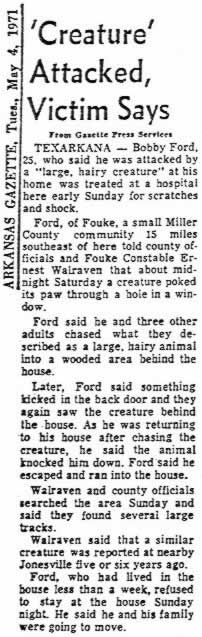
Here is another funky little film that has that student film feel. This one is directed by Charles Peierce (June 16, 1938-March 5, 2010 (aged 71). He was born in Hammond Indiana. As a small child he was moved to the same general area in which the action of Boggy Creek takes place. This is no doubt where he learned the legend of the "Fouke Monster," the Bigfoot-like creature that is the center of the film. He drafted customers from the local gas station to act in the film,[1]  (released in 1972). One might suspect the gas station approach to casting judging by the amature acting feel of the film. Even though it's about a  dark, scary,  confusing, if not corny, wacky subjet, it has a positive harmless student film quality. It's something about that amature quality I find appealing. It's not a great film, it's not even a fine film. Yet it's appealing in a home-spun way. It was also Pierce's directorial debout. He moved Carmel, befriended Clint Eastwood, Eastwood helped him get a job directing Sudden Impact (1983) a major motion picture starring Clint Eastwood (It's really Dirty Hary No.4). He is said to have invented the phrase "make my day."[2] He made other films including Boggy Creek II (which lacks the magic of BC I). The film was Written by Sean Taylor . (according to the IMBD). Wikipedia says it was written by Earl E. Smith.

There is a magic to this film. It is quite strange because all the individual elements suck. It's a pile of crap in every category from acting, to production values, yet it just has a feel the way it all comes together, innocent, sincere, alarming, scary, but somehow postive. It harkens back to child hood.


From IMBD page:
Cast overview, first billed only:
Vern Stierman ...
Narrator
Chuck Pierce Jr. ...
Jim as Boy
William Stumpp ...
Jim as Adult
Willie E. Smith ...
Willie
Lloyd Bowen ...
Himself
B.R. Barrington ...
Himself
J.E. 'Smokey' Crabtree ...
Himself (as Smokey Crabtree)
Travis Crabtree ...
Himself
John P. Hixon ...
Himself
John W. Oates ...
Himself
Buddy Crabtree ...
James Crabtree
Jeff Crabtree ...
Fred Crabtree
Judy Baltom ...
Mary Beth Searcy
Mary B. Johnson ...
Sister
Louise Searcy ...
Herself
The nerration begins with a framing device that opens and closes the film. Plays the narrating charter, who has returned to the cabin he lived in as a child. His mother and he were trying to eek out a living in that rural community, described as so small you would miss it if you blinked while driving through. The man peers through the windows of the empty abandoned house, as he sentimentally examines the property and his eyes room to the wooded horizon that sounds the poetry completely. It's moving toward dusk and he's thinking, i the dying evening sun light, "it's still out there." He ponders his memories of the creature.

We see him a as a boy, , dashing through a huge field of ankle and waste high grain or grass. he's climbing a fens and talking about how the creature had shown up he often heard it screaming from the woods. No one knew what it was but some felt it sought a mate. He hears the scream from the woods off in the distance and hurries along his way even faster. He comes to the little story on a dirt road were three old men are, one watching the other two play checkers. The boy comes in and asked teh owner, his landord, to come to the farm as his mother asks, investigate the strange noises. The landlord tells him there is no booby man in the woods, but he will change his mind by the end of the film. The boy hurries back, again hearing the scream. Then we move into the action of the film narrated by the adult version of the boy. This framing device is one of the best decisions the director made. It really takes us into the action. That scene would have been played out in the 40's when the Fouke monster first showed up. It was a latter version of a phenomenon from the 20's in neighboring county of Johnson called "the Johnson monster."

Some form of Harry monster can be found roaming that area as far back as white settlers were there to record it. The framing device close the film with the man pondering "is it still there, is it watching me now?" The sun is setting and  sense of tension grows that he's goign to be there after dark in an abandoned house and the thing is right outside. But he leaves just in time and the film ends. In the middle of these two segments he narratives the actions that happened years latte, in the 1960s. The resurgence of the Fouke monster in the 1960s is really the most famous period of activity. The film centers around a family called "Crabtree" who in real life is the family of Smoky Crabtree who has made a carrier out of the monster. He written many books and so on such as Smoky and the Fouke Monster. Notice Travis Crabtee plays himself. Oddly enough buddy Crabtree is played by James Crabtree. Kind of makes you wonder.


One member of the family sees the creature while sitting by a river bank. He only has bird shot in his gun so he doesn't fire on it. It's maybe a hundred years away so he just watches it. We catch only a fleeting glimpse of it. That is the second initiative choice the director makes that creates the magic of the film aside form the narrative framing device, that is the indirect approach to the horror. That is always the most effective appraoch to a horror tale, as evidenced by the Blair Witch Project. The whole film is really series of vignettes of various sightings. The man who owned the little story and laughed at the narrator's mother's fear saw the creator and shot it but the gun had no real effect. He now believed in the harry monster. Another saw it take two hogs one hundred pounds each, one under each arm, and step over the fence and walk away. Two boys found three towed foot prints in the mud while fishing. One of these scenes shows one of the only three semi direct views we get of the creature in the whole film. One is the scene with the Crabtree man by the bank.

The other major scene that all these little views of it are moving toward, where we see it grab a man on a porch. But it's dark and you only see ti fro a second. There's an extremely well done scene where a boy is out near his house with a shot gun he's looking for the origin of a noise. This on toward evening, it's perfectly light. He walks right up within feet of it but he has his back to it so he doesn't see it. It's only obscured by a few leafless three branches so we can see clearly it's a Bigfoot-like thing similar to the Patternson film. The creature makes a noise, the boy turns with great alarm sees it standing right there, nd fires! The creature is clearly hurt, annoyed but not damaged. It is angry! He's screaming and hitting trees. They boy is running to his house.

 photo boggycreek-thumb_zps72491d57.jpg

 Three major event-scenes that describe the film and fill in the action leading up to the denumont, which is the siege of a certain familie's house. Strangely enough there's a song in the film. It's like an Innocent Disney kind of song about what a wonderful life it is in the woods, "hey Smoky Crabtree." It's so corny and out of place. Here's this horror thing running around, no one knows what it is, it's scary but there's this innocent little song about how great it is. It's so kitschy and out of place. In trying to figure is it that this song doesn't spoil the film for me even though it's ridiclous, makes the film see like "a hoot," or does it work with the flim to help the "magic," I would have say it works with it. It would be so easy to ruin it. The song is a prelude to a since with an old hermit who Travis Crabtree befriends. He brings the old man tobacco and stuff. The old man seems to say he's never seen the creature then latter says he doesn't bother it and it doesn't bother him. It leaves one wondering "why is this here in this film?" It seems to serve no function. It's almost like he was going to make a different film and then put it in for filler. Coming right after the song seems even more superfluous.  Yet like the song it doesn't destroy the film.  For one thing part of the charm of the film is its armature nature. So this helps on that score. Then I think it's characterization. The population of Fouke and the surrounding area is a major character in its own right, this is part of charactoriztion where we see the nature of the populace.

In terms of action of the creature we see a scene in which a young girl goes to bed, taking care of her siblings. The creature comes right out side. Earlier that evening as she drew water for the house she watched the woods feeling something was there. Now she watches through a window as we hear it growling. It's supposed to be killing a cat but I can never make anything out, not even on DVD. It's all dark. Another scene shows three girls in a small clap board house, alone. They are going to bed they are having a pajama party. The three hear the creature breathing outside. It tries to get in. They put a chair at the door and get the father's shot gun. They don't necessarily know how to load or shoot it. They are not harmed but the sense of tension and vulnerability really words to make a scary scene. We do not see the creature at all. The idea the three women alone raises a question echoed throughout the film as a theme, it it looking for a mate. It's either horrassing women alone or taking live stock as food. Since it's appearances seemed to run in periods, punctuated by long periods of absence, as the Johnson monster in the 20s, the Fouke monster in the 40s, and 60s, they speculate that it get's lonely. One wonders why they would assume it's the same creature after all those years? There have to be others or it would die off.
The community has a big monster hunt with hunters from all over the state bring dogs, coon hounds and so on. But the dogs wont move in on the scent once they get it. The hunt goes nowhere. One guy sees it and is thrown from his horse. All of the scenes in the film are based upon "real" claims of sightings and stories in the community. It's narrated as a documentary but shows some dialogue in scenes as a docudrama.

Then we come to the major point, the siege. A family has moved in to a rent house along a back road in the area. The husbands are working near by and the two women and children are accompanied by a brother of one of the woman, a young man who may be the one grabbed on the porch. They hear the thing outside at night and are frightened. It comes up on the porch and tries to get in. It even turns the knob but they put a chair there. It reaches into the living room at one point through the front window. All we see is a hairy arm. It almost grabbed one of the people. It also reaches in through a bathroom window and almost gets the young man visiting his sister. The men come home and go out to confront it. All they have is flash lights. You would not find me doing that. The thing comes up on the porch behind one of them and grabs him and throughs him. I say he got off easy. They rush him to a hospital at  Texarkana. The boy is in shock. This is said to be a true story. The people decide to pack up go at first light they never come back. That's basically the end of the film.

Then the framing devise closes it with the man wondering is it watching me now. Leaving just before dark. It's not an art film and not a fine film, it has a quality to it that I find appealing. It works on a couple of levels. Maybe that's it's secrete. It's a cult classic for Bigfoot hunters but no one regards it as a serious source of information because nothing it says about the creature is advanced knowledge, so any bigfoot hunter worth his wood knocks knows that information anyway. It's not really documenting anything because no attempt is made to actually demonstrate the veracity of the stories, no story teller is really identified other than the fictitious narrator. On one level its a laughable amateurish attempt that makes the work a hoot. On a deeper level it's a respectable first attempt to bring to light a subject that the director no doubt grew up with and wants us to take seriously. But it's an innocent presentation that doesn't seek to scare the viewer with horrific nonsense but just tells its tail outright. The two best choices are the framing devise, which pulls us in to the guy's plight and his naustalgia and the wonderment at "what happened to the thing?" The indirect appraoch to presenting the horror is always very effective. The imagination can compel us to look.


accessed April 24, 2014.

[2] Ibid.


Watch the entire film on Youtube

Friday, April 25, 2014

Film fest friday: The Legond of Boggy Creek

 photo boggycreek2_zps0f17ee47.jpg


Here is another funky little film that has that student film feel such as Brighty of the Grand Canyon (see my review). This one is directed by Charles Peierce (June 16, 1938-March 5, 2010 (aged 71). He was born in Hammond Indiana. As a small child he was moved to the same general area in which the action of Boggy Creek takes place. This is no doubt where the learned the legend of the "Fouke Monster," the Bigfoot-like creature that is the center of the film. He drafted customers from the local gas station to act in the film,[1]  (released in 1972). One might suspect the gas station approach to casting judging by the armature acting feel of the film. Even though it's about a  dark, scary,  confusing, if not corny, wacky subjet, it has a positive harmless student film quality. It's something about that amature quality I find appealing. It's not a great film, it's not even a fine film. Yet it's appealing in a home-spun way. It reminds me a lot of Brighty of the Grand Canyon. It was also Pierce's directorial debout. He moved Carmel, befriended Clint Eastwood, Eastwood helped him get a job directing Sudden Impact (1983) a major motion picture starring Clint Eastwood (It's really Dirty Hary No.4). He is said to have invented the phrase "make my day."[2] He made other films including Boggy Creek II (which lacks the magic of BC I). The film was Written by Sean Taylor . (according to the IMBD). Wikipedia says it was written by Earl E. Smith.

There is a magic to this film. It is quite strange because all the individual elements suck. It's a pile of crap in every category from acting, to production values, yet it just has a feel the way it all comes together, innocent, sincere, alarming, scary, but somehow postive. It harkens back to child hood.


From IMBD page:
Cast overview, first billed only:
Vern Stierman ...
Narrator
Chuck Pierce Jr. ...
Jim as Boy
William Stumpp ...
Jim as Adult
Willie E. Smith ...
Willie
Lloyd Bowen ...
Himself
B.R. Barrington ...
Himself
J.E. 'Smokey' Crabtree ...
Himself (as Smokey Crabtree)
Travis Crabtree ...
Himself
John P. Hixon ...
Himself
John W. Oates ...
Himself
Buddy Crabtree ...
James Crabtree
Jeff Crabtree ...
Fred Crabtree
Judy Baltom ...
Mary Beth Searcy
Mary B. Johnson ...
Sister
Louise Searcy ...
Herself
The nerration begins with a framing device that opens and closes the film. Plays the narrating charter, who has returned to the cabin he lived in as a child. His mother and he were trying to eek out a living in that rural community, described as so small you would miss it if you blinked while driving through. The man peers through the windows of the empty abandoned house, as he sentimentally examines the property and his eyes room to the wooded horizon that sounds the poetry completely. It's moving toward dusk and he's thinking, i the dying evening sun light, "it's still out there." He ponders his memories of the creature.

We see him a as a boy, , dashing through a huge field of ankle and waste high grain or grass. he's climbing a fens and talking about how the creature had shown up he often heard it screaming from the woods. No one knew what it was but some felt it sought a mate. He hears the scream from the woods off in the distance and hurries along his way even faster. He comes to the little story on a dirt road were three old men are, one watching the other two play checkers. The boy comes in and asked teh owner, his landord, to come to the farm as his mother asks, investigate the strange noises. The landlord tells him there is no booby man in the woods, but he will change his mind by the end of the film. The boy hurries back, again hearing the scream. Then we move into the action of the film narrated by the adult version of the boy. This framing device is one of the best decisions the director made. It really takes us into the action. That scene would have been played out in the 40's when the Fouke monster first showed up. It was a latter version of a phenomenon from the 20's in neighboring county of Johnson called "the Johnson monster." Some form of Harry monster can be found roaming that area as far back as white settlers were there to record it. The framing device close the film with the man pondering "is it still there, is it watching me now?" The sun is setting and  sense of tension grows that he's goign to be there after dark in an abandoned house and the thing is right outside. But he leaves just in time and the film ends. In the middle of these two segments he narratives the actions that happened years latte, in the 1960s. The resurgence of the Fouke monster in the 1960s is really the most famous period of activity. The film centers around a family called "Crabtree" who in real life is the family of Smoky Crabtree who has made a carrier out of the monster. He written many books and so on such as Smoky and the Fouke Monster. Notice Travis Crabtee plays himself. Oddly enough buddy Crabtree is played by James Crabtree. Kind of makes you wonder.
One member of the family sees the creature while sitting by a river bank. He only has bird shot in his gun so he doesn't fire on it. It's maybe a hundred years away so he just watches it. We catch only a fleeting glimpse of it. That is the second initiative choice the director makes that creates the magic of the film aside form the narrative framing device, that is the indirect approach to the horror. That is always the most effective appraoch to a horror tale, as evidenced by the Blair Witch Project. The whole film is really series of vignettes of various sightings. The man who owned the little story and laughed at the narrator's mother's fear saw the creator and shot it but the gun had no real effect. He now believed in the harry monster. Another saw it take two hogs one hundred pounds each, one under each arm, and step over the fence and walk away. Two boys found three towed foot prints in the mud while fishing. One of these scenes shows one of the only three semi direct views we get of the creature in the whole film. One is the scene with the Crabtree man by the bank. The other the major scene that all these little views of it are moving toward, where we see it grab a man on a porch. But it's dark and you only see ti fro a second. There's an extremely well done scene where a boy is out near his house with a shot gun he's looking for the origin of a noise. This on toward evening, it's perfectly light. He walks right up within feet of it but he has his back to it so he doesn't see it. It's only obscured by a few leafless three branches so we can see clearly it's a Bigfoot-like thing similar to the Patternson film. The creature makes a noise, the boy turns with great alarm sees it standing right there, nd fires! The creature is clearly hurt, annoyed but not damaged. It is angry! He's screaming and hitting trees. They boy is running to his house.

 photo boggycreek-thumb_zps72491d57.jpg

 Three major event-scenes that describe the film and fill in the action leading up to the denumont, which is the siege of a certain familie's house. Strangely enough there's a song in the film. It's like an Innocent Disney kind of song about what a wonderful life it is in the woods, "hey Smoky Crabtree." It's so corny and out of place. Here's this horror thing running around, no one knows what it is, it's scary but there's this innocent little song about how great it is. It's so kitschy and out of place. In trying to figure is it that this song doesn't spoil the film for me even though it's ridiclous, makes the film see like "a hoot," or does it work with the flim to help the "magic," I would have say it works with it. It would be so easy to ruin it. The song is a prelude to a since with an old hermit who Travis Crabtree befriends. He brings the old man tobacco and stuff. The old man seems to say he's never seen the creature then latter says he doesn't bother it and it doesn't bother him. It leaves one wondering "why is this here in this film?" It seems to serve no function. It's almost like he was going to make a different film and then put it in for filler. Coming right after the song seems even more superfluous.  Yet like the song it doesn't destroy the film.  For one thing part of the charm of the film is its armature nature. So this helps on that score. Then I think it's characterization. The population of Fouke and the surrounding area is a major character in its own right, this is part of charactoriztion where we see the nature of the populace.

In terms of action of the creature we see a scene in which a young girl goes to bed, taking care of her siblings. The creature comes right out side. Earlier that evening as she drew water for the house she watched the woods feeling something was there. Now she watches through a window as we hear it growling. It's supposed to be killing a cat but I can never make anything out, not even on DVD. It's all dark. Another scene shows three girls in a small clap board house, alone. They are going to bed they are having a pajama party. The three hear the creature breathing outside. It tries to get in. They put a chair at the door and get the father's shot gun. They don't necessarily know how to load or shoot it. They are not harmed but the sense of tension and vulnerability really words to make a scary scene. We do not see the creature at all. The idea the three women alone raises a question echoed throughout the film as a theme, it it looking for a mate. It's either horrassing women alone or taking live stock as food. Since it's appearances seemed to run in periods, punctuated by long periods of absence, as the Johnson monster in the 20s, the Fouke monster in the 40s, and 60s, they speculate that it get's lonely. One wonders why they would assume it's the same creature after all those years? There have to be others or it would die off.
The community has a big monster hunt with hunters from all over the state bring dogs, coon hounds and so on. But the dogs wont move in on the scent once they get it. The hunt goes nowhere. One guy sees it and is thrown from his horse. All of the scenes in the film are based upon "real" claims of sightings and stories in the community. It's narrated as a documentary but shows some dialogue in scenes as a docudrama.

Then we come to the major point, the siege. A family has moved in to a rent house along a back road in the area. The husbands are working near by and the two women and children are accompanied by a brother of one of the woman, a young man who may be the one grabbed on the porch. They hear the thing outside at night and are frightened. It comes up on the porch and tries to get in. It even turns the knob but they put a chair there. It reaches into the living room at one point through the front window. All we see is a hairy arm. It almost grabbed one of the people. It also reaches in through a bathroom window and almost gets the young man visiting his sister. The men come home and go out to confront it. All they have is flash lights. You would not find me doing that. The thing comes up on the porch behind one of them and grabs him and throughs him. I say he got off easy. They rush him to a hospital at  Texarkana. The boy is in shock. This is said to be a true story. The people decide to pack up go at first light they never come back. That's basically the end of the film.

Then the framing devise closes it with the man wondering is it watching me now. Leaving just before dark. It's not an art film and not a fine film, it has a quality to it that I find appealing. It works on a couple of levels. Maybe that's it's secrete. It's a cult classic for Bigfoot hunters but no one regards it as a serious source of information because nothing it says about the creature is advanced knowledge, so any bigfoot hunter worth his wood knocks knows that information anyway. It's not really documenting anything because no attempt is made to actually demonstrate the veracity of the stories, no story teller is really identified other than the fictitious narrator. On one level its a laughable amateurish attempt that makes the work a hoot. On a deeper level it's a respectable first attempt to bring to light a subject that the director no doubt grew up with and wants us to take seriously. But it's an innocent presentation that doesn't seek to scare the viewer with horrific nonsense but just tells its tail outright. The two best choices are the framing devise, which pulls us in to the guy's plight and his naustalgia and the wonderment at "what happened to the thing?" The indirect appraoch to presenting the horror is always very effective. The imagination can compel us to look.


accessed April 24, 2014.

[2] Ibid.


Watch the entire film on Youtube

Wednesday, May 25, 2011

God, Bigfoot, and Trotsky: Signs Along The Way

patterson
snap from summer camp? The Patterson film.


I guess one reason for writing this is that I'm tired of atheists making comparisons bewteen God and Bigfoot. That's such an obvious attempt to ridicule believers and control the the boundaries of inquiry let's just really get into it and think about it.

When I was eleven years old (summer of 67) I went to summer camp. It was a church camp on Lake Texoma which is a serpentine lake forming part of the state line between Texas and Oklahoma. It wasn't much of a camp, we mostly swam and sort of made fun of the crafts they wanted us to do, but I didn't do them I just made fun of them. They have one mainstay of great summer camp fun, hoaxes. The thing about the good counselor inspired hoax is the pay off. If you don't go "ha ha I got you, you should have seen your face," the whole thing is for nothing. That's why I think the incident I'm about to describe really happened, that is that it was not a hoax. I think of it as "my Bigfoot sighting." Now before I talk about it, do I really believe in Bigfoot? I don't know, what day is it? I vacilate on the subject but I'm open to the possibility. I do have some big doubts but I have little patience for the kind of idiot who just dismisses the whole subject merely becuase it's associated with silliness. It is associated with a lot of stupid things but those who actually try to investigate the phenomenon as though it pertained to an actual naturalistic animal do not include the silliness in their figuring. It's all a matter of propriety and embarrassment not of scinece or fact.

I call it "my sighting" but I didn't see anything. I saw other people see something that I didn't see. I contrast it with the hoax pulled the night before "the incident" that I will describe. The night before that incident the boys dorm was going to bed. Lights appeared on the horizon where was no road. Shills in the dorm began saying they could see little men coming toward the dorm. Everyone was running around. No one really believed it was aliens but we all wanted to go along with the gag just to have fun. One of the "little men" came up to the dorm and entered, it was clearly one of the counselors made up in some stupid get up. Everyone was laughing and a great argument ensued, "we got you, you were scared!" "I was not!" I went to the bathroom as the excitement died down and heard a noise outside in the distance that gave me pause. I didn't know what I heard. I went out to investigate and listened. It was off in the dark woods I barely herd it faintly. I'm still not sure I did hear it, but it seemed like a woman screaming. Some kid came up behind me and was saying "did you hear it?" I didn't know.

The next day we all went for a nature hike. We were lined up in single file and led by the counselors (college age kids). We passed the car battery used in the hoax and someone pointed it out. Then we went into the woods about a hundred yards or a bit more, along a little trail with dense foliage on both sides. In those days Lake Texoma was remote and surrounded by deep woods. There has been a lot of development in the nearly 50 years since. We were stopped by the leaders on the edge of a clearing. One of the older guys who had been up ahead came back and said something to the leader. They had a little counsel while we waited on the trail. They went over a little rise that screened off the clearing from our view. The leader observed came back and said we have to wait. Much discussion ensued and it seemed there was something over there they found odd but they wouldn't say what it was. The main guys said "Dave so and so is coming, he's an Eagle Scout, he grew up in the woods and he'll know what it is." They really would not say what they saw, I demanded that they let me see. I told them I was real experienced in woods. They took me to the edge of clearing. I lied about being experienced. When we camped out in the woods near the farm my Dad grew up on, I was terrified by the cows. Across the clearing all I saw was trees. The guy with me said "it's not there now." But I did notice he had us crouch and sneak to the edge and stay out of sight. The counselors were all having serious whispered discussions and wouldn't fill us in. They seemed very intense and worried.

That might seem hoax-like. We stayed until the "Dave" the local Daniel Boone came. He went over across the clearing to look. When he came back he looked like he had seen a ghost. He said "get the hell back to camp." They told us to go in single file, not to speak or make any noise, and go now!" Once back my brother and I noticed no one would talk about it. When we tired to ask "what was the problem in the woods the other day" they would just say "the camp head as said he doesn't want it discussed." There was no pay off. There was no gotcha. The guys at the time were clearly afraid. We never went back into the woods. The counselors also made some official statement don't go in the woods as there are wild boards (which there are) and so on. Nothing more was said about it. I did notice (but had no idea what it meant at the time) the kid who thought he heard a woman screaming was being made fun of because no one else heard it. He claimed to hear it every night and he went out by the restroom every night to listen.

On our way home we road back with a woman who worked in the camp kitchen and was a friend of my mother. One of the counselors also road in the front. Most of the time those two talked about how he didn't want go to Vietnam. There was a lull and we asked "what was the deal when we tried to go for that walk." He said there was a "creature" and they didn't know what it was. At first they couldn't tell if it was man or animal. It walked on two legs and had a human-looking face. Yet it was covered with dark brown hair all over it's body and had no clothes, it was huge and stunk. He seemed deadly serious. He could have been lying but he didn't seem like the type. He was a pacifist who loved folk music and was caught up in the early anti-Vietnam sentiment and was considering going to jail rather than going to war. He wasn't the joking type. He said they decided it was a hobo. Now it might seem this is all reconstructed and I'm sure some of it is, but I have been in recent contact with a fried who I talked to about it when we got back. He was not at the camp but he clearly remembers me telling him all of the details about "couldn't tell if it was a man or an animal." Of course it's very possible that all of this is influenced by reading about the subject in subsequent years. Those who aer predispossed to poopoo Bigfoot have a perfect out to do so.

Now what do we make of this story? Recently I discussed it with a good friend who is an atheist, but whose views I respect. He was not convinced. His view point I have a lot of trouble buying. Even though I didn't see anything, I'm totally convenience the others did see something. I know they were scared. They looked like they had seen a ghost. The big Daniel Boone guy they relied on was clearly afraid. He wasted no time in saying "get the hell out of here. get the kids back to camp." They were serious. This was before the Patterson film was public, I had never heard of Bigfoot I had no idea what to compare it to. Over the years I pushed it to the back of my mind. When I did see a documentary about Bigfoot for the first time, just a few years latter, I was scared out of my wits. I was totally unreasonably afraid that night and even shaking. The atheist I discussed it with was so willing to accept the obvious propaganda. A naked Hobo? Covered with hair, no cloths out in the woods? Come on we can do better than that. I don't have any real commitment to the idea that it was a Bigfoot. I have huge dobuts about the existence of something that seems to run across the road all the time but shouldn't go anywhere near a road if it really exists. They would have to be saying "hey one of those funny metal things is coming, time to run out there and let them see me again." No one called it a Bigfoot, they didn't know that expression at that time. In fact it was years before I put the two together. When I saw the Bigfoot movie I didn't say to myself, "O that's what that was." I had almost forgotten it. Over the years it began to occur to me here and there as I would hear things about Bigfoot, "gee I wonder..."

Jump forward about twenty years. I'm in Seminary and doing lots of political organizing in the Central America movement. I was introduced by a friend in the movement to his "SWP (socialist worker's party) comrades." Actually I can't remember if they were SWP but they had been. I think the SWP had left Texas. At any rate these guys were amazing. They talked nothing but Trotsky. It was cleary they didn't give a rat's you know what about Nicaragua but they knew it was an opportunity to organize. They had less than 1% of the population of Texas, probalby less than 1/34, it was only about 3 of them in all the Metro-plex. Yet they spoke like they were deciding the fate of the world. Every election year they would work their bums off trying to collect signatures to be on the ballot and never came anywhere near close enough. Yet they spoke like they were just around the corner from lining up all the Stalinist rivals and Capitalists stooges and having them sent to West Texas (Texas Siberia?). When they learned I was in Semineary they said that I was a victim of the great delusion of the age. The great sickness of the age of cousre was belief in God. God is the great evil that has beset the society with delusion and the cure is to learn the word of Uncle Leon (Totsky) who is going to make us free. Free to serve the state that is. I'm the one who was delusional!

The thing that fascinates me is they way everything they said so closely mirrors the way intenet atheists talk about religion. They could have come right out of the Dawkins hand book. They had all the argument from default assumption, to the idea that religion is "a delusion." They way they traded in ideolgoical banter so closely resembles message board atheism, a decade before message board existed except for a hand full of people in silicon valley, I can't help but think that really is the model that the early Secular web used. I have noticed the totalitarian nature of atheist language. The Orwellian nature of it.

Here's the latest example of the Orwellian tendencies. They Dawkies use the term "cult" in relation to all religious belief and groups. Of course they have no knowledge of the true sociological meaning of the term. They think all cults are imposing their will upon brain washed lackies whose live they take over and ruin. An example is the posting by a CARM Dawkie named "Toast"


The title of the thread:" a few questions about cults" so he's just equating religion with cults.

If no one ever told you about your god you would still believe?

if so, would your belief mirror the one you have been indoctrinated into?

if you still would believe even if know one told you these things to
believe would you not just be making things up?


He's trying to say that because you can't come to the same conclusions you do as a Christian on your own with no Bible and no church to guide you then it must be a cult because it's others imposing their will.


another post by Toast:

sorry but everything...a religion is a cult


This is also the same tendency. Everything the other guys value we disvalue so every term they use we must re-think impose our own terms. We can't allow them to name their own things, such as "chruch" we must name them and stick them whit the connotations of our own interpretation. So thus Churches become cults. The irony meter is gong to blaring in a moment.

The really alarming tendency is the almost blatant admission that ideas which don't stack up the atheist ideology are "dangerous" and must be controlled. This statement was made on CARM sept 21 2009 by "Mountaineer Elf.


Because some ideas can be dangerous. Not all ideas deserve to be heard if they are dangerous.

Trying to usurp science and reality to stick in your deity is dangerous.


The context he's speaking of is an argument for the existence of God. The idea that a new concept or some concept that he doesn't agree with is "usurping scinece" is quite alarming. What's worse is he's not content for scinece to stay in its own domain it must conquer all and control all reality. Science when is arguemnts for God usurping scinece? That can only be the case if he thinks that science proper domain is dictating to use that we can't believe in God. It's even worse that equates science with reality. His view is so totalizing that it must control all, there can be nothing in existence that is not controlled by his view point.
Like those SWP guys they are telling me my view of the world is delusional and that I seek to control realty, but it's clearly who seek to control because they are admiate about demanding that whatever is of their opposiion is clearly "a cult" and "delusion" reality has to be shaped around their view. In deciding that the enemy seeks to control reality they seek to control it even more because they have to do prevent the enemy from doing it.

This is a good example of phenomenology vs reductionism. Phenomenology is like me saying "I don't know those guys saw. I'm not going to say what it is and I'm going to rule out options just because they are unpopular (Of course religion is not unpopular)." The fringe group who make up 3% of the popular tries to control everyone else by excluding what they don't like and privileging their position. Then of cousre it's all going to come down to someone else who wasn't there trying to tell me what I really experienced. They will say they guys weren't really so scared, it really wasn't a big deal. There was no sound of screaming. I made all that up over time as I read Bigfoot lore.

The problem is Bigfoot is a tangible thing. Even if there are no such creatures the concept of it (even if fictional) is that of a tangible thing. It could be discovered or dismissed eventually. In we could rule it out given enough time and enough looking. If search every place on earth we could see there can't be one, or we find it. God can never be found in that way. We could never search enough of the universe to rule out God even if we covered every square parsec of the universe. That's a problem for the skeptic because they usually tend to be people who don't like blurry lines. They want clear crisp understanding of reality and if anything is confusing they seek to reduce it away and lose it in it in the shuffle. We can see the forces of control vying for explanatory power. In the political struggle between capitalism and communism both sides sought to control reality. The Capitalists deny that there is any stimulating effect on the economy form public employment. The Chicago school of economics teaches that there is no multiplier effect while Harvard does studies showing that there is. In the election of 2008 a local economist firm the same school that I did my doctoral work at was on local media saying there are no studies at all to back up Obama's stimulus ideas. I started an email exchange with him. He insisted upon sending me all kinds of article asserting that there is no multiplier effect. When I emailed him four studies I found on the net showing the multiplier effect from public employment he stopped talking to me.

The Skeptic wants to fall back on controlling reality by reducing it to what we know. Since God transcends the empirical that let's him out for all practical purposes he might as well not exist. Then to make sure they control the situation some of them mock and ridicule anyone who thinks he has reason to believe in spite of the strictures of atheist propaganda. On the other hand, the organized believer tends to be just as controlling in terms of doctrine. Everyone wants to boil down reality to just what their world view can handle, that's pretty much what Thomas Kuhn says we do. The phenomenological approach would be to allow the pehomena to suggest the categories into which we file information, rather than imposing our pre set categories. To me the guy in the car on the way home filed it all away in the pre set categories; he gave the official version people were asked to give if there was a question by parents or kids, 'what was it?' A hobo! Then we forget about the screaming in the woods, the fact that it far bigger than any human, totally covered with hair. This is reductionism losing the phenomena.

Even though God is not amenable to empirical observation as is Bigfoot, and thus can't be ruled out whereas Bigfoot can be ruled out, God is undeniable reality if one knows what to look for. The fact that people deny undeniable reality is a funciton of the human ability to set up the inquiry in a way that rationalizes the outcome in harmony with our world view, or ideology. It can also be a function of the way people understand reality, the way we define our terms. The undeniable nature of God, or what I call "undeniable" depends largely upon my understanding of God. This is why I say belief in God is really about understanding our place in being. The question of God can't be based upon scientific knowledge. Thus there have to be other forms of knowledge because those other forms of are known and the attempt to reduce all forms of knowledge ot just those that can be controlled, and those that screen out belief and allow only what e already know are the propagandistic end of ideology. That includes the atheist fortress of facts idea. We have this huge pile of facts that supports our view , it's all facts and proven things and God is not anywhere in it and we don't believe that's not in our pile of facts, so therefore, we have this huge mound of truth and God is totally not part of it. The problem is eventualy the mound of truth will decay because with that attitude you can't do new research. How can you investigate the unknown when you insist that you can only believe that is known?

The difference in saying God is undeniable and adding "if you know what to look for" and closing down inquiry is the difference betewen allowing the sense data to guide the search and impossing the answers before hand. Saying "If you know wht to look for, it's a matter of how we define it" means these are phenomena that we both agree too, but it's a question of interpretation.

I don't know what those guys saw in the woods. It might have been a hobo I'm not going to be dogmatic about it, but that's the point.


In closing here's a picture I took at camp that year, this is the head counselor.

Patty

There are modern Bigfoot sightings at Lake Texoma I am a bit more skeptical of them then I am of the possibility of a Bigfoot in 1967 because it's so built up around there now. there is an animal preserve but it's small.