

"La Strada" (The Road) 1954, Federico Fellini (1920-1993).This is a truly great film (number 8 on my top 10). As with La Dulce Vita everything I have to say about it has been said before.This is Fellini's first success. Before this he put out some great films, the quirky comedy "the White Sheik" and I Vitelloni (1953) and others but they had all been bombs at the box office. Finally with this one he makes his first big impact. It's a truly great film, one of his best. It's my second favorite Fellini film. As I have pointed out before, this film, while his first success was also his first step away from Italian neo realism. Fillini was always drawn to the circus. He loved circuses. So his step away from neo realism is a step toward his own personal version of a style that,if it were in a novel, it would be called "magical realism."

Giulietta Masina 1921-1994 as
Gelsomina.
Gelsomina is a peasant girl who lives with her mother and sisters by the beach in Southern Italy. She spends all of her time on the beach, she is simple minded and has a report with animals.. The girl, played by Fellini's wife (Giulietta Masina 1921-1994) steals the film.The actress is funny looking and strange.She is a fine actress and brings to the part a freshness and expressiveness that allowes her to convey deep emotion with very few words. She is doing most of her acting as a kind of mime, not in the traditional sense of a mime pretending to be behind glass or whatever, but through facial expressions and body language; she conveys more than the character could say with words. The actual character apart from the actress is quirky, profound in her simplicity, superb in her buffoonery. She is a true clown, both character and actress.Giulietta Masina was tied into a thousand year old artistic tradition in Europe going back to the commedia dell’arte. She has been daubed the Femlae Chales Chaplin.
Gelsomina.
Gelsomina is a peasant girl who lives with her mother and sisters by the beach in Southern Italy. She spends all of her time on the beach, she is simple minded and has a report with animals.. The girl, played by Fellini's wife (Giulietta Masina 1921-1994) steals the film.The actress is funny looking and strange.She is a fine actress and brings to the part a freshness and expressiveness that allowes her to convey deep emotion with very few words. She is doing most of her acting as a kind of mime, not in the traditional sense of a mime pretending to be behind glass or whatever, but through facial expressions and body language; she conveys more than the character could say with words. The actual character apart from the actress is quirky, profound in her simplicity, superb in her buffoonery. She is a true clown, both character and actress.Giulietta Masina was tied into a thousand year old artistic tradition in Europe going back to the commedia dell’arte. She has been daubed the Femlae Chales Chaplin.
The film much more than just a sad tale of a brutal idiot who abuses a young girl, although it is that. Fellini elevates it to a much higher level. Gelsomina is bought by the brute Zampanò (his name is said to sound like the Italian word for an animal's paw) (played by American Actor Anthony Quinn). The language was dubbed in by an Italian actor. In fact becuase the sound was bad all the actors in the shooting of the film were just speaking at random or reciting numbers, the language as dubbed in latter. So Quinn's actual voice is not heard.
Zampano guys the girl literally from her mother for money and food. We also learn that he made the same arrangement concerning the sister the year before. Her sister died and now he needs another girl. She is happy to go and excited, it doesn't even cross her mind that her sister's death might have something to do with working for Zampano. He begins teaching her the "art." It's really just taking money and introducing him. His act is totally unimaginative. It's nothing more one a trick based upon his strength. He breaks a chain around his chest. His training of the girl consists of forcing her to memorize the intro by wrote and when she makes a mistake he swats her with a switch cut form a tree limb. He's really just training her as one would a dog. At least that's said by the commentator on the DVD commentary.I wouldn't train my dog that way. She get's no recognition. She does get raped, or at least "laid." She doesn't really fight back but doesn't have any say in the matter either.
They travel about giving little performances wherever they can they pass the hat. It's really just him breaking a chain. They do some skits they've worked put, but they are very childish and basic. They travel in a "caravan" or a motorcycle with a sort of truck bed on the back and covered. It's only big enough for two people to lie down in. They live a very hand to mouth existence. They eat a lot of stew and get a lot of the ingredients from vegetables and roots growing wild. There is pain connected with their lives, but there is also a magic that the girl is turned on to. One example is a country house where a party is held. They are all eating outdoors, celebrating a marriage. Zampano and the widowed mother of the bride go off to "try on some clothes" that the widow is giving Zampano. The girl sort of half knows the turth of what they are going to do. She explores the huge farm house (really more of a manor house) with children. She finds in a upstairs bedroom a boy in bed named "Oswald" who is deformed. His head is big and he looks like an elf. She tries to put on a clown show for him and cheer him up. She is enchanted with this elf life kid. A nun comes in and chases them out. So it's the chruch that breaks up the fun. But Gelsomina is taken with this kid, she's turned on to the magic in the whole situation, the children, the farm,t he beauty of art.
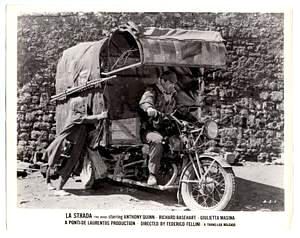
They travel about giving little performances wherever they can they pass the hat. It's really just him breaking a chain. They do some skits they've worked put, but they are very childish and basic. They travel in a "caravan" or a motorcycle with a sort of truck bed on the back and covered. It's only big enough for two people to lie down in. They live a very hand to mouth existence. They eat a lot of stew and get a lot of the ingredients from vegetables and roots growing wild. There is pain connected with their lives, but there is also a magic that the girl is turned on to. One example is a country house where a party is held. They are all eating outdoors, celebrating a marriage. Zampano and the widowed mother of the bride go off to "try on some clothes" that the widow is giving Zampano. The girl sort of half knows the turth of what they are going to do. She explores the huge farm house (really more of a manor house) with children. She finds in a upstairs bedroom a boy in bed named "Oswald" who is deformed. His head is big and he looks like an elf. She tries to put on a clown show for him and cheer him up. She is enchanted with this elf life kid. A nun comes in and chases them out. So it's the chruch that breaks up the fun. But Gelsomina is taken with this kid, she's turned on to the magic in the whole situation, the children, the farm,t he beauty of art.

Yet when Zampano finds a prostitute he goes off with her, leaving the girl to sit alone all night wondering if he will come back. She follows him around like this. As we go through time we see her become more clown-like in her costume and attire and acting. She is more fitted into the part of his assistant, she is proud of the fact that "he taguht me all I know." All she really knows is saying "here's Zampano!" and taking the money. Finally they tie up with a little circus. Apparently these little circuses were all over Italy like strange attractions used to be all over the road side of the American South in the 50s. Here they meet the secnd important man in Gelsomina's life,Il Matto -
"the fool" Richard Basehart I Knew him as a middle aged actor on "Voyage to the Bottom of the Sea," here he is young and thin and wiry. The fool can't resist antagonizing Zampano. We find there is some drama between them over Gelsomina's sister. Apprently they had some kind of jealous rivalry going over her. This is repeated with Gelsomina. But more than that, the fool is drawn to prosecute Zampano like a moth to flame. He's like the counter balancing will of Krama to take vengeance upon the abuser by pestering him. The fool shows an interest in the Gelsomina. He puts her in his act and shows consideration to her. She is falling in love with him. At one point she might have gone off with him.
I call it a moth to a flame because Zampano would and really could easily kill him. He's much bigger and much more brutal. The fool is a live-by-your-wits kind of Guy. Zampano is a take what you can kind of guy. The fool is the kind of guy who talks the bully out of fighting, Zampano is the kind of guy who refuses to be talked out of the fight. The fool begins waiting until the moment of drama when Zampano is just about to break the chain around his chest. There's a spot light, a drum role, the audience is hushed and waiting, the fool shouts "phone call for you Zampano!" Of course there isn't one and he has to start all over. Another time he's taking part in a skit and the bucket is supposed to be filled with confetti but it's water and he get's splashed. He chases the fool with a knife. He's really going to kill him. The police come and he's arrested. They have bail him out. The fool splits and they all go in different directions the girl is with Zampano.
The girl and Zampano stop at a convent and stay there a few days. The fool had told The girl that everything has a purpose. Even a stone has a great purpose in the over all scheme of things. Zampano whats to rob the nuns. The girl refuses, and she is adamant. He leaves the next day, she goes with him. She could have stayed with the convent, and she loved it there. But she is following what the fool told her and choosing to love the unlovable Zampano. She seems herself as choosing to fulfill a noble purpose by being the one person who would love this jerk that no one has ever loved. The problem is along the way they find the fool broken down along the board. He's trying to fix a flat. Zampano has him. He has no where to run, his enemy is upon him before he even knows it.
Zampano only wants to rough him up to pay him back for pestering him. He accidentally kills him. He punches him and he hits head. He dies. Of cousre the girl is totally coming unglued. Zampano hides the body and the fool's car. They go on their way but the girl proceeds over the next couple of months to lose her mind. She begins crying constantly. She goes around saying "the fool is hurt, the fool is hurt." Zampano has a unique problem. The girl has activated within him some human feelings he didn't know he had. He's growing a conscience thanks to her. For the firs time he feels really guilty. Seeing her so distraught over the fool he feels really ad and doesn't know what to do about it. He can't stand to hear her can't stand to hear her plaintive cries. It's tearing him up inside to hear "the fool is hurt." He tries to take her home but she wont go.
Finally he leaves her and goes off on his own. We next see him a few years latter. He's viably much older. He can barely do his trick now, he can't break the chain very well. He's obviously on his last legs. He goes back to the area where he he left her and tries to find her. He hears someone singing the little tune that she picked up from the fool and sang all the time. He asks the woman where she learned it and she said it was taguht to her by a strange homeless woman a few years earlier. He learned the homeless woman died. We can see it's here. The description is clear. So he goes off, he's aging, he's out of it, he's goign down hill. He feels guilty about his life, but the one person would would forgive him and would have taken care of him in his old age is dead as a result of him own temper and inability to control himself.
The God stuff is a lot harder to find in this film. The chruch is not that visible when it is it's either shutting down the party of just being a victim. The nuns did take them in and gave them food and clothes but they also were almost robbed by Zampano and he did work for them. So the chruch wasn't much of a factor. There aren't a lot of sermons and a lot of mentions of how thing should be. It's clear that's some word about human frailty, the inability to separate ourselves om our sin nature, the underlying human condition. There's also a hint about higher meaning, the big picture, the scale upon which even humble rock has a purpose. There's also the magic of life in which a fool can elevate the purpose of a clown. The girl is a martyr, she give her life to love the unlovable. Through her unselfish act, which she can't live with after he killers something inside her by causing the fool's death, Zampano finds a kind of redemption. His humanity s turned on by her sacrifice. Yet is is not a redemption he sought, he doesn't understand it, and it proves to be his undoing. In the end it's not exactly a story of Christian redemption.
I call it a moth to a flame because Zampano would and really could easily kill him. He's much bigger and much more brutal. The fool is a live-by-your-wits kind of Guy. Zampano is a take what you can kind of guy. The fool is the kind of guy who talks the bully out of fighting, Zampano is the kind of guy who refuses to be talked out of the fight. The fool begins waiting until the moment of drama when Zampano is just about to break the chain around his chest. There's a spot light, a drum role, the audience is hushed and waiting, the fool shouts "phone call for you Zampano!" Of course there isn't one and he has to start all over. Another time he's taking part in a skit and the bucket is supposed to be filled with confetti but it's water and he get's splashed. He chases the fool with a knife. He's really going to kill him. The police come and he's arrested. They have bail him out. The fool splits and they all go in different directions the girl is with Zampano.
The girl and Zampano stop at a convent and stay there a few days. The fool had told The girl that everything has a purpose. Even a stone has a great purpose in the over all scheme of things. Zampano whats to rob the nuns. The girl refuses, and she is adamant. He leaves the next day, she goes with him. She could have stayed with the convent, and she loved it there. But she is following what the fool told her and choosing to love the unlovable Zampano. She seems herself as choosing to fulfill a noble purpose by being the one person who would love this jerk that no one has ever loved. The problem is along the way they find the fool broken down along the board. He's trying to fix a flat. Zampano has him. He has no where to run, his enemy is upon him before he even knows it.
Zampano only wants to rough him up to pay him back for pestering him. He accidentally kills him. He punches him and he hits head. He dies. Of cousre the girl is totally coming unglued. Zampano hides the body and the fool's car. They go on their way but the girl proceeds over the next couple of months to lose her mind. She begins crying constantly. She goes around saying "the fool is hurt, the fool is hurt." Zampano has a unique problem. The girl has activated within him some human feelings he didn't know he had. He's growing a conscience thanks to her. For the firs time he feels really guilty. Seeing her so distraught over the fool he feels really ad and doesn't know what to do about it. He can't stand to hear her can't stand to hear her plaintive cries. It's tearing him up inside to hear "the fool is hurt." He tries to take her home but she wont go.
Finally he leaves her and goes off on his own. We next see him a few years latter. He's viably much older. He can barely do his trick now, he can't break the chain very well. He's obviously on his last legs. He goes back to the area where he he left her and tries to find her. He hears someone singing the little tune that she picked up from the fool and sang all the time. He asks the woman where she learned it and she said it was taguht to her by a strange homeless woman a few years earlier. He learned the homeless woman died. We can see it's here. The description is clear. So he goes off, he's aging, he's out of it, he's goign down hill. He feels guilty about his life, but the one person would would forgive him and would have taken care of him in his old age is dead as a result of him own temper and inability to control himself.
The God stuff is a lot harder to find in this film. The chruch is not that visible when it is it's either shutting down the party of just being a victim. The nuns did take them in and gave them food and clothes but they also were almost robbed by Zampano and he did work for them. So the chruch wasn't much of a factor. There aren't a lot of sermons and a lot of mentions of how thing should be. It's clear that's some word about human frailty, the inability to separate ourselves om our sin nature, the underlying human condition. There's also a hint about higher meaning, the big picture, the scale upon which even humble rock has a purpose. There's also the magic of life in which a fool can elevate the purpose of a clown. The girl is a martyr, she give her life to love the unlovable. Through her unselfish act, which she can't live with after he killers something inside her by causing the fool's death, Zampano finds a kind of redemption. His humanity s turned on by her sacrifice. Yet is is not a redemption he sought, he doesn't understand it, and it proves to be his undoing. In the end it's not exactly a story of Christian redemption.
IMBd page
Cast
| Complete credited cast: | |||
 |
Anthony Quinn | ... |
Zampanò
|
 |
Giulietta Masina | ... | |
 |
Richard Basehart | ... |
Il Matto - The Fool
|
 |
Aldo Silvani | ... |
Signor Giraffa
|
| |
Marcella Rovere | ... |
La Vedova
|
| |
Livia Venturini | ... |
La Suorina
|


