Wednesday, November 18, 2015

Phenomenology and Method


, Photobucket


Many Atheists are hung up on empirical knowledge. Thats why so many of them (not all by many) insist that we have no info about God, you can't verfy God and so forth.Many posts on CARM lattely have criticized "religious subjectivity." Even many christians have fallen into the trap of dicotomizing between subect and object, such that they think: subjectivity = bad, objectivity = good.
But God cannot be the subject of empirical data becasue is not given in sense data. That's becasue God is not just another object along side objects in creation. God is not just another thing, God is the basis of reality. That's like a fish scientist saying "they assinged me to study this thing called 'water' but I can't find any water." he says that because it never dawns on him that its' all around him, the medium in which he lives and he's always looking through it. he can't see the water because he's looking through it.

That's sort of the case with God because God is the basis of reality, the ground of Being. "in him we live and move and have our being." When we try to look at God and see him directly we look through him because in a sense he's the medium in which we live.

The only answer to this is to search for something else. We don't look for empirical evdience of God, we look for a "co-detemrinate." That is, we look for the signatrue of God, or to use a Derridian term the "trace of God." Like the arua of a neutrino. We can't photogrpah neutrinos directly but we have photographed their auruas that are the reaction of Nuetrinos with other particals. When you see that aurua you know you have one.

But the trace of God has to be the result of a subjective or intersubjective understanding. So rather than subject it to empirical means, we need allow the sense data to determine the categories under which we organize our thinking about God.

Schleiermacher was the originater of this kind of thinking (prior to Brintono who is attributed to be the inventer of Phenomenology). Here is Schleiermacher's take on God consciousness. We don't search for God in objective terms we search for "God consciousness."

Phenomenology


Phenomenology is very important because it is the altenative way of htinking to either empirical science and hangs ups on iductive data, or deudtive reasoing and hang ups on the a prori. When I say "allow the sense data to determine the categories," what do I mean? (this is very crucial to understanding every point I make on message boards):

What that means is, you have a bit of qualia, an impression of the say sense data strikes us,the way something appears to us. Let's say the desk my computer sits upon. Our tendency is to tuck it away into a neat category based upon our preconcieved notions of desks. This is a bit of wodden furniture, it's funciton is proving a surface for writting and bit of storage for what we write. We plug in the label "made in Hong Kong" and we say "it's a cheap desk." Now we have a sub category. all that is pre set in our minds based upon our understanding of the universe vis a vie writting surfaces. But if we appraoch the desk phenomenologically, we don't say "o a cheap peice of furniture for holding my computer--manufactured in formerly British colony, the home of Jackie Chan, thus a Kung fu capitalist cheap desk. but we just say "there is this object that appears in my sense data, and it seems to provide uses x,y,z. So it may not be a desk at all in terms of its functionality, perhaps it would work better as a door stop. Or perhaps this door put across two saw horses would make a better desk. That's not part of my preconcieved notion because it's not made to be a desk, but it might work better."


Ok that's a trivial example, so much for my understanding of desks and their place in the univrese. But, when we consider other thins, things of more gravity such as empirical science and reilgion, or religious belief and expeirnce, the nautre of myth and religious texts, you can see how the outcome might might be a lot more significant if we do it one way as oppossed to another.

The way the atheists want to to it is to demand certian things, and those things require sense data and that sense data is preconcieved to belong in certain categories and to rule out other sense data. Thus they wind up asking for probability of miracles when in fact by defition a miracle cannot be probable. So they rule out any kind of miracle based upon the pre convieved category of "things that do no happen because we don't observe them so they are too impoprobable." Whereas in reality, since miracles are things taht are impossible, but happen anyway because some higher law overrides that of probablity, they are just arbitrarly crossing out the category of the possible and arbitraily arranging their understanding of the universe to exclude the SN, then demanding that, well there's no evidence for it (because we have filed all the evidence under the preconvcieved category of "that which does not happen.").


Religion not Reduceable to Knowledge


Frederick Schleiermacher, (1768-1834) in On Religion: Speeches to it's Cultured Dispisers, and The Chrisitian Faith (Glogenschleurer) (I know my German spell has to worse than my English spelling),sets forth the view that religion is not reduceable to kowledge or ethical systems. It is primarily a phenomenoloigcal apprehension of God consciusness through means of religious affections. Affections is a term not used much anymore, and it is easily confussed with mere emotion. Sometimes Schleiermacher is udnerstood as saying that "I become emotional when I pay and thus there must be an object of my emotional feelings." Though he does vinture close to this position in one form of the arugment, this is not exactly what he's saying.

In the earlier form of his argument he was saying that affections were indicative of a sense of God, but in the Christian Faith he argues that there is a greater sense of unity in the life world and a snese of the dependance of all things in the life world upon something higher.

What is this feeling of utter depenedence? It is the sense of the unity in the life world and it's greater reliance upon a higher reality. It is not to be confussed with the stary sky at night in the desert feeling, but is akin to it. I like to think about the feeling of being in my backyard late on a summer night, listening to the sounds of the freeway dying out andrealizing a certain harmony in the lfie world and the sense that all of this exists because it stemms form a higher thing. There is more to it than thatbut I don't have time to go into it. That's just a short hand for those of us to whom this is a new concept to get some sort of handle on it. Nor does"feeling" here mean "emotion" but it is connected to the religiousaffections. In the early version S. thought it was a corrolate between thereligious affections and God; God must be there because I can feel love for him when I pray to him. But that's not what it's saying in the better version.


The basic assumptions Schleiermacher is making are Plaontic. He believes that the feeling of utter dependence is the backdrop, the pre-given, pre-cognative notion behind the ontological argument. IN other words, what Anselm tried to capture in his logical argument is felt by everyone, if they were honest, in a pre-cognative way. In other words, before one thinks about it, it is this "feeling" of utter dependence. After one thinks it out and makes it into a logical arguemnt it is the ontological arguement.


Unity in the Life world.

"Life world," or Labeinswelt is a term used in German philosophy. It implies the world of one's culturally contructed life, the "world" we 'live in.' Life as we expeirence it on a daily basis. The unity one senses in the life world is intuative and unites the experiences and aspirations of the individual in a sense of integration and belonging in in the world. As Heidegger says "a being in the world." Schleiermacher is saying that there is a special intuative sense that everyone can grasp of this whole, this unity, being bound up with a higher relatiy, being dependent upon a higher unity. In other words, the "feeling" can be understood as an intuative sense of "radical constingency" (int he sense of the above ontolgoical arugments).

He goes on to say that the feeling is based upon the ontological principle as its theoretical background, but doesnt' depend on the argument because it proceeds the argument as the pre-given pre-theorectical pre-cognative relaitzation of what Anslem sat down and thought about and turned into a rational argument: why has the fools said in his heart 'there is no God?' Why a fool? Becasue in the heart we know God. To deny this is to deny the most basic realization about reality.


All religions seek to do three things:


a) to identify the human problematic, b) to identify an ultimate transformative experience (UTE) which resolves the problematic, and c) to mediate between the two.

But not all religions are equal. All are relative to the truth but not all are equal. Some mediate the UTE better than others, or in a more accessible way than others. Given the foregoing, my criteria are that:

1) a religious tradition reflect a human problematic which is meaningful in terms of the what we find in the world.

2) the UTE be found to really resolve the problematic.

3) it mediates the UTE in such a way as to be effective and accessible. 4) its putative and crucial historical claims be historically probable given the ontological and epistemological assumptions that are required within the inner logic of that belief system.

5) it be consistent with itself and with the external world in a way that touches these factors.

These mean that I am not interested in piddling Biblical contradictions such as how many women went to the tomb, ect. but in terms of the major claims of the faith as they touch the human problematic and its resolution.


A religious tradition is like a language, and theology is a converation. Since God is mystyical reality, beyond words, to speak of our experiences of God one must encode those experinces into cutlural constructs, that makes for the differences in different religons. Traditions are like languages in that they furnish a vocabulary for dealing with such experinces based upon past experiences in an inter-subjective fashion. The point of the discussion is to mediate transformation. One moves into mediation through the conversation of theology. One is then able to come terms with mediation on a personal and experiential level as is still able to relate intersubjectively with others who have similar expeirnces.

The question then,is not which religion is "true," but which one best mediates transformation. For the individual who answers that question, and comes to identify with a tradition, that is the conversation to take up; join that traidion. For me its Christianity. As part of the conversation one can set up cirteria for understanding the conversation, criteria such as those listed above.

How Does the Bible fulfill these criteria? First, what is the Bible? Is it a rule book? Is it a manual of discipline? Is it a science textbook? A history book? No it is none of these. The Bible, the Canon, the NT in particular, is a means of bestowing Grace. What does that mean? It means first, it is not an epistemology! It is not a method of knowing how we know, nor is it a history book. It is a means of coming into contact with the UTE mentioned above. This means that the primary thing it has to do to demonstrate its veracity is not be accurate historically, although it is that in the main; but rather, its task is to connect one to the depository of truth in the teachings of Jesus such that one is made open to the ultimate transformative experience. Thus the main thing the Bible has to do to fulfill these criteria is to communicate this transformation. This can only be judged phenomenologically. It is not a matter of proving that the events are true, although there are ensconces where that becomes important.

Thus the main problem is not the existence of these piddling so-called contradictions (and my experience is 90% of them stem from not knowing how to read a text), but rather the extent to which the world and life stack up to the picture presented as a fallen world, engaged in the human problematic and transformed by the light of Christ. Now that means that the extent to which the problematic is adequately reflected, that being sin, separation from God, meaninglessness, the wages of sin, the dregs of life, and so forth, vs. the saving power of God's grace to transform life and change the direction in which one lives to face God and to hope and future. This is something that cannot be decided by the historical aspects or by any objective account. It is merely the individual's problem to understand and to experience. That is the nature of what religion does and the extent to which Christianity does it more accessibly and more efficaciously is the extent to which it should be seen as valid.

The efficacy is not an objective issue either, but the fact that only a couple of religions in the world share the concept of Grace should be a clue. No other religion (save Pure Land Buddhism) have this notion. For all the others there is a problem of one's own efforts. The Grace mediates and administrates through *****ures is experienced in the life of the believer, and can be found also in prayer, in the sacraments and so forth.

Where the historical questions should enter into it are where the mediation of the UTE hedges upon these historical aspects. Obviously the existence of Jesus of Nazareth would be one, his death on the cross another. The Resurrection of course, doctrinally is also crucial, but since that cannot be established in an empirical sense, seeing as no historical question can be, we must use historical probability. That is not blunted by the minor discrepancies in the number of women at the tomb or who got there first. That sort of thinking is to think in terms of a video documentary. We expect the NT to have the sort of accuracy we find in a court room because we are moderns and we watch too much television. The number of women and when they got to the tomb etc. does not have a bearing on whether the tomb actually existed, was guarded and was found empty. Nor does it really change the fact that people claimed to have seen Jesus after his death alive and well and ascending into heaven. We can view the different strands of NT witness as separate sources, since they were not written as one book, but by different authors at different times and brought together later.

The historicity of the NT is a logical assumption given the nature of the works. We can expect that the Gospels will be polemical. We do not need to assume, however, that they will be fabricated from whole cloth. They are the product of the communities that redacted them. That is viewed as a fatal weakness in fundamentalist circles, tantamount to saying that they are lies. But that is silly. In reality there is no particular reason why the community cannot be a witness. The differences in the accounts are produced by either the ordering of periscopes to underscore various theological points or the use of witnesses who fanned out through the various communities and whose individual view points make up the variety of the text. This is not to be confused with contradiction simply because it reflects differences in individual's view points and distracts us from the more important points of agreement; the tomb was empty, the Lord was seen risen, there were people who put there hands in his nail prints, etc.

The overall question about Biblical contradiction goes back to the basic nature of the text. What sort of text is it? Is it a Sunday school book? A science text book? A history book? And how does inspiration work? The question about the nature of inspiration is the most crucial. This is because the basic notion of the fundamentalists is that of verbal plenary inspiration. If we assume that this is the only sort of inspiration than we have a problem. One mistake and verbal plenary inspiration is out the window. The assumption that every verse is inspired and every word is true comes not from the Church fathers or from the Christian tradition. It actually starts with Humanists in the Renaissance and finds its final development in the 19th century with people like J. N. Drably and Warfield. (see, Avery Dulles Models of Revelation).

One of my major reasons for rejecting this model of revelation is because it is not true to the nature of transformation. Verbal plenary inspiration assumes that God uses authors like we use pencils or like businessmen use secretaries, to take dictation (that is). But why should we assume that this is the only form of inspiration? Only because we have been conditioned by American Christianity to assume that this must be the case. This comes from the Reformation's tendency to see the Bible as epistemology rather than as a means of bestowing grace (see William Abraham, Canon and Criterion). Why should be approach the text with this kind of baggage? We should approach it, not assuming that Moses et al. were fundamentalist preachers, but that they experienced God in their lives through the transformative power of the Spirit and that their writings and redactions are a reflection of this experience. That is more in keeping with the nature of religion as we find it around the world. That being the case, we should have no problem with finding that mythology of Babylonian and Suzerain cultures are used in Genesis, with the view toward standing them on their heads, or that some passages are idealized history that reflect a nationalistic agenda. But the experiences of God come through in the text in spite of these problems because the text itself, when viewed in dialectical relation between reader and text (Barth/Dulles) does bestow grace and does enable transformation.

After all the Biblical texts were not written as "The Bible" but were complied from a huge voluminous body of works which were accepted as "holy books" for quite some time before they were collected and put in a single list and even longer before they were printed as one book: the Bible. Therefore, that this book may contradict itself on some points is of no consequence. Rather than reflecting dictation, or literal writing as though the author was merely a pencil in the hands of God, what they really reflect is the record of people's experiences of God in their lives and the way in which those experiences suggested their choice of material/redaction. In short, inspiration of text is a product of the transformation afore mentioned. It is the verbalization of inner-experience which mediates grace, and in turn it mediates grace itself.

The Bible is not the Perfect Revelation of God to humanity. Jesus is that perfect revelation. The Gospels are merely the record of Jesus' teachings, deposited with the communities and encoded for safe keeping in the list chosen through Apostolic backing to assure Christian identity. For that matter the Bible as a whole is a reflection of the experience of transformation and as such, since it was the product of human agents we can expect it to have human flaws. The extent to which those flaws are negligible can be judge the ability of that deposit of truth to adequately promote transformation. Christ authorizes the Apostles, the Apostles authorize the community, the community authorizes the tradition, and the tradition authorizes the canon.

Monday, November 16, 2015

Elimijating Cosmological Alternatives to God: (1) Inflationary Theory


Photobucket<

There are competitive alternatives that vie for acceptance as explanations for hierarchical and ultimate oriogin in conceptualization as opposed to belief in God. It is important to recognize the validity of such alternatives. On the other hand we can eliminate these alternatives through sound analysis. The alternatives I will consider are: inflationary theory, quantum theory, gravity, Higgs boson, eternal universe (either no singularity or uncased, or ICR—infinite causal regress), multiverse, M theory, and scientific realism. Each of these alternatives presents a possible explanation, they are scientifically credible, and while none of them compete for the same ground as religious belief they do offer plausible explanations, and they are sometimes used as alternatives to belief abductive argument the skeptic could assert that one or more of these alternatives is best explanation.

All of these alternatives are interrelated. They all form the basis of a modern scientific outlook and they have the added advantage of being probably mostly true. At least they are the product of the state of the art of scientific knowledge. It's when their proponents take them beyond the domain of science and use them to bolster proponents about belief in God, or lack thereof, that we must become critical. Gravity and Higgs boson are elements or mechanisms in the larger system of theorizing. I include them separately because some emphasize that aspect as the answer to certain aspects of the problem. For example Higgs boson is thought to be responsible for helping form matter. I document below.

Inflationary theory, quantum theory, gravity, Higgs boson, eternal universe (either no singularity or uncased, or ICR—infinite causal regress), multiverse, M theory, and scientific realism.

Inflationary theory

Inflationary theory is the idea that the universe expanded to huge size from a single point very quickly, almost instantaneously, like a balloon being blown up with a single breath.

(a period of accelerating expansion in the very early Universe) is now accepted as the standard explanation of several cosmological problems. In order for inflation to have occurred, the Universe must have been formed contaiInflationning some matter in a highly excited state. Inflationary theory does not address the question of why this matter was in such an excited state. Answering this demands a theory of the pre-inflationary initial conditions. There are two serious candidates for such a theory. The first, proposed by Andrei Linde of Stanford University, is called chaotic inflation. According to chaotic inflation, the Universe starts off in a completely random state. In some regions matter will be more energetic than in others and inflation could ensue, producing the observable Universe.1
Inflation explains the large scale structure of the universe.2 But it does not explain hierarchical order. There's nothing in inflationary theory that proves inflation to be totally naturalistic in origin. Moreover, the statement above clearly demonstrates that inflation assumes the preexistence of matter, laws, and some kind of excitation. That would mean hierarchical order, organizing principles, and physical conditions already existed, so inflation can't explain them.

Physicist Paul Steinhardt, one of the originators of the theory, had doubts about it as early as his first paper on the subject (1982). He admits that the point of the theory was to eliminate fine tuning (a major God argument), but the theory only works if one fine tunes the constants that control the inflationary period. “The whole point of inflation was to get rid of fine-tuning – to explain features of the original big bang model that must be fine-tuned to match observations. The fact that we had to introduce one fine-tuning to remove another was worrisome. This problem has never been resolved.” 3Nor is inflationary theory backed by observation. Many great observations have been made to back up the original theory. But as Steinhardt points out the theory has evolved such that, “we no longer believe that inflation makes any of those predictions so that none of the magnificent observations made over the last 30 years can be viewed as supporting inflation.”.4 What's more one prediction that has not worked out is gravitational waves, predicted before '83, that should have been detected by WMAP and Planck satellites and was not..5

This argument has no implications for the cosmological argument, but it does for and fine tuning. Inflation doesn't actually explain the final cause o it's not directly a threat to the CA. But it was brought in to eliminate fine tuning, instead of doing that it actually helps it. It doesn't prove fine tuning but it weakens inflation as a means of taking it our. The real threat to the CAS is quantum theory and that's what I'll deal with next time.

Sources

1 CTC, “Origins of the Universe: Quantum Origins,” The Stephan Hawking Center for Theoretical Cosmology, University of Cambridge, online resource, URL: http://www.ctc.cam.ac.uk/outreach/origins/quantum_cosmology_one.php accessed 10/5/15.
2 Neil deGrasse Tyson and Donald Goldsmith, Origins: Fourteen Billion Years of Cosmic Evolution, NY: W. W. Norton & Co., 2004, pp. 84–5.
3 John Horgan, “Physicist slams Cosmic Theory he Helped Conceive,” Scientific American Blogs, December 1, 2014. on line, URL http://blogs.scientificamerican.com/cross-check/physicist-slams-cosmic-theory-he-helped-conceive/ accessed 10/5/15. Horgan interviews Steinhardt.
4 Ibid.
5 Ibid.


Saturday, November 14, 2015

Vive La France!


 photo liberty_zpsqsh5bs7h.jpg
Marianne, French Uncle Sam, French Revolution.


I have only supported one war since I was eight. I protested Vietnam when I was 12. I protested against the contra war in Nicaragua. The only war I supported was Afghanistan: Until now. We mourn the deaths of the people in Paris. We all agree with President Obama it was an attack on all humanity. We care about France, our nation's fiorst ally and the center of civilization; we are touched by their pain, we wish them the best. We can't allow this barbarous murder to go on. We have to stop them now. Time to be cowboys. Time to avail ourselves of some o' that God old American intervention, so wrong in Vietnam' but these guys are not the Vietcong.

hear the French national anthem La Marseillaise,one of the most stirring anthems in the world, With English Lyrics.

Friday, November 13, 2015

Norman Foster and Brighty of the Grand Canyon (fun filled friday friday)


 photo 
220px-Norman_Foster1_zpsd1dce364.jpg

Norman Foster (December 13, 1903-July 7, 1976)


I love it when I discover a new director. It's frustrating when I can't get to see the new director's stuff. This case is very odd becuase I've already seen a dozen of his films and didn't know, yet I can't get at the two that might well be valid great arts films. Norman Foster, even though I didn't it before recently, directly most of the Charlie Chan movies, most of the Mr. Motto movies, and the most Schlocky thing of all time, Batman tv show! So even though I've seen a lot of his work until recently I had only seen his shlock, although fun shlock. I love the Motto movies I love the chan movies, but they are not great art. There's a good chance that Journey into fear and Navajo are great art films. I can't get them. He was hand picked by Orson Wells to direct Journey into fear (1943).

Foster supported independent film and directed them at a time (50s and 60s) then they were not popular, at a time when "indie" meant "cheap" not "chick" not "cool" not "intellectual."  Yet his 1952 film Navajo  sounds like a great art film. It's about  Navajo boy who is forced into a white man's school were they seek to eradicate his culture from his thinking to press him into a mold, and his struggle to learn more about his culture and to remain Navajo. Those works are hard to find and I can't get them.I would love to see them.

Foster was born John Hoeffer December 13, 1903 (died July 7, 1976 (aged 72). He began his professional career as an actor. He was married to actress Claudette Colbert a major box office draw at the time. They had a violent breakup and for some reason after that he turned director. That married was from 1928 50 1935. He began directing the Motto films (he was not the first to direct them) his films were enormously popular. He was on the only B movie director to always finnished on time and under budget. He had a reputation for getting the job done, which may be why Wells selected him. The Charlie Chan movies were very popular too.

The only one of his independent films I've been able to find is "Brighty of the Grand Canyon." A story about a Donkey.
:
 photo 51u2BaxSwsuL_SY344_PJlook-inside-v2TopRight10_SH20_BO1204203200__zps4309d2a6.jpg


Cast

Cast overview:
Jiggs the Donkey ...
Brighty
Joseph Cotten ...
Jim Owen
Pat Conway ...
Jake Irons
Dick Foran ...
Old Timer, the Prospector
Karl Swenson ...
Dandy Curran ...
Homer Hobbs
 (from the IMBd page)


 Based upon Marguerite Henry's 1953 novel of the same title. The story is set in 1905, Teddy Roosevelt is a character in the film. He makes a speech about the great canyon needs to be preserved. The high profile star (the only one) in the film is Joseph Cotton, the same who co-starred in The Third Man with Orson Wells. Cotton was a major star in the 30s and 40s, he was old and by Hollywood standards of the time forgotten by the time he made Brighty. The best actor in the film by far he turns out to steal the show in the end. Pat Conway who played the murderer also does an excellent job. Both are so good and effortless I never even though about their acting. It never occurred to me "hey they can act" I just watched them. The boy I boy I said "He's not a professional actor." Teddy Roosevelt I said 'He's not doing a bad job. With those two I just watched the film. The old Timer was not too corny. He's a corn ball character in the first place (the crusty old timer prospector), the actor did a good job of trying to pull off an uncorny corn ball character.

This is not a  great art film. It's nice, it's better than a Disney movie but not far above the Swiss Family Robinson or something. I would rate it "a fine film." Not a great film but very nice to watch.

The old timer is Brighty's Human companion. Every review says he is only known by that name and the IMBD only lists him as such but the scrip clearly referees to him more an once as Hezekiah Appleyeard. You can't really say he "owns" the Donkey, the system was not for prospectors at the Canyon to own their own donkey and keep them in a pen at their house. The Old Timer just grabs whatever Donkey is near and uses him as a pack mule for a wile then let's him go. When he needs another he gets which one is handy. The Old Timer always tells Brighty "you can go run and play now, just come when I need you." He always did. They met when the young Donkey got his face full of cactus needles trying to eat a cactus. The old man pulled the needles out and they were fast friends and stayed together.

The Joseph Cotton character  know as "uncle Jim" ran a trading post and acted as tour guide to this hunting mountain lions. He guides TR in a hunt in the film, and listens to him say "bully" and make speeches about the Canyon around the camp fire. the President gives him a rifle with a name plate on the stock saying "from President Teddy Roosevelt to Jim Whatever.. blah blah."

The Old Timer discovered a major gold strike. He is working the claim as an escaped criminal (Jake Irons played by Pat Conway) who accepted his hospitality around the fire one night, follows him to see where the strike is. He murders the old man and begins to work the claim himself.  The Donkey is heart broken. He wanders about with the old man's hat in his mouth, which he found lying around, and seeks the old man's body braying terribly as if  crying. He knows he crook did it and he will not near him even though the crook keeps drafting him to work as a pack animal and beating him to make him work. At one point Brighty jumps out of a ferry cages to an icy river 30 feet below. The boy who works at Uncle Jim's story and Uncle Jim begin to suspect the old man is murdered. He never shows up, they find his camp deserted. They see Brighty alone with the old man's hat. They alert the sheriff and the word goes out to look for a murderer although they do not know who to look for.

Eventually the murderer turns up at the store. The boy truges in the snow as it's coming down to the store to warn Uncle Jim that the murderer is has been spotted (an escaped convict). Jim returns form hunting to find the convict ransacking is store and stealing his TR rifle. The boy, the convict and the Uncle are all snow bound in the store with the Donkey who is sick. They see that the convict has the old man's watch, his Donkey, other things that belonged to him and they coax him into saying incriminating things. Jim slips the Donlkey's medicine to the convict in his tea and he get's sick they force him to reveal that he did kill the old man. The convict hits Jim and knocks him out and escapes. Jim hunts him down in the snow and finds him hanging off a cliff. He saves him but he also takes him back to face trail for murder. I wont tell the reader about the Donkey being shot at the end so as to leave some surprise.

All in all it's a movie made for 12 year old boy in the 1950s. It's not a bad little movie. I'm anxious to see Navajo that's the one I really wont to find. Until then I'm happy for having seen Brighty.


Wednesday, November 11, 2015

Resurrection of Christ: Historical or History Making?


Photobucket


Jurgen Moltman


I affirm the literal resurrection of Christ, as I affirm the Nicene creed. Unfortunately, affirming it and proving it are two different things. Many apologists try to use the Resurrection as proof in itself that Jesus was the Son of God. The problem is, the event itself has to be proven, and is of equal dispute to the claims of Christ deity. Thus, I doubt that it makes a great tool for verifying the claims of the faith, since it is itself such a claim. On the other hand, let us ask ourselves, "was the true purpose of the resurrection as a proof of Jesus validity?" I think not. I think the true purpose was not offer modern scientific "courtroom evidence" of the event, but to confirm in a religious way, for insiders, by provision of an important symbol. Tillich says that a symbol participates in the thing it symbolizes. Thus a bull fighter dying young is a symbol of darning courage going awry, but a non specific figure like the American flag is not a symbol but an emblam. Thus the resurrection of Christ can be a theological symbol and stil be a real event! Thus the true importance of the event is its theological significance and not its market place value as an apologetical tool.

Atheists have argued, but more importantly historians have argued, that a view like that of the resurrection of Christ can't be understood as a historical event, thus can't be proved by historical evidence becuase history is intrinsically naturalistic. Historians must make naturalistic assumptions thus miracle can't play role in history. The first thing to notice about this argument is that far from contradicting what I've said, it supports my position in that I argue that atheist's only have ideological objections to the resurrection. There's no historically based disproof. If untrained non-historian apologists mistakenly argue "this is historical" they atheists objects are not based upon disproving the historically based evidence they are only based upon ideological assumptions. Evoking the rules of hsitory is also ideological assumption.

Secondly, I don't say "O I'm going to prove the resurrection historically." In the heat of argument I may have said words to that effect, but my actual position is not "yes we definitely prove the resurrection." There is no way to prove something that hapepned 2000 years ago, at least not to the point of making it indubitable. The only way to do that would be to go back in time and watch it happen. It's as unfair a requirement that it be "historical" as it is to say we are going to prove it historically. Either way is an unfair requirement becuase it's not something that can be proved. The prohibition on supernatural evidence in history not withstanding it's unrealistic, and therefore, unfair, to expect it to be proved. Be that as it may all is not lost for the historically minded apologist. There is still a good argument to be made for the resurrection and it invovles historically-based evidence.

The better decision making paradigm is not "proof," that is unrealistic, but "warrant." If we don't claim we proving historical events but rather that understanding an event in a certain way (as true) is warranted by the evidence, then we are not imposing the unrealistic burden of proof nor are we evoking the category of "history" to explain it thus we are not transgressing historical protocols. Rather we are finding that the placing of confidence in a hypothesis for private belief is warranted by the evidence. Toward this end we need to see text as an artifact. So rather than say "this is true becasue so and so says it,"we are saying "this is what the early community of faith believed as evidence by their texts. To the extent that we can trust their testimony we can place confidence in the hypothesis that this belief may communicate a truth. Thus private belief that this is the case is warranted. Thus the resurrection, not put in the cateroy of "historical fact" is nevertheless understood as both a religious symbol and a likely event.
Religious Symbol and Historical Likelihood.

Be that as it may, the event of Christ's resurrection offers more to the unbeliever and the cause of Christian apologetics than one might think given what I wrote. Rather than give up on it as an argument, we need to put it into a different context: we need to abandon the "court room" model of proof in apologetics, and take up a historian's perspective. The point is not that we can prove the resurrection "really happened." The importance of historical evidence surrounding resurrection is its possibility as a history making event. By that I mean, it's not as important to prove "conclusively" that it happened, as it is to show that the perimeters shaped by the evidence still leave open the validity of the possibility that such an event occurred, once one clears away the ideological clutter of naturalism. The evidence need only point to the fact that the belief tenet is still "in the running" as a possibility, not that it actually happened, although we believe, as Christians, that it did happen. The event described cannot included as a historical event, because history as a modern social science is constructed upon naturalistic assumptions; but it can be understood as a history making event, one that shaped the nature of our society and culture.

Away with the Court Room Model


So much past apologetics has been based upon the model of a court room debate, then declared to "prove history." We see this most especially in McDowell's Evidence that Demands a Verdict (the classic case). We also see it in the works of a vast array of apologists who say things like, "the man who invented rules for court room evidence (Simon Greenleaf--1783-1953 ) argued for the Resurrection, and he was a smart lawyer, so he must be right." But historians do not "prove" historical 'arguments' by holding courtroom debates! If we are going to make historical claims for the resurrection, we have to think like historians, and not like lawyers. We have to hold the evidence to the perimeters of historical evidence, not to those of jurisprudence.

History is probability. It's not mathematical probably, but it is probabilistic. One cannot go back in time and verify the assumptions of historians, all we can do is argue from extrapolated data as to the most likely conclusion based upon the "facts." But how are these "facts" ascertained? They are not derived from debate, they are not derived from physical artifacts, and they are certainly not given in any kind of absolute certainty. Many skeptics place the level of confirmation they seek on a par with a TV camera recording an event it happens. History is documents! History is not a documentary featuring live footage, although such material is no doubt going to be included in future historical records. But history is the impression we find most likely as a probabilistic guess based upon the data we find available in written documents of the past. Historians do debate documents, but they do not say things like, "would this be accepted in a courts of law?" Historians don't a flying spit wad about what is accepted in a court of law (but one hears that phrase in apologetics quite a bit). Thus, in accessing the prospects for the validity of the resurrection, one cannot worry about courtrooms, or about exact proof as though we could take a TV camera to the tomb and watch the angel move the stone. The best we can ever do is to access the possibility and its place int he likelihood of events, given our world view assumptions vis a vie, supernatural events.

The History Making Concept.

In his great ground breaking work, Theology of Hope (1964) Jurgen Moltmann did something radical. It suited Moltmann to be radical because he was one of the major influences upon radical theology of the 60s, including liberation theology. Being German Moltmann took the structures of historical scholarship very seriously. He knew that historiography of the nineteenth century had ruled out any but naturalistic assumptions in the category of "historical." Moltmann argues, the rules of history exclude the miraculous. This is because historians, as heirs to the enlightenment, automatically exclude the supernatural. For this reason the resurrection cannot be seen as historical, a priori, for the rules of making history are set by an ideology of metaphysical assumptions which dogmatically exclude anything miraculous. History must be predicated upon the assumption of a coherent natural world, therefore, the supernatural cannot be part of history (176). Yet he felt it was important to make a place for the resurrection in modern thought. So he argued for changing the rules. Rather than calling the resurrection "historical" he calls it "history making." The belief itself has shaped the outline of historical event. This is apart from the question of its truth content, the fact of belief in it made history what it is. This introduces the concept of understanding the belief as history making thus the evidence that supports the belief is also history making. His solution: change the rules. We wont call it "historical" but "history making."

"The resurrection of Christ does not mean a possibility within the world and its history, but a new possibility altogether for the world, for existence, and for history. Only when the world can be understood as contingent creation out of the freedom of God...does the rising of Christ become intelligible as nova create [new creation]. ...it is necessary to expose the profound irrationality of the rational cosmos of the tech scientific world." (179)

"The resurrection of Christ is without prattle in the history known to us. But it can be for that very reason regarded as a 'history making event' in the light of which all other history is illumined, called into question and transformed." (180)

Skeptics are too quick to argue that the resurrection is not historical fact. Before they jump into this fray, they should first ask themselves about the nature of historical facts. Most historical "facts" are not proven. "History" (whatever that is) says that Davy Crockett died at the Alamo, yet evidence indicates he did not.* History, like science is a social construct, and is determined by those with the clout to write history. In modernity we have gained an anti-supernatural bias, and so the believer is forced to ask rhetorical questions like "did Jesus raise form the dead?" and then to answer them rhetorically. The German Theologian Jurgen Moltmann changes the rules. Rather than ask if the resurrection is "historical" he merely argues that it doesn't have to be, it is history making. We change the rules of the debate because predicated upon the preaching of the resurrection is one of the most profound developments of world history; the growth of the Christian faith which has shaped the entire Western tradition. We view the Resurrection of Christ as history making because the belief in it did change history, the doctrine of it has made history, and belief today shapes the basis of all Christian doctrine. We put aside the hypocritical skepticism of naturalistic circular arguments and allow ourselves to accept the verdict of a history that has been made by faith in the event, in light of the fact that there is enough there to base faith upon. (see Jurgen Moltmann, The Crucified God, 1968).

The doctrine furnishes the basis for hope, when grasped in faith, that offers a much more profound answer to any of questions about life and death than any form of skepticism or pride in confusion ever could. Rather than merely declare a rules change, I will argue that this rules change is warranted based upon the evidence. In other words, not that the resurrection can be "proven" in the same sense that any other aspect of historical research can be proven, but that the resurrection evidence is credible enough that one can feel confident in asserting its truth as a tenet of faith. The actual case can never be proven, or disproved, but the evidence allows one to believe with impunity.

In keeping with my policy of enlightening the reader about my sources, I must point out that I do lean heavily upon two major evangelical sources here: F.F. Bruce, and William Lane Craig. Bruce is, however, one of the most highly respected Evangelical scholars, even among the liberal camp, and Craig is renown as a highly credible and effective apologist. The other sources such as D. E. H. Whiteley, Stephen Neil, Gaalyah Cornfeld, and Luke Timothy Johnson are basically liberal or moderate.A few major liberal theologians, such as Moltmann and Wolfhart Pannenberg have defended faith in the resurrection.


Historical Verdict Reversed


"The real case for skepticism of the resurrection of Christ was actually developed by 19th century liberal theology, and though they don't know it, the objections of most Internet skeptics today are echoes of those arguments. But in the postwar era even major liberal theologians began to defend the resurrection. Ernst Kasemann, student of Bultmann, at Marburg in 1953 argued that Bultmann's skepticism toward the historical Jesus was biased and Kasemann re-opened a new Quest for the historical Jesus. The great modern liberal theologian Wolfheart Paennberg argued for the resurrection of Jesus. Hans Grass argued that the resurrection cannot be dismissed as mere myth, and Hans Freiherr von Campenhausen defended the historical credibility of Jesus empty tomb." (in William Lane Craig, "Contemporary Scholarship and The Historical Evidence for the Resurrection of Jesus Christ," Truth, 1 (1985): 89-95. "Equally startling is the declaration of one of the world's leading Jewish theologians Pinchas Lapid, that he is convinced on the basis of the evidence that Jesus of Nazareth rose from the dead. Lapide twits New Testament critics like Bultmann and Marxsen for their unjustified skepticism and concludes that he believes on the basis of the evidence that the God of Israel raised Jesus from the dead." (Craig, Ibid.)

"According to Jakob Kremer, "By far most exegetes hold firmly to the reliability of the biblical statements concerning the empty tomb" and he furnishes a list, to which his own name may be added, of twenty-eight prominent scholars in support. I can think of at least sixteen more names that he failed to mention. Thus, it is today widely recognized that the empty tomb of Jesus is a simple historical fact. As D. H. van Daalen has pointed out, "It is extremely difficult to object to the empty tomb on historical grounds; those who deny it do so on the basis of theological or philosophical assumptions." But assumptions may simply have to be changed in light of historical facts.:"(Ibid.)

Before the apologist can even posit the turth of the resurrection, his truth is refuted by the very nature of historical "facts" as modern thought construes them; supernatural events cannot be part of history. But Moltmann turns this around on the nature of modern thought by arguing that before modern thought can posit a naturalistic history, the content of history is already shaped by supernatural claims.

In response to the issue that history must make naturalistic assumptions, thus miracles must be excluded.


Yes but that's just a simple matter of you not understanding my argument. I"m not saying "this is true because they say it is." I'm saying:

(1) Gospels are historical artifact that ques us in to a historically validated set of readigns that can be understood as even older artifacts.

(2) these artifacts testify to the early nature of the empty tomb as a belief of the community.

(3) community contained eye witnesses. so this fact would have been screened out if it as false.

(4) It was spread about from an early time thus we can infer form it that the eye witnesses to the situation approved.

(5)not proof but it is a good reason to assume it's valid as a belief.It has historical verisimilitude.

The standard I set my arguments:The Resurrection was a history making event. Whatever truly happened, the actual events which are make by the claims of witnesses and faith in the veracity of those witnesses, the upshot of it all is that the historical probabilities suggest the likelihood of an event, and that event shaped the nature of history itself. The faith claims cannot be historical claims, but they don't have to be. The faith itself is justified, it cannot be ruled out by history, but instead lies at the base of modern history in some form. We can suggest throughout the strength of the evidence that those actual events were the very events attested to in the Gospels. We cannot prove this claim with absolute certainty, but the warrant provided by the evidence itself is strong enough to make the historical nature of the religious hope valid. Some religious hopes are just ruled out by the facts. For example, the idea that the Native Americans are part of the 10 lost tribes of Israel; this can be dispelled by genetics as well as dentistry. The Resurrection, on the other hand, can be accepted as likely Given the suspension of ideological objections of Naturalism.

*Crockett died at the Alamo the evidence clearly indicates that (I would have to assert it anyway,I am rom Texas). The point is it's not something we can prove. We call it "fact" but it's only assumption based upomn perponderence of the evidence.


Monday, November 09, 2015

Review of Hermon Philipse's God in the Age of Science (Part 2)


 photo god-in-the-age-of-science_zpstdmh9rzj.jpg
About the graphic: obviously the cover of the book. It's a cool cover. Try to enlarge because this is one of the best paintings of a great moment in science. Robert Boyle used the air pump to prove air was good to breath. Put a rat in the chamber and pumped the air out, it died. Therefore, air is good. The thing the guy is pointing to is the dead rat in the glass chamber.The man on left facing us is Boyle, with shawl, The look on his face is priceless it says "O my God I've proved something!" The two little girls look devastated, it was probably their pet rat. What they thought before that when people suffocated I do not know. Boyle and the air pump where the center of my dissertation. It's very important in the history of science, not so much for his discovery but for the protocols of experimentation that he invented around the air pump. Also his conflict over it with Thomas Hobbes. See a book Leviathan and the Air Pump. By Shapen and Shaffer.

Turning to the Review of the book, Part 1, last Wednesday

Philipse uses the issue of of explanatory power to justify using Bayes to establish the illusion of technique for deciding the matter.[24]Of course his explanatory power is a scientific explanation but he never bothers to justify it. A scientific explanation would have to be limited to the workings of the physical world and modern theology doesn't claim to answer that. Swinburne finds God probable in the prior[25] (Bayes works by establishing a prior probability as a basis from which to begin calculations). The problem is Swinburne uses simplicity as the criterion to set the prior. Philipse apparently can't dispute it. Thus, he objects to simplicity as the criterion rather than try to argue that God is complex as did Dawkins (see above). He argues against simplicity as criterion on the basis of lack of empirical evidence. He then takes up the issue of final cause. Theists sometimes use final cause as an “ultimate explanation.” “God forms a more natural stopping place [for theists] than, say, the existence of the universe.”[26] The existence of the universe is what is in question so of course that in itself can't prove its origin. He is calling into question the satisfying nature of final cause, apparently assuming that the infinite causal regress (ICR) is not unsatisfying. He asserts that defense of God as explanation can't be “full” and “final” because it doesn't answer the kinds of questions science answers. He couches this in terms of introducing “questionable metaphysical assumptions.”[27] It seems that they are talking at cross purposes because each means something different by “full” and “complete.” For Swinburne this is causal and includes motivations. Philipse contrasts motivations as part of the cause with naturalistic explanations which are about “causal laws of nature.”[28] So Swinbure is talking about “why” and Philipse is talking about how. It may be a matter of taste but it seems that asking after why is a philosophical view and more satisfying in some ways, whereas the scientific explanation has to exclude why as though there is not one and that seems less “full” as an explanation. If there is no why there is none but why should we just assume a priori there is none? If the explanation is only a scientific one then that is what we must do. That's why we should prefer the philosophical and asked “is there a why?” When we find one that should be it.

At this point he brings in what he takes to be the ultimate “brute fact” of God's existence as a negation of a complete explanation. In order to pull this off he establishes synchronic and diachronic both as requirements of a “complete” explanation.[29] The former refers to causes immediately temporal effecting the given outcome, while the latter entails causes perpetuated through time before the event. In other words, synchronic, the match burst into flame due to friction caused by the striking board. Diachronic, the match burst into flame due to the factory used to make chemicals, applied these chemicals to the match at a given time, and the store that sold the matches and every other aspect of buying the matches, up though the motion of my hand of running the match along the striking board. So he's saying that because we don't have that sort of knowledge about God then God can't be a full explanation. Then he's going to spend a lot of time picking apart the motivations of God, such as the motivation to create humanity.[30]Because we can't understand God's exact motivations, nor is there a set of diachronic explanations for God's being, then the explanation can't be full.

There are two problems with this argument. Philipse has defined “full explanation” and “ultimate” explanations in ways that favor scientific kinds of information. The philosophical understanding does not necessarily require the same kinds of explanation. Why do we need to know, for example, what exactly God's motivation to make man felt like or even what it was? We can understand the motivation of love, all of God's motivations can be summed up in love. The demand for scientific exactitude is a smokescreen. We might qualify “full” and “complete” and limit it to matters we can understand. God as the final explanation can be based upon both the final cause and the bestowing of meaning via reasons for our own existence; these have to be in general terms such as “love” because we can understand love (at least on an instinctive level). The second problem has to do with the idea of God as brute fact (BF).

The concept of brute fact turns upon the notion of their being no reason for the BF. A BF is a fact for which there is no reason at all. That's not to say no cause but no reason other than the naturalistic causal nexus of the physical world. The BF is a slippery concept because many philosophers mean different things by the term. John Hospers understands BF simply as something that can't be explained.[31] Does this mean we don't even know a scientific cause? For Some Philosophers it does and for some it does not. Eric Barnes lists several philosophers who use the term to mean no known explanation, not even a scientific one (Freidman, Kitcher, Lipton).[32] Barnes himself says “it is my view that brute facts need not be thought to represent any gap whatsoever in scientific understanding.”[33]We can side step the problem because we can't get a scientific explanation of God. God is not given in sense data, thus it is an a priori truth that we can't have a scientific explanation of God. To say that without a scientific explanation we have not a full or complete explanation is merely to exchange one set of metaphysical assumptions for another. Privileging science as the only valid form of knowledge is just as much a metaphysical assumption as is belief in God.

Moreover, these are two fundamentally different kinds of explanations, scientific and purposive. There is no purpose in naturalistic processes and forces of nature. If that is all there is then all reality is a brute fact. For me brute fact means no higher reason than just bare existential facts. There is no higher purposive reason for God than God. That is not the same as saying the world just happens to be here for no reason other than the natural causal connections involved in its coming to be. Naturalistic processes are all cause and effect, they are all contingent. That puts God on a different level than anything else. God is the only truly non contingent reality. With all temporal natural things necessities are themselves contingent upon higher necessities. That is until we come to God. We should expect that the process of necessity and contingency would keep on going, although that leads to questions about infinite causal regress (ICR). If there is ICR it's not there for a reason. But God gives us not only a stopping point for causes but also a higher purpose in life.

That explanation is more full in terms of purpose and more complete in terms of causation. This reasoning could be circular if one is not careful. It begs the question to assert that there must be a “higher level” reason. But the opposite is also true; the assumption that there isn't a higher reason also begs the question. One way around this is to embrace the final cause argument. Another way would be to take it as axiomatic based upon proper basicality or some intuitive sense or experience that there is higher purpose.

At this point Philipse turns to Bayes theorem as a means of proving God is not probable. So he moves from denuding the empitus for belief by calling it "unscientific" to a reason not to believe. I have shown that Bayes can't be applied to God.
My Answer to Lowder's attack on my Bayes article
24 Ibid., 91

25-27 Ibid. 192

28 Ibid. 195

29 Ibid 193

30 Ibid 195

31 John Hospers, An Introduction to Philosophical Analysis (1997) p. 211

32 Eric Barnes, “Explaining Brute Facts,” PSA: Proceedings of the biennial Meeting of The Philosophy of Science Association.. Vol 1994, Volume one: Contributed Papers, (1994), 64-68, 64.

33 Ibid.

Friday, November 06, 2015

Fun Filled Friday: Review, The Legond of Boggy Creek


 photo boggycreek2_zps0f17ee47.jpg

Great one for today, boy are we having fun!


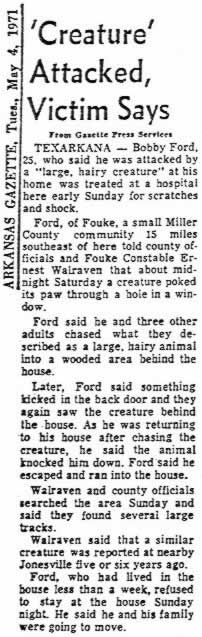
Here is another funky little film that has that student film feel. This one is directed by Charles Peierce (June 16, 1938-March 5, 2010 (aged 71). He was born in Hammond Indiana. As a small child he was moved to the same general area in which the action of Boggy Creek takes place. This is no doubt where he learned the legend of the "Fouke Monster," the Bigfoot-like creature that is the center of the film. He drafted customers from the local gas station to act in the film,[1]  (released in 1972). One might suspect the gas station approach to casting judging by the amature acting feel of the film. Even though it's about a  dark, scary,  confusing, if not corny, wacky subjet, it has a positive harmless student film quality. It's something about that amature quality I find appealing. It's not a great film, it's not even a fine film. Yet it's appealing in a home-spun way. It was also Pierce's directorial debout. He moved Carmel, befriended Clint Eastwood, Eastwood helped him get a job directing Sudden Impact (1983) a major motion picture starring Clint Eastwood (It's really Dirty Hary No.4). He is said to have invented the phrase "make my day."[2] He made other films including Boggy Creek II (which lacks the magic of BC I). The film was Written by Sean Taylor . (according to the IMBD). Wikipedia says it was written by Earl E. Smith.

There is a magic to this film. It is quite strange because all the individual elements suck. It's a pile of crap in every category from acting, to production values, yet it just has a feel the way it all comes together, innocent, sincere, alarming, scary, but somehow postive. It harkens back to child hood.


From IMBD page:
Cast overview, first billed only:
Vern Stierman ...
Narrator
Chuck Pierce Jr. ...
Jim as Boy
William Stumpp ...
Jim as Adult
Willie E. Smith ...
Willie
Lloyd Bowen ...
Himself
B.R. Barrington ...
Himself
J.E. 'Smokey' Crabtree ...
Himself (as Smokey Crabtree)
Travis Crabtree ...
Himself
John P. Hixon ...
Himself
John W. Oates ...
Himself
Buddy Crabtree ...
James Crabtree
Jeff Crabtree ...
Fred Crabtree
Judy Baltom ...
Mary Beth Searcy
Mary B. Johnson ...
Sister
Louise Searcy ...
Herself
The nerration begins with a framing device that opens and closes the film. Plays the narrating charter, who has returned to the cabin he lived in as a child. His mother and he were trying to eek out a living in that rural community, described as so small you would miss it if you blinked while driving through. The man peers through the windows of the empty abandoned house, as he sentimentally examines the property and his eyes room to the wooded horizon that sounds the poetry completely. It's moving toward dusk and he's thinking, i the dying evening sun light, "it's still out there." He ponders his memories of the creature.

We see him a as a boy, , dashing through a huge field of ankle and waste high grain or grass. he's climbing a fens and talking about how the creature had shown up he often heard it screaming from the woods. No one knew what it was but some felt it sought a mate. He hears the scream from the woods off in the distance and hurries along his way even faster. He comes to the little story on a dirt road were three old men are, one watching the other two play checkers. The boy comes in and asked teh owner, his landord, to come to the farm as his mother asks, investigate the strange noises. The landlord tells him there is no booby man in the woods, but he will change his mind by the end of the film. The boy hurries back, again hearing the scream. Then we move into the action of the film narrated by the adult version of the boy. This framing device is one of the best decisions the director made. It really takes us into the action. That scene would have been played out in the 40's when the Fouke monster first showed up. It was a latter version of a phenomenon from the 20's in neighboring county of Johnson called "the Johnson monster."

Some form of Harry monster can be found roaming that area as far back as white settlers were there to record it. The framing device close the film with the man pondering "is it still there, is it watching me now?" The sun is setting and  sense of tension grows that he's goign to be there after dark in an abandoned house and the thing is right outside. But he leaves just in time and the film ends. In the middle of these two segments he narratives the actions that happened years latte, in the 1960s. The resurgence of the Fouke monster in the 1960s is really the most famous period of activity. The film centers around a family called "Crabtree" who in real life is the family of Smoky Crabtree who has made a carrier out of the monster. He written many books and so on such as Smoky and the Fouke Monster. Notice Travis Crabtee plays himself. Oddly enough buddy Crabtree is played by James Crabtree. Kind of makes you wonder.


One member of the family sees the creature while sitting by a river bank. He only has bird shot in his gun so he doesn't fire on it. It's maybe a hundred years away so he just watches it. We catch only a fleeting glimpse of it. That is the second initiative choice the director makes that creates the magic of the film aside form the narrative framing device, that is the indirect approach to the horror. That is always the most effective appraoch to a horror tale, as evidenced by the Blair Witch Project. The whole film is really series of vignettes of various sightings. The man who owned the little story and laughed at the narrator's mother's fear saw the creator and shot it but the gun had no real effect. He now believed in the harry monster. Another saw it take two hogs one hundred pounds each, one under each arm, and step over the fence and walk away. Two boys found three towed foot prints in the mud while fishing. One of these scenes shows one of the only three semi direct views we get of the creature in the whole film. One is the scene with the Crabtree man by the bank.

The other major scene that all these little views of it are moving toward, where we see it grab a man on a porch. But it's dark and you only see ti fro a second. There's an extremely well done scene where a boy is out near his house with a shot gun he's looking for the origin of a noise. This on toward evening, it's perfectly light. He walks right up within feet of it but he has his back to it so he doesn't see it. It's only obscured by a few leafless three branches so we can see clearly it's a Bigfoot-like thing similar to the Patternson film. The creature makes a noise, the boy turns with great alarm sees it standing right there, nd fires! The creature is clearly hurt, annoyed but not damaged. It is angry! He's screaming and hitting trees. They boy is running to his house.

 photo boggycreek-thumb_zps72491d57.jpg

 Three major event-scenes that describe the film and fill in the action leading up to the denumont, which is the siege of a certain familie's house. Strangely enough there's a song in the film. It's like an Innocent Disney kind of song about what a wonderful life it is in the woods, "hey Smoky Crabtree." It's so corny and out of place. Here's this horror thing running around, no one knows what it is, it's scary but there's this innocent little song about how great it is. It's so kitschy and out of place. In trying to figure is it that this song doesn't spoil the film for me even though it's ridiclous, makes the film see like "a hoot," or does it work with the flim to help the "magic," I would have say it works with it. It would be so easy to ruin it. The song is a prelude to a since with an old hermit who Travis Crabtree befriends. He brings the old man tobacco and stuff. The old man seems to say he's never seen the creature then latter says he doesn't bother it and it doesn't bother him. It leaves one wondering "why is this here in this film?" It seems to serve no function. It's almost like he was going to make a different film and then put it in for filler. Coming right after the song seems even more superfluous.  Yet like the song it doesn't destroy the film.  For one thing part of the charm of the film is its armature nature. So this helps on that score. Then I think it's characterization. The population of Fouke and the surrounding area is a major character in its own right, this is part of charactoriztion where we see the nature of the populace.

In terms of action of the creature we see a scene in which a young girl goes to bed, taking care of her siblings. The creature comes right out side. Earlier that evening as she drew water for the house she watched the woods feeling something was there. Now she watches through a window as we hear it growling. It's supposed to be killing a cat but I can never make anything out, not even on DVD. It's all dark. Another scene shows three girls in a small clap board house, alone. They are going to bed they are having a pajama party. The three hear the creature breathing outside. It tries to get in. They put a chair at the door and get the father's shot gun. They don't necessarily know how to load or shoot it. They are not harmed but the sense of tension and vulnerability really words to make a scary scene. We do not see the creature at all. The idea the three women alone raises a question echoed throughout the film as a theme, it it looking for a mate. It's either horrassing women alone or taking live stock as food. Since it's appearances seemed to run in periods, punctuated by long periods of absence, as the Johnson monster in the 20s, the Fouke monster in the 40s, and 60s, they speculate that it get's lonely. One wonders why they would assume it's the same creature after all those years? There have to be others or it would die off.
The community has a big monster hunt with hunters from all over the state bring dogs, coon hounds and so on. But the dogs wont move in on the scent once they get it. The hunt goes nowhere. One guy sees it and is thrown from his horse. All of the scenes in the film are based upon "real" claims of sightings and stories in the community. It's narrated as a documentary but shows some dialogue in scenes as a docudrama.

Then we come to the major point, the siege. A family has moved in to a rent house along a back road in the area. The husbands are working near by and the two women and children are accompanied by a brother of one of the woman, a young man who may be the one grabbed on the porch. They hear the thing outside at night and are frightened. It comes up on the porch and tries to get in. It even turns the knob but they put a chair there. It reaches into the living room at one point through the front window. All we see is a hairy arm. It almost grabbed one of the people. It also reaches in through a bathroom window and almost gets the young man visiting his sister. The men come home and go out to confront it. All they have is flash lights. You would not find me doing that. The thing comes up on the porch behind one of them and grabs him and throughs him. I say he got off easy. They rush him to a hospital at  Texarkana. The boy is in shock. This is said to be a true story. The people decide to pack up go at first light they never come back. That's basically the end of the film.

Then the framing devise closes it with the man wondering is it watching me now. Leaving just before dark. It's not an art film and not a fine film, it has a quality to it that I find appealing. It works on a couple of levels. Maybe that's it's secrete. It's a cult classic for Bigfoot hunters but no one regards it as a serious source of information because nothing it says about the creature is advanced knowledge, so any bigfoot hunter worth his wood knocks knows that information anyway. It's not really documenting anything because no attempt is made to actually demonstrate the veracity of the stories, no story teller is really identified other than the fictitious narrator. On one level its a laughable amateurish attempt that makes the work a hoot. On a deeper level it's a respectable first attempt to bring to light a subject that the director no doubt grew up with and wants us to take seriously. But it's an innocent presentation that doesn't seek to scare the viewer with horrific nonsense but just tells its tail outright. The two best choices are the framing devise, which pulls us in to the guy's plight and his naustalgia and the wonderment at "what happened to the thing?" The indirect appraoch to presenting the horror is always very effective. The imagination can compel us to look.


accessed April 24, 2014.

[2] Ibid.


Watch the entire film on Youtube

Wednesday, November 04, 2015

Review of Herman Philipse's: God in the Age of Science. (Part 1 of 2)


Philipse makes three major moves indicative of the scientistic ideology. Rather than deal with his entire book I will isolate those points and show how they exhibit the ideology. Those three points are:

I. God, as an explanation of the world and any meaning in life, must be derived by scientific methods and must constitute a scientific explanation. Only scientific answers are real proof and can be checked by others, This is reduction of all knowledge to the only valid kind of knowledge: science.:

II. He uses that position to leverage the battle on to his own turf, The proofs of God must be scientific proofs, therefore he totally discounts revelation.:

III. Having moved the battle to his own turf he argues against Swinburne's use of Bayes so that he can use it as the scientific evidence. Having established that only scientific evidence will do then he's the only one in the debate with scientific evidence.:

The way he accomplishes move I is by dispensing with revelation and personal experience. His first chapter argues for the priority of natural theology. [1] The establishment of that point is really based upon the supposed weakness of revelatory knowledge.[2]Essentially he asserts that only natural theology can be checked by others, revelation and personal experience are unreliable and subjective. He constructs four dilemmas for the believer designed to leverage her into fighting the battle on his own turf. The first such dilemma is between what he calls “cognitive and non-cognitive.” By non cognitive he may include experiences, but he's speaking more directly of liberal theology, that tends to be metaphorical vs. a factual account. He says, “according to...cognitive interpretations a believer who says 'God exists' is making a factual claim which is either true or false, whereas according to non-cognitive interpretation such sayings have a very different function. Evaluation of these statements in terms of truth or falsity is inappropriate.[3]His examples of non-cognitive are Wittgenstein and Karen Armstrong. The non-cognitive makes belief immune to criticism but also leaves it cut off from non-believers as unprovable.

For the “cognitive believer” there's a second dilemma. Either belief must be backed by evidence or it's not needed.[4] An example of the latter is the work of Alvin Plantinga and his idea of “properly basic beliefs.” In that view belief is rationally warranted though not proven to others. Philipse answers Plantinga, “I shall argue that religious beliefs, and indeed most religious believers, not be called justified or reasonable or warranted unless the latter...can support their beliefs by abducinng good positive reasons to the effect that these beliefs are true.”[5]Here's where he starts leveraging the believer off the ground that makes strong faith (experience) and onto his turf where he controls the landscape (that of scientific knowledge). He says, “...these reasons [the believer's justification for belief] shall not derive from, or not derive merely from, a revelation or from faith. In other words rational or natural theology is indispensable to modern religious believers, if at least they want to be called 'reasonable,'” [6] Either bring religion into compliance with the priesthood of knowledge (science) or the gate keepers will slam the door in your face and you will be obsolete. Either way religion loses.

He brings out the next dilemma, either the methods used to defend belief will be scientific or not scientific. He says “both horns imply great peril for the believer.”[7] In debate we avoided that position by exposing the false premises upon which the dilemma was based. Most dilemmas are like a long horn steer, a point here, a point there, and a lot of bull in between.[8] First of all abductive reasoning means inference from the best explanation. That does not require proof and it may not involve establishing facts. He's going to have to prove that the best explanations are always and only the scientific ones. To assert that only the scientific answers count means that he reduces all knowledge to science. Secondly he's done a bait and switch in that he's demanded science but clearly substitutes the fortress of facts. Moreover, there is a distinction between warrant for the belief of the believer and warrant for an argument that will persuade others. The former is what Plantinga speaks to, the latter is Philipse's demand. Obviously revelatory proofs will mean more to the one who had the revelation. We can't let others in on it. So personal experience could be valid and warrant belief even if it does not function as proof for others. Personal experience, however, can function as warrant even for others, we do have scientific evidence, I will get to that in a bit.

Let's look at his three dilemmas. The first is factual and non factual. In the non factual camp he really includes liberalism and non literal views of theology. That's important because he has to get the believer on his turf, the fortress of facts. Apparently that's what he means by “science,” the fact producing machine. It is possible to employ metaphor in a belief system without reducing belief in God as a stark choice of either fact or metaphor. The second dilemma is for the so called “cognitive side” (for that I read “literalistic,”) it must be backed up or not. I say it only needs backing up if one needs to prove to others. Otherwise we all have reasons for believing, and if faith is sincere those reasons can only be life transforming. There's nothing irrational about that. If something is so overpowering it can't be denied and if it changes your life dramatically for the better it would be irrational to refuse it merely because it's not part of the truth regime. The third I just discussed, the demand for scientific evidence.

A major problem here is that he has these neat segmented little compartments, where reason and faith are kept apart; where natural theology and reformed theology are kept apart. Real faith and real religious thought is not like that. People have both faith and reason, revelation and objective proofs. It is perfectly possible to mix the two sides and most of us do to some extent (with a thousand variations of degree). We really need to take to heart the distinction between personal faith and the desire to convey one's reasons to others. No one believes for no reason. Belief is an existential/phenomenological matter. It's not a test for a driver's license. The scrutiny I have to care about is my own and that of those I love. When Philipse says things like, “...for modern believers faith is not an epistemic virtue but a vice, unless there are convincing arguments for the truth of its contents,”[9] there is no reason to credit that statement. Convincing to whom? The only person I have to convince is me. I do have reasons I find powerful and if others would not find them so more is the pity for them.

He says modern believers are in a methodological dilemma. “Do They have at their disposal reliable and validated methods of religious research? If so it seems that the content of their faith can be refuted...”[10] If it can be validated it can be refuted. That goes for all positions. I was a college debater I can refute anything. Actually that's not a dilemma it's a double bind. He's saying if it's validated that's bad, then he blames it because it's not validated. “...If not, [validated] how can a religious creed be credible at all in our scientific era?”[11] That depends upon who is doing the validating and upon what basis.. The philosopher kings have been in the ivory tower too long. That statement in and of itself screams ideology. Why should religion not be credible merely because we are in an age of science? We all believe for a reason, modern people have modern reasons.

Of course Philipse, brilliant and rigorous though he is, seems blissfully unaware of the fact that there is good scientific evidence backing up many aspects of religious faith. In the chapter on supernatural I will discuss the vast body of empirical work backing the veracity of religious experience; the skeptic really has no justification for dismissing experience as evidence, they way Philipse does. The “M scale” gives us a scientific means of control for understanding what is a valid experience and what is not (see chapter on supernatural). By the same token the same chapter also documents unexplained events well documented and factual form the basis for modern miracle claims. These both experiences and miracles are controlled for and validated by double blind experiments and medical diagnostics. Even so its only if one intends to persuade the skeptic that one needs to meet the demand for evidence. Then evidence need not be scientific. Yet we do have the validated scientific methods, I wrote a book about them.[12]
(to understand the studies proving scientific methods for a God Argument see the summary of my book on my blog "The Trace of God).
He continues more of the water tight compartmentalizing by stating that there are so many contradictions in the “traditional concept of God.”[13] Then the most troubling part, “without introducing analogy or metaphor...” Why should we want to avoid analogy and metaphor? That's rather irrational since we can't talk without them. It's not the literalistic aspect that makes language work as communication but the space afforded understanding in the use of analogical speech. Not only is all religious language analogical but all language is to some extent.[14]That is a major method in theology, use what we know in analogy to communicate in the face of the unknown. Yes, it can be inaccurate, but how accurate does it have to be? Why doesn't the fact that we have no empirical proof of string theory or multiverse stop scientists from talking about those things? Personal belief is a phenomenological matter. The short cut to defining that term: metaphysics imposes pre set categories upon sense data, phenomenology is allowing the sense data to suggest its own categories. In equating metaphor with untruth he is imposing many preset categories (ideology) upon the sense data.

Philipse associates literal language (no analogy or metaphor) with being reasonable defined as “objective diachronical rationality”). [15]I disagree that “objective” opposes metaphor. One can be objective about the use of metaphor. I certainly object to the implication that metaphor is irrational. To use metaphor properly one must reason about meaning and implication. Since belief is a phenomenological pursuit it requires an individual understanding. It's not science nor can it be. We just have to accept that science is not the only avenue for reason. One can be rational and reason in the continental style of philosophy, using phenomenology for example. The compartmentalizing is a hindrance. That seems to be the ideology of scientism. That's an upshot of the reduction of all knowledge to science.

He equates belief in God with a scientific hypothesis and demands of it the kind of explanatory power one finds in science. Rather he asks (rhetorically) “...whether theism can be an explanatory theory or hypothesis at all.” [16]That rather depends upon what one means by “explanatory.” What kind of explanation are we seeking? Why should it be a scientific hypothesis? It's not meant to be one. One does not dedicate one's life to a mere hypothesis. Hypotheses are meant to be tested. We can't test God. Take the Lord out for a test prayer! Science works by testing ideas and culling bad one's until the last one not culled is assumed true. It's not proved its just assumed (see chapter 3, Popper). To that extent Paul Tillich's notion of theology is scientific.[17]Tillich's “method of correlation” in which he “attempts to correlate the various analyses of the human predicament produced in modern culture with the answers provided by the symbols used in the Christian message.”[18] This a sort of hypothesis testing where one is comparing empirical experience to “theory” (doctrine). This is not to say, however, that doctrine is at all like an hypothesis. Nor is it intended to be. Philipse's demand is an example of the reduction of all knowledge to science. Yet Philipse demands that an understanding history be included to be rational (“diachronical”). Tillich said that the sources for doing theology are not only the Bible but history and culture as well. Moreover, he spoke of theology as explaining the meaning in the human condition.[19] That is a kind of explanatory power science does not have.

In order to counter the realization that all language is analogical he quotes Swinburne saying “...if theists cannot articulate their religious view except by using the key terms in an irreducibly analogical manner theism cannot be a theory of hypothesis.” [20] Well its not. He still has not bothered to say why it should be. In fact this line of argument seems to be a smokescreen. It's irrelevant what Swinburne makes of analogy because that doesn't answer the point that all language is analogical. The issue there revolves around the term “irreducible.” Philipse acknowledges that all language is somewhat analogical but not irreducibly so. If the term means that there is meaning present to the signifier then he's wrong, all language is irreducibly analogical. There is a literal meaning to all utterance but that doesn't mean that meaning is ever totally present in any signifier. In speaking of God we can say “God is the basis of all that is.” That is a literally true statement and yet it's fraught with ambiguity. God is beyond our understanding, we don't need words to feel love, or to know that love is real. Belief is personal and doesn't stop when you leave the lab. It's given a deep hidden personal slant multiplied times all believers, Naturally, it's not going to have the kind of precision a scientific hypothesis will have. Nor will it have the kind of explanatory power.

He does point out metaphor is used in science. He gives several examples. The mechanical model, seeing universe as a machine (eighteenth century) gives way to the organic model. These “models” are really analogies. He argues that science has clearly defined limits for such ideas but God is transcendent of our understanding so all our speech about God is completely analogy.xxi [21] The upshot is religion is not science, so religion is false because science is all that is. He argues that some people think they experience God's presence but of curse they don't. It's true that God is not given in sense data. A thing need not be amenable to our sense data in order to be real.:

Although some believers claim to have perceived God, the speakers of the language cannot be perceptually aware of God in the same unambiguous public manner in which human beings, cities, dogs, or mountains can be perceived. Hence no intersubjective referential use of 'God' can be established by such deictic methods. As a consequence one is only able to provide the proper name 'God' with a possible referent by giving a description of what the name is supposed to refer to. If no literal description is possible of an entity to which the word God allegedly refers...since that entity can only be hinted at by irreducible metaphors...we could never succeed in providing the word God with a referent.[22]
First of all, speaking a language does not in and of itself assure us a signified (referent) for our signification. It's irrelevant what the speakers perceive qua speakers. Secondly of course God is not going to be as well perceived as a tangible object, at that point he's merely saying God is not tangible, that cannot be equated with “there is no God.” Moreover, not to be pedantic but proper name is not God. That's his job description.

It is basically true that we can't communicate what God is in words because its beyond our understanding. That's why there are mystics. Lots of other things are known to exist but can't be communicated in words. Some examples include love, the colors, the feelings (try describing a feeling without referring to other feelings). Some philosophers try to deny the existence of feelings, those of us who don't need therapy know they exist. Now if it be objected that these things are not physical objects and God must be a physical object, that is an ideological assumption. There is no proof that there can't be real objects that are not physical. The disproof of Philipse's point, however, is the scientific data to which I refer in the chapter on supernatural, in connection with the M scale and Ralph Hood Jr.[23] The data proves that mystics around the world in all faiths are having the same kinds of experiences. These can be separated from physical causes of brain chemistry, drugs, perceptual problems and the like. Not only do they have an intersubjetive basis for referent but that basis furnishes good evidence of a reality external to their own minds which they all experience. The differences in those experiences are the doctrines used to explain them, that acts as a cultural filter, not the experiences themselves.

part two

Sources

1 Herman Philipse, God In The Age of Science, Oxford, London: Oxford University Press, 2012, 3

2 Ibid 23

3 Ibid., xiv

4 Ibid-xv

5-8 Ibid

9 Way back in the Trojan war, when I was in high school debate the Dallas Jesuit debators used that saying, that's where I got it.1973-74. Jesuit was the top school having won NFL district championship 3 years in a row (1972, 73, 74).

10 Ibid xvi

11 Ibid

12 Joseph Hinman, The Trace of God: a Rational Warrant doe Belief, Colorado Springs: Grand Viaduct, 2014. no page indicated. This book is only available on amazon.com. It covers a host of methodologies in over 200 studies on religious experience forming a huge body of work going back to the 19960s. Of these the chief study instrument is the “M Scale.”

13 Philipse xvi

14 Phiipse acknowledges this, 95

15 Ibid., 95

16 Ibid.

17 Guyton B Hamond, “An Examination of Tillich's Method of Correlation,” Journal of Bible and Religion, 1964,Vol. 32, No. 3 (Jul., 1964), pp. 248-251, 24

18 Ibid.

19 Philipse, 96

20 Ibid.

21 Ibid., 97

22 Find chapter and fn on Hood article.

23, Ibid,91