
Monday, December 21, 2015
Announcement


Rational Warrant vs Reasonable Doubt

I thought this would be a good little diaoauge which tries to pin down exactly where the progress is vis Rational Warrant. I think the upshot of this is that the atheist is privileging doubt.
"What's his face" on CARM
WHF:
your warrant to think God might not exist is not as strong as my warrant that he does.Meta:
Oh yes it is... Notice I offered just as much justification for my statement as you did for yours.[/quote]
hardly. where are your 200 studies? You don't have a single argument that works by deductive logic or model logic. you don't have any emprical evidence. you have not one single study to back up disbelief in god.
all you really have is suspicion that there may not be a God. you have no actual postiive reasons for thinking there is not. I do have postiive reasons for thinking there is.
*my reasons correlate with personal experience that back doctrine.
*they are lined up with the rationale of deductive reason
*they are backed by empirical data
*they give more than a prima facie reaosn for accepting the co-determiante
* I have 8 tie breakers that the RE argument away from naturalistic brain chemistry alone.
* my RE fit the criteria we use for epistemic judgement
less than proof is ok. it it doesn't have to be proof it need not be proof.
WHF:
Meta:
WHF:
It depends on how less than proof. Can you say how less than proof your argument is exactly, and why? I would accept beyond a reasonable doubt, such as the Earth orbits the Sun, which your case does not reach.
Meta:
calling inconclusive is misleading becuase "conclusive" is in the eye of the beholder.
WHF:
Meta:If, within the case you make "conclusive" is in the eye of the beholder, it's not conclusive.
any impartial observer would have to give it to the one that has either the empirical data or the deductive edge. tie breakers have to count.
most people's reasons for being atheists are personal and emotional and not satisfying for real thinkers.
WHF:
Meta:No Meta, this is horribly wrong. It's all about standards of evidence. Personal and emotional are more in the realm of believers.
no it's backed by several empirical studies and mound of empirical research around the concept of God image and self esteem. not just that one Lesie Francis study.
Originally Posted by Whatsisface

Meta:
now you are trying to bring proof in the back door. "Reasonable doubt" is not the limit on warrant. Neither is a reasonable doubt predicated upon a feeling of doubt. I don't think you have a reasonable doubt. you have a strong sense of doubt but how is that reasonable? It can't be backed up by reason. Yes you can give m e reasons but I disprove most of them.
It's going to reduce to a non demonstrable sense that you have in your gut vs. what I think are valid reasons that you deny as valid becuase they dont' jibe with your gut. then you are going to deny that it's intuitive and calim that it's "reason." In reality you can't ground your doubt in reason.
WHF:
You are one of the few here who actually tries to make a case for the existence of God but surely even you would admit it doesn't take you as far as beyond a reasonable doubt?
Meta:
My feeling is warrant is permissive not compulsive. so I think it comes down t a purely existential matter. No one is trying to make you bleieve if you don't want to, don't. your not wanting to believe cannot be construed as disproof of my warrant for belief.
WHF:
Can you see how you have not answered my question?Meta:
ok try it again:
WHF:
I asked you this...
Whatshisface:...It depends on how less than proof. Can you say how less than proof your argument is exactly, and why? I would accept beyond a reasonable doubt, such as the Earth orbits the Sun, which your case does not reach.
You answered with...
Metacrock...I have 200 empirical studies. you have bogus arguments like "no scientific evidence" taken out by the 200 studies.
Can you see how you have not answered my question? You have not said how less than proof your argument is and importantly, how you know this.
Meta:
He has not proved that room for doubt, which does still exist, mandates doubt as an unalterable course, nor does that room negate the validity of the postive reasons for belief.
Get answers to these questions when you buy the Trace of God: A Rational Warrant for belief, by Joseph Hinman, available on Amazon.
Saturday, December 19, 2015
Answering Stephan Fry on his "world without God"

Stephen Fry
Stephan Fry is a comic actor who was often on Blackadder,(Brit com) and had a couple of shows with Hough Laurie ("House" on tv show House). Fry is a great actor and is hysterical, he's also a big time atheist and his atheistic propagandizing has gotten him called "an activist." He has a thing on youtube in which he extols the virtues of a world without God. His basic message seems to be that religion is only about governing external behavior while secular humanism is about the spiritual and inner depths plumbed ay the arts. At 0.52 he says it exactly. God of the Bible is only concerned with governing external behavior but we humanists care about the inner person. That is right before his diatribe on Prometheus.
He speaks to the greatness and poetry of the King James translation with its beautiful Elizabethan English. secular society fails the imagination because it did not replace the poetry of Bible. At that point he makes a statement that his, society the one he would bring in and to some extent the one his side has brought in, is not just unbelieving but "anti-theist." He asserts that the atheists must care about the internal the inner person, asserting that Christianity is just about controlling behavior. He asserts that they must not allow religion to have the beautiful and virtuous spiritual altruistic morally strong, not allow it to be "peculiar to religion." In a written quotation taken from this speech he says:
"I don't think we should ever allow religion the trick of maintaining that the spiritual and the beautiful and the noble and the altruistic and the morally strong and the virtuous are in any way inventions of religion or particular or peculiar to religion."
The Blasphemy Debate[1]
Religion is the origin of the concept of spirit. It's foolish to claim that the spiritual is not the monopoly of religion. It's only the watered down metaphorical version of spirit to which non religious thinking can lay claim. Art (including literature and poetry) are directly connected to religion. Of course I'm not saying that one must be religious to do art, but it would be foolish to pretend that they are antithetical. Fry doesn't exactly say that, and yet the impression is clearly created. German philosophers such as Hegel always associated spirit mind. It's often overlooked but the Greek word for spirit, pneuma, (nou-ma) while meaning primarily breath or wind also has carries a meaning of mind.[2]So the Greeks thought of breath as spirit but also associated it with life force, and thus with mind. The exercise of thought in writing or creating art is seen as "spiritual" idea of a real spirit as something immaterial that lives and thinks is seen as totally primitive. Most modern people would probably be willing to split the difference and to understand ourselves as having a spirit as life force and that as connected to intellect it also serves a metaphorical function. That metaphor is still more connected to religion and shared with art. In terms of Christian theology it can be understood and part of the imago dei.
He does make a statement about the barren road of Dawkins style of atheism, the reductive mentality. So he understands that problem. This is not your average illiterate atheist who thinks Daniel Dennett is great literature. He was an English major at Cambridge. I can have sympathy for his view point. He is the kind of atheist my brother and I admired and tried to be, literate and literary and appreciative of the arts. His speaking style is so smooth and with that debonair English highly educated manner he really puts it over. His use of the Prometheus myth he ties in with the Poet Shelly (Prometheus unbound) and his defiance of religion.
In the myth, Prometheus gives fire to man contrary to the will of the gods.. As punishment Zeus has him chained to a rock and a bird eats out hi liver every day, (the liver grows back because he's immortal). Percy Bysshe Shelley (1792-1822)was a major leader in the Romantic rebellion and especially its poetry. He is one of the greatest poets in the English language. Shelley himself expropriated the Prometheus myth as a symbol of romantic rebellion. The poet brining the light of knowledge and reason to man against the wishes of God. Here God stands for the authority structure politically, culturally and religiously. Shelley's wife Mary Shelley wrote Frankenstein a story about a creature struggling against his creator. Fry is aware of all of this he points it out. I will pass over the odd coincidence that Lucifer is also light bearer. Of course in some versions of the myth Prometheus created man. But that doesn't fit because in Christian world view the creator of man is the creator of all things, and there can be no higher power.
According to Fry the Greeks are saying "we are as good as the gods." We have the liver. We are willing to defy the powers that be (for Fry that may mean society. organized religion, or God). He goes on in rhetorical bluster about how humanity is great. Here's a real point of contradiction in humanist ideology. Humanity is great, humanity invented God, but God ids no good. Despite the literacy and artistic appreciation Fry brings to the subject, the basic point--humanity can do it all without God--is hog wash. The truth of it is we can do all kinds of things without God. We are real good at screwing up the planet without God. We are veritable virtuosi at creating the potential for nuclear destruction. We show a fair degree of talent for murder, rape, and torture for political repression. The one thing we can't do without God is get our shit together as a species. 80,000 raped, tortured and murdered victims of the death squads in El Salvador, that was just in the 1980s. 60,000 in Guatemala, 70,000 victims of contra terror in Nicaragua. These are the things in which humanity excels.
Of course atheists try to blame Christianity for the evils of the world. We must admit Reagan fooled the Christians. Much of the support for his contra war came from evangelicals and fundamentalists. On the other hand, Stalin, Mao, Pol Pot were atheists. The level of suffering and death due to communism was estimated at 1 million lives.[3] This is wrought by atheism, Marx's brilliant new humanity8 was as screwed up as the old humanity. But it's not as though I mean to impugn Humanity. We are created in the image of God, and so e can do wonderful things, even apart from any particular belief system. Not just art and literature but humans can excels at compassion, they act to save each other and sacrifice themselves for the good. Communism screwed itself but started with the best of intensions. From the Paris commune to the civil rights movement, from Mother jones to Mother Teresa, from Joan of Arc to Joan Baez humans have all beliefs have cone wonderful things. But they forget God they screw their movements as did communism. They thought they could theorize and manage their way into changing human nature.
It's true that we can screw up our movements with belief in God ad well. Look how the charismatic movement allowed itself to be coopted into a right wing organizing tool in the 80s. The core of communism is human nature. That can be good but when its bad it can be murderous. The core of religious belief is the supernatural reality of God.[4] Mystical experience lies at the core of all religious traditions. Mystical experience is transforming. It changes one's life in vital and dramatic and positive ways.[5]
Council on Spiritual PracticesSpiriutal Emergency
STATES OF UNITIVE CONSCIOUSNESS
Research Summary
Also called Transcendent Experiences, Ego-Transcendence, Intense Religious Experience, Peak Experiences, Mystical Experiences, Cosmic Consciousness Sources Wuthnow, Robert (1978). Peak Experiences: Some Empirical Tests. Journal of Humanistic Psychology, 18 (3), 59-75.
Noble, Kathleen D. (1987). ``Psychological Health and the Experience of Transcendence.'' The Counseling Psychologist, 15 (4), 601-614.
Lukoff, David & Francis G. Lu (1988). ``Transpersonal psychology research review: Topic: Mystical experiences.'' Journal of Transpersonal Psychology, 20 (2), 161-184.
Furthermore, Greeley found no evidence to support the orthodox belief that frequent mystic experiences or psychic experiences stem from deprivation or psychopathology. His ''mystics'' were generally better educated, more successful economically, and less racist, and they were rated substantially happier on measures of psychological well-being.
(Charles T. Tart, Psi: Scientific Studies of the Psychic Realm, p. 19.)
Two of the major studies
Long-Term Effects Wuthnow:
*Say their lives are more meaningful,
*think about meaning and purpose
*Know what purpose of life is
Meditate more
*Score higher on self-rated personal talents and capabilities
*Less likely to value material possessions, high pay, job security, fame, and having lots of friends
*Greater value on work for social change, solving social problems, helping needy
*Reflective, inner-directed, self-aware, self-confident life style
Noble:
*Experience more productive of psychological health than illness
*Less authoritarian and dogmatic
*More assertive, imaginative, self-sufficient
*intelligent, relaxed
*High ego strength,
*relationships, symbolization, values,
*integration, allocentrism,
*psychological maturity,
*self-acceptance, self-worth,
*autonomy, authenticity, need for solitude,
*increased love and compassion
(3) Trend toward positive view among psychologists..[6]
MYSTICAL OR UNITIVE EXPERIENCE
Trend toward positive view among psychologists. Spiriutal Emergency MYSTICAL OR UNITIVE EXPERIENCE a. clinical literature does not see mystical experience as pathyology"we are captains of our soul" Fry adapts Henley's "Invictus." We will see if we are the captain of our souls when we face eternity. What do3s he do about the deterministic aspects of atheistic thought? That is by far the prevailing tendency among atheists. Chemical determinism is one of their most dominant positions. To hear most atheists on the nt tell it we are little more than automatons.
"Offsetting the clinical literature that views mystical experiences as pathological, many theorists (Bucke, 1961; Hood, 1974, 1976; James, 1961; Jung, 1973; Laski, 1968; Maslow, 1962, 1971; Stace, 1960; Underhill, 1955) have viewed mystical experiences as a sign of health and a powerful agent of transformation."
b. Most clinicians and clinical studies see postive.(Ibid)
"Results of a recent survey (Allman, et al,. 1992) suggest that most clinicians do not view mystical experiences as pathological. Also, studies by several researchers have found that people reporting mystical experiences scored lower on psychopathology scales and higher on measures of psychological well-being than controls (Caird, 1987; Hood, 1976, 1977, 1979; Spanos and Moretti, 1988)".
c. Incidence rate suggests no pathology.
"Numerous studies assessing the incidence of mystical experience (Back and Bourque, 1970; Greeley, 1974, 1987; Hay and Morisy, 1978; Hood, 1974, 1975, 1977; Thomas and Cooper, 1980) all support the conclusion that 30-40% of the population do have such experiences, suggesting that they are normal rather than pathological phenomena. In addition, a recent survey (Allman et al., 1992) has demonstrated that the number of patients who bring mystical experiences into treatment is not insignificant. Psychologists in full-time practice were asked to estimate the percentage of their clients over the past 12 months who had reported a mystical experience. The 285 respondents indicated that of the 20,670 clients seen during the past year, the incidence of mystical experience was 4.5%. This clearly challenges the GAP report on Mysticism, which claims that "mystical experiences are rarely observed in psychotherapeutic practice" (Group for Advancement of Psychiatry, 1976, p. 799).[8]
God no good if he exists. lqack of insight can't make a greatvclerical don't have smart Christians anymore. feeble nonesnwe
I mean it's perfectly obvious that if there were ever a God he has lost all possible taste. You've only got to look - forget the aggression and unpleasantness of the radical right or the Islamic hordes to the East - the sheer lack of intelligence and insight and ability to express themselves and to enthuse others of the priesthood and the clerisy here, in this country, and indeed in Europe, you know God once had Bach and Michelangelo on his side, he had Mozart, and now who does he have? People with ginger whiskers and tinted spectacles who reduce the glories of theology to a kind of sharing, you know?So we see that beneath the Vanier of smooth talking education there lies a bigotry of the basest sort. Of we don't know if he's read any modern theologians so he would nod not know if there are any the likes of Leibniz or not. Of course the English are not known for theological Brilliants. He needs to turn to the Germans, the likes of Tillich, Bultmann, Bart and Moltmann. In England there was D.Z. Philips. Of course in America Plantinga and Alston. I guess that's the price they have to Pay for creating an environment hostile to belief. The English have N.T. Wright who is a brilliant scholar.
(A distinctly possible side-swipe here in the then Archbishop of Canterbury being bearded and bespectacled)...[8]
So Fry uses his smooth talk to feed the delusion of atheists that they can be good without God. That's why they are so kind and understanding and never insult anyone, because they are so full of that divine fire it just shines from them like the pyres of burning books in 1930s Germany. Hey it's hard enough to be good with God. We all know they are not achieving it without God.
Sources
[1] Stephan Fry with Christopher Hitchens.~ "Hay Festival pages," On the Guardian website no date given, online resource from Fry's website Age of the Sage, URL: http://www.age-of-the-sage.org/quotations/quotes/stephen_fry_gods_religions_beliefs.html
[2] Strongs Concordance with Hebrew and Greek Lexicon: on line copy URL
http://www.eliyah.com/cgi-bin/strongs.cgi?file=greeklexicon&isindex=spirit
4151. pneuma pnyoo'-mah from 4154; a current of air, i.e. breath (blast) or a breeze; by analogy or figuratively, a spirit, i.e. (human) the rational soul, (by implication) vital principle, mental disposition, etc., or (superhuman) an angel, demon, or (divine) God, Christ's spirit, the Holy Spirit:--ghost, life, spirit(-ual, -ually), mind. Compare 5590. [3] Scholar's Corner, "Atheism's Body Count," website, URL: http://www.scholarscorner.com/apologia/deathtoll.html accessed !2/13/15
[4] Ralf Hood Jr., Theoretical Fruits from the Empirical Study of Mysticism: A Jamesian Perspective Journal für Psychologie, Jg. 16 (2008), Ausgabe 3], PDF URL:
https://greatcommandmentseminar.files.wordpress.com/2010/08/hood_jfp1.pdf
[5] Joseph Hinman, The Trace of God: Rational Warrant for Belief, Colorado Springs: Grand Viaduct, 2014, 10-20.
[6] Council on Spiritual Practices, "Unitive Consciousness Research Summary," website URL: http://www.csp.org/experience/docs/unitive_consciousness.html
Council on Spirir5ual Practices sounds like wacy New agers but they are not. The are respected psychologists and researchers.
[7] Spiritual Compotency Research Center. Onjline Resource
http://www.spiritualcompetency.com/se/dxtx/types/mysticalexperience.html
formerly called "Spiritual emergency."
[8] age of sage, op. cit.
the note about the reference to arch Bishop was made by the folks on the British Guardian website.
Friday, December 18, 2015
let me hear from you
Fun Filled Friday:The Spirit of Christmas Past
 Thank God its FFF. This is the last Friday before Christmas so I thought if I'm going to do a Christmas theme I have to do it now. One thing that ha always fascinated me is the history of Santa Claus. What I find most interesting is the shadowy forerunners of Santa, those folkloric figures from the mists of Europe's past that form the basis of the Santa Claus legend. That is what I will most concern myself with here. But of course I would be remiss in not discussing the historical making of the modern Santa Claus. Our modern North pole dwelling Coca Cola guzzling Santa has only been around since the late 19th century, and was formed out of developments that began to take shape right after the American revolution.(St. Nicholas Center)
Before that time Christmas wasn't much celebrated in America. We had it but it was not regarded. Of course the Colonists had the tradition of Father Christmas from England. Around the time of the American revolution Christmas had fallen into disfavor because he was English. The American fascination withy Santa Claus comes from The Dutch who had settled New York. The Dutch had a forerunner Claus, Sinterklaas. That name means Saint Nicholas but I'll get to him in a bit. Our term "Santa Claus" derives from this Dutch name. It Washington Irving (1783-1859:"The Legend of Sleepy Hollow"-Headless horseman and all) who first made Santa Claus popular in America.
Diedrich Knickerbocker, Irving wrote the satirical A History of New York from the Beginning of the World to the End of the Dutch Dynasty. Irving dedicates his satirical "history" to the New-York Historical Society, and makes dozens of references to an impish, pipe-smoking Saint Nicholas who brings gifts down chimneys, thus beginning a legend that will travel round the world. That it was published on St. Nicholas's feast day, December 6, 1809, was no accident.("Father of Christmas")Irving's Modus Oporandi was to draw upon the folk traditions of New York Dutch that had been forgotten by most New Yorkers and that dipped way back into the fount of Northland folklore from the old country. His Santa road a horse there were no reindeer he did not live at the north Pole. I do not know if the Horse was Irving's idea but I think going down the chimney was already a Dutch idea. Yet Father Christmas didn't that. Dutch children were given candy and nuts in their shoes not stockings, they ere left on window ledges and the foot of the bed not hung from the fireplace. Two other figures were important in the making of modern Santa, John Nast the great political Cartoonist, that's a Nast Claus at the top.
1821 brought some new elements with publication of the first lithographed book in America, the Children's Friend. This "Santa Claus" arrived from the North in a sleigh with a flying reindeer. The anonymous poem and illustrations proved pivotal in shifting imagery away from a saintly bishop. Santa Claus fit a didactic mode, rewarding good behavior and punishing bad, leaving a "long, black birchen rod. (St. Nicholas Center, op.cit.)Following that in 1823 Clement Moore's poem "A Visit from St. Nicholas" (aka "The Night Before Christmas"). That poem added the names of the reindeer. One interesting fact was the gesture he makes to go back up the chimney, putting his finger beside his nose. This gesture is recorded by Irving in his story and that same gesture was the Dutch way of winking when telling a tall tale or some story you know is just a yarn. From there the next big sr5eppw were 20 the century: Rudolph and Coke.
Saint Nicholas
The story of Santa Claus really begins with St. Nicholas who was a real historical man, although not much is known about him. We know he lived in
the Bishop of Myra (in present day Turkey) in the early fourth century, who was known for helping the poor and giving presents to children. In the Middle Ages, Christians celebrated his feast day, Dec. 6, by leaving gifts for children in their shoes.(finding Dulcinea: Christmas).He was born around 280. No one knows when he died. He was supposedly wealthy and spent his family fortune helping the poor. He became so popular as a champion of children that for centuries he was as famous and as legendary as our Santa and he was the yearly gift giver spreading through Europe. His feast day was on December 6th that used to be the toy giving day. St. Nicholas was the toy giver.(History Channel "Santa Claus")

Shadows in the mists of time
Many of these treatments of Santa history begin with St. Nicholas but there were gift givers before him. The figures became the basis for the legend of gift giving Nicholas. They only hint at trace of forgotten times and cultures.
In Scandinavia the Norse God Odin acted as annual gift giver for children. He would fly around on his eight legged steed giving gifts. Children left their boots by the Chimney for Odin; who was associated with the Solstus thus linking him to December 25. The Germanic people had another gift given Frau Holda, winter.(Santa Claus' Pagan Origins). These two date to 13th century so they don't pre date St. Nicholas. In Italy we have Le Befanna who was said to have misled the wise men as they sought the Christ child. She went to find them to put it right but could not, thus wonders the giving gifts to children so as not to miss the Christ child, she too is 13th century. (Ibid).
In pre Christian times Germanic people and English celebrated mid winter festival of Yuletide. Many aspects of this tradition were absorbed into Christmas. This is where all the holy and Ivy stuff comes from. Father Christmas probably traces to that period, even though the first written sources are 15th century (Orchard, Andy (1997). Dictionary of Norse Mythology and Legend, page 187. Cassell). Likewise Odin is pre Christian ads sa god and probably as a gift giver as well, but our written sources begin in 13th century."The appearance of Santa Claus or Father Christmas, whose day is 25th of December, owes much to Odin, the old blue-hooded, cloaked, white-bearded Gift bringer of the north, who rode the midwinter sky on his eight-footed steed Sleipnir, visiting his people with gifts. … Odin, transformed into Father Christmas, then Santa Claus, prospered with St Nicholas and the Christchild became a leading player on the Christmas stage."(Baker, Margaret (2007 1962). Discovering Christmas Customs and Folklore: A Guide to Seasonal Rites Throughout the World, page 62. Osprey Publishing).

Polish Starman
Poland has a Pre Nicholas Santa figure called "Satarman." "In some regions of Poland, at the end of supper, Father Christmas, known as The Starman (very often the parish priest in disguise), accompanied by singing Starboys, pays a visit. He brings rewards to good children from Starland, and scolds the naughty ones, who eventually get their reward, too." (Polish Christmas). Starman is not jovial figure, no Ho ho ho, He first threatens to beat the children and then relents. Then he passes out presents.
In Russiia Father front and his grand daughrt are Clauslike gift givers but they fdon't pre date Nicholas. There is onewho does. Nicholas as gict giver in Ruwi is patterend after an older figure.
Ded Moroz or Father Frost, the Slavic version of Santa Claus, long ago became the symbol of Russian winter, New Year’s and presents. He is usually accompanied by his granddaughter Snegurochka riding with an evergreen tree in a traditional Russian troika, a sleigh drawn by three horses abreast.Snegurochka is a unique attribute of the image of Ded Moroz – none of his foreign colleagues have such a cute companion.The original Russian gift-giver was Saint Nicholas, the country's Patron Saint, whose Feast Day is celebrated on December 6th. The image of Saint Nicholas originates from the image of another hero – the ancient Morozko. In Russian folklore Morozko is a powerful hero and smith who chains water with his “iron” frosts. Morozko was not hostile to people - he helped them and presented them with awesome presents.In fairy tales Morozko is at times kind and at times evil. To be precise, he is kind towards the hard working and the good-hearted, but extremely severe with the mean and the lazy. And it is not about justice only. It is rather about two personalities living in one magical person.(Russiapesia).The anti Santa
Even our modern Santa has his negative side. In my parents generation they would say that he would bring coal to bad children. Then it evolved to just a passive 'no gifts' for bad children. We have seen that older figures have more negativity. Starman is austere and threatens punishment although he's really a pushover. Even t5he Russian figure older than Nicholas is schizophrenic. There I an even older figure who hints at a forgotten past now very foreign. This is an actual evil figu8re2who balances Santa called "Krumpus." He's in the Bavarian Alps. He has a demonic face and horns, sound familiar? (Republican Candidate)?
In Austro-Bavarian Alpine folklore, Krampus is a horned, anthropomorphic figure who, during the Christmas season, punishes children who have misbehaved, in contrast with Saint Nicholas, who rewards the well-behaved with gifts. Regions in Austria feature similar figures and, more widely, Krampus is one of a number of Companions of Saint Nicholas in regions of Europe. The origin of the figure is unclear; some folklorists and anthropologists have postulated a pre-Christian origin for the figure.( wiki Author sites:Crimmins, Peter (15 December 2011). "Horror For The Holidays: Meet The Anti-Santa". NPR. Retrieved 25 November 2015).There are other such figures in surrounding areas. This is really ancient and moving back into the mists in a time we know little about. (Haid, Oliver (2006). "Christmas markets in the Tyrolean Alps: Representing regional traditions in a newly created world of Christmas". In David Picard, Mike Robinson. Festivals, tourism and social change: remaking worlds. Buffalo, New York: Channel View Publications. pp. 216–19. ISBN 978-1-84541-048-3).
Wednesday, December 16, 2015
Did anyone exist in the first century? (part 2): Paul

Kenneth Humphreys Is probably the major Paul Myther.I can't find out much about him, but he wrote a Jesus Myth book, The Christos Mythos. See a review by major historian James omerea. His anti-Paul arguments are laid out on a blog: A Fabricated Apostle: Two Different Pauls.
Humphreys has many argumens but I will deal with six, and to summarize them:
(1)Argument from silence on Paul's great acts
(2) Disparities between Epistles and Acts
(3)Conflicts between Paul's Roman citizenship and Jewishness
(4) Paul's conversion story is implausible.
(5)Supposedly parallel passages with Josephus.
(6)No evidence of Paul in Ephesus His First Argument is an Argument from Silence (OF COURSE). There's no record of Paul being assigned to enforce Jewish sanctions against heretics. Moreover, Paul was always meeting Kings and civic dignitaries yet there is no record of it in secular history. "The trail-blazing Christian missionary and apostle, St Paul, appears nowhere in the secular histories of his age (not in Tacitus, not in Pliny, not in Josephus, etc.) Though Paul, we are told, mingled in the company of provincial governors and had audiences before kings and emperors, no scribe thought it worthwhile to record these events."
Humphreys seems to assume that there's some archives to which we can go to look up all that happened in first century Palestine. There is no such place. They did not have a vast governmental achieve, if they did we don't have it now. We have little from the first century. The list of all first century writings that don't mention Jesus (excluding prolific Philo) is so small it's not much bigger than those that do. Any authority granted Paul if even written, would be so totally obscure it's silly to expect to have it.[1] As for meeting with important people a lot of that was due to Paul claiming rights of Roman citizenship when charged with crimes. There's nothing remarkable about that so no reason to expect to find the records. That's like saying "my son [the drug addict] is always talking to layers and judges so he's an important guy." Moreover, Stephan Neil points out that Luke gets the titles of all the functionaries correct in all the different regions.Neil thinks that one of the most impressive aspects of Luke as an historian is that he always gets the titles right. Many of the titles of local officials which Luke provides us with were not validated until modern times. "The writer of Acts knew the correct titles and used them with varying precision. In the words of Ramsey: 'the officials with whom Paul and his companions were brought into contact are those who would be there. Every person is found just where he ought to be; proconsuls in senatorial provinces, asiarchs in Ephesus, strategoi in Philippi, politarchs in Thessolonica, magicians and soothsayers everywhere.' The Most remarkable of these titles is Politarch the ruler of the city used in Acts 17:6...previously this word had been completely unknown except for this passage in Acts. It has now been found in 19 inscriptions dating from he second century..." Neil argues that titles are the hardest things to get right, modern French writers never get English titles right, and this is something that would easily and surely betray an anachronism (147)Historians of the modern day judge Luke a superb historian.This is good evidence that he did make the journey because getting such title's right is very hard to do.[2]It seems the author really was on the trip and thus it's not made up out of whole cloth. He probably knew Paul as well.
His second argumentis that the Pauline Epistles and the book of acts portray widely divergent views of Paul. Paul of the epistles is independent and confident, not intimidated by authority of the Apostles. He confronts Peter (Galatians); the Paul of Acts is cooperative, dedicated to the team, and willing to be commanded and led:
Now part of the brethren ("with them coming in and going out at Jerusalem" - 9.28), he is "managed" by the elders. Disciples "took him" from Damascus (9.25) and Barnabas "brought him" to the apostles (9.27). They "brought him" to Caesarea and then they "sent him" to Tarsus. Barnabas "brought" Paul back to Antioch (11.26) and then with him was "sent" to Jerusalem with famine relief (11.30) – (as it happens, a visit to Jerusalem completely unknown to Paul himself). Eventually the brethren "send" Paul on his first missionary journey (13.4). As a missionary, Paul is very much on the collective message:"And as they went through the cities they delivered them the decrees for to keep that were ordained of the apostles and elders which were at Jerusalem. And so were the churches established." – Acts 16.4,5.On this point there's an ironic but obvious counter. Humphrey's says of the Paul of Acts: "The closest Acts comes to bestowing the title [Apostle] is 14.14 where his name follows Barnabas and the plural is used." Then: "Full of his own importance, in all his letters Paul hammers home the point that he is an apostle and that his appointment comes directly from the divine." Do you see a relationship there? That is certainly not proof that he didn't exist. All it really proves is that once got out on his own he realized how they treated him and decided to do it this own way; more a proof of his historicity because it shows he was human. Moreover the fact of shaving his head means he was in conflict with them. He was commanded to do it, it was a PR move and Paul's own idea. My argument is not that here is no disparity but that Humphreys is making much more out of it than should be made. First you have the difference between Paul's account of himself (ok so he's not Mother Teresa--he has an ego)juxtaposed to Luke's understanding of him. In fact Luke's account might have been recorded and embellished from verbal recollections by a well meaning acolyte. Secondly you have to consider the tine and the on text. Luke is writing to put Paul's life in a light that would flatter him and promote unity, and he was writing in the 80s, 20 years after Paul's death. Paul was writing to churches ad hock about immediate problems confronting. Humprey's argues that Paul, in his letters, doesn't tell them about the things in the book of Acts. Yet he was not writing an auto biography. He also did not tell them about his mother, we can safely assume he had one. At worst all this proves is that the Greek physician was a spin doctor not that Paul did not exist.
From Thessalonica, Paul is "sent away" to Berea by the brethren (17.10). He is also "sent away" by sea and "brought" to Athens (17.14,15). In Cenchrea, Paul even takes a Jewish vow and shaves his head! (18.18).
In his third argument, implausible and contradictory aspects of Paul's story, Humphrey's real ignorance is showing. He thinks that if Paul was a hotshot student of the major rabbi, there would be some Jewish polemics about it. Then an even more egregious and telling display of how little he really knows: "How likely is it that Paul really studied under the Pharisaic grandee (Acts 22.3)? Paul clearly had difficulty with the Hebrew language: all his scriptural references are taken from the Greek translation of Jewish scripture, the Septuagint." He also compounds the ignorance by questioning if a Roman citizen could have any authority in Judaism and asserts nothing in the texts spell out official authority.
First, Paul's status as a hotshot student. No one ever really said, nor did Paul say, "I was the best student.." He said he learned from Gamaliel he did not say "I was the top student." He said "I was zealous" and he said kept the law he didn't say "I was brilliant I was the best." Of course there is also the possibility that such polemics did exist but are lost to posterity; I've already shown that we have little in the way of documents surviving that era. The Romans may well have destroyed any achieves they had in 70 or in 135. When they destroyed Jerusalem the second time they put Roman temples over Christian and Jewish holy sites such as the site of Jesus' tomb. hy would they not destroy archives?[3]
Secondly, the Septuagint gaff. It is common knowledge that the LXX (Septuagint) was the Bible of the early church. In fact the Jews were so angry that the Christians made so much of the Greek scripture and used it to link Jesus to Messiah that they commissioned a new Greek Translation in 100 AD. Why? Because Palestinian Jews spoke Greek. obviously Paul had no trouble with either language he used LXX because that was the favorite of the people.
This translation became very popular among Jews in the first two centuries before Christ because many Jews in those days did not understand Hebrew. Their ancestors had left Israel centuries before, and generation after generation gradually lost the ability to read the Scriptures in Hebrew.Many of the Jews in Jesus' day used the Septuagint as their Bible. Quite naturally, the early Christians also used the Septuagint in their meetings and for personal reading; and many of the New Testament apostles quoted it when they wrote the Gospels and Epistles in Greek. What is most fascinating is that the order of the books in the Septuagint is the same order in our Bibles today, and not like the Hebrew scrolls....[4]
As for Roman citizenship in Judaism apparently he doesn't know, what anyone well versed in Paul should know, that the Jews of Asia minor did have Roman citizenship and they were full fledged Jews and had rabbis and everything (Tarsus, where Paul was from, is in Asia minor).[5] The fourth argument with which I will deal is argument from incredulity; has a lot of little parts, part of his spread on implausibility. The doubts the conversion story, saying if Paul was not convinced by Jesus' miracles why would the Damascus road experience.
Perhaps because it happened to him? Let's assume Paul saw Jesus from afar as a member of a huge crowd, a hostile spectator who never said one word tov Jesus. Probably didn't get close. For all we know he could have been back in Cilicia during Jesus ministry, but let's assume he was there. He's watching Jesus surrounded by hundreds, or thousands, of followers what's he going to do attack him? He was smart enough to know he wouldn't get very far. He was a scholar not a son of Hercules. Would he be convinced by Jesus? I imagine he would think of Jesus in the same way that Modern atheists think of faith healers. Having the experience himself could be transformative.
The fifth argument is not one argument but kind of argument he makes many times. He compares passages in Josephus to those in Acts to show that "this is where they got their ideas." This takes an absurd form even counting passages that have nothing more in common than the uses of two names that are the same: John and Silas. Josephus in his Life (auto biography) says (as Humphries summarizes) "Josephus was himself betrayed by 'John', chose an ally named 'Silas', and made a miraculous escape!" While in Acts (16:25-29) Paul sees some reason not to take John and does take Silas. Jo is betrayed by a John, and has an ally named Silas. In a second such example(also from Life but not cited so we don't know where Jo tells Jews not to force circumcision on some gentiles and Paul says the same thing in relation to Timothy.
This is typical of myther thinking (see part 1). Two stories share the same word so one must have copied the other or must be referring to the other. read the parallels see that the stories are not about the same things it's only veg references like negative about a John and Silas is a friend.[6]
The Sixth Argument no evidence of Paul in Ephesus. He argues that all the legends have John founding the church of Ephesus not Paul. Paul was supposed to have lived there for three years a d founded the church there.
Just left our one little thing, mythers have so thoroughly purged the Bible from their consciousness he doesn't even consider it to exist. So he doesn't dawn on them that the txt is an artifact itself, like pot shard. All he can see is the pastoral epistles not written by Paul. But they were written in Ephesus. So why are people in Ephesus trying to attribute works to Paul? Not just because he was important but, perhaps, because he was in Ephesus. Otherwise why attribute the work to someone who was never in that city. What's really odd is that suddenly we trust these legends. The Bible is rubbish and has no authenticity, full of mythys and copied after pagan religion but in this one area the Christian legends (they are really legends) are right that John started the church in Ephesus. Praise God, We found one historical church figure who actually existed! In reality of course we better reason to think Paul was there than was John. On the other hand there is no reason why they both could not have been there. The most up to date scholarship shows us that there ere many Christian communities in Ephesus. There was no on church community that was the true official church.[7] Some were gnostic some had nothing to do with each other. There could have been a core community started by Paul that eventually merged with the Johanine community, if John was even there. Another possibility is that is that Paul could still exist even if he never went to Ephesus.
Even if we accept his major thesis that Acts is a gloss on Paul for propagandistic purposes, that still doesn't prove there was no historical man who wrote Romans and was named Paul, and was from Tarsus. none of these arguments actually prove there was no Paul. The author of Acts could have propagandized weather Paul existed or not. Just for the record, I can accept that Luke did propagandize or spin or gloss to some extent, but Acts is too well verified by Sir William Ramsey not to be a valuable historical source. But that's another blog. I will do a part 3 giving positive reasons to believe that Paul existed. Remember Paul is a source for proving that Jesus existed. see Cadre blog pieces on historicity of Acts (Nov 4, 2007 by BK and one by me against Richard "Bayes Boy" Carrier's views im marfh of 14).
Sources
[1] E.M. Blaiklock, Jesus Christ: Man or Myth? Nashville: Thomas Nelson Publishers, 1984.
Non Christian writings of Roman empire (excluding Philo) that don't mention Jesus. This is all of them, the point being we don't have much first century stuff.
* An amateurish history of Rome by Vellius Paterculus, a retired army officer of Tiberius. It was published in 30 A.D., just when Jesus was getting started in His ministry.
* An inscription that mentions Pilate.
* Fables written by Phaedrus, a Macedonian freedman, in the 40s A.D.
* From the 50s and 60s A.D., Blaiklock tells us: "Bookends set a foot apart on this desk where I write would enclose the works from these significant years." Included are philosophical works and letters by Seneca; a poem by his nephew Lucan; a book on agriculture by Columella, a retired soldier; fragments of the novel Satyricon by Gaius Petronius; a few lines from a Roman satirist, Persius; Pliny the Elder's Historia Naturalis; fragments of a commentary on Cicero by Asconius Pedianus, and finally, a history of Alexander the Great by Quinus Curtius.
Of all these writers, only Seneca may have conceivably had reason to refer to Jesus. But considering his personal troubles with Nero, it is doubtful that he would have had the interest or the time to do any work on the subject.
* From the 70s and 80s A.D., we have some poems and epigrams by Martial, and works by Tacitus (a minor work on oratory) and Josephus (Against Apion, Wars of the Jews). None of these would have offered occasion to mention Jesus.
* From the 90s, we have a poetic work by Statius; twelve books by Quintillian on oratory; Tacitus' biography of his father-in-law Agricola, and his work on Germany. [Blaik.MM, 13-16]
"To this Meier adds [ibid., 23] that in general, knowledge of the vast majority of ancient peoples is "simply not accessible to us today by historical research and never will be." It is just as was said in his earlier comment on Alexander the Great: What we know of most ancient people as individuals could fit on just a few pieces of paper. Thus it is misguided for the skeptic to complain that we know so little about the historical Jesus, and have so little recorded about Him in ancient pagan sources. Compared to most ancient people, we know quite a lot about Jesus, and have quite a lot recorded about Him!"
So there just aren't that many overall sources to go by in the first palce. But why wouldn't more of Jesus' contempoaries write about him?
[2] Stephen Neil, The Interpretation of the New Testament:1861-1961, London: Oxford University press, 1964,143.
[3]G.Cornfeld,Archaeology of The Bible: Book by Book, New York: Harper and Row, 1976, 271-2).
[4] John Barnett, "What Bible Did Jesus Use? "Jesus.org. on line resource URL: http://www.jesus.org/birth-of-jesus/genealogy-and-jewish-heritage/what-bible-did-jesus-use.html
[5] Paul Trebilco, The Early Christians in Ephesus From Paul To Ignatius,Grand Rapids, Michigan: Wm. B. Eerdmans Publishing Co., 2007.
article about Tarsus then and now, archeological excavations and pictures.
[6] compare the two passages
| " But when John [of Gichala] was come to the city of Tiberias, he persuaded the men to revolt from their fidelity to me ... A messenger had come to me from Silas, whom I had made governor of Tiberias ... Upon the receipt of this letter of Silas, I took two hundred men along with me, and traveled all night ... |
"But Paul thought not good to take John with them, who departed from them from Pamphylia ... And Paul chose Silas, and departed, being recommended by the brethren unto the grace of God.– Acts 15.38,40 " And at midnight Paul and Silas prayed, and sang praises unto God: and the prisoners heard them " And at midnight Paul and Silas prayed, and sang praises unto God: and the prisoners heard them. |
We can see there is almost nothing parallel about these passages. The names are about all they have in common.
[7] Trebilco, op,cit., 2-4.
Monday, December 14, 2015
Did Anyone Exist in The First Century? (part 1): The Peter Myth

The Jesus myther thing is funny. They wanted to be totally sure they wouldn't go to hell so they convinced themselves Jesus just didn't exist. Actually they got the idea from 18th and 19th century people such as Bruno Bauer who did not have benefit of more recent scholarly developments. It was an age of unbelieving super liberal scholarship where thinkers like Von Harnack were more common and believing scholars like Lightfoot and Wescott were less common. Atheists are already skeptical of any counter evidence and it's really the final solution of atheism to erase Jesus from history. But Paul proves Jesus existed. He met his brother and some of his best friends, and speaks of his fleshly nature and earthly linage. But not to worry, Paul didn't exist. That's right there is actually a big movement (by Jesus myth standards) to say Paul didn't exist. But Paul is proved to have existed because the author of Peter's epistles, whoever he was, said he did. Guess what? There's a group of peter mythyers. Dare I pointed out that Clement of Rome seemed to suggest that he saw both Peter and Paul, what do you think they would say?
The author of There was no historical Paul the Apostle is a brave skeptic who objectively imposes the most demanding standards of skepticism upon all but his own views. When considering the Bible he bravely informs us to be skeptical and critical think. He forgot to do that with his own stuff. I notice he's an Acharya S-ie.(like a "Moonie")he says:
Acharya is operating basically within the right paradigm, in which all the figures are approached as essentially mythological. Like most scholars, she has only a lower type of grasp of esoteric religion, but she knows that whatever esoteric religion, mysticism, and gnosis amounts to, Christianity was that rather than a literalist scenario. She argues that the apostles are all mythic-only, and more notably, argues that Paul is ahistorical.Who is Ashara S and what is her Paradigm? She's a major Jesus myth person who was given a very important mission, that of destroying Christianity. Who gave her this a mission? Moscow? No. Castro? No. The Underworld? no,. Little gray space aliens*. That being said I think we skip over the paradigm. The myther movement is full of crack pots and non professional scholars. The most scholarly they have are the band of 19th century people. i'm going to lay out the sources that I think are their best and deal withy them. Since most of us have probably heard a lot of Jesus myth stuff I will deal withy only the Paul and Peter myth stuff.
Something like real scholarship on the Peter myther scene is Arthur Drews (1865-1935) author of The Legend of St. Peter. Historian, Philosopher, representative of Monism in Germany. He was at the tail end of that pack of people who denied Jesus[' existence whom Schweitzer debunked and put to flight..[1] That's why Drews has been described as "forgotten." There's an online version of his Witness to the Historicity of Jesus (1912) is online.[2] I will deal with that one soon, but looks pretty standard. A recent translation of his St. Peter books is available on Amazon...[3]
Despite the fact that Drews was areal scholar his information is out of date because we was working a hundred years ago. Every assumption he made and all of his information it's all horribly out of date. His basic working method is a joke today. I respect him greatly for what he did in his day; that was great learning he was very learned. But in this day it's all so anachronistic. I've always observed that atheists on message boards, so many of their arguments are rooted in the 19th century. Allo of Drews's arguments are based upon a kind of associative word play where if two stories use te same word, such ads "stone," one story must come from the other. Every little nuance is jam packed with hundreds of associations like this so that Peter is called Cephus and Mithra was born from rock, therefore, peter is copied after Mithra. This was the kind of methodology that was used back then because they didn't know as much as we do. They made outmoded assumptions like all religioms are mythical, all religions barrow from each other. Barrowing doesn't happens in ideas it happens in imagery and word play from mythological narrative. Akk of his arguments are like this:
Dupuis was the first scholar to identify St. Peter as Janus [the term janitor, originally keyholder, derives from janus]. Janus in turn derives fron Dianus (>> day), a god of the daylight hours, male form of Diana, the famous lunar- and wildlife deity. Janus was considered the god of all doors, especially responsible for the portal to heaven. The month January is named after Janus.
One star in Virgo is called Janus. This implies astromythical imagery. In the old days, Janus was at the Medium Coeli at sunrise around the winter solstice, thus opening a new year. Janus was not only competent for opening and closing days and years, but also war and peace. Janus was here seen as superior to Jupiter, the father of the gods. As Janus leads the annual circle of the zodiacal signs, St. Peter leads the twelve apostles of Roman Christianity.
Hercules is called a mace bearer, but key and mace can be expressed as synonymous in Latin: Hercules is thus a key holder like Janus.
The regions of the near East get most rain in winter. This leads to the picture of Janus as a ferrymen across the invernal flood. Argo, called the ship of Janus, was back then seen in the medium coeli during rain time. Janus as a ferryman again alludes to Peter's activity as a fisherman.
Janus was depicted not only with the key to heaven, but also with a long staff that can be reinterpreted as the shepherd's staff with which St. Peter watches over the 'sheep' of the Catholic church.
Janus was depicted as two-faced, watching both ahead and back, from horizon to horizon.
This is why the Jesus myth crowd are stuck on the dying rising savior thing and the copy cat savior thesis. They respect these guys, they think they are forgotten geniuses, and they are. There' a reason why they were forgotten. They pend all their time reading this stuff and very few Christians know how to answer it. When they hear Christians say these guys aren't scholars they know better. They were scholars they are just outmoded. Schweitzer said Bauer was a genius. But he also said he was wrong. Atheists spend so much energy shouting that theology is stupid they really think that theology is about this stuff they refuse to learn.
Think about all the things that have changed since Drews wrote. First, since they discovered the Dead Sea Scrolls we can see the New Testament is really a lot more Jewish than they thought. My apologist comrades and I have always wondered why they can't see that all the elements of the Jesus story are in Judaism. Because they are reading stuff from a time when scholars thought that the NT was all Greek and gnostic, The assumption of Gnosticism was because they didn't have Naghammadi to compare to. Now that tendency to see Gnosticism in the NT was alive and well as late as the end of the 20th century with Elaine Peaggles book. But what people don't know is that the scholars were cringing at bad the book I was in the classes of some of those scholars.,
Let's look at some of the specifics of his argument. After an absurd land slide of associative connects that human being thinks in, we have two emblems that link Jesus to pagan gods and they all are given by him to Peter (in the quotation of he summary above): the Shepard's staff, and Keys to the kingdom. In addition he's linked to Mithra because they both have some tangential relation to rocks. Mithra was a Shepard, Peter as Shepard of the church is also linked through Janus as Ferryman and Peter as fisherman. They both have boats. No one thinks this way. No one would say "I'm going to make up a Pal for Jesus and Janus reminds me of Shepherds so I'll have him be a bishop of the church." Notice the association is made to Jesus giving Peter a staff but no such thing happened. Jesus tells Peter, "feed my sheep,' but it says nothing about a staff. It's like James Joyce playing charades. A stream of consciousness mae up of Freud-like associations.
Another unknown in the days of Drews was the real belief system of Mithrism. It began in Persia but Mithra is thought to be a mythological figure from India. The Persian cult traveled to Rome. Even in Drews day they knew that they had no written materials from the cult. They were guessing about the importance of sheep and the comic bull. No proof that the Roman cult had Mithra the Shepard Mithra, the links to Jesus and Peter just evaporate. They that solders in Jerusalem took Christianity back to Rome and thus Christianity influenced Mithraism. The most damaging fact is what they did not know because it was discovered by David Ulancy (Mithra scholar par excellence) in the 1980s: The Roman cult was a front for another cult. They weren't even serious the rock or any of it. That sort of cuts down on thye odds that they would be influencing Jews in Palestine. There are two statements that need to be understood concerning Mithrism and Christianity, the totally disprove the idea that Jesus was patterned after Mithra. The first is by David Ulansey the major scholar of Mithrism:
Owing to the cult's secrecy, we possess almost no literary evidence about the beliefs of Mithraism. The few texts that do refer to the cult come not from Mithraic devotees themselves, but rather from outsiders such as early Church fathers, who mentioned Mithraism in order to attack it, and Platonic philosophers, who attempted to find support in Mithraic symbolism for their own philosophical ideas. "At present our knowledge of both general and local cult practice in respect of rites of passage, ceremonial feats and even underlying ideology is based more on conjecture than fact." [5]Fanz Cumont was a major scholar, he often shows up on the bibliography of every major Jesus myther (he's on Kane's and Frick and Ghandy). He was a real scholar and a major scholar, but the mythers apparently don't read his entire book:
"There is no real evidence for a Persian Cult of Mithras. The cultic and mystery aspect did not exist until after the Roman period, second century to fourth. This means that any similarities to Christianity probably come from Christianity as the Soldiers learned of it during their tours in Palestine. The Great historian of religions, Franz Cumont was able to prove that the earliest datable evidence for the cult came from the Military Garrison at Carnuntum, on the Danube River (modern Hungary). The largest Cache of Mithric artifacts comes form the area between the Danube and Ostia in Italy." [5][6]" The connections from Mithrism to Jesus evaporate, and thus the connections from Mithrism to Peter as well. This and much more is carefully documented on my Mithrism pages. There are more big surprises there. It also would not hurt to see my Jesus Christ Copy cat savior? pages, In fact here is my whole Jesus myth menu. My historical Jesus Menu.
I don't know much about Janus but I have researched several of the figures used by mythers for the (alleged) patterns of the Jesus figure. They always evaporate when we move out of tye fairyland of myther books and read real mythology books such as Hamilton and Bullfinch. Not Christian apologists. Real secular schools of myth and folklore.
Nex time I'll deal with a couple more writers whom I consider to be challenging and scholarly and the one tangible bit of evidence outside the NT that documents the existence of both Paul and Peter.
Sources
[1] Albert Schweitzer, The Quest of The Historical Jesus. [2]Author Drews, Witness to the Historicity of Jesus (Joseph McCabe Trans.) Original publication 1912. online URL:http://www.mountainman.com.au/essenes/Witnesses_to_the_historicity_of%20Jesus_AUTHUR_DREWS_1912.htm accessed 12/1/15Atheist Press 1997 [3]____________,and Frank Zindler The Legend of St. Peter. American Atheist Press(Trans. Frank Zindler) 1997 (original 1910). [4] Klaus Schilling's summary of "Die Petruslegende" by Arthur Drews on Theory of ego website. Online resource URL: http://www.egodeath.com/arthurdrewslegendstpeter.htm#_Toc116703882accessed 12/1/15. Thisi a summary of the book. The whole thing reads like that. [5] David Ulansey, Mithraic Studies: Proceedings of the First International Congress of Mithraic Studies. UK:Manchester U. Press, 1975. ,437. [6] (Franz Cumont, The Mysteries of Mithra Chicago: Open Court, 190), 87ff.
* this is from the link to the thing by8 Holding. Radio talk show the subject was extraterrestrials. The calls says clearly he is discussing extra terrestrials. Caller: "Ok Mohammed also met one of them in a cave…a similar type of being. And also in the book of Isaiah, Daniel…all the extra-biblical texts talk of the same type of beings and other cultures talk of the same type of beings. I'm wondering how they all would describe the same thing…"
Acharya: "Well, I can tell you I've had beings around me too and they are telling me to put this information out there. So I'm not disagreeing that there are beings. But it takes a great deal of knowledge and refinement of that knowledge to realize what you're looking at and unfortunately most people don't have the platform from which to be viewing this information necessarily. So they…there's all kinds…The speculation that starts getting in becomes quite tortured…"
see the link at top
Friday, December 11, 2015
Fun virtual tour of Holy land

Church of the Annunciation, Bethlehem.

Excavating Nazareth
"For the purposes of worship, the Jewish-Chrsitians of Palestine availed themselves not only of the synagogues, but also developed their ritual in certain "sacred and mystic grottoes" as reported by the ecclesiastical historian, Eusebius of Caesarea. In Their worship in this "Lord's house" in Bethlehem which was carried on until the fourth century, they celebrated two of three mysteries par excellence: Mary's Virginity and her bringing forth the Christ child; ...Hadrian profaned the site by planting a wood over the grotto, but this helped to maintain the tradition of the birthplace of Jesus." (Cornfeld, Archaeology of The Bible. New York: Harper and Row, 1976,p.2779-280)......,,,,,,(2) Nazerath.

excavation of house discovered in Naz. 2009
Back around 2001 when I really made a major commitment of my time and resources to internet apologetic, or whatever this is I do, there was a huge presence of an argument that Nazareth was not inhabited in the time of Christ, so Jesus could not have grown up there, therefore, this lends credence to the idea that Jesus didn't exist. I wrote one of the few major responses, a page backed by my actual contact with the major archaeologist who excavated the stie in that in the late 90s or so (there's a new version on Doxa but no new material). With much publicity of my page the issue sort of faded into the background. Now it's back. There is more Jesus myth propaganda being made of this issue than ever before. The issue is still as hallow and the proof of Nazareth's existence still as obvious as ever.
There are three major atheist arguments:
(1) No historical mention of Nazareth.
(2) Tombs near by Preclude Jewish Habitation
(3) The Geography is wrong.
In this first section I will deal with argument one.
The argument always seemed silly to me becuase if you are going to make up a fictional guy and pass him off as historical, why have him come from a fictional town? To this atheists answer, writers always put fictional characters in real places. That's quite common. Exactly! Why invent the place he comes from? They did it with Superman but he's not being passed off as real. What is the major atheist evidence that Nazareth didn't exist? It's based upon argument from silence of course. No, actually there are two major arguments one is based on silence and the other is positive.
(1) no record of Nazareth being inhabited until the middle of the second century.
from a reader to blog "Facing the Challenge:"
David Couchman (facing the challenge)To say that there is no proof that something does not exist as a way to support the supposed truth of the bible is misleading. The burden of proof is on you, the believers. You say Jesus and God exist. Show us.How about the embarrassing fact that the town now called Nazareth, contains no artifacts to suggest habitation in the area until at least midway through the second century? But wasn't Jesus born and raised there? You'd think we would have found some of their wares lying around. Not only that, but the caves in the area had previously been used as a necropolis, or city of the dead. Jewish law prohibits followers to live adjacent to a necropolis.
summarizes atheist argument:
According to the Bible, Jesus grew up in Nazareth. There is no evidence that the town now called Nazareth was inhabited before the middle of the second century - that is, more than a hundred years after Jesus was supposed to live there.
My foil in this discussion shall be one of the major atheist websites on the Issue: Nazareth the Town that Theology Built." The sight is by a Kenneth Humphreys, it's a chapter from his book Jesus Never Existed. His page is par to of the website of the same title and it's basically his book on the web.
Here's where argument from silence comes in:
Humphreys argues that Nazareth is not listed anywhere as a city in that era. As though there could never be a place so small and obscure that there can't be a record of it. Of cosure just as there are millions of people in first century Palestine we will never know existed, there are probably hundreds of villages we will never know existed. To prove this point he quotes (actually just alludes without even footnoting or documenting) (1) Joshua (as though if it wasn't inhabited before the exile it could never be) the (2) The Talmud (he doesn't document that he even looked at the Talmud--of course he can't show evdience that something it's there, without making us read the whole thing, he should at least foot note the source of the Talmud he looked in so we have some idea that he at least got a copy). (3) Paul doesn't mention it. Then he claims (4) No ancient historian mentions it. This is clearly argument from silence because there's no positive reason to think it wasn't inhabited, the only reason is that the sources are silent.
As we will see the summary of those sources is more than just silent it's inaccruate. It is not true that no ancient historian mentions it.
Two mentions in antiquity
"Despite the Hellenization of the general region and the probability that Greek was known to many people it seems likely that Nazareth remained a conservative Jewish village. After the Jewish war with the Romans from AD 66-70 it was necessary to re-settle Jewish priests and their families. Such groups would only settle in unmixed towns, that is towns without Gentile inhabitants. According to an inscription discovered in 1962 in Caesarea Maritima the priests of the order of Elkalir made their home in Nazareth. This, by the way, is the sole known reference to Nazareth in antiquity, apart from written Christian sources... (next paragraph) Some scholars had even believed that Nazareth was a fictitious invention of the early Christians; the inscription from Caesarea Maritima proves otherwise." Paul Barnett[BSNT], Behind the Scenes of the New Testament, IVP:1990, p.42:Patristic writer Heggespius, a Jewish-Christian writers of the second half of hte second century writes about it:
Patristic Evidence
Franciscan cyerspot
http://christusrex.org/www1/ofm/san/TSnzarc2.html
(this sorce no longer works) (visisted 2001-04)
Even the judeo-christian historian Hegesippus (late second century) gives witness to these next-of-kin of the Lord when speaking about a persecution of the Christians by Emperor Domiziano (81-96 AD) and whose writings are quoted by Eusebius (IV cent. AD) in his History of the Church (III,19.20,1-6). Jiulius the African (250 AD) mentions how the descendents of Jesus were jealous in keeping alive the memory of their forefathers (a passage quoted by Eusebius in his History of the Church I,7,13-14). During the persecution in Asia Minor of Emperor Decius (249-251) a christian maryr, Conon, is brought to trial and he proclaims in judgement: "I am from Nazareth of Galilee, I am descendent of Christ to whom I give worship since my forefathers". The Apochryphal writings too expand this vision about the next-of-kin of the Lord. They gather the oral traditions of the first Church about Jesus' family, especially his childhood years, Mary's and Joseph's daily life with Jesus amongst them.Notice Humphreys begins dating the habitation of Naz. at late second century. This is in harmony with the standard Myther time table, but it also counters Heggisepius. Although it's not logical to think that the place would have sprang up from nothing in parallel to the life and times of the guy who mentions it.
Now Humphreys demonstrates his incredibly bad logic. He tries to aruge that the NT wirters were somehow biased because they don't mention a major metropolis which is just four miles away (from the PBS website "from Jesus to Christ," linked site by UT professor White discusses the excavations).
Humphreys on website--(link above)
None of this would matter of course if, rather like at the nearby 'pagan' city of Sepphoris, we could stroll through the ruins of 1st century bath houses, villas, theaters etc. Yet no such ruins exist.caption to picture
reads:
No, not Nazareth but Sepphoris, a 45 minute walk away – and which does not get a mention in the gospels!
[Humphreys continues]
In short order, Christian apologists fall over themselves to explain 'But of course, no one had heard of Nazareth, we're talking of a REALLY small place.' By semantic downsizing, city becomes TOWN, town becomes VILLAGE, and village becomes 'OBSCURE HAMLET'.
Yet if we are speaking of such an obscure hamlet the 'Jesus of Nazareth' story begins to fall apart.
My evidence for the recent nature of our knowledge on Sepphoris comes from a site, the URL of which has changed. PBS, Frontline, From Jesus to Christ. I visited their site on this point backin 2006.
From Jesus to Christ: Frontline, PBS
http://www.pbs.org/wghb/pages/frontline/shows/religion/maps/arch/ Tradition pictures the world of Jesus as a peaceful and pastoral place, governed by the ancient rhythms of field and farm. But recent archaeological evidence has revealed a different environment, one influenced by city life and marked by political unrest and protest.
These discoveries began to emerge twenty-five years ago, when a team of archaeologists, including Eric and Carol Meyers, began to excavate a city located less than four miles from Nazareth, easily accessible in an hours walk. The city is Sepphoris. It was destroyed in a political feud in about 4 BCE -- the approximate date of the birth of Jesus -- and it was rebuilt during the time that Jesus was growing up nearby. Known as the "ornament of the Galilee", Sepphoris was wealthy, sophisticated and predominately Jewish. An elaborate system of water works kept residents supplied with fresh water; satellite villages such as Nazareth may have kept it supplied with food.
The quotes are now gone from the site. They do talk about the city, however, Eric Meyers of Duke says he believes it wasn't as developed in Jesus' day. As Jew Jesus would have been excluded from much that the city had to offer. Meyers believes the theater wasn't there and that the city did not reflect a Roman flavor until the time of Herod Antipas, after Jesus.
This is only about half the article
Read More
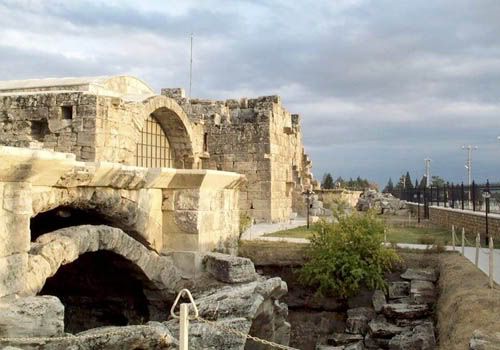
The Museum at Hierapolis where Philip lived,(The evangelist one of deacons chosen in acts not the Apostle). He provide a historical link to Jesus through Papias and the Apostle John.
The Philip Connection
Papias and The Daughters of Philip

Tomb of Philip at Hierapolis
Our understanding of Philip comes to us form four major soruces: Papias, Irenaius, Eusebius, and Polycrates. Papias (70?-155?) was Bishop of Hierapolis (in Phrygia, sort mid southwestern Turkey), where Philip lived. Papias knew the daughters of Philip after their father's time. What we know of him comes to us priarily form his student Irenaeus. Irenaeus is important as the connecting link not only to Philip but to Papias and Polycarp. Irenaeus is a major figure in the chain.
Papias and The Daughters of Philip
Papias had several important connections to the history of Jesus. He studied with his friend Polycarp and they both studied under the Apostle John. There is a controservy about weather it was the Apostel John or another John, I will deal with that on Papias own page. He lived in
Hierapolis where he was Bishop there was also Philip and his four virgin
daughters. The daughters of Philip were prophetesses, Paul is said to
have met them in Acts (8:5-40; 21:8-9.
), and Papias is said to have met them as well. Eusebius speaks of this
in the same passage that he speaks about Papias:
The residence of the Apostle Philip with his daughters in Hierapolis has been mentioned above. We must now point out how Papias,
who lived at the same time, relates that he had received a wonderful
narrative from the daughters of Philip. For he relates that a dead man
was raised to life in his day. He also mentions another miracle relating to Justus, surnamed Barsabas, how he swallowed a deadly poison, and received no harm, on account of the grace of the Lord.[6]
Polycrates testifies (AD 190) to existence of these daughters and their
burial and their father's burial at Hierapolis, "Philip of the twelve
apostles who sleeps in Hierapolis and his two druthers, elderly virgins,
and another of his daughters who after living in the Holy Spirit rests
in Ephesos."[7] William Tabbernee documents an inscription from
Hierapolis honoring a public figure which links the burial of Philip the
apostle with the monument in his honor, the "martyrium." It refers to
him as "the glorious Apostle and Theologian Philip.[8] Of
course there are problematic details in these accounts. Other accounts
give four daughters, Polycrates seems to only know of there. There is a
controversy as weather or not this Philip is the evangelist of Acts (one
of the first decons) or the Apostles, one of the twelve who traveld
with Jesus. No one really knows. In a famous debate between a Montanist
(Prokolos) and an Orthox (Gaius) reference is made to the four daughters
of Philip as having resided in that area and being burried there.[9] There is a possiblity that the tomb of Philip has been discovered:
Italian
professor Francesco D'Andria, the head of the excavation team at the
Hierapolis ancient city in Denizli, told reporters on Tuesday that
experts had reached the tomb of St. Philip whose name is mentioned in
the Bible as one of the 12 Apostles of Jesus.
Professor
D'Andria said archaeologists had been working for years to find the
tomb of the Biblical figure, and finally, they had managed to reach the
monument while working on the ruins of a newly-unearthed church in
Hierapolis.
D'Andria
said the structure of the tomb and the writings on it proved that it
belonged to St. Philip the Apostle, who is recognized as a martyr in the
history of Christianity.[10]
The Tomb is near the "martyrium" a structure put around the fifth
century to commemorate the death of Philip. The martyruim is probably
where he was crucified and the tomb where he was burred. Or it could
just be that they didn't put the monument over his tomb because a chruch
was there so they put it near by. It's not proof but it lends credence,
it at least establishes that the tradition starches back further toward
the actual event of his living there.
F.F. Bruce, an Evangelical Scholar, highly respected in all circles,
tells us: "Eusebius tells us on the authority of Papias and other early
writers that at a late date Philip's four prophetic daughters were famed
in the church for authorities in the history of its earliest days." [11] That's
probably exaggeration. As as been seen the only quotations I can find
by Eusebius about Philip and his daughters say nothing of the kind. He's
probalby basing that upon the miracle stories they told Papias. Yet
they do provide a more important link to Papias than has been observed
by scholars. These women have been overlooked, relegated to footnotes in
the questions about their father's identity. They must have been
important in their day, they show up in several sources even long after
they were gone (Polycrates wrote in 190 and the report of Gaius and
Prockleus was even latter). The site of their tombs was marked. They
were prophetesses and that gives a status. Even though tehy were
probalby weren't historians per se they surely did pass on stories about
the early days as Papias attest. They knew their father who around in
the early days of the faith. Even though the sources may have become
confused on points such as which Philip we are dealing with, in my view
it must be the evangelist [12] those are not big enough problems to lose the reality of Jesus as a real man in history.
All these connections provide a web of historicity. There are three
major trajectories along which the historical evidence is found: the
gospels (both canonical and extra canonical), the Pauline corpus, and
the apostolic fathers. These form interdependent links that make a big
web of historicity. Papias is linked to John or at least disciples of
the Lord such as Elder John, and he's also linked to the Pauline corpus
through his association with the daughters of Philip, who know Paul.
Through Philip he has another link to the early days of the chruch. We
have this big web all these groups of people that knew each other as we
go more deeply into it the inner circles come close to knowing Jesus.
Paul met several such as James and Peter who knew him intimately. He
also knew Andronicus and Junia who were around in the early days and
Priscilla and Aquila who were first followers of the Baptist. Irenaeus'
teacher Polycarp knew Papias and knew he was a follower of eye witness
disciples who saw Jesus. Yet how could it be that the core of the web
is fictional?
How absurd to think people in Jerusalem just a few years after the
disciples began preaching would say "my father never heard of this guy,
my grandfather never heard of him, his followers say he spoke to throngs
of people in the streets of Jerusalem they heralded him, they demanded
his release when he was captured but no one has heard of him, no one I
know has any memory of those events, I think I'll join his little band
of twelve guys."
You might ask how this ties into Jesus, both groups, Paul and his circle and Philip and his circle understood Jesus as a man in history. They all knew people that had seen him. They clealry told Paul about him and no doubt told Philip about him too. There's a a good chance Philip himself saw Jesus as he began his ministry in Jerusalem in the first days of the chruch.
fragments Papias writing form sources other than Eusebius.
http://www.chronicon.net/index.php/papias#Fragments
Sources on Eusbius
[1] "The Apostle Paul," Britannica Encyclopedia (1997) quoted on website "Was the Apostle Paul a Historical Person?" Kevin's Articles on Religion http://www.davnet.org/kevin/articles/paul.html aacessed 11/2/13.
[2] etherial library
[3] Gary
R. Habermas Originally published in Dialog: A Journal of Theology, Vol. 45; No. 3 (Fall, 2006), pp. 288-297; published by Blackwell Publishing, UK. on Experinces of Risen Jesus, Website http://www.garyhabermas.com/articles/dialog_rexperience/dialog_rexperiences.htm
accessed 11/2/13.
Hbermas fn
Michael Martin, The Case Against Christianity
(Philadelphia: Temple University, 1991), 81
[4] Ibid. also fn
[7]
Ulrich Wilckens, Resurrection:
Biblical Testimony to the Resurrection: An Historical Examination and
Explanation (Edinburgh: St. Andrew, 1977), 2.
[8] Joachim
Jeremias, "Easter: The
Earliest Tradition and the Earliest Interpretation," New Testament
Theology, trans. John Bowden (N.Y.: Scribner's, 1971), 306.
[9]
Walter Kaspar, Jesus the Christ, new ed.,
trans. V. Green (Mahweh: Paulist, 1976), 125.
[5] Helmutt Koester, Ancient Christian Gospels
[6] Eusebius, Oracles of the Lord op cit.
[7] William Tabbernee, Montanists Inscriptions and Testimonia:Epigraphic Sources Illustrating The History of Montanism.Macan Georgia: Mercer University Press 1997, 504
[8] Tabbernee, op cit 503.
[9] ibid, 505
[10] "Tomb of Philip The Apostle Discovered in Turkey?" News Network Archaeology. website URL:
http://archaeologynewsnetwork.blogspot.com/2011/07/tomb-of-philip-apostle-discovered-in.html#.UI6idmeZhTE
[11] FF Bruce, The New Testament Documents: Are they Reliable,published in USA by Wb Erdeman's Publishing company and Invervarsity press, originally published 1943, 1981 , p.43)
[12] The same quote by Papias about how he always tried to get word from
those who had been with the elders, names Philip the Apostle among
them. If he lived in Herapolis Papias would hardly need to learn his
words form travelers coming in from elsewhere.
Subscribe to:
Posts (Atom)