Monday, April 01, 2019

The Transcendental Signifier Argument for God


Image result for metaphysical hierarchy

Gustave Dore's illustration of Divine Comedy


Thesis: Mind is the missing dimension that makes sense out of the TS, and TS plus mind = God

the Argument:

1. Any rational, coherent, and meaningful view of the universe must of necessity presuppose organizing principles (Ops)
2. OP's are summed up in TS
3. Modern Thought rejects TS outright or takes out all aspects of mind.
4. Therefore, Modern thought fails to provide a rational, coherent, and meaningful view of the universe.
5. minds organize and communicate meaning

6. Therefore universal mind, offers the best understanding of TS

7. Concept of God unites TS with universal mind therefore offers best explanation
for a view that is Rational, Coherent, and Meaningful (RCM).

Defending the premises of the argument

(1) Any rational, coherent, and meaningful view of the universe must of necessity presuppose organizing principles (Ops)
OP 's make sense of the universe and explain hierarchies of conceptualization: effects need causes, conclusions are mandated by premises, meaning in language is organized by rules of grammar. (RCM (rational, coherent, and meaningful) = Hierarchical order).This premise is rooted directly in observation, a coherent view of the universe requires OPs, and observation. That a rational and coherent view requires a principle that organizes reality according to some aspect of logic or math should be obvious. That's really no different than saying to really understand things we need a logical coherent view. At this point the skeptic might assume that the argument is a design argument or that it is saying that “laws imply a law giver.” Jerome E. Bickenbach and Jackqueline M. Davis tell us that the argument “laws require a law giver” is the fallacy of equivocation.[1] Right they are, since scientists don't mean the term “laws” in the sense that early modern scientists such as Newton and Boyle meant it. They really meant a divine command that the universe must behave in a certain way. The term “law” is a hold-over from a former age. “The laws of physics, and other scientifically discovered laws of nature are principles formulated by scientists (not prescribed by lawmakers) in order to describe regularities and patterns observed in the natural world...while there may be a God this is not shown by taking the existence of laws of nature as evidence.”[2] Whether or not physical laws are evidence of God remains to be seen, but this argument is neither design nor laws imply a law-giver. First, it's not a design argument to the extent that the inference is not drawn from design per se. Design works through either fitness, function, or the resemblance to things we know are designed. Since it does turn upon order there is overlap with design, especially the latter kind (resemblance to known design). Yet the point of inference is not taken from resemblance to known design but to the all pervasive nature of necessary to contingent order.
Secondly, the argument is not based upon the assumption laws imply a law giver. That idea assumes that physical laws are a simple list of rules mandated by a God. That concept of God is based upon the Suzerain model. The argument does not assume a set of rules but a more organic relation. The point of inference does not turn upon a set but upon one central, simple, and elegant idea that frames and grounds the metaphysical hierarchy in a single all-encumpasing first principle. Since I don't assume that scientists speak of “laws of physics” in the same way we speak of “laws of traffic” or The U.S, Code Annotated, or Black's Law Dictionary, then there is no fallacy of equivocation. How I connect physical “law” to a prescriptive sense without reducing description to prescription will be dealt with in chapter four.
Above I point to grammar as an example of a TS. The skeptic might argue that grammar is just cultural, that would be wrong. First of all it doesn't have to be innate to be an example. If language is just cultural constructs ideas might still be formed in their function from logical necessity (not the actual signifiers themselves but the concepts to which they point). An example would be the logical rule A cannot be non A. That is not arbitrary, but self evident. A thing cannot be other than itself. Thus the logical law marks the fact as a road map marks geography, but like a map the two might not always line up. In that case, if grammar is a purely cultural construct, its still an example of hierarchical conceptualization. Secondly, there is a lot of good evidence that generative grammar is genetic. Children of one month old can distinguish between different phonemes in a language, such as “b” and “p.” Researchers know this by reaction of the infant to the sound. A phoneme is a unit of sound in a word. Two such studies are one by Kuhl and one by Scott, et al.[3] More on this in a subsequent chapter.
Western thought has always assumed Organizing principles that are summed up in a single first principle (an ἀρχή) which grounds any sort of meaning: the logos or the transcendental signified (TS). When I have made this argument skeptics have argued that there is nothing in science called an “organizing principle.” One opponent in particular who was a physicist was particularly exercised about my use of this term. While there is no formal term such that scientists speak of the “organizing principles” along side laws of physics or Newtonian laws, they speak of organizing principles all the time. A google search resulted in 320,000,000 results.[4] On every page of this search we see articles by cell biologists, cancer researchers, environmental biologists. Mathematicians, physicists, and so on. Yes there are also articles by crack pots, new age mystics, people with all kinds of ideas. There is even a book by a physicist who argues that the scientific thinking of the poet and dramatist Johann Wolfgang Goethe is valid in modern terms of quantum theory. He talked about organizing principles.[5] An Article in Nature entitled “Organizing principles” discusses a famous experiment in developmental biology: in 1924 carried out by Hilde Mangold, a Ph.D. student in the laboratory of Hans Spemann in Freiburg. “It provided the first unambiguous evidence that cell and tissue fate can be determined by signals received from other cells…This experiment therefore demonstrated the existence of an organizer that instructs both neuralization and dorsalization, and showed that cells can adopt their developmental fate according to their position when instructed by other cells.”[6]
M.J. Bissell et. al. Discuss malignancy in breast cancer. “A considerable body of evidence now shows that cell-cell and cell-extracellular matrix (ECM) interactions are essential organizing principles that help define the nature of the tissue context, and play a crucial role in regulating homeostasis and tissue specificity.”[7] All objects in nature are connected to other objects. This can be demonstrated easily enough, as William Graham makes clear in discussing “Natures Organizing Principles.”[8]  He turns to ecosystems as an example. Fish in a school work by individually possessed set of common principles such that they act in unison without a leader. These are not evidences of God they are not a design argument. They merely serve to bring home the point there are organizing principles about. I know this general informal use of the term does not mean that the Ops I want to talk about exist. But it is clear there are plenty of structures that organize and guide the way things turn out we do not have an understanding of what organizes the OP. Yet modern science still seeks a logos or a TS that would bind them all together and unite them in one over arching principle.
A skeptic could argue that there are self organizing structures in nature. The self organizing structure supposedly doesn't require an outside source to exist, that would defeat the principle of the necessity of organizing principles. Self organizing systems do exist, although they may not be truly self organizing. A self organizing system is one in which the organization is decentralized or distributed throughout the system. Examples include crystallization (snow flakes), swarms of bees or birds, or neural networks. There are two problems with trying to use self organizing against OP's. First, there are contradictions within the concept. self organizing is part of dynamic structures, but dynamic laws operate locally. They can't produce large structures (like a universe).[9]ix Moreover,

Extending the familiar notion of algorithmic complexity into the context of dynamical systems, we obtain a notion of “dynamical complexity”. A simple theorem then shows that only objects of very low dynamical complexity can self organize, so that living organisms must be of low dynamical complexity. On the other hand, symmetry considerations suggest that living organisms are highly complex, relative to the dynamical laws, due to their large size and high degree of irregularity.[10]
Secondly, the term itself (“self organizing”) is a misnomer. Systems are not organizing themselves, they are being organized by physical laws and properties. As the Johns article points out self organizing systems are limited by “dynamical laws,” thus the prior conditions under which the system emerged (physical laws) is a limit on the system. An example of physical laws limiting self organizing is entropy.[11]  The Gershen and Heylighen article shows that according to the second law of thermodynamics entropy in an isolated system can only decrease, thus, “[self organizing] systems cannot be isolated: they require a constant input of matter or energy with low entropy, getting rid of the internally generated entropy through the output of heat('dissipation')..”[12]  John Collier finds that, “Self-organization requires an entropy gradient that is external. But this need contain no further organization...”[13]  He goes on to say that new “selves” can emerge within the system but as stated above it does depend upon external forces. The article deals with self organizing systems and questions of identity. He defines self organizing as “a process by which larger scale (macro) order is formed in a system through the promotion of fluctuations at a smaller (micro) scale via processes inherent in the system dynamics, modulated by interactions between the system and its surroundings..”[14] Apparently even his definition of the process defeats the argument that self organizing is indicative of some kind of emergence from true nothingness. Some of the questions he explores include:

1) What is the self that organizes ? 2) Why is it a self ? 3) What is it for a process to be inherent to the system dynamics ? 4) What does it mean for interactions with the surroundings to modulate rather than determine or control ? Maturana holds that there are no satisfactory answers to the first two of these questions, if for no other reason than that the self that supposedly organizes does not exist at the onset of organization. Self-organization appears to require a sort of lifting oneself by the bootstraps without having even boots at the beginning. Self-organization thus appears to be an oxymoron, or at least a misnomer. Autopoiesis is a self-producing process that presupposes an organized self (Maturana and Varela, 1992 : 43ff[15]). [16]
Collier finds that Maturana and Varele are wrong, Autopoiesis does not explain the process of self organizing. The “new self” that emerges is changed enough to deserve the name self organizing, but it is not a process whereby a self creates itself apart from external forces. Of course we need not think of God interacting with new entities as each new process comes up. Clearly there is a law-like regularity that must be set up in advance of the effects it produces. We explore that law-like regularity in chapter four (are laws of physics descriptive or prescriptive?). Suffice to say self organizing systems do not negate the necessity of a TS.
A skeptic who is a physicist pointed out to me that science doesn't recognize anything called an “organizing principle.” Yes it does, they just don't call it that. Sometimes they are called “laws of physics,” or “natural laws.” But the concept is not limited to laws. There is an organizing principle grounding and influencing anything organized. Alphabetical listings, political ideas against or for which the group needs to be organized, necessity and contingency, any principle which forms the basis for organizing something, but science recognizes this too. They are also called “causes.”


(2) OPs summed up in TS


Op's can be categorized and understood in relation to a few key principles that describe their relation to each other, such as mathematics, language, thought, culminating in one overarching first principle or ἀρχή (are-kay) that makes sense of it all. Just reason might be said to make sense of thought. TS's are first principes and they vie for status each one as the first principle (TSED).
I've already discussed the logos of the Greeks and the use made of that concept in various ways. Kant's categories and abstract principles that regulate our understanding of everything, which corresponds to Ops to some extent or perhaps transcendental signifiers. I spoke of Paul Davies and his assertion that laws of physics have replaced God in the works of modern physicists, and in his own ideal along those lines as well. There's another aspects in which modern physics sees a TS. In principle this concept of a single elegant idea that explains everything is what science has been working toward for years. John Horgan says of Steven Weinberg, “In his 1993 book Dreams of a Final Theory, he extolled particle physics as the culmination of 'the ancient search for those principles that cannot be explained in terms of deeper principles.' He predicted that 'the convergence of explanations down to simpler and simpler principles will eventually come to an end in a final theory.'”[17]  A skeptic might question the scientific veracity or the idea of a single principle that reveals explanations built into the logical structure of nature. Yet in Dreams of a Final Theory, Weinberg tells us, “this is what our science is about: the discovery of explanations built into the logical structure of nature.”[18] David Deutsch a quantum physicist at Oxford produced a constructor theory that is a framework that unites all physical theories and eliminates the impossible in hopes of finding the basic principle that explains it all.[19] The concept of uniting theories and the meta law are organizing principles. The meta-law is a transcendental signifier, so where is the TS? That's the reality in the real world that these theories point to. The physicists are talking about things like gravity. The ideas in their minds that point to the TS are impersonal forces of nature; that single structure might well point to God and the physicists would have no way of knowing it or ruling it out. We have a couple of ways. One of them is to follow the logic of the argument. Clearly the premises are not ruled out by physics.
I have used TS and OP in a seemingly interchangeable way and this may lead one to ask “which is it?” TS is a form of OP. I usually use OP in speaking of ideas that are known to be either naturalistic, or if constructed, the notion of something no one disputes. The latter might be bigotry (most people agree it exists), or that of freedom. The former might be a more easily demonstrated idea such as cause and effect. TS is more theoretical and might be metaphysical such as justice, or the absolute soul, God, or the Buddha mind. TS is an organizing principle but I tend to use the term of more theoretical ideas, or ideas not as easily demonstrated to which some may or may not give ascent. If there is an actual TS, it organizes the organizers, the OP's. The TS tends to be the next wrung up in the metaphysical hierarchy; yet since TS organizes it is an OP.
The TS is necessary and cannot be abandoned. Even attempts to abandon it result in the adoption of new Transcendental signifiers that refer to to the perennial concept of the ultimate first principle. One example of this replacement theory is that of Derrida trying to break down ethics, the attempt leads to the establishment of a new TS for ethical paradigm, i.e., “differance.”[20] The goal of difference as the answer to hierarchy and becomes the new principle around which the ethical paradigm is structured. An example of imposing a new OP in science would be the paradigm shift. An example of imposing a new TS is the atheist abolishing God talk from her vocabulary and putting science in its place. Or Marx with the same motivation makes ideology his version of God or the TSED, the top of the metaphysical hierarchy.
Finally, TS as a term stands for the top of the metaphysical hierarchy. The actual thing at the top itself is the TSED, the object of belief to which all TS's point. In other words as transcendental signifiers point to one reality at the top, the transcendental signified. so any given transcendental signifier might be wrong, but there has to be a Transcendental Signified. The words that describe the reality may very but there is a reality there. That which is all pervasive and mutually exclusive is not necessarily part of the definition but it flows out of the nature of being the top of the metaphysical hierarchy. It is clear that for some examples of the TS it is exclusive, such as “God.”
We can understand this tendency of all OP's to be summed up in and explained by the TS as hierarchical ordering, This is what I call “metaphysical hierarchy,” the TS functions as the top of the Metaphysical hierarchy. This forms a major part of the argument because the TS is the best explanation for the hierarchy.


Notes

[1] Jerome E. Bickenbach and Jackqueline M. Davis, Good Reasons for Better Arguments: An Introduction To The Sills and Values of Critical Thinking. Calgary: Broadview Press, 1996, 189.
[2] Ibid.
[3] Patricia Kuhl, “Early Language Acquisition: Cacking the Speech Code.” Nature reviews Neuroscience 5, (Nov. 2004) 831-843, doi:10.1038/nrn1533.
Institute for Learning and Brain Sciences and the Department of Speech and Hearing Sciences, University of Washington, Seattle, Washington 98195, USA.
Email: pkkuhl@u.washington.edu
See also: Sophie K Scott et al, “Categorical speech representation in human superior temporal gyrus. Is Categorical perception a fundamental property of speech perception?" Nature Neuroscience,(2010). 13: 1428-1432.
[4] Google search, organizing principles in nature, https://www.google.com/#q=organizing+principles+in+nature accessed 5/3/16
[5] Henri Bortoft, Wholeness of Nature of The Universe: Goethe’s Way Toward a Science of Conscious Participation in nature. Herdon VA:Lindisfarne Books originally published by Steiner Books,1971, 1985, re worked version 1992, 69.
Henri Bortoft, (1938 – 29 December 2012) received undergraduate degree at university of Hull then did Postgraduate research at Beirbeck college. He studiedQuantum Physics with David Bohm.
[6] Barbara Marte, “Milstone 1: Organizing Principles,” Nature.Org (july 1,2004) doi:10.1038/nrn1449
Marte is senior editor Nature.
[7] M.J. Bissell, D.C Radisky, and A. Rizki, “The Organizing Principle:Microenvironmental Influences In The Normal amd Malignant Breast.” Pub Med, NCB, Dec;70(9-10): 2002, 537-46. on line resource URL: http://www.ncbi.nlm.nih.gov/pubmed/12492495 accessed 6:3/16
[8] William Graham, “Natures Organization Principles,” Nature’s Tangled Web: The Art, Soul, and Science of a Connected Nature. Oct. 30, 2012, Online resource. http://www.freshvista.com/2012/natures-organizing-principles/ accessed 6/3/16.
[9] Richard Johns, “”Self Organizations in Dynamical Systems,” Synthese, Volume 181, issue 2,( July, 2011) 255-275
Johns is in the Dpartment of Philosophy, University British Columbia.
[10] Ibid.
[11] Ibid., 258.
[12] Carlos Gershen and Francis Heylighen, “When Can We Call A System Self Organizing?” Advances in Artificial Life, Berlin Heidelberg: Springer, Volume 2801 of the series Lecture Notes in Computer Science 2003,
Gershen is from Mexico, he earned his Ph.D. from University of Burssels in interdisciplinary studies. He studies self organizing systems.
[13] John Collier, “Self Organization, Individuation, and Identity,” Revue Internationale De Philosophie, 2004/2 (n 228) 151-172, 172.
John Collier is a philosopher at University of Natal. The University of Natalis in Durbin South Africa, it has now become The University of Kwazulu-Natal. Collier is from Canada, he has taught at MIT and published extensively on self organizing systems.
[14]  Ibid., 151.
[15]   Huberto R. Maturana and Francisco J. Varele, The Tree of Knowledge: The Biological Roots of Human Understanding. Boston: Sambhala,, 43ff.
[16]  Collier, “Self Organization...” op. cit.
[17]  John Horgan, “Nobel Laureate Steven Weinberg Still dreams of a final Theory,” Scientific American, (May 1, 2015) Graham isa marine biologist.
John Horgan was staff writter, A teacher at Stevens Institute of Technology, Horgan is the author of four books, including The End of Science, 1996, re-published with new preface 2015; and The End of War, 2012, paperback published 2014.
[18]  Steven Weinberg, Dreams of a Final Theory: Scientists Search For the Ultimate Laws of Nature. New York: Vintage, reprint edition, 1994, 10.
[19]  Zeeya Merali, ”A Meta-law to rule them all: Physicists Devise a Theory of Everything.” Scientific American, (May 26, 2014) online rfesource URL http://www.scientificamerican.com/article/a-meta-law-to-rule-them-all-physicists-devise-a-theory-of-everything/ accessed 9/20/15.
[20]  Derrida misspells “difference” for special reasons dealing with his theory “deconstruction.” Se chapter three on “the Derridian Background of the Argument.


Wednesday, March 27, 2019

GDSB: Prolegomena part 2


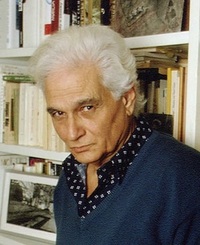
Image result for derrida
Jacques Derrida (1930-2004)


I will actually start making the argument on Monday


Jacques Derrida (1930-2004) is perhaps the closest thing to the major voice of postmodernism. If we were to try to sum up in one sentence a single idea emblematic of postmodernism we could not do better than to say postmodernism is the view that three are no meta narratives. Derrida, working in the philosophical heritage of Edmomnd Husseral. “Given this ontological critique, which Derrida claims pervades all of western philosophy, Derrida asserts a sort of post-metaphysical, post-foundational, perspective of reality that is not so much a new philosophy, but rather one that no longer naively accepts the arbitrary metaphysical claims of western thought.”[1]  Derrida holds that western thought has always assumed a logos, or a transcendental signified. “For essential reasons the unity of all that allows itself to be attempted today through the most diverse concepts of science and of writing, is in principle, more or less covertly, yet always, determined by an historico-metaphysical epoch of which we merely glimpse the closure.”[2]
Rather than seeking to destroy all truth he seeks to show that the modern metaphysical referents to which the assumptions of logos pertain are inherently problematic.

To explain the meaning of the transcendental signified with reference to the article itself as well as my previous understanding of this concept, I can say that Derrida assumes that the entire history of Western metaphysics from Plato to the present is founded on a classic, fundamental error. This error is searching for a transcendental signified, an “ external point of reference” ( like God, religion, reason, science….) upon which one may build a concept or philosophy. This transcendental signified would provide the ultimate meaning and would be the origin of origins. This transcendental signified is centered in the process of interpretation and whatever else is decentered. To Derrida THIS IS A GREAT ERROR because... 1. There is no ultimate truth or a unifying element in universe, and thus no ultimate reality (including whatever transcendental signified). What is left is only difference. 2. Any text, in the light of this fact, has almost an infinite number of possible interpretations, and there is no assumed one signified meaning.[3]
For Derrida, as with Davies, there is nothing outside of the realm of signifier that we can latch onto and pull ourselves out of the quagmire of signs and signification. There is no touchstone of meaning outside of that realm because all meaning is based upon the shifting sands of signifier and differance.[4] So modern though is between a rock and a hard place. We are either trapped in the world of signification where meaning is arbitrary and always differed to the next signifier which is also arbitrary, or we are stuck in the Cul-de-Sac of scientific reductionism.
Jacob Gabriel Hale asserts that Cornelius Van Til (1895-1987) has the answer. Van Til was a Philosopher and Reformed Theologian best known for the transcendental Argument for God (TAG).[5] Hale compares Derrida to Van Til. Both understand modern thought to be trapped in the same dead end seeking a logos but unable to connect with it. While Derridia's answer is to give up on logos and tear down hierarchies and be stuck like a character in a Becket play, Van Til understands God as the true presupposition to logic.[6] Thus Van Til fills in the blank of the logos with the Christian Logos. The Christian intellectual tradition has always regarded God as the basis of logic probably going back to the Greeks and their idea of logos. It's a concept very reminiscent of St. Augustine in his association of God with truth.
Augustine expresses the concept of the super-essential Godhead many times and in many ways. Augustine was a Platonist. In that regard perhaps his greatest innovation was to place the Platonic forms in the mind of God. That is a major innovation because it trumps the Neo-Platonistic following after Plotinus, who conceived of a form of the forms. In Augustinian understanding the equivalent of the “the one” the form that holds all other forms within itself is the mind of God. Augustine never made an argument for the existence of God because for him God was known with certainty and immediacy. God is immediately discerned in the apprehension of truth, thus need not be “proved.” God is the basis of all truth, and therefore, cannot be the object of questioning about truth, since God is he medium through which other truths can be known.[7] Paul Tillich reflects upon Augustine’s concept:

Augustine, after he had experienced all the implications of ancient skepticism, gave a classical answer to the problem of the two absolutes: they coincide in the nature of truth. Veritas is presupposed in ever philosophical argument; and veritas is God. You cannot deny truth as such because you could do it only in the name of truth, thus establishing truth. And if you establish truth you affirm God. “Where I have found the truth there I have found my God, the truth itself,” Augustine says. The question of the two Ultimates is solved in such a way that the religious Ultimate is presupposed in every philosophical question, including the question of God. God is the presupposition of the question of God. This is the ontological solution of the problem of the philosophy of religion. God can never be reached if he is the object of a question and not its basis.
Augustine says God is truth. He doesn’t so much say God is being as he says God is truth. But to say this in this way is actually in line with the general theme we have been discussing, the one I call “super-essential Godhead,” or Tillich’s existential ontology. Augustine puts the emphasis upon God’s name as love, not being. Since he was a neo Platonist he thought of true reality as beyond being and thus he thought of God as “beyond being.” This makes no sense in a modern setting since for us “to be” is reality, and to not be part of being would meaning being unreal. But in the platonic context, true reality was beyond this level of reality and what we think of as “our reality” or “our world” is only a plane reflection of the true reality. We are creatures of a refection in a mud puddle and the thing reflected that is totally removed from our being is the true reality. It was this distinction Tillich tried to preserve by distinguishing between being and existence.[8] 


Augustine looked to the same passage in Exodus that Gilson quotes in connection with Aquinas. Augustine’s conclusions are much the same about that phrase “I am that I am.” This is one of his key reasons for his identification between God and truth. He saw the nature of God’s timeless being as a key also to identifying God with truth. The link between God and truth is the Platonic “one.” Augustine puts the forms in the mind of God, so God becomes the forms really. The basis of this identification is partly God’s eternal nature. From that point on it’s all an easy identification between eternal verities, such as truth, eternal being, beauty, the one, and God. The other half of the equation is God’s revelation of himself as eternal and necessary through the phrase, for very similar reasons to those listed already by Gilson, between I am that I am and being itself (or in Augustine’s case the transcended of being). “He answers, disclosing himself to creature as Creator, as God to man, as Immortal to mortal, eternal to a thing of time he answers ‘I am who I am.’”[9]


Problems with TAG


I am about to present am argument that also uses the term “transcendental.” Both arguments argue for belief in God. The difference being that TAG proceeds from presuppositional apologetics, while my argument is made on an evidential basis. Both assume that God is at the basis of all knowledge and meaning. This is what is meant by “transcendental,” it refers to the basis of the system of thought. My argument uses the TS as an evidential basis for belief while the presupositional argument merely assumes the truth of the argument then rejects the presuppositions of other views. TAG says nothing about signifier. To understand the insufficiency of TAG (thus they need for a new argument) we must examine TAG more closely. Greg Bahnsen was the champion of TAG[10]. Van Til never really makes the argument, never actually states it.[11] TAG is basically just the assumptions of Van Til's presupositional approach, he wants to scratch starting from a point of neutrality and trying to prove truth and asserting the presuppositions we believe: “ He maintained that because God, speaking in his word, is the ultimate epistemological starting point, there is no way of arguing for the faith on the basis of something other than the faith itself.  God's authority is ultimate and thus self-attesting.”[12]  That is really the basis of TAG. The problem is he never bothers to prove it. That is an instant turn off for most atheists, and since he never states the argument clearly, it's not real clear what it is. I like the idea of not being stuck with a phony neutrality because most atheists, at least new atheists lionize their assumptions, at least in my experience those I've dealt with tend to do that. I don't seek to argue for total proof but rational warrant for belief. This argument I will present in terms of the best explanation.
I think the approach I'm taking will offer a couple of things that Van Til doesn't. First, In dealing with Derrida’s world of signifiers and it's concept of the TS we are in a better position to insist that God is the presupposition, because all the Derridians agree Western metaphysics accepts TS and that is basically another version of God. So the difficulty in getting the secular thinker to accept the premise that God is the presupposition is not as great a gap to cover if we can start out assuming the tradition affirms a God-like premise in a logos anyway. Secondly, I don't think Van Til get's us out of the closed in world of his presuppositions. He asserts that the Triune deity is the presupposition to all logic, truth, and meaning but why would an unbeliever assume it? If my argument is successful it should become apparent that God is the best explanation.
Modern secular thought can't make the leap outside itself to find God because it either rejects God or uses itself as the standard of truth. Of course this is inadequate because that is the problem in the first place. God is truth but that's not obvious because it's too transparent, we are too close to the reality. St. Augustine made an argument that might be considered transcendental in that it assumes God as the presupposition to truth. Paul Tillich summarizes this argument:

Augustine, after he had experienced all the implications of ancient skepticism, gave a classical answer to the problem of the two absolutes: they coincide in the nature of truth. Veritas is presupposed in every philosophical argument; and veritas is God. You cannot deny truth as such because you could do it only in the name of truth, thus establishing truth. And if you establish truth you affirm God. “Where I have found the truth there I have found my God, the truth itself,” Augustine says. The question of the two Ultimates is solved in such a way that the religious Ultimate is presupposed in every philosophical question, including the question of God. God is the presupposition of the question of God. This is the ontological solution of the problem of the philosophy of religion. God can never be reached if he is the object of a question and not its basis.[13]

One might ask why, if God is so basic to be synonymous with truth we can't all recognize it? That is the reason, it's so basic. So it is with being, we write it off as “just what is” and go on looking for this “God” who can’t be found because we don’t understand he’s nearer than our inmost being. Such is the pitfall of scientific empiricism. The point of course is that God is too basic to our being, too much a part of the existence we share that we don't see any indications of presence. We take for granted the aspects of being that indicate God's reality. Some of the indications might be physical or cosmological, such as fine tuning or modal necessity. Others are experiential. The atheists pointed out that water is physical and can be detected. It's only an analogy and all analogies break down at some point. Analogies are not proofs anyway. I don't offer this as proof but as a clarification of a concept. In so clarifying we find a link to being; the connection between God and Being itself.
Heidegger approaches being in this manner, it is ready-to-hand, too basic to notice. In other words like a carpenter using tools we find being so inherently part of our experience, so ready-to-hand that we don't notice it. Paul Tillich worked in the vain of Heidegger, he used the philosopher to translate classic Christian theology into modern thought. In that vain we are too close to being, it's too fundamental to what we are to realize that our place in it is to be contingencies based upon the reality of God. God is also "detectable" but of course, not in the sense that physical objects are. Like a fish in water, being is the medium in which we exist. Given certain assumptions we can understand the correlation between experience of presence and the nature of eternal necessary being. When we experience the reality of God through the presence of holiness we experience the nature of being as eternal and necessary. All we need to do is realize the necessary aspect of being to realize the reality of God. This is why Tillich says:

The name of infinite and inexhaustible depth and ground of our being is God. That depth is what the word God means. And if that word has not much meaning for you, translate it, and speak of the depths of your life, of the source of your being, of your ultimate concern, of what you take seriously without any reservation. Perhaps, in order to do so, you must forget everything traditional that you have learned about God, perhaps even that word itself. For if you know that God means depth, you know much about Him. You cannot then call yourself an atheist or unbeliever. For you cannot think or say: Life has no depth! Life itself is shallow. Being itself is surface only. If you could say this in complete seriousness, you would be an atheist; but otherwise you are not."[14] 
"Depth of being" and being itself are synonymous. Depth just means that there's more to being than appears on the surface. The surface is the most obvious aspect, that things exist. The existence of any given thing is the surface level. If we go deeper to probe the nature of being that entails the realization of the eternal necessary aspect of being and thus being has depth. Then we realize our own contingent nature and thus, we are at one and the same time realizing the reality of God (that is after all the basis of the cosmological argument and the ontological argument as well. This is why God seems to be hidden. God is not hiding himself. According to Hartshorne, "only God can be so universally important that no subject can ever wholly fail or ever have failed to be aware of him (in however dim or UN-reflective fashion)."[15]  Now the issue of why God doesn't hold a "press conference" has do do with the fact that God does not communicate by violating normal causal principles. In process terms, the "communication" of God must be understood as the prehension of God by human beings. A "prehension" is the response of an occasion to the entire past world (both the contiguous past and the remote past.) As God is in every occasion's past actual world, every occasion must "prehend" or take account of God.
It should be noted that "prehension" is a generic mode of perception that does not necessarily entail consciousness or sensory experience. There a two modes of pure perception --"perception in the mode of causal efficacy" and "perception in the mode of presentational immediacy." If God is present to us, then it is in the presensory perceptual mode of causal efficacy as opposed to the sensory and conscious perceptual mode of presentational immediacy.[16] That is why God is "invisible", i.e. invisible to sense perception. The foundation for experience of God lies in the nonsesnory non conscious mode of prehension. So now, there is the further question: Why is there variability in our experience of God?. Or, why are some of us atheists, pantheists, theists, etc.? Every prehension has an initial datum derived from God, yet there are a multiplicity of ways in which this datum is prehended from diverse perspectives.
I agreed with Hume that sense perception tells us nothing about efficient causation (or final causation for that matter). Hume was actually presupposing causal efficacy in his attempt to deny it (i.e., in his relating sense impressions to awareness).[17] Causation could be described as an element of experience, but as Whitehead explains, this experience is not sensory experience. From Hume's own analysis Whitehead derives at least two forms of non-sensory perception: the perception of our own body and the non-sensory perception of one's past.
But this is at an unconscious level. However, in some people, this direct prehension of the "Holy" rises to the level of conscious experience. We generally call theses people "mystics". Now, the reason why a few people are conscious of God is not the result of God violating causal principle; some people are just able to conform to God's initial datum in greater degree than other people can. I don't think that God chooses to make himself consciously known to some and not to others. That would make God an elitist. Now, the question as to why I am a theist as opposed to an atheist does have to do with me experiencing some exceptional religious or mystical experience; it does not have to do with amazing experiences that prove. Rather, I believe that these extraordinary experiences of the great religious leaders are genuine and that they do conform to the ultimate nature of things. It's not necessarily a "blind leap" of faith, as my religious beliefs are accepted, in part, on the basis of whether or not they illuminate my experience of reality.
The experience of no one single witness is the "the final proof," but the fact that there are millions of witnesses who, in differing levels from the generally intuitive to the mystical, experience must be the same thing in terms of general religious belief, the argument is simply that God interacts on a “human heart” (deep psychological) level, and the experiences of those who witness such interaction is strong evidence for that conclusion. This does not, however, remove the usefulness of deductive argument. The argument could be made as an inductive argument based upon religious experiences, yet with greater uncertainty. While deductive veracity is assurance of the truth of a statement, that assumes the premises are true, that's hard to establish with no basis in the empirical. that's hard to do if one finds it hard to believe that deduction can prove God we don't need to argue that. It can establish a rational warrant. For example we can't prove by observation weather the moon was a fragment of Earth or a captured meteorite, until we invent time travel we can't know empirically but we deduce a theory that makes sense. We might never know with certainty but we can have an indication that makes sense. So with deductive argument and God belief. Deductive argument can give us rational warrant for belief. The difference in warrant and proof is the difference in really knowing how the moon came to be and reaching a rational conclusion based upon deductive reasoning. One might ask “where does warrant get us in terms of belief in God?” It doesn't prove but may clear away the clutter so that we can come to terms with God on an existential level.


[1] Jacob Gabriel Hale, “Derrida. Van Til, And the Metaphysics of Postmodernism,” Reformed Perspectives Magazine, Volume 6, number 19 (Junje 30 to July 6, 2004) Third Medellin Ministries, on line Resource URL
[2] Jaques Derrida, The End of the Book and the Beginning of Writing, New York: Harcourt, Brace, Jovonovitch, trans. Gayatri Spivak 1967 in Contemporary Critical Theory, ed. Dan Latimer, 1989, p.166
[3] Ayman Elhallaq. “Tramscemdemtal; Signiofioed as the basis of Deconstruction theory,” Literary Theory in Class,
[4] Hale, op cit,
Derrida intentionally spells “difference” with an “a” to remind the reader that the meaning signifier is not based upon an essential correspondence between signifier and signified but is arbitrary and meaning is always referenced by another word that is itself arbitrary. His overall point is that there is no ultimate meaning,
[5] Michael R. Butler.“The Transcendental Argument for God's Existence,” online resourse, URL:http://butler-harris.org/tag/, viewed 7/3/15.
Mike Butler is Professor of Philosophy and Dean of Faculty at Christ College, Lynchburg, Virginia.
[6] Ibid
[7] Donald Keef, Thomism and the Ontological Theology: A Comparison of Systems. Leiden, Netherlands: E.J. Brill, 1971,140.
[8] Paul Tillich, Theology of Culture, New York: Oxford University press,1964 12-13.
[9] Carl Avren Levenson, John Westphal, editors, Reality: Readings in Phlosophy. Indianapolis, Indiana:Hackett Pulbishing company, inc. 1994, 54
“…St. Augustine’s view that God is being itself is based partly upon Platonism (“God is
that which truly is” and partly on the Bible—“I am that I am”). The transcendence of time as a condition of full reality is a central theme…[in Augustine’s work].”

[10] Greg L. Bhansen. Pushing the Antithesis, Powder Springs, Georgia: American Vision Inc. 2007Ibid., 6-7
[11] Gordon H. Clark, in Nash, op cit 301.
original, Gordon H. Clark, "Apologetics," Contemporary Evangelical Thought (Carl F. H. Henry, ed.),140.
[12] Butler, op.cit.
[13] Paul Tillich, Theology of Culture, London, op cit
[14] Paul Tillich. The Shaking of the Foundations. Eugene Oregon: Wipf and Stock Publishers, 2012, 57.
[15] Charles Harthorne, The Divine Relativity: A Social Conception of God, New Haven: Yale University press, 1982, 70.
[16] Jon Mills. “Harthorne's Unconscious Ontology,” oneline,URL: http://www.processpsychology.com/new-articles/Whitehead.htm accessed,7/3/15.
[17] This is common knowledge of Hume's take on causality that we don't see causes at work. This is the pojnt of the billiard balls.