Monday, January 11, 2016

Answeing Jeff Lowder, part 1: Demograsphics of Salvation

 photo buddhism_zps211fbce0.jpg


When I was a kid growing up in the Church of Christ in Dallas Texas I was always told you have to follow Jesus and be a Christian to be saved. That meant being baptized (which entailed total immersion in water) and it had to be in a Church of Christ, or you would go to hell. Even as a small child I would ask "what about the people born in China who never hear of the Church of Christ, would they go to hell? That issue alarmed me as early as I can remember. When that issue came up they would say "God is merciful he will take that into account." That's what we want ot hear. I still always wondered if it meant he would really let them off the hook. They weren't willing to thin it through to that extent. Still, when I went back to God and was born again at age3v23, after having been an atheist for about seven or eight years that seed was there and has formed the foundation if my adult apologetic and theological answer. Now the guys at the Secular Outpost have an argument (ala Jeff Lowder) [1] it's really against William Lane Craig,' in the comment section the troops are all enthused. They think they have a dynamite argument Christians can't answer. I think I did answer it but they just aren't listening. So I'm going to have to spell it out. The argument is not exactly about this issue but it does have a bearing. I think my answer to the issue also answers Lowder's argument.


The demographic aspects are not very prominent, they made more of a splash in the comment section. I still find it more logical to deal with that stuff first. The major part of the article is about are there sincere seeking  people who never accept Jesus but aren't resisting the Gospel. Of course most Christians say there are no true atheists. So everyone kno0ws at some level there's a
god amd they just resisting. Atheists of course claim otherwise and are offended by the idea that they are lying or self deluded. Before I deal with that it makes more sense to me to deal with the question "what happens to people who die never having had a chance to hear of Jesus?" I am going to do the wired thing and deal with that issue first then in part 2 deal with the main brunt of the article. Lowder mentions the possibility of isolated non Christians and their eternal fate as a final subpoint to his major point three in which he sights Schellenberg:

The prima facie evidence of isolated nontheists. Schellenberg defines these individuals as “those who have never been in a position to resist God because they have never so much as had the idea of an all-knowing and all-powerful spiritual being who is separate from a created universe but related to it in love squarely before their minds–individuals who are entirely formed by, and unavoidably live their whole lives within, what must, if God exists, be a fundamentally misleading meaning system” (238). [2]
I wont quibble we know it's possible that some people have never heard of Jesus so the question is still valid. I find it hard to believe that anyone would not have heard of "God" in some sense. American atheist like to say that Buddhism is atheistic, it is not. Buddhists from Asia don't think that way. They don't have a "God" per se but they do have the Buddha mind which is much like Tillich's notion of the ground of Being (the Christian concept of God ala Platonic Christianity of the 5th century). Be That as it may I will Just deal with the Gospel. Before getting on with that I have a disclaimer. Nothing I say should be taken as saying that we don't need Jesus to be saved or that we can worship Krishna as Jesus or anything of that nature. I believe Jesus is Lord and if anyone is saved it's Jesus who saves them.

Having said that I don't believe that all people need to know it's Jesus who is saving them to be saved. Cyprian said there is no salvation outside the church, he said that in about 300A.D., What they believe before that? There is nothing in the Hebrew scriptures to the effect that if you are not a Jew you are going to hell. Now it's true that the Bible lambasts the worship of idols but the OT had no concept of hell. This is widely known in most seminaries., Every thing translated as "hell" in OT is using the term "Sheol" meaning the grave. This explains Paul's words to the Greeks on Mars Hill (Acts 17--I'll get to it).

I have been assuming that experience of God is at a subliminal level. Since we all experience it that way we can experience it and not even know. Thus to talk about the inklings of ideas of God that we get and about any actual known experiences we have, we must filter that through cultural constructs. The reason is obvious, because culture is langue and it's through the constructs of culture that we interpret the world. God is beyond our understanding. Even those who experience God directly and so powerfully that they know it is real, are still confronted with a phenomenon of which they cannot speak directly. To make sense of it and to communicate it to others we must filter it through constructs. That means that our understanding of God is largely metaphor (at least our intellectual understanding).

Given this framework I've come to a slow conclusion over the last couple of decades that the same reality stands behind all faiths. That doesn't mean that I see Krishna or Bhudda as Jesus, but it does mean that I see God as the motivating instigator of religion as a whole and of belief in God in particular. I see God as working in all cultures. I see God as having interaction with all faiths, but not filling the blanks as other gods. I see a basis for my view in the Bible.

Paul said

To those who through persistance seek glory, honor and immortality he will give eternal life.But for those who are self-seeking and who reject the good and follow evil there will be wrath and anger...first for the Jew and then for the gentile; but glory honor and peace for everyone who does good. For God does not show favoritism. All who sin apart from the law will perish apart form the law and all who sin under the law will be judged by the law. For it is not those who hear the law who are righteous in God's sight, it is those who obey the law who will be declared righteous.Indeed when Gentiles who do not have the law, do by nature things required by the law, they are a law for themselves even though they do not have the law, since they show that the requirement of the law are written on their hearts, their consciences bearing witness and their hearts now accusing, now even defending them..." (Romans 2:7-15).[3]

 New American Standard and other translations say "their hearts accusing, now excusing them..." Most Christians are afraid of this conclusion and they down play this verse. Often Evangelicals will come back and say "he makes it clear in the next passage that no one can really follow the law on their hearts." Well, if they can't, than they can't. But if they can, and do, than God will excuse them. God knows the heart, we do not. The verse clearly opens the door to the possibility of salvation (although by Jesus) thorugh a de facto arrangement in which one is seeking the good without knowing the object one is seeking (Jesus). In other words, it is possible that people in other cultures who follow the moral law written on the heart know Jesus de facto even if they don't know him overtly. Paul backs up this conclusion in Acts 17:22-30 [2] Paul goes to Athens as is asked by the Athenian philosophers to explain his ideas to them.

These were pagan followers of another religion. Paul stood up and said to them, "Men of Athens, I see that in every way you are very religious for as I walked around and observed your objects of worship I even found an alter with this inscription 'TO AN UNKOWN GOD' Now what you worship as something unknown I am going to proclaim to you."He basically says that they are worshiping God, they just don't know who he is. That's why he says "I will make it known to you." He doesn't say "you have the wrong idea completely." Most Evangelicals dismiss this as a neat rhetorical trick. But if we assume that Paul would not lie or distort his beliefs for the sake of cheap tricks, we must consider that he did not say "you are all a bunch of pagans and you are going to hell!" He essentially told them, "God is working in your culture, you do know God, but you don't know who God is. You seek him, without knowing the one you seek. He goes on,(v27)"God did this [created humanity and scattered them into different cultures] so that men would seek him and perhaps reach out and find him though he is not far form each one of us." This implies that God not only wants to work in other cultures, but that it is actually his paln to do things in this way. Perhaps through a diversity of insights we might come to know God better. Perhaps it means that through spreading the Gospel people would come to contemplate better the meaning of God's love.

In any case, it does mean that God is working in other cultures, and that God is in the hearts of all people drawing them to himself. Of their worship of idols, Paul said "in past times God overlooked such ignorance but now he commands all people everywhere to repent" (v30). Now what can this mean? God never overlooks idolatry or paganism, in the OT he's always commanding the Israelite to wipe them out and expressly forbidding idolatry. It means that on an individual basis when God judges the hearts of people, he looks at their desire to seek him, to seek the good. That their status as individuals in a pagan culture does not negate the good they have done, and their ignorance of idolotry does not discount their desire to seek the good or the truth. IT means that they are following Jesus if they live in the moral life, even though they follow him as something unknown to them. IT also means that all of us should come into the truth, we should seek to know God fully, and when we do that we find that it is Jesus all along.

One thing this might change is our understanding of the chruch. It was the theologian Cyprian (200-258) who said there is no salvation outside the chruch. This doctrine is called extra ecclesiam. He was born in Carthage around 200. He was made Bishop of Carthage in 248, died in 258. In his most important work, "De unitate ecclesiae."  he states: "He can no longer have God for his Father who has not the Church for his mother; . . . he who gathereth elsewhere than in the Church scatters the Church of Christ" (vi.); "nor is there any other home to believers but the one Church" (ix.).[4] Cyprian should not come across as a bad guy even though he makes this exclusivity statement. For one thing he favored reinstating (after suitable intervals of probation and penance) those who fell away under persecution recognizing the extreme hardship they were under. He also faced sickness in order to stay in the city and care for plague victims. He was falsely accused and put to death by the very church which he so ardently defended.[5]

This is in the third century. Christianity had been going for a long time before this formal declaration that there is no salvation outside the chruch. Of course this doesn't mean they had not been saying it here and there all along. Yet they were pretty far removed from the understanding of Paul way back there in the late 50s of the first century was telling the Greeks they already knew God but needed to know more about him. Not only had a lot happened, Christianity became a religion prosecuted religion of martyrdom, but also thoroughly gentile so that the perspective of Judaism was forgotten. Jews reject idols but they did not see pagans as damned merely for being who they were. Modern Jews still largely hold to that preservative.

One problem with extra ecclesiam is I'm a protestant! That began as a Catholic doctrine, when the split came with the east the Roman Catholics continued the idea, it's a Roman catholic notion. Though many protestants passionately accept the Father's as gospel the teachings of the Apostolic fathers became the teachings of the Catholics and are acted upon as though they exclude protestants. At least before Vatican II. While I am passionately defending extra ecclesiam a bunch of Catholics are looking at me and saying "but you are outside the church yourself!" So I have to re think this business of the nature of the church. First of all I have to see the church as the tool, not the point of the mission. It is Christ's mission not the church's mission. As Motlmann says "The Mission has a church."[6]  Meaning, the Gospel, being the light of the world, is the mission of Christ, the church is a tool belonging to that mission. I also no longer see the church as the agent of salvation. Christianity has tended to make the Church the point, and membership in it and Christ became a tool of the church.Membership in the church is not what saves us. It maybe valid, it may be necessary but it's not the saving agent. Christ's atoning sacrifice is what creates the ground upon which forgiveness is possible. The church just preaches the message.

Finally, the great commission ("go ye therefore into all the world and preach the Gospel, Baptizing everyone (or 'all nations')" that is not a command. It is not in the imperative. It really should be "where you are going preach the gospel." It's not in the imperative mood so it's "go ye!" but "where you are going." More on all of this in comment section.

A poster in the comment section of Lowder's article says:

In addition to the excellent points made in the article, I think that there is very strong evidence against the Sincerity Denial Hypothesis in the form of facts about the distribution of non-belief, as well as from facts about human psychology (particularly, the fact that most people prefer not to be tortured forever).For example, belief in Christianity spread throughout the world in a way that is perfectly consistent with Naturalism but slightly baffling on Craig's views. There are no known Native American Christians prior to the arrival of European settlers. But on Craig's view the Native Americans MUST have been, on some level, willfully rejecting the belief in Christ, which one CANNOT do unless one is on some level aware that Christ is a thing that can be accepted or rejected.
Of course that assumes conscious joining of the Church as a man made institution. If as Paul suggests anyone following the moral law upon the heart is seeking Christ defacto then there is no inconsistency. If as Paul says the Athenians guessed right that there is an unknown God they need to get to know then "great spirit" of the native Americans points to the creator. Then they weren't all necessarily lost nor where they all guilty of rejecting. Nor where they necessarily not following Christ, even though they didn't  know it was Jesus they followed. All gods point to God! They are not all God but they point to God.

That same poster goes on:

Rival belief systems like Islam seem to correlate with certain areas in ways that suggest the surrounding culture was a significant contributing factor in the propagation of those beliefs. But on Craig's view one's rejection of Christ is entirely independent of one's culture, so it's a sheer coincidence that the really stubborn people who happen to find Islam more convincing, tend to be found in Islamic cultures. For whatever reason sincere believers all seem to live in the same places and those places are much less likely to be places where the dominant culture is Islamic and absolutely never places to which Christianity has yet to spread through naturalistic means at all.
Christians don't live where Christianity has not spread, that's a  tautology. But it's all over the world now. It's becoming major in China, Africa, and Japan. Did you know it's been in India since the Time of Christ? No the spread of Christianity is not in line with what naturalism would predict. Naturalism would predict it would die out shortly after the crucifixion of Jesus.

Additionally, Craig is committed to a fairly traditional conception of Hell and one in which a consequence of not accepting Jesus is eternal torment. Now, Lord knows there are some stubborn atheists out there but is it plausible to believe that not only all atheists but all non-Christians in the history of the world are so stubborn that they would prefer to be tortured in a lake of fire for eternity than believe something that Craig thinks is the most wonderful, life-changing thing that anyone can believe in?

That could cut both ways because it does not prove their denial is due purely to intellectual matters.


Sources


[1] Jeffery Jay Lowder, "WLC Denies That Anyone Has Ever Died a Sincere Seeker Without Finding God" Secular Out Post, January 2, 2016 (blog URL)
http://www.patheos.com/blogs/secularoutpost/2016/01/02/wlc-denies-that-anyone-has-ever-died-a-sincere-seeker-without-finding-god/  Accessed 1/10/16


[2] Jeff Lowde  paraphrasing John Schellenberg (in his recent book The Wisdom to Doubt - See more at: http://www.patheos.com/blogs/secularoutpost/2016/01/02/wlc-denies-that-anyone-has-ever-died-a-sincere-seeker-without-finding-god/#sthash.h28GcHgr.dpuf

[3] Romans 2:6-14/Acts 17:22-30

[4] "Cyprian," Wikipedia,  http://en.wikipedia.org/wiki/Cyprian accessed 5/13/14.

[5] James E. Keifer, "Cyprian of Carthage, Bishop and Martyr." Bibliographical sketches of Memorable Christians of the Past. Online source: http://justus.anglican.org/resources/bio/242.html
accessed 5/13/14.

[6] Jurgen Motlmann, The Crucified God: The Cross of Christ As the Foundation of Criticism of Christian Theology. Fortress Press; 1st Fortress Press ed edition (September 1, 1993) 105.

Mission is rooted in the identity of God himself. God is on a mission, and Jesus is the embodiment of that mission. Jesus identifies himself as being sent more than forty times in the gospel of John. Then, near the end of the gospel of John, he says, ‘As the Father has sent me, I am sending you’ (John 20:21). The church is sent on mission by Jesus. It’s not that the church has a mission, but rather that the mission has a church. We join Jesus on his mission.


Sunday, January 10, 2016

Debate challenege to atheists: Cosmological argument


Photobucket


 (1) All contingent things have causes
(2) All contingencies require necessities to ground them.
(3) All natural things are contingent
(4) the universe is natural, therefore, the universe is contingent
(5) the universe requires a necessity upon which its existence is grounded, Therefore, the origin of the universe must be necessary.
(6)Since the origin of the universe must be necessary (from 2,4 and 5) and not contingent the origin cannot have a cause.
(7)The origin of universe is necessary and must be eternal and first cause, since this is the definition of God (see Rational Warrant page) then the origin of the universe must be God.

This version understands Necessity and contingency largely in causal terms. The necessity that creates the universe must be understood as eternal and uncaused for two reasons: (1) The impossibility of ICR, there has to be a final cause or nothing would ever come to be, (2) empirically we know the universe is not eternal. See the supporting material. Atheists will often argue that this kind of argument doesn't prove that God is the necessity that causes the universe. but being necessary and creator and primary cause makes it the sources of all thins we can rationally construe that as God.
I do not claim to "prove the existence of God." God is not just another thing in the cosmos. God is being itself, the basis upon which reality coheres. This is beyond our understanding so it is beyond empirical proof. I argue that God arguments prove that belief is rationally warranted, The do not prove that God exists nor do they have to. ultimately belief will not be decided based upon such matters but they may help to clear away the clutter.


Below are links to essays showing the Christian nature of this idea of being itself.


Please join me in the comment section


Being itself source of consciousness
http://religiousapriori.blogspot.com/2009/01/ground-of-being-as-source-of.html


Bible God and the Depth of Being
http://religiousapriori.blogspot.com/2009/01/the-bible-god-depth-of-being.html

Saturday, January 09, 2016

Poll

Does anyone enjoy my "fun Filled Friday stuff? should I keep doing it?

Do you want to see more Bible stuff or more science stuff.,?

Friday, January 08, 2016

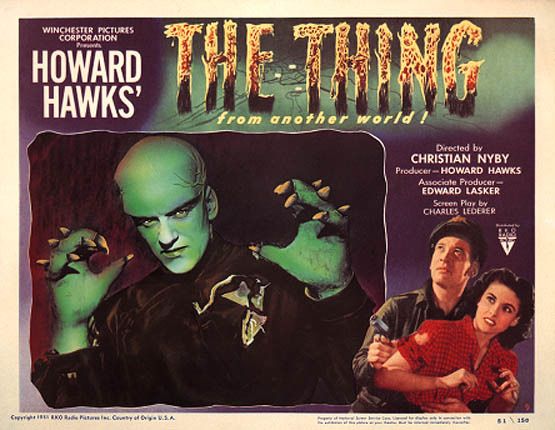
Fun filled Friday: Review, the Thing From Another World


 photo 2048044089_d079730c71_o_zps5ypigzzl.jpg


Thank God it's Fun filled Friday! Happy Friday fun loving readers. Today I am going to review one of my favorite 50's horror films, The Thing From Another World. I love the genre, cheap 50's vegly scifi-ish. The "new" style of horror in that era. I'll be doing of my favorites from that era, Creature From The Black Lagoon, And Them! I'll get to those eventually.  I first saw this as a kid, summer afternoon. One of our two best friends came over with a stack of comic books, we had pop cycles, we had swam in the morning and were settled back for an afternoon of comic books and "dialing for Dollars." That's the first time I saw The Thing From Another World (1951). It was great, exciting, suspenseful. Little did I know at the time it was also cold war hysteria. I'll get to that.

Directors: , (uncredited)     Nyby directed a lot tv in the 60s and 70s including Maybery RFD.

Writers: (screenplay), (based on the story "Who Goes There?" by), 2 more credits »    

Stars: , , |                          

Arness (Marshal Dillon) Plays the Creature, hard to recognize.

Reporter Ned "Scotty" Scott (Douglas Spencer) has come to a military base at the North Poll because he's looking for a story and he's heard that a large group of scientists have gathered there for some unknown reason. It's sort of "hush-hush" but they take him along anyway. There is a major storm in the offing, communications are getting difficult. A sub plot is introduced in the relationship between Captain Patrick Hendry (Kenneth Tobey) and Nikki Nicholson (Margaret Sheridan). They have known each other in the past, it's implied that their relationship was based upon casual sex. They play coy with each other and hint that they might resume where they left off. Of course they didn't show anything because it was a horror movie back then that meant  large part of the audience would be children.

The crew goes out into frozen waste land to explore the crash site of sn aircraft near by. This is why the scientists were there, they didn't know whose plane it was, they thought it be a meteor or it could be Russian. The see a craft under the ice. They don't see wings and they can't make out the shape so they stand over it and trace out the shape by linking arms. They notice they are standing in a circle. The craft is circular. There is a moment of stunned realization. They try to use bombs to free it from the ice but blow it up. They find the frozen body of the pilot freed from the ice by the blast.

Back at the base we have the first confrontation between the scientists and the hero  (Patrick Hendry--like Patrick Henry--"give me liberty or give me death"). This is how we know it's a red scare movie. The main scientist,  Dr. Arthur Carrington (Robert Cornthwaite),  is a type I grew up with, I recognized the trope even when I did not know what it was about. Liberal do gooder, whimpy, doesn't ant to fight, placing absolute faith in science and peace and reasoning with the enemy, in opposition to the All American hero (like Patrick Henry) who knows the answer always lies in theatrical heroics. This type was so common I remember the first time I saw the movie I said to myself "O yea that kind of guy."The thing frozen in the ice really spooks them, especially after they clean it up and can see the face is not human. They don't know if it is conscious or not, of course the scientists want to defrost it. The hero says no and he puts a guard on it. It's locked in a store room, the windows broken so the ice wont melt. OK spoilers past this point.

Of course the ice get's melted. The guy assigned to guard it leaves a heating pad on it. Stupid mistake. He put the blanket over it because he didn't want to see it staring at him. Barnes, the idiot with the heating pad escapes with his life, as the creature breaks out. He locks the door from the outsides and alerts the base. They arm and come back only to find the creature has fled through the open window. Outside they hear and see in the distance a form fighting with the dogs.

Examining the dogs they find an  arm torn off the creature during the battle.  The scientists, upon examining the arm, find that he's s vegetable man. his cellular structure is like that of a vegetable. The arm starts moving when blood from the dogs gets on it. They theorize that the creature  is made up of fiber and seed pod and can break into autonomous units. They all arm with  guns and axes and barricade themselves from the storeroom. The sled dogs are all dead, the base is snowed in, and the communication is out.

Dr. Carrington notices several of the plants he was tending have died. He theorizes that the door was open long enough to let in cold air from outside; they search the place and find a dog dead and drained of blood. The creature had been there and is getting blood to  speed up cell division and hatch his seed pods. The others are worried about surviving but weak-kneed liberal egg head Carrington expresses sympathy for the creature, isolated in the cold on a strange world and attacked by dogs. He wants the dead dog kept from Hendrey so he can communicate with the creature.

There is a missing blood supply. Nikki finds Carrington's notes and shows them to Hero Hendrey (hey it pays to snoop in a red scare). He has the major confrontation with Carrinton. Meanwhile they realize the creature got the blood supply so he's coming and going as he pleases. They barricade themselves in the mess hall. They prepare to fight to the death. Here comes the major spoilers.

The creature breaks in. They dowse it with kerosene and set it on fire. The things gets away he is just irritated and cuts off the oil supply. Now they are trapped and freezing. They still have power (oil heaters) but Hendry figures the creature will attack the generators. He wants to set up a trap but the fire didn't seem to hurt him. Someone suggests  electricity. They rig up a thing to produce an electrical arch in the door way. On his way to the trap Carrington intercepts the creature warns him of the trap (just like those traitor liberals) and makes a little speech exhibiting all the liberal values about intelligent creatures working together. It's pretty clear by that point that the creature wants their blood to nurture the seedlings from his pods so the can raise an army. He bashes Carrington out of the way and goes on to the trap. See you can't reason with the commies, not even a vegetable  man commie from another planet.

He bursts in the door, they turn on the electrical gadget, he's caught in an arching bolt of electricity and fried to a crisp. The sky clears, communication is open. Pat and Nikki decide to get serious and [plan their future together (the hero always get's the girl--when he fights commies). The film's famous ending shows the reporter phoning in his story and he says say we need to remain vigilant against further threats from outer space, he ends by repeatedly shouting "watch the skies! Watch the skies," getting louder, WATCH THE SKIES!" Film critics tend to believe that he is really saying to watch for Russian bombers.

The red scare was no j9ke it destroyed a lot of innocent lives. This  film, in spite of it's true propagandistic motives, is fun to watch and it is exciting and fun to make fun of it.


 photo 11292552_ori_zpsxffdv67e.jpg

Tuesday, January 05, 2016

Can Science Disprove the Soul ?


 photo IntuitiveIntelligenceImage3_zps3df90fa7.jpg


In “Can a Machine have a Soul?” Bill Lauritzen claims to have disproved the soul.[1] He’s considering the issue of weather or not transferring human consciousness into a machine would give the machine a soul? His solution is to disprove that humans have souls then there’s no soul to worry about. In my view the soul is a symbol and it’s the spirit that lives on after death. So there’s no question of proving or disproving the soul since there is no question or proving or disproving symbols. For the sake of this issue I’ll use his terminology. He assumes the soul is the thing that lives. After all, he would make the same argument against the spirit. That argument is made by the bogus method of merely assume what he thinks human ancestors must have thought about after life and what they based it on. Basing it on something we know is false such as an literalized analogy between smoke is the afterlife of fire, and breath sustaining life, being like smoke, therefore like the smoke form the flame breath must live on as soul. That’s his conjecture. Of course he assume this is the only reason to think there might be a soul and thus he’s swept it out of the way with modern doubt! That really is his only answer. Rather he asserts that it was the attempt to explain oxygen. He’s using as breath in that sense. It’s really breath that he means.[2]
            To reinforce it all he goes through a mock play where two cavemen have things out and this is supposed to be actual proof. It’s nothing more than detailed speculation. His little play is nothing more than taking us through the steps one might go through to arrive at the conclusion of after life after having witnessed death: He sees the blood, he reasons from past experience, that when people lose a lot of this stuff they stop living. He sees the blood evaporate. He understands that it’s going from a liquid to gaseous state (would he understand that)? So he puts it all together and reasons. Of course it’s really a modern person “reasoning” his way to answers he already knows. Is that proof that this actually what happened? No it’s totally theoretical.  He even shows a series of pictures of a goat dying and rotting away to reinforce how one might come to the conclusion that there is some mysterious thing in the air that makes us life (like he would really know evaporation pus gas in the air).[3] “So early humans thought there were ghosts and spirits living in the air. They didn’t want a ghost angry with them, so they would kill and burn animals, even humans in some cases, in other word they would make a sacrifice, to feed these ghosts and spirits. Sacrafice as the root word sacer, meaning sacred.”[4] I don’t think I’ve heard of sacrifice being a meal for ghosts. That’s a conjecture and perhaps not a good one. It really is a minor point.
            Then he goes on a long triad about how science discovered oxygen to show that science is so much better than religious thinking. Of course since he made the whole thing up and its’ conjecture and he’s stepping over a bunch of steps that took thousands of years it’s a rather meaningless point. Of course he totally ignores the fact that modern science was created by Christians and one of the chief discoverers of oxygen was Robert Boyle who was a devout Christian and who did science as a form of Christian apologetics. I say the because the actual discovery was a complex process involving several people. Joseph Priestly was another of those and he actually discovered it but Boyle paved the way.[5] Both men were Christians. [6]. [7] It’s absurd to compare primitive thinking to modern and try to pass that off as proof that science is better than religion. We have modern thinkers who are both scientific and religious, and modern science owes a great debt to religious thinkers such as Newton and Boyle, and even Priestly. In fact part of his rendition of the discovery of oxygen includes a lot about Robert Boyle, he never does actually indicate that he was a Christian, so it appears as a rebuke to religious thinking.
            He then takes a long detour though a discussion of things that really could be just left out of the issue. These are matters of brain size vs the kind of diet we have its suitability for hunter gatherer society. It really has nothing to with the issues. He discusses alchemy and how the understanding of blood evaporation and smoke might contribute to correlations between the basic elements and alchemical knowledge. It’s not relevant but I surmise that he includes it to indicate how wonderfully predictive his theories are. He can predict the nature of alchemy with it, of course we already know how it turns out so it’s not as though he’s predicting the unknown. Realizing he has strayed from the topic he springs back to summarize the issue on the soul:
Getting back to the original question: can a machine have a soul? Of course, there may be some mysterious energy we know nothing about. However, if we apply Occam’s razor, I think we can see that we have a simple theory that covers all the facts: the “soul” and “spirit” are convenient terms invented by early humans who knew nothing about atomic theory. The “soul” and spirit probably do not exist except perhaps in this ordinary sense, “a person’s moral or emotional nature or sense of identity.”[8]
The reference to atomic theory pertains to the reality about atoms and molecules and a modern understanding of what happens with evaporation. He says we have a simple theory that covers the facts. The problem here is he doesn’t know the facts. He has not given us any facts. He has literally just concocted a speculative idea with no empirical proof to back it up. He’s merely assuming correlations are cause and that he’s exhausted the facts merely because he’s brought out a few facts that back his view. Since he doesn’t value religion he doesn’t even try to understand what really went into understanding the soul or the spirit. He offers just enough facts to explain it away and then claims he has the facts. Moreover, notice that he puts his theory in terms of probability, and not in terms empirical proof. It can’t be a real disproof if it’s just a probability. There are other aspects of the spirit that he had failed to come to terms with. Basically, he has made the assumption that all knowledge is scientific so therefore the soul was invented to explain scientific questions, the physical workings of the world. It’s more likely the soul was a means of explaining religious and spiritual truth not physical truth. We don’t’ know what al that entails.
            It’s probably related to the need to explain mystical experience, or the sense of the numinous. It’s bound to be related to spiritual needs, that would relate to the special sense that engenders concept such the Holy. First of all we know that those aspects of the sacred that issue forth in mystical experience, the sense of the numinous, are used to with complex psychological issues. 
 
Atheists and skeptics reduce everything they critique and then lose the phenomena in the reduction. Thus, they only see the explanatory aspects of ancient religion and never try to think beyond the simple assumption that people were doing this to explain things. This is the “Og no like noise in sky” Idea. Stupid primitive people without science try to explain simple things they don’t understand so they make up religion. That is all the skeptic can see. But those who are aware of the mystical consciousness can see more. I am sure the skeptics will argue that they are reading it in. All I can do is to assert that if the reader will read Maslow and if the reader is aware of Maslow’s acuity as a scholar, one will place a great deal of confidence in the notion that Maslow was discovering and not reading in. Maslow   interpreted everyday psychology as laced with the trace of the supernatural, because for him “supernatural” just meant a deeper level of consciousness about ordinary things. His views of human psychology were laced with Jungian notions of archetypes. He equated the archetypes with “supernatural.” In speaking of the relationship between men and women and their relation to the psychological archetypes, he finds that the same symbols are always used for the same meanings. This comes out in psychological studies across the board. He marks archetypical thinking, as B and D. B analysis has to do with the higher, ideal, abstract, D has to do with the earthy human aspects of our existence; the practical the earthy. These are roughly equivalent to St. Augustine’s terms: height and depth. An example of what he’s talking about is the male tendency to seek two of womanhood, the goddess and the witch (or what rhymes with “witch”). Maslow says that psychology tells us that we need a bit of both. A woman put on a pedestal and seen only as a goddess is unapproachable and cannot be pleased. A woman seen only as the ‘other’ can’t be respected and won’t make a good partner. Of course this goes vice versa for the way women view men: the “good guy” vs. “the outlaw,” the rebel, the “bad boy.” Materialists are going to find that this point is trivial and just a part of daily living, and that’s the point. The reason ancients have a tendency to sacralize these kinds of ordinary relationships is because they sense a connection between them and the transcendent. That is the sense of the numinous. The same symbols turn up again and again, according to Malow, in all kinds of psychological study. Psychologically there is a link between the use of certain symbols in mythology and religion, and the transcendent.
            He makes this connection himself. Iin speaking of the dichotomy of most religious life between the “mystical” or ‘inner.’ ‘Personal’ to the organizational (he doesn’t use the phrase but the “doctrinal”) “The profoundly and authentically religious the person integrates these trends easily and automatically. The forms, rituals, ceremonials, and verbal formulae in which he was reared remain for him experientially rooted, symbolically meaningful, archetypal, unitive.”[9] He is revealing a link between the rituals of the primitives, mythology, and religious experience (especially “peak experience” or Mystical consciousness). That link is in the archetypes, the psychological symbols that ground us in a sense of what life is about and give us a connection with these concepts of height and depth, or the ideal and practical. In appendix I. “An example of B analysis,” He states:
This can also be seen operationally in terms of the Jungian archetypes which can be recovered in several ways. I have managed to get it in good introspectors simply by asking them directly to free associate to a particular symbol. The psychoanalytic literature, of course, has many such reports. Practically every deep case history will report such symbolic, archaic ways of viewing the woman, both in her good aspects and her bad aspects. (Both the Jungians and the Kleinians recognize the great and good mother and the witch mother as basic archetypes.) Another way of getting at this is in terms ofthrough the artificial dream that is suggested under hypnosis. It can also probably be investigated by spontaneous drawings, as the art therapists have pointed out. Still another possibility is the George Klein technique of two cards very rapidly succeeding each other so that symbolism can be studied. Any person who has been psychoanalyzed can fairly easily fall into such symbolic or metaphorical thinking in his dreams or free associations or fantasies or reveries.[10]

He is relating this to the mythological symbols of the grate mother, the goddess, the witch, the demon, and one might also think of Lilith or for men the Shy Father, vs. the demon the trickster. The link between mythological symbols and mystical consciousness is further born out by another psychologist, David Lukoff who made the link between the high incidence rate in the general population found by the Greely study and the use of archetypes. Lukoff framed schizophrenic delusions as private mythology.
 “This method derives from the discipline of comparative mythology but goes beyond to decipher the psychological truths embodied in the symbol-laden stories. Campbell’s (1949) study The Hero With a Thousand Faces is the premier example of this method. Lukoff (1985) treated the account of a psychotic episode as a symbol-laden personal myth and attempted to uncover themes that parallel the structure and content of classic mystical experiences.”[11]
Other studies, such as Buckley and Galanter (1979) have observed individuals in the midst of mystical experience when exposed to religious ceremonies.[12] Some might see this as undermining my own argument because skeptics do argue that religious experience is a form of mental illness. But there is a distinction between some mentally ill people having religious experiences and saying that mystical experience is mental illness. Many studies disprove this assertion (see chapter on “studies”). But as Lukoff shows, this does not mean that some mentally people can’t have mystical experiences.
Maslow talks about the psychological necessity of being able to maintain a transformative symbology. He is not merely saying that we should do this, but that this is what we do; it is universal and through many different techniques and psychological schools of thought he shows that this has been gleaned over and over again. What Jung called the Archetypes are universal symbols of transformation, which we understand in the unconscious[13] , and we must be able to hold them in proper relation to the mundane (the Sacred and the Profane) in order to enjoy healthy growth, or we stagnate and become pathological. It is crucial to human psychology to maintain this balance. Far from merely being stupid and not understanding science, striving to explain a pre-Newtonian world, the primitives understood this balance and held it better than we do. Religious belief is crucial to our psychological well being, and this fact, far more than the need for social order or the need for to explain thunder, explains the origins of religion.

As Maslow says:
“For practically all primitives, these matters that I have spoken about are seen in a more pious, sacred way, as Eliade has stressed, i.e., as rituals, ceremonies, and mysteries. The ceremony of puberty, which we make nothing of, is extremely important for most primitive cultures. When the girl menstruates for the first time and becomes a woman, it is truly a great event and a great ceremony; and it is truly, in the profound and naturalistic and human sense, a great religious moment in the life not only of the girl herself but also of the whole tribe. She steps into the realm of those who can carry on life and those who can produce life; so also for the boy’s puberty; so also for the ceremonies of death, of old age, of marriage, of the mysteries of women, the mysteries of men. I think that an examination of primitive or preliterate cultures would show that they often manage the unitive life better than we do, at least as far as relations between the sexes are concerned and also as between adults and children. They combine better than we do the B and the D, as Eliade has pointed out. He defined primitive cultures as different from industrial cultures because they have kept their sense of the sacred about the basic biological things of life.

“We must remember, after all, that all these happenings are, in truth, mysteries. Even though they happen a million times, they are still mysteries. If we lose our sense of the mysterious, or the numinous, if we lose our sense of awe, of humility, of being struck dumb, if we lose our sense of good fortune, then we have lost a very real and basic human capacity and are diminished thereby.”

“Now that may be taken as a frank admission of a naturalistic psychological origin, except that it involves a universal symbology, which is not explicable through merely naturalistic means. How is it that all humans come to hold these same archetypical symbols? The “primitives” viewed and understood a sense of transformation, which gave them integration into the universe. This is crucial for human development. They sensed a power in the numinous, that is the origin of religion.”[14]
Ceremonies and rituals about ordinary things such as puberty, sex, marriage, birth, death, these are attempts at mediating the Ultimate transforromative experiences that all religions take to the resolution of what they identify as the human problematic. Pre historic man says “I see a connection between my place in the universe, and this sense that I get when I reflect upon nature as a whole. I sense that I am one small part in a great unity, and I sense this in everything in life, falling in love, having children, death., I have a place in the universe in relation to whatever that is I sense beyond the stars…” The skeptic reduces this to “Og like girls, but girls make Og nervous.” So he makes rituals about sex and relationships to ward off the evil spirits that make him nervous. But it’s clear, while pre-historic man probably wasn’t an existentialist and perhaps wasn’t that sophisticated about it all, he did sense a connection between life and the numinous. Of course this doesn’t mean that the primitive humans had any special insight into relationships that we need to follow.  This is strong evidence that people have always had a sense of the numinous as far back as we know. This is an indication of some form of this sense because it clearly shows a connection between ordinary aspects of life and the transcendent. It also means that the typical skeptical explanation for the origin of religion is just losing the phenomena, taking out the real indications of a form of consciousness and reducing what they find to nothing more than a simplistic explanation for things.

While it is true that these experiences and their psycho-social uses have probably evolved over time, it is equally true that they were probably being put to the same uses all along because we can see the relationships between religious symbols, spiritual concepts, and psycho-social aspects. It makes more sense to think they were used in that way all along. the cocnept of the soul is just some simple idea of saying "what keeps me living?O it's some ghost in the machine" but rather why do I feel this strange sense of importance of life and the world when I stare at the stars all night? Then to explain mystical experience they come up with the realization that consciousness probably transcends the material world. From that it's easy to think it lives on after life. Then if the associate it with the wind in the trees and blood and breath and life, that's scientifically mistaken but it's not completely off track. It does at least link the feelings of mystical experience with the reality and meaning of the world and the after life.
Mystical experience is at the base of religion itself. "Mysticism is a manifestation of something which is at the root of all religions."[15] 

David Steindl-Rast,

The question we need to tackle is this: How does one get from mystic experience to an established religion? My one-word answer is: inevitably. What makes the process inevitable is that we do with our mystical experience what we do with every experience, that is, we try to understand it; we opt for or against it; we express our feelings with regard to it. Do this with your mystical experience and you have all the makings of a religion. This can be shown.

Moment by moment, as we experience this and that, our intellect keeps step; it interprets what we perceive. This is especially true when we have one of those deeply meaningful moments: our intellect swoops down upon that mystical experience and starts interpreting it. Religious doctrine begins at this point. There is no religion in the world that doesn't have its doctrine. And there is no religious doctrine that could not ultimately be traced back to its roots in mystical experience – that is, if one had time and patience enough, for those roots can be mighty long and entangled. Even if you said, "My private religion has no doctrine for I know that my deepest religious awareness cannot be put into words," that would be exactly what we are talking about: an intellectual interpretation of your experience. Your "doctrine" would be a piece of so-called negative (apophatic) theology, found in most religions.[16]


It makes sense that if every doctrine has it's roots in mystical experience that the doctrine of the soul does as well. Now it could easily be that the basic idea was invented by observing breath i the body and wind in the trees then backed up by these emotional experiences. That's ok it means there is no Casper the friendly Ghost-like entity in us waiting to get out. We do not need to hold to that view of the soul or the spirit. Spirit is mind, the word in Greek means mind, it's perfectly logical to understand consciousness as the aspect that lives on. A connection through mystical experience would be quite logical for the spirit. So the reality of consciousness as enduring connection with God and the infinite got mixed up with hoaky notions about wind in trees and evaporation and produced this idea of the ghost. That doesn't mean there is conscoiusness that survives death and unites us with God or not spirit that is reinvigorated when we give our lives to Christ. 

This tendency to want to destroy ideas of religion through scinece is nothing more than the illusion of technique. This notion harkens back to a book form the 70's by William Barrett.[17]Perhaps because science is misunderstood by many as thriving upon proof, and it is seen as the umpire of reality because its ability to prove empirically, (apologies to Karl Popper) the illusion of technique is created in the minds of those who misunderstand science in this way. I will say more about this in the next chapter. It is not the scientists who create the illusion but the needs of science groupies who expect it to ground their metaphysical needs that create the illusion. The tendency to reduce all knowledge to one thing enables the illusion to work. The illusion works in the way that reductionism works. If some aspect of reality can’t be gotten at by our methods then we assume it doesn’t exist, because that means it’s not something we can control.
"The illusion of technique," the modern dream of a single method that would apply in all areas of human concern. Such hegemony encourages thinking in terms of a "will to power," seeing things as 'manipulanda', that which awaits reshaping by humans. Barrett contrasts this with the "will to prayer," an attitude which, inspired by Platonic 'eros', seeks, not control, but active engagement leading to personal transformation.[i]
Thus the only knowledge there is, is in our control. In other words, the facts always support our view. So naturally our manipulation of the world is absolute and produces all the knowledge there is. If there seems to be anything beyond that we can reduce it and lose the phenomena and we explain it away. Religious experience is reduced to brain function, brain function is reduced to chemistry, chemistry has no room in it for transcendent sprits and thus they don’t’ exist. The illusion is backed by the fact that we can always manipulate more and more stuff and thus demonstrate our view of the world works.


sources


[1] Bill Lauritzen, Abstract, “Can a Machine Have a Soul,” Journal of Personal Cyberconscienceness. Vol. 8, Iss 1 (2013) 30-39, 30-31.
[2] Ibid.31
[3] Ibid. 32-33.
[4] Ibid. 33
[5] Zbigniew SZYDŁO, “Who Discovered Oxygen?” Proceedings of ECOpole, Vol. 1, No. 1/2 (2007)
[6] Kevin de Berg, “The Enlightenment and Joseph Priestley’s Disenchantment with Science and Religion.” Christian Perspective on Science and Technology, ISCAST Online Journal, (2012) Vol. 8. http://www.iscast.org/journal/opinion/deBerg_K_2012-06_The_Enlightenment_&_Joseph_Priestley.pdf   accessed 4/7/14.
[7] Margaret Jacob, The Newtonians and The English Revolution 1689-1720. Ithaca, New York: Cornell University Press, 1976. Boyle’s Christianity and apologetics are discussed throughout  the work.
[8] Bill Lauritzen, Ibid. 38.
[9] Abraham H. Maslow  Religiooins, Values and Peak-Experiences, “preface” to the 1970 edition.
[10] Ibid, appendix I. “An Example of B Analysis.”
[11] David Lukoff “the Diagnosis of Mystical Experiences With Psychotic Features” Journal of Transpersonal Psychology, (1985) 17, (2) 155-81 in Lukoff and Lu, Journal of Transpersonal Psychology, (1988) 20, (2) 182.
[12] Ibid
[13] Abraham H. Maslow, Religions, Values, and Peak-Experiences
Appendix I. An Example of B-Analysis


 [14]subconscious?
[15] Frank Crossfiled Haphold, Mysticism: A Study and Anthology. New York:Penguin Books, 1979, 16
[16.]David Steindl-Rast. "The Mystical Core of Organized Religion," ReVision, Summer 1989 12(1):11-14. Used by the Council on Spiritual Practices with permission. 1989
 on line: http://csp.org/experience/docs/steindl-mystical.html  
accessed 4/8/14.
Brother David Steindl-Rast, O.S.B., is a monk of Mount Savior Monastery in the Finger Lake Region of New York State and a member of the board of the Council on Spiritual Practices. He holds a Ph.D. from the Psychological Institute at the University of Vienna and has practiced Zen with Buddhist masters. He is author of Gratefulness, The Heart of Prayer and Music of Silence: A Sacred Journey Through the Hours of the Day.
[17] William Barrett, The Illusion of Technique: a Search for Meaning in A Technological Civilization.
New York:Anchor books, 1979.

[18] Raymond D. Boisvert, “The Will to Power and the Will To Prayer: William Barrett’s The Illusion of Technique 30 years Latter.” Journal of Speculative Philosophy: A Quarterly Journal of History, Criticism, and Imagination.” 22, (1), 24-32.

Sunday, January 03, 2016

Affirm the Trinity and Work forSocial Justice


___________________________

this is where the graphic would be

If I could use a picture of Mohamed.
____________________________


The reason I used such a strange broken title is differentiate my article from the dozen or so entitled they way I was going to do it, "Do Christians and Muslims have the same God." Down the row on Google,v same title again and again. The reason  so amny are writing on this because doings at Evangelical Wheaton college have made it a hot topic.

Larycia Hawkins, a professor at Wheaton College in Illinois, decided to wear a headscarf during the Advent season as a gesture of solidarity with Muslims. In doing so, Hawkins quoted Pope Francis, saying that Christians and Muslims "worship the same God."But some evangelical Christians disagree — and Wheaton, a Christian school, responded by putting the political science professor on paid administrative leave. The college says it needs time to review whether her statement puts her at odds with the faith perspective required of those who work there.[1]

The controversy pits liberals and ecumenists who are concerned about not seeming to attack Islam and not wanting to oppress the refugee against evangelicals and conservatives who fear the drift away from Trinitarian doctrine. Both sides are being alarmist. We can support refugees (I am all for that) and not be at at with Islam and still affirm the Trinity. I support all three of those things, To answer the question we have3 t do dome unpacking snd examine the nature of the question,

First, technically the God of the Quran is supposed to be the God of Abraham and Issac and Jascob. This is stated in the Quran:

Zeki Saritoprak, a professor of Islamic studies at John Carroll University in Cleveland, points out that in the Quran there's the Biblical story of Jacob asking his sons whom they'll worship after his death."Jacob's sons replied, 'We will worship the God of your fathers' — Abraham, Ishmael and Isaac. He is the God," Saritoprak says. "So this God that Jacob worshipped, this God that Abraham, Isaac worshipped, is the same God that Muslims worship today."[2]

Of course the real dividing line is the notion of Trinity. We really can't deny that as Christians we worship the God of Abraham. Jesus prayed to him and called him father. As I pointed out last time there are points of contact between God in OT and Triune God of Greek based Trinitarian doctrine.

But Christians themselves differ on this question. The Second Vatican Council, speaking to Catholics back in 1964, affirmed that Muslims "together with us adore the one, merciful God." And Amy Plantinga Pauw, a professor of Christian theology at Louisville Seminary, says Christians can have their own definition of God while still seeing commonality with Muslims and Jews."To say that we worship the same God is not the same as insisting that we have an agreed and shared understanding of God,"[3]
 Technically Mohamed made reference to God of Bible and was dealing with tht view of God but Islam has developed such a cultural palemcest over that truth that they no longer do deal with the same God. Of course that can  be said of some kinds of Christians, that does not mean that we can water down the Trinity. We can protect the rights of Muslim Americas  and work with them for social justice without abandoning the Trinity. That is imperative.


We just got through Christmas and that should remind us, truly God and Truly mean, core of the faith.


what do you think? I want commemts


[1] Tom G Jelten do Christians and Muslims worship the same God NPR, Updated December 21, 20156:40 AM ET Published December 20, 2015 RA website
http://www.npr.org/2015/12/20/460480698/do-christians-and-muslims-worship-the-same-god

[2] Ibid.

[3] Ibid

Friday, January 01, 2016

Happy New Year! Fun Filled Friday: Bible Fraud (starriijg JP Holding)


Happy New Year fun loving readers. I am sure both of you are excited that FFF lands on New Years. The other day I came across this website here a Robert Adams was extolling the brilliance of a guy named Bushby who is Hawking a book called Bible Fraud. This is sort of the national enquirer of atheism. I'll be doing more about Adams on AW pretty soon. I decided to look for Bushby's book. Found a review and clicked. What did find? One of the most hilarious reviews I've read since, the last review by him read.

Holding's review is here:

http://www.tektonics.org/af/bushby01.php
by JP Holding

Tony Bushby's "Bible Fraud": A Critique
The Bible Fraud by Tony Bushby has the inauthentic Pope Leo X quote on the cover. That turns out to be thematic.
Let's start with a summary of the plot:
Jesus married Mary Magdalene as well as two other women in his lifetime. Mary was a descendant of King Herod and Jesus was a descendant of a Celtic king named Lud. (I don't know how a Celtic managed to work his way to, and survive in, Jewish Palestine, where he'd stick out like the sorest thumb this side of Los Angeles.) Jesus' line eventually fostered Constantine [15]. However, Jesus and a twin brother named Judas Khrestus (?!) were "conceived by rape or adultery" between a member of Herod's family and the Emperor Tiberius. [41] Some stories in the Gospels, like the Temple cleansing, are actually about Khrestus [67] and this Khrestus escaped a sentence of crucifixion imposed by Caligula in 37 by appealing to an "age-old tradition" that allowed him to have someone sub in for him [84]. Judas later went to India to learn things [90]. Jesus became a king of Britain named Cunobelinus [108] where he also joined a Druidic order [115] and acquired the name Bran the Blessed [117]. He was later captured by Rome in war [125] but escaped execution because of his connections with Roman aristocracy. He later went to Egypt to be initiated into mysteries [141] but sometime later was stoned to death [153].
Clues for this whole story can be found in all sorts of places ranging from conveniently inaccessible manuscripts to statues in France and even in the works of Shakespeare. Unfortunately, much of what would prove this has been burned by the church, and other things have been edited or interpolated to hide all this. That's it. Now if you're still thinking this might have some credence, here's some particulars analyzed.
  • Bushby thinks his book was predicted by Nostradamus [11].
  • Many of his sources are -- conveniently -- "preserved in rare archival manuiscripts and difficult-to-find reference books." Among these sources are such items as the "Myvyean Manuscript" [18] in the British Museum. For some reason the only actual reference to this document anywhere online comes from references to Bushby. And little wonder why. Tekton Research Assistant "Punkish" won the Gold Star of his life with this one -- he lives in the UK, and was able to contact the British Museum about this. His report: I wrote to the British Library (who now house the manuscript collection that used to be kept at the British Museum) about this "Myvyean manuscript" and the official reply from Michael St.John-McAlister, the Curator of the Dept. of Manuscripts is this:
    "I am afraid that I can find no reference to such a manuscript in our collections. We receive many similar enquiries relating to subject matter such as this and I have to say many of them are hoaxes or refer to non-existent manuscripts."
    So much for Bushby as a credible source on alleged mystery documents.
  • In addition, because many people will disagree with his book, Bushby will "not engage in written religious argument with readers" who disagree. [12] The words "non sequitur" spring to mind.
  • Sir Francis Bacon edited the KJV [20]. Now this is an idea you do see offered up on some websites, but not one of them I have found to be of any academic bent. The source Bushby gives is by an author named Alfred Dodd who wrote some rather peculiar books like Shakespeare: Creator of Freemasonry. (He also appeals to "original documents" in the British museum that allegedly prove this, but are conveniently unquoted and unreferenced otherwise.) The idea that Bacon had some part in the KJV is so outraegous that apparently not even the folks at Wikipedia are willing to let it stand. Bacon is also said to have edited the plays of Shakespeare and added secret messages....on that one, I'll refer to a lively discussion here by an academic source and a rather detailed discussion here by someone who passes the critical source test.
  • Morton Smith is used as a source with his Secret Gospel of Mark and claim that a tombstone in Germany of a Roman soldier may have been that of Jesus' father [29].
  • It's not quite The Da Vinci Code, but the Last Supper is used for an argument as it is claimed that one of the disicples (the fifth from the right of Jesus) looks like Jesus' twin, thus evidently showing Leonrado believed in Bushby's twin theory. From what I see of that painting, that's as much imagination as Dan Brown offers to make John a woman; it is an idea also found on some conspiracy-theory sites, but the resemblance is highly superficial and the alleged "twin" has a chin that juts out rather more than Jesus'. Michealangelo is also said to have endorsed this idea, as well as Raphael, but what Bushby takes for twin sons of Mary are always taken by credible art historians as the infants Jesus and John the Baptist. Bushby dismisses this by claiming that the boys are "identical" which is quite imaginative and clearly false. The hairstyles and color are entirely different; the chins do not match, and little John already has on his prophetic garment, while Jesus is the only one with a halo.
  • Also in common with Dan Brown, Bushby makes use of the legendary Abbe' Sauniere [47] who allegedly became rich thanks to some secret documents he found in a hollow pillar in his church in France. Olson and Miesel say it all in their comments in The Da Vinci Hoax: [Suaniere] was in fact a simoniac priest whose wealth came from selling overbooked Masses until he was suspended by his bishop in 1911. The parchments were fake, the pillar was not hollow, and the tomb was not painted by Nicholas Poussin in his two works titled Et in Arcadia Ego. The so-called mystery was invented by a local restaurant owner in the 1950s to attract tourists." [237]
  • "Old records" of unspecificed origin and nature tell us that the Pharisees were founded by a "Pharez" who "developed a school of Predestination" and the Sadducees by one "Sadoc" who was "a disciple of Antigonus Scohaeus" who had allegedly founded a "School of Infidels". [51] Needless to say this is a mix of fact and fiction. The name of the Pharisees comes from the word perushim, which means separatists. "Sadducees" is perhaps properly taken from a "Sadoc" -- one of Solomon's priests in the OT, whom they regarded as their ideological ancestor, if the derivation is correct -- others argue that it comes from a Greek word for "fiscal officials" but a connection to this alleged Antigonus is not one of the options scholars use. Of course there are no other references to this "School of Infidels" or this Antigonus online, expect from those copying Bushby.
  • The Essenes are connected with the Druids of Gaul [523].
  • Even if the quote from Julian is correct [57] it has the facts mangled; Paul, Matthew and Mark all equate Jesus with divine Wisdom.
  • Bushby repeats Harpur's argument about KRST [58].
  • Bushby claims he made clergy "squirm" by asking about where Jesus was called a glutton and a drunkard. Such names were simply stock rhetoric of the time; just as the the Pharisees were not actually vipers and hypocrites, and also whitewashed walls [64].
  • The Gauls are the same people as those who lived in Galilee [75].
  • A microcosm is offered of Remsberg's list [87].
  • Bushby repeats an Anglo-Israelist argument I last saw used by Herbert Armstrong [99] that "British" combines the two Hebrew words for covenant (berit) and man (ish). More serious sources connect the name to that of a tribe of Picts, the Pritani. Also the home of Mary Magdalene, Dalmanutha [105], is in South Wales.
  • Paul [134] at one point had to flee to Wales and there was protected. One source for this information is "an ancient manuscript in Merton College".
  • Bushby uses the "Bacchus on the cross" gem of Freke and Gandy [197] -- yes, the one that's a forgery -- as well as offering all the usual copycat candidates (Mithra, Attis, etc.)
I really see no need to say more. The ideas Bushby propounds lend little credence to the rest of what he writes, though of course anyone who wishes to have me look into specific claims made by Bushby is welcome to request that I do so.