Friday, March 29, 2024

Jerusalem or Galilee? Contradition in Res accounts?


"Studies of the passion narrative have shown that all gospels were dependent upon one and the same basic account of the suffering, crucifixion, death and burial of Jesus. But this account ended with the discovery of the empty tomb." --Helmutt Koester, Ancient Christian Gospels, 208.M

Our atheist friend the regular on the comment section "Pixie" has an argument about the Resurrection accounts that is interesting and deserves answering:

Mark is clear that Jesus went on ahead to Galilee. This is in both chapter 14 and 16. The supposed appearances in Jerusalem contradict that. You page on harmonization fails to even mention Galilee, totally ignoring both Mark and Matthew!...Okay, I should have said oldest that we have, and therefore closest to the original. We know Luke and Matthew were based on Mark, and yet they chose to remove the claim that the women did not say anything. They (their respective communities) were adding their own embellishments, and it made more sense to have the women talk, so they changed the text.

again:

We have a whole bunch of facts that need to be pieced together to make a coherent narrative. The author of Mark wrote what he wrote for a reason. I suggest he wrote that Jesus went on ahead to Galilee because that is what he believed, because when he was writing there were no stories of Jerusalem appearances. He wrote of the Empty Tomb because that is what the community held to, and wrote that the women said nothing because that explained why stories of the Empty Tomb were not circulating at the time.[1]

So he is saying in Mark the angel tells the women Jesus will go meet them in Galilee they should go there, That is a contradiction to all the Jerusalem-based sightings of the risen Christ, In fact the same statement is made in two Gospels:

mark 16

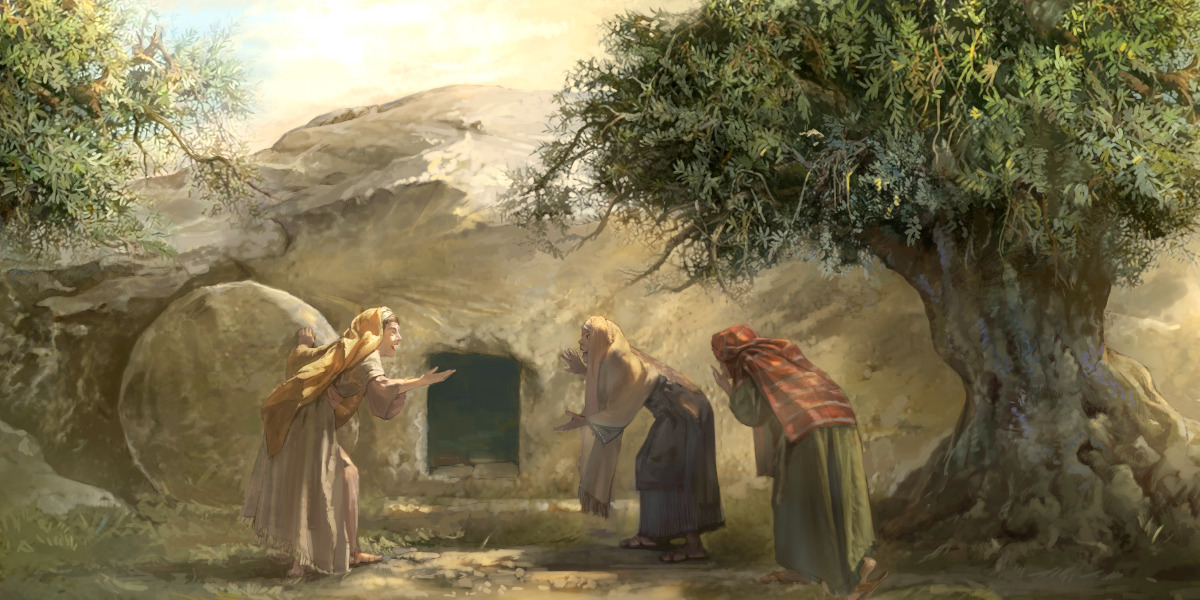
4 But when they looked up, they saw that the stone, which was very large, had been rolled away. 5 As they entered the tomb, they saw a young man dressed in a white robe sitting on the right side, and they were alarmed.6 He said to them, “Do not be amazed! You seek Jesus of Nazareth, the crucified. He has been raised; he is not here. Behold, the place where they laid him. 7 But go and tell his disciples and Peter, ‘He is going before you to Galilee; there you will see him, as he told you.’”

Matt 28

5 The angel said to the women, “Do not be afraid, for I know that you are looking for Jesus, who was crucified. 6 He is not here; he has risen, just as he said. Come and see the place where he lay. 7 Then go quickly and tell his disciples: ‘He has risen from the dead and is going ahead of you into Galilee. There you will see him.’ Now I have told you.”8 Trembling and bewildered, the women went out and fled from the tomb. They said nothing to anyone, because they were afraid. Matthew records that they did go to Galilee and that's where he gives them the great commission.

Mat 28

16 Then the eleven disciples went to Galilee, to the mountain where Jesus had told them to go. 17 When they saw him, they worshiped him; but some doubted. 18 Then Jesus came to them and said, “All authority in heaven and on earth has been given to me. 19 Therefore go and make disciples of all nations, baptizing them in the name of the Father and of the Son and of the Holy Spirit, 20 and teaching them to obey everything I have commanded you. And surely I am with you always, to the very end of the age.”

The problem is the time frame created by Luke is so tightly constructed that it doesn't allow for them to go to Galilee. He shows the travelers on the road to Emmaus meet Jesus. It tells us "on that same day":(24:13) that is Easter, the day of the resurrection, Then they invite Jesus to break bread when they get home. They realize who he is and he disappears and they get up and go back to Jerusalem and tell the 12 then and there. The journey was only about five miles. Jesus appears among them he eats in front of them, Then he leads them out to Bethany where he ascends into the sky, It all happens in one day and evening no time to go to Galilee which would be about a three day walk.

Dr. Joseph R. Nally, answers the problem by asserting there's a gap at v 44, an invisible seem that separates everything after 44 as happening days later in Galilee. [2] The justification for the dividing line the Greek word "de"(pronounced "day"). The NIV translates it merely as"he said to them" some versions put "then he said..." "I maintain that it is a merely an assumption to assert that Jesus spoke Luke 24:44ff on Easter Day. The use of the Greek "de" (meaning "and," "then," or "now") to begin Luke 24:44 does not necessitate immediacy, but merely at "a time after." Witnesses do not always share things in chronological order - this includes the Gospel writers as well. The Gospels jump from topic to topic without any warnings at times (see Luke 4:1-4; Matt 4:1-11)."[3]

He wants us to assume that there's an invisible break we are just not told about. It puts several days between v43 where he eats fish and 44 where he shows his hands and feet. In the part of Texas from which I come we call this "rationalization," (one of our folksy colloquialisms). Because it's unlikely he would wait so long, he just ate to prove he is flesh and blood then why wait several days to show his hands and feet? That's bad enough but Luke lowers the boom on this answer in v50 where he leads them back to Bethany for the ascension.So they waited three days to walk down to Galilee to see his hands and feet then turned and walked back to Bethany to watch him ascend.I think in the way Luke tries to pin it down he actually does create a contradiction with the other Synoptics (Matthew and Mark).

This need not be a faith destroying problem, however, we know Luke was not an eye witness he does not claim to be. He tries to tie the account to the documentation of his research but in so doing leaves out room for other accounts he did not consult. Clearly Luke draws upon a Jerusalem based tradition (which is consistent with the Pauline circle since Paul made contact with James who stayed in Jerusalem).[4] The witnesses of the Jerusalem community omitted rather than renounced the Galilee community, but they conflated the time frame.

Remember my basic assumption is that the witnesses fanned out among the various communities. Thus, each community reflects the perspective of those witnesses in its midst. Thus John focused on Mary Madeline as the major witness to the resurrection, the others do not. John's account seems to be told from Mary's perspective but it does acknowledge that there were other women with her at the tomb too ("we don't know where they have laid him"--John 20:2). The most likely explanation for the focus on her perspective is that she is the one of the major witnesses that wound up in that community.

I am not saying the James' Church was at odds with the Galilee band. I am just saying that over time the accounts conflated the experience of the community to the exclusion of others in some way. Interestingly enough there was a very early tradition that had Peter and some others of the 12 went back to Galilee having heard of the resurrection but not having yet seen the Lord.There is a part of the apocryphal gospel of Peter that records a trace of this tradition,After the amazing resurrection scene where Jesus is escorted out of the tomb followed by talking cross, there is a much more realistic account of Peter and others going back to Galilee to fish and wait for the Lord,[5] This fragment fits much more closely the tone of fear, mystery, and silence of Mark rather than the positive "Godspell" tone of Matthew, Luke, and John.

[58] Now it was the final day of the Unleavened Bread; and many went out returning to their home since the feast was over. [59] But we twelve disciples of the Lord were weeping and sorrowful; and each one, sorrowful because of what had come to pass, departed to his home. [60] But I, Simon Peter, and my brother Andrew, having taken our nets, went off to the sea. And there was with us Levi of Alphaeus whom the Lord ...[6]

James Tabor argues that this constitutes an early independent tradition. He thinks that Luke suggests that the injunction to stay in Jerusalem was counter to the faction that returned to the Galilee.[7] We know there was some mild power struggle in the early church in which Peter and James vied to impress one another.[8]

Omission is not contradiction, It is well known that major aspects of the synoptic are left out of John and that John includes major aspects not in the synoptic; for example John includes the whole Galilean ministry not in the synoptics, "Prior visits of Jesus to Jerusalem before the passion week are mentioned in John but not found in the synoptics. The seventh sign-miracle, the resurrection of Lazarus (John 11) is not mentioned in the synoptics. The extended Farewell Discourse (John 13—17) is not found in the synoptic Gospels."[9] Yet no serious scholar tries to suggest that this is an out-and-out contradiction. It's merely a difference in sources. A difference in the "take."

Now the question arises, how do we know what in the account is genuine and what is not? This is not the hopeless conundrum the skeptic will try to build it into. Were it not possible to answer this point by means of textual criticism we would not have it as a problem in the first place.Two points enable solution: (1) We can spot the older readings as the discovery of the Pre Mark Passion Narrative (PMPN) has been consistent with MS evidence; the existence or pre mark redaction--sources of the gospel written before Mark of course not canonical but nevertheless influenced the canonical gospels. This view is now consensus.[10] for more on PMPN (see my article article "story of empty tomb dated mid first century."[11](2) we can ascertain those points upon which all witnesses agree. They all agree that the tomb was empty they all agree Jesus was seen alive again. None of the accounts including apocryphal accounts deny these points, for at least three centuries after the events. Each account is fueled by the unique perspective of the set of witnesses in that community. They do not contradict each other they are cumulative.

My Point is we can take agreement between canonical and extra canonical sources as consensus. We don't want to use them as theological guides but as historical artifacts. Like a pot shard these apocryphal works testify as to the beliefs going around in given era and given local. It can be reckoned as fairly obvious that the cross, the empty, tomb the resurrection of Jesus were early and universal, and undisputed. Two major sources of which I speak are the Gospel of Peter (GPet) and Gospel of Thomas, (GTom). There is the Epistle of the Apostles, very orthodox but attributed to middle of second century.Epistle Egerton 2. Most of these are tainted with Gnosticism and contradict orthodox theology. For this reason many Christian apologists just date them to later second century and dismiss them as false and ignore them. That's not honest because major scholarship, even by orthodox schools (such as Raymond Brown) place these works as early or as containing early influences. Some perhaps even earlier than the canonical gospels. Again they are not theologically reliable but as historical artifacts we can't overlook them.

Skeptics often argue that Mark ends with no resurrection even though clearly says he is risen and in an atmosphere of fear and secrecy. But Marks's ending is lost so we don't know what it said. But in echoing the Galilee command it acknowledges that tradition, That's even more interesting that Mark is said to be the memoirs of Peter who according to the Pre Mark redaction led the contingent back to Galilee. Matthew not only preserves the command but says they went. All gospels, both canonical and otherwise agree with the empty tomb and the resurrection. In light of these facts we can;t regard the omission of Luke, who was not privy to the original events, as a serious contradiction to events.

The truth is, Jesus met with His disciples in both places, but He did so at different times. One of the reasons so many people allege that two or more Bible passages are contradictory is because they fail to recognize that mere differences do not necessitate a contradiction...Jesus met with His disciples both in Jerusalem and in Galilee, but at different times. On the day of His resurrection, He met with all of the apostles (except Thomas) in Jerusalem just as both Luke and John recorded (Luke 24:33-43; John 20:19-25). Since Jesus was on the Earth for only forty days following His resurrection (cf. Acts 1:3), sometime between this meeting with His apostles in Jerusalem and His ascension more than five weeks later, Jesus met with seven of His disciples at the Sea of Tiberias in Galilee (John 21:1-14), and later with all eleven of the apostles on a mountain in Galilee that Jesus earlier had appointed for them (Matthew 28:16). Sometime following these meetings in Galilee, Jesus and His disciples traveled back to Judea, where He ascended into heaven from the Mount of Olives near Bethany (Luke 24:50-53; Acts 1:9-12)...None of the accounts of Jesus’ post-resurrection appearances contradicts another. Rather, each writer supplemented what a different writer left out. Jesus may have appeared to the disciples a number of times during the forty days on Earth after His resurrection (cf. 1 Corinthians 15:1-7), while the New Testament writers mentioned only the more prominent instances in order to substantiate the fact of His resurrection.[12]

Why the dichotomy between meeting places? Who knows. Perhaps that reflects a factional split in the early church. Or maybe Jesus wanted to reminisce about his childhood before ascending to heaven. I know that sounds sarcastic but onerously what I mean is we can't know. We don't know all the things Jesus attended to during that period. He may have taken the disciples back were it all started for their own psychological needs. If it is a contradiction is it really a major one?

Sources

[1] Anonymous (aka "Pixie") Comment Section,in Joseph Hinman, "Breaking News: Liberals are not fundies; Answering Atheist assertions about folklore in Gospels," Cadre Comments blog (Jan, 7, 2018) http://christiancadre.blogspot.com/2018/01/breaking-news-liberals-are-not-fundies.html (accessed Jan 11, 2018)

[2] Dr. Joseph R. Nally, Jr. "God and Stay Discrepancy," Reformed Answers (third Millennial Ministries) (no date given) http://reformedanswers.org/answer.asp/file/44375 (accessed 1/11/18) Nally is D.D., M.Div. is the Theological Editor at Third Millennium Ministries (IIIM).

[3] Ibid.

[4] James was from Galilee but we know he stayed in Jerusalem because he became head of the Jerusalem church according to Josephus' "brother passage."

[5] "The Gospel of Peter," Trans Raymond Brown, Early Christian Writings. Peter Kirby Editor. (website coywrite 2001) http://www.earlychristianwritings.com/text/gospelpeter-brown.html (accessed 1/11/18)

[6] Ibid

[7] James Tabor, "The Surprising Ending of The Lost Gospel of Peter," Taborblog, published by Christian Origins website (December. 2015). https://jamestabor.com/the-surprising-ending-of-the-lost-gospel-of-peter/ (accessed 1/11/18) James D. Tabor (born 1946 in Texas) is a Professor in the Department of Religious Studies at the University of North Carolina at Charlotte, where he has taught since 1989 and served as Chair from 2004–14. He previously held positions at Ambassador College (1968–70 while a student at Pepperdine University), the University of Notre Dame (1979–85), and the College of William and Mary (1985–89). Tabor is a fine scholar but his Jesus Dynasty book denies the resurrection,

[8] Ibid

[9] W Hall Harris III, "Two Major Differences in John and The Synoptic," from Commentary on the Gospel of John, Bible .Org Web site. https://bible.org/book/export/html/1151 (access 1/25/18) Harris is Prof New Testament Dallas Theological Seminary.

[10] Peter Kirbey, "The Passion Narrative," Early Christian Writings, website http://www.earlychristianwritings.com/passion.html (access 1/25/18) "Nevertheless, the idea of a pre-Markan passion narrative continues to seem probable to a majority of scholars. One recent study is presented by Gerd Theissen in The Gospels in Context, on which I am dependent for the following observations." Image result for Giotto the empty tomb

[11] Joseph Hinman, "Story of Empty Tomb Dated To Mid First Century." Cadre Comments Blog, (April 2, 2017) http://christiancadre.blogspot.com/2017/04/story-of-empty-tomb-dated-to-mid-first.html (access 1/25/18) also published in Holding's anthology Deeding the Resurrection

[12] Eric Lyons, "To Galilee or Jerusalem?,"Apologetics Press (2004) http://apologeticspress.org/apcontent.aspx?category=6&article=730 (accessed Dec 8,2019)

Sunday, March 24, 2024

The Gospel Behind the Gospels

Skeptics of the New Testament usually assume a long gap exists between the events in the gospels and the recording of the events in writing, They further tend to assume that the first source of writing about these events was the gospel of Mark. Thus they assume events were exaggerated and miracles were made up and so on during this gap period. In this essay I am going to dispel this myth by demonstrating that there were written records of the gospel events that existed before the writing of Mark's gospel. I will further demonstrate that there were multiple sources transmitting the information. Mark's was not the first gospel written but merely the first of the canonical gospels to be written. None of the early works survive in MS form but we find traces of them in copies of latter works.Nor was Mark' the first teaching of the Resurrection.


A, The circulation of Gospel material can be shown in four areas:

(1) Oral tradition

(2) saying source Material

(3) Non canonical Gospels

(4) traces of pre Markan redaction (PMR)

(canonical material that pre-date Mark, assumed the to be the first Gospel, also called Pre Mark Passion narrative PMPN).

B. Oral Tradition (in Two Major Sources)

Scholars have always recognized that the telling of the gospel stories began with the transmission of oral tradition. Of course the problem with oral tradition is that it's not written, Once written it becomes written tradition. Yet the form of the oral transmission can cling to the writing, It is possible to identify sources of oral tradition even when written down. We see oral tradition reflected in the New Testament in two major sources:

Pauline references to sayings

The great scholar Edgar Goodspeed held that oral tradition was not haphazard rumor but tightly controlled process,and that all new converts were required to learn certain oral traditions and spit them back from memory:
Our earliest Christian literature, the letters of Paul, gives us glimpses of the form in which the story of Jesus and his teaching first circulated. That form was evidently an oral tradition, not fluid but fixed, and evidently learned by all Christians when they entered the church. This is why Paul can say, "I myself received from the Lord the account that I passed on to you," I Cor. 11:23. The words "received, passed on" [1] reflect the practice of tradition—the handing-down from one to another of a fixed form of words. How congenial this would be to the Jewish mind a moment's reflection on the Tradition of the Elders will show. The Jews at this very time possessed in Hebrew, unwritten, the scribal interpretation of the Law and in Aramaic a Targum or translation of most or all of their Scriptures. It was a point of pride with them not to commit these to writing but to preserve them.[1]


In my essay "Community as author" I deal with the validity of oral tradition. At this point I give examples of the traces of oral tradition in Paul's writings: 1 Corinthians 15:3-8 has long been understood as a formula saying like a creedal statement.

"For I delivered unto you first of all that which I also received, how that Christ died for our sins according to the scriptures;

1Cr 15:4 And that he was buried, and that he rose again the third day according to the scriptures:

1Cr 15:5 And that he was seen of Cephas, then of the twelve:

1Cr 15:6 After that, he was seen of above five hundred brethren at once; of whom the greater part remain unto this present, but some are fallen asleep.

1Cr 15:7 After that, he was seen of James; then of all the apostles.

1Cr 15:8 And last of all he was seen of me also, as of one born out of due time.

Koster theorizes that Paul probably had a saying source like that of Q available to him. Paul's use of Jesus' teachings indicates that he probably worked from his own saying source which contained at least aspects of Q. That indicates wide connection with the Jerusalem church and the proto "Orthodox" faith.

Parable of Sower 1 Corinthians 3:6 Matt.

Stumbling Stone Romans 9: 33 Jer 8:14/Synoptics

Ruling against divorce 1 cor 7:10 Mark 10:11

Support for Apostles 1 Cor 9:14 Q /Luke 10:7


On my site I have 16 verses, found in gospels but found in Paul first. That can only mean Mark was usmg material which had been aroound since the begining. To see these passages in nice cool looking easy to read chart go to my site the religious a priori,(scroll down to the blue box)[2]

These passages indicate that Paul knew versions off Jesus' teaching and Gospel stories two decades before Mark was written, What this means is the Gospel material was being transmitted in an era decades before the writing of Mark. This material also indicates oral tradition (as with the pericopes) we can assume this material goes back to era of the events themselves since we only abouit about 18 years between Crucifixion and Paul's early epistles.

[1] Edgar J. Goodspeed, An Introduction to the New Testament, Chicago: University of Chicago Press, 1937

[2]Joseph Hinman, "Gospel behind the gospels," The Religious a priori, website., 2010. http://religiousapriorijesus-bible.blogspot.com/2010/05/gospel-behind-gospels-part-1.html

Sunday, March 17, 2024

Sorry for eliminating post

I elemiated the post because all the side bar stuff was going to the bottom. I don't know why. I hope that fixes it. I can't fix it. I need to hear from everyone wno post here If we just goon as iswould be ok Or shall I sart a new blog?

Friday, March 15, 2024

What is the Soul?

It seems almost a universal belief among atheists on the net (with some notable exceptions) that science has explained all of consciousness, reduced "mind" to an illusory nature, a side effect of brain chemistry. Atheists argue this fantasy from the stand point of the soul or the spirit, reducing dualistic aspects of religious thought to only the material realm, thus confirming their naturalism and eliminating what they see as privative religious thinking. The problem is, this is sheer fantasy. The atheist delusion that the whole of science accepts this conclusion as fact and as a matter of course is totally contradicted by the major physicists (Pennrose) and the Nobel Laureates who support many of the new forms of dualism or quantum versions of consciousness.

Atheists argue this issue on two grounds: (1) that there is no data of any kind whatsoever supporting any sort of soul or spirit; (2) that alterations to brain chemistry seem to alter consciousness in many ways. Thus they conclude that brain chemistry is what "mind" reduce to, and there is nothing more than that and there need be nothing more than that. To answer the first point first, what atheists have in mind on the issue of soul is something like Casper the friendly ghost. They seem to think that religious thinking has not advanced sufficiently to get past the vaper notion of a by gone era. But not all religious view points understand things in is way.

"Soul," in my parlance, is a veg term which is given no consistent use in the Bible. What emerges from the Biblical text most often is the idea that "soul" is a symbolic term referring to the over all life of the individual, especially with reference to the religious sphere, the telos of the individual's life goal, the after life. This is not to say that "soul" is what lives on, except in the symbolic sense. In other words, we do not have souls, we are souls. Thus the Bible speaks of a certain number of "souls" going down into Egypt, or we speak of "lost souls" and "saving souls."

It is Spirit that I think of as the thing that lives after death. Spirit is the "life force" in a metaphorical sense. Now this doesn't mean it's a mysterious energy, for I understand "spirit" in the way that Albert Schweitzer did, as mind: Spirit = mind. Mind is an immaterial aspect of brain which produces consciousness, self awareness, and that is what lives on after death. Of course the atheist will argue that the mind is a side effect of brain chemistry, below (page 3) I present a boat load of data to show that this is simply not the case. Mind transcends brain. Of course we should be prepared to assume that mind is produced by brain function, that is "caused" by having a brain; but just being caused by the brain doesn't mean that the mind is reduced to the brain. As for living without a brain, we are talking about a state of after life. Of course we shouldn't expect minds to go running around planet earth without brains while people are still alive, but in the state of after life, where one transcends the material, why not? Some Christians might raise the issue of "resurrection body," but when Jesus was still in the flesh, after the resurrection, he told Mary he had not yet ascended to the father, and implied that his body would be transformed. Paul says he was raised a life giving spirit; he doesn't say he was a life giving spirit immediately upon raising.So perhaps in the state of after life the "resurrection body" is pure spirit? That is to say, the resurrection body is pure mind; being taken up into God's presence the mind coheres through some divine measure we know not of? That seems like the simplest solution to consider to me.

As for the issue of brain chemistry and changing brain function changes consciousness, there is a problem here between correlation and causality. There is a very strong correlation between brain damage and changes of consciousness, but there is no way to prove that this is because the mind is reduce able to the brain. If the mind is dependent upon the brain as a soft ware package is dependent upon hardware, then of course damaging the hard ware would make the soft ware inaccessible, but it would not mean that soft are is reduceable to hardware.

This idea always leaves atheists cold and usually they just ignore it on message boards. But it really does answer all the problems connected with belief in life after death and soul. It is not an entity that lives separately from the body. Its' the symbol of the over all life in relation to God. Mind is spirit, this means there is no Casper like aspect of humans that lives on after death. Mind may or may not live on after death, but as mind and we can ponder "resurrection body" another time. This makes after life something of a physical thing. If we are ideas in the mind of God this is not hard to understand. All God need to do so save our maind matrix is just think about it adhering

.

Monday, March 04, 2024

The Point of Religion

My original statement: "religion is justified on its own terms."

Pix: If your argument is right, then the belief that Thor controls thunder "is justified on its own terms". Do you really think that is the case?

Me: Only if you have a comic book understanding of religion. You think religion is a big bully boy in the clouds and you better do what he says then know nothing about religion. My statement boils down to there is ultimate transformative experience that resolves the issue in the human problematic and gives meaning to existence. One such example of this transformative experience is the feeling of utter dependence. That feeling justifies the need to resolve the problematic.

Atheists tend to see religion as competing strong men. They are always justopossimg individual deities against each other, Like in man's post human ampliofied the most powerful people and projected them imto skay riding status and that's all religion can ever be for atheists. Meanwhile thinking religious people moved on.

What follows is a statement I wrote so long ago the name Metacrock still seemed new. The statement was part of my page on Biblical revelation so it analyzes the religious a priori in terms of the Bible and specifically questions of the  historicity of the Bible. I think it does expand the meaning of my statement about the point of religion.

All religions seek to do three things.

All religions seek to do three things:

a) to identify the human problematic,
b) to identify an ultimate transformative experience (UTE) which resolves the
problematic, and
c) to mediate between the two.

But not all religions are equal. All are relative to the truth but not all are equal. Some mediate the UTE better than others, or in a more accessible way than others. Given the foregoing, my criteria are that:

1) a religious tradition reflects a human problematic which is meaningful in terms of what we find in the world.

2) the UTE be found to really resolve the problematic

. 3) it mediates the UTE in such a way as to be effective and accessible.

4) its putative and crucial historical claims be historically probable given the ontological and epistemological assumptions that are required within the inner logic of that belief system.

5) it be consistent with itself and with the external world in a way that touches these factors.

These mean that I am not interested in piddling Biblical contradictions such as how many women went to the tomb, ect. but in terms of the major claims of the faith as they touch the human problematic and its resolution.

How Does the Bible fulfill these criteria? First, what is the Bible? Is it a rule book? Is it a manual of discipline? Is it a science textbook? A history book? No it is none of these. The Bible, the Canon, the NT in particular, is a means of bestowing Grace. What does that mean? It means first, it is not an epistemology! It is not a method of knowing how we know, nor is it a history book. It is a means of coming into contact with the UTE mentioned above. This means that the primary thing it has to do to demonstrate its veracity is not be accurate historically, although it is that in the main; but rather, its task is to connect one to the depository of truth in the teachings of Jesus such that one is made open to the ultimate transformative experience. Thus the main thing the Bible has to do to fulfill these criteria is to communicate this transformation. This can only be judged phenomenologically. It is not a matter of proving that the events are true, although there are ensconces where that becomes important.

Thus the main problem is not the existence of these piddling so-called contradictions (and my experience is 90% of them stem from not knowing how to read a text), but rather the extent to which the world and life stack up to the picture presented as a fallen world, engaged in the human problematic and transformed by the light of Christ. Now that means that the extent to which the problematic is adequately reflected, that being sin, separation from God, meaninglessness, the wages of sin, the dregs of life, and so forth, vs. the saving power of God's grace to transform life and change the direction in which one lives to face God and to hope and future. This is something that cannot be decided by the historical aspects or by any objective account. It is merely the individual's problem to understand and to experience. That is the nature of what religion does and the extent to which Christianity does it more accessibly and more efficaciously is the extent to which it should be seen as valid.

The efficacy is not an objective issue either, but the fact that only a couple of religions in the world share the concept of Grace should be a clue. No other religion (save Pure Land Buddhism) have this notion. For all the others there is a problem of one's own efforts. The Grace mediates and administrates through Scriptures is experienced in the life of the believer, and can be found also in prayer, in the sacraments and so forth.

Where the historical questions should enter into it are where the mediation of the UTE hedges upon these historical aspects. Obviously the existence of Jesus of Nazareth would be one, his death on the cross another. The Resurrection of course, doctrinally is also crucial, but since that cannot be established in an empirical sense, seeing as no historical question can be, we must use historical probability. That is not blunted by the minor discrepancies in the number of women at the tomb or who got there first. That sort of thinking is to think in terms of a video documentary. We expect the NT to have the sort of accuracy we find in a court room because we are moderns and we watch too much television. The number of women and when they got to the tomb etc. does not have a bearing on whether the tomb actually existed, was guarded and was found empty. Nor does it really change the fact that people claimed to have seen Jesus after his death alive and well and ascending into heaven. We can view the different strands of NT witness as separate sources, since they were not written as one book, but by different authors at different times and brought together later.

The historicity of the NT is a logical assumption given the nature of the works. We can expect that the Gospels will be polemical. We do not need to assume, however, that they will be fabricated from whole cloth. They are the product of the communities that redacted them. That is viewed as a fatal weakness in fundamentalist circles, tantamount to saying that they are lies. But that is silly. In reality there is no particular reason why the community cannot be a witness. The differences in the accounts are produced by either the ordering of periscopes to underscore various theological points or the use of witnesses who fanned out through the various communities and whose individual view points make up the variety of the text. This is not to be confused with contradiction simply because it reflects differences in individual's view points and distracts us from the more important points of agreement; the tomb was empty, the Lord was seen risen, there were people who put their hands in his nail prints, etc.

The overall question about Biblical contradiction goes back to the basic nature of the text. What sort of text is it? Is it a Sunday school book? A science textbook? A history book? And how does inspiration work? The question about the nature of inspiration is the most crucial. This is because the basic notion of the fundamentalists is that of verbal plenary inspiration. If we assume that this is the only sort of inspiration then we have a problem. One mistake and verbal plenary inspiration is out the window. The assumption that every verse is inspired and every word is true comes not from the Church fathers or from the Christian tradition. It actually starts with Humanists in the Renaissance and finds its final development in the 19th century with people like J. N. Drably and Warfield. (see, Avery Dulles Models of Revelation).

One of my major reasons for rejecting this model of revelation is because it is not true to the nature of transformation. Verbal plenary inspiration assumes that God uses authors like we use pencils or like businessmen use secretaries, to take dictation (that is). But why should we assume that this is the only form of inspiration? Only because we have been conditioned by American Christianity to assume that this must be the case. This comes from the Reformation's tendency to see the Bible as epistemology rather than as a means of bestowing grace (see William Abraham, Canon and Criterion). Why should be approach the text with this kind of baggage? We should approach it, not assuming that Moses et al. were fundamentalist preachers, but that they experienced God in their lives through the transformative power of the Spirit and that their writings and readings are a reflection of this experience. That is more in keeping with the nature of religion as we find it around the world. That being the case, we should have no problem with finding that mythology of Babylonian and Suzerain cultures are used in Genesis, with the view toward standing them on their heads, or that some passages are idealized history that reflect a nationalistic agenda. But the experiences of God come through in the text in spite of these problems because the text itself, when viewed in dialectical relation between reader and text (Barth/Dulles) does bestow grace and does enable transformation.

After all the Biblical texts were not written as "The Bible" but were compiled from a huge voluminous body of works which were accepted as scripture or as "holy books" for quite some time before they were collected and put in a single list and even longer before they were printed as one book: the Bible. Therefore, that this book may contradict itself on some points is of no consequence. Rather than reflecting dictation, or literal writing as though the author was merely a pencil in the hands of God, what they really reflect is the record of people's experiences of God in their lives and the way in which those experiences suggested their choice of material/redaction. In short, inspiration of scripture is a product of the transformation afore mentioned. It is the verbalization of inner-experience which mediates grace, and in turn it mediates grace itself.

The Bible is not the Perfect Revelation of God to humanity. Jesus is that perfect revelation. The Gospels are merely the record of Jesus' teachings, deposited with the communities and encoded for safe keeping in the list chosen through Apostolic backing to assure Christian identity. For that matter the Bible as a whole is a reflection of the experience of transformation and as such, since it was the product of human agents we can expect it to have human flaws. The extent to which those flaws are negligible can be judge the ability of that deposit of truth to adequately promote transformation. Christ authorizes the Apostles, the Apostles authorize the community, the community authorizes the tradition, and the tradition authorizes the canon.


Sunday, February 25, 2024

historicity of the empty tomb

Photobucket


But in the last several years, a remarkable change seems to have taken place, and the scepticism that so characterized earlier treatments of this problem appears to be fast receding. Though some theologians still insist with Bultmann that the resurrection is not a historical event, this incident is certainly presented in the gospels as a historical event, one of the manifestations of which was that the tomb of Jesus was reputedly found empty on the first day of the week by several of his women followers; this fact, at least, is therefore in principle historically verifiable. But how credible is the evidence for the historicity of Jesus's empty tomb?[1]
The canonical authors give limited but acurate accounts of the kind of tomb that would have been used, [2] There is no first century account other than the Gospels early church writers do point to the empty tomb.If there was an empty tomb why would the early apologists the apostoli fathers not mention it? Because they didn't think about things the way we do.They had no concept of a modern courtroom much less courtroom evidence.

According to both Eusebius and Jerome,Hadrian (c. A.D. 135) built a temple to both Jupiter and Venus on the site of the tomb, that is how christians marked the site of the tomb. When the Jeswis-Christians fled Jerusalem after the revolt of 134 they aprized gentile christians of this knowledge. That also indicates that the tomb was vindicated at that time since Romans desecrated the site. [3]

From the second half of the second century we have the Gospel of Peter (aka GPet).GPet gives us a look at the empty tomb reflecting the notion that the empty  tomb was well established by that time.

For the stone was large, and we were afraid lest anyone see us. And if we are unable, let us throw against the door what we bring in memory of him; let us weep and beat ourselves until we come to our homes."

[55] And having gone off, they found the sepulcher opened. And having come forward, they bent down there and saw there a certain young man seated in the middle of the sepulcher, comely and clothed with a splendid robe, who said to them:

[56] "Why have you come? Whom do you seek? Not that one who was crucified? He is risen and gone away. But if you do not believe, bend down and see the place where he lay, because he is not here. For he is risen and gone away to there whence he was sent."[4]
There are critics, such as Mark Cameron support idea of GPet as reflecting an ancient and independent tradition.[5]"John Dominic Crossan argues that the Gospel of Peter, as it is found in the modern day, was composed in the 2nd century but incorporates a passion narrative source that predates all other known passion accounts."[6]

There are writers after the second century who allude to the empty tomb, "Of these the most explicit and of the greatest importance is Eusebius, who writes of the Tomb as an eyewitness, or as one having received his information from eyewitnesses."[7]

I have made a much more involved page with lots of documentation going into great detail on the subject,Its on my original website Doxa, 9t's ca;ed "have tomb,will argue."[8]

I invite the reader to read that essay.


NOTES

[1]William Lane Craig, "The Historicity of the empty tomb of Jesus,"extract, Cambridge Unversity Press,1985, https://www.cambridge.org/core/journals/new-testament-studies/article/abs/historicity-of-the-empty-tomb-of-jesus1/39C53623AC0517088951E31CF346B540

[2]Gary D. Myers,"the Empty Tomb: archeaology and early Chuch writers Point to Jesus Tomb" NOBTS, (MARCH 28, 2016) https://www.nobts.edu/news/articles/2016/the-empty-tomb-archaeology-early-church-writers-point-to-jesus-tomb.html Myers is the director of public relations at New Orleans Baptist Theological Seminary

[3] Ibid.

[4]:Gospel of Peter," Linius,org,1998;2020
https://www.livius.org/sources/content/gospel-of-peter/

[5]Walter Richard Cassels, Supernatural Religion - An Inquiry Into the Reality of Divine Revelation, Read Books, 2010. Vol. 1, p. 419–422

[6]Crossan, John Dominic. The Cross that Spoke, pp. 16–30. Wipf and Stock, 1988.

[7]Op cit,Myers fn2.

https://www.nobts.edu/news/articles/2016/the-empty-tomb-archaeology-early-church-writers-point-to-jesus-tomb.html

[8]Joseph Hinman, "Have Tomb,Will Argue," Doxa, apologetocs website, 2010.

https://doxa.ws/Jesus_pages/Resurrection/Tomb_yes.html

https://doxa.ws/Jesus_pages/Resurrection/Tomb_yes.html

Sunday, February 18, 2024

My answer to those who say Christianity in America is in decline. Civilixation is indecline, books are in decline learning is in decline. Thinking is in decline. Democracy is in decline, dencency is in decline, everything that has made modern life worth living is in declie, so why npt christianity? That is npthing more than the great falling away preduced at theend times.

Arguments for the Existence of God


I. Cosmological Argument

II. Fine Tuning Argument
dialogue o FT: https://www.youtube.com/watch?v=69C29ZNTZgY

III.Religious Experience

.....A.Thomas Reid argument


.....B.The Empirical Study of Religious Experience

IV.The Transcendental Signifier Argument

V.Hartshorne's Modal Argument


VI. Argumemt from Laws of Nature

These arguments re not offered as absolute proof that God exists but as the basis for a rational warrant for belief. https://literariness.org/2016/03/22/jacques-derrida-transcendental-signified/

Saturday, February 10, 2024

The Empirical Trace of God?

The atheists with whom I converse on the net seem to think that I really believe the studies I conclude that God exists they make a big thing of pointing out that they don/t. Of course they don't claim they do but those atheists just don't listen whenI explain my argument.

"I am skeptical" says:

I'm not belittling anything. I'm telling you that personal experience does not constitute empirical evidence. I'm telling you that all those studies make no such claim, and you are reading that into them. They don't show the causation that you infer from them. You can have all the experiences you like. Be happy with it. I have experiences, too. But don't try to tell a scientist that it's empirical evidence, because it isn't. And all the positive effects your studies point out are not the product God unless you can show actual evidence that they are. Those studies don't say that. You haven't shown it.[1]
The problem is we have two different concepts of reality working here, Notice his major concern is that there be scientific proof of God, Anythig short of that is not proof. This is not science but ideology. Science does not prescribe itself as the only form of knowledge, that is the ideology of scientism.I work by a new standard of proof, called "rational warrant." Rather than prove absolutely that God exists I seek to warrant belief. Atheists criticize fait by cayingitis believing things without a reason, That implies that having a good reason should be enough. This argument supplies a good reason to believe.

Why should we assume that such experiences are experiences of the divine? The first reason is because the content of the experience is largely that of the divine. Even when the experience is interpreted by the receiver not be about God the receiver has been known to act in way consistently with belief in God, and the experience described is the same experience as those described by those who say ‘this was God.’ Ergo it’s just a matter of interpretation. The vast majority of those who have these experiences do believe they are about God.[2]

In a survey of thousands of people who reported having experienced personal encounters with God, Johns Hopkins researchers report that more than two-thirds of self-identified atheists shed that label after their encounter. Moreover, the researchers say, a majority of respondents attributed lasting positive changes in their psychological health—e.g., life satisfaction, purpose, and meaning—even decades after their initial experience.[3]


Secondly, there is a voluminous and ancient tradition of writing about experiences by people from all over the world, and the brunt of this tradition is that it’s an experience of the divine. Literary and philosophical works such as Mysticism by Evelyn Underhill,[4]

Experiences that people describe as encounters with God or a representative of God have been reported for thousands of years, and they likely form the basis of many of the world's religions," says lead researcher Roland Griffiths, professor of psychiatry and behavioral sciences at the Johns Hopkins University School of Medicine. "And although modern Western medicine doesn't typically consider 'spiritual' or 'religious' experiences as one of the tools in the arsenal against sickness, our findings suggest that these encounters often lead to improvements in mental health."[5]
The works of W.T. Stace  [6] and many other such writings which catalogue these experiences, and many more works of the experiences of individual mystics by the mystics themselves reflect t. Thirdly, grounded in empirical evidence, the universal nature of such experiences implies the experience of a source external to the human mind encountered by all who have such experiences. When I say “external” I mean it originates externally but is experienced internally. This includes human brain structure and brain chemistry as a conduit not that it circumvents natural processes. The works of W.T. Stace are very influential. He shows that, as Ralph Hood Jr. put it, “within and eventually outside of the great faith traditions mysticism has flourished.”[7] Stace offers five characteristics that demonstrate the commonalities to mystical experience; these are characteristics that are found universally in all cultures and in all forms of mystical experience:

The contemporary interest in the empirical research of mysticism can be traced to Stace’s (Stace, 1960) demarcation of the phenomenological characteristics of mystical experiences (Hood, 1975). In Stace’s conceptualization, mystical experiences had five characteristics (Hood, 1985, p.176):

1. The mystical experience is noetic. The person having the experience perceives it as a valid source of knowledge and not just a subjective experience.
2. The mystical experience is ineffable, it cannot simply be described in words.

3. The mystical experience is holy. While this is the religious aspect of the experience it is not necessarily expressed in any particular theological terms.
4. The mystical experience is profound yet enjoyable and characterized by positive affect.
5. The mystical experience is paradoxical. It defies logic. Further analysis of reported mystical experiences suggests that the one essential feature of mysticism is an experience of unity (Hood, 1985).

The experience of unity involves a process of ego loss and is generally expressed in one of three ways (Hood, 1 976a). The ego is absorbed into that which transcends it, or an inward process by which the ego gains pure awareness of self, or a combination of the two.[8]

The experiences themselves are real and they have a total transformative effect upon thelifeofthe experoecer Thisisnot a trick or psychological problem it's real. The question is: what inexperienced? We have major reasons to think it's God:

(1)We would not even have religion without it. What are the odds this "imaginary" thing would affect the validity of the most hated aspect of life for atheists?

(2) The effects of the experience match the major promises made by God about redemption.

(3) the experiences themselves are the same the world over despite different names of deities,which indicates they are all dealing with the same reality.

"But don't try to tell a scientist that it's empirical evidence, because it isn't." The studies themselves are empirical in the scientific sense, the researchers say so."Three empirical instruments have been developed to date. They are the Mysticism Scale by Hood (1975), a specific question by Greeley (1974) and the State of Consciousness Inventory by Alexander (1982;  [9] the data is empirical we are extrapolating from that.This is done in science as with smoking causes cancer before they had a causal mechanism.

The experience of mystical consciousness itself is empirical: Definitions from Oxford Languages · em·pir·i·cal /imˈpirÉ™k(É™)l/ adjective based on, concerned with, or verifiable by observation or experience rather than theory or pure logic.

"they provided considerable empirical evidence to support their argument"[10] Webster:"originating in or based on observation or experience. empirical data. 2. : relying on experience or observation alone often without due regard for system and theory.``[11] In scientific terms: "Empirical research is based on observed and measured phenomena and derives knowledge from actual experience rather than from theory or belief.Jan 5, 2024"[12] That wpi;d still indclude the actual experience of God as emirical.

Science offers it's specialized version of empirical that fits scientific learning. But why should that be the standard by which all belief is measured? Even so the data is scientifically empirical, we are extrapolating to ask what does that data teach us?

Notes

[1] "Is there evidence for an infinite loving God?" Metacrock's BlogFEBRUARY 03, 2024 https://metacrock.blogspot.com/2024/02/is-there-evidence-for-infinite-loving.html

[2] Joseph Hinman, Trace of God:Rational warrant for Belief.Colorado Springs:Grand Viaduct, 2014.

[3]Vanessa McMains.
"Profound Experiences Linked to Mental Health Benifits," HUB,Johns Hopkins Unversity. Apr 26, 2019, https://hub.jhu.edu/2019/04/26/experiencing-god-psychedelics-mental-health/

[4] Evelyn Underhill, Mysticism: A study on the Nature and Development of Man’s Spiritual consciousness. New York: Dutton, 1911.

[5]OP Cit, Vanessa McMains

[6] W.T. Stace, Teachings of the Mystics: Selections from the Greatest Mystics and Mystical Writers of the World. New American Library 1960. A good General overview of Stace’s understanding of mysticism is Mystical Experience Registry: Mysticism Defined by W.T. Stace. found onine at URL: http://www.bodysoulandspirit.net/mystical_experiences/learn/experts_define/stace.shtml

[7] Ralph Hood Jr. “The Common Core Thesis in the Study of Mysticism.” In Where God and Science Meet: How Brain and Evolutionary Studies Alter Our Understanding of Religion. Patrick Mcnamara ed. West Port CT: Prager Publications, 2006, 119-235. Google books on line version: URL http://books.google.com.cu/books?id=0bzj3RtT3zIC&printsec=frontcover&source=gbs_ge_summary_r&cad=0#v=onepage&q&f=true visited 8/20/2012

[8]Robert J. Voyle, “The Impact of Mystical Experiences Upon Christian Maturity.” originally published in pdf format: http://www.voyle.com/impact.pdf. google html version here: http://64.233.161.104/search?q=cache:avred7zleAEJ Voyle is quoting Hood in 1985, Hood in return is speaking Stace.
:www.voyle.com/impact.pdf+Hood+scale+and+religious+experience&hl=en&gl =us&ct=clnk&cd=2&ie=UTF-8\\

[9]Vanessa McMains, op cit

  [10] About 32,400,000 results (0.32 seconds) ​based on experiments or experience rather than ideas or theories. empirical evidence/knowledge/research.empirical adjective - Oxford Learner's Dictionaries

Oxford Learner's Dictionaries https://www.oxfordlearnersdictionaries.com › english

[11]Empirical, Definition & Meaning - Merriam-Webster
https://www.merriam-webster.com › dictionary › empirical

[12]"Empirical Research in the Social Sciences and Education," Penn state University libraries
https://guides.libraries.psu.edu ›Jan 5, 2024

Saturday, February 03, 2024

Is there evidence for an infinite loving God?


Photobucket


On Randal Rauser's Blog Daniel Wilcox speaking to atheist  Dana Harpar: "I agree with you and others that there is no evidence for the infinite and loving God of many Christians or for any of the revealed religions at all."I think I've given plenty of good reason to believe in God and to make a leap of faith. Now I will argue if God does exist God is the loving God of revealed religion,ie of Christianity.

I could appeal to devine revelation then argue for the validity of the Bible. That would be a profuntory answer, one expected of any apologist and guronteed to turn off skeptics. Instead I have two arguments:

I.The nature of religious experience.

II.The Phenomenology of Christian love

I.experience.

The nature of religious experrience as a whole demostrates the loving nature of God. I will use Mystical experience (ME) as my argument but it applies beyond that.There are two core aspects to mystical experience: (1) a profound sense of the undifferentiated unity of all things, and (2) A profound sense of God's all pervasive Love. This second aspect is at the core of the experience and is so much a part of it that lift is missing that is a  good reason to doubt that it is a true mystical experience.

Mystical experience is backed empirically to such an extent that it almost constitutes proof of God's existence.200+ studies over 50 years all showing the validity of the experience with no counter study, not one. The experience is overwhelmingly positive and transformative, makes your life better across the board.What I mean by this is illustrated by a sample of one of the studies, a summary of findings from two.This was published on my religious experience argument back in the summer.

Wuthnow study:

*Say their lives are more meaningful,
*think about meaning and purpose
*Know what purpose of life is
Meditate more
*Score higher on self-rated personal talents and capabilities
*Less likely to value material possessions, high pay, job security, fame, and having lots of friends
*Greater value on work for social change, solving social problems, helping needy
*Reflective, inner-directed, self-aware, self-confident life style

Noble:

*Experience more productive of psychological health than illness
*Less authoritarian and dogmatic
*More assertive, imaginative, self-sufficient
*intelligent, relaxed
*High ego strength,
*relationships, symbolization, values,
*integration, allocentrism,
*psychological maturity,
*self-acceptance, self-worth,
*autonomy, authenticity, need for solitude,
*increased love and compassion

Short-Term Effects (usually people who did not previously know of these experiences)
[1]

II. Phenomenology

Love is more than just a feeling of butterflies in the stomach. It is an experience as well as an ideal. It's concept but it os a;so ex[eroenced,phenomenological apprehension.

I don't feel very loving right now, but I don't have to feel any way to talk about love, because love is not merely a feeling. A lot of people think that love is just the special way of feeling about a person, or the warm fuzzy that comes from being with a certain person. Love is much more than just a special way of feeling. It is also a value, a commitment, a sense of orientation toward others, a philosophy, a way of being in the world (an existential engagement).

There are degrees of love and kinds of love. The Greeks called sexual and romantic love Eros From which we get our word "erotic." The kind of love friends feel they called Phileo or "brotherly love" (as in "Philadelphia"). The highest form of love they called Agape. That is usually the kind of love the Bible speaks of when it speaks of God's love for us. 1 John tells us "He who loves knows God for God is love."

Agape Means: the will to value the other, or the will to the good of the other; the desire for the other to have the best. It entails the idea of according the other all rights and human dignity. It is not personal, it's a commitment to all people. Agape is sometimes translated Charity (as in kJ trains 1 Corinthians 13 "if I speak with the tongue of men and of angles and have not charity") but this is more condescending and patronizing than the actual meaning of the term. Charity can be paternalistic in the negative sense, controlling, colonizing, derogatory. Agape is a totally positive thing; one must actually seek the good of the other whatever that may be, even against one's own interest.

Now I will start saying "crazy stuff," these are things that I have theorized about and I guess they make up the radical edge of my own philosophy because they have been scoffed at plenty of times on these boards. But I don't care I'm saying it anyway.

Basis of everything: connection with Being

When I say love is the basis of everything, I mean it really is. I believe that when the Bible says "God is love" it means it literally. In other words, we should put an "itself" there. God is "love itself,": the thing that love is actually the essence of what God is. Now you may ask how can God be both being itself and love itself? Because these two are inextricably bound up together.

Love is giving, the idea of seeking the good of the other, according the other full human dignity equal to one's own, these are ideas that entail give over, supplying the other with something. It's a positivity in the sense that it supplies an actual thing to someone. Being also shares these qualifications. Being is giving in the sense that it bettors itself upon the beings and they have their existence. It is positive in the sense that it is something and not taking something away, it's not a void as nothingness is, but moves in the direction of filling a void; nothingness becomes being, the existence of things.

So love and being are really the same impulse and they both unite in the spirit of God. God is the basis of all being, of all reality. God's character is love; that is God seeks the good of the other and bestows upon us the ultimate human dignity of being a child of God.

Motivating force behind creation

Love is the basic motivating force behind creation. God's motive urge to create was not out of a need due to looniness, but out of a desire to create as an artist, and desire is fueled by love. Art is love, artists love art, as revolutionaries love. Revolutionaries are in love and their revolutions are often expressions of love, what He Guava called "a strange kind of love, not to see more shiny factories but for people." So God creates as a need to bestow love, which entails the bestowing of being.

Now let's not have a bunch of lectures about "perfection" based upon not knowing what perfection is. Let's not have a buck of Aristotle thrown in as though it were the Bible. There is no baseline for comparison from which one can really make the judgment that need is imperfection; especially the sort of need one feels to be creative or to bestow love; that is a different sort of need than the need for food or shelter.

Basis of morality

Love is the basis of morality. Love is the background of the moral universe, as Joseph Fletcher said. Austin said it too. That means all moral decisions are made with ultimate reference to God's love which is the driving force behind morality. Many people think Christian morality is about stopping impurity. These people regard sex as the greatest offense and think that basically sin = sex. But nothing is further from the truth. Sin is not sex, sin is an unloosing nature, or a selfish desire to act in an unloosing manner.

  Love requires selfless giving over OT the other for the good of the other. That means all moral actions must ultimately be evaluated with reference to their motivational properties. That's why Jesus spoke as he did in the sermon on the mount: if you hate you are a murderer. Because the motivation itself is the true essence of the sin, the rejecting of love and acceptance of self as the orbit creates the motive that eventually leads to the act. He is not saying that the act sin OT sinful of course, but that the sin begins with the motive not just with the act. In that sense morality is somewhat teleological, although I normally eschew teleological ethics. I am not saying that the morality of a given act is based upon outcome, but that the end toward which moral motions are given is the goal of doing love.

    Love is too central to the nature of the faith to be floating out as a mindless idea divorced from divine consciousness.


[1] Joseph Hinman,"Argument from Religious Experience (for existence of God),"Metacrock's Blog."(AUGUST 31, 2022) https://metacrock.blogspot.com/2022/08/argument-from-religious-experience-for.html

https://www.amazon.com/dp/0982408765

God, Science, and Ideology by Joseph Hinman is a very important book. Hinman was a PhD candidate in the UT system, his field was history of ideas and he studied the history and philosophy of science. He brings this knowledge to the critique of athye8ist ideology on the internet. Hinman summarizes 20years of arguments with atheist apologist and takes down some of the major atheists figures such as Richard Dawkins,

Sunday, January 28, 2024

The Dark Side of the Bible: "wipe them out" passages.


I was recently conversing with an atheist, who for lack of anything better to say, pulled out the old bit about how oppressive the Bible is. Of course he had to multiply examples with quote after quote about stoning the women and killing others and making slaves obey, yada yada yada, like I haven't thought about this. Like I was a political organizer in the central America movement for years and a seminary student in a very liberal seminary, and I never gave a thought to the social relations in the Bible!

I said the verse about the slaughter of the Amalektie infants was an interpolation. He responds with bo'd coup verses, one after another, all supposedly saying the same things (of course they really didn't say the same thing, just many things that offend the twentieth century sensibility). Since there are just way too many verses to respond once for one, and it's all just multiplying examples, I will list some general principles that I think answer the overall situation viz God and social oppression, especially as it relates to the OT.

(1)But first, it's important to recognize the objective.

The atheist has to show that belief in God, specifically the Hebrew God, made the situation worse. If it didn't worsen the lot of the people of that era, then where's the blame? To do that they have to do two things:

(a) compare to surrounding culture

(b) show that the problem comes directly from belief in the kind of God the Hebrews had, as opposed to other types of the day.

(2) Can't hold up ancient world people to modern standards.

We can't expect people in the ancient world, who lived prior to the modern western concepts of autonomy, individualism and democracy and expect them to have learned better at Woodstock. They didn't have Woodstock to learn from and they weren't hippies, they had no sexaul revoltuion and they couldnt' go to a corner drug store and read about it in a teen magazine or a tabloid.

(3) Social Evolution not Revoltuion

Christ didn't explain to people how to build nuclear power plants or the theory of germs and antiseptic surgery, he didn't write medical books to make their lives better. He did some religious thing and went away again. That's because his mission was primarily spiritual. He was not a social revolutionary, even though what he said would be very revolutionary if it were practiced.

But basically God keeps pace with the understanding of people. The atheists seem to think that everything should be a vast revelation, unfolding of the new world before everyone's eyes. I've already sketched out my theory of soteriological drama in which God wants an individual search in the heart, and that's why he doesnt' pull back the veil of the sky, reveal heaven and set up shop on earth.

God allows us to make the journey. He allows us to set up our own society to apply the principles we learn to internalize on our spiritual search as part of our ethical understanding concerning living in the world. Thus God allows Society to evolve at its own place and allows the understanding of people to guide social reform and revolution.

Naturally things will look a lot rougher at the beginning than at the end. The ancient world will be a lot more primitive and barbaric than the modern world. That's just the concept of social evolution.

(4)The Bible is personal revelation not a guide to social utopia

What throws a lot of people off is that God seemed to be leading a nation in the OT. One would then expect that he would introduce that nation to the proper social enlightenment. We forget a lot of those texts were political propaganda. The basic function of the OT is to form a cultural background so the mission of the messiah makes sense. The real nature of Biblical revelation is the dialectical relationship between the reader and text. In other words, don't be suckered by ancient nationalism.

(5) The God led society was progressive

When you compare those barbaric practices of the Hebrews with those of surrounding cultures they were better. They were more progressive. Consider the nature of war; most slaves were captives taken in war, for most nations around that day a woman captured in war was just a thing to be used as the captor saw fit. She would never again have any kind of rights or consideration and in many cases be killed. In Hebrew culture she was protected form rape and in seven years had a chance to free herself.

*poor people could glean parts of the harvest for themselves

*everyone got land *women went to Moses and demanded their fair share and it was given them

*Women takne in slavery protected from rape

*in Jubilee year the captives could free themselves.

*court system setup to hear complaints of people

Actually most of this stuff is more progressive than Trump's social agenda.

(6) Christian principles led to modern concepts of personhood and human rights.

the slave owners in the American south followed their econimic interest. But the workers int he underground RR who tended to be christains, and quakers and abolitinoists over all followed their reilgious princples,and they oppossed salvery, and closed down the slave trade in the 1820's before the civil war, and latter supported the union and helped end the insittution of slavery in the Confederacy and went on to push for women's rights as well.

*First Women's suffrage group in America Phoebe Palmer and Methodist Women's Association

* first organized Abolition group in America, very same people, Methodist women

*Chrarles Finney crusaded against slavery and supported the abolition movement,and brought the entire second great awakening into the cause. He said "revolution is of God when the intelligence and understanding of the people exceeds the oppression being done to them."

* *Pesant revolts in south Germany for rights of the poor

*Olympia, Deaconess of Constantinople gave her personal fortune to free slaves. St. John Crysostom led a social reform movement that was headed by man Deaconesses of his diocese.

*Christians for Socialism in 20th century chile

*CLamb Central america

*Snadinistas printed bibles tought Bible in literacy campign

*Father Ernesto Cardinal in Nicaragua, Father Camillio Tores in Bolivia, all over Latin America Priests and nuns lead social and poltiical revolution against US cold war poltiics and social oppression.

*1930s America Christians for socialism and industrial action

*Dorothy Day supports christian socialism and starts comminites to bring soup kitchens to poor and share all goods in common.

In every time and place, in every social setting some chrsitrians have wored against the oppression to be the salt and light.

It's a journey of the individual heart but it plays itself out in the way we relate to each other.


Monday, January 15, 2024

Are All Cosmologists Atheists?

v h


Photobucket - Video and Image Hosting


In the previous post I commented on Sean Carroll, astro-physicist and atheist soldier who wave the banner of scientism. He writes an article:"Why (Almost All) Cosmologists are Atheists" [1]Actually, he offers no data on the views of cosmologists. I offered reasons in the previous post as to why I think the title here is hyperballe. Good data shows that the majority of scientists believe in God [2]  While it may not be true of cosmologists I have no reason to believe it is not. But this is not the real issue. he real issue is that Carroll's arguments are merely ideological/ all he's doing is imposing a naturalistic ideology upon epistemology and then insisting that he has the mystique of science to back  it up. In other word it's just propaganda.

Let's start with his conclusion:

The question we have addressed is, ”Thinking as good scientists and observing the world in which we live, is it more reasonable to conclude that a materialist or theist picture is most likely to ultimately provide a comprehensive description of the universe?” Although I don’t imagine I have changed many people’s minds, I do hope that my reasoning has been clear. We are looking for a complete, coherent, and simple understanding of reality.
That seems ok so far but here's where he wants to wind up:

 Given what we know about the universe, there seems to be no reason to invoke God as part of this description. In the various ways in which God might have been judged to be a helpful hypothesis — such as explaining the initial conditions for the universe, or the particular set of fields and couplings discovered by particle physics — there are alternative explanations which do not require anything outside a completely formal, materialist description. I am therefore led to conclude that adding God would just make things more complicated, and this hypothesis should be rejected by scientific standards. It’s a venerable conclusion, brought up to date by modern cosmology; but the dialogue between people who feel differently will undoubtedly last a good while longer.

The problem is "what we know" means what we know by the methods that I choose, those methods are chosen because they yield the results I want; other forms of  knowledge I do not have to regard. He argues for a self contained paradigm and true to Thomas Kun's theory he absorbs anomalies into the paradigm so as not to admit that they are contradictions and he defends the paradigm like a political regime. My overall argument is that his rejection of theism is ideological not scientific.

In his abstract to the article he makes his purpose clear, that purpose I to rule out belief in God by moving it of the map as an issue. The way to do that is to assert science's role as the only form of knowlege:
Abstract
Science and religion both make claims about the fundamental workings of the universe. Although these claims are not a priori incompatible (we could imagine being brought to religious belief through scientific investigation), I will argue that in practice they diverge. If we believe that the methods of science can be used to discriminate between fundamental pictures of reality,we are led to a strictly materialist conception of the universe. While the details of modern cosmology are not a necessary part of this argument, they provide interesting clues as to how an ultimate picture may be constructed. [emphasis mine] [3]
Why would we be led to be led to a meticulously materialist view just because we believe that the methods of science can be used to discriminate between fundamental views? It sounds like he is saying that science can determine the truth between differing views. He actually says ifwe believe that it can He's aware that it can't. He knows all he's really doing is just advocating an ideological view point that blinds itself to other possibilities.

As further evidence of his commitment as a solider of atheism he opposes any sort of peaceful coexistence between science and religion:

One increasingly hears rumors of a reconciliation between science and religion. In major news magazines as well as at academic conferences, the claim is made that that belief in the success of science in describing the workings of the world is no longer thought to be in conflict with faith in God. I would like to argue against this trend, in favor of a more old-fashioned point of view that is still more characteristic of most scientists, who tend to disbelieve in any religious component to the workings of the universe.[4]


He disavows any claim to statistical accuracy in the title saying, "The title ''Why cosmologists are atheists'' was chosen ...simply to bring attention to the fact that I am presenting a common and venerable point of view, not advancing a new and insightful line of reasoning." [5] That's a new one, I can make false claims about support because I don't mean them and somehow the fact that I'm advocating traditional views guarantees it's veracity. Talk about propaganda! This "common and venerable view" is outmoded and has been left behind by many in scientific circles. Stpehen J, Guild with his non overlapping magisteria found peace with religion by recognizing that religion and science have different purposes.[6] The National Science Teachers Association echos the same concept that science and religion cover differing domains of knowledge. “Explanations involving non-naturalistic or supernatural events, whether or not explicit reference is made to a supernatural being, are outside the realm of science and not part of a valid scientific curriculum.” [7]

"Essentially I will be defending a position that has come down to us from the Enlightenment, and which has been sharpened along the way by various advances in scientific understanding. In particular, " No scientific understanding has ruled out God. He's appealing to tradition and the emotional investment he's made in enlightenment thinking. "Since very early on, religion has provided a certain way of making sense of the world -- a reason why things are the way they are." I suspect that what he means by that is that religion offered an explanation of the workings of the physical world, such as the river floods because God is mad at us. I have a hard time thinking that Carroll really has a conception of what religion is about.  part of what I base that upon is the the things he thinks beat it out:
In modern times, scientific explorations have provided their own pictures of how the world works, ones which rarely confirm the pre-existing religious pictures. Roughly speaking, science has worked to apparently undermine religious belief by calling into question the crucial explanatory aspects of that belief; it follows that other aspects (moral, spiritual, cultural) lose the warrants for their validity. I will argue that this disagreement is not a priori necessary, but nevertheless does arise as a consequence of the scientific method,

Of course before one can say "X has overcome Y" she/he must know what Y is about. Since science doesn't talk about existential or phenomenological matters one cam only conclude that he must think religion is about explaining where the sun came from and why it rains. This especially so since view he is juxtaposing is cosmology. So he must think that understanding the nature of reality is jus a matter of understanding the cosmic layout, planets and stars.
The essence of materialism is to model the world as a formal system, which is both unambiguous and complete as a description of reality. A materialist model may be said to consist of four elements. First, we model the world as some formal (mathematical) structure. (General relativity describes the world as a curved manifold with a Lorentzian metric, while quantum mechanics describes the world as a state in some Hilbert space.
Complete as a description of reality? That assumes of course that your methods are up to the task of probing all of reality. He speaks of a complete description and yet look at all that he leaves out/, First I refer the reader to my recent essay "can science prove the basis of modern physics?" [8] How can he claim a complete description when it can't tell us what the basic building blocks are made out of? Materialism has to rule out miracles. It will rule them out as a matter of course. That is an ideological imperative. Then in a move of pure circular reasoning it will appeal to it's own authority in declaring miracles to be scientifically disproved. All that really means is that they conflict with the ideological scheme of things. Miracles are a part of my reality. They are paert of other people's observations and have been documented scientifically.[9] [10]Any description of the universe that rules them out without genuinely disproving them is incomplete. Then of course there are issues of phenomenological and existential import.


sources

[1] Sean M. Carroll, "Why (Almost All) Cosmologists are Atheists;" On line resource, Prepared for God and Physical Cosmology: Russian-Anglo American Conference on Cosmology and Theology, Notre Dame, January/February 2003. Published in Faith and Philosophy 22, 622 (2005). See also the pdf version. URL:http://preposterousuniverse.com/writings/nd-paper/  accessed Feb 12, 2016.

Carroll is at the California Institute of Technology.

[2] Neil Gross and Solon Simmons, “How Religious Are America's College and University Professors.” SSRC, (published feb. 2007), PDF URL, accessed 9/4/15 The Author 2009. Published by Oxford University Press on behalf of thehttp://religion.ssrc.org/reforum/Gross_Simmons.pdf Association for the Sociology of Religion. 

They present a bar graph that show about 35% professor's ar elite research universities believe in God with no doubt. About 27% believe but sometimes have doubts. About 38% are atheists. That actually means that 60% are not atheists. True that's not cosmologists but there is good reason to think the majority of cosmologists are not atheists. The most atheistic groups in the study were psychologists (61%), biologists (about 61%), and mechanical engineers (50%), not physicists (among whose ranks cosmologists number).  “Contrary to popular Opinion, atheists and agnostics do not comprise a majority of professors..."
 

[3] Carroll, op. cit.

[4] Ibid. "Introduction."

[5] Ibid. all further quotes by Carroll are from this article.

[6]  Stephen Jay GouldRocks of Ages: Science and Religion in the Fullness of Life. New York: Ballantine Books. ,2002,

[7] Statement on Teaching Evolution, National Association of Biology Teachers (NABT). Adopted by the NABT Board of Directors on March 15, 1995. no page given, in Three Statememts in Support of Teaching Evolution From Science and Science Education Organizations, A National Science Teachers Association Position Statement (see fn 4) online URL http://www.nap.edu/read/5787/chapter/11#127 (accesed 1/26/2016)

[8] Joe Hinman, Can Science prove the basis of modern Physics?" Metacrock's blog,Feb. 1, 2016, URL:http://metacrock.blogspot.com/2016/02/can-science-really-prove-basis-of.html accessed 2/14/16.
[9] Bernard Francis et al, “The Lourdes Medical Cures Re-visited,” Journal of the History of Medicine and Allied Sciences, Oxford: Oxford University Press. (10.1093/jhmas/jrs041) 2012 pdf downloaded SMU page 1-28  all the page numbers given are from pdf

Bernard Francis is former professor Emeritus of medicine, Unversite Claude Bernard Lyon. Elisabeth Sternberg taught at National Institute of Mental Health and The National Institutes of Health, Bethesda, Maryland. Elisabeth Fee was at National Library of Medicine and National Institutes of Health, Bethesda, Maryland.

[10] Jacalyn Duffin, Medical Miracles: Doctors, Saints and Healing: Medical Miracles in the Modern World. Oxford University Press; 1 edition (November 21, 2008

from Bio on Amazon.com
 Jacalyn Duffin, M.D. (Toronto 1974), FRCP(C) (1979), Ph.D. (Sorbonne 1985), is Professor in the Hannah Chair of the History of Medicine at Queen's University in Kingston where she has taught in medicine, philosophy, history, and law for more than twenty years. A practicing hematologist, a historian, a mother and grandmother, she has served as President of both the American Association for the History of Medicine and the Canadian Society for the History of Medicine. She holds a number of awards and honours for research, writing, service, and teaching. She is the author of five books, editor of two anthologies, and has published many research articles. Her most recent book is an analysis of the medical aspects of canonization, Medical Miracles; Doctors, Saints, and Healing in the Modern World, Oxford University Press, 2009. It was awarded the Hannah Medal of the Royal Society of Canada...

See also Doxa. miracles pages


Sunday, January 07, 2024

Three best arguments: answering Skeptical

I.Fine Trining. Skeptical argues:
- How is order an indication of God? Order occurs spontaneously. You would need to argue that order can only happen as a result of a conscious mind. But we know that's not true. The "laws of physics" are the product of human minds observing and abstracting the behavior of physical things, but they don't govern that behavior.
First of all, the fine tuning argument does not say order implies God. It does not turn on order. I have no idea where he got that.It's about the specific combination of factors that allow for life to develop that is not the same as infuring God from order in the universe.

Secondly,when he asserts that major structures in the universe,such as natural law, do not require mind or ordering he's begging the question. He's assuming his position as a guide to settle the argument. -
And the universe is not fine-tuned for life. Rather, life is fine-tuned by evolution to exist in its environment. If your assertion were true, we should expect to find more of it, everywhere we look.
   That doesn't follow,"life is fine tuned by evolution..." means nothing, come on what does it mean? Saying that the universe is fine tuned means circumstances are arranged such that life can develop. What does it mean to say life is fine tuned by evolution and why is that not the same as saying the universe is fine tuned to produce life?

 
 But as far as we know life doesn't exist in most parts of the universe. Our planet is one place out of many that is an exception, because it happens to be conducive to life.
Fine tuning would mean small adjustments not sweeping change. So a fine tuned universe would be very similar in many respects to a non life bearing universe. So what does that do to the argument, to say Earth is a little corner where life is possible? So what? Then he harps on my major source of information: -
...Paul Davies is paid to put a religious spin on science, making it sound as if his religious views were legitimate scientific conclusions, which they are not. Nagel, too, is a religious-leaning philosopher who makes his living peddling religious ideas to a religious audience. You can't put much stock in these guys as sources of unbiased information.


Notice he doesn't document anything. Who is paying him and why? My disposition is that Skepie is assuming the Templeton prize is payment, Davies is a highly respected scientist who teaches at Arizona State and other places: He was a popular atheist apologist. Ye already won the Templeton prize so the money is his He doesn't have to earn it.

Paul Davies is a theoretical physicist, cosmologist, astrobiologist and best-selling science author. He has published about 30 books and hundreds of research papers and review articles across a range of scientific fields...Among his many awards are the 1995 Templeton Prize, the Faraday Prize from The Royal Society, the Kelvin Medal and Prize from the Institute of Physics, the Robinson Cosmology Prize and the Bicentenary Medal of Chile. He was made a member of the Order of Australia in the 2007 Queen's birthday honours list and the asteroid 6870 Pauldavies is named after him. This is all courtesy of that highly biased religious source Arizona State University.[1]


The idea that he's being paid to make pro religious arguments is ludicrous.

  II.The religious experience argument:

Skep says: "Religious or mystical experience is a natural function of the human brain. It occurs with a broad range of intensities and associated mental imagery." Actually, mystical experience is supposed to be beyond images so that statement is a direct contradiction to any real knowledge of the subject.

He then demonstrates the poor state of his knowledge of Hood's work. "Ralph Hood can try to categorize it as 'legitimate' or not, but his position would be challenged by millions of people who have had these kinds of experiences induced by means other than what Hood would allow." What he means by this is a real puzzle. Where does Hood say anything about what means mystical union is allowed? Clearly he has never read Hood and pieced together his own version of what Hood probably says being a fundamentalist christian. But Hood is not a Christian of any sort.Skeptical does not know the basics of his work. Hood has devised a means of controlling for a true mystical experience based upon British philosopher W.T. Stace who studied the great mystics of the world. He says nothing about disalloying meaning or obtaining the state.

Skeptical says:
In many cultures, they use drugs to induce it, but Hood can't tell them that their experience is not legitimate. In our own culture, churches use psychological manipulation to induce religious experiences. The fact is that mystical experience is pretty easy to trigger, either in your own mind, or in someone else's. There is zero real scientific evidence that God is behind it.


Drugs do not induce mystical consciousness, I talk about this in detail in my book.[2] His argument is begging the question. Hood's M scale is validated as a means of determining if one has actually had the kind of experiences the mystics of the world have called "mystical union." Why would people who really have the experience express indignation at Hoods work when he's merely showing them they have it? Fir those who have not really had it shouldn't they face the truth? Skep has no evidence that there would be a conflagration.

...
- "You might want to claim that atheists are threatened by science that supports a religious conclusion, but you would be wrong. Just show us legitimate science to support your religious conclusions." Obviously they are. I have shown legitimate science that supports my view, the work of Ralph Hood.

Despite the fact that you have written a book, we are still waiting. If your conclusions were valid, it would certainly draw attention, but that book hasn't made even a tiny ripple in the scientific community.


That's a really childish understanding of the way academic publishing works. I don't have a big publishing company behind me and this was my first book, I am not in the PhD club.Here is Randel Rouser's interview with me on that book. Also reviewed by Lantz Miller is an academic journal.that's not bad for a first effort.[3]My life is a failure in that I did not achieve any of the goals I set for myself. God wont see me that way because I led people to him, One soul snatched from the jaws of hell matters more than the Nobel  prize.

III.Laws of nature.

   He omitted the title hoping to confuse this with argument I. That's clear from the point below:"How is this argument distinct from the first one?"

  - "mind is the most efficient and dependable source of ordering we know". That's pure hogwash. Order occurs as a result of thermodynamics, in scales ranging from subatomic to stellar. And there is no valid reason to think that there must be a mind behind it. Simple observation provides prima facie evidence that order is spontaneous.
 
I talk about the most efficient source of ording he asserts any king of ordering means we don't need to think about that, He's just ignoring the issue I raise and putting in own straw man. He clearly confused this with a design argument. He asks "How is this argument distinct from the first one?" Argument I is fine tuning it asserts that success inproduciglife implsy devine hel since life is so improbable. This argument asserts the mind is implied in order. Clearly not the same even though they use similar ideas.
 
 
[1] Arizona State University, "Paul Davies Regents Professor (FSC), Department of Physics Regents Professor (FSC), The Beyond Center."  no Date given.https://search.asu.edu/profile/979476
 
[2] Joseph Hinman, The Trace of God, A Rational Warrant for Belief. Grand viaduct, 2014,61, 296,    
 
[3] Searching ffir God In Mystical Experience, An Interview with Joseph Hinman, January 8, 2019 by Randal Rauser.https://randalrauser.com/2019/01/searching-for-god-in-mystical-experience-an-interview-with-joseph-hinman/
Review by Lantz Miller,https://philarchive.org/rec/MILROT-11    

 
Joe HinmanPhone: 469-601-7946Website: The Religious A PrioriBlog: Metacrock's Blog My book, The

Tuesday, January 02, 2024

for im-skeptical

from a fried of mine for I am skeptocal: "This is a kind of appeal to authority. The religionist claims to be an atheist or a former atheist. Therefore, the audience is expected to believe his theistic or religion-friendly assertions. It works for Nagel. Joe does it. You do it, too." So how is Nagel a "religionist" or "religion-friendly" exactly? By not being a thorough-going scientific-reductionist? Because his theories can be interpreted in such a way that religionists can use them to support their claims doesn't make him "religion-friendly". The bigger issue, I think, is science; how much epistemic scope do we assume that science has? To me, that's an even more fundamental question than religion. That's the kind of question that Nagel is asking, and why he's gotten the scientific community so angry, and the kind of question Russell was asking when he proposed neutral monism, before he abandoned it.