Thursday, August 08, 2024

Book add


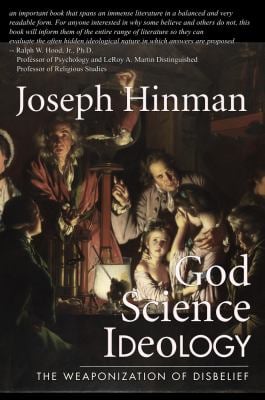
____________________________ God,Science, and ideology,a book by Joseph Hinmman

God.Science, and ideology, by Joseph Hinman, is a great book. Ot argues that positions which teach the superiority of science over religion in such a way as to negate the truth content of the religious is not a scientific position but an ideological one. The books takes down such atheist greats as Dawkins and discusses the strongest God arguments.

This is an important book that spans an immense literature in a balanced and very readable form. For anyone interested in why some believe and others do not, this book will inform you of the entire range of literature in which not only can the proper questions be asked, but the reader can evaluate the often hidden ideological nature in which answers are proposed Ralph W. Hood, Jr., Ph.D.
Professor of Psychology and LeRoy A. Martin Distinguished Professor of Religious Studies

"Hinman is highly stimulating, brilliant in places. It is rare to find a book so exuberant yet still rational."

--Lantz Fleming Miller, Ashoka University

https://www.amazon.com/God-Science-Ideology-examining-religious-scientific/dp/0982408765

Sunday, August 04, 2024

Debunking the atheist's fortress of facts


This is part of a larger framework that includes the theories of Thomas Kuhn and argues that science is a social construct. That part of it will be saved for another time. This section, although long is answering an argument that I see atheist touting all the time. They always deny it but it's unmistakably there. Section one documents that there such an attitude among atheists and gives some preliminary arguments. Section 2 shows the truly unscientific nature of the attitude.

Nowhere is the arrogance of humanity more apparent than in the many tendencies to treat God as a big man in the sky and try to subject him to scientific analysis. This is a move that most thinkers of the previous century would have laughed themselves silly over. One cannot second guess the nature of the divine by insisting that God operates under rules like a biological organism? Richard Dawkins is a major purveyor of this view but Victor Stinger is even more so. Stinger, in his God the Failed Hypothesis[1] is the genius who stated the "who created God" thing, one of the hallmarks of atheist ignorance. The method is super simple. Stinger does mess not with trying to probe the heavens or reaching beyond our tiny little sample of reality on this dust mote, he does it the "obvious way" by creating a straw man argument for God then knocking it down. The straw man is based upon a selective understanding guaranteed to denude belief of a factual basis and to load a pile of facts in the unbelieving camp so as to create the impression that atheism is a choice based upon the full brunt of scientific fact, and religious belief has nothing going for it but ignorance and superstition. This tactic I call the “fortress of facts.” The fortress of facts is something atheists deny vehemently but it’s obvious in almost every argument they make. Most scientifically inclined observers know that science is not merely the accumulation of a pile of facts. Science is not about proving facts or manufacturing a pile of facts so much as it is about testing hypothesis in a systematic fashion. Science is more about disproving than about proving. There are aspects of reality that beyond the ability of science to disprove. God is one of these. Yet, even though atheists will deny the words “fortress of facts” if we observe the way they argument this is undeniable consequence of their logic and their approach.

Science and the “God Hypothesis.”

The whole idea of referring to God as an hypothesis in the first place is an attempt to classify the God concept under the rubric of scientific domain. If God is an hypothesis then he’s something science can dispute, because science is about testing hypothesis. Of course the notion weather or not God can be so classified is a theological question and must be answered theologians. Since atheist denuded theology of any valid content (through sheer mocking and ridicule) then there’s no one to respond who atheists wont mock and ridicule. Thus truth by stipulation is written into the atheist ideology. This overall move turns upon the fortress of facts idea because a hypothesis without fact can’t be maintained. Thus while denying up front that they think about science in this manner we can see the fortress of facts as the basic assumption in the over all atheist approach to belief. We see the fortress of facts at work in the writings of Singer:

says Victor Stenger in "God: The Failed Hypothesis." The book is subtitled, "How science shows that God does not exist." Chapter by chapter, the author shows that the existence of God would suggest certain realities in the world that would be verifiable by scientific inquiry. But the data don't support these would-be realities, thereby providing evidence that no God exists. Stenger, retired professor of Philosophy at University of Colorado and of Physics and Astronomy at University of Hawaii, is successful in this line of reasoning because of his clearly stated definition that he is not just talking about any kind of god, but specifically the capital-g God of the Judeo-Christian-Islamic tradition.[2] We can see the assumption of the fortress of facts in Skeptic Magazine article reviewing[3] Stinger’s book: “conspicuous by his Absence.” "Stinger lays out the evidence from cosmology, particle physics and quantum mechanics showing that the universe appears exactly as it should if there is no creator." This is a factual approach. The facts show God doesn’t exist because if he did things would be different. To show this we use our tremendous fact finding potential in science.

How does he reckon it should if there is no God? He constructs his own fundamentalist driven version of what God would be like. Of course he has no knowledge of that. It's really a disproof of the atheist big nightmare of the fundamentalist concept of God, in other words, a straw man argument not a real disproof of anything valid. Beyond that, which is a deal breaker--because how you set up the inquiry in the first place determines everything-- there are other criticisms. For example his take on the issue of prayer studies. This is also proof of the "fortress of facts" concept which I am always pointing out that atheist ideology teaches. No atheist has of yet accepted the notion when I point it but it's clear that they argue from it all the time. The idea science gives them a big pile of facts but we believers have no facts. The facts are going to tell us if we can believe in God or not, of course the facts are only facts if they are “scientific” (ie in this case that means if they work against belief in God).

For instance, he tackles the question of the efficacy of prayer, in which the followers of these faiths fervently believe. If God exists, he argues, prayers could be shown to have been answered, using verifiable, replicable studies. And indeed, such studies have been conducted, with universally negative results. (Some studies, which supposedly yielded positive results, used flawed methodology and thus the conclusion is dismissible.) "If prayer were as important as it is taken to be by Jews, Christians and Muslims, its positive effects should be obvious and measurable," Stenger concludes. "They are not. It does not appear - based on the scientific evidence - that a God exists who answers prayers in any significant, observable way."[4]

Here again we have the same idea at work, science gives us a fortress of facts that religion can’t match, never mind the fact that we have selected which facts are important to observe and what assumptions about God set up the facts we want to select. For example consider the flip flop that has happened in regard to these prayer studies. Back in the day when they were being done (late 80s, early 90s) they were big news the atheists were on defensive grasping at whatever straws they could to answer, since they had no counter studies and counter data. One of the major arguments they used to make on every message board, every blog, ever news group where this was debated was that you can’t control for outside prayer. The defenders of the studies, such as Dr. Byrd and Dr. Harris did their own straw-clutching to answer this argument about control. Since that time, however, thing have turned around. A study with the largest data base was done that showed very little or no difference in the two groups. The atheists have gone ape making the argument that “prayer is disproved.” The study detractors (now the theists) argue “you can’t control for outside prayer, the argument atheists used to make. The atheists say “O sure you can.” When I point out that they used to make this argument themselves many of them have said “no atheist ever argued that.” How quickly we forget. I remember. I have the article. Gary P Posner did argue it:

The most striking flaw in this study's methodology is one forthrightly acknowledged by Byrd. "It was assumed that some of the patients in both groups would be prayed for by people not associated with the study; this was not controlled for ... Therefore, 'pure' groups were not attained in this study." In other words, the focus of the study - prayer - was "not controlled for," except that three to seven intercessors were assigned to pray daily for each patient in the IP group, and none was assigned to the controls. Thus, although unlikely, it is nevertheless theoretically possible that the control group received as many prayers as did the IP group, if not more.

If "intercessory prayer" was not controlled, except that each IP patient was assumed to have received somewhere between X+3 and X+7 prayers daily, as opposed to X+0 for the control patients, what are we to conclude? That God is conditioned in a Pavlovian manner to automatically respond to the side with the greater number of troops, even though the assigned intercessors had no emotional ties to their patients, and even though the IP patients were otherwise no more worthy of healing as a group than were the controls? Does God not know that the side with fewer troops is in just as much need of assistance? Where is the evidence of his omniscience and compassion?

And what can be said about the evidence for God's omnipotence? It is true, assuming that Byrd's data are valid, that in the IP group, 5 percent fewer patients needed diuretics, 7 percent fewer needed antibiotics, 6 percent fewer needed respiratory intubation and/or ventilation, 6 percent fewer developed congestive heart failure, 5 percent fewer developed pneumonia, and 5 percent fewer suffered cardiopulmonary arrest. But no significant differences were found among the other twenty categories, including mortality, despite explicit prayers "for prevention of ... death." And, reports Byrd, "Even though for [the six seemingly significant] variables the P values were less than .05, they could not be considered statistically significant because of the large number of variables examined. I used two methods to overcome this statistical limitation ... [the] severity score, and multivariant [sic] analysis" (emphasis added).[5]

So what happens if we say Posner was right? These studies don’t measure the truth of prayer because you can’t control for outside prayer? The study that shows no difference is meaningless. Of course the atheists will say but the theist still has no facts to back prayer. Of course they are just selecting the facts that support there view. There are facts that back prayer but they are ignored because they counter the ideological assumptions of naturalism. That will be dealt with in subsequent chapters. The assumptions that Stenger has to make to make his straw man work is that God is exactly as he wants him to be. The reviewer at Simply Einstein (ibid) defends him against the charge of straw man. The logical purist may object that one can't "prove a negative," that one can no more disprove God than disprove the existence of Santa Claus or an invisible unicorn in the backyard. But the fact that most people do believe in God while rejecting the latter two is part of the point. Given no real reason to believe in Santa Claus or invisible unicorns, people reject such beliefs. Yet they hold tenaciously not only to belief in their God, but specifically to the tenets that their religion teaches about him. It is really these tenets that Stinger is addressing. By showing that they are wrong, like the efficacy of prayer or the notion that God fine-tuned the universe specifically for the sake of existence of humanity, the author demonstrates that belief in God is equally unfounded.[6]

Yet this is not much of a defense. The so called "tenets" are self selected to be one's he picks out that he thinks he can beat. No religious creed or Bible passage commands us to believe on the basis of the fine tuning argument. No scientific argument can disprove the notion that God has fine tuned the universe to bear life. The only thing science can prove about fine tuning is that we can't prove it. On the other hand far greater scientists than Stinger say his arguments against fine tuning are not so good. The person answering mail for John Polkinghorne’s website (formerly physicist at Cambridge second only to Hawking, who retired to be a Christian minister) says:

Stenger did some marginally useful scientific work but his claims are far too dogmatic. As for his suggestion that Anthropic Fine tuning is a non-problem because of his simplistic program MonkeyGod that purports to simulate universes and “show” that anthropic universes are commonplace, I know of no serious cosmologist who takes this seriously. Martin Rees’s “Just Six Numbers” is a good guide to the real science.[7]

Polkinghorne himself says: “I have read several of the books expressing the current outburst of militant atheism, but not the two you mention. My impression is that they are polemical rather than presenting reasoned arguments of a truth-seeking kind, and that they largely depend upon attacking caricature distortions of religious belief.”[8]

Others find the straw man to be Stenger's usual method:

Stinger—a retired physicist who is leveraging his scientific background to try to discredit anything and everything that smacks of spirituality—doesn’t respect his intellectual opponents enough to get their positions right; in some instances he appears to deliberately misrepresent their views; and, most important, his own reasoning is characterized by unremitting carelessness. Moreover, there is a method to his carelessness—it enables him to systematically avoid addressing the tough arguments of his opponents. Hence we find him frequently setting up a straw man by misrepresenting the debate as a simple matter of science and reason versus superstition. Once having defined this as the issue, all he needs to do is assume the attitude of an outraged scientist and heap on the ridicule. But if he had done his homework and taken the trouble to really understand the science and logic supporting quantum spirituality, he would have discovered that it is harder to dismiss than he had imagined. Indeed, the more carefully—and yes, critically—one considers the issues, the more one finds quantum spirituality to be eminently worthy of serious consideration, as a plausible and measured approach to the most long-standing and intractable questions at the basis of science.[9]

Stenger doesn't deal with what I consider to be the major God arguments, the ground of being stuff of Tillich and Schleiermacher. Like most of the cult of atheism he's in thrall to his own version of science which is laced with metaphysics. Like most of them they think they are being scientific and philosophical when they denounce philosophy and theology and talk about how science is the only form of knowledge, and then they are bringing ontology in through the back door to put fiber into their world view. Stenger's straw man making is standard procedure for the new atheist. They are always spitting out some line with a dashing air of how theology is stupid so they don't have to read it. They know it's stupid even though they haven't read any. The whole point of showing they haven't read is usually because they are getting the ideas wrong but they never seem to care.

The fortress of facts concept is seen in the works of the high priest of New Atheism, Richard Dawkins.

An atheist before Darwin could have said, following Hume: "I have no explanation for complex biological design. All I know is that God isn't a good explanation, so we must wait and hope that somebody comes up with a better one." I can't help feeling that such a position, though logically sound, would have left one feeling pretty unsatisfied, and that although atheism might have been logically tenable before Darwin, Darwin made it possible to be an intellectually fulfilled atheist.[10]

Intellectually “fulfilled atheist” is code for “we have the facts.” What he’s clearly saying is that it was unsatisfying when we didn’t have the facts, God is still be rejected even though he has no real reason for it, but it’s not satisfying. The only thing that makes it satisfying is when we get a pile of facts. That’s because of the explanatory value. He makes it quite clear this is his motive reason for saying these things that he’s after is expletory power and what constitutes an explanation is a scientifically verifiable fact that can’t be disputed.

An even clearer example:

-Faith, being belief that isn't based on evidence, is the principal vice of any religion. And who, looking at Northern Ireland or the Middle East, can be confident that the brain virus of faith is not exceedingly dangerous? One of the stories told to the young Muslim suicide bombers is that martyrdom is the quickest way to heaven — and not just heaven but a special part of heaven where they will receive their special reward of 72 virgin brides. It occurs to me that our best hope may be to provide a kind of "spiritual arms control": send in specially trained theologians to deescalate the going rate in virgins.[11]

As juxtaposed to the next paragraph:

Well, science is not religion and it doesn't just come down to faith. Although it has many of religion's virtues, it has none of its vices. Science is based upon verifiable evidence. Religious faith not only lacks evidence, its independence from evidence is its pride and joy, shouted from the rooftops. Why else would Christians wax critical of doubting Thomas? The other apostles are held up to us as exemplars of virtue because faith was enough for them. Doubting Thomas, on the other hand, required evidence. Perhaps he should be the patron saint of scientists.[12]

The implication is we have the facts, that are why we understand the world. Further implication is that the world is only the surface level of physical workings. The first paragraph is clearly arguing from guilt by association. It’s asserting that if there are some brutal dangerous religious people they must be that way because of religion; therefore all religious people are potentially that way. If a Christian apologist for example were to talk about the Nazis and how their scientifically engaged members conducted inhumane experiments on Jews in concentrating camps, and tried to drawn conclusions about the dangerous nature of science based upon that association, the atheists would set up a howl. It would not take the atheist long to see the fallacy of guilt by association in that case. Never mind that, and let’s also skim over the fact that he’s using a straw man version of faith tailored to make it seem more stupid. While faith per se is not based upon facts there’s nothing in the nature of faith that causes one to ignore facts. He tried to incriminate the joy of discovery which is he hardly in a position to critique since he’s never experienced and can’t understand it. That sense of joy has nothing to do with ignoring facts. For me part of that joy came form the realization that my faith is backed by facts. The more important point is that he’s placing the tailored example of no facts along side the self selected example of fact finding to create the sense of the skeptic haing a huge pile of pile of fact that confirms his world view while in fac the believe purposely rejects having facts. That is a perfect example of the fortress of facts mentality.

While it is anecdotal, evidence from the popular level shows, to some extent, the effects of this kid of thinking upon the rank and file of the atheist movement. There’s a popular website by one of the troops called “God is Imaginary.” It’s far from special, just run of the mill message board sloganeering and propaganda. It does express the fortress of facts mentality clearly

. “God is imaginary: Proof no 11, notice that there is no scientific evidence.”

"There is no scientific evidence indicating that God exists. We all know that. For example:

• God has never left any physical evidence of his existence on earth.

• None of Jesus' "miracles" left any physical evidence either. (see this page)

• God has never spoken to modern man, for example by taking over all the television stations and broadcasting a rational message to everyone.

• The resurrected Jesus has never appeared to anyone. (see this page) • The Bible we have is provably incorrect and is obviously the work of primitive men rather than God. (see this page)

• When we analyze prayer with statistics, we find no evidence that God is "answering prayers." (see this page)

• Huge, amazing atrocities like the Holocaust and AIDS occur without any response from God.

• And so on…

Let's agree that there is no empirical evidence showing that God exists.

If you think about it as a rational person, this lack of evidence is startling. There is not one bit of empirical evidence indicating that today's "God", nor any other contemporary god, nor any god of the past, exists. In addition we know that:

1. If we had scientific proof of God's existence, we would talk about the "science of God" rather than "faith in God".

2. If we had scientific proof of God's existence, the study of God would be a scientific endeavor rather than a theological one.

3. If we had scientific proof of God's existence, all religious people would be aligning on the God that had been scientifically proven to exist. Instead there are thousands of gods and religions.

The reason for this lack of evidence is easy for any unbiased observer to see. The reason why there is no empirical evidence for God is because God is imaginary."[13]

The major thrust of that bit of flim flam is that “we” (our side) we have all the facts in a great big pile and they don’t have a single one. Most thinking atheists and most scientifically minded atheists put it in terms of “explanatory power.” Appeal to God doesn’t explain the world as well as does science. That’s a more sophisticated version of the fortress of facts. Dawkins has a variation on this argument.

Unfortunately, Dawkins pushes envelope too far. He tries to turn the simple desire to know into a moral virtue in order to make it seem that science is more moral than religion:

Humans have a great hunger for explanation. It may be one of the main reasons why humanity so universally has religion, since religions do aspire to provide explanations. We come to our individual consciousness in a mysterious universe and long to understand it. Most religions offer a cosmology and a biology, a theory of life, a theory of origins, and reasons for existence. In doing so, they demonstrate that religion is, in a sense, science; it's just bad science. Don't fall for the argument that religion and science operate on separate dimensions and are concerned with quite separate sorts of questions. Religions have historically always attempted to answer the questions that properly belong to science. Thus religions should not be allowed now to retreat away from the ground upon which they have traditionally attempted to fight. They do offer both a cosmology and a biology; however, in both cases it is false.[14]

He’s saying that religion is trespassing upon questions of science, yet he doesn’t even bother to point out that religion was there first. Just because people in the prehistoric and ancient worlds mixed religious and scientific explanations—not having developed science religion was all they had to fall back on—doesn’t mean that’s the reason religion came to exist. As science has developed there is no reason why religious people can use it to understand questions that fall into he overlap between the two domains. The questions he’s discussing are overlap questions and modern thinking religious people have used to science to help answer them. In making this point he asserts that science is the fact giving endeavor while religion is content to have faith and do without facts. Of course that’s not a good description of most modern thinking religious people.

Dawkins wants us to think in terms of the fortress of facts, nothing provides scientific facts like science does. Of course he’s not mentioning the fact that it’s only one kind of explanation. There are facets to the question about the origin of life than just the physical workings of evolution. There are questions people have asked for thousands of years that science is not prepared to answer. There are questions that science is not allowed to answer because they are out of its domain. These are questions about the meaning of the life, the reason why life is, and the ultimate “destiny” (for want of a better word) of humans. These are things science can’t tell us they are the reasons religion exits. So the kinds of facts that religion provides the uses for faith are in a different area than those provided by science. The nature of the atheist view point is self selected to focus only upon the kinds of facts that science provides and it offers a biased, fallacious and inaccurate view of religious thinking. It also provides a distorted understanding of what science is. Science is not a pile of facts. Science is not even about fact making. Science is about hypothesis testing; it’s not about proving facts but testing for verification and falsifying premises. The overall “big picture” painted by science is a lot more dependent upon they a particular culture views life than it is the demonstration f a pile of facts.

Not only is this notion of science as a big pile of facts that guarantees an accurate understanding of reality a view that most scientists don’t take to the understanding of science, it’s specifically contradicted by the vast majority of historians and philosophers of science. While there is a great of contradiction between philosophers of science, the one thing they all agree on is that this fortress of facts idea is nonsense. First let’s turn to two major philosophers of science, Karl Popper and Thomas S. Kuhn. These two are destined to be linked since they had a major showdown to so speak over Kuhn’s theory, in the early to mid 60s. In that day Kuhn was thought to have won, his views went on to define philosophy of science for about three decades. I suspect that in this day popper is more popular and is probably now thought to have won. In reality, however, I think talk of who won is foolish because no only is the field still evolving but it’s diversifying and moving away form both, so neither of them won really. There is coming to be a plurality of models. Before going into that I’m going to examine Popper first, then Kuhn. What all of this evolving plurality agrees upon is that science is too complex and problematic to be regarded as anything like a fortress of facts!

[1] Victor J. Stenger, God: The Failed Hypothesis:How Science Shows that God Does Not Exist. Amherst, NY: Prometheus Books, 2007.

[2] Jerry Petersen, Simply Einstein, Review “Victor J. Stinger, God the Failed Hypothesis.” Online web page:

URL http://simplycharly.com/einstein/victor_stenger_god_the_failed_hypothesis_review.html visited Jan 31, 2012.

[3][iii] David Ludden "Conspicuous by His Absence". Skeptic. April 4, 2007. http://www.skeptic.com/eskeptic/07-04-04.html. Retrieved 2007-10-17. visited Jan 31,2012

[4] Petersen, ibid

. [5] Secular web

Gary P. Posner, “God in the ICU? A Criticique of San Franscisco Hospital Study of Intercessory prayer and Healing.” Originally published in Free Inquiry spring 1990, Secular Web URLhttp://www.infidels.org/library/modern/gary_posner/godccu.html

[6] Petersen,ibid

[7] John Polikinghorne’s staff, formerly on Polikinghorne’s official website, now Star Course, “Polikinghorne Q and A, Stenger and Hitchens. On line reseruce: URL http://www.starcourse.org/jcp/qanda.html#Stenger_and_Hitchens visited Summer 2011.last visited Jan 2 2012.

[8] Polkinghorne,ibid

[9] David Sharf, “Pseudo Science and Stenger’s Quantum gods: Mistaken, Misinformed, and Misleading.” NeuroQuantology, Vol 8, No 1 (2010), online copy URL: http://www.neuroquantology.com/index.php/journal/article/viewArticle/272 visited Jan 2 2012 Sharf received his Ph.D. in 1986 from Johns Hopkins University, in the philosophy of physics. The title of his dissertation was: Quantum Mechanics and the Program for the Unity of Science [10] Richard Dawkins, The Blind Watchmaker. Why The Evidence of Evolution Reveals a Universe Without Design. New York: W.W. Norton & Company,inc. 2004, 6.

[11] Richard Dawkins, “Is Science a Religion,” The Humanist: A Magazine of Critical inquiry and Social Concern, Jan-feb 1997, on line copy URL: http://www.thehumanist.org/humanist/articles/dawkins.html

visited Feb 2, 2012

[12] ibid

[13] “God is Imaginary” Example no 11 no scientific evidence URL: http://godisimaginary.com/i11.htm

visited 1/30/2012

[14] Dawkins, ibid.


God,Science, and ideology,a book by Joseph Hinmman

This book makes the argument that those say science beats religion are not speaking scientifically but ideologically

This is an important book that spans an immense literature in a balanced and very readable form. For anyone interested in why some believe and others do not, this book will inform you of the entire range of literature in which not only can the proper questions be asked, but the reader can evaluate the often hidden ideological nature in which answers are proposed

Ralph W. Hood, Jr., Ph.D.
Professor of Psychology and LeRoy A. Martin Distinguished Professor of Religious Studies


"Hinman is highly stimulating, brilliant in places. It is rare to find a book so exuberant yet still rational."

--Lantz Fleming Miller, Ashoka University

https://www.amazon.com/God-Science-Ideology-examining-religious-scientific/dp/0982408765
Sunday, July 28, 2024

The Atonement: God's Solidarity With Humanity

 Photobucket


I.The Atonement: God's Solidarity With Humanity.

A. The inadequacy of Financial Transactions

Many ministers, and therefore, many Christians speak of and think of Jesus' death on the cross as analogous to a financial transaction. Usually this idea goes something like this: we are in hock to the devil because we sinned. God pays the debt we owe by sending Jesus to die for us, and that pays off the devil. The problem with this view is the Bible never says we owe the devil anything. We owe God. The financial transaction model is inadequate. Matters of the soul are much more important than any monetary arrangement and business transactions and banking do not do justice to the import of the issue. Moreover, there is a more sophisticated model; that of the sacrifice for sin. In this model Jesus is like a sacrificial lamb who is murdered in our place. This model is also inadequate because it is based on a primitive notion of sacrifice. The one making the sacrafice pays over something valuable to him to apease an angry God. In this case God is paying himself. This view is also called the "propitiatory view" becuase it is based upon propitiation, which means to turn away wrath. The more meaningful notion is that of Solidarity. The Solidarity or "participatory" view says that Jesus entered human history to participate in our lot as finite humans, and he died as a means of identifying with us. We are under the law of sin and death, we are under curse of the law (we sin, we die, we are not capable in our own human strength of being good enough to merit salvation). IN taking on the penalty of sin (while remaining sinless) Jesus died in our stead; not inthe mannar of a primitive animal sacrifice (that is just a metaphor) but as one of us, so that through identification with us, we might identify with him and therefore, partake of his newness of life.

B. Christ the Perfect Revelation of God to Humanity

In the book of Hebrews it says "in former times God spoke in many and various ways through the prophets, but in these latter times he has spoken more perfectly through his son." Jesus is the perfect revelation of God to humanity. The prophets were speaking for God, but their words were limited in how much they could tell us about God. Jesus was God in the flesh and as such, we can see clearly by his character, his actions, and his teachings what God wants of us and how much God cares about us. God is for humanity, God is on our side! The greatest sign of God's support of our cause as needy humans is Jesus death on the cross, a death in solidarity with us as victims of our own sinful hearts and societies. Thus we can see the lengths God is will to go to to point us toward himself. There are many verses in the Bible that seem to contradict this view. These are the verses which seem to say that Atonement is participatory.

C. Death in Solidarity with Victims

1) Support from Modern Theologians

Three Major Modern Theologians support the solidarity notion of atonement: Jurgen Moltmann (The Crucified God), Matthew L. Lamb (Solidarity With Victims), and D.E.H. Whiteley (The Theology of St. Paul).In the 1980s Moltmann (German Calvinist) was called the greatest living protestant theologian, and made his name in laying the groundwork for what became liberation theology. Lamb (Catholic Priest) was big name in political theology, and Whiteley (scholar at Oxford) was a major Pauline scholar in the 1960s.In his work The Crcified God Moltmann interprits the cry of Jesus on the cross, "my God my God why have you forsaken me" as a statement of solidarity, placing him in identification with all who feel abandoned by God.Whiteley: "If St. Paul can be said to hold a theory of the modus operandi [of the atonement] it is best described as one of salvation through participation [the 'solidarity' view]: Christ shared all of our experience, sin alone excepted, including death in order that we, by virtue of our solidarity with him, might share his life...Paul does not hold a theory of substitution..." (The Theology of St. Paul, 130)An example of one of the great classical theologians of the early chruch who held to a similar view is St. Irenaeus (according to Whiteley, 133).

2) Scriptural

...all of us who were baptized into Christ Jesus were Baptized into his death.? We were therefore buried with him in baptism into death in order that just as Christ was raised from the death through the glory of the father, we too may live a new life. If we have been united with him in his death we will certainly be united with him in his resurrection.For we know that the old self was crucified with him so that the body of sin might be rendered powerless, that we should no longer be slaves to sin.--because anyone who has died has been freed from sin.Now if we have died with Christ we believe that we will also live with him, for we know that since Christ was raised from the dead he cannot die again; death no longer has mastery over him; the death he died to sin he died once for all; but the life he lives he lives to God. In the same way count yourselves dead to sin but alive to God in Chrsit Jesus.(Romans 6:1-5)

In Short, if we have united ourselves to Christ, entered his death and been raised to life, we participate in his death and resurrection though our act of solidarity, united with Christ in his death, than it stands to reason that his death is an act of solidarity with us, that he expresses his solidarity with humanity in his death.

This is why Jesus cries out on the cross "why have you forsaken me?" According to Moltmann this is an expression of Solidarity with all who feel abandoned by God.Jesus death in solidarity creates the grounds for forgiveness, since it is through his death that we express our solidarity, and through that, share in his life in union with Christ. Many verses seem to suggest a propitiatory view. But these are actually speaking of the affects of the solidarity. "Since we have now been justified by his blood, how much more shall we be saved from God's wrath through him! For if when we were considered God's enemies, we were reconciled to him through the death of his son, how much more, having been reconciled, shall we be saved through his life! What appears to be saying that the shedding of blood is what creates forgiveness is actually saying that the death in solidarity creates the grounds for reconciliation. IT says we were enemies then we were reconciled to him through the death, his expression of solidarity changes the ground, when we express our solidarity and enter into the death we are giving up to God, we move from enemy to friend, and in that sense the shedding of blood, the death in solidarity, creates the conditions through which we can be and are forgiven. He goes on to talk about sharing in his life, which is participation,

solidarity, unity. D. Meaning of Solidarity and Salvation.

Jurgen Moltmann's notion of Solidarity (see The Crucified God) is based upon the notion of Political solidarity. Christ died in Solidarity with victims. He took upon himself a political death by purposely angering the powers of the day. Thus in his death he identifies with victims of oppression. But we are all vitims of oppression. Sin has a social dimension, the injustice we experience as the hands of society and social and governmental institutions is primarily and at a very basic level the result of the social aspects of sin. Power, and political machinations begin in the sinful heart, the ego, the desire for power, and they manifest themselves through institutions built by the will to power over the other. But in a more fundamental sense we are all victims of our own sinful natures. We scheme against others on some level to build ourselve up and secure our conditions in life. IN this sense we cannot help but do injustice to others. In return injustice is done to us.Jesus died in solidarity with us, he underwent the ultimate consequences of living in a sinful world, in order to demonstrate the depths of God's love and God's desire to save us. Take an analogy from political organizing. IN Central America governments often send "death squads" to murder labor unionists and political dissenter. IN Guatemala there were some American organizations which organized for college students to go to Guatemala and escourt the leaders of dissenting groups so that they would not be murdered.

The logic was that the death squads wouldn't hurt an American Student because it would bring bad press and shut off U.S. government funds to their military. As disturbing as these political implications are, let's stay focused on the Gospel. Jesus is like those students, and like some of them, he was actually killed. But unlike them he went out of his way to be killed, to be victimized by the the rage of the sinful and power seeking so that he could illustrate to us the desire of God; that God is on our side, God is on the side of the poor, the victimized, the marginalized, and the lost. Jesus said "a physician is not sent to the well but to the sick."The key to salvation is to accept God's statement of solidarity, to express our solidarity with God by placing ourselves into the death of Christ (by identification with it, by trust in it's efficacy for our salvation).

E. Atonement is a Primitive Concept?

This charge is made quite often by internet-skeptics, especially Jewish anti-missionaries who confuse the concept wtih the notion of Human sacrifice. But the charge rests on the idea that sacrafice itself is a premative notion. If one committs a crime, someone else should not pay for it. This attack can be put forward in many forms but the basic notion revolves around the idea that one person dying for the sins of another, taking the penalty or sacrificing to remove the guilt of another is a primitive concept. None of this applies with the Participatory view of the atonement (solidarity) since the workings of Christ's death, the manner in which it secures salavtion, is neither through turning away of wrath nor taking upon himself other's sins, but the creation of the grounds through which one declares one's own solidarity with God and the grounds through which God accepts that solidarity and extends his own; the identification of God himself with the needs and cares of his own creation.


Sunday, July 21, 2024

Fun with the modal argument


This is one of the most complex issues there is,especially Hartshorne's version which I use,or one similar to his. On Victor Reppert's Dangerous Idea Blog I found our old friend Stardust makimng the claim that there are no valid arguments for God. As it turns out he didn't know what valid meant. He didn't know in logic it refers to the technical presentation of the argumet Arguments must be both valid and sound, soundness refers to truth. After dancing around that for a bit I decided to just challenge him to debate the modal argument

My argument:

1. God is either necessary or impossible.
2. God can be conceived without contradiction.
3. Whatever can be conceived without contradiction is not impossible.
4. God is not impossible.
5. God is necessary.
6. That God's existence is necessary is a good reason to believe that God is real.
7. Therefore, believe in God's reality is warranted.

Notice I don't say god's "existence," Those of you who follow my blog and have seen my discussion of Tillich will understand this, for the rest of you it';snot important. Notice also that I argue in terms of warrant and not proof. Both Hartshorne and Plantinga refuse to contend they have prove the existence of God but Plantingia argues that the nodal argument is warrant for belief.[1]

Dusty argued:

"IF God exists THEN it is logically necessary that(God exists)"Only in the tautological sense that this statement applies to all existent things. If a thing exists then it is necessary that it exists since it is existent. That makes god nothing special.

Metacrock (me):

wrong, you are not paying attention ,What is being said is that there are only two possibles regarding God's modal status, either necessary or impossible. In other words no middle ground, if God exists he must exist he can't be a maybe, he could not have failed to exist, if there is a God there had to be a God. The only alternative is that if God does not exist it's impossible that God could have existed God either exists and it is necessary that he does or he doesn't exist and if so it's because he could not exit.

Dusty:

If you mean some notion of alternative possibilities that makes god special necessarily then no, one can speculate that something gave rise to god, god's god, but maybe god's god died, though previously greater than god, but now dead, so now god exists.


Meta:

Nope doesn't work that way. God has to be eternal or he can't be at all., he could not have a cause.If God exists he exists as a necessity, A necessity doesn't have a cause,if it did it would be contingent.

Dusty

The speculative alternative formulations are unbounded, hence the assertion of necessity is false.

Meta

wrong modal operators are not "unbounded." Yes there is a limitless field of speculation concerning God but NOT where modal operators are concerned.

Dusty

Fail from the git go, but then, you did not fully define your terms so you might think you have some definitional alternatives to these failings.

Line 3 is a non-sequitur. Just because we can imagine something that does not contradict itself as we imagine it does not mean the reality of the universe can possibly accommodate a realization of that fantasy.
Meta

p3 is the lynch pin of the thing, it's anything but irrelevant, the argent turns upon it.

[This argument is about logic and it came in the discussion when we where arguing about validity.So how constriction is regarded in logic really matters.The concept of impossibility is about logical contradiction. Since impossibility is obtained by being illogicality contradictory the lack of contradiction means possibility,]

Dusty

Hartshorne is asserting that mere fantasy is sufficient to allow for external realization. He obviously has a hard time separating fantasy from reality, but that is typical of the theistic mind.
Meta

No logician in the world thinks that, he is not saying that,

[He's equating using logic to Establishment of truth by logic with fantasy because he thinks empiricism is the only form of knowledge. As iv say below his position of empiricism as the only true knowledge cannot be proved empirically, He has to use logic to establish probability then to connect probability to empiricism.We know logic can tell us some things about the world. For example we don't have to go look for square circles we know there are none because the concept contradicts itself. For positive understanding of truth content thorough logic see below.]

Dusty

The whole argument hinges on thinking makes it so, an absurd notion. Why anybody takes this nonsense at all seriously is truly a wonderment for me.
Meta

It's so sophomoric to reduce the work of a recognized great thinker to "he thinks thinking makes it so." No he did not think that.He thought that the ontological principle is true. in other words if the terms of a proportion spell out the truth content of the proposition when understood then we have to assume the truth of the argument if the prepositions are valid.

Tillich's example of this principle is that the principle of truth cannot be disputed without admitting to the validity of the principle. One can only say the principle is false if one is willing to admit that truth exists and this principle departs from it, Thus to dispute the truth of truth is to accept the proportion that truth exists. Truth can never be disputed as truth or as sound based upon a logical denial. This is Duane Olson explaining Tillich's view:

The indubitability of the norm of truth is shown by a reductio argument regarding the process of knowing. In different places and in different ways Tillich points out that denial and doubt in knowing presuppose the norm of truth.[17 in the article] I want to systematize Tillich’s reductio argument at this point to show that all major theoretical postures presuppose this norm.

Sources

[1] Donald Wayne Viney and George W. Shields "Charles Hartshorne Theistic and Anti-theistic Arguments," Internet Encyclopedia of Philosophy: a Peer Reviewed Academic Resource. Internet online resource. no date indicated, URL: http://www.iep.utm.edu/hart-t-a/#H1 (accessed 1/15/17).

Donald Wayne Viney Email: don_viney@yahoo.com Pittsburg State University U. S. A.

George W. Shields Email: George.shields@kysu.edu Kentucky State University U. S. A.

[2]Duane Olson, “Pual Tiillich and the Ontological Argument,” Quodlibet Journal vol. 6, no 3, July-sep 2004, online journal, URL: http://www.quodlibet.net/articles/olson-tillich.shtml visited 8/4/10 Olson has two foot notes in this quotation which are important to examine:

1) “In one of the more significant recent monographs on Tillich’s thought, Langdon Gilkey flatly states “[Tillich] denied that an argument for the transcendent power and ground of being was possible” (Gilkey on Tillich (Wipf and Stock Publishers, 2000), 105). Gilkey never discusses Tillich’s use of the traditional arguments.” (2) “In his detailed and extensive volume on the ontological argument, Graham Oppy mentions Tillich’s name only once in the literature review, and he never analyzes any of Tillich’s statements (Ontological Arguments and Belief in God (Cambridge: Cambridge University Press, 1995), 275). To Oppy’s credit, he discusses a type of argument to which Tillich’s is related. I comment on Oppy’s analysis of this argument in the final section of this paper.”

Sunday, July 14, 2024

Death to Euthyphro!


Wes Morriston, philosopher from University of Colorado, Boulder, writes an excellent [1] paper against divine command theory and specifically attacking William Lane Craig. The guys over at secular outpost (or as I like to call it, "Kill Bill's ideas) link to that article. Divine command theory in it's simple direct form says that what is good is that which God commands and it is good because God commands it. The paper is very long and covers a lot of ground, I have isolated what I think is one of the  key points and i will deal with just that small but important section: the ground of moral duty as grounded in the divine.

Craig is answwering the Euthyphro dilemma, This is a problem raised by Plato in the from of Socrates question to Euthyphro, " is found in Plato's dialogue Euthyphro, in which Socrates asks Euthyphro, "Is the pious (τὸ ὅσιον) loved by the gods because it is pious, or is it pious because it is loved by the gods?"  [2] The answer Craig takes to it is one I have also argued for years, that the good flows out of God's character so it's neither arbitrary now does it constitute a standard above God.

Morriston takes issue with Craig at the point where he says the good "flows out of God's character.

One might wonder about the phrase ‘flow necessarily from his moral nature’. Does it mean that each divine command is necessitated by God’s moral nature – that God’s moral nature makes it impossible for him not to command what he does in fact command? Or does it mean merely that it is necessary that all divine commands flow from God’s moral nature, where the ‘flow from’ relation is understood in a weaker sense ?Craig doesn’t say.[3]

He's really conflating two different issues here: (1) do all commands flow equally from God's nature (2) could god chose to violate his nature? The question here is still veg because we are talking about Biblical commands? Or, are we talking about the human capacity to be moral itself? The latter is the kjey to the answer. Paul tells us the moral law is written on the heart (Romans 2:6-14). C.S. Lewis shows a great harmony in many Axial age civilizations as far flung as Briton and China. Although there are problems will will bracket them for fn.[4] These similarities of course don't prove divine inspiration but they may indicate that if human moral nature is God given then God's commands must be generally flowing through that basic moral nature and even though filtered through cultural constructs the basic sense of moral goodness grounded in agapic sense of human dignity is possible universally. So the latter "weaker sense" would come closer to the answer, although I would not think of it as "weaker."

But whatever the details, it’s clear that the main point of the claim that God’s commands ‘flow necessarily from his moral nature’ is to head off a familiar objection to the divine command theory. It will be convenient to refer to it as ‘ the arbitrariness objection’. It goes something like this. Either God has good reasons for his commands or he does not. If he does, then those reasons (and not God’s commands) are the ultimate ground of moral obligation. If he does not have good reasons, then his commands are completely arbitrary and may be disregarded. Either way, the divine command theory is false.[5]
That's a fair assessment of the dilemma, and the answer is all moral motions ultimately point to love. God's character is love, thus there is warrant for the assertion that Divine love stands behind morality that God's  commands are neither arbitrary nor are they stemming from a source higher than God. "Those reasons" are bound up in God's character, They are of concern to God because he is love. Obviously they are not "completely arbitrary since they arise out of the same basic aspect of who and what God is. The question about the goodness of reasons is transgression upon the concept of the transcendental signified. Truth is what is and the basis of what is is the ground being ie God). Thus God's reasons are a priori good not because they arbitrarily manufacture good via command but because they stem from the nature of God which is the ground of being. This idea that God's commands are arbitrary ( the "arbitrariness objection") is regarded as an ace in the hole by many skeptical philosopjhers.

Some philosophers think the arbitrariness objection is decisive (Shafer-Landau (2004), 80–81). But Craig thinks his version of the divine command theory is completely untouched by it. To see why, consider the duty to be generous to those in need. On Craig’s account, we can endorse all three of the following claims.

(A) God has a good reason for commanding generosity: generosity is good.

(B) Generosity is good because, and only because, God is (essentially) generous.

(C) Nevertheless, it takes a divine command to turn generosity into a duty for us.
Given (A), it might be thought that there is nothing objectionably arbitrary about God’s commanding generosity. Given (B), the goodness of God’s reason for issuing this command is rooted in his moral nature; it is not therefore independent of God. (C), finally, assures us that it is God’s command, and not merely the goodness of generosity, that raises it to the level of a moral imperative.[6] 
I take issue with the last sentence and with B to which it refers. "Generosity is good because, and only because, God is (essentially) generous." Basically true but it requires some tweaking that zi think matters. It's not just that God is generous so requires that we be generous but that generosity is a of love, it's an expression of love in the agapic sense., The reason It is played that generosity is good only because God is generous is to avoid the prospect of atheists claiming they can be generous without God. Of course that's  begging the question unless it's answering a certain kind of moral argument for God. If God exists it's legitimate to think that goodness flows from God's nature, If there is no God we are just Whistling in the dark anyway. From a purely metaethical standpoint generosity could be grounded in any number of things such as social contract theory, but they would all have a hard time establishing an ought denontologically without going teleological. It would be more certain to assume grounding in God. But switching from answering Euthephro a God argument would change the trajectory of the answers.

"Many questions remain. Could God have failed to command generosity? Could generosity have failed to be a duty ? Just what degree of generosity is required ? And why did God choose to require just that degree of generosity rather than some other ? " If love is the background of the moral universe, as is my assumption, (ala Joseph Fletcher) [7] then the direct proximity of God's will to a specific command might be less important in terms of metaethical theory than understanding the nature of love. In other words, rather than seeking to pin down a list of rules we need to be seeking ways to learn to love people. Of course that doesn't mean it's unimportant that God issues a particular command. Yet the important thing is not keeping rules but internalizing values of the good.

At this point he moves on to a second objection. If God turned around tomorrow and ordered something that is now evil such as eating children would it then become good to do so? Craig says can't happen it's opposed to God's nature.[8] That should be enough for rational people. But if you are an atheist looking to throw a wrench in the works of belief, or a philosopher, no it's not. If you are both well better start looking for that eye of the needle. "Even if such commands are incompatible with God’s nature, isn’t it still true that according to the divine command theory eating our children would be morally obligatory if – per impossible – God commanded it?" It's another version of  can God make a rock so big he can't lift it? The answer I've always given to that is "why should we expect God to do non sense.?"  It's a cleaver question for skeptics to ask because it's a perfect double bind. If we do say "well theoretically if God did command even God would be wrong," we have relativized God's authority. If we say no we relativize his goodness. Either way we make belief in higher power seem silly.

Morriston kind of concedes that the question doesn't make sense and thus it doesn't matter what is said but he still concludes in such a way as to raise doubt with the oblivious:

Remember that for Craig God is, necessarily, a perfect being. If that is understood, then it really doesn’t matter to Craig’s position whether it’s impossible for a perfect being to command such a thing. Why ? Because if a perfect being commanded it, the being would have a morally sufficient reason for doing so; and if – per impossibile, perhaps – a perfect being had a morally sufficient reason for commanding us to eat our children, we should do it. If I am right about this, then Craig’s divine command theory escapes refutation – not for the reason he gives, but rather because the alarming-sounding counterpossibles implied by it turn out to true! 10 What’s so special about being God-like? Given fairly standard assumptions about God’s moral nature, [9]

The real problem is that the skeptics have underrated the scope of God's relation to reality. We are not just talking about the most powerful being. They approach it like the question is "this powerful guy is not like this but what if he was.?" It's not about the will of a powerful guy. It's about the nature of reality and trust and the relationship of that to love itself. Like the rock issue I refuse to believe that truth can be stumped by nonsense. Truth is what is (a simplified version of correspondence theory) and God is Being itself. Love is the background of the moral universe because God is love and God is the basis of reality. Thus if God is love, truth, and being. Thus morality is an extension of the good, and the good is wrapped up with the nature of truth and being. We must understand particular moral codes as best we can having filtered moral motions through culture. There is a reality back there behind it all that can't be cheated by questions like the one about the rock.


[1] Wes Morriston, "God and the ontological foundation of morality," Religious Studies,   Cambridge University Press 2011 (2012) 48, 15–34 f doi:10.1017/S0034412510000740 URL:
http://spot.colorado.edu/~morristo/DoesGodGround.pdf  accessed 2/27/2016.

 WES MORRISTON Department of Philosophy, University of Colorado, Boulder, CO 80309-0232 email: Wes.Morriston@Colorado.EDU

[2]Plat, "Euthephro," Five Dialogues, 10a, or see on line copy, see "Euthephro" by Plato,  Translated by Benjamin Jowet, Internet archieve UROL:http://classics.mit.edu/Plato/euthyfro.html

[3] Morriston, op. cit. 18.

[4] C.S. Lewis, The Abolition of man: With Reflection on Education With Special Reference to The Teaching of English in the Upper Forms of Schools. New York, NY: Harper One, 1971, 83.
The problem with this is that it's limited to a segment of history from a period known as the Axial age, roughly from the 900 to 200 BC. The term is from Karl Jaspers. It excludes new world, Africa, Russian steppes and times before and after. Bit it is probably the best attempt to show universal moral sense. It does at least show large segments of humanity share similar moral motions.

[5] Morriston, op.cit., 18-19

[6] Ibid. 19-20

[7] Joseph Fletcher, Situation Ethics The new Moraloty.Louisville, Lomdon:  Westminster John Knox Press. 1966,    58.
Fletcher discusses the same dilemma but not by the name "Euthephro." He discusses the nominalist position and argues that modern ethical thinking is nominalist and that is what's wrong with it. That's why philosophers ask questions about this dilemma because they can't ground moraloity in love since they are reductionists and can't understand values.

[8] Morriston, op cit.,20-21

[9] Ibid

Monday, July 08, 2024

Answering the counter apologist on contingency argument


This article, by the "counter Apologist" (CA), appears to be an attack upon the form of cosmological argument known as "argument from  contingecy" which would include the modal argument. He does mention this but that's not what it's about.He also gives the principle of sufficient reason a glancing blow but it's not about that either. It's really using the Trinity as an example of various conceptual problems of contingency.[1] This involves necessity and contingency which will designated as "N/c."

He wants to set a ground rule that what is necessary cannot be based merely upon assertion so that contingencies can't be jacked up into necessities.[2] Two examples: God is necessary and God is Trinity thus aspects of God that make God  Triune  must be necessary.God is necessary but that would mean being the same in all possible worlds. However,  the aspects that spell out Trinity are cointingent such as consciousness and number, there must be three members of the godhead by why is three necessary?

This is pretty easy for me to illustrate for theists with an example. If an atheist pointed to the physical universe and our best description of the laws of nature - ie. the relatively short equation describing quantum field theory and then they said “well this is the description of the necessary entity unwriting all of reality”, the theists would object and say “that’s ad hoc!”.But why? Well because it’s not hard to conceive of those equations being slightly different, and the atheist can’t offer any formal, logical derivation showing the necessity of those equations.


All of his arguments are contingent (no pun) upon this point. But here his argument is very mistaken.He assumes we can assign contingency to some aspect like personality based upon our understanding of the thing itself. Personalities as we know them are contingent, yet that is relationship-derived.In other words human personalities are contingent because humans are contingent. Since we live in a world of contingencies any idea we use will be rooted  in that modal operator. We ask how can God have personality when God must be necessary? Not to argue God does have a personality but for the sake of argument I use this concept.

Personalities are contingent when they are human personalities. That does not mean that God could not have a necessary personality, one that can't change in any possible world, not because personalities are themselves necessary but because a personality belonging to God would be necessary since it is an aspect of the divine. By the same token. while God is necessary ontologcally there are divine attributes which are contingent. For example God being my saviour is contingent upon my accepting God's rescue and salvation.But that does not mean God is contingent nor does it make me necessary.That is a conceptual attribute not an ontological one.
Simply put, it’s out of line to draw a neat little circle around the description of what appears to be contingent and then call it necessary.  This doesn’t really provide any explanatory advantage, all it does is arbitrarily call something necessary. My contention is that this is exactly what theists do when they posit god as a necessary being that provides an explanation for all of reality.
This is exactly what we don't do.``...to draw a neat little circle around the description of what appears to be contingent and then call it necessary." Christians base the necessity of divine attribute upon God's eternal nature not upon how things look in themselves.We base it upon its relationship to divine essence.

N/c have a causal dimension to their meaning, a contingent being (a being such that if it exists, it could have not-existed or could cease to exist) exists. This contingent being has a cause of or explanation for its existence. ... Therefore, what causes or explains the existence of this contingent being must include a non-contingent (necessary) being.Jul 13, 2004 Cosmological Argument (Stanford Encyclopedia of Philosophy)[3]

 This means that it relies on our experience of the world--beyond the tools of ... that some things are caused to come into existence by other things, and that ... Aquinas supposes that not everything can be contingent in this way, ...[4]

Here is how Aquinas defines N/c

.
A contingent thing is one that either in fact exists, but might not have, or one that does not in fact exist, but might have. For example, Alumni Hall exists, but it might not have (we can imagine that they just never built it); so Alumni Hall is a contingent thing. Unicorns, on the other hand, do not in fact exist, but it seems possible that they might have; so unicorns are contingent things. There are lots of contingent things: you, me, your parents, my parents, etc. In contrast, a necessary thing is one that in fact exists, but is also something that could not have failed to exist. In other words, it is logically impossible that a necessary being could have not existed. Many people think that numbers are necessary things--i.e., that the world could never have been such that numbers did not exist. Of course, relevant to our present discussion, many think that God is similar to numbers in this way--that is, that God could not have failed to exist, and hence, is a necessary being.[5]
Here we see the causal dimension to the idea:
In the Third Way, Aquinas claims that if we look at the world, we will find that there are contingent beings all around us. We realize that not everything is something that must be, for we observe things before they come into existence, and then see them go out of existence. Aquinas supposes that not everything can be contingent in this way, for he thinks that if everything need not have been, then at one time there was nothing. But, he continues, if at one time there was nothing, then there wouldn't be anything now; for things cannot come into  existence by themselves, but must have been brought into existence by something that is already in existence. Thus, it must not be the case that there are only contingent beings. It must be that there is a necessary being, on which the existence of all other contingent beings depend. For Aquinas, this necessary being is God.[6]
Conciousness,to stay with the example, is neither contingent nor necessary in and of itself. It is either one depemdimng upon it's relationship to the devine essence. Gods coscciousness is necessary becausse it is part of somethinng uncreated and eternal. Human consciousness is contingent because it depends for its exstence upon it's relation to creatioon as a product of creation.

CA says:
I’m going to start with a great example from my Christian friends. After all Chrsitians will posit god as a “necessary being” but then also describe god as a trinity. The idea that god is three persons in one being, which frankly sounds incoherent - but they make a large amount of metaphysical assumptions about the nature of being and personhood so as to avoid those logical contradictions....The problem with this is that by all rights a “trinity” appears to be a contingent property, especially once we grant the assumptions necessary to avoid it being contradictory in the first place. After all, why is god only 3 persons and not 2, 4, 5, or any natural number?
When he says "The problem with this is that by all rights a 'trinity' appears to be a contingent property, especially once we grant the assumptions necessary to avoid it being contradictory in the first place" he's making the flip side mistake he acuses Christians of makimg. He bases contingency upon appearance rather than relationship to the divine. As for the number of persons in the Trinity there could be a reason. Even assuming no meaningful reasoon it is not and not a brute fact; God is the only true higher pupose thus can't be a brute fact.

CA takes on an argument by someone called "the Dray Apologist" and that is based upon the Dry person's concept of the Trinity. Thus ideais heeretical from a Christian perspectio e becauseit posotops a Trimmity in which the second person is created: "God is supposed to exist without limit, but then when the second person in the trinity is created the will somehow increases? If god was already supposed to be the maximal being, how could its will increase?" Yet he claims this id a problem for all Christians,


Notes

[1]The Counter Apologist, "Countering the Contingency Argument & Defending Brute Facts," The Counter Apologist blog, (February 14, 2022) https://counterapologist.blogspot.com/2022/02/countering-contingency-argument.html#more

[2]Ibid."First I want to draw some boundaries around what both sides should consider to be “off limits” in terms of how we argue about necessary things. It should be considered improper to draw a neat little circle around an entity and a description of its attributes and then simply say “well this thing is necessary."

[3]Bruce Reichenbach, "Cosmological Argument", The Stanford Encyclopedia of Philosophy (Fall 2022 Edition), Edward N. Zalta & Uri Nodelman (eds.), URL = . Jul 13, 2004 Cosmological Argument (Stanford Encyclopedia of Philosophy) https://plato.stanford.edu/entries/cosmological-argument/ Copyright © 2022 by

Bruce Reichenbach Professor Emeritus of Philosophy after teaching philosophy for 43 years at Augsburg reichen@augsburg.eduK

[4]Megan B Wallace, "the Cosmological Argument: Contingent vs. Necessary"(2008) https://www2.oberlin.edu/faculty/mwallace/CosmologicalArg.html

Megan B Wallace Visiting Assistant Professor in the Philosophy Department at Oberlin College. I recently received my PhD in Philosophy at the University of North Carolina, Chapel Hill.

[5]Ibid. [6]Ibid.br>

Sunday, June 30, 2024

The Olivet Discourse part 1


 photo Coming_zpsd3d86990.jpg


The so-called olivet discourse (from mount of olives) is held up by atheists as an example of a Jesus prophecy that did not come true. In it Jesus seems to say that the current living generation wont pass "Most certainly I tell you, this generation will not pass away until all these things are accomplished" (Matthew 24:34)."

He also says this will occur at the same time as the destruction of he temple. A thread where the CARM atheists argue Jesus was wrong (a false prophet in fact because his prophecy of the end times didn't come true). They quotes from five scholars to alleged "prove" this and none of them offer any real proof. All they offer is opinion. Only a couple of them are Chrsitains.

Jesus of Nazareth had expected to see the Temple destroyed, the Kingdom come, and the new Temple established in 30, at or as the climax of his own mission, and Mark’s community preserved the memory of Jesus’ proclamation of this belief. --Paula Fredriksen. [1]
"Jesus, the millenarian prophet, like all millenarian prophets, was wrong: reality has taken no notice of his imagination." --Dale Allison [2]

 Lookimg atthe passage upo which alll of this is prediucated,

 
NIV Mark 13: 1 As Jesus was leaving the temple, one of his disciples said to him, “Look, Teacher! What massive stones! What magnificent buildings!” 2 “Do you see all these great buildings?” replied Jesus. “Not one stone here will be left on another; everyone will be thrown down.” 3 As Jesus was sitting on the Mount of Olives opposite the temple, Peter, James, John and Andrew asked him privately, 4 “Tell us, when will these things happen? And what will be the sign that they are all about to be fulfilled?”
We can crystallize two major issues:

(1) there is no passage where Jesus says "the temple is destroyed and Messiah returns at the same time." As long as that is the case it's an open question if he was talking about that era or a future date for the return.

(2) The hypocritical way the atheists regard scholarship when it stands for their view and when it stands against it. Other scholars disagree with their scholars. Will they look for reasons or will they just insist "those are fundies so they don't count?"

.......As to the first point I would use their own ideological propaganda device against them:EXTRAORDINARY CLAIMS REQUITE EXTRAORDINARY PROOF!

There is nothing extraordinary about liberal theologians refusing to believe the Gospels. Especially when most of them are not Chrsitians. The extraordinary evidence I demand is a text that says "these two events, listed in the passage in Matt" will happen at the same time. That's the only circumstance under which this would prove that Jesus was wrong. This passeage "the Olivette discourses" is in all three synoptic gospels. So I start with Mark. I think Mark is the key because it's first written, but Math supplies the one crucial fact that there are two distinct questions. .......Of course the temple was destroyed in AD 70 and on the eve of 2013 the other part has not happened yet so therefore it was wrong. Bible wrong, Christianity not true, blah blah blah.

.......Matt 26-27  says the Messiah will return with an army of angels in the sky, and it marks the introduction of end times events and that's where it becomes clear we are talking about the end times. My answer up to this point was to compare this to the passage in Matthew where Mathew makes it clear there are two separate questions. (1) when will the temple be destroyed (2) when will the Messiah return. I have argued that the redactors got the answers to these questions cross threaded. The real answer to when the temple will be destroyed is "this generation will not pass away." The answer to the return is "you will see angels coming in the clouds." .......It's obvious this grouping is logical for three reasons:

(1) this is the way the early church understood events. They were Jews, they saw themselves not as a separate faith called "Christianity" but as Jews. they could not conceive of Judaism with no temple. so they assumed the Messiah would return (that means they had to assume he would go away) and temple be destroyed as part of the same event, the end of the age. So they mix the answers of two separate questions because they don't see them as operating.

(2) the answers go together in such a way that Messiah is part of the army in the air, if you look at the passage it links Messiah with the angles. "26 “At that time people will see the Son of Man coming in clouds with great power and glory. 27 And he will send his angels and gather his elect from the four winds, from the ends of the earth to the ends of the heavens" so then if we assume those go together then by default the gee national remark is the answer to the other question.

(3) there is no reason why these can't happen at two different times. Taken that way they work. there is no contradiction no failure it just hasn't all been totally fulfilled yet because it's not time yet

The following issues are what the whole debate boils down to:

(1) the real issue was the temple and that's the question Jesus was answering (maybe there were two questions, since Mark came firs let's assume not).

(2) the redactors added the end times stuff because that's the way they thought, that's their conception of how it had to be.

(3) the temple was just destroyed the same year that this version of the Gospel was produced and began circulating so we can look upon the redactor's additions about end times as commentary spurred by recent events.

(4) in this version Jesus doesn't say "this generation will not pass away (unless I missed it but I looked and I don't see it). so in that case the cross thread idea is unnecessary. we can just assume that mark being first originally dealt with the temple the redactor added the end times stuff and Matt added the bit about the generation.

The temple had been destroyed around right around this time, it was real important to console the people tel them the ord will return soon,

Notes

[1]Paula Fredriksen. From Jesus to Christ, Second Edition (New Haven: Yale University Press, 2000): pg. 84

[2] Dale Allison, Jesus of Nazareth: Millenarian Prophet (Minneapolis: Fortress, 1998): p. 218.

Friday, June 21, 2024

No Evidence for God? Part 2 Empirical arguments


Now we will look at not deductive but empirical. Rather than trying to prove that God is the logical conclusion from deduction we try to shown that only God accounts  for certian sets of data. I am only going to look at two arguments, those I use the most. But there are many such arguments such as design arguments of all kinds. I will look at Religious experience and fine tuning.This will be in two parts

Argumentfrom reoigiouss experiece: Empirical Supernature

The M scale is very important in my book The Trace of God by Joseph Hinman

 please click here, go to my book trailer and watch it so it will move higher up the ladder on You tube, so it will  be seen by more people.https://www.youtube.com/watch?v=0tGmDnyI7Aw

  Order The Trace of God, by Joseph Hinman on Amazon

            Why should we assume that such experiences are experiences of the divine? The first reason is because the content of the experience is largely that of the divine. Even when the experience is interpreted by the receiver not to be about God the receiver has been known to act in a way consistently with belief in God, and the experience described is the same experience as those described by those who say ‘this was God.’ Ergo it’s just a matter of interpretation. The vast majority of those who have these experiences do believe they are about God.[1] Secondly, there is a voluminous and ancient tradition of writing about experiences by people from all over the world, and the brunt of this tradition is that it’s an experience of the divine. Literary and philosophical works such as Mysticism by Evelyn Underhill,[2] The works of W.T. Stace[3] and many other such writings which catalogue the writings of these experiences, and many more works of the experiences of individual mystics by the mystics themselves. Thirdly, grounded in empirical evidence, the universal nature of such experiences implies the experience of a source external to the human mind encountered by all who have such experiences. When I say “external” I mean it originates externally but is experienced internally. This includes human brain structure and brain chemistry as a conduit not that it circumvents natural processes.

            The works of W.T. Stace are very influential. He shows that, as Ralph Hood Jr. put it, “within and eventually outside of the great faith traditions mysticism has flourished.”[4]  Stace offers five characteristics that demonstrate the commonalities to mystical experience; these are characteristics that are found universally in all cultures and in all forms of mystical experience:

The contemporary interest in the empirical research of mysticism can be traced to Stace’s (Stace, 1960) demarcation of the phenomenological characteristics of mystical experiences (Hood, 1975). In Stace’s conceptualization, mystical experiences had five characteristics (Hood, 1985, p.176):

                1.      The mystical experience is noetic. The person having the experience perceives it as a valid source of knowledge and not just a subjective experience.

2.      The mystical experience is ineffable, it cannot simply be described in words.

3.      The mystical experience is holy. While this is the religious aspect of the experience it is not necessarily expressed in any particular theological terms.

4.      The mystical experience is profound yet enjoyable and characterized by positive affect.

5.      The mystical experience is paradoxical. It defies logic. Further analysis of reported mystical experiences suggests that the one essential feature of mysticism is an experience of unity (Hood, 1985). The experience of unity involves a process of ego loss and is generally expressed in one of three ways (Hood, 1 976a). The ego is absorbed into that which transcends it, or an inward process by which the ego gains pure awareness of self, or a combination of the two.[5]

            In speaking of “mystical experience” we are not talking about visions or voices. We are not talking about miracles or God speaking to people. We are talking about “the sense of the numinous,” a sense of presence, a sense of undifferentiated unity of all things. The claim is often made that this is an unmediated experience of reality. The veil is taken back on the thing behind the façade and reality is experienced directly. The notion of an unmediated experience is debatable and not essential to an understanding of the experience. A couple of examples might be helpful. It’s helpful to understand that mystical experiences come in two forms, introvertive and extrovertive. Introvertive experiences are without time and space; they are not keyed to any external landmark or visual que. They seem to be beyond word, thought, or image. Extrovertive experiences are often keyed to a land mark and seem like projecting a sense onto the image of nature. For example the sense that God is pervading the physical space in nature around which one views a scene in nature. Or a sense that all the natural landscape around forms some sort of whole that’s meaningful and indicative as an understanding of all reality.

Common Core Vs. Perennial Philosophy

Hood takes these kinds of statements as phenomenological and descriptive of a personal experience. The true nature of that experience as unmediated is not important. The issue is that its universality, since it should be culturally constructed, is indicative of more than just a trick of brain chemistry or cultural constructs. Ralph Hood Jr. argues for what is called “the common core hypothesis.” This is not a perennial philosophy one often finds discussed as part of mystical experience. The distinction is hat perennial almost construct a separate religion out of mystical experience and puts it over against faith traditions. The common core hypothesis merely recognizes that there is a common core experience that is universal to mystical experience, and thus it can be argued that it’s an experience of some reality external to just human brain structure. Yet it doesn’t try to collapse faith traditions into a particular theological formulation. Moreover, the common core hypothesis just takes the common core as a phenomenological reality not a theological or ontological demand about reality. Yet mystical experience “promotes a special type of human experience that is at once unitive and nondiscursive, at once self fulfilling and self-effacing.”[6] Introvertive mystical has been identified as “pure consciousness.” This kind of experience lacks content and can’t be tied to a cultural construct or personal influence.[7] While it is the case that these kinds of experiences are interpreted in various ways, and it is the case that various theological explanations tailored to a given tradition are advanced for these, as many as there are mystics to have the, the real diversity comes not from the experience but from the explanations attached to the experiences.[8] Much of the discussion about common core is tied to the texts of a given literature. There are various bodies of mystical literature, the important one for our purposes is the empirical. This is a measurement based empirical scientific literature such as the work of Hood.[9]

            Many names loom large in that body of literature; Greeley, Maslow, Wuthnow, Nobel, Lukoff and Lu, none more prolific or significant than Hood. Hood entered the field in the early 70s when he was a young man. Since that time he has done a huge a mount of research and is best known for developing what is called ‘the Mysticism scale,” or “M scale.” This is a 32 item questionnaire that is scored in a particular way and is calculated to test the veracity of Stace’s theories. In other words, if actual modern mystics around the world experience the things Stace thought they do, in the way Stace thought they experienced them (see the five point list above) they would answer certain questions in a certain way.[10] Hood’s work in the M scale is becoming the standard operating procedure for study of mystical and religious experiences. It hasn’t yet been understood by everyone so we find that people evoking religious experience by manipulating stimulation of the brain don’t use the M scale for research and thus can’t prove they are evoking real mystical experiences.[11]  Dale Caird said that “research into mystical experience has been greatly facilitated”[12] by Hood’s M scale. Caird did one of the studies that validated the M scale. Burris (1999) has shown that the M scale is the most commonly used measurement for the study of mysticism.[13]

            The M scale enables us to determine the validity of a mystical experience among contemporary people. In other words, did someone have a “real mystical experience” or are they just carried by the idea of having one?[14] There are two major versions of the M scale, what is called “two factor” solution and a three factor solution. The two factors are items assessing an experience of unity (questions such as “have you had an experience of unity?”) and items refereeing to religious and knowledge claims. In other words questions such as “did you experience God’s presence?” Or did you experience God’s love?” In each section there are two positively worded and two negatively worded items.[15] The problem with the two factor analysis is that it tried to be neutral with Langue, according to Hood himself. It spoke of “experience of ultimate reality” but with no indication that ultimate reality means reality of God. As Hood puts it, “no langue is neutral.”[16] One group might want ultimate reality defined as “Christ” while others who are not in a Christian tradition might eschew such a move. In response to this problem Hood and Williamson, around 2000, developed what they termed “the three factor solution.” They made two additional versions of the scale one made reference where appropriate to “God” or “Christ.” They had a “God” version and a “Chrsit” version and both were given to Christian relevant samples. The scales were “factor analyzed” that just means they weighed each difference as a factor such as it’s mention of God or mention of Christ. In this factor analysis, where the scale referred to “God,” “Christ” or simply “reality” the “factor structures were identical.” This means the respondents saw “God,” “Christ” and “ultimate reality” as coterminous, or as the same things. That means Christians who have mystical experience understand God, Christ, and Reality as reffering to the same things.[17]

Long-Term Effects

Wuthnow:

*Say their lives are more meaningful,
*think about meaning and purpos
e *Know what purpose of life is
*Meditate more
*Score higher on self-rated personal talents and capabilities
*Less likely to value material possessions, high pay, job security, fame, and having lots of friends
*Greater value on work for social change, solving social problems, helping need
y *Reflective, inner-directed, self-aware, self-confident life style[18]

Noble:

*Experience more productive of psychological health than illness
*Less authoritarian and dogmatic
*More assertive, imaginative, self-sufficient
*intelligent, relaxed
*High ego strength,
*relationships, symbolization, values,
*integration, allocentrism,
*psychological maturity,
*self-acceptance, self-worth,
*autonomy, authenticity, need for solitude,
*increased love and compassion[18]

Short-Term Effects (usually people who did not previously know of these experiences)

*Experience temporarily disorienting, alarming, disruptive *Likely changes in self and the world, *space and time, emotional attitudes, cognitive styles, personalities, doubt sanity and reluctance to communicate, feel ordinary language is inadequate[19]

*Some individuals report psychic capacities and visionary experience destabilizing relationships with family and friends Withdrawal, isolation, confusion, insecurity, self-doubt, depression, anxiety, panic, restlessness, grandiose religious delusions [19]

Links to Maslow's Needs, Mental Health, and Peak Experiences When introducing entheogens to people, I find it's helpful to link them to other ideas people are familiar with. Here are three useful quotations. 1) Maslow - Beyond Self Actualization is Self Transcendence ``I should say that I consider Humanistic, Third Force Psychology to be transitional, a preparation for a still `higher' Fourth Psychology, transhuman, centered in the cosmos rather than in human needs and interest, going beyond humanness, identity, self actualization and the like.''
Notes


[1]Joseoph Hinman, The Trace of God: A Rational Warrant for Belief,Cp;prabo Sorig: Grand Viadict, 2014.

[2] Evelyn Underhill, Mysticism: A study on the Nature and Development of Man’s Spiritual consciousness. New York: Dutton, 1911.

[3] W.T. Stace, Teachings of the Mystics: Selections from the Greatest Mystics and Mystical Writers of the World. New American Library 1960. A good General overview of Stace’s understanding of mysticism is Mystical Experience Registry: Mysticism Defined by W.T. Stace. found onine at URL:

http://www.bodysoulandspirit.net/mystical_experiences/learn/experts_define/stace.shtml

[4] Ralph Hood Jr. “The Common Core Thesis in the Study of Mysticism.” In Where God and Science Meet: How Brain and Evolutionary Studies Alter Our Understanding of Religion. Patrick Mcnamara ed. West Port CT: Prager Publications, 2006, 119-235. Google books on line version: URL http://books.google.com.cu/books?id=0bzj3RtT3zIC&printsec=frontcover&source=gbs_ge_summary_r&cad=0#v=onepage&q&f=true visited 8/20/2012

[5] Robert J. Voyle, “The Impact of Mystical Experiences Upon Christian Maturity.” originally published in pdf format: http://www.voyle.com/impact.pdf. google html version here: http://64.233.161.104/search?q=cache:avred7zleAEJ Voyle is quoting Hood in 1985, Hood in return is speaking Stace. :www.voyle.com/impact.pdf+Hood+scale+and+religious+experience&hl=en&gl =us&ct=clnk&cd=2&ie=UTF-8

[6] Matilal (1992) in Hood, ibid, 127.

[7] Hood, ibid.

[8] ibid.

[9] ibid.

[10] find JL Hinman, the Trace of God, Studies chapter, also Hood ibid, 128.

[11] Find, John Hick

[12] Dale Caird, “The structure of Hood's Mysticism Scale: A factor analytic study.”journal for the Scientific study of religion 1988, 27 (1) 122-126


[13] Burris (1999) quoted in Hood, ibid, 128

[14] Hood, ibid, 128

[15] ibid.

[16] ibid, 129

[17] ibid

[18]Wuthnow, Robert (1978). "Peak Experiences: Some Empirical Tests." Journal of Humanistic Psychology, 18 (3), 59-75.

[19]Noble, Kathleen D. (1987). ``Psychological Health and the Experience of Transcendence.'' The Counseling Psychologist, 15 (4), 601-614.