Wednesday, April 13, 2022

Is there a Pre Mark Redaction (PMR) part 2

there is a much longer version if this page on the Religious a priori. to see the whole things go here.

Non Canonical Gospels (Lost Gospels)

Non canonical Gospels include those we have in full such as G Peter and G Thomas and "lost Gospels" which tend to be theoretical such as Q or fragmentary such as Egerton 2. Of course a lot of what is found in non canonical gospels is latter material from second and third centuries and has less historical value for our purposes. But even in some late material there are traces of early readings, Of this early material we can't really know what reflects truth and what reflects drift from the truth of the events. One thing is certain when this kind of material agrees with the canonical gospels it increases the odds that the canonical gospels represent historical reality at leas in those matters of agreement.

Following I reproduce excerpts from a newspaper story about these lost gospels and non canonical gospels.

Story by Kay Albright, (785) 864-8858

University Relations, the public relations office for the University of Kansas Lawrence campus. Copyright 1997

LAWRENCE - Fragments of a fourth-century Egyptian manuscript contain a lost gospel dating from the first or second century, according to Paul Mirecki, associate professor of religious studies at the University of Kansas.

Mirecki discovered the manuscript in the vast holdings of Berlin's Egyptian Museums in 1991. The book contains a rare "dialogue gospel" with conversations between Jesus and his disciples, shedding light on the origins of early Judaisms and Christianity.

The lost gospel, whose original title has not survived, has similarities to the Gospel of John and the most famous lost gospel, the gospel of Thomas, which was discovered in Egypt in 1945.

The newly discovered gospel is written in Coptic, the ancient Egyptian language using Greek letters. Mirecki said the gospel was probably the product of a Christian minority group called Gnostics, or "knowers."

Mirecki said the discussion between Jesus and his disciples probably takes place after the resurrection, since the text is in the same literary genre as other post-resurrection dialogues, though the condition of the manuscript makes the time element difficult to determine.

"This lost gospel presents us with more primary evidence that the origins of early Christianity were far more diverse than medieval church historians would tell us," Mirecki said. "Early orthodox histories denigrated and then banished from political memory the existence of these peaceful people and their sacred texts, of which this gospel is one."

Mirecki is editing the manuscript with Charles Hedrick, professor of religious studies at Southwest Missouri State University, Springfield. Both men independently studied the manuscript while working on similar projects in Berlin.

A chance encounter at a professional convention in 1995 in Philadelphia made both men realize that they were working on the same project. They decided to collaborate, and their book will be published this summer by Brill Publishers in the Netherlands.

The calfskin manuscript is damaged, and only 15 pages remain. Mirecki said it was probably the victim of an orthodox book burning in about the fifth century.[1]

Charles W. Hendrick, professor who discovered the lost Gospel of the Savior tells us

Mirecki and I are not the first scholars to find a new ancient gospel. In fact scholars now have copies of 19 gospels (either complete, in fragments or in quotations), written in the first and second centuries A.D— nine of which were discovered in the 20th century. Two more are preserved, in part, in other writings, and we know the names of several others, but do not have copies of them. Clearly, Luke was not exaggerating when he wrote in his opening verse: "Many undertook to compile narratives [about Jesus]" (Luke 1:1). Every one of these gospels was deemed true and sacred by at least some early Christians. [2]

These Gospels demonstrate a great diversity among the early Church, they diminish the claims of an orthodox purity. On the other hand, they tell us more about the historical Jesus as well. One thing they all have in common is that they show Jesus as a historical figure, working in public and conducting his teachings before people, not as a spirit being devoid of human life.Hendrick says,"Gospels-whether canonical or not- are collections of anecdotes from Jesus' public career."

Many of these lost Gospels pre date the canonical gospels, which puts them prior to AD 60 for Mark:

Hendrick:

The Gospel of the Saviour, too. fits this description. Contrary' to popular opinion, Matthew, Mark, Luke and John were not included m the canon simply because they were the earliest gospels or because they were eyewitness accounts. Some non canonical gospels are dated roughly to the same period, and the canonical gospels and other early Christian accounts appear to rely on earlier reports. Thus, as far as the physical evidence is concerned, the canonical gospels do not take precedence over the noncanonical gospels. The fragments of John, Thomas and theEgerton Gospel share the distinction of being the earliest extant pieces of Christian writing known. And although the existing manuscript evidence for Thomas dates to the mid-second century, the scholars who first published the Greek fragments held open the possibility that it was actually composed in the first century, which would put it around the time John was composed.[3]


Non canonical Gospels includes those we have in full such as G Peter and G Thomas and "lost Gospels" which tend to be theoretical such as Q or fragmentary such as Egerton 2. Of course a lot of what is found imn non canonical gospels is latter material from second an d third centuries and has less historical value for our purposes. But even in some late material there are traces of early readings, Of this early material we can't really know what reflects truth and what reflects drift from the truth of the events. One thing is certain when this kind of material agrees with the canonical gospels it increases the odds that the canonical gospels represent historical reality at leas in those matters of agreement.

Following I reproduce excerpts from a newspaper story about these lost gospels and non canonical gospels.

Story by Kay Albright, (785) 864-8858

University Relations, the public relations office for the University of Kansas Lawrence campus. Copyright 1997

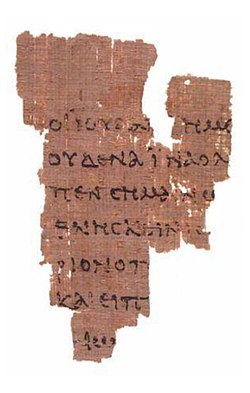
The unknown Gospel of Papyrus Egerton 2

The unknown Gospel of Egerton 2 was discovered in Egypt in 1935 exiting in two different manuscripts. The original editors found that the handwriting was that of a type from the late first early second century. In 1946 Goro Mayeda published a dissertation which argues for the independence of the readings from the canonical tradition. This has been debated since then and continues to be debated. Recently John B. Daniels in his Clairmont Dissertation argued for the independence of the readings from canonical sources.[4] Daniels states "Egerton's Account of Jesus healing the leaper Plausibly represents a separate tradition which did not undergo Markan redaction...Compositional choices suggest that...[the author] did not make use of the Gospel of John in canonical form." (Daniels, abstract).[5] The unknown Gospel of Egerton 2 is remarkable still further in that it mixes Johannie language with Synoptic contexts and vice vers. [6]The Unknown Gospel preserves a tradition of Jesus healing the leper in Mark 1:40-44. (Note: The independent tradition in the Diatessaran was also of the healing of the leper). There is also a version of the statement about rendering unto Caesar. Space does not permit a detailed examination of the passages to really prove Koster's point here. But just to get a taste of the differences we are talking about:

This is very significant because it indicates a reading independent of and therefore prior to Mark;s redaction.

Comparison of readings Egerton 2 and Mark

Egerton 2: "And behold a leper came to him and said "Master Jesus, wandering with lepers and eating with them in the inn, I therefore became a leper. If you will I shall be clean. Accordingly the Lord said to him "I will, be clean" and immediately the leprosy left him.

Mark 1:40: And the leper came to him and beseeching him said '[master?] if you will you can make me clean. And he stretched out his hands and touched him and said "I will be clean" and immediately the leprosy left him.

Egerton 2: "tell us is it permitted to give to Kings what pertains to their rule? Tell us, should we give it? But Jesus knowing their intentions got angry and said "why do you call me teacher with your mouth and do not what I say"?

Mark 12:13-15: Is it permitted to pay taxes to Caesar or not? Should we pay them or not? But knowing their hypocrisy he said to them "why do you put me to the test, show me the coin?"

This reading is from Koseter's book Ancient Christian Gospels[7]

There are two solutions that are equally improbable. It is unlikely that the pericope in Egerton 2 is an independent older tradition. It is equally hard to imagine that anyone would have deliberately composed this apophthegma by selecting sentences from three different Gospel writings. There are no analogies to this kind of Gospel composition because this pericope is neither a harmony of parallels from different Gospels, nor is it a florogelium. If one wants to uphold the hypothesis of dependence upon written Gospels one would have to assume that the pericope was written form memory....What is decisive is that there is nothing in the pericope that reveals redactional features of any of the Gospels that parallels appear. The author of Papyrus Egerton 2 uses independent building blocks of sayings for the composition of this dialogue none of the blocks have been formed by the literary activity of any previous Gospel writer. If Papyrus Egerton 2 is not dependent upon the Fourth Gospel it is an important witness to an earlier stage of development of the dialogues of the fourth Gospel....(Koester , 3.2 p.215)
[8]

Jurgen Denker argues that the Gospel of Peter shares this tradition of OT quotation with the Canonicals but is not dependent upon them.[11] Koester writes, "John Dominic Crosson has gone further [than Denker]...he argues that this activity results in the composition of a literary document at a very early date i.e. in the middle of the First century CE" (Ibid). Said another way, the interpretation of Scripture as the formation of the passion narrative became an independent document, a ur-Gospel, as early as the middle of the first century![12]

Crosson and Koester both accest the pre Markan nature of the passon narratove. they disagree about sourcesof the after resrruection apperances, But noth beieve the empty tomb pre dates Mark.

A third problem regarding Crossan's hypotheses is related specifically to the formation of reports about Jesus' trial, suffering death, burial, and resurrection. The account of the passion of Jesus must have developed quite eary because it is one and the same account that was used by Mark (and subsequently Matthew and Luke) and John and as will be argued below by the Gospel of Peter. However except for the appearances of Jesus after his resurrection in the various gospels cannot derive from a single source, they are independent of one another. Each of the authors of the extant gospels and of their secondary endings drew these epiphany stories from their own particular tradition, not form a common source....Studies of the passion narrative have shown that all gospels were dependent upon one and the same basic account of the suffering, crucifixion, death and burial of Jesus. But this account ended with the discovery of the empty tomb. With respect to the stories of Jesus' appearances, each of the extant gospels of the canon used different traditions of epiphany stories which they appended to the one canon passion account. This also applies to the Gospel of Peter. There is no reason to assume that any of the epiphany stories at the end of the gospel derive from the same source on which the account of the passion is based."[13]
Paul was writting in the 50s he died in 64AD. Mark was written in 70. Therefore, anything he says that coordiates with the Gospels is proof PMR.

1 Corinthians 15:4-8

4 that he was buried, that he was raised on the third day according to the Scriptures, 5 and that he appeared to Cephas, and then to the Twelve. 6 After that, he appeared to more than five hundred of the brothers and sisters at the same time, most of whom are still living, though some have fallen asleep. 7 Then he appeared to James, then to all the apostles, 8 and last of all he appeared to me also, as to one abnormally born.

Ressurection on third day is PMR.

Resurrected Jesus appeared to people (1 Cor 15:4ff)
James, a former skeptics, witnessed this (1 Cor 15:7)
as did Paul (1 Cor 15:8-9)
This was reported at an early date (1 Cor 15:4-8)
He asceded to heaven, glorified and exalted (1 Tim 3:16, Phil 2:6f)
Disciples were transformed by this (1 Tim 3:16)
Disciples made the Gospel center of preaching (1 Cor 15:1-4)
Resurrection was chief validation of message (Rom 1:3-4, Rom 10:9-10)

Koster and Crosson both agree that the PMR was circulating in written form with empty tomb and passion narrative, as early as 50AD

From this notion as a base line for the begining of the process of redaction, and using the traditional dates given the final product of canonical gospels as the base line for the end of the process, we can see that it is quite probable that the canonical gospels were formed between 50 and 95 AD. It appears most likely that the early phase, from the events themselves that form the Gospel, to the circulation of a written narrative, there was a controlled oral tradition that had its hay day in the 30's-40's but probably overlapped into the 60's or 70's. The say sources began to be produced, probably in the 40's, as the first written attempt to remember Jesus' teachings. The production of a written narrative in 50, or there abouts, probably sparked interest among the communities of the faithful in producing their own narrative accounts; after all, they too had eye witnesses.

[1] Kay Albright,"KU PROFESSOR DISCOVERS LOST GOSPEL," (March 10, 1997 Research), on line This site is maintained by University Relations, the public relations office for the University of Kansas Lawrence campus. Copyright 1997, the University of Kansas Office of University Relations, Lawrence, KS, U.S.A. Images may be reused with notice of copyright, but not altered. KU news releases may be reprinted without permission. URL: http://www.tertullian.org/rpearse/lostgospel/coptic.htm (accessed 10/23/16

[2] Charles W. Hendrick, quoted in Bible Review, (June 2002), 20-31; 46-47

professor who discovered the lost Gospel of the Savior tells us [3] Ibid,

[4] John B. Daniels, The Egerton Gospel: It's place in Early Christianity, Dissertation Clairmont, CA 1990. Cited in Helmutt Koester, History and Literature of Early Christianity,second Edition, New York, Berlin: Walter D. Gruyter, 186.

This is from a dissertation cited by major scholar Helmutt KIoester., so apparently Daniels did good work as a graduate student, Koester is New Testamemt Studies at Harvard.

[5] Ibid.

[6] Joachim Jeremias, "Unknown Sayings,An Unknown Gospel with Johannine Elements" in Hennecke-Schneemelcher-Wilson, NT Apocrypha vol 1. Westminster John Knox Press; Rev Sub edition (December 1, 1990,96. [7] Helmut Koester, Ancient Christian Gospels: Their History and Development, London. Oxford, New York: Bloomsbury T&T Clark; 2nd prt. edition, 1992,

[8] Ibid .215

[11] In Koester, 218

[12] Ibid, 218-220

[13] Ibid 220


Sunday, April 10, 2022

Reports of the empty tomb


Pixie wrote this in the comments to "Is there a pre Mark Redaction? part 1" (this last thursday.)

Anonymous said...
Calling an earlier version a "redaction" is very strange!

Joe:[this paragraph is what I said with which he takes issue] In this essay I am going to dispel this myth by demonstrating that there were written records of the gospel events that existed before the writing of Mark's gospel. I will further demonstrate that there were multiple sources transmitting the information. Mark's was not the first gospel written but merely the first of the canonical gospels to be written. None of the early works survive in MS form but we find traces of them in copies of latter works.Nor was Mark' the first teaching of the Resurrection.

Pix:Absolutely agree there were earlier records, written and oral. The creed in 1 Cor 15 - which I see you mention - is said to be an oral tradition from just a few years after the crucifixion. The "third day" motif therefore was in the account from the start.

But the text itself says that comes from scripture, not eye witness accounts. They knew Jesus rose on the third day because that is what it says in Hosea 6. It is certainly not saying Jesus was seen that or that the empty tomb was found that day.


Pix:


Anonymous said... Calling an earlier version a "redaction" is very strange!

Not at all that's what scholars call it. only the first writing was not a redaaction.

Joe: In this essay I am going to dispel this myth by demonstrating that there were written records of the gospel events that existed before the writing of Mark's gospel. I will further demonstrate that there were multiple sources transmitting the information. Mark's was not the first gospel written but merely the first of the canonical gospels to be written. None of the early works survive in MS form but we find traces of them in copies of latter works.Nor was Mark' the first teaching of the Resurrection.

Pix: Absolutely agree there were earlier records, written and oral. The creed in 1 Cor 15 - which I see you mention - is said to be an oral tradition from just a few years after the crucifixion. The "third day" motif therefore was in the account from the start.

Yet at other times he seems to argue that Mark invented the empty tomb.His statemet in the previous comment section that John didn't write about it until 60 years latter.

But the text itself says that comes from scripture, not eye witness accounts. They knew Jesus rose on the third day because that is what it says in Hosea 6. It is certainly not saying Jesus was seen that or that the empty tomb was found that day.

I answered this previously and Tim did as well. No they did not get the idea for the emty tomb from OT. They understood the event as proepshy reflected in OT that isn't where the idea originated. It was an historoical event in their own time. Pixie has an ideological destination where he wants the evidence to go. If the evidence does not take him there the evidence is at fault.There is no reurrection in OT. Not connected to Messiah, they find hints in Isah 53 but nothing explicit.

Pix likes to make much of the fact that Mark says (6:8) the women left in fear and told no one,for him this means never in their lives did they tell anyone. It means nothing to him that Mark says in v 12 *chapter 16 Mary M. told the Apostles.I get the impression that he thinks Mark really ended on v8 with the women not telling anyoone. That's ridiculous becaue Mark believed in the resurrection. why would he end the accoumt on a note of defeat and fear with no idea the res was real? Absurd. Moreover, a foot note (16:8) in NIV says: "Some manuscripts have the following ending between verses 8 and 9, and one manuscript has it after verse 8 (omitting verses 9-20): 'Then they quickly reported all these instructions to those around Peter.'"

Logically the women must have told someone or we would not know of it.Mary M. told Peter and peter and John went to the tomb. so the word got out that day while it was still the empty tomb. Notice she falls away from the group in Matt. and goes back seperately to tell what they saw.

Joe: a passage from my essay "did Mark invent the epty tomb?"


in respnce to argumemt that Mark 16 ends with v8[1]

All that proves is that those particular verses are not found in any Ms that is not proof that the Gospel really ended at v8, or if it did, why it did. There is no particular reason to assume that we know why and just becuase it did end at 8 does not establish a logical reason to believe that Mark made up the empty tomb. The "added verses are 16:9-20." There are scholarly arguments that they are valid. "...[T]he witnesses which bring the verses into question are few, and that the verses are quoted by church Fathers very early, even in the second century." [2] F.H.A. Scrivener makes arguments for vv9-20 as the proper ending. This is an older source quoted at length by Marlowe.[3] My purpose is not to argue for the ending of Mark, I wont belabor that point. No logical reason is given as to why a short abrupt ending means Mark made up the tomb.

My view is that Mark did not end at v8 the orignal ending is lost.


RECOMENDED READIMG (linked)

Story of empty tomb datedt mid first century

Historicity of the women

Resurrection pages

empty tomb in Christian preaching pre dates Mark

NOTES

[1] Joesph Hinmab "Did Mark Invent the Empty Tomb?" Religious a priori, no date given http://religiousapriorijesus-bible.blogspot.com/2010/05/did-mark-invent-empty-tomb.html [accessed april 8, 2022]

[2] Michael D. Marlowe. "Bible Research, Textual Criticism, Finding the Ending of Mark," Bible Research: Internet Resources for Students of Scripture. site dated since Feb 2001. On line http://www.bible-researcher.com/endmark.html accessed 4/13/2014.

Marlowe also presentes F.H.A. Scrivener's arguments from 1984, that argue for Mark 16:9-20 as the valid ending.[accessed april 8, 2022]

[3] Marlowe, quoting Scrivener, Ibid, http://www.bible-researcher.com/endmark.html#dissent accessed 4/13/2014
http://www.bible-researcher.com/endmark.html#dissent [accessed april 8, 2022]


Thursday, April 07, 2022

Is there a pre Mark redaction? PART 1

First published on my apologetoca; site "The Religious A Priori

https://religiousapriori.blogspot.com/2021/05/welcome-to-religious-priori.html


The Gospel Behind the Gospels The concept of a pre Mark redaction that was written before the Gospel of Mark, from which Mark and all the canonicals drew. this is not the Q source. It was probably circualting as early as 50-55 AD.

Skeptics of the New Testament usually assume a long gap exists between the events in the gospels and the recording of the events in writing, They further tend to assume that the first source of writing about these events was the gospel of Mark. Thus they assume events were exaggerated and miracles were made up and so on during this gap period. In this essay I am going to dispel this myth by demonstrating that there were written records of the gospel events that existed before the writing of Mark's gospel. I will further demonstrate that there were multiple sources transmitting the information. Mark's was not the first gospel written but merely the first of the canonical gospels to be written. None of the early works survive in MS form but we find traces of them in copies of latter works.Nor was Mark' the first teaching of the Resurrection.

I. Traces of Gospel Material in Gap

A, The circulation of Gospel material can be shown in four areas:

(1) Oral tradition

(2) saying source Material

(3) Non canonical Gospels

(4) traces of pre Markan redaction (PMR)

(canonical material that pre-date Mark, assumed the to be the first Gospel, also called Pre Mark Passion narrative PMPN).

B. Oral Tradition (in Two Major Sources)

Scholars have always recognized that the telling of the gospel stories began with the transmission of oral tradition. Of course the problem with oral tradition is that it's not written, Once written it becomes written tradition. Yet the form of the oral transmission can cling to the writing, It is possible to identify sources of oral tradition even when written down. We see oral tradition reflected in the New Testament in two major sources:

C. Pauline references to sayings

The great scholar Edgar Goodspeed held that oral tradition was not haphazard rumor but tightly controlled process,and that all new converts were required to learn certain oral traditions and spit them back from memory:

Our earliest Christian literature, the letters of Paul, gives us glimpses of the form in which the story of Jesus and his teaching first circulated. That form was evidently an oral tradition, not fluid but fixed, and evidently learned by all Christians when they entered the church. This is why Paul can say, "I myself received from the Lord the account that I passed on to you," I Cor. 11:23. The words "received, passed on"[1]reflect the practice of tradition—the handing-down from one to another of a fixed form of words. How congenial this would be to the Jewish mind a moment's reflection on the Tradition of the Elders will show. The Jews at this very time possessed in Hebrew, unwritten, the scribal interpretation of the Law and in Aramaic a Targum or translation of most or all of their Scriptures. It was a point of pride with them not to commit these to writing but to preserve them.
[2]

In my essay "Community as author" I will deal with the validity of oral tradition. At this point I give examples of the traces of oral tradition in Paul's writings: 1 Corinthians 15:3-8 has long been understood as a formula saying like a creedal statement. "For I delivered unto you first of all that which I also received, how that Christ died for our sins according to the scriptures;

1Cr 15:4 And that he was buried, and that he rose again the third day according to the scriptures:

1Cr 15:5 And that he was seen of Cephas, then of the twelve:

1Cr 15:6 After that, he was seen of above five hundred brethren at once; of whom the greater part remain unto this present, but some are fallen asleep.

1Cr 15:7 After that, he was seen of James; then of all the apostles.

1Cr 15:8 And last of all he was seen of me also, as of one born out of due time.

Two problems: (1) Doesn't conform to a canonical reading; (2) seems to contradict the order of appearances of the epiphanies (the post resurrection sightings in Gospels--in fact doesn't even mention the women, ). Nevertheless it is in general agreement with the resurrection story, and seems to indicate an oral tradition already in circulation by the AD 50s, and probably some time before that since it has had to be formed into a formulation statement. This is because Paul was writing in the 50s. These are clear references to events mentioned in the Gospels written decades before the Gospels were written,

Second major source of oral tradition:

D.The nature of pericopes

Pericopes are little story units we find in the Gospels like the good Samaritan. The nature of the pericopes themselves shows us that the synoptic gospels are made up of units of oral tradition. Many skpetics seem to think that Mark invented the story in the Gospel and that's the first time they came to exist. But no, Mark wrote down stories that the church had told for decades. Each unit or story is called a "pericope" (per-ic-o-pee). This is "A term used in Latin by Jerome for sections of scripture and taken over by form Critics to designate a unit, or paragraph, of material, especially in the gospels, such as a single parable, or a single story of a miracle."[3] Terence C. Mournet tells us, "Dunn Suggests, during the course of his investigations, that the variation within the pericopes under examination is reflective of is reflective of their indebtedness to the oral transitioning process described by Bailey where traditions are changed (flexible) during their retelling but remain within the boundaries established by the communities." [4] There is room in oral form or a minor variations but along an agreed upon range, the rage is no doubt set by the first telling of the eye witnesses and what the community certain it originally heard. That range of agreement constitutes a control om the dissemination of information. On this basis Baultmann developed "form criticism" because the important aspect was the form the oral tradition too, weather parable, narration, or other oral form.

E. Saying Source Material

The saying source was the forerunner of the narrative Gospel. Church father Papias who studied with Apostle John said that Matthew first wrote his gospel as a list of Jesus' teachings in Hebrew,called The Loggia. There's hypothetical Q source, Gospel of Thomas,k Egerton 2 and others. Here I will focus just On Thomas, and deal with others in part II. We see traces of pre Mark redaction in all of those I just mentioned (except Loggia we don't have a copy)..

(1). Gospel of Thomas

The Gospel of Thomas which was found in a Coptic version at Nag Hammadi, but also exists in another form in several Greek fragments, is a prime example of a saying source. The narratival elements are very minimal, amounting to things like "Jesus said" or "Mary asked him about this,and he said..." The Gospel is apt to be dismissed by conservatives and Evangelicals due to its Gnostic elements and lack of canonicity. While it is true that Thomas contains heavily Gnostic elements of the second century or latter, it also contains a core of sayings which are so close to Q sayings from the synoptics that some have proposed that it may be Q (see Helmutt Koester, Ancient Christian Gospels).[5] There are 46 sayings that parallel Q sayings in Thomas. This is what I call the orthodox core of the book.[6]

Be that as it may, there is good evidence that the material in Thomas comes from an independent tradition,that it is not merely copied out of the synoptics but represents a PMR. Through Statistical Correlation Analysis of Thomas and the Synoptic, Steven Davies argues that the Gospel of Thomas is independent of the canonical gospels on account of differences in order of the sayings. [7] Lisa Haygood of Fullerton states "serious probability exists that Thomas preserves an older tradition of the historical Jesus than that of the synoptic Gospels."[8] Stephen J. Patterson compares the wording of each saying in Thomas to its synoptic counterpart with the conclusion that Thomas represents an autonomous stream of tradition:

If Thomas were dependent upon the synoptic gospels, it would be possible to detect in the case of every Thomas-synoptic parallel the same tradition-historical development behind both the Thomas version of the saying and one or more of the synoptic versions. That is, Thomas' author/editor, in taking up the synoptic version, would have inherited all of the accumulated tradition-historical baggage owned by the synoptic text, and then added to it his or her own redactional twist. In the following texts this is not the case. Rather than reflecting the same tradition-historical development that stands behind their synoptic counterparts, these Thomas sayings seem to be the product of a tradition-history which, though exhibiting the same tendencies operative within the synoptic tradition, is in its own specific details quite unique. This means, of course, that these sayings are not dependent upon their synoptic counterparts, but rather derive from a parallel and separate tradition.[9]

There are several other non canonical Gospels perhaps the most important for apologetic is Gospel of Peter and I will deal with that and others in part II.

(2). evidence of saying source in Pauline references

Koster theorizes that Paul probably had a saying source like that of Q available to him. Paul's use of Jesus' teachings indicates that he probably worked from his own saying source which contained at least aspects of Q. That indicates wide connection with the Jerusalem church and the proto "Orthodox" faith.

Parable of Sower 1 Corinthians 3:6 Matt.
Stumbling Stone Romans 9: 33 Jer 8:14/Synoptics
Ruling against divorce 1 cor 7:10 Mark 10:11
Support for Apostles 1 Cor 9:14 Q /Luke 10:7
Institution of Lord's Supper 1 Cor 11:23-26 Mark 14
command concerning prophets 1Cor 14:37 Synoptic
Apocalyptic saying 1 Thes. 4:15, 21
Blessing of the Persecuted Romans 12:14/ Q/Luke 6:27
Not repaying evil with evil Romans 12:17 and I Thes 5:15/...Mark 12:12-17
Paying Taxes to authorities Romans 13:7 Mark 9:42
No Stumbling Block Romans 14:13/...Mark 9:42
Nothing is unclean Romans 14:14 Mark 7:15
Thief in the Night 1 Thes 5:2 Q/ Luke 12:39
Peace among yourselves 1 Thes Mark 9:50
Have peace with Everyone Romans 12:18/.... Mar 9:50
Do not judge Romans 13: 10 Q /Luke 6:37
These passages indicate that Paul knew versions off Jesus' teaching and Gospel stories two decades before Mark was written, What this means is the Gospel material was being transmitted in an era decades before the writing of Mark. This material also indicates oral tradition (as with the pericopes) we can assume this material goes back to era of the events themselves since we only abouit about 18 years between Crucifixion and Paul's early epistles

F, On The third Day William Lane Craig makes this argument. The phrase as Used by Paul im 1 Cor. 15

3 For what I received I passed on to you as of first importance[a]: that Christ died for our sins according to the Scriptures, 4 that he was buried, that he was raised on the third day according to the Scriptures, 5 and that he appeared to Cephas,[b] and then to the Twelve. 6 After that, he appeared to more than five hundred of the brothers and sisters at the same time, most of whom are still living, though some have fallen asleep. 7 Then he appeared to James, then to all the apostles, 8 and last of all he appeared to me also, as to one abnormally born. Craig tells us:

As for the “third day” motif, it is more probable that this is tied to the empty tomb tradition than to the appearance traditions. The phrase appears in the third line of the formula, which is a summary of the empty tomb narrative (see comparative chart in The Son Rises, pp. 49-50). It seems to be a theologically loaded rendering of the phrase “the first day of the week,” which is used in the empty tomb narrative. Notice, too, that the third day is always associated with the event of Jesus’ rising from the dead, never with the appearances.[10]

Sources

[1] Edgar J. Goodspeed, An Introduction to the New Testament, Chicago: University of Chicago Press, 1937

[2] Ibid.

[3] "Pericope," Oxford Biblical Studies Online, Oxford University Press, 2016 online resource http://www.oxfordbiblicalstudies.com/article/opr/t94/e1449 (accessed 10/14/16)

[4] Terence C. Mournet, Oral Tradition and Literary Dependency: Variability and Stability in the Synoptic Tradition and Q..Tubingen,Germany: Mohr Siebeck, 2005, 98.

[5] Helmutt Koester, Ancient Christian Gospels: their /History and Development, Edinburgh: Bloomsbury T&T Clark; 2nd prt. edition, March 1, 1992.

[6] Mahlon H. Smith, "Gospel of Thomas," Synoptic Gospels Pro,er 1997, online resource http://virtualreligion.net/primer/thomas.html (accessed 10/14/16)

[7] Stevan L. Davies, The Gospel of Thomas: Annotated and Explained (Skylight Paths Pub 2002)

[8] Lisa Haygood, "The Battle To Authenticate 'The Gospel of Thomas'," LUX: A Journal of Transdisciplinary Writing and Research from Claremont Graduate University: Vol. 3: Iss. 1, Article 6. Available at: http://scholarship.claremont.edu/lux/vol3/iss1/6

PDF

http://scholarship.claremont.edu/cgi/viewcontent.cgi?article=1041&context=lux (accessed 10'/12/16)

[9] Stephen J. Patterson ,The Gospel of Thomas and Jesus, p. 18

[10] William Lane Craig, "186 the Witness if The Pre Pauline Tradition ti The Empty Tomb" Reasonable Faith (Nov 8,2010) https://www.reasonablefaith.org/writings/question-answer/the-witness-of-the-pre-pauline-tradition-to-the-empty-tomb/


Monday, April 04, 2022

Evangelical paranoia quashes real scholarship

In the past few hundred years, the Bible has been under severe attack by scientific and philosophical skeptics of all sorts. In this scientific age the most-attacked book of the Bible has arguably been Genesis, particularly the first 11 chapters. Long-age geology, big-bang cosmology, secular archaeology, liberal theology, and philosophical attacks on miracles in the Bible have deceived many people to believe that the Bible is not true and therefore cannot be trusted.[1]
Notice the paranoid nature of this view. Not only does he just dogmatically charge any scholarship that disagrees with his view as an attack. It's not wrong, it's an attack aimed at subverting God's truth. But they go even further in blaming even Christians. They are blaming Christians for attacking the Bible:

"One of the major attacks on the Bible in the past three hundred years has been directed against Moses and his authorship of the Pentateuch, the first five books of the Old Testament (Genesis–Deuteronomy). Such attacks on these foundational books of the Bible comeboth from non-Christians as well as professing Christians."[2] It's not enough to profess Christ, one must see everything their way.

  Here again  christians are rebelling and seeking to undermine the word of God? Why? They can't tolerate scholarship since it doesn't work at keeping them in power. They rebuke ordinary views of scholarship when they fail to tow the party line. They charge that "Seminary courses, theology books, introductions to the Pentateuch in Bibles, and the secular media have promoted the man-made idea that Moses did not write the Pentateuch..."[3] They need the Bible to have authority strong enough to underpin the evangelical world and to write off liberal and other theological views. So, therefore, Moses must have authored the Pentateuch because that would give them that authority and defending Mosaic authorship drives the idea home. Thus they hate theories like JEDP. They quote from an ordinary introduction to JEDP and bring the accusations:

 
Despite its unity of plan and purpose, the book is a complex work, not to be attributed to a single original author. Several sources, or literary traditions, that the final redactor used in his composition are discernible. These are the Yahwist (J), Elohist (E), and Priestly (P) sources which in turn reflect older oral traditions....The introduction to the Old Testament in another Bible translation says that the J document was written by someone much later than Moses in the southern kingdom of Judah and the E document was written by someone in the northern kingdom of Israel.[4]
    JEDP is a fine theory. As I have said before, I prefer to use other methods. JEDP was almost universally accepted in the 60s but now has collapsed. Yet the Evangelicals are still fighting it. That for a time the vast majority of scholars were trying to destroy God's word but now the attack collapsed but evangelicals are still warning of the danger.Next they will be digging trenches to fight the Keiser.[5] but I have no real problem  with JEDP. The thing is that theory is not an attack. Nor is it an attempt to undermine the word of God.As a theory of Biblical study it's no worse that the synoptic problem. But then there are evangelocas who also suspect the synoptic problem as well.

  Moseic authorship is one of their major ralleying points:

The attack on the Mosaic authorship of the Pentateuch is nothing less than an attack on the veracity, reliability, and authority of the Word of Almighty God. Christians should believe God, rather than the fallible, sinful skeptics inside and outside the Church who, in their intellectual arrogance, are consciously or unconsciously trying to undermine the Word so that they can justify in their own minds (but not before God) their rebellion against God. As Paul says in Romans 3:4, “Let God be true but every man a liar” (NKJV).[6]
Mosaic Authorship is not in the Bible. It is doubtful that he wrote about his own death. so there have been other writers for the Pentatuch in addition to Moses. The right wing thinkers we're discussing have dubbed Mosaic authorship as the truth of God but they have no real basis for deeming it so. Their assertion of Mosaic authorship is no more the world of God than is JEDP. Apparently their real criteria is whatever lines up with their view of God and all else is an attack on God.

  The issues they choose to define the battle lines are just the outlines of scholarly progress in the modern world. Authorship, date of composition, redaction, these are the basics. If we followed their kind of "scholarship" Biblical understanding would be stagnant. It has nothing to do with belief or with the Christian faith. I believe in all the basic things any Christian sees as the outlines of the faith: Deity of Christ, his death,burial and resurrection, salvation by grace. The insistence upon Mosaic authorship is like worrying about using instrumental music.There is no passage that says "make a Bible'' or that tells us how to interpret how to do Biblical study. There is no passage that mandates Mosaic authorship.

  When they speak of "the word of God" they really mean their opinion of the Bible. Disagreement with them is the major sin. They are  idolizing their own world view.

  Notes

[1]Dr. Terry Mortenson and Bodie Hodge,"The Documentary Hypothesis: Moses, Genesis, and the JEDP? Appendix C," Answers in Genesis, website (December 3, 2016) https://answersingenesis.org/bible-characters/moses/documentary-hypothesis-moses-genesis-jedp/ accessed April 1,2022.

[2] Ibid.

[3] Ibid.

[4] Ibid quoting: The New American Bible(Nashville, TN: Memorial Bible Publishers, 1976), 1.

[5] David M.Carr, "Changes in Pentateuchal Criticism" PDF,2014,  434

  https://www.academia.edu/25470455/Changes_in_Pentateuchal_Criticism  

  JEDP aka "Wellhausen hypothesis" (named for Julius wellhausen) was almost universally accepted for most of the 20th century.The consensus has now collapsed.

  [6] Mortensen and Hodge, "The Documentary Hypothesis..." op cit.

Joe Hinman

Thursday, March 31, 2022

Causal Necessity/contingency is a marker for Broadly Logical N/c in the CA

There are different types of necessity and contingency.Truth itself can be either necessary or contingent:Distinction between kinds of truth. Necessary truth is a feature of any statement that it would be contradictory to deny. (Contradictions themselves are necessarily false.) Contingent truths (or falsehoods) happen to be true (or false), but might have been otherwise. Thus, for example: "Squares have four sides." is necessary. "Stop signs are hexagonal." is contingent. "Pentagons are round." is contradictory. This distinction was traditionally associated (before Kant and Kripke) with the distinctions between a priori and a posteriori knowledge and the distinction between analytic and synthetic judgment. Necessity may also be defined de dicto in terms of the formal logical property of tautology. Recommended Reading: Jules Vuillemin, Necessity or Contingency? (C S L I, 1995); Colin McGinn, Logical Properties (Oxford, 2001); Alvin Plantinga, The Nature of Necessity (Clarendon, 1989); and Margaret Dauler Wilson, Leibniz' Doctrine of Necessary Truth (Harvard, 1984).[1]

Notice there is no third kind of modal being. "It is commonly accepted that there are two sorts of existent entities: those that exist but could have failed to exist, and those that could not have failed to exist. Entities of the first sort are contingent beings; entities of the second sort are necessary beings."[2] That in so far as it goes establishes the fact that a thing is either necessarily or contingent there is no middle ground, no third option.

There are many different notions of necessity. There are different kinds of necessity they are not contradictions or different opinions they apply in different ways. For example logical necessity is not the same as metaphysical necessity, metaphysical or broadly logical necessity deals with the nature of existence.

...Something is “necessary” if it could not possibly have failed to exist. The laws of mathematics are often thought to be necessary. It is plausible to say that mathematical truths such as two and two making four hold irrespective of the way that the world is. Even if the world were radically different, it seems, two and two would still make four. God, too, is often thought to be a necessary being, i.e. a being that logically could not have failed to exist.

Something is “contingent” if it is not necessary, i.e. if it could have failed to exist. Most things seem to exist contingently. All of the human artefacts around us might not have existed; for each one of them, whoever made it might have decided not to do so. Their existence, therefore, is contingent. You and I, too, might not have existed; our respective parents might never have met, or might have decided not to have children, or might have decided to have children at a different time. Our existence, therefore, is contingent. Even the world around us seems to be contingent; the universe might have developed in such a way that none of the observable stars and planets existed at all.[3]

This is true in the cosmological argument.

The modal cosmological argument or “argument from contingency” is the argument from the contingency of the world or universe to the existence of God. The argument from contingency is the most prominent form of cosmological argument historically. The classical statements of the cosmological argument in the works of Plato, of Aquinas, and of Leibniz are generally statements of the modal form of the argument.[4]

The Universe itself is contingent and everything produced in nature is as well.

Karl Popper tells us:"Empirical facts are facts which might not have been. Everything that belongs to space time is a contingent truth because it could have been otherwise, it is dependent upon the existence of something else for its' existence going all the way back to the Big Bang, which is itself contingent upon something."[5] Contingent beings are those whose existence is caused or explained, "A contingent being (a being such that if it exists, it could have not-existed or could cease to exist) exists. This contingent being has a cause of or explanation for its existence. ... Therefore, what causes or explains the existence of this contingent being must include a non-contingent (necessary) being".[6]

Necessity/contingency broadly logical and causally related

This seems to create a dichotomy for some atheists in that they try to juxtapose two kinds of contingency against one another; There are Types of necessity and contingency but the distinction between broadly logical or "Metaphysical" necessity and the causal type reflected in my CA is not one of them. These two types were shown by Hartshorne to be united. The causal form of contingency is a marker for the broadly logical or metaphysical. This is my own idea.

Necessity is that which cannot cease or fail to exist; that for which one could contradict to speak of such things. Thus contingency is that which can cease or fail to exist.But it seems that ceasing and failing are bound up with causes and circumstances of existence in the natural world. Thus we can think of causality as an ontological marker spelling out for us the nature of contingency in the natural world. After all anything that depends for its existence upon a prior condition (even an ontologically prior condition that is not temporally prior) is contingent because it could cease or fail to exist, thus its contingency is marked by its causality.

Sources

[1]Garth Kemerling,"Necessary/Contingent," Philosophical Pages. 1997/2011 http://www.philosophypages.com/dy/n.htm#nec (accessed 3/4/19 )

[2]Matthew Davidson,"God and Other Necessary Beings", The Stanford Encyclopedia of Philosophy (Spring 2015 Edition), Edward N. Zalta (ed.), . (accessed 3/4/19 )

[3] Tim Holt, "Argument from Contingency," Philosophy of Religion, 2008 http://www.philosophyofreligion.info/theistic-proofs/the-cosmological-argument/the-argument-from-contingency/(accessed 3/4/19 )

[4] Ibid

[5] Carol Popper quoted in Antony Flew, Philosophical Dictionary, New York: St. Martin's Press, 1979, 242.

[6] Bruce Reichenbach, , "Cosmological Argument", The Stanford Encyclopedia of Philosophy(Spring 2019 Edition), Edward N. Zalta (ed.), forthcoming URL = . (accessed 3/4/19 )B Reichenbach originally Jul 13, 2004


Monday, March 28, 2022

My Criticism of Steven DiMattei's "Contradictions in the Bible"

I've discovered an interesting website:"contradictions in the bible '' by Dr.Steven DiMattei.[1] He is a Bible scholar and he's interested in making biblical scholarship better known to the public. He chides both sides, atheists and "Christian apologists:"

Yet ironically, and most unfortunately, Contradictions in the Bible is a topic generally and almost exclusively treated in the public arena by two opposing camps, both of whom are non-experts in the field: Atheists and Christian apologists. While atheists are generally correct in claiming that the Bible does in fact contain numerous contradictions.... they often present these contradictions in a shallow and belittling manner—an empty list devoid of substance with little to no real knowledge of the texts themselves, their authors, audiences, and the historical and literary circumstances that produced them.[2]
DiMattei is "a visiting assistant professor at the University of Houston and has taught at Coronell." [3] He never says what his beliefs are concerning God or the Bible. In thinking of the Bible he only tells us his scholarly views not his beliefs. He places an emphasis upon the Bible as a collection of independent works. It was not drafted to fit together.[4] It is more like a library made up of the favorite books of a set of chruches."

  The kinds of contradictions he discusses are all one's that have been thrown at me on many message boards. He says these are "identified verse by verse and explained using the most up-to-date scholarly information about the Bible, its texts, and the men who wrote them" [5]

He chides the skeptics for shallow list making with nn real attempt to understand contex:

While atheists are generally correct in claiming that the Bible does in fact contain numerous contradictions, from minute differences in narrative details to competing theological and ideological agendas, they often present these contradictions in a shallow and belittling manner--an empty list devoid of substance with little to no real knowledge of the texts themselves, their authors, audiences, and the historical and literary circumstances that produced them. The internet is full of such lists. Although often impressionable, these lists do little to foster a conversation about the Bible’s texts, nor do they help remedy the increasingly systemic problem of biblical illiteracy currently sweeping across our country.[6]
I will only deal with a few contradictions. He may have some good one's but many of those he deals with are piddling or no contradiction at all. A ew examples:

#1. Was earth created from preexistent matter OR nothing? (Gen 1:1-10; Is 45:18 vs Heb 11:3)?

"Hebrews 11:3 is often invoked as a proof text for the doctrine of creatio ex nihilo. While some may wish to debate this reading, since the verse can be read as an abstract statement about faith, literally, 'not from that which is visible did the things that are seen come into being,” I shall nevertheless treat it as if it did proclaim this doctrine....'"[7]

This merely says the seen things of creation are created from the unseen. That might mean atoms, It might mean nothing. Creation ex nihilo is a church idea it's not explicit  in the Bible.

Isaiah 45:18  For this is what the Lord says—
he who created the heaens,
    he is God;
he who fashioned and made the earth,
    he founded it;
he did not create it to be empty,
    but formed it to be inhabited—
he says:
“I am the Lord,
    and there is no other.

That does not say what material the earth was made out of it says it wasn't made to be empty, not the same thing, not a contradiction.

#2. Does God create the skies and the earth, then plants, then animals, and then both male and female in his image OR does Yahweh first form man from the ground, then plants, then animals, and then lastly woman from man’s rib? (Gen 1:1-27 [P] vs Gen 2:4b-23 [J]) #3. Does God create the earth, the skies, and man on the same day OR not? (Gen 2:4b-7 [J] vs Gen 1:1-27 [P])

#4. Is earth initially created as fecund and fertile OR dry and barren? (Gen 1:9-10 [P] vs Gen 2:5 [J])

This could be a contradiction although not an important one. The thing is it comes from two different accounts. It's like taking two opinions; it's a challenge to theology, nothing that will undermine the Gospel..

#5. "Are both man and women created in the image of God OR is man formed from the ground, and women formed from man? (Gen 1:26-27 [P] vs Gen 2:7, 2:21-23 [J]; 1 Cor 11:9; 1 Tim 2:13)"
There are no contradictions here. If man is formed from dust that not what he becomes. God says let us change the dust and put it in our image, no contradiction. Why should we assume that a woman being made from man's I(inner chambers (what it really says) would imply that shoot in the image of God. She is fashioned out of a being made in the image of God. Passages in the New Testament imply both are in God's image. Gal 4 Neither male nor female.

#6. When is all the vegetation created: before the creation of the animals, and man and woman OR after the creation of man and before the creation of the animals and woman? (Gen 1:11-13, 1:29-30 [P] vs Gen 2:9-10 [J])

Here he's reflecting the JEDP or source hypothesis. The idea that four documents are married together or form the modern OT. One uses thye fivine name the J document, J means Y, E is the Eloheim document means that author referred to God by the generic name El like just saying "GOD."[8] I won't go any deeper into that  theory, I've seen fundies who just take this as an open attempt to destory the bbile. That is peranoid, it's not a bad theory, Im not against it. I prefer to use Setz im Leben (literally "setting n life") to determine dating.

#7. Does God declare all vegetation and trees as food for the primordial pair OR does Yahweh command that one of the trees not be eaten from? (Gen 1:29-30 [P] vs Gen 2:17 [J])

The following entry is excerpted from Chapter 1, “Genesis’ Two Creation Accounts,” of  my Genesis 1 and the Creationism Debate: Being Honest to the Text, Its Author, and His Beliefs,  pp. 1-63. Ancient and modern readers alike have long recognized the differences between the seven-day creation account of Genesis 1:1-2:3 and the garden of Eden account of Genesis 2:4b-3:24.
Of course the Southern Baptists are good at harmonizing; they see the second account as a more detailed recap of the first. I don't think we need to harmonize contradictions. There can be contradictions, none of them undermine the gospel. The redactors of Genesis were not there at creation. They knew of two accounts they obviously had confidence in both. Who cares if animals came first or plants? both agree God created all.

#2. Did God create the heavens and earth from the formless deep OR did Yahweh create them from the slaying of the primaeval sea monster Leviathan/Rahab? (Gen 1:1-8 vs Ps 74:13-17, 89:11-13;

Job 26:12-13)

The two creation accounts that open the book of Genesis, the Priestly and Yahwist, are not the only creation stories found in the Bible. A much older mythic tale is preserved in passages from the Psalms, the book of Job, and the Prophets. In fact, there are remarkably few references in the Bible to the Priestly creation account (which perhaps attests to its late date of composition), while conversely, there areRead More
Many conflicting creation accounts still reflect agreement upon three things:

(1) God is the ultimate source of all beings.

(2) We can know God will redeem us; God created humanity to be in relationship with him.

(3) God' creation is orderly and purposive; it does not compete with chaos or with a conflicting pantheon.

Jump up to NT

He is making an argument that modern Christians have no idea of the extreme level of commitment Jesus demanded.

Luke is more emphatic in representing this as a complete abandonment through his additions of the word panta (“all,” “everything”) to the textual tradition....They immediately abandoned their nets and followed him (Mk 1:18; Matt 4:20)...He rose up and followed him (Mk 2:14; Matt 9:9)...They abandoned everything and followed him (Lk 5:11).He forsook everything, rose up, and followed him (Lk 5:28).On a larger note, Luke’s emphasis on abandoning everything to follow Jesus goes hand-and-hand with his Jesus’ emphasis on the fact that those on the bottom rung of the socioeconomic ladder—the poor, the hungry, the despised, the socially exploited and outcast, i.e., “the last”—will inherit the kingdom. Indeed, these individuals become “the first '' in the redefined value system that Jesus is advocating, contrary to that of the current socioeconomic worldview. (Discussed in more detail below.)
In any case, these “Follow me!” passages express an immediate urgency. Indeed, several of these “Follow me!” imperatives anticipate objections, that is requests to delay following Jesus in order to fulfill prior or immediate social and/or familial obligations, by relaying the point that this too is not permissible (Matt 8:22; Lk 9:59-62). The message is clear: Following Jesus means to immediately “forsake all” and “leave everything behind.[9]”
Of course it's true we moderns don't comprehend the level of commitment they had, Jesus never says you can't be saved if you don't give all your possessions away. He told rich people to do that, He did not tell the poor to do it.I tell people "give your life to Christ." What I mean by that is all purpose and goals make knowing Jesus the top priority and make spreading the Gospel the second top priority. You don't have to give away your house but must be willing to if necessary.

It is not a contradiction that Luke raised the level because Mark and Mattew never said where the bar was set. Matthew gives the great commission "go ye therefore into all the world and preach the Gospel." Matthew 28:19. But the Greek is not in the imperative case so its not a command. It more closely says "where ever you go tell them all."

Is Steven DiMattei an atheist? I don't want to label him because he doesn't tell us I think that would not be fair. Biblical contradictions can lead to complex issues. They do not automatically disprove the Bible. He seems to display greater sympathy for them:

"I too very much appreciate my de-convert readership, many of whom still believe in God in some form or another, but who have also grown aware that the Bible’s texts are not what they were conditioned to think they were. In this respect many of these readers find comfort in unbiased historically sensitive biblical research such as this site attempts to offer."[10]

He does tell the atheists whatI've been trying to get across to them since 1999 learning the context of Bible contradictions. But we see  he clearly gives aid to the God hater club.

Matthew Green says:August 26, 2020 at 5:05 pm S&F," "no! Just a flat-out “no!” Iwll never believe or receive Jesus Christ or anything of the sort. I am forever done with conservative Christianity. If I go to Hell, then fine. I seriously couldn’t care less. In fact, I prefer it rather than spend eternity with ]Jesus'."[11]

With anattiude like that does goving aid matter? Here's what a believer says

Saved And Forgiven says:

August 19, 2020 at 4:10 pm

To those people who read the contradictions you said in your writings and will never come to believe in Jesus Christ as their Lord, God and Savior or the power of the Bible as the Word of God because of your writing, then i think you will be accountable as a contributor or an inspiration to their decisions in denying God and His Word. Hope you use your site to bring people to the love of God through Jesus Christ. There is still a chance to change before you meet Jesus Christ and give accountability for every work being done. Believe and receive Jesus Christ. Repent and be saved before its too late. May the Lord have mercy on you and the people you mislead..[12]
"contradictions in the bible" by Dr.Steven DiMattei is a fine site. It seriously discusses many scholarly matters in a thoughtful and highly educated way.It probably does lend comfort to atheists weather intended or not this same act also enligthens believers about allowoing for some contradictions. It is not the fact of contradictions that is harmful. It is what is being contradicted that harms the Godpel or not.I think the more aware we are the stonger our faith will be if we really seek God.

Notes

[1] Steven DiMattei,"about me and the Website," Contradictions in the Bible (2017) https://contradictionsinthebible.com/steven-dimattei/

[2] Ibid.

[3]Steven DiMattei,"about me," Everything Biblical:What is the Bible? Who wrote the Bible and When? How and Why did the Bible come to be?(most recent entry Oct. 2018) http://stevendimattei.com/author/ Amazon says he taught at Cornell https://www.amazon.com/Steven-DiMattei/e/B01E6PJ7PI%3Fref=dbs_a_mng_rwt_scns_share

  I know he's an academic he reminds me so much of the profs I had at Perkins

  [4]____________, "What was the Bible before the Bible was?" Contraictions....op cit https://contradictionsinthebible.com/what-is-the-bible/

[5]Ibid.

  [6]Ibid.

  [7]_________________, "Genesis," Ibid https://contradictionsinthebible.com/category/genesis/

[8]"JEDP Theory." Theopedia, (no date given) https://www.theopedia.com/jedp-theory

[9]DiMattei, "In Defense of Jesus:A Challenge To Those Claiming To 'Follow Jesus' (part I)" Contradictions... Ibid
https://contradictionsinthebible.com/following-jesus-a-defense/

  [10]DiMattei's about me Ibid.

[11] Ibid.

[12] Ibid.


Saturday, March 26, 2022

my cosmological argument

for fun any passing atheist is welcome to a go round on this argument

1. Something exists.
2. Whatever exists exists either necessarily or contingently.
3. It is impossible that only contingent things exist.
4. Therefore, there exists at least one necessary thing.
5. If there is a necessary thing, that thing is appropriately called 'God.'
6. Therefore God exists.


Tuesday, March 22, 2022

The “M” Scale

....Many names loom large in that body of literature; Greeley, Maslow, Wuthnow, Nobel, Lukoff and Lu, all major researchers whose studies form the bulwark of the corpus in the field. But perhaps the major researcher is Ralph Hood Jr., since his Mysticism Scale (or “M scale”) has become the standard control mechanism for determining the genuineness as truly mystical experience for a given subject. There two other scales such as a specific question by Greeley (1974) and the [fn 1-7 not here]State of Consciousness Inventory by Alexander (1982; Alexander, Boyer, & Alexander, 1987) [8] This is a 32 item questionnaire that is scored in a particular way. Hood's M. Scale is designed to test the veracity of the theories of Philosopher W.T Stace, who advanced the “common core” theory of mystical experience[9] That theory argued for the universal nature of such experiences.. In other words, if actual modern mystics around the world experience the things Stace thought they do, in the way Stace thought they experienced them they would answer certain questions in a certain way [10] Hood’s work in the M scale is becoming the standard operating procedure for study of mystical and religious experiences. It hasn’t yet been understood by everyone so we find that people evoking religious experience by manipulating stimulation of the brain don’t use any sort of control, such as the M scale, for establishing a valid mystical experience. Thus they can’t prove they are evoking real mystical experiences.[11] Dale Caird said that “research into mystical experience has been greatly facilitated” [12] by Hood’s M scale. Caird did one of the studies that validated the M scale. Burris (1999) has shown that the M scale is the most commonly used measurement for the study of mysticism. [13]

The M scale enables us to determine the validity of a mystical experience among contemporary people. In other words, did someone have a “real mystical experience” or are they just carried away by the idea of having one? [14] There are two major versions of the M scale, what is called “two factor” solution and a “three factor solution.” The two factors are items assessing an experience of unity (questions such as “have you had an experience of unity?”) and items refereeing to religious and knowledge claims. In other words questions such as “did you experience God’s presence?” Or did you experience God’s love?” In each section there are two positively worded and two negatively worded items. [15] The problem with the two factor analysis is that it tried to be neutral with Language, according to Hood himself. It spoke of “experience of ultimate reality” but with no indication that ultimate reality means reality of God. As Hood puts it, “no language is neutral"[16] One group might want ultimate reality defined as “Christ” while others who are not in a Christian tradition might eschew such a move. In response to this problem Hood and Williamson, around 2000, developed what they termed “the three factor solution.” They made two additional versions of the scale one made reference where appropriate to “God” or “Christ.” They had a “God” version and a “Christ” version and both were given to Christian relevant samples. The scales were “factor analyzed,” they weighed each difference as a factor such as it’s mention of God or mention of Christ. In this factor analysis, where the scale referred to “God,” “Christ” or simply “reality” the “factor structures were identical.” That is the respondents saw “God,” “Christ” and “ultimate reality” as coterminou. That means Christians who have mystical experience understand God, Christ, and Reality as referring to the same things.[17]

All three versions matched Stace’s phenomenologically derived theory. “For all three intervertive, extrovertive and interpirative factors emerged.” [18] Respondents were answering in ways indicative of having both types of mystical experience and deriving interpretive experiences from it, they understood their experiences in light of theological understanding. The only exception was that the introvertive factors contained the emergence of ineffability because there was no content to analyze. Of course where the scale has been validated the same technique was used and tailored to the tradition of the respondent. Buddhists got a version applicable to Buddhists and Muslims got one appropriate to Islam, and so on. The same kinds of factors emerged. This demonstrates that mystical experiences are the same minus the details of the tradition, such as specific references to names. In other words Buddhists recognize Buddha mind as ultimate reality, while Vedantists recognize Brahmin as ultimate reality, Christians recognize Jesus as Ultimate reality, Muslims recognize Allah as ultimate reality, but all say they experience ultimate reality. This is a good indication that the same basic reality stands behind this experience, or to say it another way they are all experiences of the same reality.

Hood wrote a Text book with Bernard Spilka. [19]They point three major assumptions of the common core theory that flow out of Stace’s work:

(1) Mystical experience is universal and identical in phenomenological terms.

(2) Core Categories are not always essential in every experience, there are borderline cases.

(3) Interovertive and extrovertive are distinct forms, the former is an experience of unity devoid of content, the latter is unity in diversity with content.

The M scale reflects these observations and in so doing validates Stace’s findings. Hood and Spilka (et al) then go on to argue that empirical research supports a common core/perennialist conceptualization of mysticism and it’s interpretation.

The three factor solution, stated above, allows a greater range of interpretation of experience, either religious or not religious. This greater range supports Stace’s finding that a single experience may be interpreted in different ways. [20]The three factor solution thus fit Stace’s common core theory. One of the persistent problems of the M scale is the neutrality of language, especially with respect to religious language. For example the scale asks about union with “ultimate reality” not “union with God.” Thus there’s a problem in understanding that ultimate reality really means God, or unify two different descriptions one about God and one about reality. [21] There is really no such thing as “neutral” language. In the attempt to be neutral non neutral people will be offended. On the one had the common core idea will be seen as “new age” on the other identification with a particular tradition will be off putting for secularists and people of other traditions. Measurement scales must sort out the distinctions. Individuals demand interpretation of experiences, so the issue will be forced despite the best attempts to avoid it. In dealing with William James and his interpreters it seems clear that some form of transformation will be reflected in the discussion of experiences. In other words the experiences have to be filtered through cultural constructs and human assumptions of religious and other kinds of thought traditions in order to communicate them to people. Nevertheless experiences may share the same functionality in description. Christians may want the experiences they have that would otherwise be termed “ultimate reality” to be identified with Christ, while Muslims identify with Allah and atheist with “void.” The expressed is important as the “social construction of experience” but differently expressed experiences can have similar structures. Hood and Williamson designed the three factor analysis to avoid these problems of language. [22]This is a passage from my own work, The Trace of God :[23]

In a series of empirical measurement based studies employing the Mysticism scale introvertive mysticism emerges both as a distinct factor in exploratory analytic studies [24] and also as a confirming factor analysis in cultures as diverse as the United States and Iran; not only in exploratory factor analytic studies (Hood & Williamson, 2000) but also in confirmatory factor analyses in such diverse cultures as the United States and Iran (Hood, Ghornbani, Watson, Ghramaleki, Bing, Davison, Morris, & Williamson. (2001).[25] In other words, the form of mysticism that is usually said to be beyond description and beyond images, as opposed to that found in connection with images of the natural world, is seen through reflection of data derived form the M scale and as supporting factors in other relations. Scholars supporting the unity thesis (the mystical sense of undifferentiated unity—everything is “one”) have conducted interviews with mystics in other traditions about the nature of their introvertive mystical experiences. These discussions reveal that differences in expression that might be taken as linguistics culturally constructed are essentially indicative of the same experiences. The mystics recognize their experiences even in the expression of other traditions and other cultures. These parishioners represent different forms of Zen and Yoga.[26] Scholars conducting literature searches independently of other studies, who sought common experience between different traditions, have found commonalities. Brainaid, found commonality between cultures as diverse as Advanita-Vendanta Hinduism, and Madhmika Buddhism, and Nicene Christianity; Brainaid’s work supports conclusions by Loy with respect to the types of Hinduism and Buddhism.[27]

The upshot of this work by Hood is two fold: on the one had it means there is a pragmatic way to control for the understanding of what is a mystical experience and what is not. Using Stace as a guide we find that modern “mystics” around the world are having Stace-like experiences. Thus Stace’s view makes a good indication of what is and what is not a mystical experience. That means we can study the effects of having it. Of course Stace drew conclusions from his own survey vof literature of the great mystics. Now other scales have been attempted and none of them had the kind of verification that the M scale does, but taken together the whole body of work for the last fifty years or so (since Abraham Maslow) shows that religious experience of the “mystical” sort is very good for us. People who have such experiences tend to find positive, dramatic, transformation in terms of outlook, mental health and even physical health.

Over the years numerous claims have been made about the nature of spiritual/mystical and Maslow's “peak experiences”, and about their consequences. Wuthnow (1978) set out to explore findings regarding peak experiences from a systematic random sample of 1000 persons and found that peak experiences are common to a wide cross-section of people, and that one in two has experienced contact with the holy or sacred, more than eight in ten have been moved deeply by the beauty of nature and four in ten have experienced being in harmony with the universe. Of these, more than half in each have had peak experiences which have had deep and lasting effects on their lives. Peakers are more likely also, to say they value working for social change, helping to solve social problems, and helping people in need. Wuthnow stressed the therapeutic value of these experiences and also the need to study the social significance of these experiences in bringing about a world in which problems such as social disintegration, prejudice and poverty can be eradicated. Savage et al., (1995) provided clinical evidence to suggest that peakers produce greater feelings of self-confidence and a deeper sense of meaning and purpose. Mogar's (1965) research also tended to confirm these findings.[28]

The body of work to which I refer consists of about 200 studies (one could say 300 but let’s be conservative).[29] A huge part of that (about 50) is taken up with the prolific work of Ralph Hood. Not all of these studies use the M scale but it has become standard since the 90s. The body of work here discussed stretches back to the 1960s and the studies of Abraham Maslow. The study of mental health aspects has grown by leaps and bounds over the last couple of decades. Since the deployment of the three part solution of the M scale the studies have been more empirical and better controlled. The effects and their transformative qualities could be understood as rational warrant for belief in God, I have so argued in The Trace of God.[30]


sources

part 1

1-7 not here.

[8] Jayne Gackenback, “Pure Cobciousness. Mystical Experiences.” Childhood Transpersonal Childhood Experiences of Higher States of Consciousness: Literature Review and Theoretical Integration, Spirit Watch, online resource, URL:

http://www.sawka.com/spiritwatch/cehsc/ipure.htm accessed 3/32016.

[9] Walter T. Stace, Mysticism and Philosophy, New York: Macmillan,1961,44.

[10] Ibid, 128

. [11] John Hick, The New Frontier Of Religion and Science: Religious Experience, Neuroscience, and The Transcendent. UK: Palgrave: Macmillan, 2006, 66.

He does not mention the M scasle per se but shows that they do not use a standard and some use slip shod criteria for evaluation.

[12] Dale Caird, “The structure of Hood's Mysticism Scale: A factor analytic study.”journal for the Scientific study of religion 1988, 27 (1) 122-126

[13] Burris (1999) quoted in Hood, op, cit., 128

[14] Hood, ibid, 128

[15] bid.

[16] Ibid, 129

[17] Ibid.

[18] Ibid, 129

[19] Bernard Spilka, Ralph Hood Jr., Bruce Hunsberger, Richard Gorwuch. The Psychology of Religion: An Empirical Approach. New York, London: the Guildford Press, 2003.

[20] Ibid, 323

[21] Ibid.

[22] Ibid, Hood in McNamara.

[23] Hinman, Trace ...op. Cit., 168 fn72-75.

[24] Ralph Hood Jr., W.P. Williamson. “An empirical test of the unity thesis: The structure of mystical descriptors in various faith samples.” Journal of Christianity and Psychology, 19, (2000) 222-244.

[25] R.W. Hood, Jr., N.Ghorbani, P.J. Waston, et al “Dimensions of the Mysticism Scale: Confirming the Three Factor Structure in the United States and Iran.” Journal for the Scientific Study of Religion, 40 (2001) 691-705.

[26] R.K.C. Forman, Mysticism, Mind, Consciousness. Albany: State University of New York Press, (1999) 20-30.

[27] F.S. Brainard, Reality and Mystical Experience, Unvisited Park: Pennsylvania State University Press. (2000). See also D.Loy, Nonduality: A Study in Comparative Philosophy. Amherst, New York: Humanities Press.

[28] Krishna K. Mohan, “Spirituality and Wellbeing: an Overview.” An Article based upon a Presentation made during the Second International Conference on Integral Psychology, held at Pondicherry India 4-7 January 2001, published in hard copy, Cornelissen, Matthijs (Ed.) (2001) Consciousness and Its Transformation. Pondicherry: SAICE.On line copy website of the India Psychology Institute. Site visited 9/3/12. URL:http://www.ipi.org.in/texts/ip2/ip2-4.5-.php Accessed 2/7/2016

[29]Bibliogrophies from which I took the studies include Voyle. LL, Mohan, Franks. gackenback

[30] Hinman, Trace...op. Cit., this is the gist of all of chapter 2, 61-135,especially 92-107.


Sunday, March 20, 2022

Daren Brown: Atheist Propaganda and Religious Experience

Perhaps nothing scares atheists like feelings. They are scared to death of religious experience arguments. Nothing raises their hatred like talking about religious experiences. Daren Brown is some sort of British stage magician who at has a new stage act [1] supposedly inducing religious experiences. Atheists waste no time in arguing that this is proof that such experiences are just accidents that mean nothing. He states "I examined the Placebo effect and proved just how powerful fear and faith can be." Of course he assumes that because there is a psychological process that produces faith that then there's no object of faith beyond that process that has any real bearing on life. This is really no different than the one's who claim to stimulate parts of the brain to induce religoius experiences.

In calling it "placebo" he's trying to set up the suggestion that it's unreal, it's unnecessary, God is the great cosmic sugar pill. Then he totally ignores the nature of real placebo. It's only for medicine, there's no evidence that such suggestive keys can manipulate us apart from expectation.Placebo works by expectation. All the things that he does in relation to evoking the psychological process are manipulative means of setting up the association. Yet most religious experience of the sort called "mystical" is not expected. In about half the time it's experienced in childhood; children have no ideological or doctrinal expectations.[2] and much of the time mystical experiences contradict the doctrine of the experincer. If it was a real placebo it should confirm expectations. Placebo works by expectation.[3] They don't work by challenging expectations. Calling it a placebo is wrong and improper and it's probably only done to evoke the concept and prepare the atheist to inoculated against emotion by making her suspicious of religious feelings.

He sets up several incidents before the main show (the phony atheist conversion) that are intended to get across the idea that suggestion works powerfully and most such feelings as one associates with the supernatural are also just manipulation. He makes people feel afraid by putting them in a room alone after reading to them some satanic right supposedly from the eleventh century. People are turned on by a sense of dark, mysterious and ancient.  He gave people a fake drug which is no more than a sugar pill and by getting them to believe in it he got them to make dramatic changes in their lives. Of course he doesn't follow them in their lives or do a longitudinal study to determine if the changes are really transformational (dramatic, positive, and long term). He has no real control and no real way of determining if he's given anyone a real experience. Empirical study has demonstrated that religious experience is real, that's transformational, and that there is a way to determine real experiences from phony ones.[4] No there is no proof direly that it's caused by God but this can be argued successfully by paying attention to what can be proved and using it with logic. It is the M scale that provides us with that means of verification for religious experience and it's been validated by a half dozen studies around the world.[5]

His psychological explanation for the process is typically convoluted and not well throughout. He does an experiment that shows people in private when not watched lie about their mistakes. The idea is to show that there's a presence in the room no one cheats. If people are given an idea of supernatural presence they act more morally. It is asserted that there are evolutionary reasons why we developed the idea of a supernatural presence. Don't want to be outcast from the tribe so we can reproduce. divine presence would ensure the sense of being caught out. God is made up to make us be moral. In other words, like Foucault's take on the Panopticon the prisoners are learning to watch themselves. The problem here is he's convoluted several different reasons in to one

First of all, if we feel a sense of presence that in itself is reason to assume we feel it. It doesn't have to be the result of needing a moral campus and inviting an invisible God. the illustration itself shows caveman ostracize a guy because he lied. So the fact of how people treated each other would be the reason for moral behavior and the fear of being rejected by the tribe and not being allowed to make would be enforcement enough, why make up an internal watch dog to do the job as well? If one has not felt experiences one doesn't know what they are. why invent a psychological process to evoke them then try to explain them. The fact that one has had such experience itself the reason to believe in the reality of such experiences, then the need to explain it comes out of having the need. The idea of ancient caveman trying to produce a sophisticated psychological technique for evoking some experience they haven't had is ridiculous and if they had it, it has its own reality.If they had it prior to producing the process of evoking it then it is real.

 Brown is certain that the experience is explained by psychology. He asserts that these kinds of experiences come from big religious rallies with hyper suggestibility but there's no basis for that assumption. He's not using M scale studies to determine what percentage of religious experience is privately induced and percentage comes out of the big hyper rallies. Here's a clue, with half coming in childhood they are not coming form big rallies (fn2 above).

Then he goes through an elaborate production to produce a fake conversion in an atheist woman. He does this indirectly without mentioning God. He uses several techniques such as tapping his fingers while they talk about her father to make her associate the sound of the tapping with feelings of fatherly love. In several ways he evokes feelings of powerful father figures to bring atheists to believe. Establishes rapport. learns about her father. The woman is unconsciously processing, core religious belief evoked that God has a plan for us and pulls strings to help us. No direct mention of God was made the woman made the connection to God herself through feelings of the father figure (tap tap tap). Brown says things that imply a grand plan, talk about things going wrong for a reason. sense of awe and wonder. Talks about the stars and space, evokes being cherished with awe. The woman describes her experience as "all the love in the world had been thrown at me. I pushed it away by not letting it into my life." Now she sees it's so stupid and she sees through it.

He says "I feel duty bound to make sure you understand that the positive stuff you got through this is not religious belief." This is what he tells her later after they are brought back before the audience. She's already been debriefed. He says explicitly "it certainly didn't come form God." The result of this elaborate dog and pony show is that we are supposed to come away with the grand feeling that religion has been totally exposed and deconstructed and unraveled. We see close up how fake it is; there's no need for it. Of course the Brit media is operating from the assumption that atheism is the standard, the grounding for society, the status quo. The Audience is pre-selected to reflect this idea. So one's going to challenge it.

It is a dog and pony show, he has no longitudinal study, no double blind, no control, he has no scale to measure the nature, depth, or effect of experience. He has no theory of religious experience to play it off of. That is all very crucial without that he's proved nothing. He can't guarantee that what she experienced is even a religious experience. One clue to that question is she says nothing about undifferentiated unity. she didn't say that she felt an all pervasive presence. She felt there's a plan and a purpose and she's cared for but that doesn't prove that it's the same religious experience that W.T. Stace talked about Stace is the philosopher who did the theoetocal ground work describimg mystical expereomce and his worksis the basis for Hood's develp,emt of the M scale:
Stace offers five characteristics that demonstrate the commonalities to mystical experience; these are characteristics that are found universally in all cultures and in all forms of mystical experience:

The contemporary interest in the empirical research of mysticism can be traced to Stace’s (Stace, 1960) demarcation of the phenomenological characteristics of mystical experiences (Hood, 1975). In Stace’s conceptualization, mystical experiences had five characteristics (Hood, 1985, p.176):
                1.      The mystical experience is noetic. The person having the experience perceives it as a valid source of knowledge and not just a subjective experience.
2.      The mystical experience is ineffable, it cannot simply be described in words. 3.      The mystical experience is holy. While this is the religious aspect of the experience it is not necessarily expressed in any particular theological terms.
4.      The mystical experience is profound yet enjoyable and characterized by positive affect. 5.      The mystical experience is paradoxical. It defies logic. Further analysis of reported mystical experiences suggests that the one essential feature of mysticism is an experience of unity (Hood, 1985). The experience of unity involves a process of ego loss and is generally expressed in one of three ways (Hood, 1 976a). The ego is absorbed into that which transcends it, or an inward process by which the ego gains pure awareness of self, or a combination of the two.[6]
The real problem is without a control there's no way to know if he isn't just evoking the we are given by God to be able to find him (the M scale functions as a control). The fact that he's evoking some of them doesn't prove that they are merely a matter of manipulation. There was no guy tapping when I got saved. Any associations that were evoked alone in my living room had to be coincidental or accidental rather than arranged. To say that there's a psychological process that enables one to internalize the value of belief in God is hardly a denunciation of the reality of validity of that process. So there is a psychological process and we can manipulate it. I also had a need for a father figure, and guess what, I had a father. Saying that having a psychosocial need disproves the reality of the solution is just foolish.

That's like saying you have proved that love is just a psychological trick because when you do  things to make them think they are loved they respond emotionally. He's giving all the ques that God would give us to guide into a relationship with him, thus they respond because it's put in them to respond. The only real test of the validity of such feelings is the long term change and production of positive experiences and behaviors resulting from it. Plenty of studies establish that this is the case with mystical experience. It's not been proved that it is the case with phony experience evoked by Brown. He does niot follow them thorugh life to see of they dxhibit chages and trasformative behaviors. Many stuides of rleigiois experience do just that.

Essentially there is a psychological process to conversion. It makes sense that there would be because if God wants us to have  a personal relationship with him then there must be effects which would draw us into a psychological state that is conducive to that relationship. Those affects are not hard to find because we all know  about them, they are the things that motivate us and turn us on. So he merely found them and induced them in cleaver ways.


Notes

[1]Hidden Peril, "Derren Brown - How To Convert An Atheist" YouTube Video, no date given...https://www.youtube.com/watch?v=51B8MzcxOX0acess March 7, 2022

[2] Joseph Hinman,The Trace of God: A Rational Warrant for Belief Colorado Springs:Grand Viaduct Publishing 2014, 286-296.

In the Trace of God I draw upon the research of Hood to show both that half the cases are in childhood and that Children have no expectations of the experience. I also show that most adult case have no sich expectations either.

[3]Staff Academy 45c,"The Placebo effect: thye power of expectation," Academy 45c, Website. 2021. https://academy4sc.org/video/the-placebo-effect-the-power-of-expectation/#:~:text=The%20placebo%20effect%20occurs%20when,expectation%20of%20the%20treatment's%20effectiveness.acess March 7, 2022

[4] Joseph Hinman, "The M Scale and Universal Nature of Mystical Experience." The Religious a prioriWebsite. article posted 2014. http://religiousapriori.blogspot.com/2012/10/the-m-sacle-and-universal-nature-of.htmlacess March 7, 2022

[5]Ibid.

[6]Ibid.

Labels: Apologetics, conversion process, Daren Brown, God talk, religious experience Newer PostOlder PostHome Links

Wednesday, March 16, 2022

Yes Supernova Kasprzak there is a soul!

Supernova Kasprzak is an atheist and he argues that the soul does not exist. [1] The first thing he says is "if soul exists things should be the case that are not the case." But that doesn't necessarily means thing would look any different. If there is no soul, or  nothing that  lives after the body dies (such as consciousness) then we won't go to heaven or have any kind of life after death. That's a major difference but things would not look any different to us.

Essentially Super's arguments boil down to the fact that we don't have real proof, that is scientific and undeniable, that the soul exists. He talks about how we have no scientific evidence for a tangible thing called soul but never shows what things would be different if there was a soul. Tangibility almost seems to be his only  criteria. He never establishes a justification for that as a standard.

I am quoting from the auido not from printed material so I may be off by a few words. He seems to say, "mind is physical--mind is part of body;" "it's all in  the brain," "everything is a product of the brain." it's all physical when brain dies you die:(see my essay "mind does not reduce to brain [2]) "It's all physical nothing lives after you at least not the physical part." He actually says that literally, "at least not the physical part." Ironic because we are not talking about the physical part, the soul is not physical.

That's really the issue. the materialistic atheists make solid physical existence the issue. That is all one is permitted to believe in. They never establish why that should be the only criterion.All of his arguments are based upon the idea that there's no evidence. The bible does speak of soul as a physical thing that leaves the body when we die. He does point this out but he he never addresses why this should be the only criterion? The obvious reason is one of verification. He does say nothing has been or can be detected as spirit.There is no way to verify it. He thinks all christians wish there was a mark to show if one is saved or not. I never wanted that and I never heard any other Christian express that as a desire. I think he is assuming the universality of an idea that is limited to his background.

He says we can't know Christians by the way they act. He has no documentation for that. It is true that quite often Christians don't act any better than non Christians, but when we find someone who the power of God has touched the difference is quite apparent. Now it is true that this grows old, people let down and laps back. But the rekindling of the fire is only a prayer away. "We have this treasure in jars of clay"(meaning, we are still human--2 Corinthians 4:7-9 NIV). There can also be an intuitive sense of the soul or of something living on.

Actually the soul is a symbol for the overall life of the believer in relation to God. That's why we sometimes speak of people as "souls." As in "he is a lost soul." Or, "my aim is to save souls." That is the soul. Spirit is the life force that lives on after death, I equate this with consciousness. The former is a symbol so that is not a matter of literal existence. It points to something beyond itself. The latter, spirit, we know exists, we know consciousness exists. Here we are only arguing about the state in which we find it, whether living or surviving death.

Kasprzak answers behaviors merely by asserting that he was a Christian and he had belief and behavior so he should not lose the Holy Spirit, therefore, there must not be one. He had the behavior then decided the belief wasn't true and abandoned it.He never deals with behavior as indicative of the Spirit nor does he demonstrate that one can't deny the truth and lose the Spirit. That may disprove certain doctrines such as "eternal security," but it does not disprove the deity of Christ, the existence of God,or even the soul. In my view eternal security begins with death. Apparently we can throw away salvation while we live as we see from Hebrews 6:4-6.*

There are reasons to believe in the soul and spirit. If the soul is indicative of our relationship with God then belief in soul depends upon belief in God. At this point  we just advance God-arguments. If we equate consciousness with spirit we can assert the reality of spirit by asserting arguments for irreducibility of mind to brain.It is a fallacy to think  since brain is physical mind must be physical. Like saying since water is liquid ice must be liquid. Or Since fire is hot smoke must be hot. I urge the reader to examine fn 2 below.

Another reason to take the soul and spirit seriously that is not impinged upon by the kinds of arguments Kasprzak is making; this is simply that Jesus tells us we have a soul (Matt,116:26). If we credit Jesus with being the incarnate logos then would trist what he says. Surely the logos would know.


___________ *Heb 6:4-6 "4 It is impossible for those who have once been enlightened, who have tasted the heavenly gift, who have shared in the Holy Spirit, 5 who have tasted the goodness of the word of God and the powers of the coming age 6 and who have fallen[c] away, to be brought back to repentance. To their loss they are crucifying the Son of God all over again and subjecting him to public disgrace."

Notes

[1] Supernova Kasprzak, "Your Soul Does Not Exist" YouTube (Jan 12, 2014) https://www.youtube.com/watch?v=8j2MWkDOaig&t=36s, accessed 3/15/22.

[2]Joseph Hinman, "Mind is Not Reduceabel to Brain. (part 1)" The Religious a priori, 2011, https://religiousapriori.blogspot.com/2019/11/mind-is-not-reduceabel-to-brain-part-1.html,
accessed 3/23/22.

Part 2: https://religiousapriori.blogspot.com/2019/11/mind-not-reduceable-to-brain-part-2.html