Sunday, February 24, 2019

When "Smart" is Stupid: The Atheist IQ Scam

Image result for IQ bell curve


Atheists have been making the IQ argument for Some Time. They are still making it. The idea that atheists tend to score higher on IQ tests than theists is widely accepted in social sciences but it is not generally known how much atheist activists have contributed to the research.  There is one major study, using meta analysis, that establishes the overall correlation the  most corroboration is from minor studies. When that major study first came out, the study by Miron Zuckerman, I gave a two part devastating critique.[1] Not only do my original criticisms still hold but there is still no real groundswell but only the assumptions of atheists whose support is more ideological than scholarly.

Gregory Webster and Ryan Duffy, at first glance,  seem  to list other major studies that corroborate but in reality,However,  Zuckerman and Lynn et al are the only two they name that actually deal with IQ and religious belief.[2]The only other major study they cite is one by Lynn, Harvey, &; Nyborg [3]it's also about nations and IQ it is also racist and it has fundamental link to Zuckerman because a racist cronie of Nyborg's did the statistical analysis for Zuckerman [4] I will have more on the racist connection on Wednesday. Webster and Duffy, on the other hand, are not that supportive. First, they say, " we analyzed Zuckerman et al.'s meta-analysis, and after controlling for sample differences, the negative intelligence–religiosity link declined over time. The intelligence–religiosity link was non-significant among samples using men, pre-college participants, grade point average, and those collected after 2010. Education also partially mediated the intelligence–religiosity link" (Notice the title, "Losing faith in the intelligence religiosity link..."[5] that does not mean losing faith in a correlation that smart people are religious because there was no  such assertion). What all that means is the longer the research goes on the more uncertain Zuckerman's findings appear. 

Secondly,  "though the  negative intelligence–religiosity link appears more robust across people than countries, multiple variables moderate or mediate its strength, and hence, limit its generalizability across time, space, samples, measures, and levels of analysis."[6] In other words Zuckerman et al follow the link of religiosity and IQ as   manifest though people,and Nyborg et al follow it as manifest via  nations, The former  is a stronger correlation but multiple factors make it less  a meaningful concept for social analysis.  

Emma Yong says:


 Of course, there are examples of extremely intelligent individuals with strong religious convictions. But various studies have found that, on average, belief in God is associated with lower scores on IQ tests.[Zuckerman] “It is well established that religiosity correlates inversely with intelligence,” note Richard Daws and Adam Hampshire at Imperial College London, in a new paper published in Frontiers in Psychology, which seeks to explore why.[7]
In saying "Manystudies" she only references Zuckerman, He does use other studies but if the reader consults fn 1 that is  problematic. She appeals  to Daws and Hampshire as a minor corroboration That is not a big help for the hypothesis, so not so well established after all.  Then we see the result of Nyborg;s racist propaganda, Young says  "It’s a question with some urgency – the proportion of people with a religious belief is growing: by 2050, if current trends continue, people who say they are not religious will make up only 13 per cent of the global population. Based on the low-IQ-religiosity link, it could be argued that humanity is on course to become collectively less smart."[8] That says religion is going up where was that last week? It includes the world population thus third world. The problem here is Yong just said we may be making a lot more stupid people but she's actually speaking of Africans.That's one major point of increase in Christian compilation. Not to imply that Young is racist but it seems the racist implication is hanging over her position. That the Nyborg faction has engineered the discussion.

Daws and Hampshire wind up attacking  intuition by way of explanation, Religious people tend to be stupid because they rely upon intuition for religious thinking. rather than reason., In one paper I've done we see intuition be pointed to as the basis of religion. They produce no data,  nor can it be made to serve   as the clown's mistake atheists would have it be. While I would not rely upon intuition  to do my taxes, there are times when it may help. In battle, for example, when you need split second decisions and no time to think it might not hurt to be in touch with your intuitive sense. The major answer here is they never produce any data to show why intuition is the basis of religious  belief.[9]I suspect it's because they really believe religion is just about feelings. That's an academic sounding way of saying compare stupid feelings (religion) to smart ideas (science).

Daws and Hampshire really demonstrate the total insufficiency of methodological constructs in researching this topic. Their method:
To investigate, Daws and Hampshire surveyed more than 63,000 people online, and had them complete a 30-minute set of 12 cognitive tasks that measured planning, reasoning, attention and working memory. The participants also indicated whether they were religious, agnostic or atheist.As predicted, the atheists performed better overall than the religious participants, even after controlling for demographic factors like age and education.[10]
That might Just prove nothing more than the idea that atheists have better computer skills.

They test the atheist on something something they are good  at and like and passing it off as intelligence.That highlights the problem. As I argue in my forthcoming book, God.Science, and Ideology, this is he illusion of technique. Intelligence is the ability to manipulate data and material for ideological purposes. Notice we never see a study that measures   intelligence by reflective thinking or in knowledge  of the works of James Joyce. Those are certainly things that require intelligence, But social  scientists don't value that kind of intelligence they only value   the kind of intelligence they  use in their  jobs.

Edward Dutton, and his co-author, Dimitri Van der Linden,  reference Zuckerman, still the only major study I  Duttin and Van der Linden set out to explain the correlation between smart people and skepticism and stupid people and religious belief, [11]  Their explanation goes something like this: "Religion is an instinct people who raise above their instincts are smarter than those who can;t." The fact that there were studies showing religious people were smarter and there were sine that showed that liberal theology people were as as smarty as atheists  ignored, not part of Zuckerman;s study.Their definition of intelligence: "Intelligence — in rationally solving problems — can be understood as involving overcoming instinct and being intellectually curious and thus open to non instinctive possibilities.:;'[12]

The problem there is they assume religious belief is just instinctive while in reality it involves five years in seminary. One could beehive in God and still find religious belief to be primitively based yet having evolved with Huang culture theology is far more than a bundle of instinct but involves as much intellect as mathematics, This our authors don't plain the correlation. In fact it's still an open question if it holds because Zuckerman did not include those studies that contradict  the thesis. Dutten and Van der Linden's conclusions are ope to many such possibilities.

In the days before Zickerman I responded to an atheist website and looked up a number of his studies,I had 17 studies 6 were supportive of the opposite hypothesis (that religious believers are smarter ) and the rest were too veg to call. That was possessed to six studies that supported the hypothesis (religious = stupid). 17 to 6  agaisnt the hypothesis, and the only one of those studies Zcukerman uses he uses wrong: 

Several studies that I know are positive in correlation are not found in the Zuckerman study:no Simington, no Pratt, no Rummell, no Corey. All of these are found in the list by Steve Kangus (the atheist list) (see Note 17 on my FN1 part 1). Using his list (some of this were put in the wrong category) I have 6 negative (that high IQ not religious) vs. 17 either positive (High IQ are religious) or no correlation. Yet Rathi counts only 10 that dont' support Zuckerman's correlation. That means somewhere seven studies at least are being overlooked. Francis says in his first study that the  greater number was with the negative. That doesn't mean the quality studies were negative. So even though it may be that the majority of studies find negative correlation, that doesn't prove that this is the answer. The studies left out (I know there are more than 10 that are not in line with the negative) are conspicuous by their absence. Lesley Francis did a fine study that supported the pro religious view. His methodology was fine but before that most of the negative studies were horrible in methodology. They had smaller samples and not representative samples.  

Zuckerman et al says the reason for leaving studies out is:

Studies were included in the meta-analysis if they examined the relation between intelligence and religiosity at the individual level, and if the effect size (Pearson r) of that relation was provided directly or could be computed from other statistics. For several studies, intelligence and religiosity were measured, but the authors did not report the relation between these two variables. Authors of such studies were contacted to obtain the relevant information. If authors did not respond to our first request, two more reminders were sent. When necessary, second and/or third coauthors were also contacted. Studies that examined the relation between intelligence and religiosity indirectly (e.g., comparisons atgroup levels, comparisons between scientists and the general population) were excluded.;[13]
Simington seems to report it. What he says does not wash because I checked the sample sizes The pro religious studies had larger samples. [14] 

Before closing I really  should question once more the very concept being measured by IQ,  The entire part 2 of my Zuckerman article is about this topic, (see FN1). There is no standard definition of intelligence:

What exactly is intelligence? While intelligence is one of the most talked about subjects in psychology, there is no standard definition of what exactly constitutes ntelligence. Some researchers have suggested that intelligence is a single, general ability, while others believe that intelligence encompasses a range of aptitudes, skills, and talents.Intelligence has been an important and controversial topic throughout psychology's history. Despite the substantial interest in the subject, there is still considerable disagreement about what components make up intelligence. In addition to questions of exactly how to define intelligence, the debate continues today about whether accurate measurements are even possible.[15]
Atheists tend to be drawing from the ranks of scientific/mathematical/mechanical types. They are lauding their  kind of thinking as all there is to intelligence. A list of researchers who defimne intelligence differently: 

Neisser, Ulrich; Boodoo, Gwyneth; Bouchard, Thomas J.; Boykin, A. Wade; Brody, Nathan; Ceci, Stephen J.; Halpern, Diane F.; Loehlin, John C.; Perloff, Robert; Sternberg, Robert J.; Urbina, Susana (1996). "Intelligence: Knowns and unknowns" (PDF). American Psychologist. 51 (2): 77–101. doi:10.1037/0003-066x.51.2.77. ISSN 0003-066X. Retrieved 9 October2014.[16]

 IQ is not a concrete  measurement but an abstraction.[17] Religiosity is complex and consists of multiple forms many of which involve intelligence to understand,[18] Theology proper requires as much intelligence as science,Atheists are merely imposing their favorite thing, Trying to base the truth of the cosmos upon on something like IQ is probably a sign of stupidity in itself.


Sources and Notes


[1] Joseph Hinman,"New Zuckerman IQ Study: Are Atheist Smarter? Part 1" The Religious a Priopri, Social Sciences (Monday, August 19, 2013)
http://bogusatheistsocialscience.blogspot.com/2011/08/new-zuckerman-iq-study-are-atheist.html

;Zuckerman IQ study part 2: The Case Against IQ, The Religious a Priopri, Social Sciences (Monday, August 19, 2013)
http://bogusatheistsocialscience.blogspot.com/2013/08/zuckerman-iq-study-part-2-case-agaisnt.html

[parts 1 and 2 accessed 2/.23/19]

[2]Gregory Webster and Ryan D. Duffy,"Losing faith in the intelligence–religiosity link: New evidence for a decline effect, spatial dependence, and mediation by education and life quality." Research Gate abstract.  in Intelligence 55 · April 2016 with 87 Reads
https://www.researchgate.net/publication/291185580_Losing_faith_in_the_intelligence-religiosity_link_New_evidence_for_a_decline_effect_spatial_dependence_and_mediation_by_education_and_life_quality
[accessed 2/.23/19]


[3] Richard Lynn a, ⁎, John Harvey b , Helmuth Nyborg c Average intelligence predicts atheism rates across 137 nations, Intelligence, Eksevier, (April 29,2008)
http://misc.tets.cz/science_iq_atheism.pdf  [accessed 2/.23/19]


[4] "New Zuckerman IQ Study: Are Atheist Smarter? Part 1" op cit

[5] Webster and Duffy, "Losing faith in the intelligence–religiosity link: op cit

[6] Ibid

[7]Emma young, "Are Religious People Really Less Smart, on Average. Than Atheists." Research Digest, British Psychological Society (Jan 26/2018)
https://digest.bps.org.uk/2018/01/26/are-religious-people-really-less-smart-on-average-than-atheists/
[access  2/23/19]

[8] Ibid. 

[9] Josrph Hinman,"Is Belief in God Magical Thinking?" (Dec 6,2017)
http://bogusatheistsocialscience.blogspot.com/2011/08/is-belief-in-god-magical-thinking.html
[access  2/23/19]

[10] Emma Young ""Are Religious People Really Less Smart, on Average. ..." op cit

[11]
https://www.livescience.com/59361-why-are-atheists-generally-more-intelligent.html
[access  2/23/19]

Edward Dutton, a research fellow at the Ulster Institute for Social Research in the United Kingdom,

Dimitri Van der Lindenan assistant professor of psychology at Erasmus University Rotterdam in the Netherlands,

[12] Ibid

[13]Miron Zuckerman, Jordon Silberman, and Judith Hall, "The Relation Between Intelligence and Religiosity: A Meta Analysis and Some Proposed Explanations." Personality and Social Psychology Review. Sage Publications (August 6, 2013 online first version of record); Zuckerman on pib Med
https://www.ncbi.nlm.nih.gov/pubmed/23921675
[access  2/23/19]

[14] Joseph Hinman, Atheist IQ scam,religioius a priori, 2009
 http://bogusatheistsocialscience.blogspot.com/2011/08/athist-iq-scam.html

[15]Kendra Cherry,  "Theories of Intelligence In Psychology," Very Well Mind (October 12, 2018)
https://www.verywellmind.com/theories-of-intelligence-2795035  [access  2/24/19]

[16] Wikipedia, "Religiosity and Intelligence,"  srr FN 1
https://en.wikipedia.org/wiki/Religiosity_and_intelligence#cite_note-Neisser1998-1
[access  2/24/19]

[17]  Richard Haier, . The Neuroscience of Intelligence. Cambridge University Press.(2016-12-28) pp. 18–19. ISBN 9781107461437.

[18] Barbara Holdcroft,  "What is Religiosity?". Catholic Education: A Journal of Inquiry and Practice. 10 (1): (September 2006).89–103.


Tuesday, February 19, 2019

Is Religion Dying Out? (2): When Religion Does Die Out

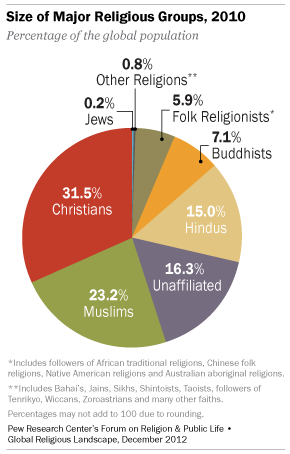
Image result for percentages of adherents to major world religions


Last time I raised the fair certainty that religion will cease to be  a major influence on society within the spice of this  century.[1] In this essay I will do two things: (1) I will discuss my own ideas about the cause of the great falling away, (2) Play the historian's "what if...?" game using the worst   case scenario. By "worst case" I mean realistically worst.

I ended last time talking about how the religious right in America has poisoned the well for young minds. That only applies to America [2] and while it means that a possible revival is short circuited it still assumes a larger world wide source of apostasy so the issue moves beyond America.

Twenty percent of American adults claimed no religious preference in 2012, compared to 7 percent twenty-five years earlier. Previous research identified a political backlash against the religious right and generational change as major factors in explaining the trend. That research found that religious beliefs had not changed, ruling out secularization as a cause. In this paper we employ new data and more powerful analytical tools to: (1) update the time series, (2) present further evidence of correlations between political backlash, generational succession, and religious identification, (3) show how valuing personal autonomy generally and autonomy in the sphere of sex and drugs specifically explain generational differences, and (4) use GSS panel data to show that the causal direction in the rise of the “Nones” likely runs from political identity as a liberal or conservative to religious identity, reversing a long-standing convention in social science research. Our new analysis joins the threads of earlier explanations into a general account of how political conflict over cultural issues spurred an increase in non-affiliation.
This tells us the decline is not due to loss of faith. Religious beliefs had not changed, it also tells  us it only pertains to America, We still have this larger  secularization looming over the world. I put oiut a dew ideas in the last issues. Here is what I said in last issue:
...economic growth brings freedom from traditional ways of life. Mass communication brings exposure to new ideas,physical security reduces the need for for spiritual consolation.[3] "An assumption lay at the core of the social sciences, either presuming or sometimes predicting that all cultures would eventually converge on something roughly approximating secular, Western, liberal democracy."[4] Thus there is an assumption that humanity is just   outgrowing outmoded belief. I think there is a better explanation. At least in term of the US the religious right is to blame.[5]
There is the modern background of "modernity" but given the fact that people have come to some kind of terms Bernstein ancient and modern over the last 500 years, that does not explain the decline. I think the overall decline tied to modernity is explained by Herert Marcuse's idea ofd one-dimensional man,

Herbert Marcuse (July 19, 1898 – July 29, 1979) was a German academic who fled to America to avoid the Nazis in the 30s. He worked for the OAS during the war and latter become the major intellectual powerhouse behind the New Left of the 1960s. He was based in San Diego where the taught, Ronald Reagan tried to have his Doctorate revoked to silence his criticisms of the war and the establishment. He was a Marxist, some say Neo-Marxist he was critical of Stalin and called a revisionist by Stalinists. Marcuse was best known for his seminal work One-Dimensional Man (1964), one of the greatest books of the era and one of primary importance for the century. In One-Dimensional Man, Marcuse argues that affluent capitalist society has been good at providing primary needs to a mass population (despite continuing poverty for some) and it has created a bourgeois society that perpetuates false needs. The American worker has bought into his place in the capitalist order as a cog in the machine, or a bit of overhead for the owners of the means of production, because in exchange will continue to supply the false needs upon which he has become admitted; that is the material trammels of an affluent society.
...The irresistible output of the entertainment and information industry carry with them prescribed attitudes and habits...The products indoctrinate and manipulate; they promote a false consciousness which is immune against falsehood. And as these beneficial products have become available to more individuals, in more social classes, the indoctrination they carry ceases to be publicity; it becomes a way of life. It is a good way of life' much better than before and as a good way of life, it militates against qualitative change. Thus emerges a pattern of one-dimensional thought and behavior, in which ideas, aspirations, and objectives that, by their content, transcend the established universe of discourse and action are either repelled or reduced to terms of this [social-political] universe. They are re-defined by the rationality of the given system and of its quantitative extension.[6]

The prognosis for one-dimensional man doesn’t end with just supporting capitalism as the basis of false needs. The whole concept of being a thinking person who lives in a society in which thinking people can determine their own lives is called into question and in fact done away with because the concept of freedom is illusory and not scientific. The scientistic crowd is telling us that freedom is a trick. The issues of one-dimensional man don’t stop Marxism because there is more to power than just capital vs labor, or capitalism vs. Marxism. Lurking behind the accumulation of false needs (technological version of bread and circuses) is operational thinking. This is what Marcuse means by "quantitative extension of the given system" (quotation above). " The trend [one-dimensional consumer society] may be related to a development in scientific method: operationalism in the physical, behaviorism in the social sciences. The common feature is a total empiricism in the treatment of concepts; their meaning is restricted to the representation of particular operations and behavior...In general, we mean by a concept nothing more than a set of operations...a positivism which, in its denial of the transcending elements of reason, forms the academic counterpart to the socially required behavior."[7] The positivist and reductionist tendencies of contemporary scientific thought, which props up the techno structure and furnishes it with "empirical proof," works to eliminate all concepts that cannot be quantified, and therefore, eventually ”commodified.”

This 1DM weighs on the sense of religious belief in that modern one-dimensional society  sells the sensations sexuality like popcorn, It trades in sexiness and sensitivities designs it into most advertising appeals, We learn to  measure selfhood by the sense of personal power and consumerism. One cannot bottle the spirit and sell sanctification like one can sell sensuality in perfume. Our consumerist society bottles personal power and sensuality and sells it in a thousand ways but we forget what spirituality is and we can;t sell that to our kids. A kid can find a cigarette butt and smoke it in secret and have her first taste of sin but she can't sneak her first communion. Not to say that I chalk it all up to a battle between holiness and sexuality.  Which would go down better for a pack of streaming teens, an episode of the bachelor or a Bible study? All amide the back drop of scientific pundits telling us we have the answers in science and religion has no place in such a world..

I don't suppose that religion will cease to exist, It will probably lose social clout  and then  be relegated to  the private realm. Religious doctrine will suffer with no institutional teaching mechanism. If the organisational structures decline the support for scholarship will wither away. Theology will become more diverse, more speculative, more absurd. Religious belief will become like philosophical ideas that are not popular but people still hold them like idealism.

On the other hand there is an upside. With no competing social stricture. with the disappearance of the older competitor that once held science back (supposedly--according to enlightenment propaganda)[8] Science will have no need to attack religion. Over time religious ideas more palatable to science will take the field. But it is likely that the theological support stricture will not wither away, although it may take a hit.After all even though some predict religion will disappear in England [9]  it will probably only decline to 2/3 of pop in America.[10]


Be that as it may  there are two basic reasons why religion will survive, at least as a private practice and philosophical idea, and probably with  some social structure: (1) Mystical Experience (2) God on the Brain.  Mystical experience is real, it is scientifically proven to be real, it is good for you it wont go away, it is also at the basis of all organized religion.[11] There is no Gene for religion but there does not have to be; it does have an adaptation that makes it hard wired. aside from a gene it could  be espadrilles.But it's part of our genetic structure and it's mot going away[12] 


Notes

[1]Joseph Hinman, "Is Religion Dyig out part 1," Metacrock's Blog, (

 FEBRUARY 17, 2019)


[2] Michael Hout, Claude S. Fischer, "Explaining Why More Americans Have No Religious Preference: Political Backlash and Generational Succession, 1987-2012." Sociological Science, October 13, 2014
DOI 10.15195/v1.a24
https://www.sociologicalscience.com/articles-vol1-24-423/  (access 2/19/19)

[3] Peter Harrison, "Why Religion is Not Going Away and Science Will Not Destroy It," Aeon,no page nimber
https://aeon.co/ideas/why-religion-is-not-going-away-and-science-will-not-destroy-it
[accessed 2/17/19]

[4]Ibid.

[5] Pew Research Center: Religion and Public Life, "The Future of Worlds Religions: Population growth projections, 2910-2050"(April 2, 2015)
http://www.pewforum.org/2015/04/02/religious-projections-2010-2050/
[accessed 2/16/19]
[6] Herbert Marcuse, One-Dimensional Man: Studies in the Ideology of Advanced Industrial Soceity. Boston: Beacon Press, 1964, 12.

[7] Ibid

[8] James Hannam, Genesis of science: How The Christian Middle Ages Launched The Scientific Revolution. New York.  Ny: Regnery Publsihinf In.,2011,4.

[9]  David Voas, "Hard evidence: is Christianity dying in Britain?" The  Conversation,  US inc.(November 27, 2013 1)
http://theconversation.com/hard-evidence-is-christianity-dying-in-britain-20734
[accessed 2/16/19]

[10] Pew Research Center: Religion and Public Life, "The Future of Worlds Religions: Population growth projections, 2910-2050"(April 2, 2015)
http://www.pewforum.org/2015/04/02/religious-projections-2010-2050/
[accessed 2/16/19]

[11] Joseph Hinman, The Trace of God:Rational Warramt for Belief. Colorado Springs: Grand viaduct. 2014.

[12] Ibid


Sunday, February 17, 2019

Is Religion Dying Out? (1)

Image result for ruins of cathedrals in England


David Voas university of Essex argues based upon his demographic research that religion will disappear over the next 50 years. [1] This is not like the usual atheist propaganda that atheism  is unceasing, for two reasons. Voas offers no data to the effect  that atheism is increasing. Never the less religion is in trouble and it has to do with the rise of the nones, . The theory is called "replacement" and it means subsequent generations are not being replaced. America is now headed for the same kimndof relgioius deliewqqe see Europe and Great Beition.
These declines in traditional religiosity aren’t offset by increasing vitality elsewhere. It’s true that the “spiritual but not religious” phenomenon has expanded in recent years. This diffuse spirituality may provide a growing market for certain kinds of religious products, such as self-help books with spiritual themes, but it isn’t offsetting religious decline, re-energizing existing religious institutions, or providing a foundation for new forms of religious collective action.It’s not just the fact of religious decline that makes the United States similar to Great Britain, Australia, New Zealand, Canada, or most of Europe. It’s also the way that secularization has occurred mainly, and in some cases entirely, because each successive generation is slightly less religious than the one before.[2]
The two reasons  this is to be taken seriously and not just dismissed as the usual atheist propagate  is because it is serious academe work and the data backs it up. How bad wi;; it get.Pew research paimts a ictirenot mraeluy as bad t;s eenmade to sound:
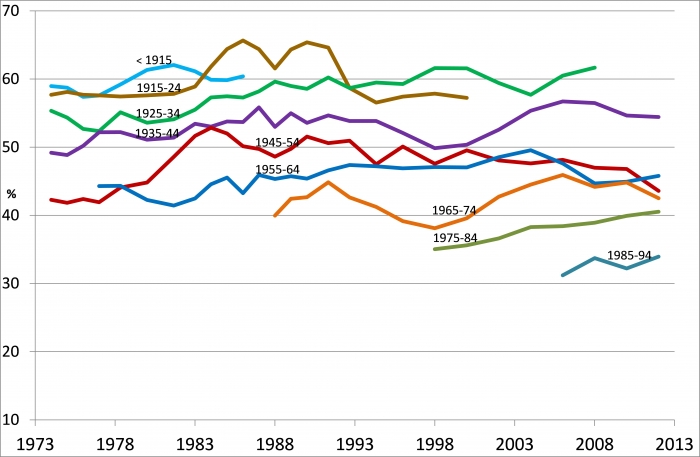
The basic results are the same whether we examine religious affiliation, attendance, or belief in God. It’s well known that an increasing proportion of Americans say that they have no religion. That’s a generational effect, and churchgoing tells the same ....story.Figure 2 [see note] shows monthly attendance at religious services in the United States; the pattern is very similar to what we see in Figure 1. Gentle decline within birth cohorts during the 1970s was followed by rising participation in the 1980s, after which within-generation change is very minor. Churchgoing decline in the United States is driven by the same cohort replacement mechanism that drives religious change elsewhere in the West.[3]
There is no real dispirit of these findings. I not  have found any demographer who is willing to claim the figures lie. Atheist philosopher Keith parson's paints a grim picture. In "There is No Way Back or religion in the  West," her says;"I suspect this fellow is probably right in the sense that the West will eventually resemble China or Japan, where religion plays only a very marginal social or cultural role. I don’t think that’s good or bad,  just a probability.Religion is in decline across the Western world. Whether measured by belonging, believing,"[4]

The religious profile of the world is rapidly changing, driven primarily by differences in fertility rates and the size of youth populations among the world’s changing, driven primarily by differences in fertility rates and the size of youth populations among the world’s  religious group, but Islam will grow faster than any other major religion. If current trends continue, by 2050 …

  • The number of Muslims will nearly equal the number of Christians around the world.
  • Atheists, agnostics and other people who do not affiliate with any religion – though increasing in countries such as the United States and France – will make up a declining share of the world’s total population.
  • The global Buddhist population will be about the same size it was in 2010, while the Hindu and Jewish populations will be larger than they are today.
  • In Europe, Muslims will make up 10% of the overall population.
  • India will retain a Hindu majority but also will have the largest Muslim population of any country in the world, surpassing Indonesia.
  • In the United States, Christians will decline from more than three-quarters of the population in 2010 to two-thirds in 2050, and Judaism will no longer be the largest non-Christian religion. Muslims will be more numerous in the U.S. than people who identify as Jewish on the basis of religion.
  • Four out of every 10 Christians in the world will live in sub-Saharan Africa
These are among the global religious trends highlighted in new demographic projections by the Pew Research Center. The projections take into account the current size and geographic distribution of the world’s major religions, age differences, fertility and mortality rates, international migration and patterns in conversion.[5]
In that scenario Christianity is  still 2/3 of American population by 2050 that's not nearly as gloomy as  Parsons makes it sound. I must say two things to keep in mind. 50 Years ago Anthony Wallace  confidently predicted religion would   die out completely. It would be killed of by  the advancememt of science of course. "belief in supernatural powers is doomed to die out, all over the world, as a result of the increasing adequacy and diffusion of scientific knowledge" Nor was Wallace alone in this prediction The social silences adopted that view as recorded truth. That prediction was blown away by the sharp rise in religious interest in the 70's with the "Jesus movement" and the 80's with the religious right. [6] 


Anthony FC Wallace (1923-2015)


The problem with the latter is it may lack a deep commitment."There is general agreement that young people increasingly do not regard themselves as belonging to a Christian religion, much less practise it. What is still debated is whether they are prone to “believing without belonging”, in the phrase popularised by the sociologist Grace Davie. Many other scholars echo the view that religiosity is being transformed, not eroded. "[7]Linda Woodhead’s comments): "Levels of atheism have not grown a great deal in the past 30 years, and stand at under 20% … people are just less likely to associate with, or relate to, a particular religion."[8] Sociologists Ariela Keysar and Juhem Navarro-Rivera's review  of numerous global studies on atheism,thry demonstrate Atheism is  only 7% of world population, that includes agnosticism some would assume the rest believe in some from of God. [9] Since that figure includes agnostics I doubt it represents any increase in atheism,

As for shallow commitment only one in five born since 75 believes in God. There is an increase in belief in a "higher power" but that may lack the deep  commitment of theism,[10] Or it might mean deeper. I contend that social science is not good at probing such levels of belief. Since the point of being "none" is to be not affiliated the conventional markers of commitment such as affiliation are useless for accession their commitment, Less religious does not mean  less believing. The majority of of  nones believe in God, although they are less observant.[11]
One way to measure depth of commitment would be to ask therm.  Americans take for granted the  idea that Europeans are all atheists  and no one believes anymore. A major study examining European values does not afirm this stereotype so they asked the people themselves.  
It is obvious that a vast majority of all the Europeans nominate themselves as religious persons. There are even more people who consider themselves as religious as there are people who attend church. It is a kind of ‘believing without belonging’. People pick and choose religious beliefs, doctrines, and practices and they are mixing and matching them, as they would select food in a cafeteria. Sociologists talk about this trend as a ‘cafeteria religion’, or as ‘church-free spirituality’. Europeans remain religious, their approach is eclectic, and they borrow ideas from several traditions. Meanwhile, many institutionalized churches, especially in the West, are running empty.[12]
What is called  "residual involvement" is often overlooked in belief, practice, and self identification.. There is a large group that neither attended services defines themselves as non religions. The term "fuzzy  fidelity" has been coined to describe this group.[13]Europe is always held up as the horror story for the end of American religion   to end up like Europe. But we must consider that while Sweden is much more homogeneous than the U.S. We are more so than Europe as whole. The case of belief in Europe is not the horror story it is made out to be.  Europe is  a collection of differing societies the analogy to the US is useless.[14]

There is cause  for concern since disjointed communication and lack of teaching will result in doctrinal crisis  for the  church and ignorance of the faith for the masses. It will not be the end of religion  or of belief in God. Another important question arises, the caused this great falling away? The cause is important since it  reflects  upon truth content.  It's only natural to pit modernity against ancient belief. Make no mistake there is cause for  concern: 7% of young people in UK are Anglican. Stephen Bullivant, a professor of theology and the sociology of religion at St Mary’s University in London.:“Christianity as a default, as a norm, is gone, and probably gone for good – or at least for the next 100 years,” ;'[15]

Sociologists have proposed many mechanisms, economic growth bring freedom from traditional ways of life. Mass communication brings exposure to new ideas,physical security reduces the need for for spiritual consolation.[16] "An assumption lay at the core of the social sciences, either presuming or sometimes predicting that all cultures would eventually converge on something roughly approximating secular, Western, liberal democracy."[17] Thus there is an assumption that humanity is just   outgrowing outmoded belief. I think there is a better explanation. At least in term of the US the religious right is to blame.

Hout and Fischer argue that the dramatic rouse of the  non  religious is due to the religious right and its phonology and tactics of culture war.. They have transformed the church into an inhospitable environment Marginalized and all who would care or their plight.;[18]Rising none rates are higher in Republican states indicating a reaction to politics. [19] Of course that does not explain the secularization of Europe. But secularization is not the  issue. American  religion has  stood up to vast secularization. But rather there is a failure of the religious institution. They are not guiding the young through the maze ways as they one did,The answer of conventional christians is to seek to restructuring maze ways along old lines, thus failing to connect with the young. 


Next time I take up with this theme part 2/

Notes

[1]David Voas and Mark Chaves, "Religion is in decline in the West, and America is no exception," LSE US Center, published  American Politics and Policy, the London School of Economics.(Dec, 2016)
http://blogs.lse.ac.uk/usappblog/2016/09/05/religion-is-in-decline-in-the-west-and-america-is-no-exception/
[accessed 2/16/19]

David Voas | TEDxUniversityofEssex

There is a film about his work on Youtube,
https://www.youtube.com/watch?v=YtAR_OGzlcg


[2] Ibid

[3] Ibid fig 2
Voas Fig 2

Figure 2 shows monthly attendance at religious services in the United States; the pattern is very similar to what we see in Figure 1. Gentle decline within birth cohorts during the 1970s was followed by rising participation in the 1980s, after which within-generation change is very minor. Churchgoing decline in the United States is driven by the same cohort replacement mechanism that drives religious change elsewhere in the West.
Figure 2 – Attendance monthly or more often by decade of birth, United States, 1973-2014
Source: General Social Survey, 1973-2014. Note: Includes respondents aged 20-84 born in the US. Graph shows three-survey moving average. To avoid overstating religious decline, the unusually religious 1972 GSS sample has been excluded.

[4]Keith Parsons. "Why there is no way back for religion in the West: David Voas."Attack the system,
(October 11, 2017)
https://attackthesystem.com/2017/10/11/why-there-is-no-way-back-for-religion-in-the-west-david-voas/
[accessed 2/16/19]

[5] Pew Research Center: Religion and Public Life, "The Future of Worlds Religions: Population growth projections, 2910-2050"(April 2, 2015)
http://www.pewforum.org/2015/04/02/religious-projections-2010-2050/
[accessed 2/16/19]

[6] Philip S. Gorski and Ate§ Altmordu,"Our comprehensive search After Secularization?"
First published online as a Review in Advance on April 9, 2008 The Annual Review of Sociology is online at soc.annualreviews.org This article's doi:
10.1146/annurev.soc.34.040507.134740
https://is.muni.cz/el/1423/jaro2015/SOC423/um/54522822/Gorski__Altinordu.txt
[accessed 2/16/19]
Department of Sociology, Yale University, New Haven, Connecticut 
long to,e readers have heard me talk abouit Wallace before as developing the  changing of the mazeway theory.

[7] David Voas, "Hard evidence: is Christianity dying in Britain?" The  Conversation,  US inc.(November 27, 2013 1)
http://theconversation.com/hard-evidence-is-christianity-dying-in-britain-20734
[accessed 2/16/19]

[8] Linda Woodhead quoted by Josephine Lethbroidge, "British social attitudes report finds trust is in freefall" us inc(September 9, 2013 )
https://theconversation.com/british-social-attitudes-report-finds-trust-is-in-freefall-17962
[accessed 2/16/19]
Josephine Lethbroidge is interdisciplinary editor for coverdstion


[9] Keysar, Ariela; Navarro-Rivera, Juhem (2017). "36. A World of Atheism: Global Demographics". In Bullivant, Stephen; Ruse, Michael. The Oxford Handbook of Atheism. Oxford University Press. ISBN 978-0199644650.

[10] Wooodhead op cit

[11] Pew Research Center: Religion in Public Life, "U.S. Public Becomes Less Religious," (NOVEMBER 3, 2015)
http://www.pewforum.org/2015/11/03/u-s-public-becoming-less-religious/
[accessed 2/17/19]

[12] European Values Study, "Religion:Church attendance – Confidence in the church – Importance of God – Traditional beliefs " Tiulburg University, Leibniz Institute for Social Change, (Feb 11 2019) no page number
https://europeanvaluesstudy.eu/about-evs/research-topics/religion/
[accessed 2/17/19]
The European Values Study is a large-scale, cross-national, and longitudinal survey research program on basic human values. It provides insights into the ideas, beliefs, preferences, attitudes, values, and opinions of citizens all over Europe. It is a unique research project on how Europeans think about life, family, work, religion, politics, and society.
The European Values Study started in 1981 when a thousand citizens in the European Member States of that time were interviewed using standardized questionnaires. Every nine years, the survey is repeated in a variable number of countries. The fourth wave in 2008 covers no less than 47 European countries/regions, from Iceland to Georgia and from Portugal to Norway. In total, about 70,000 people in Europe are interviewed.
The data of the European Values Study are available free of charge. Rich academic literature has been created around the original and consecutive surveys, and numerous other works have made use of the findings: more than 1600 publications are listed in the EVS Bibliography.


[13] David Voas, "The Rise and Fall of Fuzzy Fidelity in Europe," European Sociological Review, published by Oxford Academic, (July 19,2008) Volume 25, Issue 2, 1 April 2009, Pages 155–168, https://doi.org/10.1093/esr/jcn044
Published:19 July 2008
https://academic.oup.com/esr/article/25/2/155/491158
[accessed 2/17/19]

[14] Ibid

[15]  "Christianity as default is gone rise of non Christian Europe" The Guardian," (Tue 20 Mar 2018) 
https://www.theguardian.com/world/2018/mar/21/christianity-non-christian-europe-young-people-survey-religion
[accessed 2/17/19]


[16] Peter Harrison, "Why Religion is Not Going Away and Science Will Not Destroy It," Aeon,no page nimber
https://aeon.co/ideas/why-religion-is-not-going-away-and-science-will-not-destroy-it
[accessed 2/17/19]

[17]Ibid.

[18]Michael Hout and Claude S. Fischer, "Why More Americans Have No Religious Preference: Politics and Generations,American Sociological Review, Vol. 67, No. 2 (Apr., 2002), pp. 165-190

Michael Hout  Professor of Sociology, Director of Center for Advanced Social Science Research ...
Claude S. Fischer. Claude  (born January 9, 1948) is an American sociologist and Professor of Sociology at the University of California, Berkeley. He has taught undergraduate and graduate courses in urban sociology, research methods, and American society at UC Berkeley.