Friday, September 03, 2010

Jesus Mythers fail to meet Burden of Proof, part 1

Photobucket


These arguments were made on CARM some time back with a poster calling himself "Grog."


There Major points I ask you to keep in mind before I put up Grog's argument:


I. I have eight arguments to prove Jesus existed. grog has never answered one of them. When I put them people have knit picked until the thread was crowded and ever got around to answering them.

II. The Jesus myth posiition has the burden of proof: Jesus existed as a man in history this is acceted as historical fact, it's in all major reference books, it's backed by all major historians and has been for 2000 years. No one ever questioned it until 1900 years after the fact.

By everything we mean when we use the word "fact" Jesus' existence as a man in history is historical fact! Those who seek to overtun that have the burden of proof. It is not enough for them to argue from silence. they must use positive proof.


III. Grog totally misses the point of the argument about Gospels as historical artifacts. He keeps arguing it from the stand point that there's not enough corroboration to show facts, But that totally misses the boat.


the argument is not that any one aspect of the story can be proven, the point is that the people who wrote it believed it to be historical fact. That means the story was accepted as fact from as early as AD 50 or so becasue the sources they worked from were being circulated in writing that early.

Gorg's argument:


Quote:
I want to highlight this position because it still seems to lie at the base of foundational assumptions about who Jesus of Nazareth was as a person in history. From all quarters, I have observed the Gospels as cited as evidence for the basics of the Jesus story.

What I want to do here is demonstrate that this idea has been essentially discarded by modern scholarship.


This is far from being the case. I have sited Crosson, who is the probably the leading Bible scholar of the era, and I can and will site many others.I think we are talking at corss purposes. I think Grog is speaking of the accuracy of the stories in terms of the details, I am speaking of just the idea of Jesus existence per se.


In the latter sense the great overwhelming majority agree with Crosson who said:


Quote:
Crosson:
My very general arguments are: (1) that existence is given in Christian, pagan, and Jewish sources; (2) it is never negated by even the most hostile critics of early Christianity (Jesus is a bastard and a fool but never a myth or a fiction!); (3) there are no historical parallels that I know of from that time and period that help me understand such a total creation. There is, however, a fourth point that I touched on in BofC 403-406. It is crucially important for me that Jesus sent out companions and told them to do exactly what he was doing (not in his name, but as part of the Kingdom of God). The most basic continuity that I see between Jesus and those companions was, as I put it, not in mnemonics, but in mimetics. In other words, they were imitating his lifestyle and not just remembering his words. I find that emphasized in the Q Gospel’s indictment of those who talk, but do not do, and in the Didache’s emphasis on the ways (tropoi) of the Lord (not just words/logoi). When, therefore, I look at a phrase such as "blessed are the destitute," and am quite willing to argue that it comes from the historical Jesus, I am always at least as sure that it represents the accurate summary of an attitude as the accurate recall of a saying. For analogy: If Gandhi had developed a large movement after his death of people who are living in non-violent resistance to oppression, and one of them cited an aphorism of Gandhi, namely "if you do not stand on a small bug, why would you stand on a Big Bug," I would be more secure on the continuity in lifestyle than in memory and could work on that as basis.


Quote:Grog
Several times in the last week I've quoted Kloppenborg (1996) on this

"...the simple link between the historical Jesus and any of the gospels had decisively been severed."
He is not speaking of the sheer existence of Jesus, he's speaking of the details of the story.


Grog goes on:


Quote:
Rudolf Bultmann says:

"There is no question that the New Testament represents the Christ occurrence as a mythical occurrence." (Bultmann, 1952)


Bultmann said it was madness to say that Jesus didn't exist.


Quote:
Bultmann"Of course the doubt as to whether Jesus really existed is unfounded and not worth refutation. No sane person can doubt that Jesus stands as founder behind the historical movement whose first distinct stage is represented by the Palestinian community."[Jesus and the Word (2nd ed.; New York: Scribners, 1958).p.13


Quote:Grog
We have no documented line of transmission between actual events in the first century and the written stories contained in the Gospels.


I don't know what he means by "line of transmission." I guess he means we don't know who wrote them. But yes, we do. the communities wrote them. The communities contained eye witnesses. see my essay on "Community as Author" There is a ton of strong evidence on this.


Quote:Grog
References to "communities' and "oral tradition" are speculative first, and, second, dependent upon the assumption that something really did happen in the 30's or so that inspired the story of Mark (the first Gospel).


such hypocrisy. the same scholars he's so proud of quoting to ditch the Gospels are the same one's who do these speculations.

Read the link!(above)


Quote:grog
Metacrock makes a lot out of "pre-Mark" redaction without being specific as to the nature of what he is talking about.


a specificity he is not willing to meet. Balance that against his arguments form silence.


Quote:
There is no question at all that in the evolution of the legendary Christ that there was also an evolution of stories, collections of sayings about that Christ. Kloppenborg warns against attributing anything from these sayings sources--which were composed documents, not oral tradition-to the actual person Jesus (whoever that may or may not have been).


He's speaking of the Gosepl of Thomas and stuff he's not talking about Matt or John. "saying source" he's talking about Q. that doesn't pertain to Apostolic authority for the Gospels in the canon. Most importantly, this statement in no way contradicts what Koester and Crosson say about the pre Mark redacting being mid century. Here Grog is trying to pull a fast one by mis applying it to something it's not speaking of. The fact that G.Thomas, G.Peter, Egerton 2 and others can be shown to share an early background with the canonical Gospels is absolutely proven and is not contradicted by this statement.


Quote:
When we look at these collections of sayings and pieces of possible narrative, we do not find the full blown Gospel story. In the sayings, there is no crucifixion, resurrection, etc. The narrative, a passion narrative, is based on an amalgam of OT "prophecy"--Psalms 22 and Isaiah amongst others and pagan practices common to the area in which the passion narrative evolved. Paul references this drama play when he says in Galatians.


He's talking about saying sources like Q. of course you are not going to find narrative pieces in a saying source. It's just a list of sayings. why do you think they call it saying source!??

that is very disingenuous. It certainly doesn't apply, It applies to Q but not to GPete or the canonical gospels. There were early narrative just as there were early saying sources, although the saying sources were probably written first. That's the whole point of Crosson's Cross Gospel.


literary allusions to OT were a habit of Jewish writing they are not proof that they made it up and were unoriginal and patterned it after the OT.


Quote:Grog quoting Galatians in evidence of the previous point:
Gal 3:1You foolish Galatians! Who has bewitched you? Before your very eyes Jesus Christ was clearly portrayed as crucified.

There is no hint in Paul that the actual event of Jesus's crucifixion was a) recent or b) by the Romans.
you just quoted it.


Nor does their need to be. Galatians was written between 54 and 59, so how recent is that in Paul's consciousness? He wasn't even around when it happened. There just is no reason to think Paul would reflect upon the events in the same way that those who lived them would have. Why would he mention the Romans as crucifying Jesus when his audience was Greek, Roman and Turkish? Paul was culturally Roman he didn't see the Romans with the kind of animosity that the Jews of Jerusalem did.


Quote:
The details of the Jesus story only emerge in conjunction with the advent of the Gospel tradition. Early christians do not have a clear and consistent picture of Jesus until after (and it seems well after) the supposed time of the traditional dating of the Gospels(70-100).


That's true in a sense. That in no way proves it didn't happen before that, but it true that the canonical gospels were told in oral from and then written and redacted and circulated with in closed circles of their own community and only began to emerge by the end of the century. But that certainly doesn't prove the events didn't happen. The Koester stuff about passion narrative disproves the whole myther nonsense. It proves that the Jesus story, with empty tomb was circulating by ad 50 or there about. I have already demonstrated  that most scholars (the scholars he tries to enlist on his side take the canonical as artifacts that indicate belief. But Grog only listens to them when they back him up, when they say stuff like Mark was written in 70 they don't know anything).

Most scholars believe mark was written in 70. But new sources push the dates back to the 60s. The pre Mark stuff pushes it back to the 40s.


1 Clement is clearly aware of the story and the Gospels. It quotes from Matt and Luke and uses quotes form the Ot in the way that Mark uses them.

But what he doesn't get is that the grounding of narrative in OT passages does not mean that they were unoriginal and made them up by patterning them after the old testament. They are siting he passages in an allusion for prophecy they are not trying to pull a fast one and write the same story in a new form.


Quote:
I documented in an earlier response to Metacrock the divergent views of early Church Fathers. Metacrock's challenge was based on flawed information, which I demonstrated as well.


He demonstrated by mentioning that he disagreed, not by presenting evidence. of course he' ignoring the arguments I used that he didn't even answer.


Quote:
(He asked for reference on Origen, and I did find the reference to Jesus being invisible in de pincipiis, on the incarnation (shapeshifting I did not find which may be a flawed remembrance or I just didn't find it. I remember reading a passage somewhere, but I will let go of that one).


there is no quote where he says Jesus was a shape shifter! that's crazy. Quote it to me here! I can't believe you would actually say that.


Quote:
So we first hear of Pilate in relation to the execution of Jesus from a non-gospel source through Ignatius in the early second century. No other detail of the Life of Jesus is to be found before this time (sayings, yes, details no): no cleansing of the Temple, no flogging, no Pilate, no Caiaphas, no Mary of Bethany, no virgin birth, etc., etc.


(1) He totally ignores that fact that Pilate is accepted as historical because he is mentioned in secular history twice.

(2) he just pretends the gospels didn't exist. see how backward myther thinking is? clearly the gospels written much earlier are being discussed and martial in them spoken of decades latter by latter writers. but by pretending they didn't exist and just taking out of reality they can pretend tha those discussing the material in them mention that material for the first time.

Its' a mania, it's a disease its crazy.I cant' tell you how grossly absurd this whole contagion is.


Quote:
After the emergence and dispersion of the Gospel stories, references to details about Jesus's life become common. It is often argued that the earliest Christians had no need to refer to the story of Jesus because it was so well-known, still fresh in the memory, but this assumption (necessary to maintenance of the normative paradigm), is seriously flawed and must, if you are holding it, be examined thoroughly.

First, is it common that, even if an event is well-known it is not referred to? No, in fact, it is the other way around. You find references in the literature. People refer to what happened as a source of inspiration. People retell and retell


(1) Of course again he's leaving out the whole trajectory of the Gospels. take them out of reality put them in a little bubble they didn't' exist and those who wrote them didn't' believe anything and had no effect on the community.

(2) after this pretense they just ignore aspects of the story mentioned in other works of the day: Paul, who does mention details of the gospels, but the mythers just totally ignore them and pretend they don't' say them because they don't' say the one's the are looking for Mary, and the manger and all this stuff. the crucifixion is a detail form Jesus life that Paul meantions and they of course totally pretend he does not.


(3) Hebrews, 1 Clement, The Dideque, (Teaching of the twelve) gospel of the savior, Egerton 2, 34 lost gospels, all of these mention details of the narratives in the canonical gospels. Somehow they just manage not ignore them completely.

(4) they would have had uneven and combined development of knowledge. In other words. The Gospels weren't just dispatched to Rome the day they were written. They circulated in the community for yearsa nd were unknown in other parts of the church. It took time for them to be circulated outside of their communities. It was that period where no one knew much that we are talking about. They jsut begin to show up in wide circulation around the 90s. that's why it appears they just making up the details of the story that late, becasue the particular telling just made it there then.

but they knew some details before that as we see in Pauline writings.


Quote:
Remember that great catch by Lynn Swann over Rod Perry (was it Perry?)? And they write about it. That Paul just didn't need to retell the story of Jesus to the Galatians or the Romans because it so permeated society that there was no need is a thinly disguised rationalizatoin for the lack of references to the story until the second century. Paul when describing the burdens he carries for Christ doesn't refer to Simon the Cyrene? No. Not because he thinks everybody's heard the story so he doesn't have to recount it, but because the story doesn't yet exist.


They didn't all have the same sets of info at the same time. that's just a simple fact of the reality of the ancient world. The writings we know as the canonical gospels were unknown to Paul, but the basic story line was not. He says nothing to substantially contradict it. We have tons of indications that this is the case. The time that it starts to catch up in terms of dissemination of the Gospel writings is the late first century, tah make sit look to the mythers like they are just making it up then.

of course those guys don't need any real facts.


Quote:
The secondary assumption that the story was common and needed no retelling is undermined by the fact that there is no reference to it in the contemporary literature. Philo does not reference this story about Jesus of whom his followers claimed was the Son of God, the very intermediary that Philo had written so much about. Either for or against, one would expect Philo to say something. Josephus makes no mention, at least in his earliest work, it ever. Seneca--no mention. No one who was contemporary with time recorded this event.


foolish and dishonest argument. I've told you before, and I've proven it by documenting tom the life of Philo, he was not in Alexandra in the time Jesus did his thing.


That means he could not have heard of Jesus until latter, and he was not important to him that through your head. you don't know what you are talking about that's Jesus myther dishonesty. distorting the facts. the facts.


this is from my website Doxa:

Quote:Metacrock: Doxa
First century Sources that don't mention Jesus.


[form JP Holding--Teckton Apologetics]


"A final consideration is that we have very little information from first-century sources to begin with. Not much has survived the test of time from A.D. 1 to today. Blaiklock has cataloged the non-Christian writings of the Roman Empire (other than those of Philo) which have survived from the first century and do not mention Jesus. These items are":

* An amateurish history of Rome by Vellius Paterculus, a retired army officer of Tiberius. It was published in 30 A.D., just when Jesus was getting started in His ministry.

* An inscription that mentions Pilate.

* Fables written by Phaedrus, a Macedonian freedman, in the 40s A.D.

* From the 50s and 60s A.D., Blaiklock tells us: "Bookends set a foot apart on this desk where I write would enclose the works from these significant years." Included are philosophical works and letters by Seneca; a poem by his nephew Lucan; a book on agriculture by Columella, a retired soldier; fragments of the novel Satyricon by Gaius Petronius; a few lines from a Roman satirist, Persius; Pliny the Elder's Historia Naturalis; fragments of a commentary on Cicero by Asconius Pedianus, and finally, a history of Alexander the Great by Quinus Curtius.

Wednesday, September 01, 2010

Early Date for Mark

Photobucket

Most Jesus mythers and a lot of atheists take the old nineteenth century view that Mark was written in the second century. They accept modern scholarship when it ways Mark came first and Mat and Luke are dependent upon him, then shed modern scholarship when it says (and the vast majority do) that AD 70 was the Date for Mark.

I have argued that a new trend has emerged giving earlier dates for the Gospels. What do you suppose atheists said? I'm a liar of course! I will show that there is a much better basis for thinking of the gospel of Mark (I will just stick with Mark to makes things easier) as written before AD 70!

The major reason scholars put the date as 70 is the destruction of the temple. Mark records Jesus prediction that the temple would be destroyed. So most scholars today assume the naturalistic answer that they can't base dating on prophesy, so they have to put it after 70. It can't be much after 70 or it would cease to be very relevant. There are other and better reasons for putting around 70. That's the limit on how early they think it can be. they think it can't be latter than that becasue its too Jewish, the eschatology expectations doesn't match the second century.


there are good reasons to think Mark was written earlier than 70.

(1) The destruction of the temple does not have to be taken as a limit on the date. The problem is the basic assumption that no one expected the temple to be destroyed is wrong.

Jews of the first century had different expectations of the Messiah than do Jews today, or in subsequent centuries. Th view that has emerged from Qumran shows us that Jesus fit exactly what many Jews of the frist century expected. He doesn't fit the only profile but he does fit one profile that we know did exist, right down to the redemption. There was a view that saw Messiah as born, rejected by his people, executed, returns, and his death was redemption for the people.

Within that view they saw the temple's destruction connected with Messiah's birth. This is found in Yalkut the earliest volume of the Talmud, material from that segment goes back to the first century. This documented by Alfred Edersheim in Life and Times of Jesus the Messiah.


"Suffice it to say, according to the general opinion, the birth of the Messiah would be unknown to his contemporaries, that he would appear, carry on his work, than disappear--probably for 45 days, than appear again and destroy the hostile powers of the world..." (Edershiem, 436, Yalkut on Is. vol ii, )

"[Messiah]...his birth is connnected with the destruction, [of temple] and his Return with the restoration of the temple" (on Lamintations i.16 WArsh p 64 in Edersheim "He might be there and be known or the might come and be again hidden for a time" comp Sanhedirin 97a Midrash on CAnt.


So they already had the idea that the temple would be destoryed. If Jesus followers were expecting this, they would already be aware that since he had grown to manhood the destruction of the temple had to come soon. So they could have expected that before it happened, even by a couple of decades. This means the Evangelical apologetic loses a prophet fulfillment, but they have plenty of those to spare.

Other reasons for early date:

(1) The Jewish expectations of the Messiah are fit by Jesus in general and the view that fits him to a exactly is found at Qumran.


http://www.doxa.ws/Messiah/Messiah1.html


http://www.doxa.ws/Messiah/Fulfill.html

By the early second century this view was shifting away. Separation form the Gentile church, the bad blood that developed after the fall of the templ, the move away form the LXX and to their own translation that the Christians didn't use, made this view obsolete among Jews byt he early second century. Thus we can see the atmosphere and the Jewishness of Mark reflects an earlier period. It fits perfectly with the 30s, 40, 50s.


(2) The eschatology expectations fit the Jews of the first but not the second century. (see the links above)

The idea of the end times, the Messiah coming, the temple would be destoryed, this was all the sort of expectations they had int he time of Christ and even a bit before. But by the second century that gap with the Christians, the Jewish Christians didn't leave many writings from that period. The church was outgrowing those kind of eschatology by that time.

(3) different versions of Mark (used by Mat and Luke)

that means the date must be pushed back because you had to have time for different versions to develop.

"External evidence for two different versions of Mark circulating at an early date can be derived only from the observation that Luke does not reproduce the section Mark 6:45-8:26. Luke 19: 19= Mark 8:27 follows directly upon Luke 9:17= Mark 6:44. Luke may have used a copy of Mark that had accidentally lost a few pages. However there are some special features which differentiate this particular from the rest of Mark's Gospel. It begins with Jesus going to Bethsaida (Mark 6:45) and ends with the healing of a blind man from Bethsaida (Mark 8:22). Thereafter Jesus goes to Cesaria Philippi and the town of Bethsaida never occurs again the Gospel. This section is also of a number of other doublets of Markan pericopes. 6:44-54 the walking on the water is a variant of the stilling of the tempest (Mark 4:35-41). 8:1-10 the feeding of the 4000 is a secondary elaboration of the feeding of the 5000 (Mark 6:30-44)...The cumulative evidence of these peculiarities may allow the conclusion that an earlier version of Mark, which was used by Luke did not yet contain the Besiada section (Mark 6:45-8:26) whereas Matthew knew the expanded version which must have come into existence very soon after the original composition of the original gospel." (Koester, 285)."


Koester doesn't' argue for a complete UrMarkus ..as a more permeative version of the Gospel, but this evidence does suggest different versions of the same Gospel. While we can't find an UrMarkus, we can see clearly that the redactor who first formed the Gospel used several sources. The passion narrative has been mentioned, moreover, a miracle story source that is compatible with John, two written documents of saying sources are also recognizable. These include a collection of parables and one of apocalyptic material. (p.287)

But does this mean that Mark [the primary redactor] is merely a "cut and paste" which destorts previous sources and collects rumors and legends with no historical value? Where the skeptic sees this aspect, Koester does not. What Koester sees is a faithful copyist who has collected materials known to be of value to the community, and forged them into a certain order for the purposes of edification to the community.

"Mark [the primary redactor] is primarily a faithful collector. In so far as he is also an author he has created an overriding general framework for the incorporation of traditional material but he has still left most of his material intact.His Gospel is therefore a most important witness for an early stage for the formative development of the traditions about Jesus. The world which these traditions describe rarely goes beyond Galilee, Judea and Jerusalem, which is not the world of the author [primary redactor] or the readers for whom the book was intended. Mark's information about Palestine and its people is fairly accurate whenever he leaves his sources intact. But from his redaction of the sources it is clear that the author is not a Jewish Chrstistian and that he does not live in Palestine." (Koester p.289)


As for a trend to early dating Errantskeptic. org provides this list of both conservative and liberal scholars who are pushing toward earlier dates for Mark.


Mark

Believer's Study Bible, A.D. 65 to 68
Allan Black, Ph.D. early AD 60's
Raymond E. Brown, Ph.D. AD 60 to 75, most likely between AD 68 & 73
F.F. Bruce, Ph.D. AD 64 or 65
D.A. Carson, R.T. France, and G.J. Wenham, eds. New Bible Commentary: 21 Century Edition, 60 to 70 CE
M. G. Easton M. A., D. D. Probably about AD 63
James M. Efird, Ph.D. AD 65 to 70
David A. Fiensy, Ph.D. AD 66 or 67
Joseph A. Fitzmyer, Ph.D. AD 60 to 70
Robert A. Guelich, Ph.D. AD 67 to 70
Donald Guthrie, Ph.D. New Testament Introduction, 65 to 70 CE
William Hendriksen, Ph.D. AD 40 to 65, with the earlier date favored.
Martin Hengel, Ph.D. AD 69
A.E. Hill, Ph.D. AD 50 to 70
R. Jamieson, A.R. Fausset, and D. Brown, eds. AD 54 to 68
Howard Clark Kee, Ph.D. AD 70
Craig S. Keener, Ph.D. AD 64
Werner Georg Kummel, Ph.D. AD 70
William L. Lane, Th.D. AD 60 to 70
John MacArthur, Ph.D. AD 50 to 70
K.E. Malberg, AD 68 to 69
Bruce Metzger, Ph.D. AD 65 to 75
M.S. Mills, Ph.D. AD 68
N. Perrin, Ph.D. after AD 64/65
J.A.T. Robinson, Ph.D. Complete by AD 62
Edward P. Sanders, Ph.D. AD 65 to 70
Carsten Peter Thiede, Ph.D. Before AD 62 Director of the Institute for Basic Epistemological Research in Paderborn, Germany
Edward J. Tinsley, Ph.D. AD 60 to 70
Joseph B. Tyson, Ph.D. AD 70 AD
J. Wenham, Ph.D. AD 45
Franklin W. Young, Ph.D. AD 65 to 70

JAT Robinson is very liberal. He's one of the primary people in the early 60s who started the idea of levels to Q. Ray Brown was farily liberal, he was one instrumental in starting the trend to study non canonical gospels.

Monday, August 30, 2010

Hume's Misconception about Miracles

Photobucket
David Hume (1711-1776)


Hume is revered by the atheists as though he is the only philosopher they will listen to. Even those who say "Philosophy is bs" love and laud Hume. One of the most cherished things that Hume had to say was his misconceptions about miracles. Atheists treat that famous passage as though it has canonical status, for them it does. But Hume gets it wrong on both counts: he doesn't understand miracles, nor does he understand "laws of nature." Both observations are apparent form the opening line of the passage:

A miracle is a violation of the laws of nature;

The problem here is that science no longer regards nature as run by prescriptive laws. Every time I would argue that physical laws prescriptive, the atheist guru HRG (CARM ath) would tell me that this no longer the case. They are just descriptions of what happens. They are not real laws. But this in fact contradicts completely what their other guru, Hume, tells them. In fact they have to take this contradictory position if they want to argue against my third God argument Fire in the equations. It's also necessitated in their argument against final case. In fact Has was exaggerating, it's not as though no scientist still holds for prescriptive laws. the truth of it is there is a dispute in science between "regulaterians" and "Necessitarians." Nevertheless, those who say they are not prescriptive are contradicting Hume and rendering his point null. How can miracles violate laws if they only describe what happens? If they only describe, then miracles could just as well be part of the description, so there is noting to prevent them.


Actually laws of nature are not the confused with scientific laws or natural law.

Internet Encyclopedia of Philosophy

Laws of Nature are to be distinguished both from Scientific Laws and from Natural Laws. Neither Natural Laws, as invoked in legal or ethical theories, nor Scientific Laws, which some researchers consider to be the scientists' attempts to state or approximate the Laws of Nature, will be discussed in this article. Instead, this article explores issues in contemporary metaphysics. Within metaphysics, there are two competing theories of Laws of Nature. On one account, the Regularity Theory, Laws of Nature are statements of the uniformities or regularities in the world; they are mere descriptions of the way the world is. On the other account, the Necessitarian Theory, Laws of Nature are the "principles" which govern the natural phenomena of the world. That is, the natural world "obeys" the Laws of Nature. This seemingly innocuous difference marks one of the most profound gulfs within contemporary philosophy, and has quite unexpected, and wide-ranging, implications.


That throws up an even greater problem for the atheist. How many atheist told me that metaphysics is just fairy tales and that we don't need philosophy? Yet here is their great guru Hume using philosophy and Metaphysics no less! Be that as it may, here is a contradiction for them. If laws of nature or "laws of physics" in science (ether one) are merely descriptive, then where is the basis for standing against miracles?

Moreover, I say that Hume says miracles are a violation of the laws of Nature, but that is a misconception of the concept of miracle. First of all, it's a misconception of the supernatural to believe that supernatural means "breaking into the natural," or a "contradiction" to laws of nature. Supernatural is not a contradiction to the the laws of nature, they are framework in which the laws of nature make sense and in which the laws of nature have their warrant. The concept of the supernatural has been misconceived in modern times. It was first degraded in the Renaissance, and this process began with the dissolution of the medieval synthesis. See my pages on the Supernatural, (Doxa). Thus miracles are not violations of anything. They are, as C.S. Lewis put it occasions where the lower law bends to the higher (see his book on Miracles, sorry I don't have a page number or link). An example of what he's talking about is seen in Martin Luther King's speech ("I have a Dream") where he says "The arch of the moral universe is long, but it bends toward Justices." what is the talking about? The Supernatural is the ground and end of the natural. That's the framework, when I the SN is a larger framework in which the natural plays out, that's what I mean. The natural is rooted in the SN as it's origin and it is moving toward SN end which are set by the higher protocol. Thus when SN effects happen, it is because the lower is obeying the higher, not because the higher is breaking in.

Miracles are also contextual.It's almost meaningless to talk about them. Miracles could naturalistic because the dichotomy between SN and N is artificial and the creation of this modern era which sought to destroy religious thinking and to create a fixed standard of science as the umpire of reality and rule out all that is not part of their naturalistic ideology. The difference between miracles and "anomalies" is merely that miracles have a religious connotation. When an anomalous event happens and produces verification of a religious belief it's a miracle.

The nature of science as paradigm driven is also a major theoretical reason to quite thinking in terms of this dichotomy between N and SN. Science is not cumulative, scientific facts are stacked up until they equal truth. As Thomas Kuhn says, When the paradigm shifts the former anomalies in the old paradigm become the proofs of the new paradigm. The facts of the old paradigm become anomalies under the new. So facts are not stacking to equal progress, they are relative to the paradigm. The current paradigm is naturalism; that will change in some way eventually. when it does change the arguments and facts used to back naturalism will be extent,t hey will no longer be regarded as facts but useless anomalies. Hume's statement can't hold any real cogency for us because its entirely relative to the paradigm. It's already looking pretty out of date since the prevailing wind seems to be blowing in the direction of the descriptive laws of nature crowd. If laws are only descriptive, miracle can be part of the description. There is nothing to prevent them.

Hume goes on:

and as a firm and unalterable experience has established these laws, the proof against a miracle, from the very nature of the fact, is as entire as any argument from experience can possibly be imagined.


Here we have the essence of circular reasoning. Now any atheists have to tried to sell this passage on the basis that he's not saying that laws of nature are prescriptive laws but that our experience of them is unalterably. In fact he is saying nothing more than, as they would have us believe: we never see miracles so we must assume they never happen, they are not part of the description. I think it's clear he's not saying that. I think it is clear that he's saying laws of nature (and thus "the laws of physics") are prescriptive and unalterable. He speaks of unalterable. Now it's true he says the experience is unalterable. But it's the experience of the laws he says. So he is saying that the laws are unalterable and thus our experience of them is as well. If not, then there could some day be an exception. If one saw a miracle at some point that would still have to invalidate all the observations of the past, unless one assumes that there is a prescriptive element and that's why the observe rations are always the same.

The circle in reason is here: we do see miracles. There are thousands of claims of miracle. There are 4000 remarkable cases at Lourdes. That means they are amazing, they can't explained. They fail to be declared official only because of some technicality. But Hume would, at least in the interpretation of most atheist, we must discount hose cases because according to our experiences they don't happen. So those must be hoaxes. Yet, they do happen according to our experiences, becasue these are the ones' that people have experienced.

This is so obviously circular reasoning:

X doesn't happen because we never see X

we can discount claims that people have seen x because:

we never see x.


Hume:

Why is it more than probable, that all men must die; that lead cannot, of itself, remain suspended in the air; that fire consumes wood, and is extinguished by water; unless it be, that these events are found agreeable to the laws of nature, and there is required a violation of these laws, or in other words, a miracle to prevent them?


Here he clearly appeals to the authority of the laws of nature, they prevent them, to happen they must be agreeable. That means his views are metaphysics, they validate the need for metaphysical observation. They are also outmoded and relative to the philosophical discussion still progressing. I've seen atheist vow and declare that his argument is totally about the regularity of our observations, not prescriptive laws. Here he clearly says whatever happens must agree with the laws.

Hume:

Nothing is esteemed a miracle, if it ever happen in the common course of nature.


Here I take issue on the grounds that he doesn't understand the true concept of the supernatural.Miracles are contextual not "factual."


It is no miracle that a man, seemingly in good health, should die on a sudden: because such a kind of death, though more unusual than any other, has yet been frequently observed to happen.


Here he intentionally blurs the discretion between the perspective nature of laws and the observation of frequency of behavior. I think he is purposely blurring the distinction. He shifts it back over to what he sees happen because it's the only basis he has for denying the resurrection. He can't argue that there's a physical law against it, except by the implication that we never see it, as argument from sing. He has the weight of common experience, and yet it is only argument from sign, thus dangerously close to fallacy. There is no "structural reason" from the laws of nature that would prevent it.

But it is a miracle, that a dead man should come to life; because that has never been observed in any age or country. There must, therefore, be a uniform experience against every miraculous event, otherwise the event would not merit that appellation....


Doubly fallacious because miracles are supposed to be contradictions to what we see. In trying to say it can't happen because it's not naturalistic he's merely evoking the ideology of naturalism in order to impose the circular reasoning that naturalists accept axiomatically.

Hume's logic:

Atheist: The Res couldn't happen because it violates what we observe

Believer: but some people did observe it, so it is part of what we observe

Atheist: no it can't because we never observe such things.

But of course, we did that time. It's a circular reasoning that is used to ignore counter proofs on the premise that they can't exist because if they did they would be counter, we can't have that! The truth of it is there are millions of claims that miracles are seen and that they happen.


The plain consequence is (and it is a general maxim worthy of our attention), 'That no testimony is sufficient to establish a miracle, unless the testimony be of such a kind, that its falsehood would be more miraculous, than the fact, which it endeavours to establish....'


Of course this is meaningless prattle. It's more circular reasoning. He is saying that because miracles contradict our ordinary observation (which of course they should because that's their definition) then to establish it it would have to be more amazing that it would not be true." But of course if that was the case then would would have to say "that X isn't true contradicts our regular observation of the world." Now how could it be that miracles not being true could ever be so obscure a condition that they would contradict our normal experience? In such a case our normal experience would be miracles. thus they would not be miracles. This is so like the dictum about extraordinary evidence. I'm sure that's Sagan got it. The problem with that is it's absurd because no one can say what "extraordinary" evidence is. It's just a trick so atheists can keep raising the bar. Of course this what they always do. No evidence is ever good enough.


When anyone tells me, that he saw a dead man restored to life, I immediately consider with myself, whether it be more probable, that this person should either deceive or be deceived, or that the fact, which he relates, should really have happened. I weigh the one miracle against the other; and according to the superiority, which I discover, I pronounce my decision, and always reject the greater miracle. If the falsehood of his testimony would be more miraculous, than the event which he relates; then, and not till then, can he pretend to command my belief or opinion.

In the foregoing reasoning we have supposed, that the testimony, upon which a miracle is founded, may possibly amount to an entire proof, and that the falsehood of that testimony would be a real prodigy: But it is easy to shew, that we have been a great deal too liberal in our concession, and that there never was a miraculous event established on so full an evidence.


In fact this quote basically says "our ideology rules out miracle a priori so ignore any evidence because it's ideologically improper." By the circular reasoning of the ideology any contrary evidence must be ruled because it is contrary.

Clearly the more rational standard would be to take whatever cannot be explained, having been documented with sufficient evidence to establish veracity, as assumed miraculous if violates our sense of "normal" reality, with out any biased pre determination as to the possibility of such events. By definition miracles are anomalies. Anomalies are absorbed into the paradigm until so many have been absorbed that the paradigm can no longer hold them, then the paradigm shifts. Kuhn establishes that when paradigms shift the supporters of the old regime defend it just as though and in the same way as supporters of the old guard stave off a mounting resolution. For this reason we can expect the paradigm to be defend by an ideology, and one that unfairly rules out any change. Such is clearly the case. We see that the paradigm has shifted from "materialism" to naturalism and physical ism. This is because materialism couldn't hold the anomalies. The paradigms they are shifting from physicalism to property dualism and other smile face versions of physicalism which are closer to being miracle friendly. This I will take up next time.

Saturday, August 28, 2010

tell me if you don't see the links

someone told me they don't see any links or anything else on the site but the text

Friday, August 27, 2010

Jesus The Revolutionary

Photo Sharing and Video Hosting at Photobucket
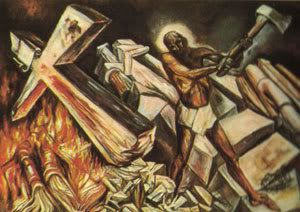
Mural by Jose Clemente Orozco


I have been deeply moved by Mexican muralist José Clemente Orozco's (1883-1949) painting of Jesus chopping down his own cross. The Christ of this mural prostrate is drawn in a very primitive style. Christ is not the Pascal lamb but refuses his destiny and will not go to the cross. The painting is disturbing because the first impression is that of blasphemy. Is the artist mocking Christ? Is he rejecting faith at its most sacred level? Rosco is not trying to blaspheme Jesus, nor is he denying the atonement. I find this painting very moving not our any rejection of Christ’s sacrifice or any desire to defame the doctrine of atonement, but because for me it says Jesus would, weather as the sun of God, or if he was only a man in history, refuse to be the poster boy for institutional hypocrisy, Jesus would allow himself to be used as symbol to sanctify the institution as it oppresses the poor and ignores the needs of the people. I believe that the real Jesus of history is both the Son of God and the man of history, and he does refuse this role. The real Jesus was a revolutionary of a most remarkable kind. Often we hear that Jesus is the great ethical teacher, and he claimed to be the Messiah, and savior of the world. We usually understand his ethics as an addendum, something any self respecting son of God would be required to have, but mainly irrelevant to his claims of godhood. Jesus ethics were far from being an addendum, however, they were the weaponry and major battle tactics of his amazing revolution. Politics and religion were intertwined in first century Hebrew society. Jesus’ ethics and his Messianic claims work together to fulfill his ultimate mission of world saving and together they make for one the most unique revolutions in human history.

It is not so strange to think of Jesus as a revolutionary. There were even Priests in Latin America in the 60’s, such as Camillio Tores but joined Che and became gorilla fighters. But Jesus the man of history was a true revolutionary. The region from which Jesus is said to have sprung is known as “the Galilee.” The Galilee was a hot bed of revolution, filled with uprisings and tensions. The Romans regarded it as the seat of Zealotry where the real revolutionaries were based. Just four miles from Jesus’ family farm “Nazareth” is a major metropolis known as Serapes. Just four miles down the road Jesus would have had access to what was then modern sophistication, political unrest and new ideas. Nor did he have to go to India to learn of traditions beyond his native prudential Judaism, the major trade route to India went right by his house,. That route lay on the plain of Megiddo where the end of the world is supposed to take place, the final battle between good and evil. Nazareth overlooks the plain of Megiddo and apparently the battle of Armageddon. All of these influences would have been at work in Jesus upbringing. Not to mention the fact that he was a descendent of David, born in Bethlehem and named as the high priest of Zechariah (Joshua = Jesus) who is linked to the Messiah (Zechariah 4).

Jesus revolution, however, was a bit odd. He did not lead an army nor did he command his followers to fight or pick up weapons. His was a non-violent revolution in the mode of Gandhi and that is where his ethics play a major role in backing his mission. The role of the Messiah in the society of Israel was that of political liberator, but it took on overtones of cosmic proportion. In the book of Isaiah we see the concept of Messiah first begins to be introduced, and is then back read into previous statements such as Moses admonition that “a prophet like me will come” and even God’s word to Eve “I will place enmity between the serpent and your seed.”  The Messianic kingdom sketched out at the end of Isaiah is not the millennial kingdom of Christ’s post epochal reign on earth, but Israel after the return from the exile. By the second temple period and the time of Jesus, the concept had grown to almost divine proportions. The Messiah was to stand on the top of the temple and shout “Jerusalem your time at hand” the end of the world would ensue. The Messiah was to rise from the dead all of fallen Israel and for that reason he held the keys of life and death. The Jews did not see the Messiah as world redeemer; they did not see him as atoning sacrifice. These weren't entirely Christian innovations, they were foreshadowed at Qumran. But they weren't mainstream. The Jews certainly did not expect the Messiah to be crucified and raise from the dead.

Jesus was such a radical revolutionary, that is a "strange" different, unconventional one, that when his guys made noises about actually installing him on the throne the ran from them. That's because he knew, as everyone from the Galilee knew, the futility of trying to fight the Romans. The slaughter of the innocents in the book of Luke, is not recorded in history. Atheists are always quick to remind us of this. But it does not have to be because that kind of thin happened all the time. Even a gathering as innocent as the sermon on the mount risked attack by Romans even though nothing provocative was being said. When they started talking about making Jesus king he slopped away and ran from them. Not because he lost his nerve, but because that would totally divert the people from his true purpose. Jesus has no intention of leading an armed revolt that was the opposite of what he had in mind. neither did he intend to pacify the people to accept pain and hardship with platitudes about pie in the sky. Was his program escapist? Was it just a personal nirvana with no touch stone in reality or responsibility to the world? It was not this ether. It was a practical and pragmatic system fro changing the nature of the world by changing the way people relate to each other. He accomplished this by taking people out of the world while keeping them in it.

In Jesus' system we live by the dictates of a higher citizenship, a world beyond this one ruled entirely by God. This is echoed in the model prayer he taught the disciples "thy kingdom come thy will be don't on earth, as it is in heaven." The device Jesus used for this trick of living by the rules of world while being physically in another, we the kingdom of God. The Kingdom of God was the essence of Jesus' message:


Mt 3:2
and saying, "Repent, for the kingdom of heaven is near."


atheists think Jesus was saying "If you don't believe in me you will go to hell." But he actually never says this. All the action  is in the kingdom and the kingdom is the big deal. The coming of the kingdom Jesus makes out to be an immanent, immediate, almost emergency status event that will happen soon, and when it does, man is it a big thing!


Mt 4:17
From that time on Jesus began to preach, "Repent, for the kingdom of heaven is near."

Mt 4:23
Jesus went throughout Galilee, teaching in their synagogues, preaching the good news of the kingdom, and healing every disease and sickness among the people.

Mr 1:15 - Show Context
"The time has come," he said. "The kingdom of God is near. Repent and believe the good news!"


He never says the Kingdom is  reward becasue you had the good sense to believe on him, but he does speak as though its the answer to all our troubles:


Mt 5:3
"Blessed are the poor in spirit, for theirs is the kingdom of heaven.

Mt 5:10
Blessed are those who are persecuted because of righteousness, for theirs is the kingdom of heaven.


Most revolutionaries come to abolish the standing order, not imposes a kingdom, one kingdom over another.It is within this context that he talks about the ethics and personal relationships and how to relate to people. This is not just some ad on that's in addition to believing the right things, nor is it unrelated, but it is an outgrowth, a logical extension, one is the basis of the other. The Kingdom is coming. It's power is already here. We can be part of it now, because it has two aspects. This is "realized Eschatology" which was developed by the theologian C.H.Dodd; the kingdom has an "already" dimension" and a "not yet" dimension. We live in the kingdom now even as we are in the world. How we treat each other is an integral aspect of the kingdom.


Mt 5:20
For I tell you that unless your righteousness surpasses that of the Pharisees and the teachers of the law, you will certainly not enter the kingdom of heaven.


Mt 7:21 - Show Context
"Not everyone who says to me, 'Lord, Lord,' will enter the kingdom of heaven, but only he who does the will of my Father who is in heaven.


Living as though we were in the kingdom now is the most radical move of any revolutionary program. We don't need to hurt anyone, we don't need to fight anyone. ;We just treat people the way God wants us to treat them, out of love. Over time like the mustard seed int he parable he told, the kingdom will grow into a mighty tree that will shade the world. Of course that brings up a sore spot. Some might suggest that has not happened. Others might suggest are still working on it. I think it's worked out much better than skeptical types are willing to admit. Of course the problem is the quasi religious types who think they can manipulate the truth for their devices, and the legalistic types who think they have to kiss up the quasi religious types or they aren't religious enough. While there's a long way to go we need to be cognizant of the fact that Christianity is more than just a  social agenda and plan for living. The Kingdom of God is not just a social club or a political prgram  it's spiritual power.

Tuesday, August 24, 2010

Agasint Infnite Causal Regress

Photobucket
The Infinite causal regress is an important issue in dealing with the cosmological argument, especially the Kalam version, and the argument form final cause. It basically means that any infinitely recurring causality for any event is impossible, since one never actually arrives at a cause. The importance of this argument applies not only to the now largely abandoned notion of an oscillating universe, but to any finite causes of space/time. This is because in light of the impossibility it means that the ultimate cause of the universe must be a final cause, that is to say, the cause behind all other causes, but itself uncaused and eternal. These are two major issues because they indicate why the ultimate cause of the universe has to be God. Since arbitrary necessities are impossible, the ultimate cause cannot be something which is itself contingent, such as an eternal singularity. The ultimate cause, or "final cause" must be God, since God is a logical necessity.

But lately skeptics have sought to deny these principles. They have actually been denying that infinite causal regress is impossible. This causes me to suspect that they don' really understand the concept. For no one truly understanding the notion of an eternally repeating cause could seriously consider that an infinite causal regress can actually exist. But this denial takes two forms. First, they just deny it outright. They don't' believe me. And secondly, they sometimes try to provide examples such as the number line, that's a favorite. And of course the ever popular claim that God is also an infinite Regress. That is three arguments to deal with:

1) Out right deniel that ICR is impossible

2) The argument that one can find examples in Mathematics

3) The idea that God is also an ICR


Before dealing with the nuberline I will just make a little argument on the impossibility of an actual infinite causal regress (that is that one could actually exist in real life).

1)A beginingless series of events is impossible.

A actual infinite is defined as A beginingless series of events This is not to say that nothing actual could be eternal, but that a series of events with no beginning cannot exist in reality. A thing is said to be actually infinite if part of it is equal to the whole. For example, mathematicians show that the number of fractions is equal to the number of whole numbers, even though fractions can divide whole numbers infinitesimally, because its all infinity and infinity is without number. Now here I'm distinguishing between existence in actuality, the "real world," as opposed to existence in mathematics.

A linear Causal infinite regress is thought to be possible by Auqinas and Farther Copeleston, but only if it has a prior hierarchical cause. In other words, the causality can be not just linear but also hierarchical. A hierarchical infinite regress is also impossible for the same reason, it never really has a cause since it has no beginning. A liniar regress of causal nature is impossible without a hierarchical cause.

The great mathematician David Hilbert argues for the notion that a beginingless series of events with no higher cause is impossible. ["On the Infinite" in Philosophy and Mathematics (Englewood Cliffs New Jersey: Prentice Hall), 1964, 139, 141.)

(2) ICR is Circular Reasoning

William Row Quoted on website below

www.faithquest.com/philos...cosmo.html

Rowe's version of the standard answer goes as follows: Suppose we are wondering why A exists. Suppose further that A was linearly caused to exist by B and that B was linearly caused to exist by C, etc. Here is a causal series, Rowe says, which might well extend infinitely back in time. This is because we need do nothing other than point out B in order to explain why A exists; although B was itself caused to exist by C, we still need refer no further back than B to explain the existence of A. But, Rowe says, suppose we are trying to explain not why A exists but rather why a certain sort of causal activity - the activity of causing A presently to exist - is going on. Here we cannot as before merely point to B. because presumably B is itself being caus ed to engage in the causal activity of causing A presently to exist (and is thus only a kind of intermediary). Accordingly, we have to talk about C's causal activity the causal activity of causing B to cause A presently to exist. This, then, is a series that cannot be extended infinitely; this series must have a first member. For if there were no first member, we would never succeed in arriving at an explanation of the existence of the causal activity of causing A presently to exist. We would never be able to explain why this activity is going on.11

(But this author supports Aquians' and Copleston in saying that linier causal regress is possible but not a hierarchical one. Easy to see why he says this, because he believed the universe to be inifinite in time, but he still asserts that there must be a higher eternal generation)

Just extend Rowe's argument a little further to see that ICR is circular reasoning. The need for a cause is granted bye ICR advocate; and that need will be supplied, so they say, by the cause of the previous event (for example in an oscillating universe, the previous Big Bang supplies the need for the cause of this universe). But, when it comes to explaining the ca usual relation to the whole series they will say that is uncessary, because they have that previous link in the chain and it's covered by the infinite serious of previous links, but nothing ever explains how the previous link could be there, except a previous link.

This is just circular reasoning because no matter how far back you go you have a cause that allows for any particualr link to exist. Take this example:

a => b, b => c, => d => e, e => f

Now if we say "how can f exist without a cause? They say well it has a cause in e. But e doesn't have a cause except in a equally unexplained d, and go back as far as you will, there is never an explanation for how this could be. Yet they agree that the causal principal is necessary because they keep sticking in intermeidate causes. If the causal principal is necessary, then there must be a final cause taht expalins how it could begin. Causality is linear and if they are going to argue for cyclical universe they have cover a linear concept of casu and effect.

If a series of events go back in time forever it is a beginingless series of events. IF the universe existed forever, for example, this would constittue an actual infinite. This is because the series of events that led to the current universe would be infinite. This is to distinguish it form a "potential infinite" which might be achieved by adding one event to another in a series and going on infinitely. But a series of events that has already transpired infinitely is an actual infinite.

Or let's look at the notion of finishing an infinite series. If a man claims to have been counting for infinity and is at last about to reach zero, he says -3, -2, -1, he's finally finished. Yet, he should have finished eons before, an infinity of time passed eons ago, or centuries, or decades, so he should have finished by now. Another strange paradox is that if we could check this man's counting in the past we would never find him counting. For he would have finished an infinity ago so we could never find him counting at any time that we ever checked his counting. Yet if he never counted he could never finnish. Now may skeptics are going to say that it is impossible to count infinitely and so forth, yes, obviously. But these are the kinds of examples used in transfinite mathematics to illustrate this point.

"This illustrates once more that the series of past events could not be without a beginning for if you could not count numbers from eternity, neither could you have events form eternity. These examples underline the absurdity of a beginingless series of events in time, because such a series is an actual infinite and an actual infinite cannot exist. This means that the universe began to exist, which is what we set out to porve" (William Lane Criag in his early work, The Existence of God and The begining of the Universe Here's Life Publishers 1979 p.4 [and don't forget the empirical scientific data which also proves this same pint with the Big Bang).

3) An Actual Infinite Cannot Be Achieved by Adding one event to the series, thus the series of events in time can never be actually infinite.

This can also be understood in the fallacy to trying to count to infinity. This should be pretty obvious, because no matter how many events we add we can always add one more and continue to add events forever. One can never count to infinity. Most people understand this pretty well.So one could never add one event to another and reach infinity, it's the same thing. This is also called The impossibility of traversing the infinite.

Thus an actual infinite could come to exist only if all the memebers came to exist at the same time. As Craig points out "if an infinite number of Days existed before today, today would never come because one can never traverse the infinite." (50).

Philosopher John Hospers states:

"If an infinite series has proceeded the present moment, how did we get to the present moment? How could we get to the present moment--where we obviously are Now--if the present moment was proceeded by an infinite series of events?" [An Indtorduction to Philosophical Analysis, 2nd ed. (London: Rutledge and Kegan Paul, 1967) 434)

This First argument, the impossibility of a beginingless series of events with no higher cause was repeatedly defended and always successfully by G.J.Withrow, Professor of Mathematics at University of London's Imperial College of Science and Technology. see "The Age of the Universe,"British Journal for Philosopher of Science (1954-55) PP215-225. Natural Philosophy of Time (London: Thomas Nelson, 1961) See also Philsopher William Rowe The Cosmological Argument Princeton University press 1975

Now What if someone argues that the infinite series would be beyond time? In that case the skpetic loses the argument that there is no causality before time. IF there is no motion, causality, or change beyond time than there cannot be a series of events leading form one cause to another beyond time.

Now let's examine the three arguments.

1) Out right deniel that ICR is impossible.

Well, if they don't believe the logic, they are pretty hopeless. And if they dont' accept the word of the mathematicians that are quoted, there isn't much you can do about it. But it seems pretty obvious that if you have an ifinite series of causes leading back infinitely you would never have an actual cause, and the thing to be caused would not exist, just as you cannot count to infinity, or just as the counter claiming to have arrived at zero from infinity would never have actually counted.

2) That the number line is an example from Mathematics that proves the actual infinite, or Infinite causal regress.

David Hilbert has prove, as quoted above, that transfinite mathematics cannot exist in life. The number line is not an actual series of events, it is only hypothetical. Moreover numbers do not cause each other. It is not a causal regress.

3) That God is an ICR

This is merely to confusse an infinite with an infinite regress The ICR is an infinite series of events. God is not a series of events. God is not an event, God is not a recurrsion of causes, he is one final cause. God is not in time, he is eternal. So the two are not analogous at all. God is not an ICR.

The ICR is an impossibility, it cannot exist in actuality. This means the universe cannot be eternal, for the universe is an infinite series of causes, each one leading to the next. It certainly means the old oscillating universe notion of eternally recurring big bangs and crunches is right out! Therefore, there must be a final cause which is eternal and is not a series of events but one final cause that transcends the chain of cause and effect. It causes the universe but it is not in turn an effect of any other cause.

Aristotle and Bertrand Russell agree

Robert Koons, University of Texas

www.la.utexas.edu/phl356/lec5.html

Lecutre 5 Phil 356 Theism Spring 98


Another example is mentioned by al-Ghazali. Suppose that the sun and moon have each been revolving around the earth throughout an infinite past. There are 12 revolutions of the moon for every revolution of the sun. As we go back in time, the gap between the number of months and years grows ever wider, yet, taken as a whole, there are an equal number of elapsed months and years (both infinite). Cantorian set theory agrees with this paradoxical result: the cardinal number of months and years is exactly the same.

Bertrand Russell discusses a similar paradox, which he called the Tristam Shandy paradox. Tristam is writing is own autobiography. He takes a whole year to write down the events of a single day. In an infinite amount of time, Shandy can complete the task. Here's a time-reversed version of the paradox: suppose that Tristam is clairvoyent -- he writes about his own future. Last year he wrote about today's events; in the year before last, he wrote about yesterday's events. Today, he has just completed an infinite autobiography, cover all the events of his infinite past, despite the fact that, as we go farther in the past, Shandy is every further behind in the task -- i.e., 1000 years ago, he was still writing about the events of only the last three days.


Final note: The paradox of Time.

Some thinkers believe that time is an infinite series. I do not agree with this notion, I accept t=0, time begins in the Big Bang. But this is a valid viewpoint, I just dont' happen to agree. But that does not prove that a beginingless series of events with no higher cause can exist. Time can still have a higher cause, God perhaps, in heierarchical fashion.

Brap Gronk 3

Blogger Brap Gronk said..Part 3 of 3 (hopefully):

Meta: "Religious evolved out of the human contact with the sense of the numinous. . . . Mystical experince at the root of all religions"

Brap: I have read your links in the past where you discuss the studies about mystical experiences and their documented transformations. The reason this atheist doesn’t view that evidence as a rational reason to believe in God is that the cause of the mystical experiences themselves is too easily explained by the current state of knowledge about neuropsychology, cognitive sciences, etc.

 That is total absolute bull shit. I've demonstrated over and over again that it is not the case! That's the usual atheist tendency to say "Ok if one littel tiny connection is made tot he natural realm then the the whole thing is explained naturally. Here's an analogy to what's going on there. That's like if you argue with a young earth guy and shows conclusively that one fossil is really much younger than it's supposed to be, they says "see that proves the whole age of the earth is off and it's really only 10,000 years old." Then he doesn't' listen to your answer and goes off for the next 40 years telling people he's proved that the earth is only 10,000 years old. That's exactly what you and all other atheists are doing. Its' become an easy mantra for dismissing one of the most powerful arguments for belief that has ever been. People should be coming to God in droves if they understood the research, but it's easy to muddle and easy to dismiss since people are not concerned with details and not careful with facts and couple of buzz words like "naturalistic" can through off years of research for no reason.

Brap:They have natural explanations, in other words. (See Valerie Tarico’s work) 
 Wrong there are several problems with that.

(1) no research, not Tarico or anyone who claims to have evoked religious experience by manipulating the brain has actually  used the M scale (invented by Ralph Hood Jr. University of Tennessee Chattanooga) (except the Grifiths study of Johns Hopkins, I will deal with that in a moment).

 That means they can't prove they did evoke mystical experience because they can't demonstrate what it is. The M scale is the most valid measurement scale because it has been validated in the field cross culturally many times. Without that there is no proof that mystical experience can be evoked by brain chemistry or stimulating parts of the brain.

(2) Grifiths said that his study does not disprove divine presence in mystical experience.

(3)  Andrew Newberg, one of the pioneers in research on the genetic basis for religious experience tells us that the brain is constructed such that if God spoke to us he would have to use brain chemistry. So the fact that we find a link form Religious experience to brain chemistry no more proves it's only naturalistic than does the fact that we have ears. If God wishes to speak to Moses he must gives Moses ears, and if he wishes us to feel his presence he has to go through brain chemistry. God himself made us that way (if God made us) so we should not find it odd that there is a connection, it doesn't mean that much.

(4) There is no research that links the naturalistic processes to thee outcomes.

Brap:I think you had a blog post a few months ago arguing that it doesn’t matter if there are natural explanations for these mystical experiences or the sense of the numinous. If I’m getting the gist of that right, it takes me back to a question I asked earlier in this comment, which is how can we tell the difference between a God that interacts with our world in a way that doesn’t violate the laws of nature and a God that does not exist? 
 I answered that question too and you have not responded to it. The result of having the experience cannot be explained. The qulia that make up the experience itself are linked to brain chemistry and manipulation of the brain, but what is not linked to anything is the link to the result; the life transforming effects. There is no external cause that can be linked to long term positive effects of such a dramatic nature, and all the organic processes are degenerative. There is nothing that can explain how it is that having this experience changes your life so.

There's also no way to explain how such experiences would give such noetic qualities. So there is an explanatory gap.


Meta: "Creation myths as we know them are late inventions." 


Brap: Is “late” anything after the Pentateuch was written? 
 Pentateuch guy did not invent creation myth. That was written and redacted in the form we have it in the inter-testamental period, very recent. But even it's invention in oral form which pre-dates Summer is relatively recent in anthropological and world history terms. Anything after the last great ice age is "recent." Humans were sensing the numinous and burying their dead with herbs and flowers and celebrations of after life 30,000 years ago.

Meta: "Creation myths as we know them are mythology and mythology is about archetypes . . . It's about the psyche not about history." 

Brap: The creation myth in Genesis does seem fairly important for Christianity, though, because that is the reason, as I understand it, humans are burdened with original sin.

 The point is, besides the fact that you used creation myth as supposedly religious explanation for scientific fact and I said it's theological tenet not an explainable for the world, the major point is that humans have been sensing the numinous since before they were actually humans (Neanderthal 60,000 years ago give evidence o burying the dead prepared for afterlife and decorating knives and other implements--which indicates magical ideas). So religion has been a part of humanity from the inception of modern humans. Creation myths are relatively recent (within 5000 years). they are not the reason anyone believes and they aer not designed to explain stuff like rain. But of cousre the question "where did we come from" is in there but it had more metaphysical import than it did scientific curiosity. Religion is not must primitive failed scinece. It's an existential response to existential questions.


Brap:I have asked this question on other blogs, but never have gotten an answer: Without a literal Adam and Eve, how are humans burdened with original sin? 

 We are not. That's why I don't bleieve in a literal Adam and Eve. Not all Christians believe in orignial sin. That's a Catholic (Augustinian) doctrine and it's been distorted anyway. Augustine just said it's the basic capacity to sin. Its' not surplus guilt. Original sin dos not say we are born guilty of sin. I think the question you really want to ask is "how is the capacity of sin transmitted to humanity if there is no one original sinner that led humanity down into the ditch, right?"

Answer: There does not have to be a one original sin that leads people down. The basic tendency of being sentient and being self transcendent that leads to anxiety and causes people to sin. It happens to everyone just like getting sexual urges and wanting to master-bait when you reach a certain level of development happens to everyone. I'm not equate sex with sin, but it's that kind of thing, you come of ge, Its lose of innocence.


Brap: 7. I have read “The Demon-Haunted World” by Carl Sagan, and I can’t think of anything in that book I disagree with.


Meta: "I have not read that book, but I'd be willing to bet that he got it wrong. If what Brap is saying is an accurate reflection I would assume that Sagan makes the same fallacious assumptions that Brap does." 

Brap: I would estimate that less than 5% of the book deals directly with religion, and Sagan is much gentler on religion than Dawkins or Hitchens would be while heavily sedated. I would love to see a review of that book by a person of faith, to see if they disagree with any sections not dealing with religion, and why. 

I have no doubt that he is not raving like Dawkins and Hitchens.  I like Sagan's personality, he came across as a nice guy. I enjoyed Cosmos on PBS. Maybe I'll review the book if I get a chance to get it. On the other hand, the things I'm calling "fallacies" are ideas form the nineteenth century that even benign liberals get wrong, such as the assumption that religion was invented to explain nature.


Brap:As I recall there are sections where he does focus on the mythological aspects of religion, so you wouldn’t like those parts.

Depends upon what he says


Meta: "We need to move beyond the simplistic understanding of the world that seeks to set "scientifically proved" "facts" as the foundation of the world view off against all other forms of knowledge. . . . Thus we need to shed this delimiting crutch that only "scientific proof" counts as a valid reason to believe something and move toward a global understanding of knowledge in general."


Brap: “The Demon-Haunted World” clearly spells out the dangers of believing in things with insufficient proof, providing examples throughout history and in modern times. It’s easy to come away from that book both scared for and disappointed in humanity. Groupthink is a powerful and potentially dangerous phenomenon, and nobody and no group is immune from it, including scientists and atheists.

 Sagan's assertions about religion are not backed by real facts or studies. I'm sure he never new anything about the research I've done. A lot of it was not done until after he died. you are basing the case on fiction. I don't need a diatribe against religion to be disappointed in human history. I can understand (I say "can" I share) disappointment of fellow political liberals in the nature of fundamentalism especially when it comes to the politics of the era.

Belief in God is not based upon lack of evidence. Atheists join my parade of shame of things humans do that disappoint me when it comes to discussion of reasons for bleief in God.

I have a ton of evidence for God. the inability of atheists to evaluate it fairly or rationally is shocking and disheartening. The atheist ability to fairly evaluate evidence for God is like the ability of people in the deep south in the 1950s to fairly evaluate the notion of integration. God is speaking to our hearts. Atheists are people who closet heir hearts to the truth God is speaking because they seek to protect little pet sins. The junkie analogy would fit there. It's like trying to get junkies to rationally decide to quite drugs.

Sunday, August 22, 2010

Major discussion with Brap Gronk part 2

Photobucket


Delete


Blogger Brap Gronk said..

Let's try this again. Part 2 of 3: Brap: 6.   
Brap: Humans have wondered about the origins of the earth, the sun, the stars, and themselves for a long time. Many creation myths were developed in ancient times in an attempt to explain these origins, and these creation myths are easily proven to be untrue given the current state of scientific knowledge. The account of creation in the book of Genesis appears to be another easily disproven creation myth.  


my previous answer: 

  Meta: “This is interesting because he takes at face value the creation myth as the point of departure for justification. . . . (1) it assumes that the reason for belief in modern world is the same as the reason for the existence of religion in the ancient world.” Brap: A major factor in both is the carryover of the beliefs of the prior generation. Any original religious beliefs typically lead to schism. “(2) it assumes that religion exists in order to explain where we came from,as though that's the only major question that really concenred ancinet man.”  
 His most recent answer:
 Brap: I think religions came about to explain not only origins but also what happens after death, and what causes weather, natural disasters, disease, etc. But I think the true origin of religion has to do with two things: A) Worship of imaginary gods who controlled the weather and the few other things early humans cared about (such as fertility, or bountiful crops once people started farming.)
 That's demonstrably disproved. The sense of the numinous is real and it can be seen at work in all religion without exception. Since mystics are found in all religions going back as far s we have writings form them, and since the facts about their experiences being totally universal despite their doctrines being different, and the studies that have demonstrates that they habitually relate in the same way to their experiences, the world over; it's pretty obvious that mystical experience and the sense of the numinous has more to do with the reason for religion than does this other stuff, which is really just atheist reading their own interests in scinece into religious history. I've quoted that material before at length. In fact I think I quoted in relation to this discussion with you.


Mystical experince at the root of all religions Transpersonal Childhood Experiences of Higher States of Consciousness: Literature Review and Theoretical Integrationm (unpublished paper 1992 by Jayne Gackenback http://www.sawka.com/spiritwatch/cehsc/ipure.htm
Quotes:

"The experience of pure consciousness is typically called "mystical". The essence of the mystical experience has been debated for years (Horne, 1982). It is often held that "mysticism is a manifestation of something which is at the root of all religions (p. 16; Happold, 1963)." The empirical assessment of the mystical experience in psychology has occurred to a limited extent."


a). Core of Organized Religion


The Mystical Core of Organized Religion

David Steindl-Rast

http://www.csp.org/experience/docs/steindl-mystical.html


Brother David Steindl-Rast, O.S.B., is a monk of Mount Savior Monastery in the Finger Lake Region of New York State and a member of the board of the Council on Spiritual Practices. He holds a Ph.D. from the Psychological Institute at the University of Vienna and has practiced Zen with Buddhist masters. His most recent book is Gratefulness, The Heart of Prayer (Ramsey, N.J.: Paulist Press, 1984).

"If the religious pursuit is essentially the human quest for meaning, then these most meaningful moments of human existence must certainly be called "religious." They are, in fact, quickly recognized as the very heart of religion, especially by people who have the good fortune of feeling at home in a religious tradition."

b)What all Religions hold in Common. Cross currents Thomas A Indianopolus prof of Religion at of Miami U. of Ohio http://www.crosscurrents.org/whatisreligion.htm
Quote:

"It is the experience of the transcendent, including the human response to that experience, that creates faith, or more precisely the life of faith. [Huston] Smith seems to regard human beings as having a propensity for faith, so that one speaks of their faith as "innate." In his analysis, faith and transcendence are more accurate descriptions of the lives of religious human beings than conventional uses of the word, religion. The reason for this has to do with the distinction between participant and observer. This is a fundamental distinction for Smith, separating religious people (the participants) from the detached, so-called objective students of religious people (the observers). Smith's argument is that religious persons do not ordinarily have "a religion." The word, religion, comes into usage not as the participant's word but as the observer's word, one that focuses on observable doctrines, institutions, ceremonies, and other practices. By contrast, faith is about the nonobservable, life-shaping vision of transcendence held by a participant..."

Smith considers transcendence to be the one dimension common to all peoples of religious faith: "what they have in common lies not in the tradition that introduces them to transcendence, [not in their faith by which they personally respond, but] in that to which they respond, the transcendent itself..."(11)


 Brap:
Any young tribesman who told the elders it was a waste of time to do a rain dance because the rain is a result of natural processes would have been quite the outcast. As the saying goes, in an insane society, the sane person appears insane. So belief in the false gods persisted and other false gods were added over time.
 I said this before you didn't answer it. That is a fictional account! you have no historical examples at all whatsoever. you made that up because it's the romanticized crap of the enlightenment that philosophies used to flatter themselves as brae and daring and so forth. You  have no evdience that it ever happened. You are also attributing forms of thought to people that they were not capable of. You are assuming there were all these budding young Einsteins out in the boonies herding sheep and discovering the valid reasoning of cause and effect, there's no evidence it ever went down that way.

Then to extrapolate form the fictional romantic reading of history to assume that this is the origin of religion is just silly. This is not social science it's bull shit. Surely an alien from an advanced race light years away who could construct a way to get to earth, must be sociologist, I can't see any other reason why intelligent life would want to come here! So I can't believe advanced alien sociology is so backward!
Then someone had the bright idea of worshipping an omnipotent god who controlled everything, but even that omnipotent God couldn't keep all of his followers on the same page. And B) Religion did help bring people together for common activities during and after the transition from a mostly nomadic species of hunter-gatherers to a more settlement-based society. 
 That's really a Lamarkian account. But myth of worshiping gods is not the origin of religion. Religion is not about gods, it existed a long time before they had gods. This is the Freudian motivations reading themselves into history to do battle with the father. In other words atheists are so hung up on hating their own fathers (which psychologists have predicted) that they become focused on fighting the father figure in religion. Even if a particular atheist had a good relationship with a good father (I did, I was an atheist I had a great Dad), those Freudian motivations are still there so even people with healthy relations can get hung up on opposing the father figure. Before they had gods religions had spirits, and they used mazes and the hunt as focal points of sense of the numinous. They weren't trying to explain anything except why they had this sense of something behind it all. Everything they did was at an organic level, the mysteries of birth, life, and death, the need for wholeness and complication and integration with nature and the cosmos this what lies behind it all. They experienced it as an organic whole in daily life, not some question they could set aside and debate. There are labyrinths in Scandinavia that go back to late megalithic times. The labyrinth was an ancient symbol of the journey of life and used in religious devotion and markings as far back as we find any evidence of humanity. That's the origin of those Celtic lines we see decorating megalithic tombs in the British Isles. It wasn't about "why does it rain?" It was about life, read the Ideonopolis quote from above."By contrast, faith is about the nonobservable, life-shaping vision of transcendence held by a participant..."

article on labyrinths
 (this article is a bunch of new age blather but it demonstrates the spiritual connection to labyrinths and some of their presence in ancient times). In researching my book, The Trace of God (soon to be released) I found evidence of stone age mazes and labyrinths that indicate the spiritual connection going back into pre history.


 Meta:
“(3) since they assume science is the only form of knowledge they assume that scinece must be the origin of all human thought.” Brap: Quite the contrary, I know the human brain is quite capable of thinking up non-sciencey stuff. “(4) it assumes creation myths are the actual accretion of ancient religious wisdom” 
Brap: It doesn’t really matter to me whether a creation myth is the accretion of ancient religious wisdom, the foundation of a religion, or just a side story. The fact that the creation story in Genesis was generally accepted as fact only until the evidence against it became overwhelming, and is still accepted as fact by some people, is troublesome.
It is only so due to the fundie baggage that says everything in the Bible must be literal history and must be true in a literalistic way. Why should the fact of mythological symbols that speak to the psche wrapped in an ancient myth spell any sort of problem with belief in God? That's especially so when we consider that no one really believes BECAUSE of such myths? I don't know anyone who says "I was an atheist until I read about Adam and Eve boy that really conveniences me." It's just a simple matter these myths clinging to a tradition becuase people forgot what they are for and began to push them literal history in response to historical happenstance (Darwin). The whole point of being liberal in the theological sense is to analyze accurately the historical nature of faith, separate the historical baggage from the acute bits, and move toward some sort of progressive understanding. You can't do that if you are not prepared to find that there actually is some baggage to move beyond!
Delete


Friday, August 20, 2010

Major discussion with Brap Gronk

Photobucket Part 1 of 2 (maybe 3): In the category of better late than never, my comments:
Meta: "Any given argument might be rationally warranted, depending upon how it's argued. Rational warrant is like "logical permission to believe something" not actual proof. A person is logically justified in not believing something if that person truly has no reason to believe it."
Brap: I had long response written about that paragraph, but in the end it didn't really go where I thought it was going. Maybe this will be shorter. Essentially I think it boils down to when an argument for rational belief or non-belief is presented, the debaters will treat it as an argument for proof of that position and respond accordingly, as you did in this post and as your friendly (and not-so-friendly) atheist opponents do on your site. I can understand your not wanting to present your arguments as positive proof of God's existence, but that's how they are perceived and addressed by the peanut gallery. Just an observation, really, since I don't think it matters whether you call it rationally warranted belief or proof of God's existence, the responses will likely be the same.
That's true. you are right but I don't know what to do about it. If you go on not making arugments they dance around going "there's no proof, there's no proof!" Now they will never ever never never admit a God argument has  a good point, but at least they shut them up for a bit and one can tell they are worried when their answers are so bad it's obvious they are beaten they get testy and all, so the arguments are rhetorically necessary.
Meta: "Why do I say that "I have never seen God" and the other initial responses are only understandable for someone who has never read a book and knows nothing about modern thought? . . . I include these answers because they are fallacious as reasons not to believe in God."
Brap: These points were just to establish that God is not part of the perceived universe. (Dividing the universe (or whatever the universe is a subset of) into three categories: Perceived, Detectable, and Theoretical.) God may have chosen to be part of the perceived universe for some people in the Old Testament, but that doesn’t seem to be the case in modern times.
Yes God is part of the perceived universe. It just depends upon how one is perceiving it. God is not given in sense data, but that's a given. We all know that. Atheists accept all kinds of things that are not given in sense data. Phenomenological methods go around sense data.
Brap: 5. I am not aware of any evidence of God’s interaction with our world. Natural laws can explain how things work and why things happen, as far as I know.
I am part of the world, I have interaction with God. Natural law is a game atheists play. When they need to deny it's perspective nature they do so, then when they need to be so they spring back tot he point there it's prescriptive.
Meta: “We should not expect to see anything but natural laws at work in the world becasue they are made to work autonomously. But such laws are a dead give away that there has to be a mind running the universe at some level, see my 3d God argument, "fire in the equations.""
Brap: Can we tell the difference between these three things: a) A God that interacts with our world in ways that do not appear to violate the laws of nature. (In other words, undetectable.)
 Yes we can tell the difference but not in ways that demonstrate the reality of God as objectively demonstrable apart form other phenomena. So those ways discerning it may always be subjective and thus can't be used as proof, but for the person willing to make a leap of faith they can used as a guide. One way to distinguish that is not so subjective is porobablity. For exmaple the probability of religoius experience as prophetically noetic and transformative (positive, not negative at all, teaching and restoring and reviving one to a higher life) as a total accident or misfire of the neural net is so extremely improbable that the result of religious experience are a good indication of God, that's why I call it the book The Trace of God. Although that is meant to be undestood as the Derridian trace.
b) A God that does no longer interacts with our world, because nature runs on its own and works autonomously.
 God does interact with the world. The sense of the numinous and the sense of God's presence the feeling of God's love are interactions.I do believe that God answers prayer. I beieve the Lourdes miracles are good evidence to that effect.
c) A God that does not exist.
Yes obviously there's a difference in God not given in sense data and not there being no God. The term "exist" has implications for Tillich, and as a student of Tillich's thought (although unfortunately not of his classes in seminary) I have to point this out. But never mind that, there is a difference in the reality of the divine and not being able to objectively demonstrate that reality to one who does not wish to see it subjectively.
Brap:Your “fire in the equations” argument seems very similar to the argument for intelligent design, which simply theorizes that absent a more plausible scientific theory regarding the origin of an apparently designed X, some sort of intelligence is behind it.
 It's similar to a design argument but it doesn't suffer from the fatal falw in most design arguments, that we don't have something known to be designed or undersigned to compare it to. This is becuase comparing to law and mind we do have previous laws and minds to compare to. Rather than God of the gaps, this is atheism of the gaps. The argument doesn't just turn on a gap, it's a logical problem; how can you have a law based upon the tendencies of universe braining that universe into existence? What are "tendencies" derived from prior to the existence of the thing with the tendencies? That would seem to mandate prescriptive laws. But if the laws are prescriptive what else makes prescriptive laws but a mind? Dawkins wants us to be persuaded by the issue that only brains produce minds and only bodies produce brains, so God must have a body or he can't have a mind. But here's evdience of mind apart from body, yet it's based upon something we also never see, prescriptive laws apart from mind. How do you get a prescription without a mind to write it?
Brap:(Intelligence - - > Supreme Being - - > God) I will agree that the appearance of design does exist in both DNA and the laws of physics, but at one point in the not too distant past the human body appeared to be intelligently designed, as did the arrangement of the earth, moon, sun and stars.
 "supreme being" wrong terminology, violation of Tillichism. Begging question, you do not know that there is not intelligent design so you can't use the existence of things in nature as proof that such design is not needed. Here the skeptical answers suffers from the same flaw as the design argument. But again, we have minds to compare to in judging about prescriptive law.
Brap:Science eventually closed those gaps in human knowledge, so fewer and fewer gaps needed God as an explanation. Right now the last two major gaps seem to be abiogenesis and the Big Bang.
Science did not close any gaps, that's a misunderstanding. The reason religion exists is not to explain things. The reasons for belief in God are not based the need to explain the world. There are major gaps in that regard that can't be answered, such as the need for final cause. But be that as it may even that was "closed" as you say, it would not dissipate the need for religion becuase that's not what religion is predicated upon. Religion is predicated upon the sense of the numinous. That is not a gap, either you sense it or you don't. 
There is no scientific proof that demonstrates that the world was not created. There is no scientific proof that demonstrates there is no divine aspect to reality. Science is as untried and untested in that regard as it was in 1492 or 1200 or 300 BC. The situation with regard to the big bang is not so simple that all we need do is find some half assed cause to stick on it and everything is proved. As I quoted Hawking recently saying when we get all that sorted out then we will be in a position to ask "why is there something rather than nothing?" But even so science can never ask that. If you know all there is to know scientifically you can't derive a "why" from an is. You always have to step beyond scinece and enter the world of metaphysics in order to even ask the question. Indeed scinece is metaphysics but most of it's adorers will  never admit that. Science is like a southern belle who happens to be a prostitute. All her suitors spend their time hanging around outside her door refusing to accept that it could be the case, before they go in and pay for her favors. It's really metaphysics in disguise. But it can't legitimately incorporate metaphysical questions without admitting that.
Brap:But I don’t push the God of the Gaps argument because it’s really pointless. If and when science does solve that last remaining gap, the believers will simply say, “So that’s how God did it” and continue believing.
I'm already saying it because that's not a reason for belief. Atheists always assume it is becuase it has to do with their reasoning. Having an alternate explanation will get the atheist off the hook, in terms of having to believe because it's the only explainable. So atheists approach reality as nothing but a surface level collections of things, the existence of which has to be explained.  So they imagine the reason for belief is nothing more than a surface level explanation. The reason for belief in God is realization about the depth of being. Belief in God is not just adding a fact to the universe. God is not merely another "thing" alongside the list of things that exist. Belief in Bod is realization that one is contingent, that being has depth. Being more than just the surface fact of things existing, it's the why of existence as well.
There's a lot more to this exchange but I'll do that ni the next couple of days.