https://christiancadre.blogspot.com/2017/09/christianity-and-supernatural-part-2.html?m=0
By Joseph Hinman (Metacrock) - September 10, 2017
Mathias Joseph Scheeben
The Supernatural was something very different than it is now. This is important because that original meaning, which Christian spiritually was predicated upon, is empirically provable and and can be shown to be real by simple scientific means. We have to understand the original concept, there are two thinkers who tried to restore the concept to it’s original form and we need to listen to what they tried to say. The first one was Matthias Joseph Scheeben (born, 1 March, 1835; died at Cologne, 21 July, 1888.) His major work was Nature and Grace. [17] Scheeben was a mystic who contemplated and studied divine grace and hypostatic union. He was also a greatly accomplished academic and was a fine scholar of scholastic theology. He studied at the Gregorian University at Rome and taught dogmatic theology at the Episcopal seminary.
at Cologne. Scheeben was the chief defender of the faith against rationalism in the nineteenth century. The generation after his death ( in Cologne in 1888) regarded him as one of the greatest minds of Catholic thought in his day. He left three major works: Nature and Grace (1861), The Mysteries of Christianity (1865), and the massive yet unfinished Handbook of Catholic Dogmatics. Among his major accomplishnents were defense of Vatican I's defense of infallibility, defense of religious freedom against Bismark's attempt to control the Catholic Church.
His books were repeatedly republished in Germany up into the 1960s and translated into other European languages, including English (the Dogmatics, alas, only in highly truncated form). Since the Second Vatican Council, though, he has mostly been neglected by theological teachers and students who have wrongly imagined the nineteenth-century Catholic tradition to be a period of anti-modern darkness….The Catholic world of a hundred or more years ago was quite right, I think, to see the Cologne seminary professor as perhaps the finest modern Catholic dogmatic theologian. His writings not only yield rare insight into the mysteries of Christian faith, they draw the attentive reader ever more deeply into the mysteries themselves. Scheeben is more important now than he has ever been. He can teach a theological generation that has sold its inestimable birthright how to restore and renew dogmatic theology.[18
The other thinker is Eugene R. Fairweather (2 November 1920-) an Anglican scholar and translator of Church fathers from Ottowa. MA in Philosophy form University of Toronto (1943) Ordained priest in 1944 and became tutor at Trinity college Toronto same year. He studied theology at Union theological seminary and earned his Th.D. in 1949. He had an honorary doctorate from McGill University. At the time he wrote his article “Christianity and the Supernatural” he was editor of the Canadian Journal of Theology and professor of dogmatic theology and ethics at Trinity College, Toronto.[19]Fairweather quotes Scheeben and bases part of his view upon Scheeben’s.
Fairweather’s view of the supernatural is contrary to the notion of two opposing realms, or a dualism. He uses the phrase “two-sidedness,” there is a “two-sidedness” about reality but it’s not a real dualism. The Supernatural is that which is above the natural in a certain sense but it is also working in the natural. There are supernatural effects in the natural realm that make up part of human life. Essentially we can say that “the supernatural” (supernature) is an ontology. Fiarweather doesn’t use that term but that’s essentially what he’s describing. Ontology is a philosophical description of reality. Supernature describes reality in that it is the ground and end of the natural. What that means is unpacked by Fairweather : an ordered relation of means to immediate ends with respect to their final ends. “The Essential structure of the Christian faith has a real two-sidedness about it, which may at first lead the unwary into a dualism and then encourage the attempt to resolve the dualism by an exclusive emphasis upon one or the other [side] of the severed element of complete Christianity.”[20] He explains the ordered relation several times through paring off opposites or supposed opposites: human/divine; immanent/transcendent; realm of Grace/realm of nature. All of these he refers to as “ordered relations.”[21] If this was Derrida we would call them binary oppositions. In calling them “ordered” he is surely saying one is ‘above’ the other in some sense. They are not necessarily oppositions because that’s his whole point, not a true dualism.
Supernature is working in nature. It’s not breaking in unwelcome but is drawing the workings of nature to a higher level. Fairweather describes it as the “ground and end of nature.” In other words it is the basis upon which nature comes to be and the goal toward which nature moves. Now it’s true that science removes the teleological from nature it doesn’t see it as moving toward a goal but that’s because it can’t consider anything beyond its own domain. Science is supposed to be empirical consideration of the natural realm and is practitioners often profess disdain for the metaphysical while inso doing keep a running commentary on metaphysics. Of course modern science become a form of metaphysics by infusing itself with philosophical assumptions and then declaring there is nothing beyond the natural/material realm. That is to say, when it is dominated by secularist ideology that is the direction in which science is cast. Be that as it may, theologically we can take a broader view and we see a goal oriented aspect to the natural. Supernatural effects draw the natural toward supernature. That is to say human nature responds to the calling of God in elevating humans to a higher level of consciousness. There is another example of the ground and end of nature. Fairweather doesn’t give this example, but I think it applies. This is Martin Luther King’s statement about the “arch of the moral universe is long but it bends towards justice.” Nothing in nature bends toward justice, if by “nature” we mean rocks and trees but there is more to the natural realm than just those aspects that science studies. Humans are part of the realm of the natural and it is part of our social world that we understand concepts of justice. Due to our own purposive nature we bend the arch of the moral universe toward justice.
Long before Dionysius spoke of huper hamousios “From an early period the concept of 'that which is above nature’ had been seized upon by Christian Theologians as an appropriate means of stating the core of the gospel...” [22] Origen...[185-254] tells how God raises man above human nature…and makes him change into a better and divine nature.”[23] John Chrysostom (347-407) speaks of humans having received grace “health beauty honor and dignities far exceeding our nature.”[24] That view has persisted even in modern times. “In the West the most concise expression of the idea is to be found in the Leonine prayer ‘grant us to be partakers of his divinity who deigned to become partakers of our humanity.’”[25] “In these and a multitude of patristic texts the essential point is just this, that God, who is essentially supernatural perfects with a perfection beyond creaturely comprehension. Nevertheless, supernature elevates human creatures to a true participation in divine life an indwelling of God in man and man in God.”[26] The important point here is that human nature is being raised to the higher level of divine. We can see this manifests itself through the experience commonly known as “mystical.” That I will take up shortly, First, let’s turn to Scheeben to document further the nature of the supernatural. Supernatural is the power of God to raise us to this higher level.
The Trace of God, by Joseph Hinman, on Amazon. The 200 studies in this book prove that Mystical experience is real, this article just proved that the original concept of SN is mystical experiemce. Therefore, SN is real.
Sources
[17] Matthias Joseph Scheeben, Nature and Grace, Wipf and Stock Publishers, 2009 (paperback) originally unpublished 1856.
[18] Bruce D. Marshall. “Renewing Dogmatic theology: Mathias Joseph Scheeben Teaches Us the Virtues Theologians Need.” First Things. May 2012. On line version:http://www.firstthings.com/article/2012/04/renewing-dogmatic-theology accessed 11/8/2013
Bruce D. Marshall is professor of Christian doctrine at Perkins School of Theology.(c) 2012 Institute of Religion and Public Life
[19] Editor’s introduction to Eugene R. Fairweather, “Christianity and the Supernatural,” op.cit.
[20] Ibid, Fairweather,.237.
[21]Ibid.
[22] Ibid.
[23 ]Fairweather, ibid (239).
[24] ibid
[25] Fairweather quoting Leonine prayer, ibid.
[26] Ibid
Here Fairweather seemsto contradict Saler who says there is no term in the writings of the so called “church fathers” that could be translated as “supernatural” until Cyril and Dionysius, here Fairweather says the Patristic texts God is suernatural. He is back reading the term based up the concept. The term isn't really used by his pre Crylian examples.

Monday, January 01, 2024


Tuesday, December 26, 2023
3 best God Arguments
I. Fine tuning
II. Religious experience
III laws of nature
sources on argument 3 Sources
[1] Bradly Bowen, Adamson's Cru [de] Arguments for God part 1, Secular Outpost, (April 25, 2016) blog URL: http://www.patheos.com/blogs/secularoutpost/2016/04/25/adamsons-crude-arguments-for-god-part-1/ accessed April 28, 2016
[2] Marlyn Adamson, "Is There a God," Every Student, Published by Campus Crusade for Christ On line resource, URL: http://www.everystudent.com/features/isthere.html She sites fn 11:Dinesh D'Souza, What's So Great about Christianity; (Regnery Publishing, Inc, 2007, chapter
[3] I recently posted on criteria by which to judge best explanation.
[4] Ratzsch, Del and Koperski, Jeffrey, "Teleological Arguments for God's Existence", The Stanford Encyclopedia of Philosophy (Spring 2016 Edition), Edward N. Zalta (ed.), URL = .
[5] Peter Lipton, Inference to the Best Explanation. 1st Edition. London: Routledge (1991, 58): quoted in Ratzsch, Ibid.
[6] ."Paul Davies, "Physics and the Mind o God; Templeton Award Address, First Things ON LINE URL http://www.firstthings.com/article/1995/08/003-physics-and-the-mind-of-god-the-templeton-prize-address-24 accessed 1/1/16
Paul Davies is Professor of Mathematical Physics at the University of Adelaide in Australia and the twenty-fifth recipient of the Templeton Prize for Progress in Religion, which he received on May 3, 1995 at Westminster Abbey. His books include The Mind of God, God and New Physics, The Cosmic Blueprint, Superforce, and Other Worlds.
(1)the universe must be structured in very exact ways to produce life. (2)these criteria are so exacting that hitting them all is very improbable. (3)that gives us a good reason to think the game is fixed. (4) God is the most likely fixer
The argument says simply that the universe must be structured in very exact ways to produce life. It's so exacting as to be totally improbable. Because it's so improbable that gives us a good reason to think the game is fixed. This differs from the ordinary design argument because we have something to compare it to, all that is not the target level,
A. Universe Displays purposive order Max Planck (1858-1947), Nobel Prize winner and founder of modern physics. 5 "According to everything taught by the exact sciences about the immense realm of nature, a certain order prevails--one independent of the human mind . . . this order can be formulated in terms of purposeful activity. There is evidence of an intelligent order of the universe to which both man and nature are subservient."
......(1)laws have simplicity and elegance.
"The equations of physics have in them incredible simplicity, elegance, and beauty. That in itself is sufficient to prove to me that there must be a God who is responsible for these laws and responsible for the universe, " said astrophysicist Paul Davies in his book Superforce (1984). The famous Russian physicist, Alexander Polyakov put it this way in Fortune magazine (October, 1986)
......(2) Universe is fine tuned for life
Sir Fred Hoyle, the famous British astronomer and agnostic, in The Intelligent Universe ..commented on the cosmological coincidences discussed by Mackie, "Such properties seem to run through the fabric of the natural world like a thread of happy coincidences. But there are so many odd coincidences essential to life that some explanation seems required to account for them."
Paul Davies, Author of God and The New Physics, and The Mind of God, skeptic turned believer due to the new evidence on design. From First Things, Tempelton Award address:
"All the richness and diversity of matter and energy we observe today has emerged since the beginning in a long and complicated sequence of self- organizing physical processes. The laws of physics not only permit a universe to originate spontaneously, but they encourage it to organize and complexify itself to the point where conscious beings emerge who can look back on the great cosmic drama and reflect on what it all means."
...The laws that characterize our actual universe, as opposed to an infinite number of alternative possible universes, seem almost contrived-fine-tuned, some commentators have claimed-so that life and consciousness may emerge. To quote Dyson again: it is almost as if "the universe knew we were coming." I cannot prove to you that this is design, but whatever it is it is certainly very clever."Paul Davies, Tempelton Award Address,in First Things
"Humanity is Cosmically spoecial,: The Washington post: Howard A. Smith is a lecturer in the Harvard University Department of Astronomy and a senior astrophysicist at the Harvard-Smithsonian Center for Astrophysics. https://www.washingtonpost.com/opinions/humanity-is-cosmically-special-heres-how-we-know/2016/11/25/cd327520-b0cc-11e6-8616-52b15787add0_story.html?utm_term=.0378288d2447 The first result — the anthropic principle — has been accepted by physicists for 43 years. The universe, far from being a collection of random accidents, appears to be stupendously perfect and fine-tuned for life. The strengths of the four forces that operate in the universe — gravity, electromagnetism, and the strong and weak nuclear interactions (the latter two dominate only at the level of atoms) — for example, have values critically suited for life, and were they even a few percent different, we would not be here. The most extreme example is the big bang creation: Even an infinitesimal change to its explosive expansion value would preclude life. The frequent response from physicists offers a speculative solution: an infinite number of universes — we are just living in the one with the right value. But modern philosophers such as Thomas Nagel and pioneering quantum physicists such as John Wheeler have argued instead that intelligent beings must somehow be the directed goal of such a curiously fine-tuned cosmos.
II. Religious experience
The M scale is a survey devised by psychologist Ralph Hood to function as a control on religious experience so that we can understand weather or not a recipient has had real mystical experience. It's the main methodology used in studies today in studies on religious experience. I write about it extensively in my book.
A British philosopher reads all the mystics of the world and summarizes the things they say that mark their experiences as unique and draws up a list.
50 years latter studies all over the world ask various people chosen at random if they ever had these experiences, 32 items. all those who say "Yes I have had these" choose the very same things the msytics that Stace read said they had.
the those don't check "I have had this" don't have the same things that mystics say they had.
It would be ridiculous to assume that pest ants in Iran and India read Stace. the things they saying they experienced are unique they are not things people normally experience. Since the people can't ling, the odds of them all in six countries saying exactly what they need to say in 32 items to confirm Stace, then it's pretty obvious that Stace got it right.
there has to be a certain kind of experience that some people have that has these characteristics and marks them out as those who have experienced something most people don't experience.
now when we examine the characteristics they say they had they are all about God. the are about experiencing the divine even if they didn't believe in the divine. Moreover, those who have those experiences across the board have these amazing revitalization of their lives.
when psychologists compare the characteristics to those of mental illness, delusion, and other pathological states they find no comparison. So that is not what it is.
The M Scale is the major validating construct in social science research that demonstrates the validity of religious experience. By that I mean it shows when a person's responses coincide with the theories of W.T. Stace. Because several studies validate the scale in a half dozen different cultures from Sweden to Iran to India and Japan, we have a standard that tells us when a person has a valid mystical experience and when they do not. For example some researchers feel they have evoked religoius experience becuase they go someone with a dream about Jesus who felt something when they shocked him and they this proves he had an experience so they evoked it by shocking him. Yet Stace's theories don't include dreams so there's no way to say this is a mystical experience.
On the other hand Stace finds that all the major mystics speak of undifferentiated unity so he theorize that this is the core of mysticism.
It's threatening to a lot of atheists to think that some scientific research could validate some aspect of belief becuase you have so much vested in believing that science disproves all religion. Yet the M scale is validated and it is accepted as the standard in psychology of religion and in the research of religious experience. The modern studies using the M scale find that a significant portion of people who claim t have had an experience state that it was undifferentiated unity. When enough of the correlations stack up then we know someone has had an experience. They could not get that many people to lie about the same things in all those different cultures.
This is the lynch pin of my religious experience studies because it shows a standard by which we can validate and establish controls for knowing when a religiosity experience is really a valid one and when it's not. If you can establish that you can study it by studying the effects f the experience on the experience. If you can't determine what is a valid religious experience you can't determine the effects of having such an experience. Though M scale we can. That's why atheists are just duty bound to treat the m scale like crap.
III laws of nature
The argument: 1) mind is the most efficient and dependable source of ordering we know,
(2) Random ordering is usually inefficient and the odds are against it's dependability.
(3) The Universe Displays a Law-like efficiency and dependability in the workings of it's natural machinations.
(4) Such efficiency and dependability is indicative of mind as ordering principle (from 1,3), therefore, it is logical to assume mind as the best explanation for the dependability of the universe..
(5) A mind that orders the universe fits the major job description for God, Thus mind is the best explanation, assuming the choices are mind vs random chance.
Notice I said nothing about law implying a law giver. The rational for mind is not based upon analogies to law. This does raise the one real sticking point, premises 1-2. Can we prove that mind is the best explanation for law-like regularity? I'm going to assume that it's pretty obvious that (P3) universe displays like-like efficiency. Also I don't think it will be such a struggle to prove 4-5 linking a mind that orders the universe with God. Therefore I wont bother to argue those here. Thus I will concern myself primarily with P's 1-2.
All the richness and diversity of matter and energy we observe today has emerged since the beginning in a long and complicated sequence of self- organizing physical processes. The laws of physics not only permit a universe to originate spontaneously, but they encourage it to organize and complexify itself to the point where conscious beings emerge who can look back on the great cosmic drama and reflect on what it all means."
...The laws that characterize our actual universe, as opposed to an infinite number of alternative possible universes, seem almost contrived-fine-tuned, some commentators have claimed-so that life and consciousness may emerge. To quote Dyson again: it is almost as if "the universe knew we were coming." I cannot prove to you that this is design, but whatever it is it is certainly very clever][6]
sources on argument 3 Sources
[1] Bradly Bowen, Adamson's Cru [de] Arguments for God part 1, Secular Outpost, (April 25, 2016) blog URL: http://www.patheos.com/blogs/secularoutpost/2016/04/25/adamsons-crude-arguments-for-god-part-1/ accessed April 28, 2016
[2] Marlyn Adamson, "Is There a God," Every Student, Published by Campus Crusade for Christ On line resource, URL: http://www.everystudent.com/features/isthere.html She sites fn 11:Dinesh D'Souza, What's So Great about Christianity; (Regnery Publishing, Inc, 2007, chapter
[3] I recently posted on criteria by which to judge best explanation.
[4] Ratzsch, Del and Koperski, Jeffrey, "Teleological Arguments for God's Existence", The Stanford Encyclopedia of Philosophy (Spring 2016 Edition), Edward N. Zalta (ed.), URL = .
[5] Peter Lipton, Inference to the Best Explanation. 1st Edition. London: Routledge (1991, 58): quoted in Ratzsch, Ibid.
[6] ."Paul Davies, "Physics and the Mind o God; Templeton Award Address, First Things ON LINE URL http://www.firstthings.com/article/1995/08/003-physics-and-the-mind-of-god-the-templeton-prize-address-24 accessed 1/1/16
Paul Davies is Professor of Mathematical Physics at the University of Adelaide in Australia and the twenty-fifth recipient of the Templeton Prize for Progress in Religion, which he received on May 3, 1995 at Westminster Abbey. His books include The Mind of God, God and New Physics, The Cosmic Blueprint, Superforce, and Other Worlds.
Thursday, December 07, 2023
On Burden of Proof in God Talk
Atheists are fond of saying the believer has the burden of proof (BOP) because we believe in the positive existence of something. I think that is true in so far as it goes. Of course the atheist who simley doesn't believe has noburdenif proof, He/she is really advocating at that point, ;but I real dust up with a board full of atheists who suggested that the moment athestss proclaim as a fact "there is no God" they take ona BOP.
The board exploded with angry insults and statmemts about how stupid I am. No one this stupid would be in graduate school, spoken by people who have never been in graduate school. They kept reiterating that you can't prove a negative so they have no burden of proof. But they are mistaken about what is a negative and what is a positive statement; They think a positive statement is one that affirdmd=s the existence of something. But the proclamation "there is no God" is a positive statement because it asserts as a positive fact a certain condition (ie no God) as the nature of thngs.They never did really grasp the concept,I quoted a logician but they just go by the atheist party line.
Does the BOP really matter? Logically it does and yet I think it's unfair to impose the term "Proof" or to insist that God must be proven. They think that is only logical given the advocacy of a positive existence. But proof is not possible, not because there is no God but because there is an epistemological gap imposed by the transcendent.
How would one go about proving something that is not given in sense data? How would one prove the existence of something removed totally from physical presence? Speaking of actual proof is unfair. If we use the term there should be an understanding that it's in a practical sense and means belief is warranted not that it is absolutely demontrated.It's unfair to expect religion to embody the kind of hard proof demanded in science.Science deals in tangibility,God is transcendent.Proving God would be like proving the laws of physics. Where are they? can we go to the place they are kept? they are spread throughout reality, they are too basic and tangible. But they are real, as is God.
Of course atheists will argue this is a real come down. It's not. God does not want to be turned on and off like a light switch or demonstrated as though he were an artifact.God wants to enter into a reationship with us.At least accordimg to standard Christian theology.Thus under the right circumstances God will reveal himself to us.
The real burden of faith is that the payoff comes after we are all gone from this life. we can't be justified to critics in any absolute sense until later, i can well imagine that will be satisfying and scarry.
Since atheists are making the claim that God does not exist, then they need to offer evidence for that claim. As you can see above, atheism is not the “lack of a belief in God.” This is agnosticism. Instead, atheism is the positive assertion that God does not exist. If atheism is merely a “lack of belief in God,” then on this redefinition, babies are atheists because technically they lack a belief in God! Or as philosopher William Lane Craig has argued, his cat is technically an atheist on this definition. The same would be true for infants and the mentally disabled. But is this really what we mean when we use the term “atheist”? Of course not. Atheism is not merely a psychological state of mind; it is a philosophical position that is defensible. Consider the various ways that philosophers have defined “atheism” in the philosophical literature: Cambridge Dictionary of Philosophy (1995): “[Atheism is] the view that there are no gods. A widely used sense denotes merely not believing in God and is consistent with agnosticism. A stricter sense denotes a belief that there is no God; this use has become the standard one.”2023. [1]https://www.evidenceunseen.com/articles/truth/the-burden-of-proof/ In lue of proof we have warrant, That says despite not being able to prove absolutely we still have good reason to believe in this position, [1]James M. Rochfordm "the Burden of Proof,: Evidence Unseen
Thursday, November 30, 2023
Faith is not belief without evidence
I am tired of hearing atheists say "faith is believing things without evidence." No definition of faith in Christianity says that.Let's Get this out of the way up front. Heb 11:1: faith is the substance of things to be hoped for, the argument (argumentum) of things that are not apparent.Most translations say "evidence of things not seen."This does not say faith is belief without evidence it says faith itself is a kind of evidence because it points to the reality that caused one to have faith.
The most important dictionary in theology is the Westminster Dictionary of Christian Theology. There are two kinds, one for theologians and one for ideas. Let's consult the latter.
faith (Gr. pistis, Lat. fides, “trust,” “belief”) In Christianity, belief, trust, and obedience to God as revealed in Jesus Christ. It is the means of salvation (Eph. 2:8–9) or eternal life (John 6:40). Faith affects all dimensions of one’s existence: intellect, emotions, and will. See also salvation.[1]
According to that definition there is nothing like a lack of evidence. There Is no hint that faith involves a lack of evidence. Consulting the same source for different uses of the term "faith:"
faith, explicit (Lat. fides explicita) Faith in that of which one has knowledge. Thus the term may be understood as referring to what one professes to believe because of what is known.[2]
Here faith is equated with knowledge. Since evidence involves knowledge and builds on knowledge it would seem that faith is actually dependent upon evidence rather than being without it.
faith, implicit (Lat. fides implicita) The Roman Catholic view that one believes as true “what the church believes,” even without certain knowledge. It was rejected by the Protestant Reformers as a true faith because the element of knowledge was lacking.[3]
The Catholic view seems closer to being without evidence, but not an exact fit. In any case that view was rejected by the reformers and is not really compatible with the Protestant view.The Protestant view rests upon knowledge, which again, would have to involve evidence at some point. Thus direct contradiction to the atheist bromide.
Then we turn to the protestant notion of "saving faith." That is faith that saves. Remember Paul tells us salvation is by Grace through faith:“For by grace you have been saved through faith” (Ephesians 2:8).[4]
faith, saving. The gift of God through the Holy Spirit whereby one accepts and believes the promises of the Gospel as the reception of salvation through the life and the work of Jesus Christ. One is incorporated into Christ, participates in his benefits, and is an heir of eternal life. [4]
No indication is given that there is no preliminary basis for belief which might involve evidence.Before one can trust God one must believe that God is. None of these definitions preclude basing that initial belief upon evidence. It is after one accepts the conviction that God is real that faith might supersede evidence in matters such as trusting God for salvation.
Let's turn to some major figures in Christian theology to see if they define faith as belief without evidence:
St. Augustine
Faith, to Augustine, is a humble posture of seeking and confession, in which the individual confesses their sin and brokenness before God, and by his Grace, is cleansed. The individual surrenders to the God who is already present in the soul. This initial work begins the process of cleansing the soul so that it can see clearly. As the individual continues to seek God, the soul is continually cleansed as a gracious process, which slowly flakes away the filth of the Fall. Augustine believed that much could be known through Platonic meditation: eternal things and God’s presence could be apprehended, but God could be known only for a moment.[5]
Thomas Aquinas
Popular accounts of religion sometimes construe faith as a blind, uncritical acceptance of myopic doctrine. According to Richard Dawkins, “faith is a state of mind that leads people to believe something—it doesn’t matter what—in the total absence of supporting evidence...Such a view of faith might resonate with contemporary skeptics of religion. But as we shall see, this view is not remotely like the one Aquinas—or historic Christianity for that matter—endorses.
To begin with, Aquinas takes faith to be an intellectual virtue or habit, the object of which is God (ST IIaIIae 1.1; 4.2). There are other things that fall under the purview of faith, such as the doctrine of the Trinity and the Incarnation. But we do not affirm these specific doctrines unless they have some relation to God. According to Aquinas, these doctrines serve to explicate God’s nature and provide us with a richer understanding of the one in whom our perfect happiness consists (Ibid.).[6]
Here again knowledge, an intellectual thing, compatible with evidence. How could faith be based upon knowledge and be an intellectual act and yet without evidence? By intellectual he means one consciously assents to belief.
Marin Luther
... faith is God's work in us, that changes us and gives new birth from God. (John 1:13). It kills the Old Adam and makes us completely different people. It changes our hearts, our spirits, our thoughts and all our powers. It brings the Holy Spirit with it. Yes, it is a living, creative, active and powerful thing, this faith. Faith cannot help doing good works constantly. It doesn't stop to ask if good works ought to be done, but before anyone asks, it already has done them and continues to do them without ceasing. Anyone who does not do good works in this manner is an unbeliever. He stumbles around and looks for faith and good works, even though he does not know what faith or good works are. Yet he gossips and chatters about faith and good works with many words.
Faith is a living, bold trust in God's grace, so certain of God's favor that it would risk death a thousand times trusting in it. Such confidence and knowledge of God's grace makes you happy, joyful and bold in your relationship to God and all creatures. The Holy Spirit makes this happen through faith. Because of it, you freely, willingly and joyfully do good to everyone, serve everyone, suffer all kinds of things, love and praise the God who has shown you such grace.[7]
John Wesley
With a deep conviction, Wesley repeatedly stresses the necessity of faith. ‘Saving faith is a sure trust and confidence which a man has in God, that by the merits of Christ his sins are forgiven, and he is reconciled to the favour of God.’1 It is also clear that Wesley sees faith as a gift of God, although he does not emphasize that very much.[8]
There is an initial coming to faith where one decides "I do believe in God." In that stage evidence is not a contradiction to belief. Most of the activity of faith involves personal trust in God's salvation and his providential care. In this regard evidece is irrelivant, unless we want to think of the content of personal experience of God as evidence.It is evidence of God's goodness. I think for the most part evidence is irrelevant to faith. Faith is not belief without evidence, it's the content of a relationship with God and is based upon the private experience of God's love.
Notes
[1] "Faith," The Westminster Dictionary of Theological Terms,SECOND EDITION, Revised and Expanded,Donald K. McKim ed.,Louiscille Kentucky:John Knox Press, 2014. https://www.mybibleteacher.net/uploads/1/2/4/6/124618875/the_westminster_dictionary_of_theological_terms_by_donald_k._mckim__z-lib.org_.epub.pdf
[2] Ibid.
[3] Ibid.
[4] Ibid.
[5] Mark Hansard, "Faith and Reason, Part 2 Augustine," Intervaristy: Emerging Scholars Network, (August 18,2018) https://blog.emergingscholars.org/2018/08/faith-and-reason-part-2-augustine-summer-2018-series/
[6]Shawn Floyd,"Aquinas Philosoph8ical Theology,"Internet Encyclopedia of Philosphy, https://iep.utm.edu/thomas-aquinas-political-theology/#SH3a
[7]An excerpt from "An Introduction to St. Paul's Letter to the Romans," Luther's German Bible of 1522 by Martin Luther, 1483-1546.
Translated by Rev. Robert E. Smith from DR. MARTIN LUTHER'S VERMISCHTE DEUTSCHE SCHRIFTEN. Johann K. Irmischer, ed. Vol. 63 Erlangen: Heyder and Zimmer, 1854), pp.124-125. [EA 63:124-125] https://www.ligonier.org/learn/articles/martin-luthers-definition-faith
[8]J. W. Maris, "John Wesley's Concept of Faith," Christian Library taken from Lux Mundi 2010 https://www.christianstudylibrary.org/article/john-wesleys-concept-faith
https://www.amazon.com/dp/0982408765
Joseph Hinman's new book is God, Science and Ideology. Hinman argues that atheists and skeptics who use science as a barrier to belief in God are not basing doubt on science itself but upon an ideology that adherer's to science in certain instances. This ideology, "scientism," assumes that science is the only valid form of knowledge and rules out religious belief. Hinman argues that science is neutral with respect to belief in God … In this book Hinman with atheist positions on topics such as consciousness and the nature of knowledge, puts to rest to arguments of Lawrence M. Krauss, Victor J. Stenger, and Richard Dawkins, and delimits the areas for potential God arguments.
Monday, August 29, 2022
The most important dictionary in theology is the Westminster Dictionary of Christian Theology. There are two kinds, one for theologians and one for ideas. Let's consult the latter.
faith (Gr. pistis, Lat. fides, “trust,” “belief”) In Christianity, belief, trust, and obedience to God as revealed in Jesus Christ. It is the means of salvation (Eph. 2:8–9) or eternal life (John 6:40). Faith affects all dimensions of one’s existence: intellect, emotions, and will. See also salvation.[1]
According to that definition there is nothing like a lack of evidence. There Is no hint that faith involves a lack of evidence. Consulting the same source for different uses of the term "faith:"
faith, explicit (Lat. fides explicita) Faith in that of which one has knowledge. Thus the term may be understood as referring to what one professes to believe because of what is known.[2]
Here faith is equated with knowledge. Since evidence involves knowledge and builds on knowledge it would seem that faith is actually dependent upon evidence rather than being without it.
faith, implicit (Lat. fides implicita) The Roman Catholic view that one believes as true “what the church believes,” even without certain knowledge. It was rejected by the Protestant Reformers as a true faith because the element of knowledge was lacking.[3]
The Catholic view seems closer to being without evidence, but not an exact fit. In any case that view was rejected by the reformers and is not really compatible with the Protestant view.The Protestant view rests upon knowledge, which again, would have to involve evidence at some point. Thus direct contradiction to the atheist bromide.
Then we turn to the protestant notion of "saving faith." That is faith that saves. Remember Paul tells us salvation is by Grace through faith:“For by grace you have been saved through faith” (Ephesians 2:8).[4]
faith, saving. The gift of God through the Holy Spirit whereby one accepts and believes the promises of the Gospel as the reception of salvation through the life and the work of Jesus Christ. One is incorporated into Christ, participates in his benefits, and is an heir of eternal life. [4]
No indication is given that there is no preliminary basis for belief which might involve evidence.Before one can trust God one must believe that God is. None of these definitions preclude basing that initial belief upon evidence. It is after one accepts the conviction that God is real that faith might supersede evidence in matters such as trusting God for salvation.
Let's turn to some major figures in Christian theology to see if they define faith as belief without evidence:
St. Augustine
Faith, to Augustine, is a humble posture of seeking and confession, in which the individual confesses their sin and brokenness before God, and by his Grace, is cleansed. The individual surrenders to the God who is already present in the soul. This initial work begins the process of cleansing the soul so that it can see clearly. As the individual continues to seek God, the soul is continually cleansed as a gracious process, which slowly flakes away the filth of the Fall. Augustine believed that much could be known through Platonic meditation: eternal things and God’s presence could be apprehended, but God could be known only for a moment.[5]
Thomas Aquinas
Popular accounts of religion sometimes construe faith as a blind, uncritical acceptance of myopic doctrine. According to Richard Dawkins, “faith is a state of mind that leads people to believe something—it doesn’t matter what—in the total absence of supporting evidence...Such a view of faith might resonate with contemporary skeptics of religion. But as we shall see, this view is not remotely like the one Aquinas—or historic Christianity for that matter—endorses.
To begin with, Aquinas takes faith to be an intellectual virtue or habit, the object of which is God (ST IIaIIae 1.1; 4.2). There are other things that fall under the purview of faith, such as the doctrine of the Trinity and the Incarnation. But we do not affirm these specific doctrines unless they have some relation to God. According to Aquinas, these doctrines serve to explicate God’s nature and provide us with a richer understanding of the one in whom our perfect happiness consists (Ibid.).[6]
Here again knowledge, an intellectual thing, compatible with evidence. How could faith be based upon knowledge and be an intellectual act and yet without evidence? By intellectual he means one consciously assents to belief.
Marin Luther
... faith is God's work in us, that changes us and gives new birth from God. (John 1:13). It kills the Old Adam and makes us completely different people. It changes our hearts, our spirits, our thoughts and all our powers. It brings the Holy Spirit with it. Yes, it is a living, creative, active and powerful thing, this faith. Faith cannot help doing good works constantly. It doesn't stop to ask if good works ought to be done, but before anyone asks, it already has done them and continues to do them without ceasing. Anyone who does not do good works in this manner is an unbeliever. He stumbles around and looks for faith and good works, even though he does not know what faith or good works are. Yet he gossips and chatters about faith and good works with many words.
Faith is a living, bold trust in God's grace, so certain of God's favor that it would risk death a thousand times trusting in it. Such confidence and knowledge of God's grace makes you happy, joyful and bold in your relationship to God and all creatures. The Holy Spirit makes this happen through faith. Because of it, you freely, willingly and joyfully do good to everyone, serve everyone, suffer all kinds of things, love and praise the God who has shown you such grace.[7]
John Wesley
With a deep conviction, Wesley repeatedly stresses the necessity of faith. ‘Saving faith is a sure trust and confidence which a man has in God, that by the merits of Christ his sins are forgiven, and he is reconciled to the favour of God.’1 It is also clear that Wesley sees faith as a gift of God, although he does not emphasize that very much.[8]
There is an initial coming to faith where one decides "I do believe in God." In that stage evidence is not a contradiction to belief. Most of the activity of faith involves personal trust in God's salvation and his providential care. In this regard evidece is irrelivant, unless we want to think of the content of personal experience of God as evidence.It is evidence of God's goodness. I think for the most part evidence is irrelevant to faith. Faith is not belief without evidence, it's the content of a relationship with God and is based upon the private experience of God's love.
Notes
[1] "Faith," The Westminster Dictionary of Theological Terms,SECOND EDITION, Revised and Expanded,Donald K. McKim ed.,Louiscille Kentucky:John Knox Press, 2014. https://www.mybibleteacher.net/uploads/1/2/4/6/124618875/the_westminster_dictionary_of_theological_terms_by_donald_k._mckim__z-lib.org_.epub.pdf
[2] Ibid.
[3] Ibid.
[4] Ibid.
[5] Mark Hansard, "Faith and Reason, Part 2 Augustine," Intervaristy: Emerging Scholars Network, (August 18,2018) https://blog.emergingscholars.org/2018/08/faith-and-reason-part-2-augustine-summer-2018-series/
[6]Shawn Floyd,"Aquinas Philosoph8ical Theology,"Internet Encyclopedia of Philosphy, https://iep.utm.edu/thomas-aquinas-political-theology/#SH3a
[7]An excerpt from "An Introduction to St. Paul's Letter to the Romans," Luther's German Bible of 1522 by Martin Luther, 1483-1546.
Translated by Rev. Robert E. Smith from DR. MARTIN LUTHER'S VERMISCHTE DEUTSCHE SCHRIFTEN. Johann K. Irmischer, ed. Vol. 63 Erlangen: Heyder and Zimmer, 1854), pp.124-125. [EA 63:124-125] https://www.ligonier.org/learn/articles/martin-luthers-definition-faith
[8]J. W. Maris, "John Wesley's Concept of Faith," Christian Library taken from Lux Mundi 2010 https://www.christianstudylibrary.org/article/john-wesleys-concept-faith
https://www.amazon.com/dp/0982408765
Joseph Hinman's new book is God, Science and Ideology. Hinman argues that atheists and skeptics who use science as a barrier to belief in God are not basing doubt on science itself but upon an ideology that adherer's to science in certain instances. This ideology, "scientism," assumes that science is the only valid form of knowledge and rules out religious belief. Hinman argues that science is neutral with respect to belief in God … In this book Hinman with atheist positions on topics such as consciousness and the nature of knowledge, puts to rest to arguments of Lawrence M. Krauss, Victor J. Stenger, and Richard Dawkins, and delimits the areas for potential God arguments.
Monday, August 29, 2022
Sunday, November 26, 2023
"The Bible is Just Mythology"
The most radical view will be that of mythology in the Bible. This is a difficult concept for most Christians to grasp, because most of us are taught that "myth" means a lie, that it's a dirty word, an insult, and that it is really debunking the Bible or rejecting it as God's word. The problem is in our understanding of myth. "Myth" does not mean lie; it does not mean something that is necessarily untrue. It is a literary genre—a way of telling a story. In Genesis, for example, the creation story and the story of the Garden are mythological. They are based on Babylonian and Sumerian myths that contain the same elements and follow the same outlines. But three things must be noted: 1) Myth is not a dirty word, not a lie. Myth is a very healthy thing. 2) The point of the myth is the point the story is making--not the literal historical events of the story. So the point of mythologizing creation is not to transmit historical events but to make a point. We will look more closely at these two points. 3) I don't assume mythology in the Bible out of any tendency to doubt miracles or the supernatural, I believe in them. I base this purely on the way the text is written.
In Kerenyi's essays on a Science of Mythology[1] we find the two figures of the maiden and the Krone. These are standard figures repeated throughout myths of every culture. They serve different functions, but are symbolic of the same woman at different times in her life. The Krone is the enlightener, the guide, the old wise woman who guides the younger into maidenhood. In Genesis we find something different. Here the Pagan myths follow the same outline and contain many of the same characters (Adam and Adapa—see, Cornfeld Archaeology of the Bible[2] 1976).
But in Genesis we find something different. The chaotic creation story of Babylon is ordered and the source of creation is different. Rather than being emerging out of Tiamot (chaos) we find "in the beginning God created the heavens and the earth." Order is imposed. We have a logical and orderly progression (as opposed to the Pagan primordial chaos). The seven days of creation represent perfection and it is another aspect of order, seven periods, the seventh being rest. Moreover, the point of the story changes. In the Babylonian myth the primordial chaos is the ages of creation, and there is no moral overtone, the story revolves around other things. This is a common element in mythology, a world in which the myths happen, mythological time and place. All of these elements taken together are called Myths, and every mythos has a cosmogony, an explanation of creation and being (I didn't say there were no explanations in myth.). We find these elements in the Genesis story, Cosmogony included. But, the point of the story becomes moral: it becomes a story about man rebelling against God, the entrance of sin into the world. So the Genesis account is a literary rendering of pagan myth, but it stands that myth on its head. It is saying God is the true source of creation and the true point is that life is about knowing God. The mythological elements are more common in the early books of the Bible. The material becomes more historical as we go along. How do we know? Because the mythical elements of the first account immediately drop away. Elements such as the talking serpent, the timeless time ("in the beginning"), the firmament and other aspects of the myth all drop away. The firmament was the ancient world's notion of the world itself. It was a flat earth set upon angular pillars, with a dome over it. On the inside of the dome stars were stuck on, and it contained doors in the dome through which snow and rain could be forced through by the gods (that's why Genesis says "he divided the waters above the firmament from the waters below”). We are clearly in a mythological world in Genesis. The Great flood is mythology as well, as all nations have their flood myths. But as we move through the Bible things become more historical.
The NT is not mythological at all. The Resurrection of Christ is an historical event and can be argued as such (see Resurrection page). Christ is a flesh and blood historical person who can be validated as having existed. The resurrection is set in an historical setting, names, dates, places are all historically verifiable and many have been validated. So the major point I'm making is that God uses myth to communicate to humanity. The mythical elements create the sort of psychological healing and force of literary strength and guidance that any mythos conjures up. God is novelist, he inspires myth. That is to say, the inner experience model led the redactors to remake ancient myth with a divine message. But the Bible is not all mythology; in fact most of it is an historical record and has been largely validated as such.
The upshot of all of this is that there is no need to argue evolution or the great flood. Evolution is just a scientific understanding of the development of life. It doesn't contradict the true account because we don't have a "true" scientific account. In Genesis, God was not trying to write a science text book. We are not told how life developed after creation. That is a point of concern for science not theology.
How do we know the Bible is the Word of God? Not because it contains big amazing miracle prophecy fulfillments, not because it reveals scientific information which no one could know at the time of writing, but for the simplest of reasons. Because it does what religious literature should do, it is transformative.
Notes
[1]C.G. Jung and Carl Kerenyi, Essays on a Science of MythologyOakton VAL Mythos, 1969. [2] Gaalya Cornfeld, Archaeology of the Bible Book by Book,New York: Harper & Row, 1976.
In Kerenyi's essays on a Science of Mythology[1] we find the two figures of the maiden and the Krone. These are standard figures repeated throughout myths of every culture. They serve different functions, but are symbolic of the same woman at different times in her life. The Krone is the enlightener, the guide, the old wise woman who guides the younger into maidenhood. In Genesis we find something different. Here the Pagan myths follow the same outline and contain many of the same characters (Adam and Adapa—see, Cornfeld Archaeology of the Bible[2] 1976).
But in Genesis we find something different. The chaotic creation story of Babylon is ordered and the source of creation is different. Rather than being emerging out of Tiamot (chaos) we find "in the beginning God created the heavens and the earth." Order is imposed. We have a logical and orderly progression (as opposed to the Pagan primordial chaos). The seven days of creation represent perfection and it is another aspect of order, seven periods, the seventh being rest. Moreover, the point of the story changes. In the Babylonian myth the primordial chaos is the ages of creation, and there is no moral overtone, the story revolves around other things. This is a common element in mythology, a world in which the myths happen, mythological time and place. All of these elements taken together are called Myths, and every mythos has a cosmogony, an explanation of creation and being (I didn't say there were no explanations in myth.). We find these elements in the Genesis story, Cosmogony included. But, the point of the story becomes moral: it becomes a story about man rebelling against God, the entrance of sin into the world. So the Genesis account is a literary rendering of pagan myth, but it stands that myth on its head. It is saying God is the true source of creation and the true point is that life is about knowing God. The mythological elements are more common in the early books of the Bible. The material becomes more historical as we go along. How do we know? Because the mythical elements of the first account immediately drop away. Elements such as the talking serpent, the timeless time ("in the beginning"), the firmament and other aspects of the myth all drop away. The firmament was the ancient world's notion of the world itself. It was a flat earth set upon angular pillars, with a dome over it. On the inside of the dome stars were stuck on, and it contained doors in the dome through which snow and rain could be forced through by the gods (that's why Genesis says "he divided the waters above the firmament from the waters below”). We are clearly in a mythological world in Genesis. The Great flood is mythology as well, as all nations have their flood myths. But as we move through the Bible things become more historical.
The NT is not mythological at all. The Resurrection of Christ is an historical event and can be argued as such (see Resurrection page). Christ is a flesh and blood historical person who can be validated as having existed. The resurrection is set in an historical setting, names, dates, places are all historically verifiable and many have been validated. So the major point I'm making is that God uses myth to communicate to humanity. The mythical elements create the sort of psychological healing and force of literary strength and guidance that any mythos conjures up. God is novelist, he inspires myth. That is to say, the inner experience model led the redactors to remake ancient myth with a divine message. But the Bible is not all mythology; in fact most of it is an historical record and has been largely validated as such.
The upshot of all of this is that there is no need to argue evolution or the great flood. Evolution is just a scientific understanding of the development of life. It doesn't contradict the true account because we don't have a "true" scientific account. In Genesis, God was not trying to write a science text book. We are not told how life developed after creation. That is a point of concern for science not theology.
How do we know the Bible is the Word of God? Not because it contains big amazing miracle prophecy fulfillments, not because it reveals scientific information which no one could know at the time of writing, but for the simplest of reasons. Because it does what religious literature should do, it is transformative.
Notes
[1]C.G. Jung and Carl Kerenyi, Essays on a Science of MythologyOakton VAL Mythos, 1969. [2] Gaalya Cornfeld, Archaeology of the Bible Book by Book,New York: Harper & Row, 1976.
Sunday, November 19, 2023
Interview with Randal Rauser
https://randalrauser.com/2019/01/god-in-a-transcendental-signifier-a-conversation-with-joseph-hinman/
I am under the weather so I don't feel like prepearing a real essay tonight. This is my Randal Rouser interview about my secomd book. It's on his site,this is the link.
I am under the weather so I don't feel like prepearing a real essay tonight. This is my Randal Rouser interview about my secomd book. It's on his site,this is the link.
Monday, November 13, 2023
Evolutionary Development of The God Concept part 1
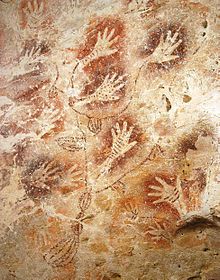
An Atheist on Cadre blog linked to a Wiki article (an article flagged as needing work be that as it may) saying:
Barbara King argues that while non-human primates are not religious, they do exhibit some traits that would have been necessary for the evolution of religion. These traits include high intelligence, a capacity for symbolic communication, a sense of social norms, realization of "self" and a concept of continuity.[1][2] There is inconclusive evidence that Homo neanderthalensis may have buried their dead which is evidence of the use of ritual. The use of burial rituals is thought to be evidence of religious activity, and there is no other evidence that religion existed in human culture before humans reached behavioral modernity.
That is supposed to prove that religion is made up entirely by humans with no God involved. I suggest that evolutionary nature of religion in and of itself is not enough to rule out God,After all of God users evolution in creation then we should expect God to allow evolutionary nature of religion to shape human development. Here is my article (part 1) showing how the evolutionary nature of religious development is not contrary to God.
All experiences of the divine must be filtered through cultural constructs, or symbols. God is beyond our understanding, thus beyond language. If we are talk about our experiences, however badly, we must filter them through culture.
RELIGION, although inherent in man, borrows its expressions from the setting or milieu in which man appears. The forms through which man expresses the supernatural are all drawn from the cultural heritage and the environment known to him, and are structured according to his dominant patterns of experience.In a hunting culture this means that the main target of observation, the animal, is the ferment of suggestive influence on representations of the supernatural. This must not be interpreted as meaning that all ideas of the supernatural necessarily take animal form. First of all, spirits do appear also as human beings, although generally less frequently; the high-god, for instance, if he exists, is often thought of as a being of human appearance. Second, although spirits may manifest themselves as animals they may evince a human character and often also human modes of action.[1]
Narrative is psychologically important to humans because it enables us to put things in perspective, to put ourselves into the story and to understand. Anything can be narrative. Even when events are taken as historical and the consciousness of myth falls away, the narrative is no less naratival. The resurrection of Christ, the existence of Jesus and his claims to be Messiah, all I take to be history and truth. Yet these are also part of the meta-narrative of Christianity. The meat-narrative is not closed or not an ideology or truth regime as long as it can be open to outside voices and to adult itself to them. For that reason the narrative hast to be fluid. The reason for this is that it has to explain the word in a new way to each new generation. To the extent that it can keep doing this it continues to be relevant and survives. This is equivalent to Kuhn’s paradigm absorbing the anomalies. Even when a certain set of fact is held out as historical and more that, but “the truth” such as Jesus’ death, burial, and resurrection, there is still an interpretation, a spin an understanding of just exactly how to put it, that varies from time to time and culture to culture. The facts of the event don’t change, the historical significance of it doesn’t change, but the way of relating it to each generation anew does change. This is not say that ideology doesn’t change, but the change is much slower and less obvious and less fluid. Even when the meta-narrative of a given religious tradition features factual material it’s not closed in the sense that ideology is closed and it’s still fluid.
This is not to say that religious traditions don’t get infected with ideology. When traditions take on ideology they usually form something more than Orthodoxy, something like “fundamentalism.” Orthodoxy is just the recognition of stable boundaries that ground the fluid nature of the narrative in expression of continuity. While ideology seeks to create a black hole, like the eternal conflict between communism and anti-communism, that absorbs all light and allows nothing to escape; the attempt to suck everything in one eternal understanding. Ideology in religious tradition probably is most often he result of literalizing the metaphors. When we forget that the metaphor bridges the gap between what we know and we don’t know—through comparison--and that it contains a “like” and a “not-like” dimension, we begin to associate the metaphor with truth in literal way then we begin to formulate ideology. Critics of religious thinking might be apt to confuse dogma with ideology. Religious ideas are not automatically ideological, dogma is not automatically ideological. It’s the literalistic elements in some religious thinking (not all of course) that closes off the realm of discourse and crates a closed truth regime. The danger of form ideology may be acute in a religious setting since it is easy to confuse the metaphor with literal truth by casting over it the aura of the sacred. We often associate the things pertaining to belief in God with God, and in so doing forger a literalism that closes off discourse. Yet religious belief as a whole is too fluid to be fully ideological. Ideology is self protecting and self perpetuating. Thomas Kuhn’s talk about damage control in paradigm defense is a good example of the self defending nature of ideology. While meta-narrative often reflects concepts of divine truth, it’s too changeable to be ideological. Even though theology resists change and novelty is a bad thing in theological parlance, meta-narrative changes in spite of it all. The fact of changed is noted in the many examples of different versions of the same myth. One such change turns upon a burning question that must be raised at this point, why did religious thinking move from numatic realization to a theocentric nature?
Why “God?” The same can be asked of the female form? Why a pseudo-parental, suzerain figure who creates the world and is in charge of the cosmos? Why not, since this model is obviously a metaphor comparing the unknown with some aspect of reality we know well, why that aspect and not another? What did people worship before they worshipped gods? Anthropology tells us that the shamanistic style of animism is older than the concept of a creator god.[2] This form of belief dates back to the stone age. Native American tribe “Shosoni, like other hunting people in Africa, Asia, Europe, and North America, have an idea of a “master of the animals,” or an “owner,” a supernatural being who is in charge of the animals:
Hunting peoples in Africa, Europe, Asia and America have developed the idea of a supernatural owner of the animal species, or of all animals, who protects them, commands them, and at request from hunters delivers them to be slayed and eaten. The concept is not infrequent in North America. The master of animals is a spirit, generally figured as an animal. The Shoshoni have possibly in very remote times known the coyote, or rather the mythical Coyote, as a master of animals. With the impact of Plains Indian culture the buffalo and the eagle have halfway achieved the position as master of animals and master of birds, respectively. In all fairness it should be pointed out, however, that this type of concept is very little noticeable among the Shoshoni.[3]
We must be cautious but since “shamanism” is connected to animism this owner of the animals might imply a transition between animistic thinking and beliefs in gods. We can’t say that all religions evolved in the same way in every location, but it does seem that in general it was an evolution from nameless “spirits” to specific pantheon of gods. The development of the concept of God was probably influenced by thoughts of parents, of tribal chiefs, or the leader, long before they became complex enough to fit a suzerain model. Yet it does seem that the concept of God evolved out of an understanding of nature oriented religion and evolved slowly over time based upon comparison with the authority figures we know best in life.
In his work The Evolution of God,[4] Robert Wright distills the work of anthropology over the last two centuries and demonstrates an evolutionary development, form early superstition that personified nature (pre-historic people talking to the wind)[5], through a polytheistic origin in pre-Hebrew Israelite culture,[6] to monotheistic innovation with the God of the Bible.[7] Wright is distilling a huge body of work that stretches back to the ninetieth century, the work of countless archaeologists, historians, and anthropologists. Another such successful distiller of scholarship in recent years is Karen Armstrong. In her work A History of God: The 4000 year Quest of Judaism, Christianity and Islam, [8] she presents a similar evolutionary story, focusing specifically upon the Biblical religions. She sees the pre-historical religious scene through the eyes of wonderment at the world around us. The cave paintings she understands as an attempt to record participation in the all pervasive aspect of the enchanted world.[9] The general agreement between scholarship, social sciences, and the work of anthropologists is that the concept of God is a product of the evolution of human thought.[10] At one time the concept was not, then it began and it has developed over time. Of course the great body of this work is coming out of naturalistic assumptions, especially in the ninetieth century. In the anthropological study of the evolution of religion those assumptions centered around the concept of projection in human thinking. People are projecting the relationship with the father or the king. This assumption can be traced to the work of Ludwig Feuerbach, social critic and precursor to Marxian analysis (God is the mask of money). He understood the concept of projection in terms of Hegel’s philosophy of spirit.[11] In The Essence of Christianity Feuerbach argues that superhuman deities are involuntary projections based upon the attributes of human nature.[12] How this thesis came to be the basis of modern anthropological understanding of religious evolution is not hard to seek. As Harvey puts it “It became the Bible to a group of revolutionary thinkers including, Arnold Ruge, the Bauers, Karl Marx, Richard Wagner, Frederic Engles.[13] This circle became a major part of the basis of modern social thought. While modern anthropology has not necessarily played out Feuerbach’s actual inversion of Hegel it has taken its que from him by making assumptions about theoroes of prodjection of one kind or another. Hegel did not think of God as some projection of human imagination. Feuerbach inverted Hegel’s concept to produce the idea. Hegel understood stages of human culture as “moments in the unfolding of absolute spirit.”[14] Thus, as Harvey points out, the various stages in religious development can be seen as stages in the self manifestation of Spirit.[15] In other words, from the cave paintings, to the shamans and the wind talkers to the highest aspirations of Judo-Christian ethics, Spirit (God), is making himself aware of himself by moving through progressive revelation to humanity. “In other words, the history of religion culminating in Christianity was a progressive revelation of the truth that the absolute is not merely an impersonal substance but a subject.”[16] Feuerbach inverts this principal by asserting that finite spirit is becoming aware of itself through externalizing its own attributes and then projecting them into magnified from.[17] On Feuerbach’s part this was the result of a long struggle with idealism. Be that as it may, and for both sides, it’s clearly the roots of ideology. It sowed the seeds of ideology in terms of the social sciences naturalistic assumptions. Now we find those same kinds of assumptions being made with regard to the laws of physics. Paul Davies has been quoted to say that the traditional view of the laws of physics are just seventeenth century monotheism without God, “Then God got killed off and the laws just free-floated in a conceptual vacuum but retained their theological properties,”[18] The assumption of modernity is always that belief in God is dying out, religion is of the past, these are the things that are dying. Armstrong sounds the death knell and starts singing the dirge in first book. She observes that “one of the reasons why religion seems irrelevant today is that many of us no longer have the sense that we are surrounded by the unseen.”[19] It’s so irrelevant she’s writing books about it.As Thomas Borges, the Sandinista leader said, "that God refuses to die."20
(Original publication Tuesday, March 21, 2017) sources
[1] Ake Hultkrantz, “Attitudes Toward Animals in Shashoni Indian Religion,” Studies in Comparative Religion, Vol. 4, No. 2. (Spring, 1970) © World Wisdom, Inc. no page listed,online archive, URL: http://www.studiesincomparativereligion.com/Public/articles/browse_g.aspx?ID=131, accessed 3/21/13
[2] Weston La Barre, “Shamanic Origins of Religion and Medicine,” Journal of Psychedelic Drugs, vol 11, (1-2) Jan. June 1979 no page listed, PDF, URL: http://www.cnsproductions.com/pdf/LaBarre.pdf accessed 3/22/13.
[3] Hultkrantz, op. cit. the author also cites other works by himself on the matter: Cf. Hultkrantz, The Owner of the Animals in the Religion of the North American Indians (in Hultkrantz, ed., The Supernatural Owners of Nature, Stockholm Studies in Comparative Religion, Vol. 1, 1961). Hultkrantz, The Masters of the Animals among the Wind River Shoshoni (Ethnos, Vol. 26:4, 1961).
[4] Robert Wright, The Evolution of God, New York: Back Bay Books, reprint edition, 2010. The book was Originally published in 2009. The company “Back Bay books:" is an imprint of Hachette Books, through Little Brown and company. Wright studied sociobiology at Princeton and taught at Princeton and University of Pennsyania. He edits New Republic and does journalistic writing of science, especially sociobiology.
[5] Wright, ibid, 9 [6] ibid. 10 [7] ibid, 11 [8] Karen Armstrong, A History of God: The 4000 Year Quest of Judaism, Christianity and Islam. New York: Ballantine Books, 1994. [9] Ibid, 4-6 [10] T. M. Manickam,, Dharma According Manu and Moses, Bangalore : Dharmaram Publications, 1977,6. [11] Van A. Harvey, Feuerbach and The Interpretation of Religion, Carmbridge: Press Syndicate for the University of Cambridge, Cambridge Studies in Religion and Critical Thought, 1995/1997, 4. Harvey is professor emeritus, taught religious studies at Stanford Univesity. His Ph.D. from Yale in 1957. His thesis supervisor was H.Richard Neibhur.
[12] Cited by Harvey, ibid., 25.
[13] ibid, 26
. [14] ibid.
[15] ibid.
[16] ibid.
[17] ibid, 27
[18] Dennis Overbye, quoting email message from Paul Davies, “Laws of Nature, Source Unknown,” “Science” New York Times. December 19, 2007. on line edition URL: http://www.nytimes.com/2007/12/18/science/18law.html?pagewanted=all&_r=1& accessed, 3/25/13.
[19] Armstrong, op.cit. 4.
[20]Redding, What Difference does a revolution make? I no longer have the book and can't find a reference to it. He quoted the famous leader of the Sandinistas, the founder of their party. Borge wrote to other revolutionaries with the proposal of a united front. He was a Christian even though he was a communist revolutionary.He wrote ro Father Ernesto Cardinal and told him "I tried to kill a God I thought oppressed the poor but God would not die." He tried to be a communist atheist but God kept coming back in his heart. Instead God led him to reach out to mainstream reformers.
Sunday, November 05, 2023
Being itself, and the Personal God.
Hans Urs Von Balthasar (1905-1988)
I feel like I talk too much about Tillich and not enough about other theologians who agreed that God is being itself. Balthasar is not as well known but is as deeply respected as Tillich in Catholic circles. He believed God is being itself and personal.
Balthasar one of the most interesting and brilliant figures of the twentieth century, yet hardly anyone has heard of him outside the confines of academic theology. Even most theological students in the Proestant world are not very familiar with his works. He was a friend of John Paul II, called “the most cultured man of our time by Henri de Lubac. His achievements are called ‘breathtaking’ my one of the major catholic theologians of the century, Carl Rahner.[1] He wrote over a thousand books and articles. He was born in Lucerne Switzerland, 1905, and Grew up a Catholic, son of a pious mother.[2] He took his doctorate from the Liberal Protestant University of Zurich, having grown up educated by Benedictines and Jesuits. He became a Jesuit priest. He worked as a student Chaplin in the 30s. He became good friends with Protestant theologian Karl Barth, one of the greats of the century.
Balthasar was unable to work as a full fledged Jesuit priest due to the war years and the arrangement the government had between Protestants and Catholics, he was seen as belonging to the area of south Germany. He made a living as a translator and lecturer and editor. He ran publications and started a spiritual community. He spent most of his adult life this way, in association with a woman named Speyr who was never recognized as a mystic by the church. He had miracles and visions but being unrecognized, Balthasar’s community was not accepted and he was unable to gain a post. This situation dominated his life in the 40s,50’s, and 60s. He had to leave the Jesuits. He also lectured in these years on spiritual topics and made a living that way, but his health deteriorated as a result. In the 60s he began to be recognized as a theologian and was given honors and doctorates. In 1988 John Paul II made him a cardinal. That was also the year of his death. His community of st. John was a publishing house and he ran a journal called Communio. These eventually found great success in the 70s and were recognized by the Vatican. The major avenue to his success was his books and his lectures.[3]
Balthasar’s overall theological project centers upon the dualities between human conflict with ourselves and our place in being. Examples of the dualities that fascinate Balthasar include: our own contingency and that of the world around us in contrast to the sense of being itself.[4] Balthasar openly and obvious equates being with God. In his work about Balthasar’s live, David L. Schindler includes a short article by Balthasar himself called “a Resume of my Thought.”[5]-] He begins this “resume” by talking about the dilemma between human contingency and limitation in contrast to the infinite nature of being. This does not necessitate asserting God up fornt although he’s not concerned with a “proof.” His thesis is that all human philosophy either explicitly or tacitly concerns itself with this topic and by implication tacitly affirms the infinite and the absolute.[6] He comes to the conclusion that the duality is inescapable. The finite is not the infinite. Even the monism of the east is seen through nuanced dualities. Thus he asks the question “why are we not God?” The basis of the question is that we are aspects of being. We are products of being, yet we are contingent being, Why are we contingent and not necessary? The solutions that he ponders seem to end in one way or another with an indignant God creating a finite world out of need or alienation from his own infinity. He finds that only the God of the Bible offers a satisfactory answer, and that answer is in a sense the opposite of what we would think.
The common human tendency is to think God created because he needed something. Balthasar is hinting, I think, that God creates because its his nature as being to foment more being, in other words, its creative and God is Creative. It is not for God’s need that he creates but for what will become our need once we are created. In other words, God created us so that we can enjoy being, not because he needed us because once a part of being we would need and would be fulfilled in the need by love. No Philosophy could give a satisfactory response to that question [why did infinte create finite?] St Paul would say to philosophers that God created man so that he would seek the Divine, try to obtain the Divine. That is why all pre Christian philosophy is theological at its summit. But, in fact, the true response to philosophy could only be given by Being himself, revealing himself from himself. Will man be capable of understanding this revelation? The affirmative response will be given only by the God of the Bible. On the one hand this God, creator of the world and of man, knows his creature. “I who have created the eye do not see? I who have created the ear do not hear?” And we add who who have created language, could not speak and make myself heard?” This posits a counterpart: to be able to hear and understand the auto-revelation of God man must in himself be a search for God, a question posed to him. Thus there is Biblical theology without a religious philosophy. Human reason must be open to the infinite.[7]Notice how he capitalizes “B” in being and refers to being as “himself.” He personifies being and clearly speaks of it as the creator.
Balthasar sees the understanding of the revelation of “being himself” (my phrase based upon his) to humanity as rooted in the most fundamental human relationship. He says, “the infant is brought to consciousness of himself only by love, by the smile of his mother. In that encounter the horizon of all unlimited opens unto him.”[8] What he means by that is it is only through being por soir, for itself, in other words, consciousness, that we are able to comprehend the infinite and that only in contrast to the finite. Before we can do that, however, we have to become aware of ourselves so we can know we are finite. I think he’s making an implication that love is a link to being itself, and that through our encounter with love, the mother, we encounter the father, so to speak—by way of encountering love. We can see this in four truths that Balthasar finds rooted in this encounter: (1) realizing that he Is other to the mother, the only way the child realizes he loves the mother; (2) love is good, therefore, being is good; (3) love is true, therefore, being is true; (4) love evokes joy therefore being is beautiful.[9] Notice the link between being and love. He is one of the rare theologians to point out this curial link.The one, the true, the good, the Beautiful, these are what we call the transcendental attributes of being, because they surpass all the limits of essence, and are coextensive with Being. If there is an insurmountable distance between God and his creature, but if there is also an analogy between them which cannot be resolved in any form of identity, there must also exist an analogy between the transcendentals—between those of the creature and those in God.[10] In this quotation he as much as equates being and God, since he speaks of the attributes of being then connects the understanding of these to the link between God and the creature. There is more to be said about Balthasar based upon this observation and it will figure importantly in two more chapters, including the last one, and the over all conclusion.
Balthasar confirms for me so many things I thought but didn't have the courage to say, or that I "sort of thought" but didn't have the intellect to formulate. I think he boldly and unabashedly resoled the problem of paradox between personal God and being itself. He was the first to show me the link bewteen being and love (although Tillich does mention it but I saw it in Balthasar first). He capitalizes "B" in "Being" and speak of Being a "he." The idea that God created not becasue he "needed to" but becasue his nature is creative.
[1] Joel Graver, “a Short Biography,” website:Hans Urs Von Balthasar, an Internet Archieve. URL sighted: http://www.lasalle.edu/~garver/bio.htm (visited 12/3/10).
[2] Ibid
[3] Ibid.
[4] Ibid, “overview of Balthasar’s project: URL: http://www.joelgarver.com/writ/theo/balt/overview.htm
[5] Hans Urs Von Balthasar, “A Resume of my Thought,” in David L. Schindler, Hans Urs Von Balthasar: His Life and Work. San Francisco:Ignatious Press, 1991, on like version p1-2 URL: http://books.google.com/books?id=LLhBuwGFEugC&pg=PA237&lpg=PA237&dq=Hans+Urs+Von+Balthasar+connection+between+Love+and+Being&source=bl&ots=E6-L_5GF4p&sig=A-MzjMjMmqjBqRmAaUOWGYiOUww&hl=en&ei=xrTSSdLiJdqJnAe4tNTgBQ&sa=X&oi=book_result&resnum=7&ct=result#v=onepage&q=Hans%20Urs%20Von%20Balthasar%20connection%20between%20Love%20and%20Being&f=true
[6] Ibid, 1
[7] Ibid., 3
[8] Ibid.
[9] Ibid.
[10] Ibid.
Posted by Joseph Hinman (Metacrock) at 5:22 AM Labels: apologetics, being itself, existential theology, God takl, Hans urs Von Balthasar, Paul Tillich, Personal God, philosophy of religoin
Balthasar one of the most interesting and brilliant figures of the twentieth century, yet hardly anyone has heard of him outside the confines of academic theology. Even most theological students in the Proestant world are not very familiar with his works. He was a friend of John Paul II, called “the most cultured man of our time by Henri de Lubac. His achievements are called ‘breathtaking’ my one of the major catholic theologians of the century, Carl Rahner.[1] He wrote over a thousand books and articles. He was born in Lucerne Switzerland, 1905, and Grew up a Catholic, son of a pious mother.[2] He took his doctorate from the Liberal Protestant University of Zurich, having grown up educated by Benedictines and Jesuits. He became a Jesuit priest. He worked as a student Chaplin in the 30s. He became good friends with Protestant theologian Karl Barth, one of the greats of the century.
Balthasar was unable to work as a full fledged Jesuit priest due to the war years and the arrangement the government had between Protestants and Catholics, he was seen as belonging to the area of south Germany. He made a living as a translator and lecturer and editor. He ran publications and started a spiritual community. He spent most of his adult life this way, in association with a woman named Speyr who was never recognized as a mystic by the church. He had miracles and visions but being unrecognized, Balthasar’s community was not accepted and he was unable to gain a post. This situation dominated his life in the 40s,50’s, and 60s. He had to leave the Jesuits. He also lectured in these years on spiritual topics and made a living that way, but his health deteriorated as a result. In the 60s he began to be recognized as a theologian and was given honors and doctorates. In 1988 John Paul II made him a cardinal. That was also the year of his death. His community of st. John was a publishing house and he ran a journal called Communio. These eventually found great success in the 70s and were recognized by the Vatican. The major avenue to his success was his books and his lectures.[3]
Balthasar’s overall theological project centers upon the dualities between human conflict with ourselves and our place in being. Examples of the dualities that fascinate Balthasar include: our own contingency and that of the world around us in contrast to the sense of being itself.[4] Balthasar openly and obvious equates being with God. In his work about Balthasar’s live, David L. Schindler includes a short article by Balthasar himself called “a Resume of my Thought.”[5]-] He begins this “resume” by talking about the dilemma between human contingency and limitation in contrast to the infinite nature of being. This does not necessitate asserting God up fornt although he’s not concerned with a “proof.” His thesis is that all human philosophy either explicitly or tacitly concerns itself with this topic and by implication tacitly affirms the infinite and the absolute.[6] He comes to the conclusion that the duality is inescapable. The finite is not the infinite. Even the monism of the east is seen through nuanced dualities. Thus he asks the question “why are we not God?” The basis of the question is that we are aspects of being. We are products of being, yet we are contingent being, Why are we contingent and not necessary? The solutions that he ponders seem to end in one way or another with an indignant God creating a finite world out of need or alienation from his own infinity. He finds that only the God of the Bible offers a satisfactory answer, and that answer is in a sense the opposite of what we would think.
The common human tendency is to think God created because he needed something. Balthasar is hinting, I think, that God creates because its his nature as being to foment more being, in other words, its creative and God is Creative. It is not for God’s need that he creates but for what will become our need once we are created. In other words, God created us so that we can enjoy being, not because he needed us because once a part of being we would need and would be fulfilled in the need by love. No Philosophy could give a satisfactory response to that question [why did infinte create finite?] St Paul would say to philosophers that God created man so that he would seek the Divine, try to obtain the Divine. That is why all pre Christian philosophy is theological at its summit. But, in fact, the true response to philosophy could only be given by Being himself, revealing himself from himself. Will man be capable of understanding this revelation? The affirmative response will be given only by the God of the Bible. On the one hand this God, creator of the world and of man, knows his creature. “I who have created the eye do not see? I who have created the ear do not hear?” And we add who who have created language, could not speak and make myself heard?” This posits a counterpart: to be able to hear and understand the auto-revelation of God man must in himself be a search for God, a question posed to him. Thus there is Biblical theology without a religious philosophy. Human reason must be open to the infinite.[7]Notice how he capitalizes “B” in being and refers to being as “himself.” He personifies being and clearly speaks of it as the creator.
Balthasar sees the understanding of the revelation of “being himself” (my phrase based upon his) to humanity as rooted in the most fundamental human relationship. He says, “the infant is brought to consciousness of himself only by love, by the smile of his mother. In that encounter the horizon of all unlimited opens unto him.”[8] What he means by that is it is only through being por soir, for itself, in other words, consciousness, that we are able to comprehend the infinite and that only in contrast to the finite. Before we can do that, however, we have to become aware of ourselves so we can know we are finite. I think he’s making an implication that love is a link to being itself, and that through our encounter with love, the mother, we encounter the father, so to speak—by way of encountering love. We can see this in four truths that Balthasar finds rooted in this encounter: (1) realizing that he Is other to the mother, the only way the child realizes he loves the mother; (2) love is good, therefore, being is good; (3) love is true, therefore, being is true; (4) love evokes joy therefore being is beautiful.[9] Notice the link between being and love. He is one of the rare theologians to point out this curial link.The one, the true, the good, the Beautiful, these are what we call the transcendental attributes of being, because they surpass all the limits of essence, and are coextensive with Being. If there is an insurmountable distance between God and his creature, but if there is also an analogy between them which cannot be resolved in any form of identity, there must also exist an analogy between the transcendentals—between those of the creature and those in God.[10] In this quotation he as much as equates being and God, since he speaks of the attributes of being then connects the understanding of these to the link between God and the creature. There is more to be said about Balthasar based upon this observation and it will figure importantly in two more chapters, including the last one, and the over all conclusion.
Balthasar confirms for me so many things I thought but didn't have the courage to say, or that I "sort of thought" but didn't have the intellect to formulate. I think he boldly and unabashedly resoled the problem of paradox between personal God and being itself. He was the first to show me the link bewteen being and love (although Tillich does mention it but I saw it in Balthasar first). He capitalizes "B" in "Being" and speak of Being a "he." The idea that God created not becasue he "needed to" but becasue his nature is creative.
[1] Joel Graver, “a Short Biography,” website:Hans Urs Von Balthasar, an Internet Archieve. URL sighted: http://www.lasalle.edu/~garver/bio.htm (visited 12/3/10).
[2] Ibid
[3] Ibid.
[4] Ibid, “overview of Balthasar’s project: URL: http://www.joelgarver.com/writ/theo/balt/overview.htm
[5] Hans Urs Von Balthasar, “A Resume of my Thought,” in David L. Schindler, Hans Urs Von Balthasar: His Life and Work. San Francisco:Ignatious Press, 1991, on like version p1-2 URL: http://books.google.com/books?id=LLhBuwGFEugC&pg=PA237&lpg=PA237&dq=Hans+Urs+Von+Balthasar+connection+between+Love+and+Being&source=bl&ots=E6-L_5GF4p&sig=A-MzjMjMmqjBqRmAaUOWGYiOUww&hl=en&ei=xrTSSdLiJdqJnAe4tNTgBQ&sa=X&oi=book_result&resnum=7&ct=result#v=onepage&q=Hans%20Urs%20Von%20Balthasar%20connection%20between%20Love%20and%20Being&f=true
[6] Ibid, 1
[7] Ibid., 3
[8] Ibid.
[9] Ibid.
[10] Ibid.
Posted by Joseph Hinman (Metacrock) at 5:22 AM Labels: apologetics, being itself, existential theology, God takl, Hans urs Von Balthasar, Paul Tillich, Personal God, philosophy of religoin
Sunday, October 29, 2023
Historical validity of the Gospel
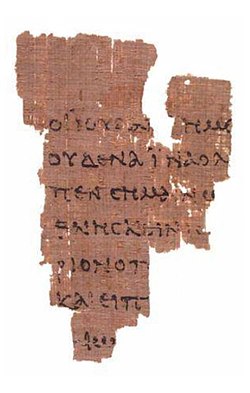
Originally Posted by Westvleteren View PostI had said that by historical critical methods we can corroborate the Gospels as historical evidence of Jesus' existence. I also laid out an extensive criteria for determining what is mythology and what is not. I didn't claim the Bible corroborates itself. There is obviously a method or no book could ever be corroborated. That method is called "historical critical method." This is so basic and these guys act like I made it up. They are practically saying there's no such thing as historical criticism. This more than more than anything else shows the Orwellian nature of atheism. Anything that they can't out argue by reason or historical fact they merely claim doesn't exist and make to go away because they don't like it. They just brain wash their mentions into thinking "there can't be such a thing as historical critical methods."
There is no method that allows the Bible to corroborate itself, as soon as you said that it nullified any possible argument you could make. Quite simply it is asinine. And no I could not care less that you are a PhD candidate as it has no bearing on the validity of your assertions.
Doesn't it seem really imbecilic to think that there's this one book that can't be corroborated? I used three different senses in which a book can be corroborated in order to show how foolish it is to make the statement "no method could exist that would do this." Each sense in which the Gospels can be corroborated (use the Gospels since the historical Jesus was the issue) I use another kind of book. Let's look at the three aspects of the historical critical method that verify the Gospels, and then at the criteria for understanding mythology from historically based writing. Three ways of corroborating the Gospels:
I. The authority of the teaching for the tradition
Most scholars point to the fact that the four canonical Gospels were already used by most of the church by the time of the canon[Martin Franzmann (The Word of the Lord Grows, St Louis: Concordia, 1961, 287-295)]. They bear the stamp of approval of those who were in charge of the teaching for the tradition. The problem is modern skeptics refuse to accept the facts, despise the truth, refuse to accept any sort of defense regardless of how good it is and basically refuse to even investigate the facts. If one actually examined the facts there is no way one can conclude other than that the four canonical gospels are the most logical choices of all the writings we have. Of the 34 lost gospels of which we have copies, fragments, theories, or any sort of inking only the four canonical Gospels makes sense as candidates for the canon. The Gospel according to Thomas has a historical core that probably goes back to the time of late first century. Yet it also has obviously late, maybe 3d century, heavily gnostic material. The Gospel of Peter had material that is corroborated as independent of the synoptic or of of John (see Ray Brown, Death of the Messiah) yet it encases this material in a clearly late framework. Only the canonical Gospels can be bore out as early dated, the trend is to even earlier dates, and at the same time has this vast body of attestation including the final inclusion in the canon. Skeptics also overlook the extent to which these 34 lost gospels supplement and corroborate the canonical Gospels. Most of the historical core of Thomas is in agreement with the synoptic.
American Theological Library Association
More than half of the material in the gospel of Thomas (79 sayings) is paralleled in the canonical gospels:
*
27 sayings are in Mark & the other synoptic
s; *
46 parallel Q material (in Matthew & Luke)* *
12 echo material special to Matthew; & *
1 is only in Luke.
* [Q parallels include 7 sayings where Mark has a variant version]
Thomas is important for synoptic studies for two reasons:
Form: It proves that collections of Jesus sayings with no narrative were known in the early church. Thus, it gives indirect support to the hypothesis of a synoptic sayings source, Q. *
Contents: Its version of some Jesus sayings is simpler than the synoptic parallels.
For the past 40 years scholars have debated whether Thomas is directly dependent on the synoptic gospels or not. Some have maintained the traditional view that Thomas is a 2nd or 3rd c. gnostic composition whose author extracted Jesus sayings from a Coptic translation of the NT & edited them to fit a gnostic worldview. Most recent experts on Thomas, however, regard it as an early sayings collection based on oral tradition rather than any canonical text.
There are four main reasons why scholars who have studied Thomas conclude that it is independent of synoptic tradition:
No narrative frame: If the compiler of Thomas drew these sayings from the canonical narrative gospels, he removed every trace of the stories in which the synoptic writers embed them. *
Non-synoptic order: If the compiler of Thomas drew these sayings from the synoptic gospels, he totally scrambled them, separating adjoining sayings & scattering them at random. No one has yet proven that the sayings in Thomas are arranged according to any logical pattern. *
Random parallels: Sayings in Thomas sometimes echo Mark, sometimes Matthew, sometimes Luke. There is no clear pattern of dependence on any one text. *
More primitive form: Sayings in Thomas are often logically simpler than their synoptic counterparts. If the compiler drew these sayings from the synoptic gospels, he edited out the traits characteristic of each writer. While some synoptic parallels in Thomas have gnostic embellishments, these are easily removed.
Together these traits of Thomas make it highly unlikely that any synoptic gospel was used as its source. In fact, the random, eclectic character of the contents of Thomas makes it a more primitive composition than the synoptic sayings source that scholars call "Q." While many individual sayings in Thomas may be of late gnostic origin, the core of the collection (sayings with synoptic parallels) is probably as old or older than the composition of the canonical gospel narratives (50-90 CE). To date this gospel any later makes it hard to explain the general lack of features dependent on the synoptics.(Copyright © 1997- 2008 by Mahlon H. Smith All rights reserved.)
[For more details see Crossan, J.D. Four Other Gospels (Sonoma CA: Polebridge Press, 1992) pp. 3-38 or Patterson, S. J. in Q-Thomas Reader (Sonoma CA: Polebridge Press, 1990) pp. 77-127.]
The old independent core of Peter supports the idea of guards on the tomb, meaning it also supports the crucifixion, the tomb, and the resurrection, empty tomb.
What this means for us so far is that the stamp of approval given by inclusion in the canon means several things:
(1) it means the church as a whole already recognized those books as valid based upon the teaching handed down from the Apostles through the Bishops.
(2) That is corroborated historically and can be verified by the extra canonical materials that agree with the readings, such as Thomas and Peter.
(3) The very fact inclusion in the canon is a priori testament to this fact, since apostolic affirmation was part of the criteria.
An examination of how the canon came to be will bear this out. This is written by me based upon the Franzman source above. It's found on my website Doxa> Bible> The Canon: how do they know the got the right books?
this was originally part ofa much longer work, to see the whole thing here's a link: https://religiousapriorijesus-bible.blogspot.com/2011/08/historical-validity-of-gospels-part-1.html
Sunday, October 22, 2023
Discussion on Mystical experience argument

Travis CottreauReply 30m Joe Hinman
There are a few issues in your blog post. Mystical experience doesn't mean the spirit world exists. It is an experience. People have mystical experience in lots of extreme situations including but not exclusively psychedelics.
I think jumping to god existing from this is a bit of a stretch. I think it's good to collect the information and talk about it. I don't think it quite means what you think it means.
Most theories out there for quantum physics and cosmology are WAY ahead of the practical experiments for them, so, they will be theoretical and mathematical. String theory isn't something just you have an issue with. There are lots of psycists who have abandoned it. Note: they move on to something equally incomprehensible to us. Loop quantum gravity say. But they are trying to form a framework that can make predictions. It's a fair thing to do and I wouldn't say "you can't see it so it doesn't exist". If it is able to make predictions, then you assume it is somehow related to reality. I don't get how "god exists" is the same kind of claim. The whole "I can't see/hear/smell god" is a dumb argument. What they should be saying is that there doesn't seem to be a difference between no god and a god that doesn't interact with the world in any way that we can detect.
Travis Cottreau my argument is that the experience has more empiricism behind it than do these theories of physics which are only backed mathematically,The link between the experience and God is easy, logical, and obvious. God is in the content of the experience, Itis n experience of Gd so say 90% if those who have it. its the basis of religion, it;s in every religion, the experiences are all they same even though they should not be. they means theres an external reality,
Reply\\\\ Travis Cottreau
clearly not the case though. They aren't ONLY mathematical. They are mathematical purely for predicting real world observations. However, if you get something that is predicting real world observations, there might be other implications to it that we have not observed. So,.something like many worlds or Copenhagen interpretation of quantum physics are like this. The math can be seen in a couple of ways. They aren't the only ones either. "Only backed mathematically" is spoken by a non physicist, non mathematician. 🙂 The link is by no means easy, logical and obvious. Hindu versus Buddhist versus Christian versus Muslim all look different. People have content in their experiences that don't exist all the time. I don't know why you are trusting this one but not others. It might be because you want to believe? There are lots of these experiences, but they vary by culture and background of the participants. They don't go outside of their culture very often. I agree that it is probably the basis of religion. This is why there are so many different religions, because the expeirences are all different. You are not white washing the actual results and trying to make them all the same when they are varied.Reply 5h Edited Joe Hinman
Travis Cottreau subatomic particles and multiverses have no support except mathematical constructs, mystical experience has real first hand empirical proof.the latter are empirical the farmer are theological only''''\\\\\==We are talking about one certain kind of experience not all experiences. Of course you can find different experiences among the world religions but not among mystical experience, All mystical experiences have same contents and the same reactions, Religions do very by culture that's because religion is cultural not genetic. Thus we should expect mystical experiences to be different, the M scale studies prove they are not, they are the same in India, Arabia, Japan, England and so on."You are not white washing the actual results and trying to make them all the same when they are varied." I read tbe studies I didn't colate them, Contact Dr Hood if you dont believe me, Reply 1m Travis Cottreau
Subatomic particles create trails in cloud chambers at CERN, you aren't going to win that one. Multiverses are a consequence of a theory that predicts outcomes, specifically the Schrödinger wave equation. That's without any kind of measurement collapse. Mystical experiences are experiences. They are as much proof of anything as tasting chocolate is proof of a chocolate god. I have read a book on mystical experiences and they are not all identical. Unless you are making the claim that what you are talking about are only one, specific kind of experience? I'll read some of your references. I suspect I understand what you are saying but I'm not sure.Reply 10m Joe Hinman
SAPs aside, Multiverse has no empirical backing it not hard to find a lot of scientists who say MV may never be provable. Even if is that is not the point That doesn;'t disprove the emprical nature of the religious experiences.
Sunday, October 15, 2023
Things Tangible and Things Unseen
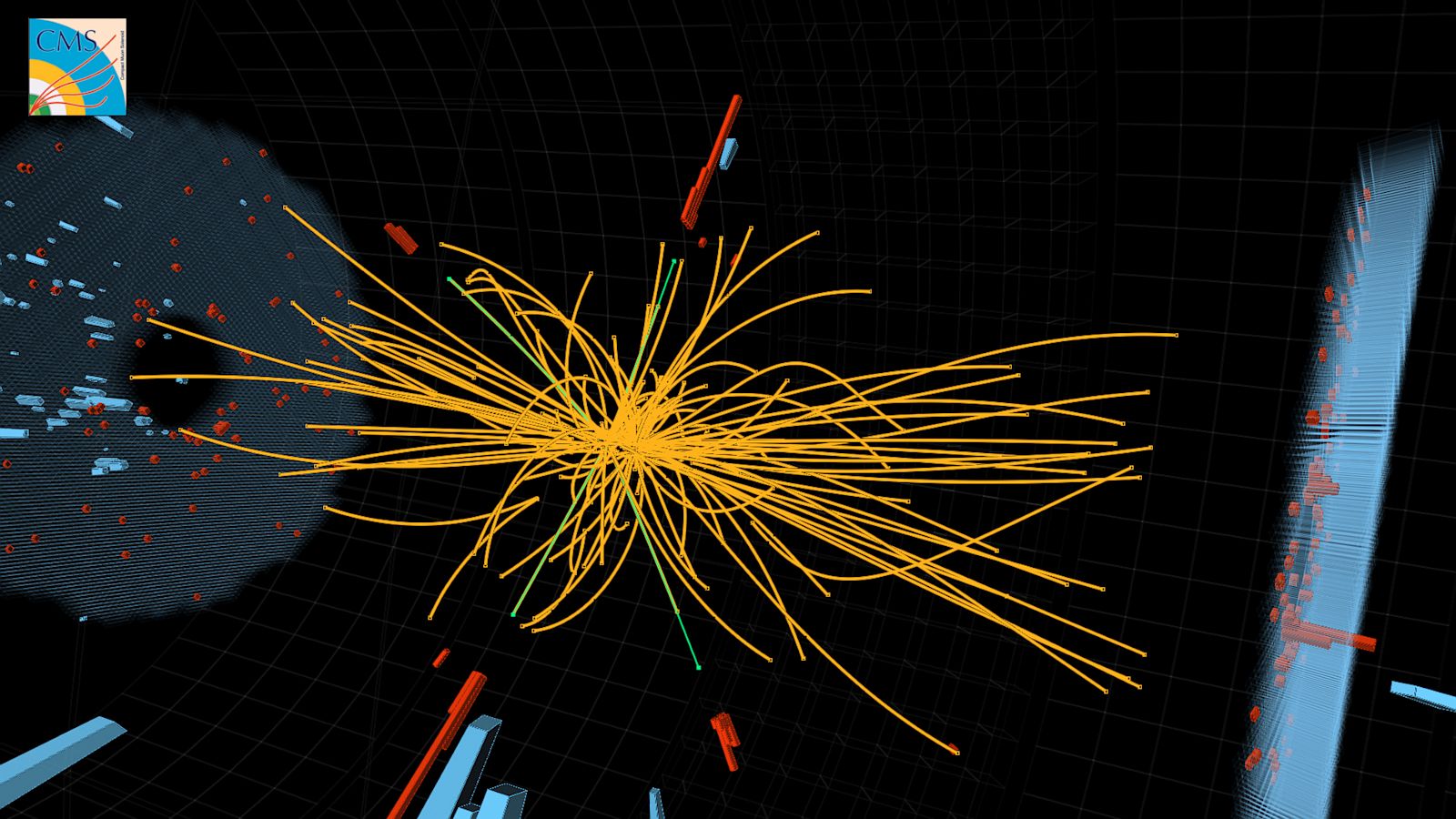
A statement on a blog by an atheist that well illustrates a major attitude of skepticism and new atheists that one encounters all over the net.
Roger Higman:
But God is a figment of your imagination. S/he can't be seen,heard or sensed in any way and all claims for what s/he thinks or says are just figments of the imagination of other people. At least science is based on things we can all see, hear, smell and taste.[1]He must mean things like sub atomic strings, dark matter, quarks, nuetrinos,the big bang, and other things we clearly see and smell every day? As for figments of imagination I demonstrated in The Trace of God that 200 peer reviewed studies in journal articles demonstrate that mystical experince is good for you and that it is a valid experiece of something that is being experienced with the same qualia by people from all faiths all over the world.[2] Thus it seems God has more of a basis in empirical evidence than do subatomic particles.
Here is Part of an article I wrote for this blog back in 2020,"Can Science really Prove The Basis of Modern Physics?" (JULY 13, 2020):
Are there realms beyond the natural? Of course there can be no direct evidence, even a direct look at them would stand apart from our received version of reality and thus be suspect. The plaintive cry of the materialists that “there is no evidence for the supernatural” is fallacious to the core. How can there be evidence when any evidence that might be would automatically be suspect? Moreover, science itself gives us reason to think there might be. Quantum physics is about unseen realms, but they are the world of the extremely tiny. This is the fundamental basis of reality, what’s beneath or behind everything. They talk about “particles” but in reality they are not particles. They are not bits of stuff. They are not solid matter.[3] Treating particles as points is also problematic. This is where string theory comes in. This is where string theory comes in. In string theory fundamental particles aren't treated as zero-dimensional points. Instead they are one-dimensional vibrating strings or loops. The maths is hair-raising, and the direct evidence non-existent, but it does provide a way out of the current theoretical cul-de-sac. It even provides a route to unifying gravity with the other three fundamental forces - a problem which has baffled the best brains for decades. The problem is, you need to invoke extra dimensions to make the equations work in string-theory and its variants: 10 spacetime dimensions to be precise. Or 11 (M-theory). Or maybe 26. In any case, loads more dimensions than four.
So where are they then? One idea is that they are right under our noses, but compacted to the quantum scale so that they are imperceptible. "Hang on a minute", you might think,"How can you ever prove the existence of something that, by definition, is impossible to perceive?" It's a fair point, and there are scientists who criticize string theory for its weak predictive power and testability. Leaving that to one side, how can you conceptualize extra dimensions?[4] There is no direct evidence of these unseen realms and they may be unprovable. Why are they assumed with such confidence and yet reductionists make the opposite assumption about spiritual realms? It’s not because the quantum universe realms are tangible or solid or material they are not. Scientists can’t really describe what they are, except that they are mathematical. In fact why can’t they be the same realms?
Then there’s the concept of the multiverse. This is not subatomic in size but beyond our space/time continuum. These would be other universes perhaps like our own, certainly the size of our own, but beyond our realm of space/time. Some scientists accept the idea that the same rules would apply in all of these universes, but some don’t.
Beyond it [our cosmic visual horizon—42 billion light years] could be many—even infinitely many—domains much like the one we see. Each has a different initial distribution of matter, but the same laws of physics operate in all. Nearly all cosmologists today (including me) accept this type of multiverse, which Max Tegmark calls “level 1.” Yet some go further. They suggest completely different kinds of universes, with different physics, different histories, maybe different numbers of spatial dimensions. Most will be sterile, although some will be teeming with life. A chief proponent of this “level 2” multiverse is Alexander Vilenkin, who paints a dramatic picture of an infinite set of universes with an infinite number of galaxies, an infinite number of planets and an infinite number of people with your name who are reading this article.[5] Well there are two important things to note here. First, that neither string theory nor multiverse may ever be proved empirically. There’s a professor at Columbia named Peter Woit who writes the blog Not Even Wrong dedicated to showing that string theory can’t be proved.[6] There is no proof for it or against it. It can’t be disproved so it can’t be proved either.[7] That means the idea will be around for a long time because without disproving it they can’t get rid of it. Yet without any means of disproving it, it can’t be deemed a scientific fact. Remember it’s not about proving things, it's about disproving them. Yet science is willing to consider their possibility and takes them quite seriously. There is no empirical evidence of these things. They posit the dimensions purely as a mathematical solution so the equations work not because they have any real evidence.[8]
We could make the argument that we have several possibilities for other worlds and those possibilities suggest more: we have the idea of being “outside time.” There’s no proof that this is a place one can actually go to, but the idea of it suggests the possibility, there’s the world of antimatter, there are worlds in string membranes, and there are other dimensions tucked away and folded into our own. In terms of the multiverse scientists might argue that they conceive of these as “naturalistic.” They would be like our world with physical laws and hard material substances and physical things. As we have seen there are those who go further and postulate the “rules change” idea. We probably should assume the rules work the same way because its all we know. We do assume this in making God arguments such as the cosmological argument. Yet the possibility exists that there could be other realms that are not physical and not “natural” as we know that concept. The probability of that increases when we realize that these realms are beyond our space/time thus they are beyond the domain of our cause and effect, and we know as “natural.” It really all goes back to the philosophical and ideological assumption about rules. There is no way to prove it either way. Ruling out the possibility of a spiritual realm based upon the fact that we don’t live in it would be stupid. The idea that “we never see any proof of it” is basically the same thing as saying “we don’t live it so it must not exist.” Of course this field is going to be suspect, and who can blame the critics? Anyone with a penchant for the unknown can set up shop and speculate about what might be “out there.” Yet science itself offers the possibility in the form of modern physics, the only rationale for closing that off is the distaste for religion.
All that is solid melts into air
This line by Marx deals with society, social and political institutions, but in thinking about the topic of SN it suggests a very different issue. The reductionist/materialists and phsyicalists assume and often argue that there is no proof of anything not material and not ' ‘physical” (energy is a form of matter). The hard tangible nature of the physical is taken as the standard for reality while the notion of something beyond our ability to dietetic is seen in a skeptical way, even though the major developments in physics are based upon it. Is the physical world as tangible and solid as we think? Science talks about “particles” and constructs models of atoms made of wooden tubes and little balls this gives us the psychological impression that the world of the very tiny is based upon little solid balls. In reality subatomic particles are not made out of little balls, nor are these ‘particles” tangible or solid. In fact we could make a strong argument that no one even knows what they are made of.
We keep talking about "particles", but this word doesn't adequately sum up the type of matter that particle physicists deal with. In physics, particles aren't usually tiny bits of stuff. When you start talking about fundamental particles like quarks that have a volume of zero, or virtual particles that have no volume and pop in and out of existence just like that, it is stretching the everyday meaning of the word "particle" a bit far. Thinking about particles as points sooner or later leads the equations up a blind alley. Understanding what is happening at the smallest scale of matter needs a new vocabulary, new maths, and very possibly new dimensions. This is where string theory comes in. In string theory fundamental particles aren't treated as zero-dimensional points. Instead they are one-dimensional vibrating strings or loops. The maths is hair-raising, and the direct evidence non-existent, but it does provide a way out of the current theoretical cul-de-sac. It even provides a route to unifying gravity with the other three fundamental forces - a problem which has baffled the best brains for decades. The problem is, you need to invoke extra dimensions to make the equations work in string-theory and its variants: 10 spacetime dimensions to be precise. Or 11 (M-theory). Or maybe 26. In any case, loads more dimensions than 4.[9]
Particles are not solid; they are not very tiny chunks of solid stuff. They have no volume nor do they have the kind of stable existence we do. They “pop” in and out of existence! This is not proof for the supernatural. It might imply that the seeming solidity of “reality” is illusory. There are two kinds of subatomic particles, elementary and composite. Composites are made out of smaller particles. Now we hear it said that elementary particles are not made out of other particles. It’s substructure is unknown. They may or may not be made of smaller particles. That means we really don’t know what subatomic particles are made of. That means scientists are willing to believe in things they don’t understand.[10] While it is not definite enough to prove anything except that we don’t know the basis of reality, it does prove that and also the possibilities for the ultimate truth of this are still wide open. To rule out “the supernatural '' (by the wrong concept) on the assumption that we have no scientific proof of it is utterly arrogance and bombast. For all we know what we take to be solid unshakable reality might be nothing more than God’s day dream. Granted, there is end to the spinning of moon beams and we can talk all day about what ‘might be,’ so we need evidence and arguments to warrant the placing of confidence in propositions. We have confidence in placing evidence; it doesn’t have to be scientific although some of it is. That will come in the next chapter. The point here is that there is no basis for the snide dismissal of concepts such as supernatural and supernature.
Notes
[1]"The God Cpnsclusion,"Facebook, No date given. https://www.facebook.com/permalink.php?story_fbid=pfbid026zwX5w1B83ewVadJz8osCAANt6u7D7ZLVnyMkcU2umBVo5C3qmi7oQe86WVkCfmVl&id=110569734986874&comment_id=776115883509430&reply_comment_id=1133078190613576¬if_id=1660685142035948¬if_t=feed_comment_reply&ref=notif
[2]Joseph Hinman, The Trace of God: Rational Warrant for Belief, 2014,' On Amazon: https://www.amazon.com/Trace-God-Rational-Warrant-Belief/dp/0982408714 In this, my first book, I discuss a body of scientific work in psychology (200 studies going back to the 1960s The jist of these studes is that relgioius experomce is an experience of something real.Although we cant [rove that God is the thimg experoence thyatis the best explaination.
[3] “are there other dimensions,” Large Hadron Collider. Website. Science and Facilities Council, 2012 URL: http://www.lhc.ac.uk/The%20Particle%20Detectives/Take%205/13686.aspx
[4] Ibid.
[5] George F.R. Ellis. “Does the Miltiverse Really Exist [preview]” Scientific American (July 19, 2011) On line version URL: http://www.scientificamerican.com/article.cfm?id=does-the-multiverse-really-exist George F.R. Ellis is Professor Emeritus in Mathematics at University of Cape Town. He’s been professor of Cosmic Physics at SISSA (Trieste)
[6] Peter Woit, Not Even Wrong, Posted on September 18, 2012 by woi blog, URL: http://www.math.columbia.edu/~woit/wordpress/
[7] ibid, “Welcome to the Multiverse,” Posted on May 21, 2012 by woit URL: http://www.math.columbia.edu/~woit/wordpress/?p=4715
[8] Mohsen Kermanshahi. Universal Theory. “String Theory.” Website URL:http://www.universaltheory.org/html/others/stringtheory5.htm
[9] STFC ibid, op cit.
[10] Giorgio Giacomelli; Maurizio Spurio Particles and Fundamental Interactions: An Introduction to Particle Physics (2nd ed.). Italy: Springer-Verlag, science and Business media, 2009, pp. 1–3.
Monday, October 09, 2023
What is the Supernatural?
The term "supernatural" comes from the term "supernauturalator" or "Supernature." Dionysius the Areopagite (around 500AD) began talking of God as the supernaturalator, meaning that God's higher nature was the telos toward which our "lower" natures were drawn. St.Augustine has spoken of Divine nature as "Supernature" or the higher form of nature, but that is speaking of nature in you, like human nature and divine nature.
In the beginning the issue was not a place, "the realm of the supernatural '' but the issue was the nature inside a man. Human nature, vs. divine nature. The Supernatural was divine nature that drew the human up to itself and vivified it with the power (dunimos) to live a holy life. This is the sort of thing Paul was talking about when he said "when I am weak I am strong." Or "we have this treasure in earthen vessels." The weak human nature which can't resist sin is transformed by the power of the Godly nature, through the spirit and becomes strong enough to resist sin, to be self sacrificing, to die for others ect ect.
This was the "supernatural" prior to the reformation. It was tied in with the sacraments and the mass. That's partly why the Protestants would rebel against it. Austine (late 300s early 400s) spoke of Christians not hating rocks and trees, in answer to the assertion that Christians didn't like nature. But the extension of the natural world as "nature" didn't come until later. The idea of "the natural" was at first based upon the idea of human nature, of biological life, life form life, that's what the Latin natura is about.
Prior to the reformation Christian theologians did not see the supernatural as a separate reality, an invisible realm, or a place where God dwells that we can't see. After the reformation reality was bifurcated. Now there came to be two realms, and they juxtaposed to each other. The realm of Supernature, is correlated to that of Grace, and is holy and sacred, but the early realm is "natural" and bad it's mired in sin and natural urges.
But all of that represents a degraded form of thinking after going through the mill of the Protestant Catholic split. The basic split is characterized by rationalism vs fideism. The Catholics are rationalists, because they believe God is motivated by divine purpose and wisdom, the Protestants were fideists, meaning that faith alone apart form reason because God is motivated by will and sheer acceptation, the desire to prove sovereignty above all else.
The rationalistic view offered a single harmony, a harmonious reality, governed by God's reasoned nature and orchestrated in a multifarious ways. This single reality continued a two sided nature, or a multi-facets, but it was one harmonious reality in which human nature was regenerated through divine nature. But the Protestant view left Christian theology with two waring reality, that which is removed from our empirical knowledge and that in which we live.
The true Christian view of the Supernatural doesn't see the two realms as juxtaposed but as one reality in which the natural moves toward its' ground and ends in divine nature. It is this tendency to move toward the ground and end, that produces miracles. A miracle is merely nature bending toward the higher aspect of Supernature.
But with the Protestant division between divine sovereignty, acceptation and will motivating the universe, we mistake univocity and equivvocity for nature and supernature. We think nature and supernature are not alike, they are at war, so difference marks the relationship of the two. But to make the Supernatural more available they stress some aspect of nature and put it over against the rest of nature and pretend that makes it supernatural, this is univocity, it's the same. So will and acceptation, sovereignty, God has to prove that he is in charge, these are all aspects of univocity.
It's the natural extension of this bifurcation that sets up two realms and sees nature as "everything that exists." or "all of material reality" that sets up the atheist idea that supernatural is unnecessary and doesn't exist.
In the beginning the issue was not a place, "the realm of the supernatural '' but the issue was the nature inside a man. Human nature, vs. divine nature. The Supernatural was divine nature that drew the human up to itself and vivified it with the power (dunimos) to live a holy life. This is the sort of thing Paul was talking about when he said "when I am weak I am strong." Or "we have this treasure in earthen vessels." The weak human nature which can't resist sin is transformed by the power of the Godly nature, through the spirit and becomes strong enough to resist sin, to be self sacrificing, to die for others ect ect.
This was the "supernatural" prior to the reformation. It was tied in with the sacraments and the mass. That's partly why the Protestants would rebel against it. Austine (late 300s early 400s) spoke of Christians not hating rocks and trees, in answer to the assertion that Christians didn't like nature. But the extension of the natural world as "nature" didn't come until later. The idea of "the natural" was at first based upon the idea of human nature, of biological life, life form life, that's what the Latin natura is about.
Prior to the reformation Christian theologians did not see the supernatural as a separate reality, an invisible realm, or a place where God dwells that we can't see. After the reformation reality was bifurcated. Now there came to be two realms, and they juxtaposed to each other. The realm of Supernature, is correlated to that of Grace, and is holy and sacred, but the early realm is "natural" and bad it's mired in sin and natural urges.
But all of that represents a degraded form of thinking after going through the mill of the Protestant Catholic split. The basic split is characterized by rationalism vs fideism. The Catholics are rationalists, because they believe God is motivated by divine purpose and wisdom, the Protestants were fideists, meaning that faith alone apart form reason because God is motivated by will and sheer acceptation, the desire to prove sovereignty above all else.
The rationalistic view offered a single harmony, a harmonious reality, governed by God's reasoned nature and orchestrated in a multifarious ways. This single reality continued a two sided nature, or a multi-facets, but it was one harmonious reality in which human nature was regenerated through divine nature. But the Protestant view left Christian theology with two waring reality, that which is removed from our empirical knowledge and that in which we live.
The true Christian view of the Supernatural doesn't see the two realms as juxtaposed but as one reality in which the natural moves toward its' ground and ends in divine nature. It is this tendency to move toward the ground and end, that produces miracles. A miracle is merely nature bending toward the higher aspect of Supernature.
But with the Protestant division between divine sovereignty, acceptation and will motivating the universe, we mistake univocity and equivvocity for nature and supernature. We think nature and supernature are not alike, they are at war, so difference marks the relationship of the two. But to make the Supernatural more available they stress some aspect of nature and put it over against the rest of nature and pretend that makes it supernatural, this is univocity, it's the same. So will and acceptation, sovereignty, God has to prove that he is in charge, these are all aspects of univocity.
It's the natural extension of this bifurcation that sets up two realms and sees nature as "everything that exists." or "all of material reality" that sets up the atheist idea that supernatural is unnecessary and doesn't exist.
Sunday, October 01, 2023
An Atheists Request.
On CARM (atheist message board) Vladimir posts:
The major problem is it's a means of circumventing the search in the heart that God has designed belief to be. The search is real imporant becuase it enables us to interlace the values of the good. If God did force his presence upon the world in such a way that no one could doubt many would resent it. the more lib service they felt forced to give the more deeply they would resent it. But those who seek for the truth and find in a leap of faith have a personal commitment of love. It's that existential aspect that people most fear, and this is most necessary to the search; the point whereon realizes the nature of ones own being is that of content upon God. That's the moment of truth, the only choices are get "real" with God in your heart (repent and change) or reject the whole thing and live in pretense telling yourself "i'm a smart tough cool skeptic."
Meta:
Originally Posted by A Hermit View Post
Then you have no reason to expect anyone else to believe, do you? I never said I EXPECT anyone to believe me. I expect people to listen and think about my reasons but so atheist ever do.
META:
God is (supposedly) omnipotent. If he tried to communicate to anyone, he would do so. Claims that he tries but fails mean that he is not omnipotent. If you believe God to be not omnipotent, fine. If you do not, you are contradicting yourself.
No, you do not prove God at all.
Meta:
why should the king of existence surrender to your terms? YOU surrender! you take his terms!
Posted by Joseph Hinman (Metacrock) 2012
Could I request something from any believers here, who have a good relationship with God and who regularly pray to God for guidance and direction and who hear God's voice (no matter how subtle)?I'm sure this sounds perfectly reasonable to many atheists. It's like a scientific test, what better way to prove that no one is "up there answering prayers?" There are some problems with approach. The irony is I remember an atheist on CARM who had as a signature some quote about "if God revealed himself to me I would not believe my senses." So he's saying een if God revealed himself I wouldn't believe is. So why ask? I know all atheists aren't saying that, but at least for that one guy it's a real pretense to ask questions like this.
Next time that you pray, could you ask God to tell any of the non-believers here something profound?
A message from God himself for the non-believers here would be appreciated.
I'm being serious. Not joking.
The major problem is it's a means of circumventing the search in the heart that God has designed belief to be. The search is real imporant becuase it enables us to interlace the values of the good. If God did force his presence upon the world in such a way that no one could doubt many would resent it. the more lib service they felt forced to give the more deeply they would resent it. But those who seek for the truth and find in a leap of faith have a personal commitment of love. It's that existential aspect that people most fear, and this is most necessary to the search; the point whereon realizes the nature of ones own being is that of content upon God. That's the moment of truth, the only choices are get "real" with God in your heart (repent and change) or reject the whole thing and live in pretense telling yourself "i'm a smart tough cool skeptic."
Meta:
the evidence is he communicated with us. your evidence that he doesn't is just that you haven't open enough to receive it. that is not a disproof. your narrow mindedness is not a disproof of God.
Originally Posted by A Hermit View Post
Then you have no reason to expect anyone else to believe, do you? I never said I EXPECT anyone to believe me. I expect people to listen and think about my reasons but so atheist ever do.
META:
Those are a rather different order of belief though; I have a mother and brothers and went to school too; on the other hand you're telling me that the almighty, all loving creator of the universe chooses to talk to you, but not to me; or on the other hand that I'm too stupid/ignorant/selfish/small minded/evil/not fully human enough to measure up to your standards when it comes to appreciating the depth and beauty of life because I don't choose to embrace you language for it.
"talk" here is metaphor right? I didn't say God wont communicate with you. You are decided to ignore and pretend it's unreal the communication that he did do and to close off the possibly of future communication. that's your deal.Yes you do or you wouldn't work so hard at convincing me and others, or react so strongly to something as innocuous as my last comment...
I'm not out to destroy or damn anyone or anything; just to suggest an alternative point of view. Why does that make you so angry?Originally Posted by Electric Skeptic View Post
God is (supposedly) omnipotent. If he tried to communicate to anyone, he would do so. Claims that he tries but fails mean that he is not omnipotent. If you believe God to be not omnipotent, fine. If you do not, you are contradicting yourself.
No, you do not prove God at all.
Meta:
I have discussed in the past the problem with the concept of omnipotence and how it's an anti quested concept. that's become your excuse. the one thing God requires you to do is the one thing you refuse to do.
becuase you refuse to do it your big excuse is "it's God's fault I rejected him because he didn't make it so overwhelming enough I couldn't deny it."
that's an excuse. that's not searching.
"you don't prove God at all!" can't you see what an excuse that is? I say over and over again. Its' not about proof, can't prove it because God is beyond understanding. the battle is in the heart. you have to search in your heart and when God reveals himself that's where he iwll do it."
your answer to all that is "but he didn't do it MY WAY so I'm absolved of all responsibility!"
as long as you refuse to repent and seek God in the heart! there ant gonna be no revelation.
why should the king of existence surrender to your terms? YOU surrender! you take his terms!
Posted by Joseph Hinman (Metacrock) 2012
Subscribe to:
Posts (Atom)